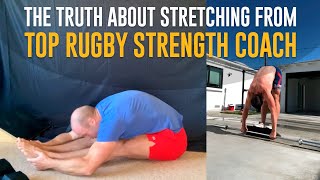
A rugby strength coach reframes static stretching as low-intensity isometric strength training. The key difference isn't flexibility versus strength, but load: light loads for injured athletes, progressively heavier ones for elite players to prepare for extreme-range movements in sport. Ditching the term "static stretching" makes training more efficient and injury-proof.
Chapters
So do we need to static stretch? Do we need to static stretch to be able to get into this position without the ankles burning like they used to for me to be able to sit in a deep squat, a Chinaman squat, touch the elbows to the floor, These positions, do we need to static stretch to get to these positions? It's a really interesting and important question and it's something that's kind of controversial. Should we stay stretch? Should we not stake stretch? I think it's the wrong question. Let's throw that out. What is static stretching? Static stretching is low intensity strength training. Does very low intensity strength training work? If I press this 10 kilo dumbbell, which I can press a bunch of times, what is the impact that it's going to have on my system versus if I press a 20 kilo dumbbell or, or if I press a 30 kilo dumbbell? Try to right, this is the question. That's all the question is about. The debate around static stretching is completely null and void. It's simply can you get results with high repetition strength training versus low repetition strength training? That is all we're talking about. If we threw out completely the concept of static stretching and just called it low intensity isometrics, then we'd be in a much better position. Okay, so you'll hear about Olympic weightlifters sitting in the bottom of a squat with 150 kilos on their back for 5 minutes, 60 seconds in the bottom and then stand up with a heavy weight on the back. Okay, it's isometric strength training. All right. That's really what we need to change our terminology to. And then for sure, you know, you can train biceps with a 1 kilo dumbbell and get some gains, or you can just train it with a more challenging weight and you're going to get a result a lot faster. The reason why we putting so much emphasis on this is because the range of motion and being strong through a great range of motion is really important to performance. But we get wrapped up if we get wrapped up in the idea of flexibility training and end up spending a lot of time in positions. It's fine if you've got a lot of time to spend, but most people don't have a lot of time to spend. So then other areas of training will be neglected. Skill development, even, you know, time with the family, strength training, etc. Are going to suffer if you're spending a lot of time. So it becomes a question of load. If I'm using this position with just body weight, is it just body Weight. Is this static stretching? Well, it's actually just strength training with less weight. I'm only using my upper body to weigh me into this position. My head, my arms are pulling down. It's on a continuum with doing the same movement with the 10 kilo weight. Okay. And then I can progress that up as my tissues become more tolerant to load. So if a tissue is injured, then we should use less load. If someone's very deconditioned, then static stretching can make a lot of sense because it's just very low intensity strength training. Just like you wouldn't start your grandma with 10 kilogram curls, you start with 1 kilogram curls. So static stretching, think of it in the same way. The reason why it's so ineffective with strong people is because they already have a lot of ability to deal with force in the tissues. They have a lot of tissue there, so it needs more load to be able to adapt. Stake stretching is really ineffective for rugby players. As an example, you know, having the background in rugby you're told to static stretch. So after training they're standing around and they're doing this. They just need more weight. There's just not enough leverage into this. Now once they've worked on it for a while, then yeah, for sure they're going to be able to do this. But you never have to static stretch to be able to get your head to your knee. You just simply have to progress load. If you have a lot of time to sit around a static stretch, cool. If you want to train your biceps with sets of 50 or sets of 100 as your strength training method, that's great. Is it the most efficient, effective way? Is it going to prepare you for extremely high load, end range position scenarios which happen in sport? No, it's not. So it's not very time efficient and it's not going to take you to the position where you can handle all the load in those positions if there's an injury there, if there's deconditioning, then sure, it's just light training. There's nothing to it. So I think if we abandon the terminology of static stretching, then we'll see a bigger increase in performance. Just think of it as end range or long range strength training. It's either light, moderately heavy, heavy, very heavy. Okay. So in standing, if I'm going leaning forward, what I've just demonstrated to you, I can use my arms with this stretch to provide load. If I get my head bigger, then I'll provide more load. If I flex my abs, then my abdominals can provide some of the loading, but it's all just applying weight. If I just sit here and don't apply any weight, then I'm not going to get any result. The more weight I apply by shifting my head forward, by turning my abs on, then the more I'm going to get a training effect. In conclusion, if we can abandon the concept of static stretching and just call it long range isometrics, I think we're going to see a big improvement in strength and extreme range strength. We're going to see performance go to another level. Injuries decrease. There's nothing wrong with static stretching. It's simply low intensity, end range strength training.