The ULTIMATE Athletic Ability Every ATHLETE Needs
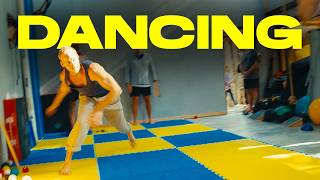
Keegan Smith explains why dancers move better at every sport. Rope work, tennis balls, and soccer drills build the rhythm and timing that transfer to sprinting, combat, and parkour. A former parkour athlete used rope work to recover from ankle surgery.
Chapters
The dancer is one of the archetypes in new athlete, and it's there for very good reason. If someone is a dancer, they can pick up new skills and new motor patterns much faster. They have a sense of rhythm and timing. They're able to get multiple parts of the body moving in synchrony at the same time. Athletes will do this in their specific sport and specific movements, but they won't have that universal ability to pick up new things that dancers have. A lot of the best athletes in my experience are good dancers. And I'm very confident that whatever level you have at the moment as an athlete and as a dancer, you will improve your athletic ability when you improve your dancing ability. Now, I was one who stayed away from dancing. It was associated with homosexuality in my youth. Most of the guys who wanted to do dancing, especially my family, it was kind of just looked, looked down on. And the dancing at school was, yeah, it was lycra and it was pink and there were a few guys involved. Some of my friends did it, but there was no way I was going to do it. And so I felt awkward at dancing at the school dance when it was like the first time that everyone was dancing when I was 10, 11, 12 years old, and then I never really wanted to dance again. I went into some mosh pits, but I would say I never really danced until I started using the rope. And I do think the rope is probably the best way for most athletic men who haven't been dancing to get into dancing. So it gives us a natural beat. Boom, boom, boom, boom. And it's funny how initially it can feel so challenging just to move the rope from one side of the body to the other and keep things in time. If it's uncomfortable for you to begin with to do simple rope patterns, that's okay. It was the same for me. As we learn to do more of these patterns and link them together, we have more of a foundation for dancing. But even more important than that, and the reason I started with the band is like, you can start with the band and just find some movement. If you have issues with your feet, Achilles, ankles, anything, you don't even have to leave the ground with it. That's why the rope is such a powerful tool. Marcel, who you might have seen working with us building out this new athlete project, he rehabilitated his ankle from being a super high level parkour athlete and doing crazy jumps and flips. He got to the point where he couldn't jump or do anything. He'd had a surgery and it Wasn't coming back very well. And it was the rope and just being able to twist a little bit and just feel the positions that you get with with the rope and just gently moving. That was the foundation for him to get back to being able to. To do parkour again and flips again, which he's doing now. The main thing I want you to emphasize when you are dancing with the rope is the movement of the feet. And initially this might feel really awkward and difficult. You might say it still looks awkward and difficult the way I'm moving now. But I can guarantee you I'm a much. I'm much smoother and more comfortable with it and just more comfortable in my own body as a result of using the rope. So I would recommend that as a. As a good starting point if you would like to get into this dancing. If you want to be a new athlete, you really. Dancing is one of the nine archetypes and everybody's doing it to some extent. Another great one is using foot skills. Soccer players are naturally going to be better. Dancers are going to be better on their feet. Not going very well here to start with his tennis ball, but just, yeah, bouncing it down is a good way to find some rhythm. And if you ignore the ball, it becomes a little bit of a dancing pattern. But you're at the same time finding the coordination to meet the ball. Where it's at, the timing. Every bounce is a little bit different. Highly recommend the soccer as a starting point. Just getting more comfortable on the feet, practicing the same patterns, any pattern. These are less intimidating ways than just putting the music on and you have to bop. If you feel comfortable just to turn the music on and start bopping, go for it. You know that that is a good path as well. And I would recommend that if you're already comfortable with dancing, learning other types of dancing is also a good idea. The other simple way to get into the dancing is like the speed ladder work that you might have done as a soccer player or as a rugby player. Any kind of line will do. And you can start to feel into different patterns of movement. This is something that I've also been working on over the last year. Just getting more comfortable to find patterns. And eventually it kind of becomes. Becomes a bit of a dancy thing to do the same. You're doing the same. The same things as the foot patterns with the ladder, but if you do them on the spot, that becomes somewhat of a dance. So all you really need for this is like a line or a square and you can start to play with with the patterns. Simple, one foot in, one foot out. You can do that both sides, which makes it more of a karaoke. You can then link to the back, do it going backwards. There's no right and wrong. We'll go into this in more detail. But what I'm giving you now is foundational concepts. How, why we're doing the dancing and then some. Some ideas about how to get started. Another one that I really like is. Comes from watching the Kazakhstan boxing. They do a lot of this work. There's scissors and then scissors across the. So it's just jumping back and forward and then little turns. Being able to make the turns initially I really struggled to make the. The turns. You can do more body twists with it as well. None of this was natural to me. It was quite uncomfortable and I wasn't able to do it as well as I'm able to do it now. I wouldn't say by any means that I'm good now. I'm not particularly comfortable at dancing when the music's on and such, But I'm definitely better because they're versions of the same thing that I've just been doing to then play around with. You know, if it's break dancing type stuff, it's all the same. There's a lot of the same kind of foot patterns. And we're getting a general ability to deal with the ground to be able to be reactive. But rather than just focusing on always maximum force from this like track and field perspective, we're building a foundation of lower intensity bouncing that gives us so much more space. When we decide we want to do maximal jumping. We've got this childlike foundation again that the child has from playing tag and running around the playground. You can play tag and run around the playground as well. Also recommending that. But this is a better foundation for us to be able to run around the playground again and feel comfortable to do that and be safe to do that. There's so many ways we can progress from. From there. If I was to do that, all that, that same thing holding the nine kilogram ball, then I'm progressing the force component. If I'm doing more, more jumping variations with a little bit more weight, we can add bands to it. So getting the band pulling, we get horizontal loading. You can see that some of what I'm doing is more like boxing. And you would say, well, that's combat. Why is this not in the combat? You can't be a good combat athlete without having the dancing type of footwork. So we need the dancing to be the combatant. We need the combat in a way to be the kind of dancer that we want to be. And even for sprinting, if we're able to do the sprinting drills, we just want to be able to do them as a dancer first. We don't need to be able to necessarily produce massive amounts of force. We just want to be able to find the patterns. You see how like the spread stuff doesn't have to be a whole separate world from the dance and they're all going to cross over. If we've got the rhythm and timing to do these hurdle drills that sprinters will do, It's going to come from the dance foundation. If you look at how the Japanese are developing elite soccer players, sprinters, runners, long distance runners, they're doing a lot more of this foundational work on the timing and rhythm. And there are actually athletic dance systems which I'll introduce you to within new athlete that have been used successfully in Asia with sporting teams, young soccer teams, young soccer players. This concept is foreign to the west for the most part, but it's not, it's not brand new. It's been done before. I'll take it a step further and say our ancestors danced in many, many parts of the world. All of our ancestors danced in the village. There was a village dance. If you were going to get married at some point, if you were going to be a member of the tribe, be a part of the village, then you did the village dance. The tribal dance. You can still see this with like Maasai warriors. No one opts out from being a jumper in the Maasai system. And your ancestors didn't opt out of their village dance either. So this idea, now that we get to choose, are we going to do ballet, are we going to do tap dancing, are we going to do break dancing? Yeah, it's cool. But in a way it gives us the opportunity to opt out of dancing because everyone in the village is doing different things. Everyone in your city does different things. In usly, everyone dances. You can choose the type of dance that you're doing. You can go deeper in some and not as deep in others. But everybody dances one last one to finish off. Little challenge. Ballet challenge. I learned this from a high performing ballerina ballet guy. It's three beats with one arm and four with the other. Arms to the front side. Boom, boom, boom, boom, boom, boom, boom, boom, boom, boom. So it's going to be three beats on one arm like this, and the other one's going to be Going over the top four beats, because this one's four and this one's three, they're going to meet up after 12. That's where the numbers coincide. And it's a little bit like the challenge of patting your head and rubbing your tummy. This one took me a little while of sitting around and playing with. But this is part of what we get with the dancers, where once we start to coordinate it and memorize it, One of the things that dancers will do, they'll be judged on their ability to remember, like, 6, 12, 18 movements in sequence. Great dancers will remember a bunch of movements, and they'll be able to repeat it back. Like, with language, if I say to you a sentence, you'll be able to repeat those words back to me. Dancers are able to do that same thing with body movement. Movement and vocabulary to mimic what they see, which is a higher level of athletic ability and self awareness. Athletic awareness. Awareness of where the body is than what most athletes experience and have. So if you're already a good dancer in some style, keep going with that. I would challenge you to take on some different types of dancing. Today was really about an introduction, how to get started, and why. Questions are welcome, but yeah, let's. Let's get moving, let's get popping. And most of all, if you feel really uncomfortable about this, you 100% need it the most. And I was one of those as well. So I'm with you if this is uncomfortable and challenging. But let's move.
Starting the dance class this year with the tennis ball to get some rhythm in the feet. And like Keegan said, when you think about not kicking a ball, it becomes like a dance in some way. And of course, we want to be more loose on the feet, and the tennis ball can help us to coordinate that. Even if you think about bouncing a tennis ball with your hands, you can add your feet in, and then it becomes footwork and arm work at the same time. The tennis ball is away now, so when we compare the two, you play a nice song you like, and then a tennis ball is away, you're already in a pattern. You're already working the dance, the work the feet, you work the hands, and then you can work certain patterns. I'm not a good dancer either, but I started to implement also these tools. The robe is a great way to introduce more rhythm. And with your favorite music, it becomes a good practice. And then you can easily get into a flow and find the rhythm with the beats. And again, when the rope is not there, it can become kind of like a dance. It's also part of not thinking too much about yourself and not taking yourself too seriously. I think these are just tools that you that can help you to become more comfortable moving with rhythm. Using a soccer ball as well. This can be a great warm up before your strength training because then you're active, you learned how to articulate your body and it gives you more options to produce force as well. I hope you can take away from that video something. See you in the next one.










