Unlocking Dragon 🐉 Squats | How & Why with @DiMFiT
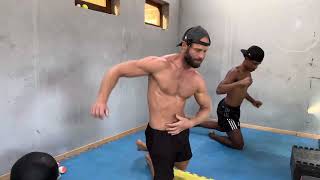
YouTube coaching session demonstrating how to unlock and progress the dragon (pistol) squat. The instructor assesses a participant’s tight glutes and walks through mobility tests, long-range glute work, crossed-over box holds (loaded stretch), kneeling/dragon variations, counterbalance strategies, troubleshooting cues, and beginner guidance; includes programming tips (pre‑fatigue) and an upbeat wrap-up.
Chapters
So Kadeem here is a dragon squat virgin. I'm planning to run 100km and I've been standing on one foot quite a lot as part of the strategy to be able to be on my feet for a long time and practicing being on my feet for a long time. I know it sounds crazy, but it's made my glutes pretty tight. At the start of the summer, I was doing dragon squats and then I tried again today and there was no chance. You also probably have no chance, Kadima. Well, let's, let's see what, what happens when we open up this position.
So let's see here.
The pistol, the dragon squat looks pretty mystical. Looks pretty amazing. Maybe we can b roll one in. Maybe I can. Now one. Holding a weight out to the side can really help to, to counterbalance looks. This. Oh, wow. The foot is the.
Wow.
The tail. This makes it a little bit easier. The big challenge is to open up this glute. And so let's just see. Like first thing to do is just have a look at it, have a feel. There's not too much force, there's not too much risk relative to some other movements. There's not so much to worry about generally. It's just tightness is the issue. So, yeah, you can put your hands down at any point if you want to, if you need to. Let's just have a look, have a feel. Yeah. What are you seeing?
Yeah, first time when I tried it, yeah, instantly the glute, like the limitation.
Yeah. So this is like long range for the glute. In the world of range training atg, we're thinking about the muscle being under stretch when we're contracting it. So a lot of the glute work that you see, it's short range when you're bridging up, the glute is short and you get some metabolic stress. You can grow glutes like that. But if we want athletic glutes, then this is this long range is a way to do it. So I'm going to show you the best ever glute exercise as well within this video. So stay tuned. It's going to help us to unlock this. It's also going to get the glutes pumping in a way that you probably haven't experienced yet. How's that feeling?
It feels really good. And the interesting thing is, like, usually when you try to get into long range glute stuff, see, the good mornings, the knees want to cave in. But on this one you can't cave. The knees in it's like, no, there's no way. There's no way. So I like the way it activates the glutes. Even just getting this range and now.
Yep. Yeah. Boom. So, yeah, any time that you spend in the bottom, there is going to be gold is going to be open up. You want to try the other side as well, get some space.
I even felt like the groin at doctors.
Yep.
So multi.
So. So we don't bore you to death. I'm going to show you what you can do along the way with this. As Kadeem's open up this side, one of the ones I like to do is just simply. Yeah, nice. How's that side feel compared to the other side? Yeah.
I feel like this one, the ankle mobility allows me more. I feel like on this one I have less ankle mobility.
Yep. So the biggest thing we need to do is going to look crazy. You're going to think, oh, there's no way. If you spend some time down in this crossed over position so you have your, your opposite foot on the box. Just getting some time down in this position. The biggest issue that people have with mobility is it's too heavy and it requires too much strength. You don't find that Goldilocks weight where you feel some load, but it doesn't feel so heavy that you have to block against it. So you want to let your body accept the stretch, accept the load. And then if we can push a little bit into this, I'm using probably, I don't know, I think 60, 70% of body weight. You can actually put a scale on there if you really wanted to know. And you can know how much of your body weight you're putting into the thing. But if you're getting some pulses, getting some time into that deep position, you can see you can have it with the foot flat or you can let the foot come up a little bit so you get even further into the hip and still push out of the hip. A little bit of push with the hands. This is going to open up this movement and also just teach us the position. If you haven't been in the position before, you're not going to be strong in the position for. So you get some learning time. The more time you spend on the tension there, the more it becomes normal. How's that feeling? This is the key here.
Like. Yeah, I mean the bottom position is. It's like everything is working. I feel like it's not just. It's not just the glute.
Yeah.
It's like even my feet need to, like, the ankle needs to push in, pronate that. Like, it doesn't fall out.
Yeah. So you're gonna.
Typically, what you want to do here is like, yeah, let the ankle roll out.
Yeah. And it's not too bad to let it roll out. If you want to emphasize the glute like it's. There's nothing bad about rolling into that position as well and feeling even deeper into the glute, pushing through the side of the foot. So this kind of stretch, the crossover that you would see in the rest of the world would be like putting the foot behind the head, the one that a lot of children do, the pigeon pose, the 90, 90 stretch. These all have crossover with what we're doing here, but it's more of a real world application in a way that it's a feat that's got a binary outcome. I love testing. If you have tight glutes and you want to have a binary outcome of whether you've progressed with your glutes strength and length, then this is an exercise that is going to give you that. You either get the Dragon Squat or you don't. You either need 8 inches or 4 inches or 2 inches. You need a counterbalance or you don't need a counterbalance. You're getting this black and white feedback of is this area improving in the same way we get with the Jefferson curl, in the same way we get with something like a knee extension? This gives us accountability around glute progress, makes it a game.
Yeah, that's the fun in it. Like. Yeah, you got me hooked on this. Now, see, the Good Morning is amazing for me, but this is an all other level.
This is going to be more.
Yeah.
A bit more lateral glute and, yeah, different. Different flexibility compared to the seated Good Morning. It's not going to give you that back. That flat back stiffness that we get from the seated Good Morning is a beautiful thing to protect us against the back squat. It's not going to substitute for that, but, yeah, you can definitely light up the glutes. So the other exercise I want to show you, this is one that I've been playing with and I'm really in love with it at the moment. The first way you can do it is simply kneeling on one side. I'm a huge fan of kneeling squats. If you haven't played with kneeling squats, you should definitely play with them. If you keep the shoulders forward, then it's easier. If you keep the shoulders backwards, it's going to become more fascial, longer. Range. These are beautiful movement, but the sister to this or the counterbalance to this yin to the Yang is using more of the. The glute in this movement. So letting this other leg come back.
Yeah.
So you can go all the way. Chest to floor, head to floor. Doesn't matter whether you balance it or not. If you want to balance it, balance it. But if you want to put pinkies down on the floor, hit the left side, hit the right side. And then the dragon variation of it is to put that trail leg across the body. So we'll put that. Let this leg come behind, sit into that same position, and then coming out with the glute. Yep, yeah. And see if you can get that glue as close to the floor as you can. Yep. And head to floor. Yep. Boom. Yeah. Pinkies down. So the balance isn't there, isn't the thing. Just use a very light balance with the. With your fingertips. Yeah, yeah. And then extend the hip. Sit up. Yeah, yeah. Come up to kneeling again on that side. Yeah. Like that? Yeah, yeah, yeah. Test it out left to right. What do you feel? Can you notice the difference?
I feel the hip socket really opening up there. Yeah, it's like.
Yeah, it's gonna get. It's gonna get into the joint capsule. If that is a tight area for you, it really isolates this component of what we need for the Dragon squat. If you feel anything really sharp pain in the joints, then don't do it. Ease off. But. But if it's muscle stretching and gentle sensation in the hip, then your body tells you if it's a winner or not. I did, like, 100 or so of these yesterday, and then when I was running, I could really feel my glutes lighting up. Some pre fatigue. Pre fatigue is a great trick bodybuilders use. If you don't refill your glutes on a deadlift, for example, and you want to feel them more, you can pre fatigue into that muscle. Yeah. Really isolate it. Go slow so you can feel it. There we go. Did a lot of quads already today. How's it feeling?
I love this. The gorilla push up I was talking about.
Yeah, you show me.
Is this one right? Okay, but here you have the assistance.
Yeah, yeah, yeah.
The same deal, but now push. Pushing that, like, even more.
Yeah.
To the side.
Wrap it in behind. Yeah.
Even the low back, Everything's working.
Yeah, I like getting through to the extension so you're getting the short range.
Next level is to keep the leg up. The back leg, or.
Yeah, you can keep the. Keep the Leg up. We opened up a little bit. Let's see now. Let's see it with the counterbalance. Try the weight in the hand. See where you get to. I like to do these as a kind of a drop set, step by step. So start on the 8 inch, see how it feels. And then you challenge yourself with more mobility as you go. You'll also see it's short range for the adductor. So what I mean is that the groin is going to be working to keep that foot off the ground, which is also fighting against that whole sling of tension down the outside of the body. So if his ITB is tight or lateral quad on the right leg, it's going to be more difficult to keep that off the ground. And it's a good thing to practice as well. You can get sore doctors from this. I don't know. It's hard to know which one which what makes it sore if you practice both sides. But you can definitely get some groin fatigue after you do this because it's actually working on both sides. You feel it, like, stabilizing hard as well on the plant leg.
This one. Yeah, But I feel it more on the. Yeah, the back leg here.
Yeah.
Just keeping it up. Pretty crampy.
Yeah. Yeah.
But definitely I felt now on the left leg. Definitely more range.
Yeah. Smooth. Yep, yep. Yeah. So you can. If you watch tutorials on this, they'll, like, put this knee on the back of this leg and kind of like slide it down so you take pressure. So. Yeah. Yeah, you kind of. Yeah. Push it against with a bent. Bend the knee first. Yeah, that's it. Slide it down the cuff. This is how people. Okay. Will assist a little bit. And then when you get to the bottom, you want to extend. Yeah. Lean yourself into it and see if you can get out straight. But yeah, they're all good variations. Subtle differences. It's not like right or wrong. Especially if the goal is mostly better glute length, something accountable around glute activation and stretch in the lateral hip. Then it's just a game if he strains the leg. If he doesn't. Yeah, you want to get it around. Like, the goal is to face it forward. If you slide it down on the way. How's it feel? It's.
It's really intense and it's like. I can't say that.
It's just.
Just one thing working. It's really. And also just the knee. Like, there's a lot of stuff happening at the knee rotation.
Yeah.
It's not stuff you usually do when doing the normal strength training.
Yeah, exactly. So. Yeah, yeah. If we're really thinking about bulletproofing, then we want to be able to gently and under control, experience different lines of force, different angles. If the body's adapting to that, then we're in a better place. This is impressive. For first session, you pretty much just went straight in the D pad, but. Yeah, we want to pin this to here. Yeah, yeah, yeah. Let it keep sliding down. Some people hold the weight out the other side as well. Depends how.
So go this with you.
That's where, you know, that's what you normally do. Yeah. But some people hold it like. Yeah. I don't know if it's. Yeah.
Which one? Just feel like this.
Pull it out. Yeah.
Try a new variation here.
There you go. Yeah. Get the knee, the other side of the car. There we go. There we go. Yeah. I test that one out as well. There you go.
Oh, this is it, huh? Like this. Oh, interesting. Now the. Because I felt literally the neurological connection, I couldn't straighten out the leg.
Yeah. It's a little bit of assistance.
Interesting.
It's a little bit of assistance with the stretch if it's getting stuck. Let's see.
Yeah, that's it. Beautiful. Wow. That's crazy. That's the dragon sculpt right there. Then push out. Wow.
He push it with everything there. Adductor, glute, obliques, jump in. Boom.
Boom.
Wow. Day one. There you go. Now you know.
Oh, we keep working at it. 100.
You think there's no way when you watch in.
Yeah, it's crazy. One way, other way without holding.
Here we go.
Wow.
Boom. Shoulder to floor. Nice and deep. Easy. Cramps everywhere now. Cramps everywhere.
Where's the cramp? Adopters. Beautiful foot Every. Everything. Wow.
What else do we need to cover here? For the glue or for the dragon? I think wrapping this up, we jump.
Pretty much into it. How would you recommend someone really at a beginner level to even. Should a beginner even focus on that or work on other areas first?
I think you should probably have pistols and be able to do pistols. I think if you can do pistols. Yeah. Then you have some foundation and you have the. Generally just assisting a lot is the main thing as well. I think there's nothing wrong with it. Use the. Use a lot of assistance. And there's not much to fear with this one. No.
Yeah.
Even the locomotion you do for walks, there are these, you know, just reaching out, like what we did in the park. Reaching out. Yeah, yeah, yeah. Some of your lunge variations. Everything's gonna. A lot of ways to build a general base for it. Yeah. Yeah. If you're. If you're assisting a lot, there's nothing to. Nothing to be scared about. Yeah, just. Yeah, but even just putting your hands, I like just putting the hands down. I usually do a lot of repetitions like this before I try and do the full rep. You know, just giving. Giving the body a chance to feel the positions.
Love it. I don't know the introduction. Yeah, that's a. Yeah. This is pistol squats. Nice. Like, because I haven't really. I mean, I like this one because it's also like more lateral movement also on this knee. Like to put a lot of pressure in this position. Like pre athletic position. Right. People get into this position when playing their sport.
But.
But yeah, the Dragon Squad is kind of the opposite. Like, this is in, Dragon Squad is out. I love it.
See if you can do a real summary of your experience.
Yeah.
As a wrap up, this is gonna be just one take. This whole thing's gone on YouTube. So no pressure. Let's go.
No pressure. Is a Dragon Squad worth chasing? Yes, it is. Because all your strength training is going to focus on linear movements, whether that's forwards, backwards. There's rarely any lateral movements and where the knee is really challenged to go in and out. I love this for the Dragon Squat and the whole activation from the foot up is something I've never felt before. So you try to merit it.
Let's go.
We're not chilling.
We're not just chilling here in Montenegro.










