Where Old Time Strength Secrets Overlap With ATG
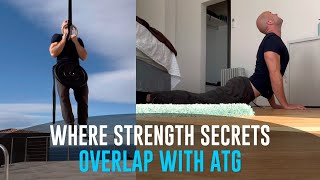
Keegan Smith walks through his training session combining old-school powerlifting methods with ATG principles. He covers high-frequency squats, snatching progressions, one-arm chin work, and pin presses while sharing concrete details on weights, rep schemes, and recovery philosophy.
Questions this video answers
2022-01-23
120 kg (front squat, five singles)
He referenced front-squatting 125 (and singles at 125) and had a goal to front squat 130 to clean 120.
Snatch 100 kg
140 kg (pin press; initially failed then successfully pressed)
Chapters
The definite and certain choice to do something with your life, to know what you want to do and then do it. Something really special. Now, I'm not ever going to be the world's best runner, but it's not about that. It's about improving myself and going on a mission and choosing what's important. These definite decisions are rare but important. It's hard to live without them. Right? I don't know if you've felt this way at some stage in your life that you're not really sure why you're here and you're not really sure why you're getting up for the day. It doesn't matter whether it seems silly to other people. It doesn't matter whether it has significance to them. It matters that whatever is burning inside you is allowed to express itself. We want to express what wants to be expressed within us. We can't suppress that. We get too wrapped up with science and thinking about trying to do something optimally rather than just making the decision to work hard, to be uncommon, to create something worth creating, to experience it for ourselves. I love reading books and watching YouTube videos, podcasts and discussing things with people who've been really successful. But ultimately what matters most is first hand experience. Then the joy is in the experience. So if you give away all the power of the experience to some other expert just to receive the outcome, kind of missing a lot of the. A lot of the fun, a lot of the joy. Is it too much to squat every day? Well, there are a lot of people who've proven that squatting every day is fine. Yes, some of them use steroids, but some of them didn't. And the Bible teach us. Can you squat the barbell every day? 100%. Can you squat the barbell in two plates every day? Probably. Can you squat the barbell in four plates every day? That's a question that very few people are ever going to try and answer. But maybe it's one worth answering if it burns inside of. Okay, what is the answer to this question? How does this feel? What will the experience of this be then? That's what needs to be done. That's the fun of it, right? So the reason I'm making these videos is to encourage you to run your own experiment. It may be a chin up bar in your doorway and you may decide, I'm just going to go at this chin up bar every day and see where I get to. And after a month you might decide, actually now I'm going to, I'm going to do some front levers now and you might work on the front lever for a month. Back in 2014, I decided to front lever every day. I did it for about two or three weeks and had a front lever and I was doing like five seconds a day. It's crazy how quickly the body will adapt if you give it repetition. Now, power lifters are the only lifters who don't lift every day. If you look at BJJ strength athletes, if you look at Olympic lifting, weightlifting athletes, if you look at gymnasts, they all rely on high frequency. They all train daily. Now, the reason powerlifters don't train quite so frequently, I think, is mostly because they get injured if they train too frequently, because they haven't understood athletic range, the principles of atg. I think you're going to see some powerlifters training with higher frequency and setting new records because they're recovering better. I know a few powerlifters already who've taken themselves to new levels because they're using these principles. Time will tell, and it's cool if the world records change, if there are guys that win Olympic medals, different sports. Charles Poliquin is the winningest strength coach in history, with the most Olympic medalists, gold medalists. But what matters to me more than that is your journey and you deciding to get yourself in the best place you've ever been in your life. Athleticism is one part of that. Everybody has to have an economic existence, a physical existence, a spiritual, emotional, psychological, mental existence. The athletic existence continues to exist. Health. If you don't have health, there's only one thing you want. Health. So for me, the journey is towards health. I live as if there is no medical system, no orthopaedic surgeons, no antibiotics, no hospitals. That's the way I live my life. I guess a lot of people have lived their lives that way for a long time. It actually was that way for quite a while. For a lot of people at least, living too far away or not being able to afford medical treatment still is, I guess, for a lot of the world. My experiences and my understanding through studying health science and thinking deeply and researching and listening to doctors and, and all sorts of people is the more you can stay away from that system, the better. So my lifting can't end me with needing to get blood tests or needing to get surgeries. The objective of training is to avoid all of that. But I still want to challenge myself. So that's the challenge that is the battle. Can I be smart enough to train every day to test myself to get to a new level? Without putting myself into that system that I don't want to interact with. If I do have to interact with it, then that's okay. I'll deal with it. I'll pay for it. I'll deal with the health consequences. If it's loss of life, if it's loss of lifespan, if it's loss of quality of life, then that will be the consequence. We'll live by the consequences. Solve puzzles. So I solved the Rubik's Cube for the first time maybe four years ago. I had a friend who did it. He tried to teach me the way he taught me. I couldn't learn it. Then I learned a different way. And I've since taught 100 people to solve the Rubik's Cube. It's the first time actually playing around with it between squats. I don't really know why I did. Today. I went up to 120 on these for doubles. Played around deep in the hole with 60 kilos, super slow with 80 kilos. And I went 5d2, 5d2 at 110. So doubles on the minute at 110. It's good to solve new puzzles, new challenges. The Rubik's Cube is one that you can battle away on and make mistakes on and spend as much time as you want. With the barbell, you can't put quite so much time into it because there's a cost to the body, to the muscles, to the bottom. I've been thinking about focusing more on bar speed, decreasing the intensity slightly now that I'm getting back. So I figured out I once ran dense strength on front squats. I started at 100 kilos and I added 2.5 kilos each session every two or three days up until I did 125 for 5D1. And the goal at the time was to front squat 130 so that I would clean 120 and hit a new record on my clean. And I did so by getting to 120 today for five singles. On the back squat, I'm effectively around 80, 85% of the strongest I've ever been. Now, those were with a belt, and they were very maximal. And my form was deteriorating. I can remember the day of the 125 for five singles because it was extremely intense. And this was when I was on the mission to snatch 100 kilos as well. I knew I needed to get my squat up. I was getting pinned in the bottom of snatches. Now, the reason I was getting pinned with like 85, 90 kilos in the bottom of the overhead squat was because I couldn't use my quads to get out of the bottom. And with the overhead squat I wasn't able to lean forward, so I was literally getting stuck in the bottom. Now my mission is to snatch that hundred kilos again, but I want to do it better than I did it in the past. So here are the singles at 120. What percentage of the do you think this is? I would say that these are much better than the way I hit that. 120, 125 front squat singles back in 2014. Yeah, jump. There's gonna need to be some, some jumps and some jump squats in the mix here at some stage as these legs start to come back online and we'll see what that transfers into. I did nearly pull a basketball ring down in Germany a couple of months ago. I surprised myself by grabbing the rim. But I definitely want to become more athletic with these squats and I will, I will, I'll stand under the ring and jump up and grab the ring from standing under the ring at 5, 10, not so tall. So yeah, these look pretty smooth. They felt like pretty maximal, like I probably shouldn't do any more weight than that. But watching them now, I'm pretty happy with how fast they were. They look relatively comfortable. That's why it is good to, to film some squats from time to time, whether you're putting them on YouTube or not. I'm documenting my journey here. But yeah, getting back to 120 for five singles and then being pretty fast, beltless, nice and deep. I'm pretty happy with that in month one. I'm not quite to the end of the first month. I got the, the barbell on the 25th of December. I've used it every day since. So I haven't been doing many chin ups pretty much because they're outside and it's about 8 meters away from where I'm training where this is. But I just haven't built the habit yet of getting out there to train. So yeah, I'm due to build that habit and today was the start of that. So I did triples, threes on the minute. I think the single ring should really help for the one arm chin. I do still want to have a one arm chin up now. I'm putting all the energy into my legs, but I think I'm still a long way away from being able to say I have such tree trunk legs that I can't do it. A one arm chin up. I was trying to Figure out a way with the belt where I was going to be able to do some push ups. So I can probably put this around my chest or something. I don't know. I don't know. I'll work it out. But yeah, doing some push ups in between the chin ups occurred to me as well, seeing as though they're nice and comfortable. So I think that I could get this for 10D5. I'll probably do a 5D5 one or the other. I'll probably do the fours next and then do fives and then go to 20 kilos. After that there's no real hurry. Right, so some incline push ups. What's good is it can get into stretch, get the body down in between the bars. I didn't have the camera set up so well for that. I'll pan it around a bit further to the left next time. But the push ups are a nice stretch and if you do a few reps, they still work even on a, on an incline. So I'm glad that I started this journey again. I would like to perform this kind of repetition five reps with 40 kilograms. That is what I would like to do. But you can see it's quite a ways away. I could probably get. I think I've done 12 with 20kg. I have done. Yeah, I have done 40 for five, I think. But yeah, I haven't done them for a while, so we're gonna build into it. But yeah, this was a nice session. I did hills, I did squats and then I came outside and did some chin ups. Now it is cold and people sometimes say, what are you doing? I say whatever I want to do. I think it's good to get some light on the skin, regardless of the temperature. And I am starting to get back in a bit of better shape and I am feeling a bit more proud of what I'm doing there physically. But yeah, still quite a bit of work to do to get towards where I really would like to be. The physique will follow the reps. Right. If you're thinking about your body composition, if you can do when you can do what I'm doing and you eat okay, you'll look good or you'll look better. It depends. You know, it's all subjective. What's, what's good and what's not good. But as these numbers progress, I guarantee you when I'm doing this with 30kg and I'm doing 5d3 triples on the minute, I'll look better, I guarantee you, and so will you. And yeah, it's okay to be wherever you're at today. That's simply the result of what you've done in the past. Where I'm at now is the result of what I've done in the past. I haven't trained well in the last 18 months, but I've had a couple of little blocks of where I've. Where I've trained. Okay. I've been pretty consistent with chin ups all through this time because I had a doorway chin up bar in Sark and I was working on my one arm chin up recently. But yeah, it is what it is. These are actually an interesting variation. So scat pull and then chin up from there. I'm much weaker at that and I think that that is much more specific to the one arm chin up because you do tend to really pull with the scap to get you out of the bottom and then you have to transition into the arms, into the biceps. So I think I may have unlocked a secret and a key to why I haven't been able to build the one arm chin up as yet. But yeah, today the journey recommences. So pin press now and I'm thinking about if I'm going to be able to floor press between these things. I think I am. One way or another, I'm going to be able to floor press. But yeah, I'm pressing this maybe to six inches, whatever the height of the through. Yeah. What I wanted to do on these was to feel more weight than I've been using recently. So 100 kilos is what I've been using for double singles and I wanted to feel that for more reps. I was also getting used to the setup here. I could, with close grip, I could put it down on top of the hooks, which wasn't ideal to try and feel the groove. You don't want to mess up when you're doing stuff around maximum weight. You don't want to have to wrestle with the bar. You can challenge the rotator cuff more than more than you want to. These are ones, yeah, close grip. So when you go a little bit closer, you see the range of motion increases just slightly. I got the thing of put the bar to the front of the hook and then hit the hook and guide on the way down. Seemed to work okay. So I did a lot of fives at 100 kilos. Give my body a chance to get comfortable with this movement and just feel the weight that I want to be able to press for multiple sets of five. This is the, the way that a Lot of the old time powerlifters trained this way. Before there were bands and chains. They would overload each part of the movement on vertical presses as well. They'd have chains hanging from the roof and then adjust the height of the weight in the chains so they could do this sort of work. And they would press out. Guys were pressing out hundreds of kilograms above their head, like more than 300 kilograms for small lockouts overhead. And they built phenomenal triceps. And a lot of guys had phenomenal presses, standing presses in those days, like John Grimek. If you look back at the old time stuff, this is my reinitiation into that style of work. I will do some banded work, but yeah, it's quite different to this kind of movement. The slingshot is another way to assist at the bottom. And then you get to feel the heavy weight at the top. Or the lightning method, the reverse bands. If the bands were coming down from the roof, that would make it lighter at the chest and then heavier at lockout. That's effectively the kind of work that I'm doing with this. But it's. It's also to prime the nervous system and let the nervous system know this is, this is not too heavy. So feeling the weight in the hands is important. I'm feeling away in my hands. Okay, it's 110. That doesn't feel heavy at all. I can do a bunch of reps with that. No big deal. So went to 120 and this is the first time I've felt 120kg for a long time. Close grip, feeling the weight. It is important for the body to become accustomed to whatever you want it to do. There's also adaptation there. I could feel the triceps really switching on hard. Whenever I go a little bit wider with the grip. I could feel the chest. So what when you work with these pins, you can gradually put more force in and inch it off instinctively. You'll want to lift it fast. So I was playing around with some both ways. Somewhere I sort of hit it, hit it fast and others where I was kind of more grinding it off. And they probably all start to look like they're just grinding it off with 120 because I'm not that strong for blasting this weight as yet. Takes time. Sometimes people will ask about arching and foot position, all that stuff. I like the arch mostly because it's like a stretch for the hip flexors and the glutes contract and there's some thoracic arch that I'm trying to make there. And all those things are really positive. They can be a bit safer for the shoulders as well. Most powerlifters will tell you that it looks after the shoulders a bit more when you arch. I probably should do some flat, non arched presses. I think I do sometimes, but I'd say I will continue to arch. I'm not really like trying to build the biggest arch I can, but I don't know, maybe I will in the future. Some people get problems with their lower back with arching too much. Okay, so here's 140 and it didn't move. Let's try again. Yeah, so I had two goes at 140 before the third time. Lucky actually pressed it and I was like, okay, well yeah, I can move 140. There's another miss. Try and reposition my. Because the bias, the bench and the stands and everything are not rock solid. You can get like slight micro adjustments where it's, it's not lined up. But yeah, I was happy with getting some repetitions at 140. I think I may have got a couple more than what were on camera. But then I went back and just felt hotter again because I knew after all those 140s, 100 was going to feel like not much. So yeah, this was the press work for today. I do value this style of pressing. A lot of people haven't played around with it. A lot of powerlifters will tell you, don't bother, but all the, all the ranges are important. It's a bit like doing step ups with your split squats and squats. This is kind of an equivalent of step ups. At least know for the, for the tricep, for the elbow. How much weight can you handle? It's not unilateral like the step ups, but it is a lockout type movement. So I couldn't have done anywhere near this amount of volume at this weight. I definitely can't press 140 kilos at the moment, but my triceps can lock it out. So if I never train heavy lockouts, then I never maximally develop this area of strength and there will be carryover from this area of strength into full range of motion. Now some people will say just focus on full range of motion. Just keep doing full range of motion until, you know, never, never worry about developing the top part maximally. But that doesn't make any sense to me since my goal is to be as strong as I can be, not have the highest bench press number. So if you don't train strength in an area, then that area isn't strengthened. Now a world class powerlifter will have a much bigger blockout strength than than I will but it's about me versus me bringing up the weaknesses. So the hamstrings are switching back on. It is important to have some tension down the bottom. You can see I'm assisting myself, but I'm not. You can. I did a couple on the fingers. I'm not taking. I'm taking just as much force as I need. Rather than switching off in the bottom. You don't want to switch off in the bottom, you want to stay on. Because that's the part where I want to be strong. Now the other part to put even more emphasis on developing the bottom of the movement is I've been working on these. So I'm pulling with the hamstrings as well as the lower back. Trying to look as far back behind me as I can. I'd like to be able to hold that position. So I'm actually pulling to actively hold myself in that position. But there's too much tension in the abs, not enough strength in the hamstrings and lower back. That was today's training. Hit me with any questions. I will go back through and answer any questions and comments. Hope you got something out of this today. Let's keep getting stronger. I'll see you soon.










