Why & How To Dominate Handstands & The 5-5 Handstand Challange
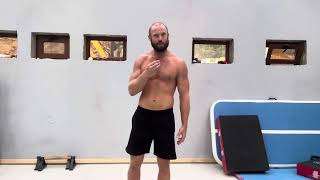
A single-presenter instructional video explaining why handstands are desirable and how to learn them through stepwise progressions. The speaker situates the skill in an "evolutionary/natural" learning frame, then gives concrete progressions (frog sit, tuck planche), strength markers (bench/press strength and tuck planche utility), wall-based drills (kick-ups, heel/toe pulls), safe exits for overbalance, psychological tips (breathing, reducing stress), and a practice recommendation emphasizing consistent 5-second entries (the "5×5" challenge).
Chapters
So the ability to stand on your hands is a rare one. Very few men who go to the gym, even though you might go every day for years, get the ability to actually stand on the hands. At some point, pretty much everyone tries to do it, whether as a child or as an adult. If you start doing handstands on the beach, you're guaranteed someone else is going to attempt to do a handstand. And so it's an innate desire for most of us to want to have that ability. Now, the gap between the desire and being able to do it is the same as the gap between wanting to have money and actually having money or wanting to travel the world and actually traveling the world. There's something that has to happen in between the desire and actually having the thing. And so with the handstand, what is that process? One of the best ways to go about it is like with nutrition, looking at the evolutionary perspective on nutrition, what did our ancestors eat? Like, what was available to them? And that soon makes ridiculous, and clearly with other motives, the way that food has been pushed, we've been pushed in the direction of eating. That doesn't make any sense from a historical perspective. If you look at nature, if you look at other species in movement, we should also consider that perspective of what is the evolutionary or basic natural way to get into something. So with the handstand, you can see right now, I'm standing on my feet. It's actually from thinking logically about standing on our feet that we can understand the handstand. As a child, the ability to just stand in one place is something that we work on, but it starts from crawling, it starts from leaning on something, and then eventually we're able to stand. And then sometime for a while after we can stand, we walk. Now, often with handstands, people will learn how to walk before they can actually balance. I prefer to start with being able to balance, but either way, we can get there through that approach of gradually making the task more difficult. And so the easiest way initially to stand, if you think about it, or if you've had a baby, is going to be standing in a lower position. And you'll see babies in this position. They hold the bottom position of what we could call a foot stand. Once we start thinking about it from this perspective, it's no longer a mystery how are we going to get to that handstand. We're going to follow the same principles that a baby followed to be able to finally stand and then eventually walk with our hands. Let's start with a frog Sit. Now, this is a position that my children are able to use and, and it helps them to be able to understand this exact same progression that I'm talking about with you. And so this initial ability, can you feed off the ground for five seconds? If that's too challenging at the moment, you can go to just having one toe on the ground. Okay, so a tiny, tiny, tiny little bit of support, taking a little bit of the weight or even helping to balance. But most trained, strength, trained individuals will actually be able to hold the frog stand if they're not. If you're not very heavy, if you're not extremely overweight or extremely immobile, then that position will be something. A position that you can already access and therefore you already have a handstand. The game is then to be able to do that in a higher position. How do we progress from being able to stand in the, in the bottom, in this very low center of gravity handstand versus with the body in a vertical position? So it depends on how strong you are, but you might find you're able to start putting weight onto your hands. If you can press close to body weight, if you can bench press close to one and a half times body weight, then it's likely that you'll be able to get some hand balancing without your knees resting on your arms in that bottom frog sit position. And at that point, you're kind of pretty close to being able to at least press into, into a handstand. Yesterday I had Fabian here, who's on my left. We were competing on handstand push ups and deficit handstand push ups. And you need to have a handstand to be able to play that game. And it is a fun game to be able to play. Gradually we're going to raise the center of gravity to be able to hold a higher handstand. And if you're strong, if you're coming at this from a strength background, especially if you've got a tuck planche, we can really just work from those positions. I'll show you the tuck planche variation. Again. This is a handstand, So you can see that I'm pressing from the tuck planche into a tuck handstand. That will take less skill but more strength or more mobility to be able to execute. So that might be the first handstand that you're able to execute. I was able to do that before I was able to kick up to handstands and hold handstands, but I was coming from a position of having trained in the gym Having decent mobility and high relative strength. So if you have the strength, then work on these lower positions and you'll find that you're able to get some, some handstands quite early. Now the other way to go at it is to use the wall. Using the wall gives us that support just like the child holding onto the coffee table. Same deal. So kicking up, The main things with kicking up is we want to set up with the shoulders over the wrists. The shoulders are over the wrists here. I don't mean not back here. If we set up back here, it's not going to go anywhere. If we set up with the shoulders over the wrists, then when we kick up, the shoulders don't actually have to move. And so the goal initially kicking to the wall is to do that same thing and to be able to move gradually further away from the wall. Now the danger with this is going through the gap. The danger is that when you go further and further away from the wall, eventually the you can fall down that space between your hands and the wall as you progress with the kick ups. And when you're comfortably able to get your foot to the wall initially it'll feel uncomfortable. But if you've got a base of strength, if you can do your push ups, then it won't be too crazy. And you want to work on being able to just lightly touch the wall. Rather than smacking into the wall, we want to just slightly touch the wall with the heel. So that will be the game that we progress into. And I'll show you from the side what that will look like. You want to arrive to the handstand as slowly as possible so you can see if the wall was there, I would gradually reach to that wall. The more gradual I can be in getting to the wall, the more skilled I am with that and the sooner I'll be able to actually not use the wall. Now the kick up is one part and I've shown you also how to get into the handstand through strength. Once we have those or alongside those, we can work on some wall drills. So one thing is to be able to get into that, the inverted position. And then another thing is to be able to hold and to rebalance so you never actually on balance, you never on balance. In life, the idea of having a balanced life is a myth. It's always a rebalancing act. Things change from day to day and with the handstand it's always about rebalancing. So we want to get into a good position and then move, make adjustments. As needed. So from the kick up, this is going to be our heel pull. Can we get the heel away from the wall, back onto the wall? Slight adjustments. Being able to move from the wall, off the wall, back on the wall, you don't want to be pushing into the wall. You want to be moving your body. So rather than pushing against the wall to get away from it, we want to be adjusting the body from the wall. It's easy to do on your feet. Why is it tricky to do on your hands? It's because you haven't practiced it yet, haven't developed the skill, or maybe you have and you're just watching this for 10 tips. You can already do nice handstands. But if you think of it in this way of like, well, yeah, it's not complicated for me to stand on two feet and do this. To go from the wall and back. It's the same thing that we need to learn how to coordinate the movement through the body while we're on our hands. So this is the heel pulls. We also practice our toe pulls. This is our second key rebalancing drill. So don't go too close. And then, same deal, putting some weight into the fingertips, coming away from the wall. The goal is to be able to get onto the wall, back off the wall, onto the wall, back off the wall. Being able to get safely up and down is another consideration here. So let's look at how we get down. Because it's the fear of the overbalancing that is the. One of the biggest barriers to handstands. You don't want to be going kamikaze style on handstands, slapping down on your back over and over. Very few people are going to persist with training them if they are all over the place like that. So how do we get down and how do we. If we overbalance on the kick up? So I'll show you over balancing on the kick up. This is the problem that we're solving for. So we get to the handstand, but it goes too far. The best thing we can do is just take one half step forward. It's like a little cartwheel. But initially, it might feel stressful and challenging. Require too much skill to do that. So practicing that from the wall is a good way to be able to progress into it. So here we are. Toe pull, over, balance step onto one hand, come down. Practicing this as a drill itself, even practicing just coming down to the side, letting your legs come down to one side. These skills will take some of the fear out of Your handstand practice so there's less adrenaline, less stress. We want it to be as relaxed as possible, even when you're upside down. If you're thinking, shit, shit, shit, if you're thinking this is, this is really tough, this is hard, this is hard, this is hard, I'm really stressed, not breathing, then you're not going to be able to practice as much. Handstands are not going to be as enjoyable. So learning to be able to control your emotions, control your psychology, not get stressed out is one of the keys to being able to progress into the handstand. From there we want to be able to consistently get into the handstand. The game of being very consistent with the entry is what makes handstands a lot more fun. And it's the foundation for being able to do your handstand push ups and such is that you can be consistent with getting into the handstand. So rather than going for maximal holds, I really like encouraging consistency of entry. So we want to hold five second handstands back to back. This is one of the tests in the uncommon game is to do a five second handstand rest for five seconds, do another five second handstand rest, five seconds, continuing that way. So while you can practice to always go for the maximal handstand practicing entries, Practicing getting into and out of the handstand over and over again is going to have more reward, more carryover to better handstands. So the record on the Oncom leaderboard at the moment is nine as far as I remember. I didn't check it today. So it would look like this. You're going over and over consistent reps, consistent reps, consistent entries. That gives you a foundation to not waste a lot of energy if you're working on handstand push ups. Headstand to handstand is a great one to work on. If you're close to body weight on the standing press, around 90% is kind of the minimum. 85 90%, but yeah, you can then plug that into more skill work. So see if there's a handstand push up here, finish the video on a higher. Otherwise cut this out. I went extra wide on the hands but got one there. So if you are doing strength work in the gym and you haven't yet worked on the handstand, I would recommend it. It's going to take some time, but it's a skill that you'll then have for the rest of your life. You can pass it on to your children, you can pass it on to your friends. If you're a coach, it shows you've got dedication, you're willing to take on new things, you can learn new things. And a lot of people have built businesses, a lot of coaches have built good businesses around handstands, the mobility work that goes with handstands. So hope you found this useful. There's more we can talk about in terms of wrists, in terms of other drills, in terms of progressions once we get past this point. I hope this was helpful to get you started. Why of handstands and also more around the how. Comment away with any questions, anything or more I can help you out with. Until next time.










