Why I'm Squatting 3 Times Everyday On A Rapid Fat Loss Diet
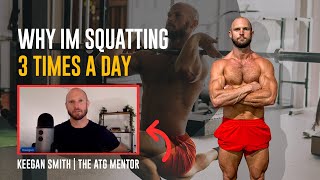
Keegan Smith describes an experimental personal protocol combining high-frequency squatting (three short ramped sessions per day with one challenging top set each) and a rapid fat-loss diet based on the protein‑sparing modified fast. He explains session structure (morning 2–4 reps, mid 4–6, afternoon 8–12), low overall daily volume (≈10–12 sets), diet details (mostly lean protein, minimal carbs, pulse refeeds with higher fat), goals (200 kg back squat before age 40), and practical coaching thoughts about recovery, mobility and sport-specific power-to-weight tradeoffs.
Chapters
My name is Keegan Smith. I help coaches think bigger and then achieve it. In this video I'm going to share more about what I'm doing at the moment. Squatting three times a day and following a rapid fat loss diet. Why it's not as crazy as it sounds, why coaches may benefit from this style of approach and then exactly what I'm eating and how I'm training. Okay, so squatting every day, three times a day. I squat in the morning, I squat a few hours after that, three or four hours after, and then I squat early afternoon. The idea is not to squat too late at night so it's easier to get to sleep. But the fact of the matter is that I'm not actually squatting to maximal or near maximal weights on this program. I say that, but then in reality I was pretty close to maximal. This morning I got to 120 for four. The last one was fairly slow. Now I love these approaches of taking on experiments and looking at what's possible and sometimes I do these things and it really doesn't work at all. I was doing like 20 rep squats when I was doing a lot of fasting and that, that didn't work well at all. It took me a couple of months to recover from maybe, maybe not. But it's was, it's 2016 so it's quite a while back. That approach is one that I probably won't try again. What I'm doing at the moment I actually feel like is quite sustainable. There have been a lot of people in the past who've trained multiple times a day for weightlifting. You'll find a lot of crossfitters will train multiple times a day and they may not be doing the same movement. But difference is that, yeah, within CrossFit, like everything is a squat one way or another. There's a, there's a squat within a box jump, there's a squat within a snatch, there's a squat within squats. And so it is possible, it is done and it has been done. I'm following something like the Wolfgang Onsalt Squat holiday program, but I'm not using all the carbs and I'm not doing as much volume. So again, I'm only doing around about 1012 sets a day. So it's not crazy in terms of volume. And they are ramping sets. So there's only one challenging set. So there's three challenging sets a day and that's what I'm doing. So in the morning it's two to four repetitions for the Top set. And the goal is to increase and do more than I've. I did on the first day. So I'm up to day three at the moment. I've been able to beat the previous two days. We'll see if I'm able to continue that. I'll probably reset back down to a lower intensity if I, if I'm not able to continue and then build again. Second session, I'll go for four to six repetitions. And then third session, sort of eight to 12. And I'm going on the, on a steeper slant on that one. So why with the squat? Well, I went to, I went traveling and I broke my squat every day. And so this is somewhat of an attempt to recapture the momentum that I had. I had a really good first two months of the year, and then I lost some momentum on my squat. And this is an endeavor and a fun approach to recapturing that momentum. I've actually probably never squatted this well. Beltless, consistently, pain free. So I can really thank the ATG program. I never used to be able to squat with the form that I have now either. Not saying I have the world's best squats, but my squats used to be really ugly. I never used to use my quads. And thanks to the ATG program and Ben basically telling me, hey, you don't use your quads when you squat. Like, yeah, your quads, your squats are getting heavier and you're using the slant, but you're still not using your quads. I think that was maybe 2019. He sort of said that and I was like, it was a hit to the ego because everybody likes to think that they know how to lift, especially since I'd been lifting for nearly 20 years, probably at that stage, and coached world champion teams and all those sorts of things. But now I can actually use my, my cords more. I've still got issues and challenges. I think that will always be there. Everyone should be looking at, okay, well, where are the details that I can improve here? Um, but yeah, the mission, the vision is to get to a 200 kilo back squat. Thousands of people, tens of thousands of people probably have achieved 200 kilo ass to grass, Olympic lifting style back squats, But I haven't. And so the fun is in me seeing if I can do that. I'd like to do it before I'm 40. I'm 40 at the start of next year. And so that's the game that I'm playing. And this challenge is part of that. Now the other Side which doesn't necessarily generally go well with high frequency squatting is that I'm doing a rapid fat loss diet. So it's based on the protein sparing modified fast. But again, I'm going to explain why. It's actually probably not that crazy and I'm a huge fan of it. The diet involves eating mostly really high quality protein, not that much fat, basically no carbs. And because you have protein satiety, it's not actually that hard. So you're eating enough protein, you're eating the amount of protein that your body needs or even more than it needs. A lot of the protein needs are based on the minimum amount to stay alive. That's not necessarily what we want. We want the amount that we can thrive on wolves. Smaller animals than us will consume like, cannot consume up to like 10kg of meat at one time. So we have. There's a case where to say that a lot can be consumed and processed. We're not wolves. But anyway, it's lean meat. And then when you need more energy, more calories, traditionally on this sort of diet you would use carbs. If you look at a lot of the original, I think rapid fat loss diet, there's a few different ones that sort of based on some of the Maro de Pasquale stuff as well. Protein sparing modified fasting is a clinical treatment for obesity that a lot of studies have been done on. It's not recommended for people who are relatively lean, but I found that it's quite good. You just don't need to take it as long and you probably need to have higher protein and you just pulse in the energy source. So as an energy source, you can either use carbohydrate or you can use fat as the energy source. I prefer to use fat. So if I'm having like a refeed, then I'll have more fat. So what I'm doing exactly is to consume lean protein. So like lean, lean beef, lean chicken and yeah, consuming around about a kilo to a kilo and a half of of that per day. You shouldn't be. Yeah, you shouldn't be hungry for protein is the main thing. You might feel like you want to eat something else, but if you're not hungry for protein, it's much easier to stick to a plan. And the reason why this diet isn't that crazy is because a lot of athletes roughly consume this sort of diet. This is something like what the, you know, the diet that Ben Patrick is using. Some athletes, you know, some people will believe in more Carbs, some, some less. You will hear if you I was watching one of the Chinese Olympic weightlifters talking about how he's almost eats, no carbs, he's super shredded, like low weight category lifter. I don't remember his name. But it's not unprecedented for athletes to focus on lean proteins, especially during a time of cutting and preparing for competition. It's a traditional, it's a bodybuilding technique that's been used for a long time. Vince Gironda was a big fan of this style of diet, more or less. And Charles Poliquin used to put people on a diet where the first two weeks was two licks of a dried prune in terms of carbohydrates, lean protein. So almost exactly what I'm doing at the moment, within those first two weeks you get a massive change in body composition which gives you a huge shift in power to weight ratio. Now there is a case for hey, like take it step by step, you know, change one grain of rice every day and then 10 years from now you'll be in a calorie deficit and that'll be super sustainable. That's fine if you want to use that step by step approach and things, you know, of that nature. But if you do have discipline and if you have already, you know, tried different things in the past, then this approach is not that challenging. On the edges of this, okay, so I'm having those lean protein meals. You can have green vegetables if you want to. I'm not really consuming many, I consume some. But I've done carnivore diet in the past. I don't feel strongly about the need to consume vegetables on the edges of the diet. So if I want to, I'll have a kefir drink that is like 130 calories or something. If I feel like I need, want something else different and my discipline's not there to just stay a hundred percent strict to that, I'll have that. And sometimes I'm having some blueberries or frozen berries. I'm going to get to any questions as well. If anyone who's listening in or comments. So the kefir and some berries are like on the fringe and then at a period of time that you choose, you add more, add more fat. You know, for me like it's like a refeed meal. So I'll have like a fatty steak or something like that as the, the break from the diet and you'll find that that gets rid of all the hunger. I like to take morning weight. Some people don't like to weigh themselves. I do. I've used the sculpt device in the past. Sculpt me. I don't have one here at the moment but I do like to use that as a measure as well to show that things are changing. But yeah, I've lost like four kilograms on the scales. I was 83 to 84 kilograms. Now I'm 79 and a half to you know, 80 and a half kind of range and it's been get like two weeks. Yeah, just over two weeks. But the squatting every day is. I'm only third day in so that's. That is the story so far. Spacing of meals is a question there from Daniel Hargraves Timing with your workouts. I don't really fuss over that too much Daniel. Sometimes I will have a meal in the morning, like 10 o' clock or so. Sometimes I'll go through till 2pm if the focus is really getting leaner then I don't mind getting kind of stretching that intermittent fast. There is a case for not always doing the same thing so that your body will use your body's resources but it won't kind of habituate itself to economizing energy expenditure in the morning. Um, yeah, I haven't had anything yet today. It's 20 past 11 here and I've done one session of squats. I walked out on the hill a bit and yeah, generally I'll finish eating by like 6 o' clock but sometimes you know, I'll have that later. I don't really stress about the timing. I'm more focused on work and training and yeah, it doesn't really cause me an issue if I shift around with that. How much protein per day do you recommend for someone trying out carnivore diet for the first time? The main thing yeah when you start is not to be hungry. I think is it makes it easier if you're not hungry and so having more protein can help. People can have really different tolerance to fat and ability to digest fat. So some people will try carnivore diet and their gallbladder and things is not ready for super high fat. So you might listen to some people talking about know medicinal use of carnivore diet. There are some really powerful case studies that paleo medicine are. If you check out the institute in Hungary they're doing phenomenal work. They recommend a really high fat approach but some people feel nauseous and don't really do well with that initially. So the main thing is to sort of go to satiety and personally I don't follow the carnivore diet as a religion. I did it for six months, really strict. But there's a lot of people kind of on the fringes of it now in different variations. My variation would be adding in some berries, adding a little bit of dairy, and then if I feel like some other sort of fruit, some other sort of vegetables, then I'll have it. I've even had a little bit of bread a couple of times lately, which was like I went probably I meant many years with no bread, like no, no gluten source at all. And because I had serious gut issues. And I think at that time, I don't know if it was, you know, gluten, but all the grains, all the gluten free stuff also caused me trouble. But yeah, like I'm sort of experimenting, like, does it really matter to me now? What sort of situation am I in now? So, yeah, I'm not religious about it, but that's what I will generally do. Reuben's going to play around with some protein sparing, modified fasting, basically high protein, like lean, lean meat. You can also use fish. Doesn't really work for a vegan type plan. Yeah, cheese is a funny one. Like some people are great with cheese, some not so much. Yeah, I appreciate the positivity around my transformation there. This is definitely a quite a big change. And yeah, it sort of shocks me sometimes as well. Like it's literally three or four days, like three or four days of being very focused with lean protein and. And I'll notice a difference. Like some will say, you know, you can't lose fat that quickly and it's not sustainable and, but you can. It just, it depends what you know, what you eat, what your training is. Like. If your body's used to running on fats, then it's also very easy for your body to continue to use those fats. I think it's a lot easier to go on to the protein sparing. Modified fast, rapid fat loss approaches. If you've been doing some intermittent fasting or some ketogenic days, some low carbohydrate days, then your body knows how to use fat. Struggling to gain adequate dorsiflexion. For the squat, what do you recommend? Squatting and pausing in the bottom is one of the best ways. Rory, without being able to see exactly what's going on there. I like pauses in the bottom. I also like split squats where you put something on top of the knee. So the atg, split squat and then put Something on top of the knee. It's either, you know, it's generally the muscle, like it's, it's important to think about the sensation as well. Is the sensation in the calf, lower calf, Achilles, or is the sensation sort of in the front of the ankle? It doesn't really matter so much. Where it is the same, the solution is the same. But if it's more of a sensation in the front of the ankle, like it feels like a bony block, then it can take longer to change and to adjust. I've had surgery on my left ankle and I lost some range of motion with that. It was a long time ago, but now my left ankle is the one that's easiest with range of motion on the right side. I hurt my Achilles like 12 years ago and that one stiffens up and sometimes when I squat deep, I'll get like a click, like an adjustment of the joint and then I'll have a little bit more range in my right ankle. So as long as there's no pain, it's not necessarily a bad thing. I kind of blast into that new range. Yaza here is asking about hill sprints, mountain running, lactic threshold training. What are your thoughts? Yeah, power to weight ratio, Yaza, power to weight ratio. So any extra kilogram that you're going to carry up a hill is going to have a significant impact on your time, on your success. Any level of maximum strength, maximal force output will mean you're using a lower percentage of your maximum when you go and do those hills or mountains. Right. So how can you be more powerful and, and how can you drop the extra weight if you had to carry a bag up there with you? So you really want to be for, for, if you're serious about mountain sprinting, then you want to be super shredded. You would also want to be very lower body dominant in your strength. So you'd have big calves, you know, really super strong feet, well developed quads, hamstrings, lower quads. And then you'd be lighter in the upper body because you don't really have a use for it if you wanting to be world class in that endeavor. And then, you know, you want to practice your sport a couple of times a week. But the main thing is to get the physics in place. Oftentimes there's huge gains to be made in neural output and ability to produce force elasticity of the tissues. If you can make big gains in that, big changes in body composition, then best to focus on that first. For example, if you wanted an obese person to run a faster 400 meters. Like, let's take this example to the extreme to illustrate the point. If an obese person wanted to run a 400 meters faster, would you go and take them out on a track and run four hundreds and time their intervals, or would you help them to transform that body into a 400 meter runner body and, and then let them run, you know, and develop the muscles that a 400 meter runner has well developed, the positions that are well developed, you know, you focus, focus on the foundations is the approach that I've found to be most successful. And then, yeah, get around. World class 400 meter runners, like, learn, learn from the best hill sprinters and mountain runners about their specific knowledge. What chances are they they're not experts in strength training? Body composition. Strength training and body composition are the fundamental key language. You need the character traits and the beliefs that go with what you do. But if you don't have those, the foundation of force output, neurological output, tissue tolerance to force, and you're carrying extra weight in what you're doing, then there's no chance that you're gonna have optimal, optimal results, optimal outcome. Very few people will do the work with this. And you see this with like fun runners and triathletes spending like 20 hours a week training and they're 5 or 10% above their ideal body composition. Doesn't make any sense to me. You could train a quarter of that amount and drop the extra fat and you'll beat your, your former self. All right, thank you so much for jumping on and yeah, look forward to continuing the conversation. Hope there was some value there around the squat every day and the lean dieting and how for a coach, it can make a lot of sense to experiment with things, to take things to the extreme, to see how it feels. And then you're also less likely to give people things to do that you wouldn't do or that will be beyond their level of discipline. It can also be something that inspires people around you to take themselves to a new level. So, yeah, maybe don't take on this challenge. Maybe do, but let me know how it goes.










