The spread of Search Funds around the world - IE Search Fund Club
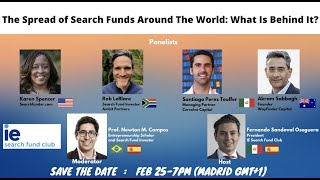
This is a YouTube video titled "The spread of Search Funds around the world - IE Search Fund Club" created in August 2025. It features a panel discussion led by Newton Campos with multiple international participants including Karen Spencer, Akram Sabar, Santiago, and Rob. The conversation focuses on the global growth and challenges of search funds, sharing insights from different regions such as the US, Australia, Mexico, Africa, and emerging markets. The discussion includes data on search fund trends, investment dynamics, and practical advice for searchers in emerging economies.
And sometimes. Okay. So I just wanted to acknowledge that all of this started when, you know, EK just mentioned, you know, we should someday meet and debate about how and why, you know, search funds is spreading around the world. That was some three or four months ago and I thought that was an amazing idea. And then I started together with him, we started to consider inviting other people from other regions not so, let's say knowledgeable as the US and the UK about search funds. And so I'm very, very happy that we made it happen. And we have so much interest and we have all these amazing panelists here. I prepared a number of questions for you guys. But before that I was talking to Fernando on how we could make this more engaged, make people more engaged to it. And we thought about playing a game, you know, in the beginning about search funds. A typical kahoot game. However, I think that I was thinking now that as you know, time passed so fast and this topic is so relevant, I thought that although the game is ready, I prepared with Fernando. We have 10 questions. A lot of fun. I think we will gain more and I'm seeing so many smart minds here. I think we'll gain more if we put our panelists to actually think and say about what they've been living. I think we will all get more from this very brief meeting than if we just play on search funds. I see that most of you know quite a lot of search fund already. So I think we should go straight to the point and work hard here to build up some knowledge and spread some knowledge on the spread of search funds around the world, which I being happily witnessing too in the last five years or six of my life that I've been working with search funds. So before starting then I would invite our panelists just to introduce very briefly themselves. So you have to know what they been doing. And I will start by inviting Karen Spencer for you, please just to introduce yourself briefly.
Hi everyone. I am delighted to be here. I am Karen Spencer, COO of SearchFunder.com and one of the three co founders of Search Funder. You probably will see me the most and the most communications. I like to think of my role as just chief happiness officer. So if you are unhappy with Search Funder, please reach out to me and if you're happy, just definitely reach out to me. And I'm just delighted to be here. Thank you.
Thank you. Thank you. Karen. I'm very happy that you are@searchfunder.com the only complaint maybe is that's too much information, but it's Not a complaint, actually. It's like I just would like to be able to, you know, to read everything that is there.
Thank you. And you know, when we first started, we had no information, so I consider that an accomplishment.
Cool, thank you then. Akram, you're in the other side of the planet. By the way, where are you currently? I'm in Sao Paulo. And you?
We are all in Portland, Oregon. So I would love to be where AK is right now because I love Australia.
So, ak, where are you?
Well, Perth, Western Australia. It's ten past two in the morning over here and I'm probably the only person awake in the whole town. But I thought I'd put that. That's the backdrop up from the river of our city. So I thought so people who hadn't been to this part of the world might get a view of it. So yeah. AK Sabar. We began our journey in search about three and a half years ago, and when we heard of the term and were pretty much fell in love with the idea of search funds back then, traveled a little bit to the US For a couple of different conferences and decided that we bring Search fund as an investment class to Australia. And that started with a business called Second Squared, which is to accelerate the progress of search and the concept of search in Australia. And we're literally about to launch a fund in the next two years, certainly in March, called Wayfinder Capital. It'll be the first fund of funds in Australia and we start working actively and officially raising the first $25 million fund starting next week. So it's very exciting times in Australia.
Oh, cool. Thank you. Ikram, welcome. Thank you for the effort and very welcome here to our panel. I'm sure you will be able to share what's going on with us in Australia, which is very interesting.
And.
Okay. Santiago, are you there?
I am. Good to see you. Nutan, thanks so much for the invite and for the ES search on cloud for putting this together. I wish I was a happy officer or something as Karen is, but I have a more boring job. I'm a partner at Cerralvo Capital, where we invest solely in search funds. We have invested so far in 29 search funds and nine acquired companies. We are a team of five partners made by CEOs, former searchers and people very involved with finance. And I'm seeing some familiar faces here among people we've partnered with and some that we hope we partner with. So very excited and grateful to be here.
Cool. Thank you. Welcome Santiago from Mexico. Right, you're there now from Mexico City.
Yes, sir.
Cool.
And Rob, are you there? I think Rob is in Cape Town.
I am, yeah, in Cape Town, South Africa. Pleasure to be here. Thanks for organizing and inviting me and to IE and Search Funder for putting it on. It's also nice to see a bunch of familiar faces from the international search fund community here on the call. So see, by way of background, I'm Canadian originally, although I now live and invest out of South Africa. I grew up in Canada, worked in management consulting and private equity and then went to business school at HBS where I first learned of search going on more than 10 years ago, which makes me feel quite old actually to think about it. But have been down in Southern Africa doing a lot of search like small cap, private equity investing since graduating from my mba and have been investing in search for the last few years. Myself personally primarily actually in North America. So started there and started quite traditionally, but then have been working on bringing the model to Africa ever since and now run a firm called Ambit Partners that invest in search funds globally and also raising our first fund at the moment. So I with ACC can identify with the upcoming challenge.
Cool. Thank you so much for coming. Okay, let's start. I have prepared a bunch of questions just to warm up our panel. And then of course, you guys are completely free to join us after we finish a couple of rounds of questions. And I would start with Karen. Karen. You know, I still remember when searchfunder.com was created. That was like, I think five or six years ago. I'm not sure. But you know, I remember when I came across the web, I said, wow, these guys are so crazy because, you know, it's like, this is so small. Why someone is like paying attention to something, to an asset class that is so small and so, let's say, little relevant worldwide. And that was what I thought six years ago. And then my question to you is, were you foreseeing this growth that we are witnessing now around the world or your focus at that time was because you saw the growth in the U.S. what did you think about when you started Search Funder at the beginning? Would you mind sharing with us?
Yeah. Oh, I would love to. Mark and Luke had the idea to to provide a service to the search fund niche when they were at MIT's Sloan School of Business and they themselves realized that they could not break into the traditional search fund space because they just didn't have the network and access to information. Now being MIT folks, they're like, this is something that's ripe for a platform and looking at all of the data about aging globally, it seemed to make sense that this would expand globally. And in fact, the first thing that we did on Search Funder was to provide a map of all of the search funds around the globe. So we've always had a global view.
Yeah, it's true, it's true. And actually I have some print screens of those maps from years ago and precisely where I can see the evolution. So that's nice to see. And hear that it was already started with this global view from the beginning. That's very, very cool. Very cool. Thank you. Thank you. Let's see now, Rob. I have a question for Rob, guys, for you in the audience, the questions just for you to understand, we prepared in a way that they are, let's say, somehow fast, and then we can, you know, engage in fast and quick questions and answers so that we don't have, let's say, some of us speaking for five or 10 minutes, which we believe to be a bit boring in panels in general. So we're trying to be a bit faster. Of course, sometimes it won't be possible, but that's the objective. So, Rob, I have a next question for you. As you said, you're originally Canadian, but with a lot of experience in Africa. Do you remember when you first thought about, well, maybe there'll be room for search funds here in Africa? You know, when did that came, you know, cross your mind? And how. Why did you see that coming in Mexico and the expansion on it? And my question for you is why? You know, I don't know if it has something to do with being close to the US or Mexicans go to study in the US A lot. What is the reason behind that in Mexico? And also if it has any relation with the private equity industry, I don't know if you can clarify that for us. Yes, thanks.
Of course, Newton. Yeah, I think the opportunity to the US was crucial. Taking to Ekram's last point, you know, most of the early searchers have been in American business schools before that, where they learned the model and so its value creation potential. And I also think that the first searchers that pioneered the model in Mexico were vital for the community to take off. There were early acquisitions in Mexico in the education and healthcare sectors done by Mario Cecilia and Jose Fernandez on one side and Memo Sombrano, his partner on the other side. And these were crucial to get attention and inspire people to take that career path because they proved the model, the returns that could be made, and an actual market, you know, where you could buy and sell small to medium companies which not many people believe that could happen in Mexico.
Interesting. Okay, thank you. Thank you for sharing. Yeah, it makes sense. I think somehow all of us who are following up on first searchers in each market, we will see that. I can see already in some markets where you find the first time searcher there operating, if they are not very well successful, then of course it creates a kind of a stigma of people being a bit more scared of that market. And I think it's precisely the opposite of what happened in Mexico. And for sure in some countries in Brazil it's the same. We've been watching some interesting stories in Brazil and I think that makes more Brazilians consider the search fund as a possibility of a career. So interesting. Thank you. Thank you. Okay. I just would like to go back to Karen and in general I see traditional large American funds a bit uncomfortable in investing in search funds overseas. Do you think that the search fund industry needs a strong local investment community to thrive or you think that few, perhaps large funds will be able to make this industry to work?
I think that a few large funds will be able to make it work. And the reason why I think so is that the search fund community is a virtuous cycle just as Santiago described. So what we saw when we first started Search Funder was that investors would not invest in SaaS or E commerce or anything that sounded kind of techie seeming. And over time we're able to build up younger cohorts of investors, primarily searchers, who became operators who then became investors and they're much more comfortable with that space. We also see other SaaS&E commerce investors being pulled into the search fund community. So what I think will happen is that as more searchers are successful and we have more high quality searchers around the globe, that virtuous site cycle will kick in. And I suspect that that will happen much sooner than we all expect.
Oh, that's cool. That's interesting. It's a nice point of view. Thank you for sharing. And I would like to take the opportunity to ask you if you could share any interesting information about numbers or insights from the data you have with regard to the growth of search funds.
Outside of the the US I can share some data with you. I found, I looked at some data last night and I found some interesting statistics. So I just need to pull up the numbers to have them handy. So if you look.
You need some minutes?
Yeah. Oh no, it's fine. So if you look at search ones outside the US they're Definitely becoming an increasing share of the proportion of overall search funds. And what I did was I looked over the last 20 years at search fund formations and about one in every five search funds, whether traditional or self funded, was outside of the United States. And then by 2019 that gap had, that percentage had increased to 1 in 3. So then I looked at acquisitions. If you look at what has been acquired over the last 20 or so years, the average is about 1 in 7 entities that were acquired were outside the US but by 2019 that gap had closed to 1 in 4. That tells me that the knowledge is getting out there that people are becoming more successful at searching. And of course the overall percentage increasing. I, I at some point would expect that it could be even as high as 40%.
Wow. Wow. Impressive. So it's justified our meeting here today? Yes, yes, thank you. Thank you. Okay, cool. Very interesting data. Thank you for sharing. I never say if I must say data or data because you guys have different accents. But Rob, I think a good question for us to start exploring it's that we all started in search funds looking at the typical by the book traditional search fund model in the US And I would like you to share as you've been doing global investments, what would be the top three differences that you find when comparing the typical, let's say by the book search fund, traditional American model compared to what you've been witnessing with the searchers and acquisitions you came across in Africa and other emerging economies? Would you mind sharing that?
Yeah, it's a good question. I guess if we stick to stick to traditional search funds only because there's a comment there, it's actually easier to probably go self funded in a new emerging market as a model choice. And if you are going to go traditional, it's probably a little easier to go solo because it's sometimes hard to find someone as crazy as you are to pioneer in a new market at the same time. But if we stick to traditional, I'd say there's really probably four dimensions that we think of as quite a bit different or can be quite a bit different. So one is just talent. There's going to be fewer searchers in more frontier markets, so it's going to be easier to stand out. But then conversely it's going to be harder to recruit and hire talent to scale your business once you do acquire it. So it's sort of a double edged sword. Targets can sometimes be harder to find or on thesis targets that are the right size, the right level of complexity and typically they're smaller and more complex per dollar of EBITDA in an emerging market. And they're harder to find because data is less aggregated and less available. They're harder to value because data is less accurate and more opaque. And you're also more likely to find private equity competition at the lower end of the market because there's fewer bigger medium sized businesses. So private equity firms come down market a little bit to compete with searchers, then on the capital side, you'll find it harder to raise equity. You always have the twin problem in a new market of convincing international investors that the local market is worth risking. And then you have difficulty convincing local investors that the search fund is a viable model and not craziness from the us. And then also very importantly, debt can be harder to raise and if you can raise it, it's often more expensive. So that can dramatically impact deal economics for the searcher and for the investors. And then the last piece is the fourth one is probably just the way you create value emerging markets because you're starting from a smaller base, often with less debt, you often have to grow the business more and that creates slightly higher execution risk. But is, you know, content potentially have a lot more upside if you execute on that growth because there's typically less debt, there's less gearing and less returns to equity from leverage. You have to actually grow the business.
Nice. Nice.
Cool.
Interesting. Yeah, it's true. I agree. I would take the opportunity to ask you how do you think that searchers from emerging economies could be more prepared for those differences?
So first is awareness coming to a chat like this and learning about what's different. Then the second piece is probably just homework, right? Deeply learn the traditional model and then reach out to other searchers in emerging markets, ideally the ones you're interested in going into and investors that are experienced in that market. To stress test what's different. Then do your own research and test the assumptions on just how different they're going to be. For example, what is the availability of good looking targets in your country? Like go look, try to find some and just test the water. And then I would also, just as part of that homework process, start consciously cultivating your network of allies across the search fund life cycle quite early. So think about investors and investors. You should think about global serial investors, ex searchers in your market, local private equity investors and friends and family. Also lawyers, advisors, brokers, bankers on the debt side. So start testing whether it's going to be possible to raise debt. And then also business media and press, you know often if you're the first searcher in a market, it's also a press event that you can get a little bit of buzz around your search and accelerate, put some some wind, but wind in your sail through a bit of a PR effort as well. So the earlier you start cultivating those relationships, the faster you can hit the ground running if you do go for it.
Very cool. Thank you. Thank you. Thank you. Interesting. I saw that we have a question here in the chat. I'll go to that in a moment. And Karen has been also she shared some interesting interviews of the cases that we mentioned here. I've watched already those interviews. I strongly recommend and.
More from Newton
Dr. Newton Campos crash Course on Entrepreneurship through Acquisition - Understanding Search Funds
IE University Search Fund Club - Latin America Search Fund Study 2022 with Prof. Newton M. Campos