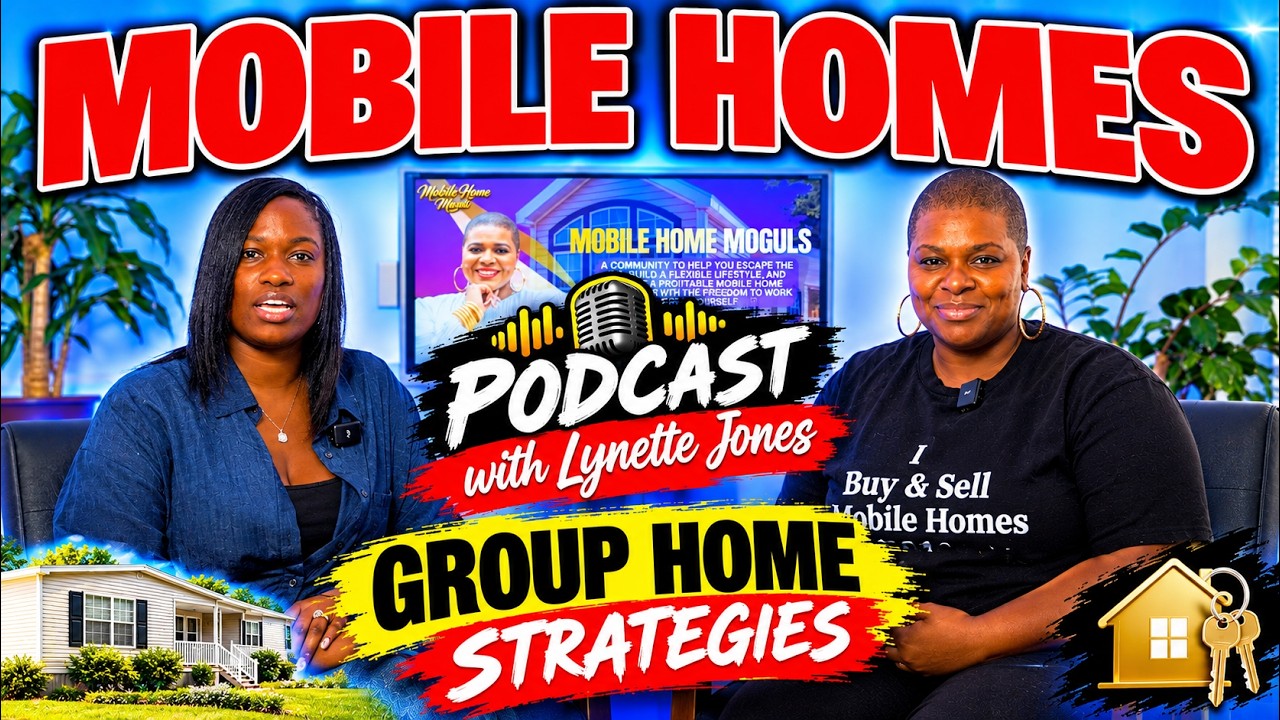
In this interview, Nichole Briscoe talks with Lynette Jones, a self‑described "group home guru," about how she built a profitable, unlicensed group‑home business without a traditional real‑estate license. Lynette recounts starting in 2021 by converting her own home’s bedrooms—while her children were away—into shared rooms for people exiting prison or otherwise underserved. She explains how her background as a correctional officer gave her insight into the need for second‑chance housing and how she assessed residents’ histories, temperaments, and medical issues. The conversation covers the mechanics of building referral relationships with reentry coordinators, prisons, hospitals, and shelters, and how to generate leads even with no capital by acting as a placement‑referral agency. Lynette details scaling from a single home to seven properties (including mobile homes and 3‑bed/5‑bed units), achieving roughly $500,000 net profit at full capacity through a mix of bed rents ($800‑$1,600, income‑based) and stacked services via a separate non‑medical home‑care agency. She shares cost‑saving tactics for furnishing (using Facebook Marketplace, low‑cost twin XL beds, and minimal décor) and rental‑arbitrage approaches. The interview also touches on vetting residents (behavioral records, medical history, work experience), pricing strategies, and the broader affordable‑housing crisis that makes shared‑room models attractive. Throughout, the tone is conversational and enthusiastic, with Lynette presenting practical, actionable advice for aspiring operators.
Chapters
Home Mommy. What's up, y'all? Guess what? I am super, super excited. Y'all ask me all the time, how do you run an unlicensed group home in your mobile home? How you find the people? What do you say to the people? How do you get them to call you? How do you know they qualify? Ding ding ding! This girl right here, this is my sister in real estate, Miss Lynette Jones. She is the group home guru. She has taught me everything, everything, everything, in the words of Mary J, about the unlicensed group home strategy. So I want y'all to meet my sister, and I want you to tell them who you are, how you got started.
Okay. Hey, y'all. My name is Lynette. I am the number one group home expert across the country. I teach people how to get started with the group home business that does not require a license. So I got started back in 2021. I used my personal home, and actually I used my children's bedrooms at the time.
Child.
We'll get into that. I put my kids out to run a business. I'm just playing. But yeah. I had 3 bedrooms upstairs. I ended up bringing people from prison as well as people who are underserved in my community and put 2 people in each room. And back in 2021, I was charging $650 a bed. Now today I start at $800 for a shared room and it's been great.
Okay. So let's talk about putting your children out. No, seriously, tell them that story, how that went.
So actually, my kids went to Mississippi for the summer every year anyway, and I had just recently lost my job. It was June, uh, 6th, actually June 6th of 2021. And so I already sent my kids to Mississippi, so I just took advantage of that opportunity, um, to empty their rooms and put their, uh, furniture in storage. And I put 2 beds in each one of my rooms upstairs, so I already had a guest room. Mm-hmm. And then I had my son's room and my daughter's room. And so we converted it to get started with the business.
You weren't scared to put people in your house? Because I would have been scared.
Mm-mm. So I wasn't scared because I worked as a correctional officer.
Oh.
So with working in corrections—
So you knew how to fight?
I mean, I just realized that people weren't as scary as the media portrayed it to be.
Okay. Okay.
So I was mindful about the people that I brought in by doing my assessment.
Okay.
To kind of get their history, their temperament, any type of medical issues, behavior issues. But also my room was downstairs and then they were upstairs. So we had some separation there.
Okay. Well, what made you want to start doing this? You had a correctional officer, so you was making good money and you had a good job. So what made you want to do that?
Yeah, there's no such thing as a good job, but— Okay. We're not doing no good jobs. I understand. Any job, listen, it's work. But while working as a correctional officer, I was able to identify with a huge need, which was second chance housing opportunities for people who needed a place to live when they were making parole or coming home from prison and discharging their sentence. So just imagine going to work every day, seeing people who held a parole certificate in their hand, but it's like, I can't go nowhere. because I don't have a house. Broken buns with children, parents gone, been gone for a very long time and just don't have anything to return to. And just wanted to be able to problem solve and say, okay, well, I don't mind housing y'all. Because I was dealing with them every single day that I worked. And if you know anything about corrections, they say that correctional officers, we voluntarily lock ourselves up because we We are incarcerated too. As long as we on the clock, we have to, you know, be subjected to some of the same things, um, that people who are incarcerated are subjected to. We just get to leave, but we walking into prison. So I mean, the interactions, you know, I just— it just wasn't scary. So I was like, I'ma solve a problem. And I was able to do my research and understand, um, that some people come home with guaranteed income. Mm-hmm. So I had already Figured out how I was going to get paid, how I was going to set up the business by way of targeting people who was eligible for Social Security benefits.
Interesting. Okay. You can forget them. Just talk to me.
Okay.
So this is what I need to know, because a lot of people ask, do you only house people in prison? Are you really saying if I get parole, I can't leave prison if I don't have an address?
Yeah, because you're still a property of the state.
Ooh.
So if the state— if you're on parole, you still belong to that Department of Correction, and they got to be able to know where you are and approve for you to be there.
Okay.
So if you don't have an address, um, the only other thing you'll be able to do is, uh, go to a halfway house, state-run facility. But they're not going to build another facility because you need to get out. So you wait, you on a years-long waiting list. So I was like, okay, well, what else can be done?
Okay.
And so that's when I started researching to be able to bring them in.
Okay. And is it hard to get relationships with the prisons? Do they want to talk to you? Talk about that. And do you also tell them how you also manage getting referrals from other agencies?
Yeah. So when it comes to people coming home from prison, you would just contact the reentry coordinators. Their job is to find placement. Their job is to help them get their IDs, Social Security cards, birth certificate, and apply for any benefits that they're eligible for. So that's what reentry is for. So they want you to reach out to them because the more resources they have is the better chance for them being able to help people reintegrate back into society. And another thing is, when we are looking at people who are discharging their sentence altogether, like they're no longer on parole, if they are a senior or if they have somebody who have some mental health challenges or some physical disability, They can't just put them on the street. So if your date to get out is tomorrow, but I don't have safe placement for you, then that person has to stay in. So obviously then that's not good for the Department of Corrections to continue to keep someone and they've flat discharged. So now it's like, okay, the, the better— the best thing to do is to reach out to these operators that will take them in so that they can let them go. Mm-hmm. 'Cause it kind of puts you in a mindset of like people in the community. If someone goes to the hospital and let's just say they're on oxygen or they on some type of continuous IV antibiotic, you can't just put that person on the street if they still need treatment and need support. So it's the same standards held in the prison system.
Ms. Jones, hold on one second. I heard somebody typing in the comments. Is this business successful for you, Ms. Jones? Yes. Ms. Jones, how many homes do you own?
I grew my business to 7 homes, and I'm still growing.
Ms. Jones, how much money do you make a year net profit on these homes?
$500,000 at full capacity. So $500,000, a little over $500,000 at full capacity.
Oh, okay. And I know she ain't lying because I have 4 of them inside of mobile homes because I listened to her. Right? So she has taught me the same strategy, and I'm like, well, I got this vacant mobile home that I overpriced the rehab. What can I do to make it work? And guess what? That mobile home that's inside of a mobile home park on the land that I don't own, I make $5,000 a month net on that home because I'm providing people with affordable housing and I'm making Profit. So this strategy works. This strategy works. And, and, and y'all, this is the little sister of the group, okay? This is another one of my real estate sisters that I met on the internet. On the internet, y'all. Accountability. Sometimes the people you want to partner with who literally sleep next to you or who are your best friends are not the people you have to partner with. Sometimes you have to partner with strangers that's going to hold you accountable and then grow into your best friends. That's just how life works, okay? So don't be afraid to partner with other people.
Right.
Now, I'm new and I want to get started. To someone, we may sound like we have money. What if I don't have no money and I want to start this business? What would be the best way?
So I would recommend doing a market analysis. When we do market analysis, it determines the need in the area, right? And so when we are breaking down a market analysis, we have to find referral partners. And so when you are reaching out to, let's just say, hospitals, um, rehabs, prisons, shelters, you are going to ask to speak to somebody.
Yep.
So while speaking to them, now you don't have any money right now, we're just doing calls, we're just feeling out the market. There may be times when you reach out to people and they have immediate placement opportunities for you.
Right.
Instead of you saying, well, oh, no, I'm launching a coming soon campaign, or we're not getting started yet, you can start taking those same leads to other group home operators and get paid as a referral partner, just like the middleman. You find the leads, and you fill somebody else's home, and you charge a fee. So if you don't really have a whole lot of money, you'll get started by running a placement agency, kind of like A Place for Mom. I'm sure a lot of people heard of that before.
I 100% agree with that because what I was doing at first, you taught me how to place them and that's what I was doing. I was placing them. But the people that didn't qualify, I was like, okay, bye. Okay, bye. And I'm like, wait a minute, she has a group, Group Home for Newbies, on Facebook with over 100,000 people. I start referring them to people in the group. Today I referred a lady from a rehabilitation center that needs to be discharged on Sunday. Boop, passed on to somebody else in Greensboro and made $800 off of that referral.
Mm-hmm.
So it works. Even if you can't place them, we don't send them to a dead end. We network with other people. So we're helping people find affordable housing.
Yeah, because right now we are in the middle of a nationwide affordable housing crisis across the U.S. And I like to tell people it doesn't matter, um, what type of real estate, you know, whether it's a mobile home or house or apartment duplex, You can use this cash flow strategy anywhere to keep it affordable for people because right now, even low-income apartments are no longer affordable for people who are below the poverty line because of what we are experiencing in the economy. Yeah. So shared rooms, shared housing is becoming a new thing for affordable housing. So I think that it'll behoove anybody to just start looking into it because this is the direction That we're going.
And
they may think it's going to be a crash, but it's not going to be a crash.
And I tell people all the time, how bad do you want it? She was anxious enough, desperate enough as a single mom that I need to get the money while my kids are gone this summer. Let me put people in my house. That may not be for you, but I've also seen her do this for— show people how to do this with, oh, let me show you how to do rental arbitrage, where you can basically rent out a house Mm-hmm. And start your business there. And y'all trust me, one thing you don't know about Ms. Jones, I'm going to let you know, she is cheap.
Yep.
So don't feel like you got to fully furnish this from Ashley's Furniture. Okay? This girl will throw you on Facebook Marketplace looking for stuff, have you begging on your Facebook posts and like, you ain't got no aunties getting rid of furniture? She helped me furnish a whole house. I thought I needed $2,000. We got most of it done under $1,000. I'm like, good Lord. She was like, oh, this is nice. We just need to steam clean it and put a furniture cover on it. Okay. Listen, so I promise y'all, you can get it done. And before it's even done, you will have people saying, can you help me? Y'all, today it is Friday. She's like, the lady at the rehab center is like, I'm sorry to call you the last minute. I didn't know this little lady don't have nowhere to go. She getting discharged on Sunday. And don't think these people don't have families. This young lady has a daughter, and the daughter just don't want anything to do with her mom, unfortunately. So a lot of people that we're housing, we're housing people who have nowhere else to go.
So with the older generation, they did not properly plan for retirement. They wasn't investing in long-term care insurance. And so they was able to take care of the generation before them. But with us having to still, well, you know, with the working class people, You don't have that flexibility to stop working or be able to go stay with big mama because big mama got a savings, a house. It's just a whole different situation now. So I don't think that— I mean, a lot of times it's broken bonds with children and their parents, but then some other times it's like, I can't afford to take care of you. And we definitely got to stop making our children our retirement plan because that's not going to work no
more.
And that's not fair neither.
Oh boy. Okay. So I want to get back into 7 houses, $500,000. How are you making $500,000 off of 7 houses? Are these really big houses? Like, what is it?
So I have a variety of houses. I got some 3/2s, some 5-bedrooms. So the idea is, you know, the rates start at $800 a month, but we base— it's kind of like income-based too.
Okay.
So my entry rate is like $800, but it can go up to $1,600. For a private room. We do sometimes, if they're needing a little bit more services, not like care, but case management services, some supportive services, then we'll charge based on that. So kind of keep in mind of when you have income-based apartments, some people pay the market rent, some people pay a portion of the market rent.
Yep.
We just adopted that standard. So not everybody in the same home is paying the exact same amount because the needs and services are a little different.
Gotcha. But, and I know you talk about though maximizing your house. So you stack services. Talk about how you stack to get to that $500,000.
No, so, um, you can get that off just the bed. The additional services brings more money. So I do have a licensed non-medical home care agency.
Okay.
Where we send in caregivers into people's home or even group homes to assist them with their activities of daily living.
Okay.
Such as cooking, cleaning, bathing, dressing. Just kind of keep it in mind, like, you know, you may see somebody who's in a wheelchair, they got some limited mobility issues, but not to a point to where they need skilled services for a nursing home 24 hours a day or in a licensed facility. Okay. They just got some physical limitations preventing certain self-care. So Medicaid will pay a home care agency to send in caregivers to accommodate them a couple hours a week. So with the group home strategy, We don't provide 24-hour care and supervision. So these people would get a caregiver that may come 3 hours or 4 hours a day to help them with certain activities and leave every day. So, um, that's just a separate stream of income under a separate entity, um, and it's perfectly legal. It's not double dipping as long as you make sure that you understand, you know, you can't be offering the same services under the housing and then want Medicaid to pay for the exact same thing.
Okay, so like a different business entity. Okay, okay. All right, so when it comes to furnishing the house, what, what is it that we need? And is there any place you look besides Facebook Marketplace and, yeah, posting on Facebook?
Yeah, so, um, as far as furniture, you would do like some twin XL beds. I don't do the bunk bed thing, so you definitely want to do, uh, twin beds in the shared rooms. You can do full-size beds in the private rooms. I like to keep things, um, low as far as my initial investment because of the demographic that I target.
Mm-hmm.
So for me, targeting people who are— let's just say for instance their income is anywhere between $800 to $2,000. Those are considered low-income individuals, right? So I'm not going to go out and splurge on furniture and drapes and all of the things, because if you keep in mind, if a person only makes $800, $900 a month. They never, um, they never been exposed to certain things, so they don't understand the quality and how to treat it and care for it.
Say that.
Because when I first got started, you know, I had the mindset like other people. I want to make it like I can live in it.
Yeah, super nice.
And then when I did that, then stuff started coming up missing, uh, things that shouldn't be— Chipped up. Yeah, the decorative tiles was regular, you know. So I was like, nah, let me just keep it basic, clean, comfortable, and affordable. So even though I keep my budget low, it's still comfortable for them and they appreciate it.
What are— let's say, okay, let's say I got my contact list. I'm calling these probation officers, the parole people, the prisons. I'm renting a house out. Bet. I got it furnished, kept it cheap. What is the vetting process looking like? What are some red flags I should possibly look for when getting people in?
So when it comes to the prison system, some of the things that you can do is you can look and see if they've ever been written up, because they can catch new cases while incarcerated. They can get written up just with inside their system, so you can kind of see what their behaviors was like while incarcerated. You want to request their medical to see if they have any type of severe mental health challenges, some critical illnesses. You also want to see if they ever worked a job while incarcerated.
Mm-hmm.
And then one thing I always tell people, if somebody is going up for parole, you don't just get parole because it's your time to go up to speak to the board. A lot of them get denied on the first time. So understanding that if they met every qualification to actually make parole, being, you know, that speaks to their character as well. Okay. When making a determination, but that's—