The $29 Billion Pivot: How Fujifilm Survived What Killed Kodak
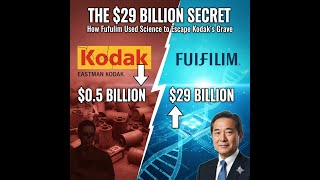
Kodak and Fujifilm faced the same digital photography crisis in the 1990s but diverged wildly. Kodak invented the digital camera in 1975, then buried it to protect film sales and went bankrupt in 2012. Fujifilm asked what it was uniquely good at—chemical synthesis, precision coating, anti-oxidation—and pivoted into skincare, pharmaceuticals, and electronics, reaching a $30 billion valuation.
Chapters
Alright, so this is one of those classic business stories, but it's a really good one. It's about a corporate cliff. You've got two giants, Kodak and Fujifilm, in the exact same industry. They're standing on the very same edge, staring at the exact same existential threat: the digital revolution. And what happens? One of them just plummets into bankruptcy. The other one? Well, somehow, it learns to fly. The question is, how on earth did that happen? Let's dig in and find out. Okay, first things first, let's just look at the scoreboard today. I mean, the numbers are just staggering. As of late 2025, Fujifilm's market cap is sitting at nearly $30 billion. And Kodak? Just over half a billion. You know, that's not just a gap, that is an absolute canyon. We're talking Fujifilm being worth over 50 times more than its old rival. Insane, right? So, this is the big question, the mystery we're trying to solve here. I mean, think about it. They were head-to-head rivals selling basically the same stuff and staring down the exact same barrel of a gun. So how, how could their paths have split so, so dramatically? That's exactly what we're going to unpack. All right. Section 1: Titans of Film. You know, to really get how this all fell apart for one and worked out for the other, we've got to rewind the clock. We're going back to the beginning, to that pre-digital world, you know, where the click of a camera shutter and that distinct smell of a darkroom, that was everything. Just look at this number: 80.1%. Let that sink in. In 1996, that's how much of the U.S. film market Kodak owned. They weren't just a company; they were basically a cultural monopoly. The phrase "a Kodak moment" wasn't just marketing; it was a real, tangible part of life. And, you know, that kind of wild success, it shapes you. It created two totally different company mindsets. On one side, you had Kodak. They were the comfortable king, to sitting on their throne. Their whole model was razor and blade—sell the cameras cheap and then make a killing on the film for years. This made them kind of insulated, a little, well, complacent. But then you had Fujifilm. They were the scrappy challenger, always nipping at their heels. They were more aggressive, and this is super important—they were already thinking about diversifying their business. That difference in culture right there? That's the seed for this entire story. Okay, moving on to Section 2. The Digital Fault Line. So everything's going great for the film guys, and then the ground starts to shake. The digital camera shows up, and let's be clear, this wasn't just some cool new gadget. This was an asteroid, an extinction-level event headed straight for the entire film industry. So suddenly both companies are staring right down the barrel of what we call the innovator's dilemma, and the choice they had to make was just brutal. Do you stick with the film business that is making you billions? I mean, an absolute cash machine. Or do you pivot to this new kind into scary digital tech that, by the way, has way lower profit margins and will literally kill your main source of income. What a nightmare. And this, this is where the story gets almost painfully ironic, especially for Kodak, because you want to know who invented the world's very first digital camera all the way back in 1975? Yep. An engineer at Kodak. So what did the bosses do? They buried it. They were so terrified that it would hurt their film sales that they literally put the future in a closet and pretended it didn't exist. Well, fast forward to 2012, that future came knocking down the door and the company filed for bankruptcy. Just incredible. Alright, Section 3: The Pivot vs. the Paralysis. This, right here, is where the two roads split. So, let's get into the nitty-gritty of the actual choices each company made when they were staring at what looked like the end of their world. So, you might be asking, why was it so unbelievably hard for Kodak to just let go of film? Well, this number right here is the answer: $1.4 billion. That's how much money their photography division made in a single year, in 2000. Profit like that? It's like golden handcuffs. For the executives running the show, making a hard pivot to digital didn't just look risky; it looked like straight-up financial suicide. And really, that's the diagnosis in a nutshell. It was the fear of cannibalization, the fear of eating their own cash cow. And that fear led to complete and total paralysis. It's not that they didn't see digital coming, they absolutely did. They just couldn't bring themselves to pull the trigger on their own golden goose. So how did Fujifilm manage to dodge this exact same trap? Well, it's because they were focused on a completely different idea. This concept of core competence. See, they asked a fundamentally different question. Kodak was asking, how do we protect our film business? But Fujifilm was asking, wait a minute, what are we really uniquely good at? I mean, beyond just the physical film we sell. And the answer they came up with was just fascinating. They realized that to make really great film, they'd become world-class experts in 3 incredibly complex things. First, chemical synthesis. Making super, super pure chemicals. Second, precision coating—like, applying layers of stuff at a microscopic level. And third, anti-oxidation tech—the science that stops photos from fading. And that's when the lightbulb went off. They realized: we're not in the film business; we're in the high-tech materials science business. And this is the big aha moment of the whole story. They literally took their library of film patents and just—translated them. So all that deep expertise in collagen science they had for film? Turns out, it's perfect for making anti-aging skin creams. That anti-oxidation tech to keep photos from fading? Well, it's also great for protecting human skin. And that crazy precise coating technology? It was the exact thing the electronics industry was desperate for to make semiconductors. It's just brilliant. And the results? I mean, they were just stunning. Suddenly, Fujifilm is launching a premium skincare line called Astalift. Then, they're pivoting into making life-saving drugs and biologics. And, on top of all that, they've become a critical supplier for the AI and 5G revolution. They didn't just survive the storm; they totally reinvented themselves into a 21st-century tech company. Okay, Section 4: The Final Verdict. Let's bring this all home and just look at the final score—the result of these two wildly different paths. The big lesson here? It's all about capability over product. Honestly, the numbers just speak for themselves at this point. You've got Fujifilm, a nearly $30 billion powerhouse with growing revenues, playing in huge sectors like healthcare and electronics. And then you have Kodak, a $1 billion company focused on commercial printing, with revenues that are actually shrinking. It's just crystal clear—the choices they made 20 years ago are what created this reality today. And this chart really paints the picture of just how total that transformation was. I mean, look at this—you can't even call Fujifilm a film company anymore. Healthcare is now their single biggest business. And that original imaging business, the film and cameras, it's now the smallest piece of their pie. They didn't just renovate the house, they built a whole new foundation. So if there is just one thing you take away from this whole story, let it be this: real, lasting success isn't about desperately protecting the product you sell today. It's about having a deep, honest understanding of what your unique capabilities are, what you're truly great at, and then having the guts to apply those skills to problems of tomorrow. And that really leaves us with one final powerful question to chew on, and it applies to everyone, whether you're running a massive company or just thinking about your own career. It might just be the most important strategic question there is: What business are you really in?
More from Nick

A 30 Year Hunt, One MIT Geologist: The Father-Son Team Who Finally Found Gold in the Selwyn Basin.

How Former NASA Scientists Built the World's Biggest Spy Fleet (And Why the Stock is EXPLODING)



Building a $10m EBITDA Leader in a Fragmented Space | Nick and Dillan Interview