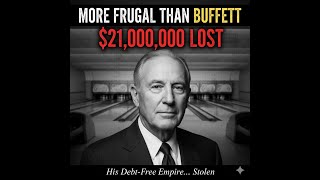
The video narrates the rise and fall of Bowl America, built by founder Leslie Goldberg into a 55‑year streak of profitability through an extreme aversion to debt, cash‑hoarding, and clever cost‑saving tactics such as buying used Japanese bowling equipment at pennies on the dollar. Goldberg treated the company like a mini Berkshire Hathaway, running the bowling centers as a cash‑generating engine while maintaining a separate investment portfolio that included a prescient $800,000 stake in AT&T. He reinforced his philosophy to shareholders with annual letters that began “Dear Fellow Owners,” emphasizing long‑term ownership over short‑term trading. To protect this vision, Goldberg instituted a dependent board filled with insiders and a dual‑class share structure giving the board ten votes per shareholder vote. After his death in 2019, the board swiftly sold Bowl America for $44 million despite analysts estimating the real‑estate and investment assets alone at over $65 million, prompting a lawsuit alleging the sale was a low‑ball transaction enabled by the founder‑designed governance. The story serves as both a case study of disciplined, value‑oriented entrepreneurship and a cautionary tale about the paradox of founder‑centric control structures that can be weaponized against shareholders once the founder is gone.
Chapters
Okay, let's dive into this incredible business story about a company called Bowl America. It's a masterclass in how to build a financial powerhouse, but it's also a serious cautionary tale about how even the strongest fortress can absolutely crumble from the inside. So that's the big question we're gonna unpack here. We're gonna explore this story of pure financial genius, incredible long-term discipline, and, well, a single fatal flaw that brought the whole thing down. It's a really fascinating look at what truly creates and destroys value. Alright, so let's start at the very beginning. We're gonna look at how its leader, a man named Leslie Goldberg, built an absolute empire in one of the most unexpected places you could imagine: the humble bowling alley. And this is where it gets really interesting. On one side, you have the popular narrative, right? That bowling is this kind of fading, old-fashioned pastime. But then you look at the reality for Bowl America. 55 straight years of unbroken profitability. I mean, think about that. That just doesn't happen by accident. This right here was the foundation for everything. Goldberg had an almost pathological aversion to debt. While all of his competitors were leveraging up to grow, he was just hoarding cash. And this discipline, it gave the company this incredible flexibility and resilience that nobody else had. You see, Goldberg didn't just see cash as a safety net, he saw it as an active tool. For him, a powerful balance sheet wasn't just idle money sitting there. No, it was an insurance vehicle that protected the business during recessions and could even generate its own returns, all while waiting for the perfect moment to fund a smart expansion. And then there was his second masterstroke, which was just as brilliant. While other companies were buying brand-new, expensive equipment, Goldberg went shopping— in Japan, where bowling centers happened to be closing down. He bought top-of-the-line lanes and machinery for, you guessed it, pennies on the dollar, creating this structural cost advantage that no competitor could possibly replicate. So, all of this, it wasn't just a business strategy. For Goldberg, it became a kind of philosophy, almost a gospel that he shared directly and consistently with his investors, year after year. And get this, every single year, Goldberg's letters to shareholders began with the same two words: "Dear Fellow Owners." Now, this wasn't some kind of gimmick; it was a signal of his deep, profound commitment to creating long-term value over the kind of short-term stock trading that dominates Wall Street. He basically ran the company like a tiny holding company, kind of a mini Berkshire Hathaway. The bowling centers were engine number one, just churning out reliable cash. But engine number two was a savvy, completely separate investment portfolio that provided diversification and a rock-solid floor to the company's value. And if you want a perfect example of this strategy in action, look no further than his investment in AT&T. He put in $800,000 of the company's cash because he anticipated its breakup. That one bet grew massively and was still paying dividends 40 years later. Just incredible foresight. Okay, so let's just put all this in perspective for a second. On the left, you see Goldberg's core beliefs: no debt, shareholders as owners, finding deep value, owning your property. And on the right, You see the typical corporate playbook. It just shows how radically different and frankly countercultural his thinking really was. But here, and this is so important, here's where we find the tragic flaw in the fortress. Goldberg didn't believe in the modern idea of having an independent board of directors. No. He preferred a dependent one, filled with insiders and major shareholders. He truly believed this protected his long-term vision, by making sure everyone had real skin in the game. And that's the incredible irony, right? The very structure he designed as a shield, well, that became the exact lever used to undo the entire company after he passed away. This is where the story takes a really dark turn. And man, look how fast this all happened. After Goldberg's death in 2019, the fortress that he had spent an entire lifetime building just crumbled with shocking speed. The pandemic hits, and within 2 years, Boom, the company is sold, triggering a massive lawsuit that's just now getting settled. So, to really understand why shareholders were so furious, you just gotta look at the numbers. Let's break it down. First, analysts estimated that the company's real estate alone was worth a bare minimum of $60 million. Okay, now on top of that, you add the investment portfolio, which at the time was worth another $5.5 million. So, just between the property and the stocks, you get a bare minimum asset value of over $65 million. And remember, That's not even counting the actual profitable bowling business itself. And yet, the board sold the entire company for just $44 million. I mean, do the math, that is a staggering discount. They were literally selling dollar bills for 67 cents. It's unbelievable. So, of course, a lawsuit followed, and it laid it all out. It claimed the price was a joke, that a huge termination fee blocked other potential buyers, and that the directors used their complete control to just ram the deal through. And where did that control come from? From a dual-class stock structure, the one Goldberg put in place, that gave them 10 votes for every 1 vote a regular shareholder had. This brings us to the key takeaway from this whole saga. You know, for anyone interested in business and investing, this is one of those stories you just have to understand. On the one hand, it's a brilliant case study. It shows how being frugal, being patient, and thinking for the long term can create immense, durable value, even in an industry that everyone else has completely written off. But on the other hand, it's a stark, painful warning about the paradox of control. The very mechanism Goldberg designed to protect his fellow owners from short-term thinking was the exact tool the board used to sell them out for a quick, lowball price. The shield became a sword. And ultimately, the Bowl America story leaves us with this powerful, really provocative question: Goldberg was a genius, there's no doubt about it. But was his genius enough? Or is the true measure of a great company a governance structure that protects all the shareholders, long after the founder is gone? It's something every investor really has to think about.