
How To Approach Your Health & Business Holistically
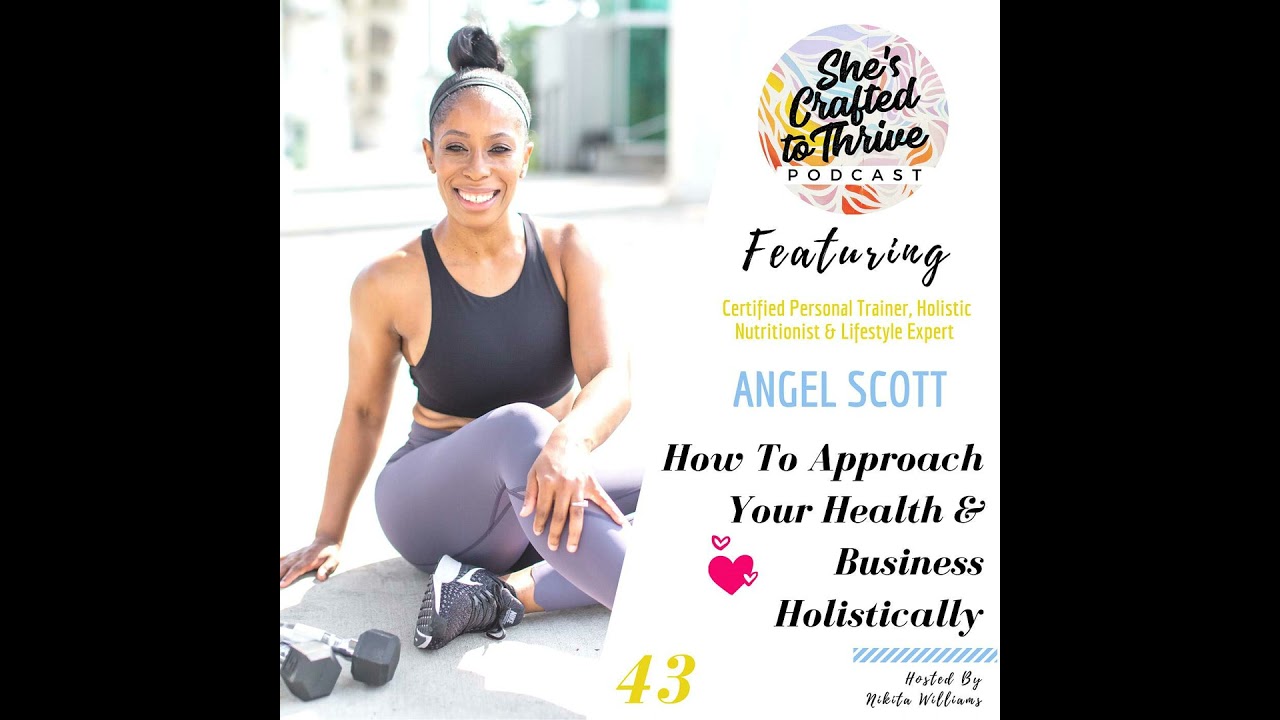
In this episode of the "She's Crafted to Thrive" podcast, host Nikita Williams interviews Angel Scott, a nationally certified personal trainer, holistic nutritionist, and wellness warrior living with Graves' disease. Angel shares her journey from a weight‑loss‑focused fitness coach to a holistic health advocate after her 2016 diagnosis, highlighting how chronic illness reshaped her perspective on nutrition, stress, and lifestyle. The conversation covers the red‑flag symptoms that were initially dismissed (persistent fatigue, hair loss, elevated resting heart rate), the importance of listening to one’s body, and the need for women entrepreneurs to prioritize self‑care to sustain their businesses. Angel explains how inflammation, stress, and environment influence autoimmune conditions, and she offers practical strategies: mindful nutrition, stress‑management techniques (especially meditation), realistic goal‑setting, and building supportive communities. She also discusses the evolution of her business—from a traditional coaching model to the "Healthy Vibes Happy Life" community—along with tools she relies on (Canva for branding, meditation for health). The episode ends with actionable resources (website, Instagram, community) and encouragement for listeners to adopt a holistic, balanced approach to health and entrepreneurship.
Chapters
On this episode of She's Crafted to Thrive, I am super excited to have Miss Angel Scott on the show. She is a nationally certified personal trainer, a holistic nutritionist, and a lifestyle expert. Now, I'm super picky about who I have from the show to talk about health and wellness because I don't want to trigger anyone. Matter of fact, I don't want to talk about calories or weight management or all those different things, but what I do want to talk about is more of a holistic point of view when it comes to our lives and businesses. And in this episode, that exactly is what we're going to talk about. Angel shares her own journey of being diagnosed with Graves' disease and some 3 things that she kind of explained away, even with the training she has, that actually led to her diagnosis and the importance of finding the balance between life and work and how they all work together. And besides all that, she's just so fun and I love her voice and I love just chatting with her and she's a great woman. So I can't wait for you guys to tune in and see if you grab any tips to help you in your life and business to have a holistic point of view. Welcome to She's Crafted to Thrive. I'm your host Nikita Williams and this show is for all the ladies who are making and creating things that they love. You will hear conversations about the real everyday struggles of juggling life and business while trying to maintain passion and harmony. As women, we have the skill of getting things done, but sometimes we get in our own way. It's here where you'll see that you're not alone. You'll discover that success does not mean perfection. Fear and negative thoughts and challenges are all a part of the journey. And on this podcast, you'll find the inspiration and tools you need to have a life and business that thrives. You guys, I'm super excited to have Angel on the show. She is a fitness trainer and a fellow— you said on the phone when I was talking with you that you're a fellow wellness warrior. And I love that because obviously I deal with chronic illness. I deal with endometriosis. So it's nice to hear someone who is going through something similar, but they spin it and it's beautiful. So please tell us who you are and what you do. Yes.
Thank you so much for having me. My name is Angel, as you said, and I am a holistic nutritionist. And certified personal trainer. I'm based in Nashville, but I'm originally from Toronto, Canada. And so when I use the term wellness warrior, I really am speaking to anyone out there who is on their journey, kind of fearlessly fighting for their own wellness. And in my case, I'm actually living with Graves' disease, which is a thyroid-related autoimmune disease. And so I was diagnosed in 2016, and so I've been warrioring my way through this illness ever since. So yeah.
Well, thank you again so much for being on the show. I appreciate it. I was telling you when we talked previously that I'm really like sensitive to having certain people on the show that's going to talk about wellness in general because sometimes it's very one-sided. And I think it is one of those things that when you're dealing with a chronic illness like you are and I am, things kind of— it's a different approach and it's a different mindset. And I just really appreciate how you're going about doing that and how you're educating women to do that as well. So tell us a little bit about how you started in your journey of being a holistic coach and getting into fitness.
Yeah, so I actually, um, I've been involved in sports in some capacity or another ever since I was young. So I started off doing track and field and gymnastics as a young kid, and then just as I got older and was looking for ways to continue to be active, I really got into coaching. So my first experience as a coach started as a gymnastics coach. Because I was a gymnast. And so that was just a really natural progression. And then from there, I got even a little bit older and really was looking for a way to continue that kind of competitive spirit that I had. Also experiencing the way that my body had changed from being, you know, a competitive athlete to being a more mature— even though I was in my early to mid-20s, there's still a transition that happens with, you know, women's bodies as we you know, mature. And so, um, at that point I had put on my bucket list as something that I wanted to do before I turned 30, um, was to do a fitness competition. So yes, and so in the process of preparing for my very first fitness competition and even doing my first fitness competition, which I won, by the way—
go ahead—
um, I just really learned even more about firsthand how much strategic fitness and nutrition could completely transform my body. And so I was on a mission even then to share that with other women and, you know, teach them how to use real food and strategic exercise to just change the way that their bodies looked and feel. And so, you know, I've done that for several years and then was living my best life. And then came this diagnosis in 2016. 2015, and that actually completely shifted my perspective in the sense that before then, a lot of the work that I had done was, again, even though it was using real food and strategic fitness, it was mostly weight loss driven because most of us want to lose weight, right? Like that's the primary, typically is the primary motivation for people to really start their fitness or wellness journey if you're not dealing with underlying condition, right? So most of us are wanting to lose weight or drastically change the way that our bodies look without giving so much thought to the back end, right? The underlying, like the health perspective. And so for a really long time, granted, I did, you know, teach women how to do that in a healthy way. The focus was still most of the women that I was meeting and most of my clients were weight loss driven. And so once I got my diagnosis, I was like, hold up, because, you know, at that time my weight was fine. I was actually really, really lean. And looking at me, you would have never known in a million years that I was dealing with the illness I was dealing with, especially at the severity at the time of my diagnosis. You would have never known just looking at me. And so that's when I was like, okay, everything is changing because I don't want, um, I just don't want to feed into that mindset that, you know, healthy looks a certain way because I looked a certain way and I wasn't healthy. Um, and I just want women to understand that it is possible to be healthy and have your body look a certain way. I don't want that to be the initial motivation.
Right.
And so that's when things really shifted for me and it completely shifted the work that I do, the women that I work with, because now I'm determined, like if somebody comes to me and their sole motivation is weight loss, I'm very upfront and, you know, encourage them and I'm happy that they're wanting to do something about their bodies. But if their primary motivation is weight loss, I'm not the person for them.
Wow, that is like completely flipping on its head from where you started to where you are now. So I guess just to kind of dig a little bit into that, what you just shared with us, when you were diagnosed with Graves', were you dealing with symptoms before? Was it like, first of all, tell us a little bit more about what that diagnosis means and what that presented for you.
Yes. So Graves' disease, like I said, it's a thyroid-related autoimmune disease where basically your body is attacking your thyroid. And so for me, in my case, you can have, you can have hyperthyroidism, which is an overactive thyroid, and you can also have an underactive or hypothyroidism. In my case, it was overactive. And so in terms of symptoms or how, you know, the textbook symptoms presented in me, I did have some textbook symptoms that I was able to recognize after the fact. But a lot of the symptoms are things that we can very easily just kind of excuse or explain away. Right. So, you know, some of the red flags that I really encourage women to pay attention to that I ignored and that I easily explained away was my energy levels. So I was exhausted all of the time. And not just like, oh, I wish I had more energy to get through my day. It was I would be driving to work in the morning 8 o'clock in the morning after sleeping a full night and could not keep my eyes open.
Wow.
Like, that's like a completely different level of exhaustion. But for me, my excuse, or the way that I was able to rationalize that, was, oh, you know, I'd gotten up early because I used to get up and work out at 3 o'clock in the morning. Oh girl, crazy. But yes, right? So I was like, oh right, I know, that's, that's another, that's, that's another conversation we will have. Um, but yeah, so, oh, I'm just tired because I was up really early, or, oh, I'm just really tired because I was up really early and I worked out, right? So there's always a reason that I could come up with. So again, really big red flag, um, is change in energy level and a consistent thing. So not you're having an off day where maybe you're a little bit stressed or you've had, you know, one night of bad sleep. If like consistently, if you are having really low energy levels, that is a red flag that your body's sending you. Another really big one was my hair. My hair was coming out in more than handfuls, like, to the point where, um, for the first time in my life, I seriously had like that, that conversation with myself about, okay, I'm gonna have to wear a wig. Oh, and how, how— and I've never, you know, I've never worn any type of, you know, um, added things to my hair, but I was like, okay, I'm about to have no hair. And how am I going to deal with this? But at the time I was able to explain it away because I also— and it's just circumstantial, I guess. But at the exact time I was also starting to transition my hair from going from relaxing, right, to going natural. So in that process, a lot of times we experience a lot of hair shedding. So it's like, oh, it's just me doing this transition of going from relaxer to natural.
Wow.
So another way that I was able to kind of explain it away. But again, hair, significant hair loss, pay attention to that. Um, another really big one that specifically applies to hyperthyroidism, um, is my resting heart rate. So my resting heart rate was through the roof all of the time. So it was basically equivalent to me doing an extreme obstacle course 24 hours a day.
Wow. And then you're not getting— and you're sleepy. That's why you're so tired. Your body's constantly up there. Exactly. Yeah.
Wow. Exactly. So, you know, resting heart rate, pay attention to that. You know, anything over 100, like especially significantly over 100, which mine was significantly over 100, um, is something you should pay attention to. Um, so those are the big ones.
So did you have like a, like a, um, like a health like, did you go to school for this? Did you like, were you trained? So it's interesting because, you know, most of us haven't gone to school for this, you know, and most of us are like, oh, you know, like we're probably making a lot of excuses for the things that we deal with anyway, like our bodies and things like that. And we're like, oh, it's, you know, we can always think of something, but you have the education as well. But just, you know, and I also feel like maybe it's part, like if you were to go to tell a doctor that honestly, I mean, I can only imagine like 10 years ago if I went to a doctor and said, I'm really tired, my hair is falling out. It would just be like, oh, it's because you're a woman, you have, you know, that's what women have. Like, but like, it wouldn't be something that they would just be like, oh, well, this could be a sign of, you know, Graves' disease. I wouldn't have heard that.
Yeah, no, you're absolutely right. And again, that's one of the big reasons why I'm so adamant about, you know, sharing as much information as I can, educating women so that they know what to look for and really empowering them because, um, you know, you do have to advocate for yourself when it comes to um, being in your doctor's office. Um, I have to do it even now, um, all the time. And so, you know, knowledge, as they say, is power, and you have to really advocate for yourself. If you're— if you have a physician that isn't listening to you or isn't willing to do the test that, that can rule things out for you, then you need to find somebody that will. And I'm really big on that.
How does this, like, go into your, your business? Like, have you always— I know you've said you worked worked for someone else, but now you've been doing your own thing.
Yeah, so actually, in a strange kind of way. So as I mentioned, I'm originally from Toronto, Canada, and so when I lived back home, I was doing this for years. And so when I relocated to Nashville, especially this year, it will be 12 years. Oh my gosh, since I, since I moved here. But when I first moved here, just demographically, like Nashville was not the, you know, wellness fitness hub that it's become in the 12 years that I've been here. Um, and so it was just, yeah, I just didn't see the opportunity because people's lifestyles here, and again, especially at that time, were just so hugely different. Um, and so when I got here, I was like, I can't do this. Nobody, like, everything's drive-through. Nobody wants to eat healthy. You know, all the things that come with moving to a new place. But, um, and then I got a job here. Just like an admin job.
Yeah.
So that's what I talk about when I say I was on my way to work. But then I, you know, gradually started to work with women one-on-one here, and then the word kind of got out. People were really seeing results, and then I was able to transition back to doing this full-time.
You know, it's so interesting. I never really realized the difference in where you live and what you can eat, how that affects you. So for a few, few years, we were in Florida, and St. Pete, Tampa Bay area, which is like, in my opinion, like frou-frou, like it's a lot, it's a lot of frou-frou-ness. Like you're not going to get this kind of frou-frou-ness here in Atlanta now that we're back. And I find myself craving the food there because there was a lot more options for like fresher foods. Like if you're going to eat out, they would have places that have organic this and organic that. And you know, like it's like there were more of those than there were of like the bad fast food here. And so Someone recently asked me, she's like, what do you miss so much, like the most from where you were? And I was like, you know what? I honestly can say I really miss the food. Like I crave that food because you felt good eating there. You never felt like you were leaving somewhere feeling like, so, you know, I don't know, just yucky. And so it's really interesting how you are teaching women that food is a big part of that, but it doesn't always mean the same thing for everybody. Like, yes, right?
No, absolutely. And Like you said, where you live definitely dictates what you have access to. Um, even where we live now, um, in terms of, you know, just healthy eating restaurants, for example. So the small town that we live in, um, doesn't have a lot of those options, but if we drive, you know, 20, 30 minutes outside of where we live, then there's so much more, um, variety in terms of organic vegan options.
Right.
And sometimes that's what it takes. Like when we go to eat out, that's what we do. We don't, have the ability to necessarily eat exactly where we are, right? Um, but that's why it's so important that we prepare our own food. We grocery shop, you know, be it at your local market, like big, big chain, um, grocery store, or, you know, your local farmers market. It's just really important to buy your own food, prepare your own food, because then you have an impact on what it is that's actually going into your body, as opposed to, you know, trusting corner shop.
So, so I have a question for you that I have heard and had multiple conversations. A lot of the ladies on the show that have listened and have been guests on the show are living with a chronic illness. And one of the things that people always— and I, we talked about this previously— is that we think we associate health with, with food all the time, which is, it's a big part of it. I have a good friend I just had an interview with yesterday, and she's like, I She has really bad migraines, like chronic migraines. And so she was trying to do all the things that were healthy. And so she was like eating organic fruit and lettuce and all these things and garlic and all the things that are considered good for you. And she's like, half of those things, after she realized it, were things that weren't really necessarily good for her body. She had to change that. But those are all the things you hear, you know, if you're dealing with a chronic illness, oh, just stop, just stop doing this, just stop doing that. And from a perspective of a health expert like you and living with a chronic illness, how is food and your chronic illness related, or are they related?
Yes. So in my specific situation, especially as it relates to thyroid diseases, absolutely. There's a huge link between nutrition and my disease because again, I have an autoimmune disease. And so that is a very different kind of animal, if you will, than someone who just has hyperthyroidism and not the autoimmune component, right? And so for me, the way that I eat is super strategic because I am constantly fighting inflammation. Inflammation, be it from, you know, environmental factors, be it from, you know, the actual food that I eat, or the way that the food is prepared that I eat, can also trigger inflammation. So For me, that's a really, really big thing. But I do want to really emphasize that regardless of whatever condition you're living with, that nutrition is a big part, but it's not the only part of the wellness equation. And that's something that I really want people to understand. And even getting a little bit deeper into that, I meet a lot of women that are focused, you know, like they think that healthy eating is, you know, a certain amount of calories each day, or they think that healthy eating is eating a certain amount of macronutrients every day, right? Being like, as long as I get 1200 calories, I'm good. Or as long as I'm eating enough protein, carbs, and fat, I'm good. And I always tell people, like, yes, again, that's important and that's one part of the equation, but that's not the only thing that impacts our health. So I really encourage people to look at lifestyle. How are you managing stress? So especially when it comes to us female entrepreneurs doing all the things in our business is one thing. You add a spouse, that's another thing. You add children, that's another thing. And then if you're not in a position where you're just focusing on your business and you're also working full-time, that's another thing. So really looking at lifestyle stress management is huge, huge, huge. Over 90% of illness is caused by stress.
Yeah, right, which is crazy. I mean, I mean, it makes complete sense. Our bodies were not intended to really deal with this kind of stress, so it makes sense that we would it would be the spark to all of a lot of our issues.
Yeah, and it's, you know, people really realizing it's like what happens to our body when we're stressed, right? So cortisol levels basically put us in this mode, like your body is literally like, okay, what's going on? I'm about to die. Okay, so it's like fight or flight, fight or flight, fight or flight, right? And that is a natural occurrence that's supposed to help us, but we're not supposed to stay in that mode, right? So when we're stressed and we stay in that mode it literally causes a ripple effect hormonally that opens us up to so many chronic— not just chronic, but, you know, sometimes quick fatal—
yeah, things.
Heart, stroke, you name it. So yeah, it's really important, um, for people to pay attention to stress levels. Make sure that you're managing them. Make sure that you have an outlet. Make sure that you have support. Um, you know, use your friends and your family to communicate if you're If you need somebody to watch your child for an hour so that you can take a moment and breathe by yourself, then ask for that. Um, but yes, it's just really, really, really important. That's really, really, really big. I know myself during that time, because I was working in a job I will say that I didn't exactly love, um, was wanting to transition into doing, you know, what I love full-time, trying to balance that as my business was growing, doing them both at the time. Again, still working on becoming acclimated to my new home of Nashville, which took me a really long time. And I will say that that's one thing I didn't give as much, like, weight, I guess I'll say, that I should have, because I literally, like, relocated to a different country. I didn't realize how different it would be. No, it's America. I'm from Canada. It's not like I was moving, you know, from, like, a little tiny town in Australia. So it's like, I'm like, I'm, you know, how different can it be? Extremely different.
Yeah.
Like, and in ways that I could have never really prepared for. And so it's taken me, I would say this long to just deal with that, let alone all the other things that were going on. Um, so yeah, I just, you know, and encourage people to have grace, you know, give themselves grace, um, especially as you're working to build a business. Because that in itself, if all the things were perfect and you were just working on building a business, that would be stressful. Yeah, that would have an impact in some way on your health. Or it could, I should say, it could have an impact on your health. So yeah, just really wanting people to be mindful of that.
Yeah. Yeah. I think it's really interesting that, that you put it in that way. Like, health is not just about food. It's an important part. It's not just about getting your body moving. It's about that, but it's also about, like you were saying, your lifestyle. And I think the choices we make every day affects our body and how we deal with situations and all that kind of stuff.
It's all—
I keep saying this. Someone said recently, oh, business is business. I'm like, business is not personal. I'm like, who? I don't know who said that. I know to a degree that business is business, but in almost every way, business is personal. If you have a business, it's involving so much of you. And so it makes sense that you need to figure out how to do your— do that in a healthy way so that your body can be healthy. And so I love that that's what you're focusing on, teaching women to really focus on that. It's just like, yeah, you want to lose weight, but here are some other lifestyle things that you really should consider in order to make that stick, right? Because you can lose the weight, but if your lifestyle isn't working with you, how long are you going to keep the weight off or how long are you going to stay healthy?
Yes. And not just that, I find especially nowadays, like a lot of women are just willing to do so much to lose that weight, even at the expense of their health, right? So, right, and like I said, there's already so much of that out there, um, but yeah, I'm on a mission to really challenge that and encourage people to walk away from that mentality, do something different, honor their bodies, honor their health, um, yeah. And like I said, the thing is, when your body is healthy and it's functioning well your body will change, it will look different, it'll be leaner, you'll have more energy. All of those things happen. But yeah, it doesn't— you don't— it doesn't have to happen at the expense of your health.
Okay. So we're going to go into talking a little bit more about like what inspires you. And then we kind of touched on it a little bit, but what inspires you and your business right now or has?
So I would say, you know, honestly, ever since that day in 2016, the thing that keeps me inspired is just my, my personal wellness. Knowing that if I'm not well, if I don't feel well, if I don't have energy, you know, and with Graves' disease there's so many other symptoms that people can experience from severe debilitating bodily pain. I'm very thankful that's not something that I fight with, but I know that it's possible. But yeah, I just realized that if I'm not well, then nothing happens in my business because it's me.
Yeah, right.
Like, I'm the one that's meeting with clients. I'm the one designing and creating the programs. I'm the one doing social media posts. I'm the one doing the accounting. I'm the one, right? So it's like, if I'm— if I don't have the energy, or if I'm down and out for a couple of weeks, that's not just my business, that's my livelihood. So that is a huge motivation. My wellness is a really big, um, motivation when it comes to my business, even to the point that I'm like, that's, that's number one before almost anything. Because, because again, and then also realizing again, if I'm not well, how can I be here to support my husband? Can't do that, right? So it's just keeping that at the forefront and really the mission to, to share that with other women. Um, I hear so many stories, um, really heartbreaking that, you know, women are dealing with illnesses, cancers, and things that your lifestyle does have a direct impact on. Um, and then being at a point where You know, it's really tough to come back from. I am so grateful that I got my diagnosis at a point, um, you know, before I had had a stroke because I was on the verge, or before I had had a heart attack because I was on the verge. Some of those things people don't come back from. Um, and so that's a huge motivation for me. Like, the reality of that is what inspires me.
Yeah, so to your point, um, and that inspiration is beautiful because people have gone through that where they've gone through their lifestyle. Matter of fact, one of the ladies that I've had on the show, her name is Courtney Elmer. I know you know her. She's in Social Curators. You know, she was 20, I think 24, 25 or something, and she was diagnosed with cancer and she was completely taken aback. Like she didn't know what happened. She's like, I don't understand how that happened. But she admits, and you know, this is her inspiration, is like, you know, I allowed stress to take over my life. I kept going, I kept doing, I kept taking care of everyone else, just trying to put on this face, trying to do all these things. And then snap, you know, this huge, huge, you know, health scare. And thankfully, you know, she's thriving now and she's realizing how much and how important it is, like you're saying, to take care of yourself healthily, like mind, body, and, you know, everything, right? Because health isn't just one component of what you look like. It's everything, you know, it's all of you. Um, so it's a beautiful thing that that's your inspiration because that means you're helping other women get that too. They're starting to realize like, look, I need to take care of me if I'm going to take care of anybody else, you know? So that's, that's really beautiful. Yeah.
And like I said, the big thing is, and it's the reality of it can be tough to swallow for some people, but like I said, the reality is some people don't make it back from those things, right? Like some people get those cancer diagnosis and, you know, weeks later. Yeah, they're not with us anymore. Yeah. Or they, or they have a stroke and that's it. Right. So my thing is really getting women to listen to their bodies, make the change before they get anywhere near that. Yeah.
Yeah. Yeah. I think it's a hard thing to do. I, you know, it's, I mean, I think it's a hard thing to do. You know, I think it's also a generational thing. Um, you know, just a mindset of just keep going, just keep going, just do, cause you got to do the work. You got to get it done no matter what the pain is, whatever it is. But at the same time, you know, I feel like for myself, even with myself, I've learned just from my own diagnosis of dealing with endometriosis that, look, if I don't take care of myself, I won't be here that long. Like, you know, I have things I want to do. I've been put here on this earth to do something.
Yeah.
So I can't not take care of me. Like, you know what I'm saying? I can't put me off. I can't just keep saying, oh, I'll get to it. I'll get to it. No, you have to make that work. And so, um, But if you look at generations behind us, they're still working to get to that point. I think it's hard because you see it and you're like, no, no, take care of you first. Okay. You know? So I love that. That's a mission. And that, that's, I'm seeing more and more women embrace that particular point of just taking care of themselves. Yeah.
And I would say, you know, for those women that really struggle with doing it for themselves, maybe don't do it for yourself. Do it for the people that you love because they want you here and they want you feeling your best. Um, maybe do it for your business and the fact of who you're serving in your business. If you are not here to serve those people, then what does that mean for them? Right? So use what you can until it becomes that you're doing this solely for yourself.
Yeah. Yeah. So what are some fears that you've had to kind of overcome with your journey dealing with Graves and with your business?
Um, I would say especially initially because I, like I mentioned, I was like, okay, hold up, things are about to change, right? All the things. It was a hard stop. Um, and so at first I was, I really didn't know how that would impact my business because I will confess that at that time, for example, like I was working with some clients that were stressful. They, they brought me a lot of stress. And so I chose to not work with those people anymore. And so, but that also can, you know, affected my livelihood. So at one point I was like, okay, am I really going to be able to, you know, maintain my household from a financial standpoint? Like, how much of this can I really do while I'm on this mission to reduce stress and keep my wellness at the forefront of, you know, my mission? So that was a huge fear. Like, am I going to be able to maintain my business? While making my health and wellness the top priority. But I will say, ironically enough, and it's so funny because the more I think about it, it's just, it's insane. So again, I was diagnosed. I'm like, okay, the only thing I'm going to truly focus on is my health and wellness. Whoever has to go is going because I'm not going to allow them. And, you know, that was, that was friends, that was family, that was clients. That was— I mean, I was—
You did an exodus.
I was on one. Um, but ironically enough, my business actually grew during that time, and it grew organically. It grew like the right people were, were finding me, the people that were looking for more of this type of work that I was focusing on. Like, it just happened.
So yeah, what is it the saying? What your energy— like, you're try— you're Tribe, your vibe attracts your tribe. So it's like once you change your vibe, they was like, oh, wait a minute, who's over here doing this?
And then there you go. And it's so funny that you should mention that because, um, I actually created a graphic tee, um, with the slogan Healthy Vibes Only because of the fact that, hey, that's all I wanted around me. I was like, if you are not talking, breathing, thinking, embracing sharing, spreading healthy vibes, I don't want any part of it. So at that time, I was like, okay, how do I communicate this with people? Because even simple things, you know, people would offer me food that I was not eating because I just— right? So it's like, let me just put healthy vibes only. Healthy vibes only. So yes, I have a t-shirt that I now sell and it says healthy vibes only because of that.
We might have to do it. I might have to do a little giveaway for that because I love that. I think That is a big part of it. I've been focusing a lot on mindset myself, just in general, having healthy mindsets. And it's hard to have a healthy, positive mindset when you're surrounded with people who don't care or want to even try to change that to being more positive. So that's such a good thing to have a visual reminder of. Yeah. So how do you balance or find harmony in your business and life now that you've kind of figure it out. You got to take care of you. So what does that look like for you?
Um, for me, it's really about trying to make sure that, um, I'm not hyper-focused on business. Um, really checking myself, if you will, because, um, I'm like, I'm realizing I'm a striver by nature, right? So I like to do, I like to see progress, especially in my business. I like to create when it comes to my business. Um, and so doing things like instead of making a list of 5,000 things that I'd like to accomplish this year— oh my goodness, I like to narrow that down to, you know, one or two big things that I want to accomplish for the year and focus on that, right? Instead of overloading my plate with all of these ideas and a million things that I want to do. And don't get me wrong, it's great to be, um, you know, inspired and to have goals, um, but especially when we're talking about our health and just maintaining balance We have to be realistic and understand that we don't have to do it all today. And I know that I was— that was a struggle for me where I was like always wanting to do so much. Oh, I can do this, this, this, this, this, this, and this. Right. So yeah, just really making sure, you know, narrowing down those goals. I don't have a million things that I'm trying to focus on at once because I am a person who will try to do each and every one of those things. That's one thing, you know, making sure that just from a personal standpoint that I am taking time to, you know, move my body in a way that feels good, right? And every day that's different. It might be going for a walk one day, it might be doing a really, you know, awesome workout in the gym, but it's not always the same thing. And not putting that pressure on myself to do it one way all the time. Um, and then, you know, the big thing too is connecting or reconnecting with the people, the places, and the things that give me true joy. Like, like the deep down, you know, like when I go home and I sit with my girls that I've known since I was 8 years old and we just chat and are crazy and giggly and, you know, like that kind of stuff, like literally gives me life. So it's just making sure that you're connected to those things more often than not. Because like I said, when we're in our business and we're doing all the things, it's like, we tend to stay there and forget about all the other stuff. And it's so important to just reconnect with the people that, you know, that literally sets your soul. You're like, oh my gosh, just being right.
Just being with those people or just chatting for 10 minutes.
We all have, we all have those people.
We do.
And if you do not have those people, you need to reach out to me. I'll be that people for you.
Yes. Yes. You guys know there's tons of people on the show that would be like, yes, let's go have a tea party and do something. Yeah. So totally.
Yeah.
So who are some women now that you're talking about, like people that give you vibes? Who are some women that inspire you or that you like, you really look up to?
I would say, and I know it's like, so cliché because we all say it, but for sure it would have to be my mom. She is the strongest, most resilient woman I know, um, and so I get all of my strength, um, and stubbornness from her. Um, but I would say, you know, there's a lot of really cool, um, I will say educated, certified women kind of in the social space, um, that are doing some cool things. I just would say I would caution people when they're looking for information or inspiration when it comes to wellness to really pay attention to not just the titles that you see in bios, but really look for people's qualifications, um, and experience when it comes to, you know, where you get your, your inspiration from. But like I said, for me personally, it's my mom. She's the most amazing woman I know. Um, yeah.
And I don't know, I don't know that there's anyone, you know, I love Oprah.
Like, obsessed with Oprah and her journey. I mean, who, who can't relate to Oprah in some way, shape, or form, especially as a woman who has any type of aspiration, and the struggles that she's gone through from childhood to who she is now. So amazing.
Yeah.
You know, another super inspirational story or journey, um, that I love is Tyler Perry. Like, I was actually— I was in Atlanta a few months ago and I saw, I saw like a, an exit on the highway, I think it was, with his name on it. Like, that is amazing.
Oh yeah, I think he— yeah, because he just— yeah, yeah, yeah, yeah.
And like, okay, this is a man who once lived in his car. Talk about inspiration.
Yeah, yeah, yeah.
So those types of stories where people, um, have been able to overcome deal with things in a way that I'll admit that even, you know, more so than I've ever had to deal with at this point, um, really inspires me because I'm like, okay, if they can overcome all of that, deal with all of that and still be all the way, you know, reach their goals, dreams and beyond, then what's my excuse?
Anything's possible.
Anything is possible for sure.
Okay. So Angel, tell me the best advice you've ever been given.
The best advice I've ever been given. Let's see.
I know, I know. This is like one of those, like, such— it's a broad, because, you know, is there really one thing? But there's something that will stick out to you in a minute. I'll come to you and be like, oh yeah.
I would say probably like not to be afraid of taking the path that's unexpected or the path that is, um, I would say like the unbeaten path, right? So everybody might be doing one thing one way. Don't be afraid to go off in the opposite direction and do your thing your way. Um, it's funny because I feel like I've always been— I've been like that. My mom tells this story about when I was maybe 4 or 5, and, and again, I mentioned earlier, I get my stubbornness from her. And, um, we were getting ready to go somewhere and I wanted to go to the store, and everybody, you know, the parents were getting ready and I was already ready and I was just waiting. I want to go to the store. So I left the house and got hit by a car. But that's another—
what?
Yeah, because, because I was so stubborn.
Oh, Angel H. Okay, so wait, look, do not try this at home.
No, right, I'm going somewhere. Yes, but I say all of that to say that there is a point where it's okay to do your own thing your own way, in a safe way, not the way that I did as a 4-year-old. Um, but yeah, just, you know, there's going to be a time when— especially industry-specific— so there's going to be a time when your industry is doing a certain thing, um, and it might be tempting to join the bandwagon because people are doing it and they're successful and why not. But you may also have an idea of doing either doing that same thing in a, in a unique way And you might be hesitant or fearful. And I just say, do, do your thing your way.
Yeah.
Um, and it will, yeah, like it will, you'll learn something. Yeah. And it'll bring the people that are meant to find you to you or the people that you're meant to work with. It'll bring them to you.
Yeah, totally. I agree with that. Yeah. That's good advice. So what are some tools that you love to use in your business or tools that you feel like women who are living with a chronic illness should have or should implement into their life?
So I think I'll share one of each. So from a, you know, someone living with a chronic illness, I think the biggest, least expensive thing that you should implement in your life would be meditation. So I think people's ideas of meditation can be different, or they might think like, oh, you need all this stuff to meditate. You don't. You need some time. It can be 1 minute to start off with. And you need a place where you can sit down and breathe. That might be in your car during your lunch break, that might be first thing in the morning before you start your day. But again, just taking time where there's quiet, there's you, and there's your breath. That is huge and it has such a huge impact on our physical health, our mental health. Um, really, really, really, really, really big thing that I encourage women to do, especially when you're dealing with, with chronic illness, helps with, you know, stress management, all of that stuff. And it's free, just where you are and breathe. Um, from a business perspective, I would say, let's see, something that I can't really live without— I use a lot of Canva. I think people—
girl, I love it.
Yes, I mean, to the point where I'm like, I, I use it so much and I feel like, do they realize how big this is? I'm like, they must not realize.
And they keep making it better and better and better.
I'm like, and they're they're giving us all of this and it's not expensive.
It's $13 a month.
Right. I'm like, do they know? I'm like, don't tell them. I hope they don't realize how great this is.
Have you ever seen those IKEA commercials where they're like running out of the IKEA store because they feel like they're stealing something? That's Canva. That's Canva.
Start the car. I use that all the time. That commercial is life.
Yes.
That's how I feel about Canva.
Yeah. They just keep adding and adding so many cool things. I'm just like, who needs Photoshop anymore?
Dog.
Yes, this is awesome.
Yes, if you don't have it, yeah, you need to get—
yes, yes. Oh yes, well, thank you so much for sharing all your goodies and your personal experiences. Um, we really appreciate having you on the show.
Thank you for having me. Um, yeah, I've had so much fun chit-chatting, and like I said, I really hope that, um, that all of us Wellness Warriors out there reach out to somebody, um, you know, that is either going through the same thing that you're going through, or if not, maybe just someone that's going through another, um, health challenge, if you will. But there's something in community, right? So it's like, find other people that can support you that are also going through, um, the journey.
So how can we find you online? And if— do you have any cool things that you would love to see them join you in?
Yeah, so people can find me, um, on my website. It's simplydefinedfitness.com. Um, you can find me on Instagram, um, at @simplyfitangel or @simplydefinedfitness. So I have both of those pages going where I post lots of information about food, hormones, fitness. Um, and then I do have a brand new community that I've launched. It's called the Healthy Vibes Happy Life Community. And yes, and in that community, every single month I share healthy low allergen recipes, um, easy to make like and maintain flexible nutrition plan, workouts that you can do literally in your living room with some dumbbells, and lots of tips related to wellness. Not weight loss. We're not calorie counting. We're not having crazy challenges where we're like, okay, sacrifice your health for one month so you can, you know, it's none of that. It's about learning to tune into your body, eat in a way that nourishes your body intuitively, move your body, and just create wellness. So yes, it's the Healthy Vibes, Happy Life community. You can get more information on my website.
All right, ladies, that's a wrap for this episode of She's Crafted to Thrive. Thank you so much for joining me. Please share with your friends and be sure to like and subscribe and leave us a review on iTunes. In the meantime, check us out at sheescrafted.com to check out the show notes for all the goodies and things that we talked about, and there'll be links there for you guys. So in the meantime, just remember, you are crafted to thrive.
More from Nikita

How She Built a full-Time Income with 5-10 Hours a Week (No Ads, One Platform) | Tracy Beavers

How to Adapt Your Business Model When You're Living With Chronic Illness | Laura Reeves

How to Build a Business Around Your Capacity (Not Market Demands) | Gwendolyn Young




How Your Caregiving Experience IS Business Training (Stop Undervaluing It) | Julie Cole

You're Not Late: Building Your Dream Business at 51 with Rheumatoid Arthritis | Janet Diaz


Why Short-Form Content Is Burning You Out (And What to Do Instead) | Isabella Sanchez Castañeda

How Women Entrepreneurs Can Hold Grief and Growth at the Same Time | Amanda Guin