Esther's Story
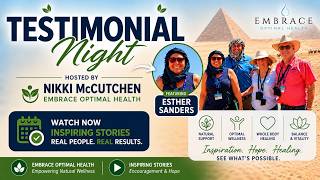
Esther, founder of Comfort Zone Whole Body Wellness, uses infrared patches, bioenergetic testing, and homeopathic remedies to treat pain and illness. Her clients include someone who recovered from hip surgery without prescription painkillers, a pancreatic cancer patient whose tumors shrank, and her own experience managing Ehlers-Danlos syndrome. The patches are worn 12 hours on, 12 hours off, and work by activating GHK copper peptide.
Chapters
Good evening, everyone. Thank you so much for joining us this evening. We are so excited that you're here. I am super excited to introduce you to Esther. She has an amazing business, Comfort Zone Whole Body Wellness. And so I— anything that she wants to add or talk to us about that too, I'm always, um, just so happy to, uh, promote her business and all that she does as well because it's truly amazing. Um, but first, I always want to get started with our health disclaimer. All the technology we will be sharing tonight is informational and educational purposes only. We always recommend that you check with your preferred healthcare practitioner first before starting anything new, just like that would be the recommendation for even a diet or exercise program as well. So we make that recommendation here with this technology also. So I am super excited to turn the floor over to Esther. And just also just to give you guys a little bit of a background, What she does is truly phenomenal, working with homeopathy and what she prescribes and uses with her patients. But I had had some gut stuff going on that I could not figure out, that I had just completely out of balance my body. And I was eating, like, super healthy, but the way I was eating was not actually good for my body, which was super interesting. And it just sent my gut completely out of balance. And I can't even tell you, I probably had seen 3, 4, 5 different practitioners trying. So it had been several months of this going on, trying to figure out how to get my gut back in balance and all of this. Well, like I said, she has this amazing stuff that she does, and she did these drop-in-print things for homeopathic drops. Within a week, my gut was completely back into balance. So I cannot recommend what she does highly enough. After all the practitioners that I had seen, I was so thankful to have met her and to know her and have her as somebody that, oh yes, let me come see what you do. Maybe you can help me with this. And yeah, homeopathy, the original medicine, right from the very beginning. And that's what it does, is just balance and help our body. So I'm so excited to have you here tonight. So everyone, you can share anything with that. We can come back to even homeopathy if you want to as well. But we would also love to hear what you and your family have been experiencing. With the patch technology and how long you guys have been using it.
Okay, um, I don't know where to start. Um, so I guess with, you know, the, the patches— so I had started my journey with, um, with the holistic— I mean, years ago. I've, I've always been the kind of person where I don't want to treat the symptom, I want to treat the root cause. Um, and so that I guess this kind of leading me to you was when I, I do what I do for myself is, or myself is, uh, bioenergetic testing. So we are testing your body on the energetic level. You have, um, you know, your cellular level and below, and then the very bottom core is your energy, is the energetic level. Um, most people understand that everything has an energy to it. And so that's what we're testing. It uses very similar technology actually to an EKG, which, you know, people that are really talented at reading EKGs from the— those are electrical signals, you know, that they're testing your heart specifically with. And you can tell if a person is out of balance with electrolytes even just from that EKG. And so it's a similar technology. However, instead of just testing your heart, we are testing your entire body. We're getting down to that energetic level, finding those imbalances. And, you know, addressing them again at that energetic level. Sometimes physical supplements, but mostly just the, the energetic imprints, like what we gave you and, you know, helped your gut to— your gut knew what it wanted to do, it was just missing some key components. And so we, we kind of fixed that and tweaked it a little bit to where your body was able to heal itself. And so that's what I do with my energetic. I, uh, I met you at the Holistic Wellness event back in October. And my husband was dealing with some hip issues, so a very physical ailment because his hip bone is actually misshapen, or it was. He just had surgery on Thursday to fix the shape of his hip so that he would quit getting labrum tears. And then they, of course, fixed the tear as well. Your patch, when he met you and tried those patches on, it helped his pain level like pretty much disappear. Which was great because he'd been dealing with it for over a year at that point. And, you know, doctors and getting referrals and getting, you know, you have to do this before you do that. It just, it was insane. Like I said, he just now got the surgery. And so in almost 2 years that he's been dealing with it, but if it weren't for the patches in the meantime, he'd be on disability because on the days that he would forget to put them on or He works 48-hour shifts as a paramedic, and so he would wear them for that 48 hours and of course then take a break so that he could continue benefiting from them. So like on Wednesdays when he would come home, he would just be in excruciating pain because he wasn't able to use those patches. And so it made a huge difference for him. And even now, he's not even a week post-surgery and he's— he hasn't taken a single prescription pain pill. From the surgery. He's just been using the patches, which is amazing because— Praise the Lord.
Yeah, that is amazing. Yeah.
So that's, that's one thing. But I think the most benefit or the most amazing and like inexcusable is my dad. When I— when they worked for Matt's pain level, I sent my dad to come and talk to you about it because of course I was doing my thing at that event, so I had no time to talk to you. I just like— we didn't even meet. I don't think.
I mean, we barely—
Yeah, it was crazy. But yeah, so my dad went and started patching because he has drop foot, or had, I guess I should say he had drop foot. And again, it was an insurance nightmare even trying to get him diagnosed. Like, it happened all of a sudden, like drop foot usually does. And I'm also a massage therapist. And so he came to me to say, hey, you know, what's going on with my foot here? And I'm assessing him and working on it, gave him some relief. but within an hour it was right back. And so I'm like, this has to be drop foot. It has to be. And so he goes, starts going to the doctor. They won't do an MRI until he does a nerve test, et cetera, et cetera. Like so many hoops to jump through. By the time he actually gets diagnosed with the drop foot, which we knew all along, um, it had been almost a year or a little over a year, I think at this point. Um, he had just started patching once he finally got the diagnosis and was sent to a surgeon. I think he might have been patching for maybe a month, maybe. And, um, but the surgeon said if this has been going on for a year, then he's like, we can do the surgery to get the disc off of the nerve, but most likely that nerve is dead. Like, there's— the surgery is not even going to be— not even going to do anything. He's like, it's minimally invasive, so we can still do it, but there's really no point. And we had a vacation coming up, a cruise. And so he's like, well, let's go ahead and schedule the surgery because even only a month into the patching, he had already seen a little bit of improvement. It was, I mean, it was minimal, but he was definitely starting to feel some more in his foot. And so my thinking was, hey, if we're getting that nerve to wake it back up, then if we can get that disc off of it, then we can actually get it to heal. So he goes ahead and schedules the surgery. But of course insurance won't approve it. They're like, no, you have to do physical therapy first. So by the time he gets the physical therapy done and gets back to the surgeon, I think it had been about 3 months or so at that point. And he had so much improvement that basically the surgeon was like, there's no point. Like, so he didn't even do the surgery. And it's been a little over 6 months now. I think he started in October. Yeah, and he's— the drop foot is pretty much gone at this point. He is 74, so his healing is probably a little bit slower than someone that was younger because he is, you know, older. But, um, at this point, really the only thing that we're dealing with is the atrophied muscles. So we're, you know, doing the therapies and stuff like that to build that muscle back up in his foot. And the muscle memory, I think, is probably more than anything because he's been having to swing that leg for so long. And so it's Yeah, I'm like, I really want to get another MRI so that we can actually see that the disc has healed too. But of course, insurance isn't going to approve that.
Yes, exactly. Exactly. Praise the Lord. That's amazing. That's a fantastic story. I'm so thankful for both of them. That's amazing. Yes. And like what you're talking about, sometimes with your husband, you do need to have the surgery. Whatever is going on with you, the surgery is necessary. Getting your, your regenerative cells up and working and running on your behalf before you have to go into surgery is huge to just help with that, you know, healing from the surgery along with then, you know, the pain management of, of after, after you have the surgery too. And having this, you know, in your back pocket to help with the pain management is huge.
Yeah, it is for sure. Yeah, we've, we've been super happy with the benefits from it. Even my mom had to have a hip replacement, um, and shortly after— like, we— she's known for years that she's needed it, and she finally did. And even with a full hip replacement, I think she took pain prescription pain meds for like a day and a half after the surgery. And everybody that I had talked to about having that surgery said that like days 3 and 4 are the absolute worst for the pain level because, you know, your nerve block is more torn off and all of that fun stuff. And day 3 and 4, she was, she was up walking and like we were having to force her to use her walker and stuff like that just to, you know, listen, we don't want you falling.
Exactly. You just did this. Please. Yeah. She felt good enough to tell you she didn't need it. Oh my gosh.
Pretty much. Yeah. Yeah. 3 months later she was back up on her horse.
Wow. 3 months later. And do you mind telling her age? How many years young she is?
She's also 74. She'll be okay. 75.
3 months back up on her horse. That is remarkable. Doing the things she loves, right? Like, that's vitality. That's why we pursue optimal health. That's why we do anything, you know, to try to support our health as we are aging. So that we can be 74 and have a surgery and 3 months later get back up on our horse if we have to have the surgery to do the things that we love. That's truly remarkable. What an absolute blessing.
Yeah. And now we're going to Portugal in, uh, September for their 55th anniversary. And, uh, the whole family's going, so I'm looking forward to being on a trip where mom's not hurting the whole time.
Yes, absolutely. Yes. Because the trip that you went on, they were wearing patches, but they hadn't had their surgeries yet. Right?
Right.
Yeah.
Which, well, so Mom and Dad were both patching at that point, and Matt was. But, um, so the last cruise we went on, we started in Greece, and our luggage actually got stolen in Greece.
I remember you telling me that. Nightmare.
Yeah. So Matt didn't have his patches on the trip and, and yeah, so he, he had some issues with that. He had— we had actually gotten the labrum to completely heal, like he wasn't in pain really anymore at all. But when he went back to his normal amount of activity and then of course didn't have the patches on the trip, we went bike riding in Croatia and, you know, hiking Mount Etna like we did a lot. And he, on that vacation, he re-tore the labrum.
Oh my gosh.
Which is when we discovered, yeah, that's when we discovered like it was the shape of his hip. He was, he's just very prone to that. So, wow.
Yes. Oh my goodness. Yes. Well, that's amazing that the labrum had already healed, but unfortunately, yeah, not having all the tools and then pushing it to the limit at the same time. Right. Just push this puppy to the max.
Yep. Yeah, he did. So now we're, we're looking forward to him getting back to his normal activity level as well.
Absolutely. I'm sure he's so excited to be able to do all the things and not have so much pain as well.
Yeah. Yeah, for sure.
Yes.
Yeah. Between that and healing everybody on energetically, like my mom's dealing with a lot of emotional issues right now and that's, you know, so the, the energy things that I can do. Deal a lot with emotions also. That's actually probably one of the— I think the biggest things that I do with my, my Quest and the testing is, is heal people's emotions. Like, literally getting rid of trapped emotions from, you know, old trauma or from whatever. Like, it's— it has been phenomenal being able to help people like that. So I am loving this journey for sure.
Yes, absolutely. That's awesome. Now, do you use the Bach flowers also?
Yeah. So it's, um, it's not physical, the Bach flower remedies, like physically, um, at least not from with what I do now. I will, I test the body with those Bach remedies, with those flower essences, with, you know, any kind. I've got over 1,200 different homeopathic remedies. Um, you know, the energy of them in my system. And so it actually tests your body and it asks your body what it wants. So rather than playing a guessing game of, you know, oh, okay, here's your symptom. This matches that symptom. Let's try it. It actually is asking your body specifically what it wants. Because I mean, if you go through the homeopathic stuff and the Bach remedies, they all, you know, all of them help with digestive distress, for example, or all of them, you know, there's hundreds of them that help with sore throats or with whatever. Um, but they're all different and they all work in a different way. And so by asking on that energetic level, like we're really getting to the root of what's causing you to have a sore throat in the first place, or what's causing your stomach to not be happy in the first place, and getting the very specific remedy that you're wanting. And so then if it comes up in a dilution that, you know, it, it's apparent that you do need the actual physical Bach remedy, then, you know, you can obviously get those as well. Um, but for the most part, I just give the energy of those, those remedies. Yeah.
Which is phenomenal. It's totally amazing. Like I, all, all the things that can, you know, go into one little tiny, you know, vial of drops that you have to take for 30 days, 45 days, like, whatever it is, and just to support your body. It's truly mind-blowing when you see, like, all the things that even, like, vitamins, right? Like, even supplements, different types of supplements can be energetically imprinted onto the drops.
Yeah. Yeah. And it's even like, I even put the patches, the energy of the patches into the machine so I can test people on those to see which one, you know, that they resonate towards the most. Um, like for example, you know, between the 39 and the 49, some people are like, well, which one should I use? And I'm like, well, let's test, let's see, um, you know, and see which one you want.
Yeah, absolutely, that's awesome. Which one their body, their body actually wants. Yeah, yes. So, um, we have a question of what energy modality do you use to monitor your clients?
So I use—
No, you, you responded. Okay.
Yeah, I did. Sorry, I didn't realize you were gonna ask it. Um, so yeah, I use the— I use what's called the Quest 4. Um, it is, uh, it's basically quantum physics. I mean, I know that's kind of— that's a— seems like a simple word for all that it entails. Um, but it's— it uses electrodes and it sends those energy currencies, frequencies, um, through your body. And then tests or sees how it changes, what it affects and how it affects it, um, to see which one works the best. So it's sending all of those different energies and testing which one your body resonates towards the best, um, and then gives numbers and, you know, information. Um, and then by looking at all the information that comes through, you know, I can recognize patterns and say, hey, you know, You have issues with this and, or, you know, has this been a thing? And almost always people are like, how did you know that? Like a lot of the emotional testing that I do, like it, I literally will say, okay, so it says you have issues with this and this and this. And it's like, how do you, what, how is that so accurate? Like it, it, it is crazy. Um, you know, I've had people say. I feel seen by, like, it's putting words to my emotions. So it's, you know, it's validating these things. It's helping them to say, okay, I'm not crazy. Like, I really am, you know, having this issue, or I really am feeling this way, and it is affecting, you know, on a physical level. It's affecting my vision. It's affecting my stomach. It's affecting, you know, whatever it is. Like, I had one client that had, um, hyperhidrosis. I don't know if you know what that is, but basically if she gets warm at all, like in any way, shape, or form, just barely warm, sweat just pours off of her. And I mean, it pours off of her. Like, it's— and, you know, we live in Oklahoma, like, that's terrible in the summer.
How do you do that?
Yeah, exactly. Yeah, how do you not get warm? Exactly. And so, you know, I was testing her with the Quest on, you know, for for other things as well. But then I did the trapped emotion, um, testing specifically for the hyperhidrosis, and 2 sessions, and she hasn't had any issues with it so far this summer. Like, we had days, and, you know, she's still sweating, obviously, when it's, you know, 100 degrees outside, but it's, it's not the, the pouring sweat, you know, the, the abnormal amount that— and, and she's just like This is crazy. She's been dealing with it for years, and all of a sudden, like, praise the Lord.
Praise the Lord. That's incredible. That's why we do what we do, right? Because we get to see miracles. Like, people think they have no answers, they're losing hope, they don't know where else to turn or what to do. And then we have these amazing tools that are out there that can help them completely naturally, just supporting the body in the way it was designed.
Yeah, absolutely. It's, it's— I have always believed that the body is capable of healing itself if it's just given the right tools and the right pathways. And so that's— I've— I'm absolutely loving the fact that I get to, you know, kind of facilitate that in a small way for some people.
Absolutely. That's huge. Yes. Do you have any other stories with the patch technology for yourself or your clients that you'd like to share?
Um, I guess my most recent one, um, is a client of mine that, um, she a few months ago got diagnosed with pancreatic cancer, and she had a— has a huge tumor. This was a, um, this was not a bioenergetic client, it was a massage client of mine. And, um, so she went through surgery, got septic from the surgery, had like a horrible time with it. When she finally came back to me, she, you know, she was like, it's been like the worst month of my life, basically. And so I told her about the patches. I was like, hey, you know, she's going to be going through chemo. She said, I'm going to be starting chemo, you know, next week or tomorrow, actually, at that point. So it was just, you know, all this stuff. And I was like, let's see if this, you know, if this can help you or whatever. And couple of weeks later, she had gone through her first chemo treatment and, you know, using the— and using the patches. And she's like, there is such a huge difference in how I feel on the days that I have the patches on versus days that I like forget to do it or, or whatever. She's like, it's, it's insane how much of a difference. She's like, I have pretty much a normal life even though I'm going through chemo and going through all this stuff. And she's even already— she's gone through 2, maybe 3 sessions of chemo, and she can already tell that the tumor has, has shrunk quite a bit.
Wow.
They weren't even sure if the chemo would shrink the tumor.
Yeah. Wow. Praise the Lord. And that's, that's right. I mean, like, people have to go through these things and go through these super hard treatments on their body, and to have some sort of tool that could potentially help them you know, just to be able to deal with the, you know, the body's reaction to the, you know, treatments. That's fantastic because that— it's, it's very, very rough on your body. Most people don't get to have normal days when they're doing that much chemo.
So yeah, she's, she's doing pretty good with it. And then she just went to her niece's graduation. Um, and of course, you know, her energy is still a lot lower than it was before. And so I gave her a couple of the energy enhancer patches to use, um, so that she could have, you know, enjoy the graduation a little bit better and that sort of thing. And she was like, they made a huge difference.
Praise the Lord. That's wonderful. What a blessing, right? You want to go to your kids' graduation and enjoy it, right? Not like think, okay, when is this going to be over? Because I need to go lay down. You know, how am I going to get through this because I feel so bad? You know, I want to be here, but I just don't feel well enough or have enough energy to go do that. So to have something that would allow you to actually get to enjoy, even though you're going through something really hard in your health, but you can still enjoy what's going on in those people around you that you love and you care about.
Wow.
That's amazing. That's incredible. I'm so glad. I'm so glad you've had this technology. It's another tool for your patients. That's amazing. Yes. Yeah. Anybody else?
Of course, those are the people that are closest and nearest and dearest to my heart.
Yeah, they come up first. Yeah.
Yeah. Yeah, for sure. I mean, I'm using them also. I don't ever think about myself though.
I know, that's what's hard.
I'm really bad about that. Yeah, so I have, um, I have a connective tissue disorder. I have what's called Ehlers-Danlos. It's becoming more and more prominent, more and more people know what it is. I don't know if you guys are familiar with it or not, but yes, yes. Okay, so basically I have too much elastin in my joints, or in not my joints, but in my ligaments for the most is my issue mostly is my ligaments. So my, my shoulders, my knees, my knees are the worst. Also my hips, they just pop in and out of place like they'll just dislocate just for the fun of it. Basically.
And yeah, my hips are there.
Yeah. Like it's really funny because, you know, I'll be walking and like my knee is out and I'm like, oh, hold on, I got to put this back in place. And people look at me like, what? What just happened? Because it pops really loud when it does it. And I'm like, it's fine. It happens all the time. And like, my family is like, you know, a lot of times they're like, you okay? And I'm like, yeah, fine. And now it's happened so many times that they're just like, oh, it just popped out of place again. So they're kind of along with me like the same way, you know, where it's like, oh yeah, she's fine. So but between the patches And also I have this device, it's called a Qi Palm. It does like infrasonic and ultrasound type sound waves to promote healing at like the cellular level. So between the patches and between that, like if I, if something subluxates or dislocates and it does like tear something, I'm usually back up and running within, you know, a couple of hours. Rather than it being, you know, weeks of—
Wow.
Oh, Tito wants to join.
Hello, Mr. Cat. That's amazing. So normally it would cause you to be out for a couple weeks?
Yeah, most people with my condition, when they have a joint— I mean, there's varying degrees, um, you know, for everybody, and then also depending on what joint it is, depending on, you know, what you do for a living, depending on, um, you know, how bad this— the, uh, the dislocation is. You know, it always varies. Um, but yeah, I mean, just like the other day I did— I was shoveling outside because the rain had like washed some stuff. But anyway, but I grabbed the shovel and it, it burst a blood vessel in my, my finger right here. And I mean, it just— it immediately bruised and swelled super big. I couldn't even bend my finger. Like I could not do this. It was, it was stuck like that. Um, and it, I mean, I couldn't even touch it. It hurt so bad. And I put the chi on there for about 15, 20 minutes and then it was fine. Like the bruising went away, the tenderness was gone. Um, I was able to, I had a massage client that was, you know, on her way. Basically I had it, like a client in like an hour and I was able to do it just fine.
That is incredible. Oh my gosh, that's amazing. So, so then like with the patch technology, what do you see then with the Ehlers-Danlos? What do you see then the support that it's given you like over time, like a compounding effect? Are you seeing any of that with the patch technology?
There's a lot less pain, like it's just a daily— I didn't even realize because I just lived with it for so long. I didn't really even realize like that there was like that constant, you know, ache basically in my joints. And, and it's, it's definitely helped a lot with that, especially like it's, it's kind of weird because my husband, when he puts the patches on, he can tell the difference immediately in his pain level with what he's been going through. And mine's not like that. They're not like a pain reliever for me. Um, but if I remember to put them on for, you know, a few days in a row, there is definitely a huge difference in, in how I'm able to move. Um, the— I don't feel like an 80-year-old person that is creaking and groaning and, and having to, you know, work myself up to moving as much when I remember to wear them regularly. Yeah.
So you notice mostly in your mobility and in your inflammation stagnation.
Yeah, yeah, yeah.
That's incredible. That's incredible. And hopefully, who knows, hopefully you'll have some other great things as you, you know, consistently wear them over time. That compounding effect. Hopefully there'll be some other things that will all of a sudden you'll think, oh, I haven't— I guess I haven't really noticed that and I haven't had that in a while. And normally that would be a normal symptom, symptom with what I've got going on. So Hopefully you'll notice a few more things too as you keep consistently wearing them. That's super exciting. So yes, yes, that's awesome. So cool. Well, let me go real quick. I— we're, we're about out of time, but I'm just gonna real quick just tell you short blurb about how the technology works. Um, you can always come back. I'm on every Monday night at 6 o'clock Central Standard Time for 30 minutes explaining how the technology work so people can come on, listen, ask questions, all of that on Mondays. But just so you know that, um, what this technology is doing is working through your own body's infrared light. So if you watch a movie and you see them talking or looking at something at night through night vision goggles, and they're talking about a heat signature, but you see all those different colors on there, scientifically that's low-grade infrared light that emits out of our body everywhere. So what happens is, is that that infrared light hits the center of this tiny little patch that is made, you know, crystal lattice structure at the stereoisomer level. So, you know, teeny tiny, can't see it with the naked eye. It hits that center of the patch and is reflected back into the body like a mirror at a very specific frequency. So you heard Esther talk all about, you know, the frequency and the energy and that that's That's what we're made of. That's what our cells are made of. That's what our body is made of. So that frequency hits the center of that patch, goes back into the body, turning on GHK copper peptide. So that in particular peptide is kind of classified or dubbed as the fountain of youth in the body because it does so many things across the body. It's why, you know, like in Esther's life, she's got a parent and a husband who are having, you know, need to have surgeries and they're having health with help with different types of surgeries and what they're going through. And then, of course, her dad is able to avoid surgery and then the things that she talked about for herself. So your body knows what it needs and it will send those regenerative cells wherever you need them to give your body the proper support to bring it back into balance or homeostasis, which is what's so cool. So, and that's the other amazing thing is it doesn't stop with just the regenerative cells. It supports your entire cardiovascular system, the heart, um, the, the blood vessels, the lining of the blood vessels. It supports your brain. So people often say they think clearer, they feel better, um, anxiety or depression will kind of lift, even they'll feel more calm. So all kinds of different brain support that happens with GHK, as well as your immune system. So obviously the way that her family has been healing as well, that all has to do with our immune system and how it deal with whatever's going on with it, whether that's toxins or whether that's surgery. Those all are about how our immune system works properly. So, and then your collagen, again, with any type of surgery, that's going to deal with the collagen in the body too, and your skin and the ability to heal. And the collagen is not just hair, skin, and nails, but it's the fascia, it's the ligaments, it's the tendons. It's literally the glue that holds our body together. So you need that collagen to work properly in your body along with the regenerative cells. And so then you can have some of these amazing results like what Esther is talking about with her family, because those two things are working together and they actually have, you know, they decline at about the same rate in the body as we age, the collagen and the regenerative cells. So once you get those up and running, you can start having that compounding effect. The longer you wear it day after day, week after week, year after year, and really just see how your body's going to decide to regenerate itself, which is what's so cool. So, um, anyway, hydration is key. Obviously, Esther is a massage therapist. She's going to tell every single client, please drink a lot of water today when you have had this massage. That will be true with all of our technology as well. But that's true for anything in health, is that we need to be hydrated. And so that's key with this technology as well. And you can wear the patches anywhere on the body. I put mine on in the morning when I get up. I take them off before I go to bed at night. And then the next day I put on a brand new patch. So 12 hours on, 12 hours off. Now, Esther, you said something interesting about your husband. He was wearing them for a whole shift, right? He would just leave the patches on for an entire shift. Is that what he was doing? And then he'd take a break after he would come home.
It would depend. Depend on how the shift went, um, and depends on how busy he was and then what he remembered to do for the most part. Um, since, you know, when you're working a 48-hour shift and on emergency medicine, you don't have a schedule, so there's not a, oh hey, I'm getting up, let me put this on, or I'm going to bed, let me take this off kind of thing. You know, you sleep when you can, you rest, whatever. Um, and so it's Sometimes he would end up wearing it for the full 48. Sometimes he'd remember to take them off and put on a new one. But almost—
I did that the other night too, like, and there goes my earring. Yes.
Oh, it was my earbud. Oh, your earbud. It has a mic on it too, so I didn't know if you could hear me still. But yeah, it likes to get caught in it. Let me grab it out of my ear. But he, um, so yeah, if he would come home and he had been wearing them for a while, then he would take a break, um, you know, for a day or so just to make sure that, that his body would still respond to it.
Yeah, absolutely. I love that. And I think that's so important, is that's what's so interesting about the patches too, is that if you do have a schedule that's a little bit difficult to deal with or whatever you've got going on, that, you know, as long as you're giving your body that day or two break, like you could wear the patches for a longer amount of time to get that, you know, relief based on whatever is going on with you. Obviously, the standard recommendation is going to be that 12 hours on, 12 hours off. But it's nice that you can modify that and then make sure, you know, that you've given, you know, that signaling. So like going to the gym, you know, signaling your muscles to work. Work like that. You're giving your body that break, your cells, the GHK, that break so it has enough time off, you know, to where if he does wear it longer, he does forget to take it off or whatever, that it's going to give him enough of a break so that when he puts the patches back on again, those cells will signal correctly again and keep working. So that's huge. I'm so glad you all figured that out. It's always fascinating to me when someone you know, does something, you know, different and they figure out how to make it work for them in their schedule. I just think it's fantastic. So that's super cool.
Yes.
Awesome. Well, thank you so much, Esther, for being on here tonight. We so appreciate your time. I know you're— yes, I know your stories are going to help so many people. Is there anything else you would like to add before we head out?
I don't think so. If anybody wants to contact me for the Quest you know, the bioenergetic, feel free. Um, you know, I, I love helping people out on, on that, those questions. You know, the, the doctors say my labs are fine, but something obviously is wrong. And, you know, I— my, my motto is stop guessing and start healing.
So I love that.
Figure out what's really going on.
Yes. And you— it's just locally, right? So like, there's a lot of people that are here not in the Oklahoma area that are on tonight, so It's just when they're, when they're local that they can see you?
Um, no, actually I can do all of the testing, um, uh, long distance. Basically you just send in a DNA, a DNA sample. You use a Q-tip and swab your cheek and put it in a bag and you can mail it to me and I can test you that way and, uh, and then send you the imprints and the, the information. So, okay. Oh, awesome.
I did not know that. I guess I didn't know that. So, okay, if they want to find you, what's your website address?
It's comfortzonewholebodywellness.com.
Okay. comfortzonewholebodywellness.com. So, um, yes. So I, I don't know if I can type that fast enough in the chat. I'll let somebody else type it fast, or you reach out to me. I think I know all y'all that are on the— oh, there we go. That's awesome.
Oh, that's mirrored, but you know.
Yes. There we go. Thank you. Pastor Ed typed it fast enough. I knew somebody could do it. Yes. That's awesome. That's so fantastic. Thank you, Pastor Ed. Thank you so much again. I know your story is going to help so many people, and I know that's what you care about and that's what you actually do every single day. Um, so I hope people will keep reaching out to you and, um, basically just having tools to get their body back into balance. So thank you again so much, Esther. Thank you so much, everyone, for taking 30 minutes out of your schedule. We're here every Thursday night sharing stories like this. So if you have an amazing story, we would love to have you on and share your story as well. Um, and with that, we pray blessing over each and every one of you. Good night, everyone. Thank you so much, Esther. Thank you, Miss Karen, for being on. Thank you, Esther.
God bless.
Good night. Good night. God bless. Yes, good night, everyone.
More from Nikki


What if your own body could switch on regenerative peptides already inside you?