Portland Real Estate 2023 in Review
This content was created by Nick Krautter. This content was uploaded by Nick Krautter. This is a YouTube video titled "Portland Real Estate 2023 in Review" (metadata created 2024-02-19) that presents a conversational, interview-style market recap between Nick Krautter and Darby Britton. They review Portland residential real estate performance in 2023 — covering average and median prices, the jump in mortgage rates (discussed as ~3% to as high as 8%), a ~25% drop in sales, inventory trends, seller-paid buydowns, buyer and seller behavior by price tier, and predictions for 2024 (stabilization and potential rebound if rates fall toward ~5%). The exchange includes practical advice for buyers and sellers and ends with a contact call-to-action. (The speakers reference recording mid-January 2024 in the discussion.)
Chapters
All right, this is Nick Krautter with Darby Britton, and we're going to give you guys a breakdown on what happened to residential real estate in Portland, Oregon in 2023. So big picture, um, we're going to be scrolling through a lot of data here, but we wanted to hit on the big highlights. Um, so I think the biggest highlight is our average sales price is down only 2%. 2023 versus 2022. But that's the same year where we saw interest rates go from about 3% to— where did they peak this year, Darby?
Oh, at 8%.
So we go from about 3% to 8% between 2022 and the end of 2023. And we're going to show you a sales chart that'll show you the effect of that last year and kind of a recovery over this year. We saw sales were down quite a bit too. So in 2022, we had 27,000 sales in the Portland metro, and this year, uh, this last year was 21,000. So about a 25% decline. But again, a lot of people sold homes. Darby, you had a really good year helping people buy and sell.
Yep.
So here's the average and median sales price chart, and this is going back to 2008. And you can see typically in Portland what happens is a normal seasonal trend here in Portland is that prices go up in the spring and summer and then they dip into the winter. But what you see towards the end of this chart here that's really pronounced is from the summer of '22 into the winter, huge pullback in pricing. So we mentioned that the prices are down about 2%. But from last December to this December, prices are actually up because last December was so bad, and this December, uh, is just what I would call kind of a normal, you know, rainy, kind of winter Portland, you know, season where people— if you don't have to move, you're going to wait until it's a little sunnier and easier to move. So, you know, we see the effect of the rising interest rates pushing pricing way down as a lot of buyers got priced out of the market. What were some things, Darby, your clients are doing, um, to afford homes with higher interest rates? And, you know, do you think it's having a big effect on sellers, or do you think that that's dependent on the price point? What are some trends you're seeing that aren't showing up in just this one big chart?
Yeah, I mean, to combat affordability and combat the higher interest rates, we've been doing and seeing a lot of seller-paid Buydowns, um, that's been a huge one for us and for our clients, um, and something that also really helps with sellers maintain price integrity. So, um, let's say, you know, a seller can contribute $20,000, um, and that really helps with the buyer— that helps the buyer qualify for that higher price point. It also really helps with their affordability on their interest rate So the seller buys down that interest rate by 2 points. And in turn, the seller then, you know, maybe saves a couple, you know, $10,000 to $20,000 not having to reduce the sales price. So that's something that we're seeing people really take advantage of right now. I think for kind of the higher, more luxury price points, kind of in that million plus, we're not seeing buyers be as affected by interest rates. Just because we're seeing more cash kind of in that price point, more investors kind of coming in trying to get more aggressive. And then for sellers, the big thing right now is that a lot of people refinanced when interest rates were in that 3%. So there's a ton of sellers out there right now sitting at a 2 or 3% interest rate, and they're just not wanting to sell. Sell, you know, they might want to sell, they might want to make a move, you know, transition into a bigger or smaller home. Um, but financially for them, you know, it's just not making a ton of sense to kind of get out of that lower interest rate to get into a higher one. Um, so we're really seeing that kind of stagnate inventory, um, which is really keeping inventory low, right?
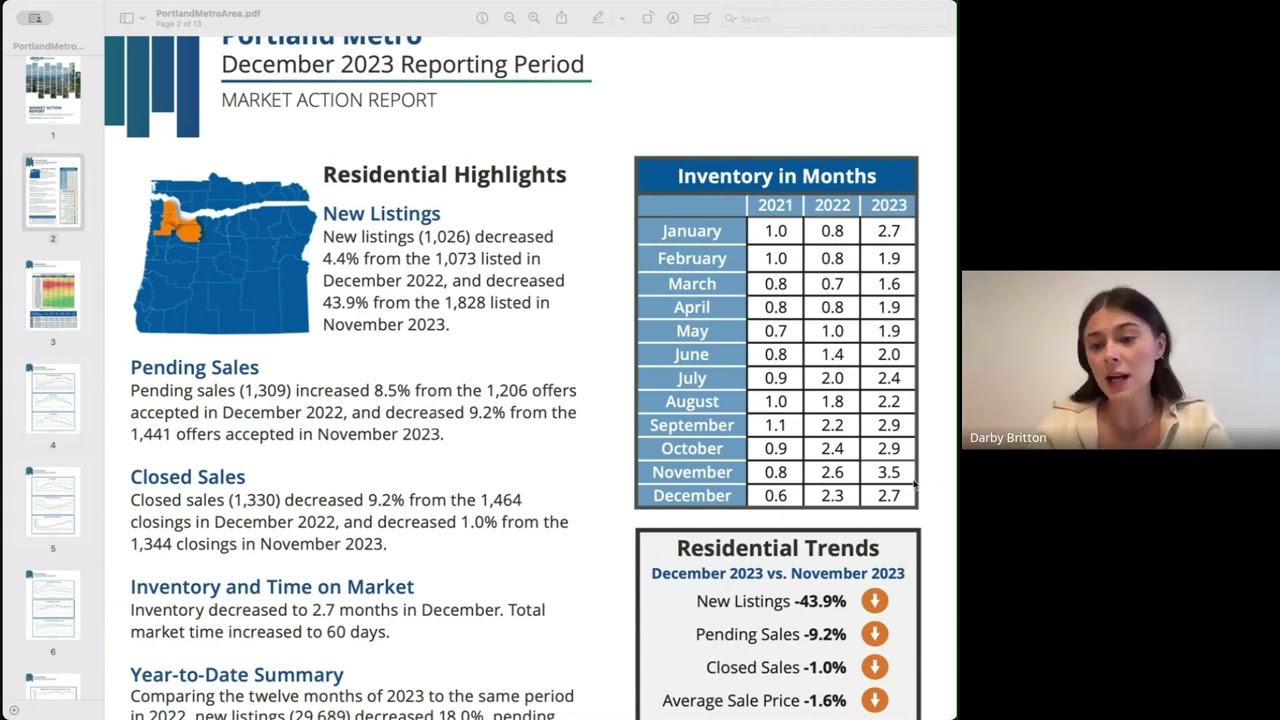
Yeah. If you want to scroll back up to that inventory chart on the first page, that was pretty interesting to me as well. And this is another way to kind of look at the effect. Because, you know, a couple things happened with interest rates, right? More buyers aren't able to qualify because affordability is down. Keep going all the way to that first page where you can see the monthly inventory, because I think that's really helpful. And but the flip side is, like you said, uh, for every buyer that got priced out of the market, um, you had a lot of sellers that chose not to sell, so there was less homes on the market for sale. And so just like any economic system, supply and demand works in real estate. And typically what they say a balanced market is, is 6 months of inventory. That means if no one else listed their houses at the current rate of sales, it would take 6 months to sell all the homes that are currently for sale. It's not a real thing, it's, it's a, it's a way to look at market trends and the health of a market. But you can see the highest inventory we've had in the last 3 years was, um, this November actually, at 3.5 months, which is still a seller's market. I personally wonder if with a prolonged low inventory market, if, if we're going to change that wisdom of what we call a balanced market from 6 months to something lower. Um, you know, the way I would look at it, there's 2 ways to look at inventory and how it affects pricing. So the way that, you know, if 6 months is really the number, if we had 12 months of inventory, you have to lower prices until you get the sales up and you get investors or buyers to buy property. And the way you do that is by lowering the prices or making the interest rate much lower so the affordability goes back up. Um, but what will be interesting, and I think the way we can look at this monthly inventory and kind of where is the new middle that doesn't really favor buyers or sellers is really where pricing's going. So if we end up at 2.5 months of inventory but prices go down, I would argue that that maybe is kind of a new balance point. What are, what are some conversations you're having with, with buyers around interest rates for those— I'm sorry, for specifically for the, the buyers that already own a home? You know, the people that want to move to a new neighborhood, that want to downsize, upsize, you know, all the different reasons people move, that have that 3% mortgage and, and want to move. Like, is there a certain new interest rate where they, they feel like, you know, it isn't— you're kind of giving up a good deal, but it's, it's worth it because rates are at 4% or 5% right now? It's, uh, we're recording this mid-January of 2024, and Where are our rates about right now?
Um, about mid to high 6s.
Okay, so definitely not as high as they had gotten, but not real low. And I know the Fed is kind of holding rates, and the economic data that I think a lot of people are looking at of whether we should lower rates, uh, is still kind of saying that rates need to be this held high or maybe even raised again as opposed to lowered. I think that's why we're seeing the stock market at this, the beginning of this year, kind of starting to come down because I think that the stock market was thinking rates were going to be dropped, and it, based on the economic data, I'm not seeing that. But do you have a sense for your client what, at what point it's worth it to move?
Yeah, I think right around that 5% mark is where I'm hearing a lot of people kind of mention, um, You know, I think they said— I don't— don't quote me on this, but I believe I heard a lender recently say that if interest rates drop by just 1%, then 3 million buyers will enter into the market. So when we're looking at supply and demand, interest rates, pricing, you know, all those things, at some point it does kind of wash where, okay, you know, you're selling there's more people, you know, interest rates go down, maybe we're at that 5%, you know, we're gonna see more inventory because people are gonna be, you know, selling at that point and more buyers are gonna enter into the market. So, you know, we're gonna have demand on that listing. So maybe you get more activity, a higher price, more favorable terms. But then on the flip side of that, you are in a lower interest rate as well on your purchase. So I think the big thing is, you know, for people who are buying and selling is really finding that sweet spot and that middle ground, you know, looking at equity and, you know, current market conditions. But we're really kind of looking at that 5% mark is where I think people will really start to make that switch.
Yeah. Yeah. That starts to make it, you know, assuming prices haven't dropped, right? You know, prices are like, like, like right now in Portland, the prices are down a little bit, but across the country there's some markets where pricing is up. Um, I was talking to some friends in Bend, Oregon, and, you know, you wouldn't even know that anything's going on in the economy based on the activity that I'm hearing that they're having there.
We're seeing that now again, you know, just even in this ice storm that we're having, we, you know, our team put 6 new properties under contract over the weekend, you know, because buyers are excited, they're taking advantage, they really want to get into their homes. So even now we're, we're seeing things pick back up again after the new year, um, and buyers getting more and more familiar, comfortable, um, with the interest rate. So, and I, I believe the Feds are going to be meeting in March next. So, um, that's kind of that big date that we're looking at, um, to see if there's any fluctuation in rates, because that's typically when, when that might happen.
Okay, let's talk about what, what are your big kind of predictions for 2024? So if we record this video a year from now, what do you think is going to happen?
Um, I think that this year is going to be a little bit of a rebound year again. Um, I think we'll see some uptick in activity, especially if rates drop, you know, or go down. Um, I don't expect anything drastic to happen, um, the first half of the year. I think again, we're just kind of settling into the turbulence of the rates. Um, so I think we'll probably, we'll have probably a pretty strong, um, you know, first half of the year. Um, nothing too crazy, nothing too slow. I do think that if rates go down, we're gonna a pretty huge uptick in buyer activity. And so that's kind of my prediction. I think we're going to see, you know, prices pick up a little bit and restabilize from where they were and rebound. And I think we're going to see more buyers enter into the market.
Yeah, I mean, I think it's, you know, I've been doing this almost 20 years and it's worth remembering that the normal cycle is the prices increase in the summer and then decline through the winter. Um, and so I think we're seeing kind of a more normal cycle trend. I think COVID kind of broke that cycle for a couple years because you had so many people moving out of cities and into rural areas. You had so many first-time buyers. You had so many people that all of a sudden had the money for the down payments and that had the the buying power with low interest rates entering the market, and that really, really pushed demand. And so now we're seeing, you know, lower demand, but in terms of what you can see in pending and sold properties. But we're also, like you said, there's a lot of sellers on the sidelines as well that are waiting because they need to buy as well. And so my advice to people, and it's a little different now because we've seen such a huge shift in the interest rates Um, you know, if you're moving within the same market, it— you can wait for prices to go up, but then when you buy, you're paying more. Or you can wait for prices to go down to buy, but then if you sell, you're selling for less. And so it's really about being in a property you can afford, that you plan to be for, you know, a decent amount of time. You know, if someone's saying they only want to live in a home for a couple years, it might make more sense to rent than buy. If you're thinking 5 or 10 years, then buying has historically been really advantageous. That's not always the case. I mean, we definitely had a big pullback from 2008 to 2012. And it took a while for people to recover from that if they had bought. And I was one of them. I bought my first house in '06 and my second house in '08. Those were both underwater for a long time, but I had a property I could afford. It was where I wanted to live. I was planning to be there long-term. So that second home was kind of my move-up home. And I ended up keeping that home for 10 years. And so it worked out in the end. If I had had to move across the country and needed to sell it, I would've taken a loss. And just like with the stock market, you don't always make money. I think people sometimes forget that in real estate. But if you can hang on and you're not forced to sell, you can kind of weather the storm.
Ride the wave.
Yeah. And I think that long-term real estate is still a good investment. And I think, again, long-term, I don't think we're going to see the end of city living in our lifetimes. I think people want to be, they want the convenience, they want They want the activity, the entertainment. They want the economic mobility. They want the social aspects of living in a city. And I think I talked to a lot of people that during COVID moved out to the woods or moved out to the country. And after a while they were like, oh man, I miss being able to walk to the grocery store. I miss walking to my favorite restaurant or bar, going to see a movie that isn't, you know, mainstream thing at like a cool little theater in my neighborhood. And, and so I think we're gonna see that. But yeah, so your big predictions— pricing up a little bit, rates come down a little bit.
Yeah, nothing too crazy. I think this is more of like a stabilizing year. Like I said, if rates come down around in the 5s, then I think we're potentially looking at a different story, um, which would be, you know, more activity, more competition, more demand. Um, but, you know, all in all, I think, I think things are going to be pretty stable.
Awesome. Well, thank you guys for watching this if you made it all the way to the end. Um, and, uh, give Darby and I a call if you have any real estate questions or needs we can help with, or you have friends or family, uh, in the Portland area or anywhere around the country. We've got great connections all over we can connect you to.. And whether you're thinking about making an investment or need to buy or sell property for your business, you know, we're here to help and would love to be of service. So thank you guys for watching and hope you found some value in this and feel free to share.
Yeah, thanks so much. And we'll talk to you guys soon.