Innovation X Roundtable – Algorithms and AI for Media in the 21st Century
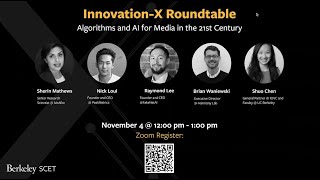
Experts in AI and media detection discuss how generative models create deepfakes from a single image and audio clip. They distinguish misinformation, disinformation, and cheapfakes, then debate supply-side fixes like detection tools versus demand-side approaches like media literacy. The panel emphasizes that faster GPUs and democratized content creation accelerate both deepfakes and legitimate production.
Chapters
Okay, all right, welcome everyone. Um, welcome to our InnovationX roundtable on algorithms and AI for media in, um, the 21st century. I'm Ikhlaq Sidhu. I'm Chief Scientist and Faculty Director for the Sutardja Center for Entrepreneurship and Technology at UC Berkeley. Our mission at the center is to empower innovators to positively change the world. We do this through educating students, and we do it— we educate students using something called the Berkeley Method of Entrepreneurship, and that's designed to develop professional skills, and it's designed to develop the entrepreneurial mindset and behavior that, that really everyone needs to be successful. Other things that we do include the Engineering Leadership Professional program. That's a certificate program that we've been running since 2010. So it's a good decade now. And it's designed for technical professionals, people working for some period of time, 10, 15 years, that type of thing, who are in technology firms, many, mostly technology firms, but really all kinds of firms. And are rising in a way or needing to take on larger roles and broader understanding. Students in—
let me—
so we also run, I'm going to say, a highly applied set of laboratories. And these are labs that start companies and they advance innovation. So we have labs in data, blockchain, deplastify the planet, a lot of activity now in alternative meats, and our newest one is in discovery avoidance and avoidance and recovery. I'm sorry, did I say discovery? I meant disaster, disaster avoidance and recovery. So usually all of our lab areas are, are made in the way that where we think not just one company would start, but where really whole industry changes happen. One last thing about the center, in case you're new to engaging with it, is that there's 20 global partner universities that are part of our overall community and network that are also working to advance innovation and teach entrepreneurship. Now, for the roundtables, which is the topic of today, the world is basically changing all the time. And I'd say it's probably accelerating in its change. And innovation is either adapting to that change or pursuing opportunities that are related to that change. Each roundtable we talk about different changes that are going on, and we also use these roundtables as small advisory board meetings in a way to have our distinguished, um, uh, basically our distinguished panelists, uh, give us feedback on and ideas on how Berkeley and our community can best engage in the changes that are going on in the world. So that means students, researchers, everyone. And so with that, it's a basic setup. I'd like to kick off the InnovationX roundtable on algorithms and AI for media in the 21st century. And to do that, I'm going to ask our lead moderator, Shuo Chen of IOC— V— sorry, IOVC, and our newest, um, definitely among our newest faculty members at Sutardja Center to kick it off. And, uh, um, I will take it to you, uh, Shuo.
Hello everyone, thanks for joining the InnovationX Roundtable. This is Shuo Chen, partner at IOVC and faculty at UC Berkeley. It's great to be here today.
Wait, deepfake Shuo? If it wasn't quite a giveaway that the speaker view says Ray's name, hopefully it's obvious that that's a deepfake of me rather than the actual Shuo. But Ray, thank you so much for doing that. You can continue to do the event for a while looking like me, but maybe really quickly before we have everyone introduce themselves, since you're doing this demo, you could briefly explain on a high level how this works.
Sure thing. Um, so what's happening now is I took one image of you that I found online, and, um, what's happening is the model has learned how to regenerate a face based on a driving video. And so the driving video now is basically a video of me behind my webcam, and the model is regenerating all my facial expressions onto your image. So I can control the eye movements as you see right now, and I could also control the mouth movements through talking, and then I control the head movements as well.
Very cool. I have to say, I saw some of my students— ah, there we go, Clara is a student of mine from class— so I'm sure they realized by the moment you spoke not sounding like my voice that something was off. Though this is pretty scary to see firsthand. Had you been also able to imitate my voice, I would have thought that maybe I really did say something like that. So very, very cool. We could have you here for a little bit longer. But while you're still here, can I also welcome Nick, Sharon, and Brian to the stage as well, and then we can all do introductions of the panel together. Awesome. I know we're going to do a little bit of a pinning of speaker views. Welcome back, Ray.
Thank you.
I think we need to get Sharon pinned. I'm just going to start pinning everyone.
And to your point, the— yeah, if I just had 10 minutes of your audio, I could create a machine learning model that would be able to replicate your voice. So that's really all that's needed, one image and 10 minutes of audio to create a live deepfake now.
Oh man, I have to share for full transparency, I didn't share anything in advance with Ray. It was just purely based off of what he was able to find online. So imagine if he found a video that would have been way more realistic and with my voice and all too. So with that, thank you again, Ray, for the live demo. I am super excited to welcome you all to this particular roundtable. As you can tell with that That live demo right there, we are already by far the coolest roundtable so far. I'm really excited to have everyone here with us today to talk about future of media and particularly the role not just deepfakes but technology plays in what the future of media looks like for all of us. So I would love to start by having each of you briefly introduce yourselves. And Ray, since you ran the demo, would you like to introduce yourself first?
Sure thing. Raymond Lee. I graduated from Cal School of Information through the Master's of Information and Data Science program. During my time as a student, I studied deepfake detection, and since then I've received funding from Meta, formerly known as Facebook, as well as several Berkeley accelerators such as Berkeley Impact Venture Partners and the Big Ideas Contest. And what we do is we help enterprises defend against deepfake attacks by providing training, threat assessments, and detection tools so that they can detect deepfakes.
Super cool. We'll definitely talk more about that later on as well. And Nick, would love to have you introduce yourself as well.
Hi everyone, uh, nice to meet you all virtually, I guess. Uh, my name is Nick. I'm the CEO and co-founder of a company called Peakmetrics. We are a data analytics company that tracks and analyzes how conversations and media narratives spread online. So basically trying to answer this question of how something can start on a subculture like 4chan and wind up creating, you know, a global movement like QAnon. Our work in this space includes tracking how disinformation spreads, so particularly looking at things like state-sponsored attacks on behalf of large brands, as well as multiple government agencies.
Amazing. Thank you, Nick. And Brian, over to you.
Thanks, Shuo. Thanks everyone for having me. My name is Brian Winisky. I'm the executive director of Harmony Labs. And Harmony Labs is a nonprofit media research center. We have a mission to help media systems move in the direction of actually supporting democratic culture and healthy, happy people.
Awesome. Welcome, welcome. And Sharon, last but not least.
Hi everyone. Great to connect here. And about me, I am a senior data scientist and I work in the area of deep learning, machine learning, I have been in the team called Office of CTO within McAfee, and in my role, I develop deep learning or machine learning solutions to improve, say, the effectiveness of cybersecurity products. So in my previous, I mean, in my, I would say, last projects or previous projects, I have worked on techniques like explainability and even, I mean, trying to work on developing solutions for deepfakes. So that's like my area of interest. I do have a background in computer vision and machine learning, and I love to, you know, work on that domain. And so deepfake is like my very favorite project, if I can put it that way. Amazing.
So as everyone can tell, we have such an amazing panel with us here today. It's a real treat to have everyone together and to be talking about where everything fits in terms of future of media. So I thought to make sure that we're all aligned on just key definitions to start. I think a lot of students and alumni and faculty aren't necessarily up to date on what all the different terminology we're using so far might fit in terms of kind of the bigger framework of things. So to start, if you don't if you don't mind, would love to kind of start off by with some definitions and some drawing of frameworks for how we should be thinking about this. For example, what are some of the key terminology like disinformation versus misinformation? Where does everything fit in? Any first takers? I can go. Go for it, Sharon.
OK, got it. So I think misinformation, if you can categorize it mainly refers to like false information, like out-of-context information which can be presented in the form of a fact with an intention to might deceive. I would say disinformation is more of a type of disinformation that is intentionally false and intend to mislead and, you know, deceive. That, that's the whole aim. So, uh, that's something— it's of— if you can— I can consider disinformation as a false information created with an intent to deceive, whereas misinformation can be considered as an information which is not factual, maybe because of poor verification or any other methods like that. So that's like, I think, uh, I mean, how you would kind of understand what the technology is.
Yeah, super helpful. So basically disinformation has issues in motivation and kind of the motivator behind where that information is coming from. And then where does deepfakes fit in?
So I think, uh, I kind of put it in a broader perspective. So deepfakes is possibly like The idea of deepfakes was, I think, at least from my perspective, you are trying to create some kind of synthetic content using AI tools, be it audio, image, or video. Now, they can realistically depict human speech and actions. Essentially, they are just a synthetic representation. Now, how a person uses it, it basically depends on, you know, what's the target audience or what is he trying to achieve by doing that. So you can categorize as to what the person or who's impostor is trying to do with it is Right now it's mainly used for entertainment purposes and kind of not always misusing, but depending on where the person would use it, so I would put it.
Super helpful. So deepfakes are not necessarily always malicious in intent, but can be used for exactly like you said, for entertainment and for other purposes. Any other key terminology, um, Nick, Bryan, or Ray, that you would like to define upfront as we have this conversation that you think would be kind of foundational knowledge for our audience today?
Yeah, I definitely— sorry.
Oh, sorry. Well, as we're talking about deepfakes, I also want to mention, uh, cheapfakes, uh, as well, because, um, the term deepfake can sometimes be used, uh, incorrectly, uh, and refer to cheapfakes. So cheapfakes are, are, uh, traditional, uh, image manipulation, um, techniques that have been around for many, many years. Certainly, uh, Photoshop has been around for 30 years now. So anything created with non-artificial intelligence techniques is a cheapfake. So you can imagine superimposing somebody else's head onto an image is a cheapfake if you just use Photoshop, for example. Or say miscaptioning, intentionally miscaptioning an image, say, of an empty grocery store aisle from 1990 and saying that happened yesterday, that would be another example of a cheapfake, out-of-context cheapfake.
Super helpful. And Nick?
Yeah, I, um, I was going to add, totally agree. You know, there's the difference really between mis- and disinformation, uh, heavily lies in intent. So I like to say misinformation is your grandma accidentally sharing something that, you know, she got through an email chain with another person. Well as disinformation could be a state-sponsored coordinated attack. Um, 3 other words that I'll throw out there that I think are worth considering in this conversation are content, audience, and distribution. This is a lot of how we think about, um, thinking about this space. So content could be, you know, looking at deepfakes, which are largely image and video versus text content. You know, audience could be looking at tribes of audiences that are interacting with a particular piece of content And then distribution is, how's that information moving? Is it largely getting distributed on Facebook or Twitter, like social media, or through email chains? So thinking about that as well, I think, is worth considering.
In fact, a quick follow-up to the distribution piece. Have you noticed any common characteristics where disinformation tends to move? Because it tends to be kind of a motivation where it's malicious in intent, and it's an organized effort. So any patterns in distribution channels that we can identify?
Definitely. So one of the things that I kind of mentioned earlier was this question of, like, how does something start on, like, 4chan and then bubble up? This is a pattern that we see pretty frequently, where particular narratives will develop on niche blogs or subcultures within Reddit or 4chan. And the intent there, particularly if you're coordinating a campaign, is to try and bubble it up, to make enough noise that this gets covered by bigger blogs and then eventually gets covered by major media. And then you start the cycle again and again. So it's definitely a pattern that we see sort of in this space. So part of the question that like we ask ourselves a lot is how do you get in early enough in that conversation so that you can reduce the impact if it's, if it's going to be a problem.
Super helpful. And building on top of that, Brian, any additions for vocabulary or terminology that you think would be important to define for the audience in advance?
Nope, I don't think so. I think we Got some good ones.
One of the things that actually in our preparatory session that really resonated well is that actually, Brian, you really contributed to the perspective that we tend to think a lot about kind of thinking about disinformation and misinformation dissecting down into supply side versus demand side. So would actually love to have you talk a little bit more about that when we are kind of setting aside definitions as well. What does supply side, demand side mean when it comes to misinformation and disinformation?
Right, yeah, I think I was talking about how a lot of the solutions that I see out there proposed to disinformation, to deal with disinformation or misinformation, are largely trying to stem the supply of mis- or disinformation. So they look like fact-checking or filters that we can put on different platforms to either flag things that might be specious or remove them from our feeds. And that seems to me just one side of what a potential solution could look like. There's also the people who consume disinformation or misinformation and share it, who also have a role to play in its propagation, existence and propagation. And so there are other kinds of solutions we could also think about to deal with sort of the demand side of misinformation, which tend to look more like public education or media literacy.
Yeah, I really appreciate you explaining that up front because I think a lot of the times we do tend to think about the supply side as well and not so much about what we can do from kind of a consumer perspective, how to stem some of that.
So if I can just add one thing too that's important to consider, I think, in, in respect to demand side, um, you know, what we've seen in our work at Harmony Labs so often with respect to disinformation is that the percentage of people who are actually exposed to it is quite small. But like actual disinformation, like in the course of one's media day, it's very rare to actually encounter it for most people. And yet there is a sort of continuum of high-quality to low-quality information. And it's much more frequent that someone will encounter something on that spectrum more towards the low-quality information. And that sort of encounter is not one that a supply-side solution would necessarily pick up or try to address, whereas a demand side, like a better-educated media participant, would be better equipped to sort of come through that situation.
Absolutely. So now that we all kind of have a foundation upon which to build our rest of the conversation, I would love to start start by talking a little bit about the different technologies that could make an impact on future of media, given that's our topic area for today. So, of course, we talked a little bit about one specific application of AI as applied to deepfakes. Would love to hear from all of you, what are some of the technologies that you see, whether it's other aspects of AI, how it's being used, or even other technologies like VR/AR, how have those technologies played a role in terms of how we think about future of media and when it comes to distribution of misinformation or disinformation? Any first takers? Nick?
Yeah, well, so one thing I'll throw out there is, I think what will be interesting to watch is how, as our computing hardware gets better and better, as network connectivity gets better and better, One of the things that we see in sort of the spread of media online now is just the speed of which it's distributed and consumed. And we know from studies that if we want to slow down, for example, misinformation, like actually slowing down some of the UI/UX patterns, like that's part of what helps contribute to sort of a healthier ecosystem. But I do wonder, you know, with the— just the exponential leaps that we'll see in hardware and network connectivity over the coming years, how that will sort of affect this conversation. So that's something that I'm tracking is how better GPUs will support that, how better network connectivity and fiber will sort of change the conversation.
Mm-hmm. Ray, any additional thoughts?
I think I think that, yep, I mean, as GPUs— so deepfakes have just gotten better and better, and they're getting more realistic. They're becoming faster to create, and they're becoming more accessible. So part of that is the hardware improvements. Part of that is better algorithmic— more efficient algorithms as well. And also deepfakes are now— you can create deepfakes by downloading an app now, whereas it used to take hours to create and you needed to know how to code. So I think by having this sort of increased accessibility, that basically means that deepfakes will become more believable and they'll also be— will become easier to create and therefore will become more prevalent in the next few years. So I think that's one thing to consider during our discussion.
Any additional thoughts, Bryan or Sharon?
I think one thing that I'm personally tracking is like deepfake as a technology does seem scary because of, say, ethical issues or even uncertain future applications. Now, most of these deepfake videos that have been created might be just for entertainment purposes. You know, some of them, beyond the technology, I would say, being creepy to some, there are some political videos or ethical implications of generating videos like this. Now, with that being said, there is always a growing concern about what is the potential misapplication on deepfakes for unfriendly ends or including misinformation. So we might not be able to, say, prevent the creation of such advanced simulations because, you know, the technology is kind of constantly improving. You have better technologies in terms of GANs, newer models coming in. How would you use AI itself to counter those? That's something which I think we could focus more on. We could focus more on detection forensics capabilities to detect these kind of advanced threats. Additionally, another area that I'm looking at is something called explainability. So you can have advanced explainability techniques that can add values for cases where you have misses. So for example, your model is failing to detect something, you can get a better understanding of your own model's prediction and get some kind of informed decisions to provide insights as to that can be used to improve your model per se and thereby improve, kind of add trust to your model. So kind of expanding as to how you can look at AI as such and how you can bring your techniques to detect deepfakes.
And those, those sorts of technologies, Sharon, can you imagine those being put somehow in the hands of people who are actually encountering the media, or is that always something that will be in the hands of experts?
I think, I mean, it kind of depends on the use case again. So right now, I think in terms of detection, it's better off, you know, being the person who is trying to detect it. So that, that's what I would put it right now. Yeah.
One of the interesting things to me that's sort of building off of that is As some of this technology starts to become available in the commercial sector, how do we respond as business owners or as society? One example that's happening right now is OpenAI's GPT-3 is getting deployed in the commercial sector for the marketing world. All of a sudden, programmatic content marketing is a reality. It's not perfect. It's kind of terrible writing. But nonetheless, we're seeing the commercial sector adopt this pretty widely and without any issues. So I can see how that extends very naturally to sort of, you know, deepfakes. Like, it seems like we're actually as a society kind of willing to accept this right now as it's happening.
I'm so glad that you brought up marketing and advertising because Avi actually has a question in for all the panelists. Advertising as a professional or industry has evolved since the earliest days of marketing. How is this new definition of media expertise not just part of the evolution of advertising?
I'm not sure I understand the question.
So, Avi, I— you're welcome to add additional context in our chat or to follow up with Q&A. I think the question is just trying to understand where advertising fits in, especially because now there's just more definitions of media expertise and different technologies changing the landscape. And that could be the incorrect interpretation. So Avi, you're welcome to add in any additional context on that.
I can kind of, I mean, answer a bit if I can. Please. I think, I mean, deepfakes kind of, they have their negative implications and they sound serious. I think there is a positive side of deepfake as well, right? You can completely create new images through noise using the GAN method. And this can be a valuable tool for creating art. I mean, be it you are trying to animate still images, create, I don't know, advertisements for that and create contents of videos and even events. That cannot be filled in real life. So beyond looking at the negative implications, there are positive implications like looking at art, even like fashion industry where you can turn customers into models or virtually trying out the latest apparel or accessories. That's like a positive implication that you can use by using technologies like this. Additionally, I have seen work where people kind of use to create personal avatars, and these can be used for many apps where people try to, you know, do hairstyling or trying to apply different applications for a number of professions. So I think there is a positive side of it as well, and that's where this would come into play beyond the negative implications of deepfake.
To add to that— Oh, sorry. Go ahead. Yep. To add to that, I think, you know, a lot of times when I talk to a company that does actually generate deepfakes, they say that overall sentiment that they receive on social media is that they shouldn't develop this technology. Why are they developing deepfake technology? It's only going to cause harm. But I think it's important to highlight like why this technology is being created. And Sharon touched on a few great use cases. And I think in terms of media production, it's going to significantly reduce the cost of media production because you don't have to have a whole crew there to film and you don't have to have an actor and film different types of scripts. All you have to do is essentially type things on a keyboard and then it'll have the deepfake say what you want it to say. So you could create really highly personalized content, which could be positive in the marketing and advertising world. Another type of positive use case is the fact that you can really de-identify individuals with this technology while still making a movie production engaging. So, for example, there's this documentary called Welcome to Chechnya, which followed a marginalized group And the actors in the story, in the documentary, were able to tell their story without fear of repercussion because they knew that during the post-production their faces would be swapped via deepfake technology with somebody else's.
Yeah, so I come from the sort of marketing PR world. So, you know, to me there's a lot of overlap here between future media and the sort of marketing, advertising, PR sectors. 3 things that— trends, I guess, that I think are worth talking about. One is that the media landscape now is much more multichannel than it's ever been. So if you are working in PR or advertising, you're not developing for a single channel anymore. You're creating, for example, a creative, and your intent is that that needs to go onto YouTube, TikTok, broadcast. Like, you have to develop so many more types of media now. Than you ever used to have to create. And it's also personalized. So the expectation is that the media that you're creating has to talk to specific audiences. Otherwise, you know, you could get canceled online. Like, that's a problem. Second trend that I'm seeing is that these are sectors that historically have not been as data-driven. You had personalities where it was like, I'm developing an Oscar-worthy ad campaign. And that's not the case anymore. Now it's like, how much revenue did we generate from this ad? In the PR world, you know, when I was in school, there was the myth that PR can't be measured because there's too many secondary effects. And you're seeing now clients basically expecting PR agencies to be much more data-driven to try and attribute, you know, dollars to campaigns. And that's really new, and that's sort of shifting the whole industry. And then the last thing I'll mention is in the context of misinformation, disinformation, the marketing sector has a huge role to play. One of the quotes that I'm about to butcher from Renee DiResta's report on the 2016 election. Renee DiResta, coming from Stanford, was— there's a blurb talking about how Russia's IRA during the 2016 election operated like a marketing agency. They were developing content. They had target audiences. They were building brands. So the playbooks that we've seen in sort of the commercial marketing sector are highly relevant to what's happening in mis- and disinfo.
I was just— one last thing I'll add on that topic. So the— we all know the origins of mass advertising were actually in war. So that started as coordinated influence campaigns against the enemy, and then that was brought back into a civilian population in the US. And so, and over time, you know, those early campaigns in the US around getting people to smoke or whatever were really ugly and very effective. And then over time, we as a society developed notions of what was acceptable and what was not acceptable. And out of that came norms. And out of that came regulations and rules. So advertising and marketing has always shared a boundary with disinformation and propaganda, I think. We've just learned how to police that boundary as a people.
Super helpful. In fact, extending this conversation a little bit further for a lot of the students and maybe younger we have a lot of Hager alumni as part of our conversation today. Curious to hear what your recommendations would be for thinking about what they can do to strategically position themselves for success, whether it is working in the industry or if they work in a completely unrelated industry but are interested in learning more. Sharon, I'm going to pick on you first.
So I think, are you suggesting like what they could be— what they could use to be aware of techniques or how they could detect deepfakes Or is that what you're directing towards?
Yeah, absolutely. So for example, if they're still in school, what are some of the things that they can learn more about during this particular period of time? Or even if they've started working full-time, what are the things that they could do to gear themselves up?
Sure. So I think I would put it this way. So let's— I mean, perhaps the issue of this media illiteracy is a result of our approach to teaching literacy, right? So with this new civic online reasoning, I think everyone would be— should be kind of taught to currently distinguish between what is what is to mislead. So that's like something that we need to kind of channelize or at least build avenues as to how we would create awareness as to people as they can detect deepfakes. So say if you can incorporate, you know, news-related key terms like, can you check for credibility of the source? Is there a bias or is there a satire in this particular article that you're reading? You're taking time to ensure that a person is able to distinguish and even know, you know, terms like fake news terms and then somehow empower them to make the students actually question whether what you see is actually true news or fake news. That's something you can do. Additionally, like when you're trying to look at articles, I have seen experiments where people are providing examples to kids where distinguishing between real news and satire news and fake news for them to compare and distinguish between them. So you might get into insights as to, you know, as to what are people picking up. Also, I would also, I mean, reiterate to stress on the importance of source verification. You should always try to see whether you can determine to mind factual websites versus websites that simply provide data for entertainment purposes. Sometimes it's kind of difficult to distinguish between them, but if you are able to look for verification or even stress on the importance of source verification, that might help you as well. Yeah.
Perfect. And then any different perspectives on this from kind of a data perspective, Nick?
Not so much from a data perspective, but I do think that if you're a student right now, You're in a really interesting moment for what's happening in sort of media and technology. I think if I look at Gen Z, it's a generation that understands sort of the mechanics of this more than any other generation. Like, it as a group, it's a group that understands how TikTok works and how to leverage the algorithm, which is really interesting because that's a new phenomenon. It's a group that understands influence culture, where there was a poll that came out that some like 50% of graduating college seniors want to be like influencers. Well, that's like directly connected to future me and what that means. So if I'm sitting, you know, as someone who's in college right now, questions I'd be asking are, you know, what does that mean? Am I okay with that? I'm part of an entire generation of like, you know, propping my brand up, my individual brand up in a certain way, or am I okay with sort of hacking the algorithm as part of, you know, the way that we approach product and sort of business. Because this is also a generation that will be the future product managers at these big tech companies, future, you know, writers of legislation, future data scientists, future educators. So I think in many ways, this is the generation that will write the rules of what's to come and help dictate how that shapes because they understand it better than anyone. So that's, that's exciting to me.
A quick follow-up. Sorry, please, Ray, go ahead.
Yeah, to Nick's point, I think better understanding the algorithms, how they work, the study of AI ethics is a nascent field of study. And there's coursework, there's courses you can take now, and researchers are developing foundations and getting organizations to adopt these AI guiding, AI ethical guiding principles. I think that's, as AI algorithms sort of become more prevalent and have more impact on our lives, it's going to become more and more important to study this field. So that we can understand how AI affects issues such as privacy, fairness, accountability. And ensure that we can continue to innovate in AI while reducing, mitigating, preventing unintended consequences.
Absolutely. And Brian, any recommendations, maybe even beyond technology to— because Ray was talking about ethics, but what about—
Yeah, the question was how to prepare. How should students prepare? Yeah. So I would say there is such a strong feeling of a pipeline from our educational institutions into our professional institutions. And that pipeline can feel so alluring and strong, and the pull of it kind of inexorable. Right now, any of you could leave your learning institution right now and with just a small technical facility, make a lot of money. So I would stop worrying about it. Actually, I would encourage you to get out of that pipeline. Go do something else. Just get out of that pipeline and experience the world. All the people who— the Steve Jobses, that whole generation had their formative experiences in India and on acid and doing all sorts of things. And so go for those experiences.
I think it's super practical feedback. And actually, we have a new question from Andrew who is asking, as people consume disinformation, beliefs form, which are difficult to change due to resonance with existing worldviews, tribalism, et cetera. Has anyone considered ways to bring back to reality those who form strong beliefs due to disinformation as propaganda? Or disinformation and propaganda. Basically, once we've lost them to these beliefs, how do we bring them back?
From my perspective, it's really hard, but it's definitely not on social media, right? I think it's a lot of one-on-one conversations. Human outreach. That's my opinion.
There's a lot of work around that. A lot of it has been done in the context of hate groups, folks who get involved in those both online and in the real world. Yeah.
And we also have an anonymous question that asks, I think as a follow-up to the how to prepare question— oh, sorry, before I move on, Ray and Sharon, was there anything you wanted to add on to how to bring folks back?
I think so. Some social media companies are starting to label content that contains inaccurate information, and one of them, one of the social media companies, did a study, and they found that when they did label COVID misinformation, they found that users who saw that label were less likely to click on that link. And so I think better ways to sort of tag misinformation and communicate that to the user will be— is like a promising field of study. There's also another group, the Guardian newspaper group, the British newspaper. They found that every year in February they would get a lot of Facebook referrals to this old article about contaminated meat. And that's because they found that the post that was on, that was being shared on social media, it said February, but it didn't show the year. So people thought it was recent news. So they found that by editing that image that gets circulated on social media with the clear year and date actually helped reduce the Facebook referrals to that article. I think there's a lot of work that can be done there in terms of presenting the information so that people have a better idea of what they're reading, whether or not it's accurate or not.
And Sharon, any add-ons?
Yeah, I think we would have great points here, but with that being said, we are trying to create more awareness. The more aware you are, and then with your awareness, you're able to solve this problem of, you know, if you're able to see this kind of news, are you able to decipher whether it's like fake news and what you need to do? Like if you can label them and kind of pass it on back saying that, hey, this is like fake news and report it out, that would actually help back the community. So those kind of inputs always help.
Absolutely agreed. A lot of it is a lot of a common theme of what we're describing here has a lot to do with peer-to-peer support as well. And so I think that's a really helpful approach. So to also to answer our anonymous question, Question: How do you go about formative experiences? Any advice for a freshman on how to maximize summers in college?
Brian, I don't know if the advice I can give can go— can— is friendly for online. Online, just— I don't, I don't know.
I just—
the— so my— I don't have— I don't teach regularly or anything, but I do, I do give seminars every now and then or participate in things like this. And the students I often meet in those settings are just so so stressed out and there's so much demand, sort of cognitive demand that they're dealing with and expectations that are placed on them from external sources. And I just think you need to get out of that. I mean, I'm not trying to be glib or funny either. There's something deeply not working about how we are stewarding our world. And I don't think those solutions, better solutions are gonna come from sort of jumping into that world and just doing more of the same. And so we need some way for people to sort of experience something different and come up with a different idea of how we can sort of relate to each other and steward our, our society and our planet. And so anything you can do to sort of get different inputs, I think, would be great.
It makes a lot of sense.
Yeah, I think one suggestion is if you can do a social media detox, it would be good So that's something like you should— I think people are so addicted to their phones and their work and everything that you kind of have addiction there. So kind of get that out using your social media detox for a period. That might help you.
Agreed. And any other advice from Nick or from Ray?
I mean, summers for me were a lot of interning and really meaningful experiences. Experiences coming out of those internships. But then, you know, to Brian's point, also still leaving time for fun. Like my best internships were ones where I did them with friends I knew and we could sort of hang out and still enjoy summer. So there's probably some careful balance there.
Yeah, I think internships are a great way to sort of really get an in-depth understanding of what you want to do. You could immerse yourself in a new type of field industry for 3 months and really decide if you want to continue to pursue it or not. So I think doing a lot of like short engagements like that, that really, that are immersive and short so you can understand better what you like, are super helpful for helping you decide what you want to do, as opposed to say, you know, going all in on one field without trying other things. I think it's, it's important to try other things. So you really understand it. At least for me, I'm sort of someone who likes to learn through experience. So as many experiences as you can get will be super helpful.
Yeah. And on that note, I want to ask kind of leading into the rest of the industry, what are some of the biggest challenges and opportunities you see as we move forward, whether it's technology-based, ethics-based, other types? I'm curious what your thoughts are there. There. It could be, for example, how people can better protect themselves, etc. Sorry, not to interrupt. Please.
No, I was gonna say, you know, technology and algorithms are built by people. And historically, technology and algorithms have been built by a very specific set of people who come from a specific set of schools and have a specific demographic. I really hope I hope that we can all make an effort to start to diversify that pool of people working on these problems because that will reflect in the algorithms and the output.
There's also a big opportunity right now just to talk about how we're using technology and as a society what's in bounds and what's out of bounds. The sort of recent willingness to have a regulation conversation with respect to Facebook seems like a really healthy sign. It's just a tip of an iceberg. But if we could find a way for our political institutions to have informed discussions and make effective decisions about that, I think that would benefit everyone.
I think technology as such has always been empowering, and I think exceptionally, I think it's an enabler technology, right? But with that being said, say pertaining to even deepfakes, say as we are going into the future, there are higher quality deepfakes coming in. There are there are better techniques to create it. I think a deepfake future is much closer than what we think it is. It's kind of a Pandora's box has opened and we kind of have to realize that the competition between creation and detection and prevention of any kind of threats like this will become increasingly fierce in future. So that's something we need to kind of keep in mind and always progress in technologies as to how you can counter and develop technology to detect them as well. So that's where I would put in.
Yeah, I would agree. I would agree there. Like right now, deepfakes are sort of a nascent technology and perhaps now is a great time for us to develop ways to counter deepfakes effectively before it gets out of control. So I think one thing we could do is we know that deepfakes are kind of like a They're developed through this underlying technology called generative adversarial networks. And so you have a generator model create an image, feed it to a detector model. The detector tries to give it feedback on how to improve until eventually the generator fools the detector. And I think if we have a partnership between generators who are creating the best deepfakes right now They could generate deepfakes and provide data to detectors right now, and detectors could also train their models so that they could better detect deepfakes. And so if we have this like close-knit group of good actors who are leveraging the best technology, we can perhaps keep the bad actors from sort of manipulating our detection systems. And I think that's one, one type of partnership that would be super helpful.
If I can really quickly add one thing I was thinking about earlier was in sort of this world of deepfakes, I think back like a decade ago where Instagram in its early days somehow managed to leverage filters to turn everyone into a photographer. And since that moment, we've seen entire industries arise around cell phone photography and the democratization of becoming a photographer and influencer culture. In the context of deepfakes, we're kind of where we were there, where it's what happens when you give everyone in the world the power to become a Hollywood visual effects artist? And what does that mean if they can do that in real time? So I think it's sort of right at the tip the tip of that turning point.
So I want to make sure to bring Iklaq in for questions as well. Maybe one last quick question for everyone before that. If you had one ideal takeaway for all of our participants to walk away remembering, what would your quick point to remember would be?
My quick point would just be technology is something human beings built. And so human beings can have the power to decide how it's being used and what's in bounds and what's out of bounds and the rules and regulation which govern its usage. It's all within our power.
I think just to add on to it, like, I think in today's world we mainly trust human video and actions or video and and audios to kind of capture human people's word and actions without any bias or misinformation. But there can be technologies which can create like a dark web economy where it can produce misleading content to influence, say, which car you buy or which supermarket you go to. So I think making sure that you're aware of these kind of technologies, like having that awareness is always important. And then being able to identify if— I mean, that's like more of like a corrective measure, but at least being aware of that, the technologies to create something like this, and then looking at technologies that can detect can help. So I think it's more about the awareness that I would kind of push towards.
I'd like to add to that as well. So we know what's possible with live deepfakes. And if you want to see what's possible sort of with— if you put a little bit more— I'm sorry, there's some background noise. Apologies for that.
All good. That's how we know you're not a deepfake.
So, yeah, so if you want to see what the highest quality deepfake looks like, check out Tom Cruise deepfakes at the Deep Tom Cruise TikTok, and you can get an idea of how realistic those could be. One thing to be aware of though is that those deepfakes took days to create. Requires several thousand dollars of GPU compute power as well and required a VFX artist to actually render every frame in a post-production process. So we're far away from those deepfakes being live. So you can kind of tell what's available now. I mean, you can fool somebody with a live deepfake and there have been incidents of people being fooled by live deepfakes. There was one bank that got scammed or several banks that got scammed for a total of $35 million with an audio deepfake. So just to give you a sense of what's possible now will help you understand better what you're looking at. And so you could look at it with the right level of scrutiny. And it's important to stay on top of this technology so that you can understand, you know, the different methods in which deepfakes can be used for an attack.
Yeah, I think if I'm thinking about how do I stay up to date on this topic of future media and ethics, I think I mentioned I bucket this world of technology into 3, which is looking at technology that's fundamentally changing the way we think about content, looking at technology that's affecting how we look at audience and audience resonance, and technology that affects distribution of media. Those are sort of the 3 buckets to me that that affect sort of what the future media will be. So I would be paying attention to changes in those areas.
Perfect. Thank you so much for all of that. Iklok, over to you.
Yeah, okay. First of all, thanks for a really engaging and broad discussion on the topic. If I had to kind of recap to recap what you talked about so far. I think the definitions were very useful, good to like have a common terminology, for example, disinformation having intent in it, separating demand and supply side, positive aspects of deepfake. I think you definitely stressed or communicated that. And I think, you know, we're— so ultimately, the question that I want to get to is— there's kind of two parts to it. You might have a comment on this, which is, do you think that the solution to these issues lies in the technology? Or do you think the solution lies in the policy? Of what happens. And while you may have a comment on that, I think the real central thing that, you know, that we would wanna know from kind of the Berkeley perspective is for students, for researchers, for basically the center for overall, what is the way for that community to be a helpful advocate? Like how to engage. Should we be building technology? Should we be researching things? We have all kinds of different skill capabilities as well as perspectives and people and so forth. So I think, think about all the things that you, you've been thinking about, and then put that into our context. And what, you know, what can this community do to be the most helpful?
I think my take on this is one of— I would— the main solutions to combat this kind of incredible growth of deepfakes is to turn back to AI itself, like using AI to develop solutions to combat deepfakes. That's one thing. And there are companies or even frameworks that mainly develop like intelligence platforms that apply deep learning, computer vision, look at audio, look at text. Like you can have a multimodal a framework to create a detection platform that can monitor, say, 1,000 sources and trying to find the likelihood of malicious deepfake. That's one. I think beyond that, I think there is always a growing appetite to seek legislative readdress as to how do you combat dissemination of these kind of deepfakes. So I think working in unity from both aspects is kind of important to solve this problem. That's my take.
OK, yeah. I mean, because there is always that issue that what— like, it was encouraging to hear that labeling is actually effective, and that if you can mark it as something that's either misinformation or just not accurate or whatever, that it really works. But there's also the issue that some, you know, people's psychology— people actually want a certain amount of misinformation. They are wanting to know that whatever they think was actually true And so, you know, is there a solution to the fact that maybe people just want to be told a lie once in a while, or maybe all the time?
I mean, there are studies where they label information and it actually increases engagement with it.
So, yeah, so it can go the other way.
Yeah, yeah, yeah.
I mean, I think the solution— I agree with Sharon that it's not an either-or thing. I tend to put my faith more in people and the policies that people are able to make in the long run. I think that technology will always be a battle between good actors and bad actors. And it'll just be important that it escalates in a symmetrical fashion.
Right.
So that's fine. And then in terms of what you can do at your center, I think I would put resources towards imagining a future I feel like that's what we do too little of, is we spend a lot of time hand-wringing about the problems in the present versus applying our imaginations to what the future we actually all want to inhabit might look like.
Imagine a future with truth in it.
Yeah, I think from my perspective, there's obviously no silver bullet answer here. I think the biggest I think the first question that I would be looking at as a center is this question of incentives, and why, how to look at incentives, because we know that, you know, social media being largely an advertisement, like an advertising industry, and optimizing for speed of delivery, speed of engagement, you know, regardless of other impacts, you know, there's not necessarily from a platform from the platform perspective, the right incentives. So what are the incentives that we can create for platforms to care more, for audiences to care more, and reduce things like confirmation bias, to your point? How do we reimagine the system in a way that creates a healthier media environment?
Okay. Raymond, you may be talking, but you're—
Oh, sorry. Okay, so I think there are cases in which, say, social media platforms mislabel misinformation and then they get a lot of backlash for that. So that is something that they need to do better or else that ruins the whole credibility aspect. I think, you know, not everyone that wants to— I mean, there are on the demand side of disinformation, some people Some people use it to confirm their views, but some people also see it as an opportunity. For example, they see a trending topic and they want to pile on because they get some sort of validation by spreading that hate speech or perhaps calls to violence or what have you. So if we can find a technology-based solution to sort of remove those instances and look at this more clearly, then we can stop those instances at least. I think the field of ethical AI is just so nascent, and I think there's a lot of research that needs to be done on applying the principles that we've developed so that we can actually better understand how it works in practice. So I think coursework that encourages research in ethical AI practicality is going to be a very fruitful endeavor. And I think that could spur innovation later on, because if we know that we're using AI the right way, then AI as a field will advance.
I know we're running at the end of our time here, but it just occurs to me that with advertising, if you go back, I know about 100 years, there is something that came about, right? That's basically truth in advertising. And there's a huge disincentive disincentive for writing something that, you know, making an advertisement for something that's just not true. And, you know, I'm just thinking about the how much can you solve with educate you to be like, to be able to pick through the ad and to know that this thing is actually not true, versus the disincentive of, you know, if you, if you put something out there and it's not true, you're actually the one in trouble.
So imposing— is that essentially imposing penalties on spreading disinformation?
Yeah, definitely. Yeah, exactly. I mean, like, a proper company cannot do it, right?
I think that's a good point. I mean, the advertising industry has standards on advertising and what's allowed. And platforms have restrictions on advertising. The problem is now everyone's an advertiser, right? If I have a million followers on Instagram, I'm basically a brand advertising whenever I post. So that's a big change in prior media.
Which makes the regulatory solution a lot more complex.
That's right. Okay. Well, I did not mean to open a whole different can of worms at like in the last minute. I just wanted to tie the— the idea of incentives back in, and I— it seems like, you know, incentive or disincentive probably is a big issue here. But I definitely captured your input here. I love the topic of imagine a future that, that this problem is solved and— or some sort of vision for it. I appreciate the technical perspective and the policy and incentive perspective. And more than anything, I just want to thank all of you for bringing your expertise and your ability to translate that into how the world is changing so that we can all be part of whatever that change is. So I'll just say thank you for being on the panel.
Thank you so much to everyone for being on the panel, to the team for making this event possible and setting everything up, as well as to all the audience members who stayed super engaged and asked asked really good questions. I'm sorry we didn't get a chance to get to all of the questions. I know Vivek had one more question, but if all our panelists are open to potential follow-ups, is it okay if people reach out to you, say, on LinkedIn afterwards? Perfect. I see a lot of nods and thumbs up from all our panelists. So Vivek, I would definitely recommend that you reach out, and I do apologize we didn't get to, to your questions. You have two really good ones. So a huge thank you to everyone again, and hope everyone else has a wonderful rest of their afternoon.
Thank you.
Thank you so much.
Thank you, everyone.
Take care.