AI for Africa : Empowering African Business Owners with AI
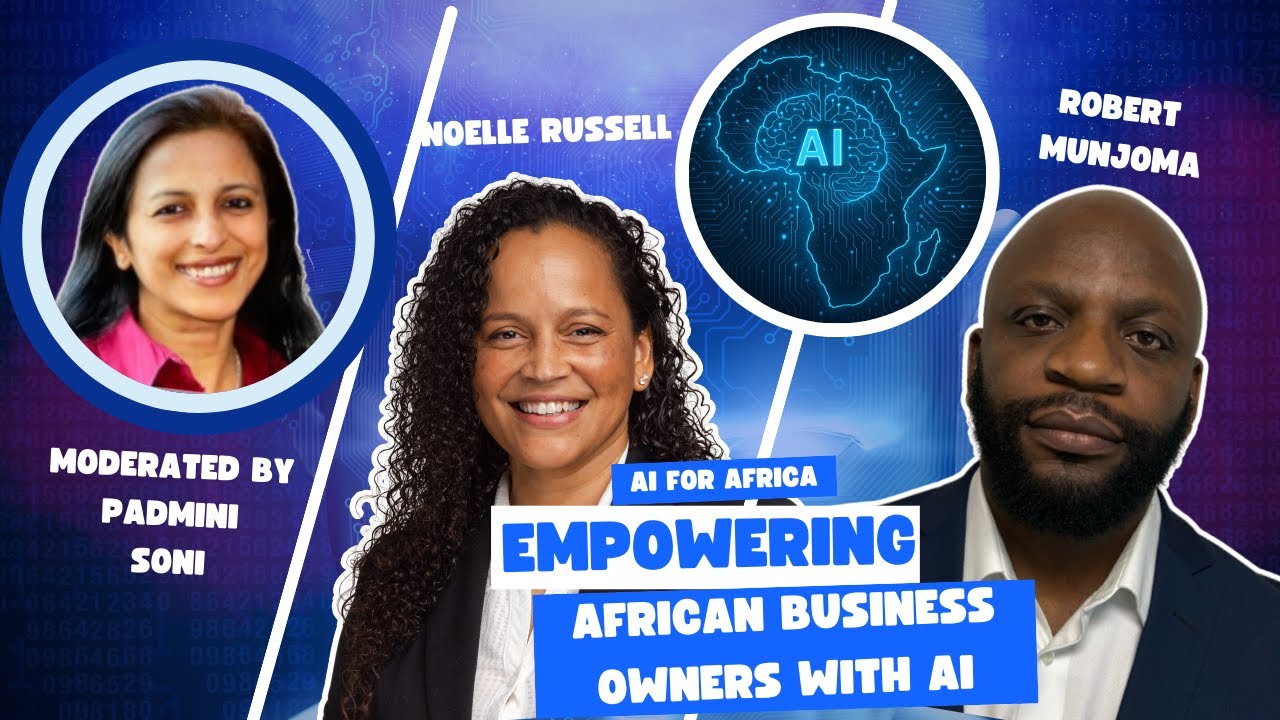
In this recorded Zoom panel hosted by Noelle Russell of the AI Leadership Institute, moderator Padmini Soni, AI ethicist Rob Goldstein, and Noelle discuss how African business owners can adopt AI responsibly and profitably. The conversation begins with an overview of Noelle’s background and the launch of the 2025 AI Business Accelerator. Rob describes the evolving perception of AI in Africa, noting early skepticism, limited national AI policies (6 of 55 countries), and a recent $60 billion AU AI investment pledge. He highlights practical barriers for SMEs such as unreliable internet, power shortages, fragmented data, language diversity, and lack of regulatory frameworks. Noelle introduces the “baby‑tiger” analogy and the concept of a Minimum Remarkable Product (MRP) to help businesses start small, focus on a single high‑impact use case, and iterate. She emphasizes data synthesis as a way for African firms to generate unique datasets and achieve data sovereignty. The panel then outlines a responsible AI governance checklist (transparency, explainability, fairness, governance, data privacy/lineage, robustness/elasticity) and points to resources from the EU, US federal agencies, and major AI firms. Padmini asks about AI literacy pathways; Noelle advises shifting from problem identification to solution‑architect mindset, leveraging open‑source models (e.g., GPT‑for‑All) and community support. Rob stresses the need for a home‑grown African AI ecosystem, collaboration among academia, startups, government, and investment in local talent. The discussion moves into practical community building: the AI Leaders in Africa LinkedIn group, the AI Business Accelerator, and a live bot‑building demo that showcases Noelle’s “5 Ps of Prompt Engineering” and the “6 Ps of building a business” framework. Participants are guided through concrete steps for problem discovery (social‑media outreach, short interviews, industry focus), the use of Kenyan data‑curation initiatives as a template for synthetic data generation across the continent, and strategies to engage skeptical political leaders through targeted workshops. The session closes with actionable advice: start with a small, revenue‑generating AI use case, join the AI Leaders in Africa community, consider the Bot Builder Bootcamp, and keep the conversation alive through webinars and LinkedIn groups.
Chapters
Good morning, everyone. Thank you for being here. Hello, Padme.
Hello.
Wonderful. Good morning, Rob. What's up? Amazing in the house. Welcome everyone. Super excited to have you all here. We're going to give people a couple minutes. We're still a little bit early, so we'll give people a couple minutes to get online. And, but know that this is also being recorded. So if you are interested after we've done this session in sharing it with your friends, sharing it with people that you think would be interested in hearing what we're talking about, feel free to share it. It will be available on demand after this call. So welcome everybody. If you are here live in the Zoom room, which is only for the special people, you can say hello in the chat so we know you are here and can talk to you. Always nice to know where everyone is coming from. Come on in and say hello. I'll get the party started. Let's see.
Excited to be here.
Yes.
Uh, is there a separate Q&A? I just see a chat in here.
Yeah, there, there's a Q&A button at the bottom.
Okay, I don't see it, but hopefully others can.
Yes, you are a panelist, so maybe—
I know. Okay, so no Q&A for me.
Good to see you, Patrick, from Kenya. That is amazing. Hello everyone. All right, and if you are here, um, I'm also going to be monitoring the chat, uh, for our team. What's up? Hello everybody. Frank is in the house from Baltimore. Good to see you, my friend. I'll be back in DC momentarily, so as soon as that happens, hopefully we can reconnect live. If you are here and you are watching either on LinkedIn, Facebook, YouTube, hopefully you will also throw a note into the chat and let us know you're here. You could either say #live or just be like, hey, what's up? Good to see you all. So we are here today to talk to you about, you know, I'll give you a little backstory and then let our guests and Padmni, who's moderating our discussion today, kind of jump in. But we, you know, I'm— many of you know who I am and, and what I do, but I'll give you a quick update for those of you who are new. My name is Noelle Russell. I run the AI Leadership Institute. I'm always on kind of brainstorming ways to get more and more organizations that maybe aren't part of the Fortune 100, Fortune 500 that have immediate access to technology. How do we, really equalize access to AI, to leveraging AI safely, responsibly, and profitably for the growth of every business. I'm a huge proponent of every business owner, specifically those though that are in underrepresented demographics like women and people of color, of which I am both. And so today, as a matter of fact, tonight we are launching, um, our very first cohort of 2025, our spring cohort of the AI Business Accelerator. We'll tell you more about that at the end of this call. But it will, this call was created because Rob reached out and was like, hey, what can we do for African businesses? And I was like, 100%, let's get online. Let's talk about the very specific challenges that African business owners have and then correlate that to what I know, what Padmini and Rob, what we are all very familiar with in what is necessary for businesses to be successful in this day and age. So We're hoping that you will find an opportunity to throw some questions into the Q&A. If you are here live on the chat, you can of course throw them into the chat. I'll keep an eye on the YouTube, Facebook, and LinkedIn chat. Um, but if you are here in the Zoom room, you get priority. So thank you for being here. Thank you for registering. And as I mentioned, yes, this call will be recorded and you will get access. So, um, I will, uh, maybe start, uh, with a quick introduction of my background, and then I'll hand it over to Rob, and then we can lastly have Padmini, you can introduce yourself and then begin the moderated conversation. Hopefully that sounds like a plan. So as I mentioned, uh, Noelle Russell, I own the and lead and really excited about the work we're doing at the AI Leadership Institute. We have over 150 members of the Leadership Institute. Many of them have decided to invest in their own education. And be part of our school community. So thank you to all of you who are here that are part of that community and supporting us today. But I got into this world, into this, you know, journey of AI, specifically emerging tech, well, quite a long time ago. I was an early member of Amazon Alexa. I was also an early member of the, of the Microsoft AI team. And in both of those experiences, I realized that my perspective was very different than kind of the homogeneous perspective of everyone around me. And many of you know, as a, a, a business owner, um, sometimes you have ideas and not everyone's come along with you yet. And so I've become, I've gotten very good at being okay in that moment when people don't quite get it and helping other businesses grow. And so, uh, scaling responsibly is my jam. I don't know if I've got, uh, a book around here. I think I've probably put them all away, but I just launched a brand new book, Scaling Responsible AI. That literally documents my journey over the last 10 years building AI in some of the largest companies in the world. So I'm so excited to share my secrets with you today. I wanna give Rob a chance to introduce himself and his business, and then we'll hand it over to Padmni. So Rob, please take it away.
Thank you so much, Noelle Russell Russell. Uh, good morning everyone. I'm super excited and thank you so much for joining us. Um, my name is Rob. And I'm from Zimbabwe, but I'm based in the USA. I'm an AI ethicist and organizational transformation strategist, and I have extensive corporate consulting and research experience. I'm a trainer of trainers, and I'm also very serious about building intercultural teams. Um, and I advise on national AI policy, ethical implementation, and change leadership.
Amazing.
Yeah, the idea being empowering governments and organizations to harness responsible AI and digital tools for sustainable systems-level transformation. And I'm the author of Mindful Machines, Masterful Humans: The Role of Innovation, AI, and Tech Mastery. That's about me.
Yay, Rob! So glad to have you here. All right, Padmini, you're up, and then you could take us into our wonderful chat today.
How do I follow that, those two introductions? Hi everyone, so glad you're here today. My name is Padmini Soni and I've been in the tech space for 25+ years. I'm the founder of Resonance AI and the head of responsible AI growth at the AI Leadership Institute. I am extremely excited to be moderating this panel today with the two brilliant duo, Noelle Russell and Rob Goldstein. Without further ado, let's get into it. A quick note on the format. We'll have a 45 to 60-minute discussion followed by a bot building session and then a Q&A. I request you to please add your questions to the Q&A tab and not in chat as we may miss it if it's in chat. Thank you. Let's dive right in. AI is shaping economies across the globe. There is a race to adopt AI, but the adoption in Africa still presents unique opportunities and challenges. So my question to you, Rob, is in your experience working with African businesses, how do you perceive AI today? Has the narrative shifted recently? Maybe you can share a personal story, or what have you seen change?
Okay, thank you so much for that question. Yeah, so a couple of years back, when I started talking about AI solutions within African business circles, it was met with skepticism. You know, some were saying the idea, the whole idea AI is far removed from African realities. And they would say it's a tech luxury driven by Silicon Valley buzz, you know, for global tech giants. And they would say, ah, it's too expensive, it's too complex, considering the data infrastructure scarcity and investment needed. And the other thing was fear of job displacement, worsened by absence of regulatory frameworks. I mean, I will hasten to say that as of now, there are only 6 African countries with AI national policies in place out of 55. African countries according to the AU. And, um, so take a clinic I recently worked with. I helped implement an AI tool that flags high-risk pregnancy cases by analyzing patient data and vital signs, detecting complications which would have gone unnoticed. And so the perception moved from previously 'Rob, your AI doesn't know our patients' to 'AI is now saving lives.' And even more, when my book came out, someone very close to me said to me, 'Hey Rob, congrats about your book, but your AI and robots thing, do it yourself, keep it to yourself.' And I understand, you know, it was coming from a place of not appreciating what AI can do and the change it can bring. Um, and for me, that was the very motivation, uh, behind delving deeper, researching about AI, because I had— I have been involved in the development of breakthrough innovations, disruptive innovations, uh, in business, business solutioning. And I knew that AI sits at the center, at the core of those innovations. So I went and dive deeper researching on how we can integrate AI into modern business models. Hence, you know, the title of my book, Mindful Machines and Masterful Humans. However, having said that, a gradual shift is underway as African people are now seeing more practical use cases and benefits of AI. And with the recent commitment at African Union level to support AI development across Africa. They have pledged a tune of $60 billion on AI development in Africa. And so I foresee AI getting increasingly embraced as a tool rather than a threat in Africa.
Wow, that's amazing. $60 billion, did you say?
$60 billion, yes, according to the to the Continental Artificial Intelligence Strategy document that has recently been released.
That's amazing.
Yeah.
Um, but thank you for that glimpse into how perceptions are evolving on the ground. But we understand perception is one, just one piece of the puzzle. To turn that into action, that awareness into action, we must address the gap between what is possible and what is practical. So with that, Noelle, a question for you. Globally, we often talk about AI being hyped. So how do we bridge the gap between hype and everyday business utility, especially in emerging economies?
Yeah, I think one of the things that I often think about is, you know, like when I was at Amazon Alexa in the early days of building these systems, no one really knew what we were doing, even though today it's very commonplace for anyone to talk to a machine. Back then, it was very unnatural for people to talk to their technology, to scream at their device, to yell at Siri. Like, all of those were very foreign behaviors when they began. And I always encourage companies to kind of remember that, that as you begin this journey in AI, it is going to feel a bit unnatural to create a relationship with artificial intelligence inside your business. But the way that I've really kind of thought about like, how do you get started? How do you go from kind of like the, the beginning of the hype cycle, if you will? I actually have an analogy that I use that many of you may be familiar with. It's why you kind of see a collection of these so adorable baby tigers. I have this analogy and you'll start to see some of you were newly connected on LinkedIn, um, you'll start to see some of the social media that I do. But, uh, but when you think about a brand new, like adopting AI into your organization, it's kind of like adopting a baby tiger. It's, it's usually pretty novel. You've kind of figured out what, what it can do. You're like, oh look, it can like summarize our meetings. That's pretty cool. Or it can help us answer quick questions about, you know, get our customers answers 24/7, things that maybe a human really struggled to do. Like, it's very exciting, uh, honestly, in the beginning. It's, we're, we're enamored with AI, many of us. I mean, there are 3 million active users per week, um, on ChatGPT, which is like a huge number of people are just talking to this technology in this kind of mode. However, what I always think about now that I've worked at Amazon and IBM and Microsoft and helped like launch these models into production, I realized that in the beginning we get very excited about it. It's cute and fluffy and we're like, oh my God, it's super cute. But we don't really ask the hard questions. And that's kind of what we're gonna talk about, I think here today is it's important to start asking at the beginning, kind of like, oh, like look at this baby tiger, right? Look at its paws. How big is it gonna get? Or like, wow, it's got like razor sharp teeth. Like what is it gonna eat? How much is it gonna eat? Where is it gonna live? And most importantly, what happens when you don't want it anymore? Like, most people don't think about that. When you first get a baby tiger, you're just like, it's so cute and fluffy and I love it. And it's literally the hype cycle of AI is around this kind of enamored attention for a system that's pretty good at doing whatever you ask it. The challenge with pretty good is that these models typically, um, these models typically when they're pretty good, they can actually be pretty bad very quickly. I will, I will often say things like, um, baby tigers become big tigers and big tigers hurt people, right? Like if you're not careful, this system as it grows can actually be pretty damaging, not just to the customers that are interacting with it, but to your business, to your bottom line, to your relationship with your partners. Like your, your model will end up being a, representation of your organization. And so you have to be very intentional about what it does, how it does it. And today I think easy— it's easier than ever to adopt a baby tiger into your organization to get an AI model to help you grow and scale. But it's also equally as important to ensure that you're thinking about it in the right way. And so I have a framework by which I think about this. It's basically 4 levels. And Microsoft, they call it an AI safety system, and I'm a big fan of that. But it, it requires you to kind of think, how do you build an AI system and not get completely lost in like the enjoyment and excitement of the baby tiger mode? And the way we think about it is through kind of how do you design the system, how do you control the system, how do you select the system, and how do you support the system? And We'll go through a couple more of the details of that throughout the call today, but I think it's really important to realize, like, as exciting as it is to think about how AI can change your business, there is a right way to do it in order to generate ROI and significant ROI. And I think that is, that is part of what we wanna talk about today.
Thank you, Noelle. I, I, I love the baby tiger analogy. It's so, so like you said, Beyond this perception and promise lies that reality of implementation. And that's where often things get tricky, especially for small and medium-sized businesses. So Rob, my question to you is, what are some of the practical barriers African small to medium-sized enterprises face when they are trying to adopt AI tools? Is it just cost or is it more of a contextual fit? If you could throw some light on it.
Yeah, yeah. So from my interaction and experience with the African business space, the deeper barrier, like the, you know, the operational realities of Africa, the greater part of Africa, such as unreliable internet, patchy internet in most cases, power shortages, businesses operating with and within informal markets, Diverse languages, dialects, and limited access to large, clean, labeled data, which is essential for AI application, those present serious challenges for effective AI application. And another barrier, I mentioned that earlier on, the lack of regulatory frameworks. Really do stop some businesses from adopting AI because they prefer structured processes in case of tomorrow. And like I said, only 6 countries out of 55 African countries do have national AI policies, from which I believe those can guide industries on how to design, train, and deploy AI. So we still have a lot of work to do. To take along with the Continental AI strategy that I talked about. And the 6 countries are Algeria, um, Benin, Egypt, Mauritius, Rwanda, and Senegal out of 55.
Um, yeah, well, okay, they have a long way to go then.
Yes.
Yeah. So, uh, so speaking of practicality, and if we zoom in on the architectural reality of implementing AI. Many assume it's all code and tech and complexity. So from an architectural perspective, Noelle, what is the reality of what it takes to implement AI solutions?
Yeah, I think it actually will dovetail into one of the questions I see in our chat. Thank you for that. And definitely you're asking about AI expertise and talent and how, you know, like how do you get that talent, I'm presuming. So definitely type in more about that question you have about AI expertise. But I think that's part of it. One of the things that, you know, as we think about implementing, I'm just gonna, as we think about implementing AI technologies, like all of these are valid and very concerning limitations, perceived limitations. But I think it's really important to think about kind of how did these early big massive models today, how did they start? OpenAI, Amazon Alexa, Siri even, how did, like, these models begin? And the way that they all started, uh, was with a minimum remarkable product. And it's a little different. Many of you might know the term MVP or minimum viable product. Like, what's the minimum thing you can do to demonstrate viability of an idea? But in AI, it's not just about viability. And I've been saying this for the better part of a decade, that viability is no longer the bar. Like if you build a, a viable solution, that viable solution will be like, no one's gonna buy viability. People are gonna buy remarkableness. And so when you have a chance to build something, to create something, it's really important you have that inclusive perspective on your team that can help you break apart your big huge vision of what you wanna do with AI and break it down to something very small. And it, and, and then of course you're gonna start small and iterate. And so one of the things I got a chance to do was be on a team that grew a practice very, very quickly over the span of a year, and very specifically building that practice doing generative AI projects. And the reason I like, I, I was excited about that work was because we weren't selling $3.25 million, $10 million deals as is often seen in software engineering. Right? When you sell cloud services or you sell AI services, as a, uh, practitioner and an evangelist at Microsoft, I influenced over $1 billion in AI sales. But AI as a software purchase is very different than implementation, like actually getting it out of the box and using it. And when an organization tries to use it, this concept of not just viability, but remarkable delightfulness in what you choose to create and deliver to a customer, or a vendor or whoever you're trying to serve within your ecosystem with these services, it's really, really important to make sure that you don't try to boil the ocean, as they say, or do too much, 'cause it'll end up detracting from your ability to do the minimum thing, even half as good. So, so I encourage, but the, the challenges that people often have around like data scarcity, as you mentioned, Rob, like around infrastructure, Here's the good news is that when you go after this remarkable, this minimum remarkable product, um, and I'll give you an example, like at Alexa, our minimum remarkable product for the finance industry ended up being a research-driven approach to finding out, and I encourage you all to do the same thing. Look at your business and figure out what is something that people are trying to do every single day, like your customers. What are they trying to do with you every day that's hard for them to do? So it's a correlation of volume of requests correlated to the complexity of getting the answer. Like, is it 5 clicks away? Do they have to fill out a large application? It is in this, like, right in this cross-section of somebody's trying to do this every single day on a system, but it takes them forever to get it done, or it's complex to get it done, or it takes a long time, or it is just frustrating. This is a really good spot to start. And so in finance, back in the day, this was 10 years ago, we started with, uh, routing numbers, just helping banks surface routing numbers because it had this magic cross-section of something that businesses were requesting all the time, but it took 5 to 7 clicks inside a bank to find it. And so we were like, what if we could just say, ask for your routing number and it will appear? Right? It, it wasn't business changing. It wasn't mission critical, but it was delightful. And everyone who did it was like, this is awesome. I wanna do more of this. What else can we do? And it ignites this energy in the organization to build more use cases. So this is really critical, I think, for those of you who are building businesses in Africa to not kind of overwhelm yourself with the complexity of AI system development and really think about what is the one thing I could do that would delight my customer or delight my vendor Um, what is one thing I could do to make that the experience easier? Um, and along with that, of course, AI, we often talk about AI and we get this vision of like a big AI in the sky and that there's like a big button we press on and like AI is this monolithic thing. But the reality is, is AI is very not monolithic at all. It's extremely iterative, agile, and modular. So That's why, I mean, most people don't really understand the concept of agentic AI, even though we're really pushing people in this direction. But the concept of agentic AI is the ability for you to build modular AI services that you will orchestrate together. And the good news is, is that each one of those modular services ends up being a minimum remarkable product. So imagine when you could start, you know, piecing together minimum remarkable, delightful experiences to create bigger and bigger solutions. So, uh, the idea of data scarcity, infrastructure scarcity, when you start small, you don't have to face that or, or deal with that right away. But one thing I'd also encourage you to think about is how valuable these new models are. These reasoning models like GPT-4.5 in research or Sonnet-3.7. These reasoning models now have the ability to generate for you good data. So you don't have to actually create or, or find data or collect data the old-fashioned way. You actually just need a, a collective group of people that understand what good data looks like, and you can manufacture— it's called data synthesis. And I think for African businesses, this is a huge opportunity for you to not only generate unique data for your own business, but you can create datasets that the rest of the world desperately needs right now. That will help them diversify their own data in their own models, right? You become a valuable asset builder of datasets that are uniquely, let's say, African data, right? That's unique like that. Most organizations, most like Stanford, MIT, like these research organizations really struggle to create datasets like this. And it's something I think that African business owners can really do a service to, to the world in building.
Yeah, and I think that is a good segue into my next question, which was right around data. You know, without the right data infrastructure, even the best AI models can fall short though. So Rob, you did speak about data infrastructure scarcity. How do businesses typically handle that today in Africa, in what you've seen, and do you see a room for improvement?
Oh yeah, um, maybe quickly as a follow-up to, um, Noelle Russell Russell's comment and insight, I've seen good workarounds in Africa around, around that, you know, making AI more accessible, such as WhatsApp-based AI services, mobile apps, of which most businesses are actually on mobile apps. And lightweight multilingual AI models that work offline even with patchy internet. Yeah, so, so you're very right, Noelle, about, you know, starting somewhere and creating these modular solutions. So to your question, Padmin, um, uh, so save for very corporate entities, uh, in Africa, you would find that the majority of our businesses have data fragmented across emails, data is sitting in spreadsheets, WhatsApp chats, and paper files, and often not unstructured and unmanaged. So that's a reactive approach, and you find that people reach out for data during like reporting times or when there is a problem. So without a clear data strategy, these businesses are missing out on valuable insights which which can accelerate growth and guarantee transformation is decisions end up based on partial or outdated information. But having said that, there's room for improvement. Uh, once we treat data as a strategic asset, keeping it clean, connected, and usable, and investing in infrastructure and skills, uh, we can unlock some serious value. There.
So do you think there is like— there's an African approach that we should think of which is unique to Africa around infrastructure and ownership?
Of course, of course, we need an African approach, uh, you know, systems built for our own realities as Africans. Even with copied models from the West, we can always tweak those models to suit our realities. We need to protect our interests, our values, and ownership of data. We need to grow our own talent pipeline locally from the ground up. Because if we don't control data, we are doing a disservice to future generations. Because without data ownership, Africa doesn't have real digital sovereignty. You know what I mean?
Yeah, so having heard what Rob said, Noelle, are there some creative or responsible strategies that, you know, you've seen that can help overcome poor data practices, like especially when data is unavailable or scarce?
Yeah, I think the most important thing in my opinion is really intentionality. And this is something that Rob writes a lot about in his book. And Rob, I don't know if you can go grab a link and put it in the chat for people. So that if they haven't read your book yet or have access to it, they can grab it. Because I think this is the biggest, uh, I think one of the things that I experience when I go into these clients, um, is that they end up over-relying on this data. Like they over-rely on AI, they over-rely on the concept that AI is gonna save them. Um, and they don't realize that in the very beginning when you choose, the moment you decide, I'm gonna grab a baby tiger and welcome it into my company, that you are now, it is 100% up to you how that system operates. Like how it, uh, some of the most common challenges when AI models are adopted by an organization, the first challenge you run into is accuracy. Like making sure that that model understands what truth is, organizational truth. And many times it requires, in order for you to care about the truth of, You know, a model, being able to say the right thing at the right time to the right customer or partner. Alongside of that is, you know, not only do I want it to say the right thing, but do I know what right is, right? As a leader, as a business owner, do I understand accuracy? Do I understand what truth is for my company, for my customers, for my partners? And so it requires a level of self-awareness. Honestly, uh, and even emotional intelligence. Like our, in a world where we're adopting artificial intelligence, our emotional intelligence quotient has to go up, right? Mm-hmm. We call it EQ. Like your EQ has to go up. And this is something, again, Rob is an expert in, but your EQ has to go up as you adopt more AI, right? And so when that, when that happens, now you start asking the AI, questions about how it's doing its job. And it is in that questioning that you can develop maturity, uh, in this, in the solution that you're building. So once it builds a, you know, you, uh, one of the questioning, you know, I, I'm a big fan of, of asking models lots of questions. Um, I don't take a model's output, especially its initial output at face value. I don't copy and paste it and use it. Like, I wanna know, How did you come up with that? And that's why I mentioned these new reasoning engines are very useful because we now get to, rather than force chain-of-thought prompting, which is a machine learning, a specifically generative AI prompting technique, rather than us like constantly asking questions to pull content from a model. Now when we ask a question, it's gonna tell us what its thought process is so that we can interject and go, oh, I like what you're doing there. However, It's a little different because of this, because of what I as a human know contextually changes the problem that the model is trying to solve for us. So one of the things that I encourage organizations to do, number one, is become more self-aware, more organizationally aware, more intentional in your approach to build a system. One of the skills that you're gonna require as an AI user, as someone who is gonna consume a model to solve a task, is you're gonna need clarity of thought. You're really gonna need to understand like what do you want this model to do? And can you clearly articulate to a machine how you want it to do it? And this is why I created like AI Leadership Institute, right? Because in the world of AI, we're no longer, you know, you might lead humans, of course there'll be humans in your organization, but whether you have direct reports or not, you're definitely gonna be leading machines. And it is in that leadership that you are going to have to be very clear about not only what do you want, But how will you measure success? So this is for all of you, whether you're building a customer service chatbot or building an agentic system to solve order processing, no matter what the level of complexity, every system needs to have a clear, super clear description of what it's meant, what it's gonna do. And then also a very clear single metric if you can, that identifies did the model do its job in supervised learning, which is like a more traditional form of machine learning, which is why you were saying about all the data that's required, Rob. Like in supervised learning, we're giving data to the model and saying, here is what good looks like and here is what bad looks like. And then we're testing it in training. We're testing it like, okay, here's a picture. Is it good or bad? Right? Is it a dog or a cat? Can you tell? So we're, we're using data and we as the data scientists, we give that data to the model. In generative AI, the data is already there. The training has already been done. So our, our interaction with that model needs to shift to, okay, how do I clearly articulate the model to the model what I want it to do? And I ring fence the behavior of that model. We call it the 5 Ps of prompt engineering. Many of you have been here. Hey, Alonzo. Alonzo's in the house. Nice to be here. And Varol is here as well. Awesome. Thank you for for putting, uh, your comments in the chat. Definitely take a look at those. Um, but it's really critical to think about, like, no longer are you like going and trying to figure out how do I collect data to solve a problem? Now what you wanna do is figure out, do I understand the problem enough to ask the model what data it currently has that is helpful and find out what the delta is or the gap is between what you're trying to do and what you wanna do. It's a very different, almost higher level of thinking that is required. And that's why the, You know, Mindful Machines but Masterful Humans. That book is so important because it's the— we have to master ourselves and our understanding of the problems we're trying to solve before we can really recruit an AI system to support us.
Well said.
Yeah. And Noelle, you did touch upon, I mean, you're talking about it too. The— I do feel like, I think every AI journey starts with AI literacy. We absolutely have to know what we are dealing with. And there is this growing appetite to learn, but we don't know the right path to get to it always. So we know you don't have to be a data scientist to participate in AI revolution, but if someone in Africa wants to become an AI architect, but doesn't have like a technical degree, where do they begin? What does their journey look like? And this question is for you, Noelle.
Okay, I was like, should I answer this one?
Yeah, yeah, that's why I asked.
Yeah, I think, you know, one of the things that I think is probably the most important is to first identify yourself as a solution architect. And everyone who's listening to this, thanks to everyone who joined the Zoom as well as all of the people we have listening, um, on the social platforms, but every one of us has to shift from kind of a problem identifier, which is an easy place to be, like, that's not working, that's not working, that's broken, this is old, to being a solution architect. And it is a mindset. It's not a technical level of aptitude. And once you shift your mindset into this concept of solution architecture, you start moving into someone who says not, you know, that's not working, but more how do we make it work, right? We shift to how do we make— like, that's not possible to how could this be possible? And when you do that now with the benefit of large language models, we actually can ask a system, how could this become possible in the light of like literally asking a, a model that you own, that you've created inside of your company. And that is a suggestion, you know, along with some of the things Rob was saying earlier around, you know, some of the challenges of building infrastructure is that the number one thing you wanna do, and this is okay if you haven't taken notes yet, this is a good one.
Right.
Even if you don't have the ability to use a data center in the cloud, like at Microsoft, Amazon, or Google, you can even on your own hardware, on your own laptop, you can use what's called GPT for All. It's a, or it's a nonprofit GPT for All. I think it's gptforall.org, but I'll have to check. Somebody could go and look it up. Um, but it allows you to go into, you know, create a GitHub account if you don't already have one, and you can fork a repository that allows you to load an LLM onto your own machine. Now, of course, the size of the amount of data you can use will be dependent on how big your machine is, but you get to at least have an environment that you could create. And all those questions about where's my data going and who's getting trained on this data and who's getting at, like, all that goes away cuz you own that environment, right? And so, uh, yes, exactly. Um, thank you, Malik. Yes, thank you. Um, uh, so it's really important to realize sometimes we go in and we're like, oh, infrastructure is hard. Model selection on these big cloud computing companies is hard. Data sovereignty, because the data center that is gonna run my services in the US, that's hard. But there are initiatives, especially open source initiatives like GPT-4, and they're not the only one, they're just my favorite right now. That allow you to actually decouple yourself from that narrative so that you can get to a solution. And then remember, if we're starting small, right? When we start small, we have the ability to use these smaller solutions to get the product to market. This is probably the most important thing that I would want you to gain from the really cool, you know, information we're sharing with you today is that it is critical that you figure out the problems that you wanna partner with AI in. And then go to market as fast as possible. Let the world know what you are doing. I actually have a philosophy, um, that has worked very well for me, that when I get an idea to do something, as all of you as business owners, that's why we asked you to join us. Like, we were very intentional about who we invited here. If you are a business owner in Africa or are an aspiring business owner in Africa, the very first thing you need to do is identify what you wanna do. Like, what is the problem you're gonna solve? And as an entrepreneur, you're gonna wanna fall in love with that problem. Like, and when I say that, I mean that you're not gonna be tied to, I want to use an LLM to solve this problem, or I want to use an AI service to solve this, or I want to use Microsoft. You're gonna say, I want, I'm in love with the problem of helping, you know, teachers educate more students in Africa. If that's the problem you're going after now as a solution architect, you're gonna think, okay, how can I use AI to solve this problem and what's the minimum, like, remarkable solution that I can start with? And then before you build it, although you could build— I'm, I'm a builder, so I like to build it too, and I'll show you that at the end of our call today. But before you build it, or as you're building it, you wanna go out to those very people you're trying to serve and get their attention and say, is this good? I have a phrase that I use: never build for someone without that person right alongside you. So if you're building, like, I have a son with Down syndrome. I naively as an engineer would build solutions that I thought would help him, and then I'd give it to him and he'd be like, meh, like, I'm not really excited about it. And I would, I'd be like, what do you mean? This is awesome. And he is like, it's cool, mom, but I don't like, I don't need that. But what if I had started with, hey, I've got this idea before I built anything and I just go to him and go, What do you think if I did this? He would immediately have been like, oh my gosh, I like what you're saying, but if you did it in this way, that would be helpful to me. And it is in that moment, that intentionality, that like, you know, like that mindful approach to beginning that we change the entire trajectory of that project. So you get your idea, but then you get attention from it or for it from exactly the people you're trying to help with it. And if you get enough attention, and you get enough information, you're gonna build something the world is already looking for, that they're already asking for, that's in the mind. They're thinking about it every day. I wish I had this solution, but the only way to know what that is is to actually connect with them. So we have a principle at AI Leadership Institute, designing with inclusivity, and that's what it means. It means when design happens first, not last, right? When we start thinking about a solution, the first thing I'm gonna do is think about A, how can I use AI to solve this? But B, who do I need? Who do I need to talk to? Who do I need to bring in in order to complement the work that I'm trying to do?
Exactly.
Wonderful. So having heard all that Noelle said, Rob, what do you feel is like the appetite for upskilling in Africa? Are young professionals and small and medium-sized enterprises What are they interested in and what support do they need?
Oh yeah, thank you for that. There is growing curiosity among African professionals, and I would say forward-thinking small to medium enterprises. Yeah, they are all exploring AI, how it works, how to apply AI, and how to to even evaluate AI. They are thinking like that, and many are interested, but they are uncertain about the how part and where to be— to begin, especially when it comes to navigating the cost aspect, which is the biggest barrier that I alluded to earlier on. But what I think they need most importantly is a supportive ecosystem. You know, they need mentorship, they need a hands-on learning, practical, that is speaking, that is contextual, speaking to their environment and their communities. And that helped them move from just being interested to action. So I, I— that's why I was really persuaded with the work that the AI Leadership Institute is doing.
Yeah, I think the right place, if, if everything that you said is what is needed for, you know, youth Africa, businesses in Africa, the, the AI Leadership Institute, you found the right place to do that. So we've talked about access, talent, adoption, but now this is my favorite part. None of it is sustainable unless it's done responsibly, right? In fact, regions where regulations are still evolving, responsibility becomes even more critical. So Noelle, how do we ensure AI is not just adopted but adopted responsibly, especially where legal frameworks are still evolving?
Yeah, absolutely. I think one of the first things that you'd want to realize is that, especially now, you are not alone in the journey, that there are lots of really great resources that you can use in order to ensure that people have ensure that you are approaching the problem of building responsibly in a way that is consistent with others who have had similar success that you want. So this is what I always say: success leaves clues. So go find people who have done this successfully and follow what they did. The good news about responsible use is that most organizations, including the biggest companies, they have documented their success. And so I'll give you a couple of old resources and some very new ones that I think you'll be delighted to have. And I'll jot them, I'll throw them into the chat unless one of you, one of our amazing members of the audience, wants to go find the links for these. But the first thing is to realize that, for example, the EU, right, European Union, has done a lot of work in this space. And so the first thing I did when the EU Act was in proposition, meaning that it was being proposed, I went and printed it out. And I mean, literally, I'm kind of— I guess I'm showing my way of thinking, but I printed it out because I wanted a physical copy, right? I print things out all the time. Don't laugh at me. Don't judge me, people. But I like print it out and I like highlight it and dog-ear it and put Post-its on it because I wanted to understand. And what you should know about these acts, these resolutions, when they are created, it is not a single person in a room going, let me think what I could do. They go and recruit some of the brightest minds in the world to create this information, this proposal. And then it goes through lots and lots of peer reviews in order for it to become a thing that is like an act that is enacted. And so there's— excuse me— there's so much value in that. So that's the first thing is like actually look at the EU Act as a— not necessarily as the rules you'll follow, though. Sure, do that. But more importantly, as if these are the frameworks that the government is using, what can I adopt for my own organization? And, and it's already like there. So you can adopt some of those, some smaller. Now obviously the EU is kind of a, it's a big thing that they're attempting to do. So maybe you don't wanna model the entire thing for your small business. So go and look at mirrors of that. So for example, the Department of State and the Department of Energy in the United States, these federal organizations last year they documented their enterprise AI architecture, which we'll share with you. Again, what I like is like, could I go learn this? And I'm gonna give you some of these resources as well. I could go and like learn this theoretically from Stanford and MIT. They're doing research in this area all the time. But what I wanted is I was, I was like, no, I want the end. I wanna know how did you get to the end? What is actually being implemented in these organizations that are highly regulated. This is the benefit of adopting from government decisioning, is that if you lean towards the highly regulated way of doing business, even if you're not required to be regulated, you will be more safe and more secure as a result of that direction. As opposed to, I mean, you might be a, a music brand selling merch online and you wanna use AI. It is not going to hurt you to think about What does, you know, uh, another one is, um, Arizona, uh, the state of Arizona documented their AI strategy. The city of Seattle documented their AI strategy. Like, look at organizations that had to be very resourceful in the people that they used to create, 'cause they, someone was asking about AI experts earlier. They don't have experts, right? Like, who's gonna build their responsible AI infrastructure? So use the proof that's already out there as a reference point. But here are 5 things that it should at least include. And you could go see these in the responsible, um, tenets adopted by IBM, Microsoft, Amazon, Google. They've all got tenets that kind of have these 5 characteristics. One is you wanna make sure whatever you do moving forward, that you are transparent in what you do. And I don't mean just the models that you pick and select and use, I mean in everything that you are clear to your customers and your partners and vendors, this is how we do business. This is how we leverage technology. This is how we create, you know, provide security and data privacy. The second thing, so transparency is one. However, pulling back the curtain and showing people how you do stuff is not enough. It actually has to be understandable. Like, you have to know what you're talking about. So translating those complex decisions that you've made in terms of, uh, infrastructure, translating that is critical. So you're gonna wanna provide an explainable approach, meaning I always say like, explain it to me like I'm in 5th grade. Like, explain it to me like I'm in 5th grade. Like, that's the level you're gonna want to approach. Here's how we do what we do and be declarative about it. Post it on your website, maybe on, not on your homepage, but certainly make it accessible to people. And so we've got transparency, explainability. You're gonna want to have a, a position on how you see fairness and equitability in these model selections that you do in use of technology. How are you gonna make sure you don't hurt anybody with this? You should have a strategy for that. There should be governance in place, rules, process, right? It's not enough to just say, I'm gonna try not to hurt anybody. Like, how are you going to do that? Are you gonna use reinforcement learning? Are you going to capture data about users? Are you gonna survey your customers? Like, have a plan. And then the last two might surprise you. Maybe one won't. Data privacy, of course, have a plan for protecting. Uh, I have a, I use, I have a saying that I use in my keynotes about, um, misrepresented authors. There's so many times where quotes get misrepresented, right? Where you see a quote and you're like, oh my gosh, I know who wrote that. And then later you find out it wasn't that person at all. It was actually someone else. Data lineage is your responsibility. If you get data, if you, even if you manufacture it, if you get data from a model, that data came from somewhere. And so it's your responsibility to know where your data comes from and also what's gonna happen to it when it leaves you. And that lineage is yours to protect and it is your responsibility to protect. So that should be part of your responsible approach as well. But finally, it's probably my favorite 'cause I'm a cloud architect at heart. Um, is robustness or resilience. How do you make sure that in a world where you build something awesome and a million or a billion people come and ask you for that thing, how do you make sure that you don't crumble under that pressure, right? That you don't build a super cool, awesome t-shirt, you know, design company and millions of people wanna buy your t-shirt and you don't crumble under the pressure and your customer service goes down and like your servers go down and everything breaks. Like, ask airlines in the United States, right? When something, a weather condition happens, they strand people all over the country. Not, not good. It's not a good experience, right? So we wanna think about how do we create resiliency? And I'll just use one word to explain this to those of you who are on the tech side, is elasticity. How do we create elasticity in our architecture so that we can grow and shrink in alignment with the work that we're doing. And that is a cloud infrastructure component. But that's also, I think, really critical for African businesses because you do not want to allocate any more than is absolutely necessary to support your, your initiative, right? So we want to do the minimum possible amount of infrastructure to support whatever we're trying to do because cost is going to be a key. But let's say it's the best day of your life and you're getting lots and lots of customers. How do we make sure you don't lose that opportunity because you didn't think about scaling with them? So we wanna be able to start small and scale automatically, and that is known as elasticity in architecture, and that is a core principle. And I think it's our responsibility as AI implementers to think, how does this AI scale over time? Um, so that's kind of like a whirlwind tour through all of the things that I think we need to think about. But the good news is, is that you don't have to start alone. Oh, and then I was gonna give you a reference that's relatively new. So OpenAI as well as Anthropic, they both have documented the work that they've done to become responsible. So, uh, at OpenAI, it's called the Responsible AI Framework or something like that. You could just type in trust and responsible AI and OpenAI and it'll come right up. And then, uh, Anthropic also has documented it in the responsible AI policy document.. And in these they say, here are the rules by which we create our models. So use that as an example. Like, I would want to follow in their footsteps. They're not doing too bad out there.
Yeah. And I think OpenAI, no, Anthropic is doing something with model welfare too. They have a project. Yeah. And it would be even better to do all this sustainably, you know, have that as one of the pillars of responsible AI. So, so Rob, what are some of the ethical questions that African businesses are most concerned about? Is it regulation or the absence of it, or is there a bigger issue? If you could help us understand.
Yeah, they are asking some of the questions which I actually had Noelle highlighting right now. They are concerned about data privacy, for instance. Who owns the data? Who stores the data? And who has access to the data that has been collected? And how is it used? Bias and fairness, again, is another key, key question. How do we ensure there is no discrimination against certain groups and societies? And how can biases be detected and corrected? They also ask about accountability. If AI makes a mistake, for instance, who is responsible? Is it the developer? Is it the company? Is it the machine? Transparency, again, like what Noelle Russell said, is it explainable? How are AI decisions made and can they be challenged? And the last one, job displacement. How do we balance innovation and protecting livelihoods? Because of that fear, you have had the topical issue of AI will, um, uh, take people's jobs. And so it's, it's, it's, it's, it's, it's an ethical concern to say, how are we going to balance innovation with protecting, uh, livelihoods? Uh, and, uh, as for regulation, uh, the last part of your question, so both, yeah, so both fear of regulation and fear of no regulation are major issues. So get me right there. Some are fearing that strict regulations will slow down innovation and add costly compliance burdens, whilst others worry about the absence of rules, which they think— and they could be true— the absence of rules will create risks such as consumer backlash in the future, you know, litigation,, as a result of maybe misuse of AI and reputational damage.
Yeah, and there's a lot that you touched upon there, and I think it'll take several sessions to sort of unpack each one of it. But given the time constraint, I want to get into the last part of our discussion. And as we enter this final section, just a quick reminder to our audience, please add your questions to the Q&A tab so that we can address them later. We may lose them if it's in the chat, so please, if you've added in chat, please paste it into the Q&A so that we can pick it up from there. My final few questions is around the community. We talked about AI being a powerful technology, but ultimately it isn't just about tools, it's about people and building a community. With that said, um, Rob, do you feel that AI has been sort of imported into Africa? How do we change that, uh, narrative? And what need— what needs to be done to build like local innovation ecosystems?
Yeah, you know, to some extent, yes. I mean, everything starts from someone. So yes, there is a view that Africa is a mere consumer of AI solutions, not co-creators. And, you know, the same argument that, you know, many solutions don't match the local realities, the context, and stuff like that. And so to change that narrative, we need to empower local creators, local builders, our own data scientists, ethicists, and engineers. And for us to build thriving innovation ecosystems, we need to foster collaboration among the academia, the startups, the government itself, and business. So we need to bring together key players and invest in local talent, fund research, encourage experimentation, and let people fail because we learn from our failures, and support homegrown platform. So that is very key.
True. And Noelle, how do— How were you saying something?
I was just saying it was so good. That was so good, Rob. Like, that was me. Yes, I preach. That was 100%. Yes.
So then how do Noelle Russell Russell global leaders and companies genuinely support these local ecosystems without actually dominating them?
Well, I don't know. Maybe I'll take it from the, the smaller, like most of the organizations, I think, like everyone listening to me here, I feel there's a lot of power today, regardless of the size of your organization, that AI— when I was at Amazon, Jeff Bezos would always say AI is the great equalizer, right? Like its job is to equalize, you know, the rising tide of emerging technology. It rises, all the boats rise, not just the yachts, not just the big companies. And so now you can go toe to toe like Anthropic, right? Anthropic was this tiny little company and they ended up outseating the decade-old data science team at Amazon for Alexa's model. Like, that's crazy and awesome at the same time, right? Like, obviously I'm, I'm like excited and hurt at the same time because, you know, like that was our baby. We built that for 10 years and then a small company built a competitive model. Look at Deepseek, right? Super tiny little company and they're building a model. Now it's not necessarily about the size or strength of your organization. It's about the problem you're trying to solve. And how accurately and clearly and responsibly you solve it. Now, responsibility, I guess, is probably one of the most controversial sides because, um, all models at the beginning typically start, uh, I don't know if you've done this, but I'll invite you all to do a little, uh, experiment. You can just take the terms of service when a new model comes out, just go and grab their terms of service and compare it to a more mature model. All models. Deepseek is one of them, right? When you go to, when I grabbed Deepseek's terms of service and mapped it to OpenAI's current terms of service, there was huge gaps. Like Deepseek was vague and like didn't really say anything. And I was like, wow, that's weird that they're so vague. But then what I did, which I thought was so interesting, is I went back and looked at OpenAI's terms of service. 3 years ago, and it turns out they also were very vague in those early times. And this is what I, I want this to serve more as inspiration than concern, is that you don't have to have it all locked in, but you do have to have an intention to lock it in, right? That when you start, you can be a little bit vague, like, I'm not really sure how this data is going to work, but we're going to have an intention, a process for securing this. We're going to— and I know it sounds scary, but that's how That's how everything starts. I always say everything starts at awful. You can't get to awesome without going through awful. And that's true for AI models and public speaking and doing webinars, right? Like you have to start somewhere. At first no one's looking and then billions are looking and AI models grow that way. But without that intentionality from the beginning, you won't be able to really even see that success. So it's a good exercise to realize like all of these models started pretty weak. Amazon Alexa, it's now a household name across the globe. But when it started, no one knew what it was. And most people said talking to a box in your kitchen is probably not going to work out like that was the vibe. But that's not what happened, right? And similarly, who would have thought 5 years ago that we would be, you know, that my mother or my grandmother would be talking to ChatGPT and posting to Facebook about it like That was not foreseen, but the only way that they got there was that they started small. And so just as another example, ChatGPT, before it launched in 2022, it had spent 7 years broken, not performing well, not achieving its desired outcomes, not meeting the metrics of that team. 7 years of walking into the office being like, nope, still broken. Like, that's a long time. To like face something that— a perceived failure. And this is why I said at the beginning, the most important thing you can do is fall in love with the problem. The researchers and engineers at OpenAI, they fell in love with a problem, which was this technology can help people. How do we safely get it to them? And it— no matter what you wanna say about like, you know, their current march towards AGI and their current march towards profitability, in the beginning, OpenAI was actually open. It was the problem they were trying to solve was democratization. And whether we like it or not, they 100% did what they said. They democratized artificial intelligence, specifically using your voice, using your words to launch software. Um, and, and I think it's a really exciting time because that means you, it's the sooner you start on this journey, the sooner you can get to that level of success. But it doesn't happen unless you start. And that's kind of the reason that we wanted to talk to you all.
Thank you. And I think we— yeah, we are at 9:03 here in Central Time. Um, so just to close it out, uh, we've talked about a lot of things today. If there is one piece of advice for African entrepreneurs or business leaders looking to dip their toes into AI, what would it be? And this question is to both of you. And, um, You know, one of you can start, maybe Rob, do you have one thing that you want? Okay, take away.
Yeah, so to reiterate what, uh, Noelle Russell said right now, start small, surround yourself with the right minds, one problem, one use case, one tool at a time. You do— if you need to, to build from scratch, I mean, no need to build from scratch because there are now a lot of resources out there Just as what Noelle Russell alluded to. So solve real problems like, like those problems that slow you down as a business or that cost money. And you need to understand the basics to lead with clarity. There's no need to be too technical, you just need to be strategic. So if you collaborate with experts, you are good, you know. Your net worth is as good is your network. So collaborate with us. You're not alone. Work with us, you know.
Nice. Thank you. And Noelle Russell?
Yes, along those same lines, as you were mentioning that, Rob and I've created a LinkedIn group to carry on this conversation longer term. We're going to also have additional webinars, and of course this content will be available, but I just posted the link in the chat for those of you who are here. We'll also post that link in the conversation on LinkedIn. So for those of you listening on LinkedIn, you could see that. Um, or you could just Google Af— AI, uh, the name of it is AI Leaders in Africa. And so if you wanna just type in AI Leaders in Africa, you'll see that group show up. It has Africa and AI in the little logo. So hopefully we'll see you there because I think the most important thing you can do is start just like you said, Rob, like one, get in the community of people who are on this journey with you. Because learning by doing is the way that I have seen success. And that right now, for example, uh, we have an AI, uh, accelerator going on. It actually starts today. So if you are a business and you are not currently leveraging AI to help you build a brand for your organization, if you're not using AI to get leads into your organization so that you can convert them into sales to grow your revenue, At the end of the day, no matter what problem you are in love with, you don't get to solve that problem unless you are a revenue-generating organization. Like, you have to make money. And I want, you know, I, I don't think it's far for anyone listening to the sound of my voice to build a 6-figure business. I do think that in the future we are, we have 31 million small businesses in the United States alone. So in Africa, I don't know what that number is. I'm sure one of you probably do. That's why I'm here with Rob. But I would love to make sure that the things I'm teaching small business owners in the United States is carried over specifically to business owners in Africa. So if you wanna join us, you are welcome to join us. The accelerator takes you, we go through what's called the 6 Ps of a, uh, building a business. And it starts with making sure you've got a way to get paid internationally. Um, obviously there's some challenges, but right now We have an approach to not just like who you are in the marketplace, but what offer are you going to provide? What pricing are you going to use? Like, how are you going to position yourself? What is your go-to-market strategy? For small business owners, the number one thing you need to do is be able to articulate to the market that you do a thing and that what you do is valuable. And that's it. Like, you don't have to be the only one. You don't have to be in what they call a blue ocean, like you could be in a red ocean. But if what— if who you are is known, if someone goes, oh, Noelle, like, you know how many people call themselves an AI expert? But people look for me because who I am is different, because I'm authentic and real and I'm— I care about the problem. And then I'm willing to do anything to help solve that problem for a company. And the problem I care about, of course, is helping small businesses. Hit that $1 million mark in revenue. Because once you hit a million, the first million, it's like a 747 taking off. That first million, it's like all the energy in the world. But once you get there, you could scale and collaborate and it's just, it becomes a beautiful experience. But I want you to know you're not alone. You have us. We can help you. So that is, uh, yes, thank you so much. Uh, Sherlyn posted it in the chat if you wanna check it out and see what we, What we do, we get some water.
Oh, I, I hope Noelle— yeah, get some water, Noelle. So we do have some questions in the chat, and there's, uh, one from Sandrine to you, Rob, um, and she says, hi Rob, as a member of the African diaspora, what would be an effective approach to creating AI-driven solutions that address local challenges in Africa? Okay, um, if you do, do you want to, do you want to see the question? If you click on the more at the bottom, Rob, you'll— okay, do you want me to read it again?
Yeah, please do.
Yeah, so as a member of the African diaspora, what would be an effective approach to creating AI-driven solutions? That address local challenges in Africa?
Yeah, so like we said earlier on, and I think, uh, Noelle did allude to that earlier on, let's collaborate. That way we can help analyze the problem before we can craft solutions, um, uh, that, that, that are contextualized. At the end of the day, I mean, they will make sense, um, to, to, to us Africans on the ground. So collaboration for us to analyze what the problem is and then to draw a map forward to say how can we solve this and develop appropriate AI solutions that can at the end of the day bring results.
True. And like, this is the same thing as build for people with people. So, so we need, uh, the local inputs to actually address the challenges there.
Um, are you okay?
Are you okay? Okay. And then we have one more from Alonso. It is, um, it's a long question, so it's noted on high-level advice about defining problem to be solved by AI, defining what project success looks like numerically in terms of profit or other metrics and making sure it's responsible, ethical, and having data to be used by AI properly structured. What does that look like in terms of specific steps to be taken? Is the best next step to look at case studies done by Microsoft of different types of African companies that have implemented AI and steps taken by such companies? So basically, he's asking what would be the next best step to take, you know, to get started on this journey.
Okay, I'll try and talk. Um, sorry about that. Um, but one of the things comes to my mind, uh, and Alonzo, thanks for this question, it's such a good point. And this is where a lot of people get stuck, right? It's like How do I get from what I have, the idea I have in my mind to like doing a thing? So the first thing I would suggest is kind of think about what it, what, what is the problem that you're trying to solve? So in this case, right, if you don't know the problem, here's one thing you can do, which is what we did kind of at the beginning, is just start asking people, set up a call, say, um, like literally put on social media, Hey, business owners in Africa, I want to talk to you and have 15-minute, 20-minute conversations with business owners and just ask them what hurts them right now, what's bothering them, what, you know, it depends on which kind. Like you can then narrow that focus to industry manufacturing. One of the things that Rob has identified are like specific industries inside of Africa that maybe are the most ripe for these opportunities, right? So agriculture, for example, like contact those companies and just say, hey, now I'm gonna give you all a, a really cool idea that I use myself. You could start a podcast about this. Start a podcast. It doesn't have to be your face. Some of you are worried about this, but it could be cuz we wanna see you no matter what you look like. I like seeing your face. Um, but you could start a podcast and just invite business owners to be on the podcast and talk about their problems. Like, what are they struggling with? And then as you find solutions, here's the next thing, is that you reach out to people like myself and Rob, and we can come on your podcast and talk about those solutions. Like, this is what I think the reality is, is that the more open and public you can be, the more likely people who have the problem are gonna find you and go, oh my gosh, I care about this too, I want to solve this too. So I think that one of the strategies I use is to actually just find people that are my audience and I have conversations with them. The way that I find them is that I do things like this. I do webinars, I publish on social media. I want people to raise their hand and go, oh yeah, I care about that. And you could do this very easily on LinkedIn or Instagram with a poll, right? Just put a poll up and be like, Hey, do you care about this problem? And if they say yes, DM them and say, hey, would you like to hop on a call? I'm, I'm thinking about building a solution. I would love your support or ideas. People like talking about themselves. They like talking about their business. And if you're going to help them, it's even more valuable.
Thank you. I'm seeing in chat there's a question from Veral, and he says Kenya was the ground floor where data was curated, cleaned up, harmonized for the big LLMs. To train their initial models. Could that Kenyan experience be used across the continent to create synthetic data and guide in creating data infrastructure? So do you want me to read that again? Can we replicate the Kenyan experience across the continent by using synthetic data?
I, I think it depends on how good and how well it was done before, you know, you know, it can be adopted as a benchmark for the whole of Africa, but we do appreciate those initiatives. But like I said, it's important to look at it together as a community or a team of people who are trying to provide solutions to critically analyze it and build from there. And then maybe we can put it out there and say, I mean, that's a model from which we can all learn and build systems in our respective countries.
And here's an interesting one from Philip: In the African context, we still have a lot of roadblocks from political leaders. Even though they will use media to act like they are in favor of AI, the reality is not so. How have you addressed this particular challenge, Rob?
So we are working with respective ministries to, to come and address them, like to actually do presentations to highlight as people who are specializing in the subject matter. So that the idea is to highlight what can make their life better, how can they serve better as politicians leveraging on AI. So if we offer those free webinars, those meetings, I have been actually engaging and you know, talking to African, some African governments, uh, representatives to say, you know what guys, give me the opportunity to, to, you know, to highlight the value addition of, of, of AI. Because by nature, remember I told you, people tend to dislike what they don't understand. So they are coming from a place of not appreciating what AI can give them. So they'll play lip service and they just wait for the next election. They don't really care about this because they don't understand. But we are here. We can work together.
Yep.
And, um, Noelle Russell, were we going to, uh, build a bot? We have about 15 minutes left, so we want to take some time to do that.
Yes, that would be amazing. So we thought everyone here— there's a few people who have been in our community for a while, um, that have gotten through this exercise. But one of the most important things I think that's necessary as you adopt and think about adopting AI is that you understand how to build a model, a responsible model, end to end. And so we thought what would be fun, and actually, luckily for us, we had some members of the audience submit some of the websites that they have put together. So I grabbed one of those websites and we are going to actually build an AI system end to end in about 8 minutes. Uh, we'll see what happens. Hopefully I will be able to keep it together between now and the end of the call. Um, but that being said, I'm gonna share my screen and just show you the philosophy that I am just so passionate about in making sure it's a literacy thing, right? Like everyone should know these bare bones skills. And the skill is when you build an AI system, I call it the 5 Ps of prompt engineering. But it, when you build an AI system, you're going to want to make sure that that system has intentionality, that is built for a specific purpose, and that you've put in some guardrails, any guardrails that you can control inside of that system to ensure that it doesn't do things it's not supposed to do and that it's resilient against some simplistic levels of attacks like prompt injection. So I'm going to show you a little bit about this now. But we do, of course, offer this. So if you are interested in actually going through, we have a 4-hour Bot Builder Bootcamp. It's actually part of our accelerator. It starts tonight. You can go through and you'll learn this in depth. But today I just wanted to demonstrate to you one, a capability that you can learn, but more importantly, you could become the provider of this capability to businesses in Africa. So let's get started. Let me share my screen. I'm going to try and just stay hydrated here. We'll see what happens. All right, so someone in the community, in the audience here, shared their website. So thank you for that. It is Voice for AI Governance. So yay, I love it. But specifically for Africa, according to this. So if you're in the chat, you could say hi and that it's yours and all that. I just saw it and grabbed it. But what I'm gonna do is I'm gonna build a chatbot that's gonna sit right on top of your website. And this is what you should do for your own website. But more importantly, this becomes a valuable capability you could deliver to your customers or for your customers. So let's start here. So I leverage a platform called AI, it's basically Chatbot Builder or CBB. This platform, as if you, when you join the AI Leadership Institute, you get an account on this platform. And it allows you, you get 3 million tokens on ChatGPT to test out and build a prototype, which I think is amazing. What I like about this prototype is that when you build this system, it allows you to create an omnichannel AI system, meaning an agentic system. So these are, right, remember, small autonomous, uh, AI systems that are orchestrated together to create an agentic solution.. But every agent solution starts with a very small MRP, right? Or minimum remarkable product. So you can see here, these are all the channels. Like if somebody— I build a conversational application that knows a certain task or process, it now is accessible whether people are talking to me on Facebook, Instagram, via voicemail, via, um, chat, whether it's on my phone or in WhatsApp. Like I create a single— I call it one brain to rule them all, right? A single location for this data. Now I'm going to go in and actually you'll also notice that this platform supports a bunch of different models, but I like ChatGPT because you get 3 million tokens and it works really well and it's automatically configured. No API configuration is necessary. So this is no code, no limits. Anyone can build this. The challenge is not in the technology. This is about 10% of the problem is figuring out the tech to do the work. The rest of it is how do you find the right, like, how do you address and build the right model to solve that problem? So I'm going to go in here. This is a typical system prompt. You'll notice here you have 375,000 characters. I'm not going to fill it all, but I will share with you that the 5 Ps are a system prompting technique. Now, system prompting, it is part of the AI safety system, if you remember, right? So that AI safety system in the middle is how do you tell a machine what to do? These are the system-level instructions. Every model you use, you should be describing to it how to behave through the system prompt. If you are, unless you're using a free model, which means you shouldn't do anything special there, but if you're using a paid model, you will be given an opportunity to instruct that model on how to perform, either through memory management or through custom configuration. So I'm going to share with you the 5 Ps right now. Right now it's very simple. Most system prompts, most instructions that companies are using have less than 2 sentences. Like, awful. So we're going to— I'm going to go in and put in the 5 Ps so you'll learn what those 5 Ps are right now. But remember, we have a class that takes you through it. And if you want to become a certified agent builder, we have a course that you can get a certification in, and that'll help you again deliver the same capability to your customers. The first P is called purpose. And what that means is that you want to be very intentional about what this bot's job is. Can you use ChatGPT to help you write a good purpose statement? Absolutely.
But I'm not.
So the purpose of this bot And I'll have to make sure— where was it here? Voice for AI Governance. So thank you for being a guinea pig, by the way. To help is to— I'm going to try here— is to help people visiting voice for AI governance. Act, uh, learn about the site and the company. I would go into ChatGPT and say, what else should I say about the purpose? Maybe it's like answer questions, right? Or provide feedback or whatever. And support customers. Okay, the next P. So first is P is purpose. The second P is what we call people or the audience, right? So the audience for this bot— oopsie— is people. And usually the website itself will have this information. So let's just say people looking— oh, look, it's governance training. I love it. You are after my own heart. I do training. So people looking for training, looking for a governance, AI governance training program.
Cool.
Is— oopsie. For people Looking for an AI governance training program. The reason you want to put up a, a people statement is that you want to train the model on who this is for and who it's not for. It's a very simple way to guardrail the machine to say, if you come in here and ask me questions that are not in alignment with my purpose and with my audience, then I'm gonna tell you you're not you know, you're not in the right place. And so these are all little indications to the model, hey, this is for a specific purpose and a specific audience. So people and purpose. And then the next one is probably the biggest aspect of it, which is profile. This is the profile of the data. And if you have 375,000 characters, put it all in there. This is basically anything that's on the website. That you want to control. So I'm going to go over here to the website, and I'm just going to Ctrl+A, Ctrl+C. Now, inside the Bot Builder platform, there's actually the ability to create a knowledge base. If you're familiar with AI and building these LLM systems, there's an architecture known as RAG, or Retrieval Augmented Generation, which means you're going to augment the retrieval of information You're going to augment it from using its training data to using a data source you provide. And you could definitely do that here. In my case, I'm going to feed it that information instead of a separate data source. I'm going to put all that data inside the system prompt. Information. All right, so I put it all in there. There's like enrollment, there's websites, all this cool stuff. Okay, looks good. I just copied and pasted. I have no idea what it says, so let's hope it says some good stuff. All right, so now I've added the profile, but in addition to that, the last two P's are around basically persistence. And I put this here just so you could see it, and perfection. And what this means is that I want the ability to be able to see every conversation that's been had with this system so that I can audit its capability. And then the last one is that I wanna always strive for perfection, which means that I will constantly be observing and optimizing this model for performance. There are two things though that I need to do to make sure this bot doesn't break. One of them is that I need to make sure that, um, Here are some undesirable conversations. So I want to make sure that the bot does not accidentally say something that is undesirable, meaning if someone comes and asks like, um, quote, help me with my taxes, I'm gonna say reply with, I, um, I can only support AI governance questions. And you would fill this out, like, I have a whole template that I offer in the class of all these questions, like, help me find the post office, do you know this artist, have you ever made cookies, like, any random question we wanna create some training, uh, in the form of examples in the system prompt that tell the model, if you get a conversation like this, gracefully decline to answer those types of questions. And again, that's a guardrail that you'll implement. All right, so I'm gonna go in, I'm gonna save this as is. We'll see what happens. I'm gonna go back into, uh, that prompt, make sure it's all in there. Yeah, it is. I'm up to 5,000 characters. Once you're done with this, I usually will put it into ChatGPT and ask it to, harden the system prompt for responsible use, and it'll add a bunch of other stuff in there too. Now that that's done though, in our last couple minutes, I'm going to demonstrate this for you. So you'll notice here we have the channel. I'm going to use web chat. I'm also going to look down here and make sure— oh, let me go to integrations and make sure we've got the default agent selected. It's going to use automatic voice, as well. Oh, I have to stop sharing and reshare to make sure you guys can hear my session. So let me do share sound so you can hear it. Hopefully you'll be able to. Um, and then we're gonna just test it out really quick. So the cool thing about this platform is I can actually test it out in a very realistic way without actually doing any code integration whatsoever. So in the marketing tools, there's what's called a simulator.. And so I'm going to simulate the behavior of this bot. First, I think it was this one that I built. Then I'm going to go over to this website and I'm going to grab the URL. Oh wait, that's not it. Where was it? voiceforaigovernance.com. Let me see if I can find it somewhere. There we go. Found you. All right, and, uh, I'm gonna grab this URL and I'm gonna go into the Bot Simulator and I'm gonna paste that URL and I'm gonna put my— my agent I just built, I'm gonna stick it on that website. And then I'm just gonna go over, open a new tab, and you'll notice that agent is now right down here. Can you see that? Okay, bam, you see it. All right. So what I'm gonna do is I'm gonna ask it some questions like, what can you do? Or something like that. And of course I can prime the pump with a welcome message. I can, and it'll say, oh, I can help you with questions about our AI governance training programs. Well, that's exciting. And then I can, can you tell, Oopsie. Can you tell me that in Spanish? But if I actually spoke to it in Spanish, it would work. But I can't speak in Spanish right now because I don't know Spanish. But it supports 140 languages. So when you test this out, support the local language of whoever it is. But I just want to show you how instantly this happens. All right, pretty cool. And then, um, I don't know, let me see, how do I say— I'm gonna go to Google Translate and ask how—
how—
oopsie, um, that's not what I wanted to do. Uh, Google Translate, come right up. There it is, Google Translate. There we go. So I'm gonna say, um, I'm gonna go from English to— oh, detect language— and then I'm gonna change it to, I don't know, Um, let's just say Spanish for— because I know I can at least see Spanish and understand what it's saying. Um, hopefully I could see here. Oh, I should just type it in. All right, so I'm gonna say, what do you do?
Okay.
Okay. Oh my gosh. Uh, what, um, training is available. Que formación hay disponible. Make sure— disponible. Okay, let's see if I could say this. Que formación hay disponible. Okay, you want me to try this? Okay, we're gonna try it. Um, all right, I think this is it. Is that the right one?
Oh, I hope— oh no.
Know which one it is. I think it was this one. All right, I feel like I already had one open. Where was it? I think this was it. Wasn't this it?
Probably. Oh no.
Oh, oh, here we go. Okay, I'm gonna try it. Oh my gosh, I forgot already what it was. K Formación, hey, disponible. Okay, K Formación. Okay, are you ready? Qué formación es formidable. Oh gosh, that's not right. Let's try it. Wait, wait, wait, I'm gonna try that again. Hold on. Qué formación es disponible. Okay, I got it, I got it. Are you ready? All right, here we go. Qué formación es disponible. Let's see what happens. All right, that sounded pretty good. Let's see what happens. Hopefully it will open. I feel like that was good. Sometimes it takes a little while. Y las habilidades necesarias para gestionar la inteligencia artificial de manera ética y efectiva. So pretty cool. So in just a few minutes, like I literally just manufactured a bot, but it is actually protected. So if I say, um, uh, tell me that in English, 'cause I wanna, otherwise I'd have to speak to it in English. Beautiful. And then, um, can you help me with my taxes? So you could see like some, of course I spent a minute on this, but this provides some guardrails around like, okay, it's not gonna answer every question. And we've already built a bot in 7, 8 minutes that's better than most conversational agents on most companies' websites if they even have one. These days. So this is the type of thing, but building that, that system prompt becomes your superpower. Knowing that you need to create the state purpose statement and the audience and the profile, and then the guardrails embedded in the instructions, all of that becomes a superpower that you can offer to local businesses, that you can offer to your own business. So I thought it would be fun for us to end with a little bit of activity and excitement. I hope you all enjoyed it. But that— yes, that is it. And of course, it's multilingual and it's voice-enabled. So why wouldn't we do this for people?
Amazing. It's always fun to watch this, this when it responds in a different language, when it speaks to you. But I think, yeah, we are 5 minutes over. So thank you everyone for joining today. It has been an incredible discussion. Thank you, Noelle Russell Russell. Thank you, Rob. And let's keep building together with intention, responsibility, and community at the core. And please do join the AI Leaders for Africa, and we'll keep the discussion live there. Thank you. Bye, everyone.
Everybody, see you soon. Bye, everybody.
Thank you so much. See you soon, and let's stay connected.
Yes, let's connect, everybody. Find us on LinkedIn and stay friends. See you soon.
So I don't know if Rob dropped his, uh, LinkedIn in chat, and Noelle, if you did, they'll find you.
Oh, oh, I didn't, but everyone here, uh, everyone who sees that got to us from LinkedIn.
So yeah, so awesome.
But we'll also include the link in our— in the welcome, like in the exit email that they get, they'll also get links to connect with us. Cool. Yay! Thank you, thank you. Thanks everybody, y'all are amazing.
Oh great, oh amazing. Rob, you've dropped it in the host and panelists only, so I'll paste it into—
when did chat—
yes, but it defaults to just us. Thank you for doing that though. That's all right, happens to me all the time.
So yeah, I'll drop it in, um, for everyone.
All right, well done everyone. And then if you three— I'm gonna send you another link and we'll chat really quick. Thanks everybody, talk to y'all later, have a great day.
More from Noelle

Take the Unlocking AI Challenge and Get the Keys to Unlocking Time and Revenue for Your Business



Don't Get Left Behind: The AI Executive Challenge #ai #business #fearofmissingout





