AI Leadership Q&A wth Noelle
In this live community call, Noelle Russell shares updates on her AI leadership activities, including her recent Amazon Live Influencer experience, upcoming speaking engagements (Lisbon, Vegas, Microsoft MVP Summit), and recent events with Capicuity and the University of Nebraska. She highlights gender equity data, noting the World Economic Forum’s projection that achieving workplace parity for women will now take 137 years (down from 208). She discusses the importance of scaling responsible AI through AI impact assessments, the "baby tiger" analogy for moving from early enthusiasm to mature, safe AI systems, and the need for human‑AI experience design. Noelle reviews the evolving AI model ecosystem, contrasting large monolithic models with specialized small models, and showcases tools such as Alibaba’s new model, Manus, Microsoft’s AI Foundry, Azure AI model catalog, and Copilot Studio. She explains Microsoft’s three‑pronged Trustworthy AI framework (academia, policy/regulation, product) and the role of AI red‑teamings. Practical guidance is offered on building successful AI projects: defining a specific problem and metric, designing the human‑AI experience, crafting system prompts (the 5 Ps), selecting models, and performing human validation for safety, fairness, and security. She promotes community participation through the AI Leadership Institute’s monthly live labs (AI Builder), a new book on upskilling, and a call to action for members to build and share AI solutions.
Chapters
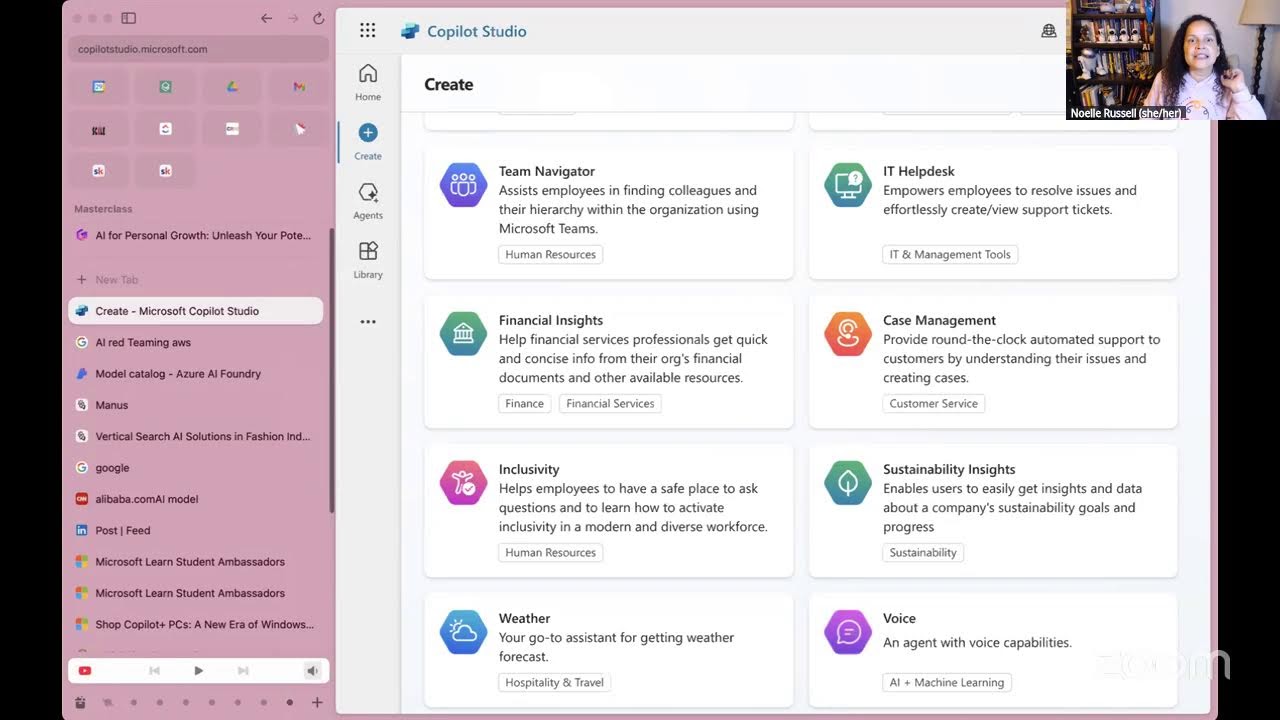
Oh, one of our little guys is running out of juice. Hi, Margaret. Good to see you, Tara, Joe. Good to see you all. Uh-oh. I don't know what's gonna happen. What is happening? All right, here we go. Yuta! All right, I am— oh, I think we're good to go. I'm gonna go on to Amazon Live. So we have a new platform that we've been testing out, Amazon Live. See how it goes. Oh boy, my cat's gonna attack this thing. Oh my goodness. I hope it works. Let's see what happens. I did it right. Uh-oh, it says waiting for video stream data. It does not seem to be working. All right, well, I tried it. All right, let's see here. Let me now— Wow, we're live. So hi, everybody. Oh my gosh. Oh my gosh! Yeah, you guys need to take a nap. Thanks for being here. I like— I appreciate you entertaining me for a moment. Thanks. Go to sleep. Go to sleep. Hello everyone, welcome in. Happy Monday. Normally we do these on Fridays, but happy Monday. Nice to have you all here. I was planning on going live on a new platform, but Apparently my RTMP code is not the same the second time I use it. So anyway, we'll fix it next time. But great to see you all. Thanks for chiming in. This is our I Love AI community call where I share with you a little bit about what we're doing to increase our understanding and usage of AI in the world. So many of us are using AI in different ways. So it's not only a chance to hear from my perspective, but also a chance to connect with people that are on this journey with you, and that is everyone in the comments, in the chat, in the live. Oh, I know. Thank you. Yes, Margaret, you are absolutely right. I should actually just pick those up right now. So we had a little, little sunny-side-up sandwich. So thank you for that. It's done now. You can relax. And a bear claw. Oops. And a bear claw. So here, can you see it? Anyway, so I will— everyone seems to be busy eating things, so I will just put those right here. Super fun. Amazing. So let's see, you know what I'm gonna do? I got an idea. I got an idea. I'm gonna actually go live on Amazon right now, just differently. Let's do this and save and preview. Let's go. Oh, enable camera, allow. So we'll just be doing more than one. So if you see me look around, uh, that's where I am. Here we go. Oh, let me make that a little bit better. Um, Use some of my swag. There we go. Oh, I love it. I love it. All right, here we go. Go live. So now I'm on Amazon. Amazon has this really cool creators program called Amazon Live Influencers, and I was given an opportunity to join that program during COVID I shouldn't say given, I took it. They sent out a note saying they were looking for live creators to support the cause, and I was like, Sure, I'll go live on Amazon every so often. Hi everybody, welcome! Um, so, uh, so yes, uh, pretty, pretty exciting. I don't know if I got all the cat swipe stuff, but we'll see. I'm gonna also put this right in the middle. There we go. Okay, awesome. Now let's see what we are up to today. So welcome to this amazing weekly call. We actually may have two this week, or we might have to have two on this Monday. Oh, next Monday I'll be in Lisbon. So we'll be doing this call on Friday. But typically they operate on Fridays where you get a chance to come on into either my home or wherever I am in the world and hear about all things AI from my perspective and what I'm doing in the world right now. So as I mentioned, you know, I'm a big fan of— I like robots. So I always like to— I'm usually playing around with them, or they're just playing in the background. I often use them for timers and celebrations. My son's birthday yesterday, uh, he turned the big 2-0, so we did a little robot party, um, and we're singing again today because we don't just do birthdays one day. Uh, it is a week-long affair. And then, um, come Sunday, it's my birthday. Yeah. Uh, so Sunday, March 16th, 3-16, the numbers of hope, I will be celebrating my birthday. So I'm super excited for that as well. And on my birthday, I'll be heading to Lisbon, Portugal for an amazing week. Not just birthday festivities, but to actually speak at an incredible internal event for Boston Consulting Group, and I couldn't be more excited for that. So, so really cool, very exciting, so exciting. So over the weekend on Saturday, I had an opportunity to do one of my first Amazon Lives since COVID actually, and I wanted to do it because International Women's Day was on. Oh my goodness, Kat. International Women's Day was on Saturday. However, it is International Women's Month. So what that means is that all day long, every day is Women's Day. We are really working on equality and equity, two very different topics for women, both in the workplace and careers and founders and VC funding across the board. And what we've realized, or come to realize, is that the World Economic Forum, as well as an organization called— oh, I should share my screen and show you this one, but it's called— it's actually a division of the Gates Foundation. Represent— oh my gosh, what was the name of that, that report? Representation Matters. And Representation Matters, this subset of functionality, or this organization, They do a report where they actually look at representation across corporate America and kind of tell us the status. And, uh, at the World Economic Forum this year, as they do every year, they release statistics. And what they've identified now is that it'll take 137 years at the current pace of innovation to actually see equity for women in the workplace as far as pay and, uh, titles and opportunities and responsibility is concerned. 137 years. Now here's the good news, my friends. If I can even call it that, is that it was 208 years. That's how long we were away. 208 years, just 5 years ago. So 5 years ago, it was going to take 208 years in order to see parity. Now it's 137. So we are doing a good job, but not nearly good enough. Um, so— oh, thank you. Uh, so please know that anything that you can do to support women, like women authors, which is what I did on Amazon Live on Sunday— Saturday, um, is that I, uh, created an opportunity for people to hear from authors, not just current authors, which there are many, um, but also authors from before. And I didn't go into nearly as many as I could have. I just went through the books that were kind of on my shelf, um, at the time. Uh, but we talked about voice, people who have been writing about voice technology, AI, in the world of natural language processing, in the world of speech recognition, of voice design, Alexa skills, Google Assistant, Siri, like these types of developers. Though today we kind of take for granted the ability to just talk to our tech, it is and has been some of the most like groundbreaking kind of ideas around how to design technology you can talk to. Now today you can one 100% design technology you can talk to. The technology has been out. It's mature. It's ready to use. But do you know how to use it safely, responsibly, and most importantly, successfully? Because so many projects die on the vine. Many, many projects, AI projects, never see the light of day just surely because they don't really understand the world of AI from this perspective. So I encourage you to take a look at that Amazon Live. You can go, you could follow me. I think I'm just amazon.com/live/noelle. So you can find my link. You can listen to all my previous, my previous podcast episodes, and it'll give you a sense of kind of who and what I'm thinking about and caring about. But most importantly, it'll give you some really cool authors that you can check out. So that being said, I always do like to give you a sense of what's happening both in the I Love AI community as well as for Noelle. Abroad. So I'll just be walking through some of the events we have coming up as well as some of the ones that we just completed. First off, first and foremost, February was an amazing month for me. I love it. It's the first month I really start getting back on the speaking circuit and start meeting people live. Really great. Had some amazing adventures. But my journey into March started this week at Capicuity. Capicuity had a client event for their clients, partners, for their entire ecosystem. And I was in a— I was given a chance to speak to them. I delivered a keynote on scaling responsible AI and how important it is for our unique perspectives to be brought to the table in building AI. Because when you start building an AI system, no matter who you think you're building it for, it will likely serve way more people than that. And it is our responsibility to actually design with that in mind, to think about that, before we even hit production or even testing. We should know and be working very closely with the very people we're trying to serve and expanding our idea of who that is every single day. And so that is, that was a wonderful opportunity I got to do. That was at the Hard Rock in Orlando, which is always really fun. And then follow that up with Nebraska. So I got a chance. It's so cool. I got a chance to go to the University of Nebraska and talk to them. We have some alums in the house, so shout out to you all. I love it because it's in business. Noelle's business. So I like everything Nebraska has an N on it. I'm Noelle, so I felt very much at home. So I now have little swag all over the place that has Noelle or N on it. So I'm a big fan. And I don't know if you all know, but many times I take the stage, I wear a shirt that says, I love AI. And in that, on that, and it's a black shirt with red and white lettering. And anyway, super fun. So I felt right on brand when I was at that event. But at the University of Nebraska, I also got a chance to share a slightly different perspective as opposed to— oh, and fun fact, I don't know if you know this. But we are now seeing data come out of, you know, the McKinseys, Deloites, big consulting firms of the world that shares one of the areas, one of the verticals for the highest level of ROI, meaning per dollar you invest in AI, the return on investment you'll get back from those AI initiatives. Like, we are seeing that financial services is reaping the largest benefits. Who knew? So I, I share that with you for those of you in finance or those of you looking to find your way. Financial services is a huge opportunity to actually generate results leveraging this technology, mostly because, as you may know about finance organizations, they tend to not adopt the latest and greatest technology immediately. But once it's proven, they do start adopting it. But as a result of this, there's many parts of the entire workflow, sets of workflows that financial services organizations have to do that AI is ripe to help take over those, those specific tasks. Now, as many of you know, I, I believe that AI is an incredible task killer, that what we do at the AI Leadership Institute is we go into organizations and we help them do what's called an AI impact assessment. And in that impact assessment, we literally will just say, okay, do your thing, human. And we let the humans do the work. We observe that work, and then we can identify areas of friction. And usually that friction is because either the human runs into an application that's old or doesn't really work well or run into a situation where they have to manually process something or any of these types of things. And so when, when that happens, it's a great opportunity for us to co-create with an AI system how to reduce that friction. Now, notice I don't say remove, though I have in many cases removed friction entirely from business processes. It is not the ultimate goal, right? The goal is just to keep the human engaged, productive, winning. And AI systems can do this very, very well, especially with humans that are willing to orchestrate and architect those interactions, those system-to-system interactions. Many of you know we're in the world of agentic AI. Many of you saw my big unveiling of, the— I don't know if you'd call it an award, but basically, there's a leaderboard for influencers, run by an organization called Thinkers360. And I recently hit the top of that leaderboard by lot. But hit the top of that leaderboard for agentic AI. I'm also in the top 10 for generative AI, in the top 25 for artificial intelligence. And, and the reason for this is because I do things just like this. I take what I'm learning and I share it with you. So let's get to some of the more pertinent, pertinent, maybe updates that are happening in the world of AI. But before I do that, I do wanna share with you, hey, my Atlanta peeps. I'm gonna be in Atlanta starting tomorrow. I will be there for a couple days. If you are around, please let me know. It'd be great to hang out. We might all meet up at a Starbucks and get to know each other. But I always believe in connecting with my community. So if you're part of the I Love AI community, reach out, let me know. We're gonna be live in Atlanta. I will be at the NRECA event. And NRECA is the National Renewable? No, hold on. Anyway, it's an energy consortium, but it's basically for co-ops that own local municipality type energy organizations, and I could not be more excited to be going there. And so that's in Atlanta. Super excited, can't wait. And you'll probably see some posts of me there when we get there. But I'm really big in energy. I'm also on the leaderboard for energy, surprisingly. But I was at REPower last year, which was the renewable energy conference with 40,000 people. I also spoke at another energy co-op association last year as well. So I do feel like, you know, I mean, sustainability is a big term, but I think in the world of artificial intelligence, understanding kind of the energy landscape, it's important for a couple reasons. One, we're starting to see these massive infrastructure investments by companies like OpenAI and Meta, right? I'm sure you all have seen the, the The story's a couple weeks old now, but this massive investment, right? Stargate, isn't that what it's called? Yeah, yeah. $500 million investment, half a trillion dollar investment in AI infrastructure, much of it going to Texas. But with that infrastructure comes energy consumption. And so the energy world, which has been pretty, I don't know, let's call it like stable, is now starting to see a very big uptick in utilization, grid optimization requirements, like All sorts of things are really changing for the energy industry as a result of these massive investments. Luckily, it's not overnight. So once these investments are announced, it gives the industry a chance to kind of regroup. But in order to regroup, you're gonna have people who need to have a growth mindset of, wow, we're not gonna be able to do the things that we did last year or 5 years ago or 25 years ago. We're gonna have to reinvent what energy consumption looks like at scale. Scale. And that, I think, is a really cool and fun conversation. So I encourage you to follow these organizations that are leading these conversations and, and listen in, listen in on some of these, including my keynote, which is on Wednesday. I will be in Lisbon next week for my birthday week. I'll be in Lisbon, and then as after that, I will be in Vegas for a few days, and then I'll be headed to my favorite week of the year. M— Microsoft's MVP Summit, where I get to learn all of the crazy new things that are coming down the pipe, as well as give feedback to the products that I use every single day. This would be like AI Foundry, which I am in every single day these days, and leveraging the ability to create custom Copilots. And for me, AI Foundry and custom Copilot Studio go hand in hand, especially in the world of agentic AI. Here's the reality that I see when I go into a client or when a client asks me to get on the phone with them and talk about their solution. What they are asking me is how to get results. They're not so much interested in how, like, what tool I use or what model I use or how safe it is. That's my responsibility as a practitioner, and that's your responsibility too as a practitioner, is that when somebody goes, oh my gosh, that's so cool, how can we do that? That I layer in, that I infuse that conversation not only with the amazing cool things they can do, but also enter, right, our baby Tiger. Also educate them on the Bruiser syndrome. This is Bruiser, everybody. I don't know if you've seen me at a keynote recently, but this Bruiser, he comes, hangs out with me every so often. I try to take him on every stage that I go on. But Bruiser gives me the opportunity— I should have added him to my Amazon Live. Y'all could buy one of your own. But Bruiser gives me the opportunity to talk about how AI is working today. And the analogy I like to use is everyone's adopting a baby tiger, right? Like everyone's adopting a little baby tiger and this little baby tiger, it's cute. It does cute things. It's pretty novel. Everyone likes it. It's kind of exciting. It literally generates this huge amount of enthusiasm about what's possible. But most people in that baby tiger mode are not thinking about what happens when the tiger grows up. They're not thinking about how big it's gonna get or what it's gonna need to eat. Or how often it needs to eat, or where it's gonna live, or what happens if they don't want it anymore. None of those questions usually come up in baby tiger, it's so cute, oh my goodness face. So I like, you know, introducing this concept to people both on every stage I'm on as well as in my new book, Scaling Responsible AI. And it's literally from enthusiasm to execution, which is from baby tiger mode to big tiger mode. Let's make sure we build tigers big AI systems. You never know how big it's gonna get, but when it does start to grow, we wanna be prepared for that growth and we wanna be building scalable solutions. Meaning we're thinking about transparency, explainability, fairness, trust, security. Not super fun conversations in baby tiger mode, right? Because you're like, but it's so cute. These are harder questions. They take longer to answer, but hugely worthwhile because we get to deliver more value to more people over a longer period of time. While we are very excited about some of the AI models that have just hit the market, one of— oh, thank you, National Rural Electronic Cooperative. Thank you, Sherrilyn. Sherrilyn was nice enough to throw my Enrica— I'm not great. I know the acronyms. I just don't, you know, it's like IBM. What is that again? That one I know. 12 years at IBM. I will always remember International Business Machines or How minus one. Some of you know what I'm talking about, but thank you for that. And it is the Rural Electronic Cooperative or Electric Cooperative. So I'm super excited to be talking to those organizations because I believe AI is a rising tide that everyone should be able to do more, get better, you know, elevate their status, elevate their ability to deliver services. AI is an amplifier. It allows you to just do more if you know how to do it and know how to do it safely. So really excited. Yeah, right, Joe. All right, cool. Thank you. I know it was a myth, a myth or real, whatever. It was an urban legend, as they say, HAL being IBM one letter away. I think it's kind of fun. Alright. So cool. So here we go. Let's see here. What else did I wanna share with you? Oh, yes, of course. So let me go over here and launch. I'm gonna, I'm gonna share with you a couple tools that recently hit the market that I think you'll enjoy. I mean, I hope you do. Anyone, if you are here in the Zoom and you have a tool, I don't— if you can think of a tool that came out this week that you— well, if you think of one, just throw it in. We'll play around with it. See, see if we can play around with it. One of the things I did finally do was break down, um, because I really liked Sora and I ran out of credits. So guess what I had to do? Yeah, Noelle's a pro member. Oh yeah, why? You're the second person to mention Sesame to me today. So here's a fun thing I got to do earlier today. I was invited by, um, a news, uh, organization in Ireland to join their radio show this morning, which had been in their— yeah, this morning or their afternoon. Anyway, I think they're gonna be playing it tomorrow. It was a recorded session. But it was in an interview about the state of AI. And one thing that was fascinating to me about this interview was, number one, we, we talked about a couple of these different models. Alibaba's new model, which most people— it's funny because they're like, you know, the new model from China. And I'm like, I mean, yes, but it's also a really popular company that we as a world we have invested heavily in over the last 10 years, 15 years, maybe longer. But Alibaba came out with a new model, which I think is really cool. And so let me see here if I can pull it up and let you all see it. But the other one is Sesame. That was another one that the radio host brought up. And the perception, though, I uncovered was that AI was kinda like this big thing, like a singular thing. And so I wanna encourage you, as this is our I Love AI community, and it's meant to bring in people of all AI levels, whether you are a 12-year-old trying to figure it out or you are an 85-year-old trying to figure it out, that we have all of these different levels. I wanna make sure we get We, we know, and again, most of you all on my Zoom know this, but AI is not one big thing, right? The way he was talking about it, I was surprised to hear him be like, you know, this monolithic button that you press. And I was very clear about telling him and sharing with him that actually there are hundreds of thousands— oh wait, millions of models. Just ask Hugging Face. Millions of models that are now available. And Hugging Face, granted, has a lot, but Hugging Face plus, you know, AI, Microsoft has its own catalog of models. Cohere, like Anthropic, like Meta. You start adding thousands and thousands and thousands of models. So when you start saying things like AI does this, one of the questions he asked me, he's like, I mean, can— is AI getting better at answering questions? And I was like, that's surprising because yes, but, but not in the sense that there's a big AI that's getting better at a global scale, but that there are millions of little models getting very good at very specific tasks. And I do think that this is the evolution of agentic AI, that we are building smaller models. Actually, it was one of the questions I got from the stage at the University of Nebraska. Where there was a government contractor in the audience, female-run, awesome government contractor in the audience. And she said, she asked me, she's like, can you, you know, help educate the audience on small language models versus large language models? And I do see this as a trend that we're— there's a couple trends in here. One trend is, do I need to use a public model to do things? And I know some of you have been with me for a long time and you know better now. But there's a huge world out there of millions of users on these models. Millions of users, dare I say a billion users, um, of these models, right? Of all the ones I mentioned, Anthropic's like Claude and Meta's models and AWS's models and Microsoft's and Google's and IBM's. Like across all of them, we have billions, billions of people interacting, or at least inferences happening against these models every single day. What I'm worried about now, having been interviewed twice and asked this question twice, is that the world does not really understand that there are specific models for specific things, and that even ChatGPT itself was an 8-headed model, meaning that there were a bunch of little models, little in the, to the tune of billions of parameters. But you know what I'm saying, right? Like little billion parameter models combined together to create a massive trillion parameter model. And I just, yeah, I'm, I'm a little bit worried that we think that there's some big, you know, Oz behind the curtain making this AI thing happen when it actually is a vast variety of models and that we have way more control over those models being selected and used in our solution than we think. And certainly than we're taking advantage of right now. Most of you know this, I'm a huge fan of the work Oops, sorry. I'm a huge fan of the work that they're doing at Stanford, in human-centered AI. They just had an event called AI in Action in Paris. I was at another event, or I totally would've been there. What an amazing event. But Fei-Fei Li was there. She did the opening keynote. I do believe it's on YouTube. If I find it, I'll definitely share it with you in the AI Leadership Institute. But there were a lot of really interesting conversations from people, honestly, that surprised me. But what I liked about this was the concept, of course, of the session was it's AI in action, what's working right now. And one thing that I find when I go into an organization that I often surprise them with is, number one, that you build for safety and security. That when you first start your journey into AI, the first thing you're going to do is identify a problem, and then you're going to figure out how you're gonna measure the effectiveness of your solution against that problem space. Like, you have to know the target you're going for and how you're gonna know when you hit that target. It's the number one reason why AI projects fail is because we don't accurately identify the thing we're trying to do. But the difference between where we were 3 years ago and where we are now is that we can actually build very fine-grained, model-driven solutions for each part of that solution that we wanna build. Like, we don't need one model to rule them all. Right? I used to say that all the time and kinda giggle to myself. I think on one of my podcasts, I had little, fake elf ears. So I, I wanted, I wanted that to be true to some degree because I like saying it, one model to rule them all. But the reality is, is that there won't be one model to rule them all. There might be one UI, right? One user experience. There might be an Alexa Plus, right? That's coming. Oops, sorry. Alexa Plus is coming to the stage. It's leveraging Anthropic. Oh my gosh, did you all see the latest update on that? That Apple— Apple was going with— in one direction, uh, and then decided now that they're going to go with Google as their model. We'll see what happens. It is still the Wild West out there, um, so you never know, right? All right, Cynthia, 100%. Um, so really crazy. Um, oh my gosh, I love Ren and Stimpy. Joe, we're such good We're like peas in a pod. Uh, we think the same things. I try not to say all the things I, I think, but other people will write me and be like, I know what you were doing there. So it's really fun. Um, all right. So, so yeah, so really interesting, like, changes. Go ahead and take a look at that. I encourage you to research for yourself. I'm just giving you little directional access, uh, to pockets of information in this crazy world of information and misinformation. But that is an interesting thread to pull on is the decisioning behind Apple Siri, the Apple intelligence in Siri. Now, granted— oh, I'm using my phone for Amazon Live. Hi, everybody. So on my phone, for example, I'm a huge fan of Siri and the new Apple intelligence. I was a beta tester on it. I like— I love it. And I love it because it represents a new age in technology. Like, I try not to take too much of any of the models that I use today too seriously. Unless I own the model and I own the data it's inferencing from and I own the infrastructure in which it's running, I try not to take it too seriously because I don't own it and I can't control it. But what you can control is the models you select. And as I was mentioning Stanford and their AI in Action event, one of the, one of the frameworks that they developed over the last 5, 7 years, is called the Holistic Evaluation of Language Models or HELM. And it's got a cute little boat logo, but it's on GitHub. You can download it to your computer. There's Helm Lite, and it allows you to benchmark models against a standardized set of metrics. And this is something that I feel should happen kind of on day one, baby tiger mode. It's a baby. How bad will it be? How, how mischievous will this tiger be? How unfair will it be? How insecure will it be? How inaccurate will it be? The earlier I know that, the more the easier it is for me to mitigate those risks. The reason most people use a model is sheer marketing. Sheer marketing. That's why, you know, many of us went to Deepseek. If Deepseek didn't just say like, hey, I mean, granted their performance, of course, bar none, right? Gotta give it to 'em. But it's a marketing play. ChatGPT, same thing. Like, it, it is how many eyeballs can they get on this? Their content goes viral on platforms they have relationships with. Hmm. Right. It's very fascinating to see kind of the world that we are in right now. Oh, awesome. Thank you, Sherilyn. So this— so in the chat, for those of you on Zoom and you are all welcome to be on Zoom, all you have to do is join us here. Oh, I haven't shared my screen yet, but you can join us here in Zoom every single week. It is— you can easily find it by just going to Noelle, my first name, N-O-E-L-L-E ai, uh, and you can join us either in our free community or in our premium community where we actually get our fingers on a keyboard and build something together every single month. Well, we— I meant to get— we did actually build stuff together last month. Um, however, I had a big project that I wanted us to do together, and because I was traveling last week and my flights got all messed up, I ended up not being home during our next live learning lab together. So in the AI Leadership Institute, and for those of you who are— hopefully you'll be around. But in our, in our AI Leadership Institute, every month we do a live learning lab. And this week on Thursday night, we will be doing the live learning lab that's all about AI Builder. Have you heard of AI Builder? This is a no-code platform provided as part of Power Platform on Microsoft. But it is, it's cool because when it first came out, it was super lightweight. So lightweight, I couldn't even really figure out, like, I was like, why, why do this if I can use— in that case, back then it was AI Studio. I was like, I'd rather just build it myself. But now with all of these applied models, with the concept of agentic, you now have an orchestration platform to pull a bunch of models together, tie them together, provide little orchestration instructions between each system. It's super fun. So I went through this workshop with another team, and I was like, you know what? I should share this with people. So this coming Thursday, again, you have to be a member of the AI Leadership Institute to join. However, it is free to join for 7 days. So if you wanna join and see if you like it, see if you like hanging out with us. We have a different type of conversation. It's much more for doers, not just talkers. We do a lot of labs. We also launch new initiatives. But this coming Thursday, and it's an evening session from 8:00 PM to 10:00 PM. However, that evening session will be recorded. So if you can't catch us live, you can always catch the replay. But like I said, that is only available to our premium members of the AI Leadership Institute. So I hope you'll join us. If nothing else, join for free, take the class, and then either fall in love with our community or don't. Either way. But I would love to have you there because it's really cool. And critical to put your fingers on a keyboard and build something. That brings me to another announcement. I was part of an incredible campaign at a company called Gravitas, a business consulting firm. Gravitas created— I don't have it on right now, but they created us beautiful blouses that were a, a collection of women's suffrage, uh, snippets from the news all over my shirt. You can see my live on, um, Saturday, that live I was wearing that shirt. And this campaign was all about taking action in 2025. And for those of you who are women, it was specifically geared to how do we change this equity conversation, this, you know, how do I make sure that I am putting myself in the right position in order to be as successful as possible at the things I choose to go after? And so Gravitas put together 25 actions you can take in 2025. So 25 and 25. And, uh, mine is down at the bottom because it might be hard, uh, but it's learning by doing. Of course it is. So learning by doing. And again, regardless of your gender, I think it's a great list to look at. Talks about advocating for your own brand, creating, uh, yourself as a thought leadership— thought leader and an expert. But more also, you know, how do you take care of yourself? How do you make sure you put health first? How do you put your fingers on the keyboard and build something awesome. There's 25 different things that you can take on this year and ways to kind of track your progress against those 25 actions. So it's pretty cool. So, uh, that is on LinkedIn. I'll also repost it inside the community so you can all participate and play along. You can even for the month of March, you can buy that shirt, um, at— and all the proceeds of that shirt, I don't remember how much, but the proceeds of that shirt will go towards the campaign and increasing awareness and equity for women worldwide. So super, I think, really critical and important campaign. Awesome. Oh, yeah. Thank you. Thank you again. Let's see. Okay, great. So let's see. All right, here we go. So let's see if we can see it here. So the— I wanted to take a little bit of time to talk about the model that Alibaba launched, Manus.ai, I think it's called. Nope, just kidding. Maybe it's Manus.com. It was created by Alibaba, so they probably could buy whatever one they wanted. M-A-N-U-S. Let's call it— anyone remember the extension? I'm looking. Let's see, let's do Manus.com. Nope. Just Google it, someone said. Fine, I'll just Google it. Um, do you remember what the— oh yeah, I am. Thank you, thank you. That's it. See, this is why we have community. It takes a community. Manus.am. Beautiful. Let me share my screen really quickly. Hopefully Here we go. Share. And it's really cool. They update it often. So every day there's new content on this page. So I think it's a good idea to kind of keep an eye on it. It is a Chinese company. Um, but again, we, that's not new, uh, us using, you know, leveraging Chinese companies. Our awareness in the whole AI race, arms race or war or whatever we're doing, um, that's a little new. Uh, but, but us collaborating with China, I mean, many of like the people that I am, Asian Americans, like that is a huge area, like people that I have interacted with, probably even in a large scale in the world of AI. And so yeah, I met quite a few of my friends that are involved in this project. And so I was like, I wanna talk about it. Alright, so here you go. Leave it to Manus. And, and this, like I said, what I liked about it is that every day they're updating it and they're updating it based on people who have access. Now, if you want to get access, the best thing you can do is actually apply to get access. So either you'll get an invitation code, which you— if you have, awesome. But otherwise, you could just apply for access and tell them why you deserve to have access. And so that is how you get an account. Remember, this is a long game. So, so many people are like, I want it right now. And if you can't have it right now, you don't even try. I would encourage you to apply because this is not the only model that they will build, and they will likely all go through this application route just like we did in OpenAI. And getting access, once you're in, you get access to all of the models that come out. So I'd encourage you to do that and get started. Let's look at some of the use cases though. So what I liked about what they do is they keep adding use cases. And what they do, and I've posted a couple of them to our community, but let's see, let's see, Tesla stocks. No, I don't really wanna amplify that. Okay, research AI products for the clothing industry. So I'm gonna go into these use case, and what they've done is they've actually given you the prompt and then allow you to watch what hap— what happen if you execute that prompt, generate answers for that prompt. Notice here what it's doing is it's— all of these are like little agents researching a bunch of little things, and then it's going to aggregate all of that into a result. So it's fascinating to watch. Like, I just go through. I mean, it's almost the same as typing that prompt in yourself. The only thing obviously is that you can't interact with it, correct it, etcetera. But I try to run all of them just to kinda see how's it thinking. Okay. I see you're creating a file, editing a file. Oh, I see you're building a markdown that will be the solution. And this is what it ends up generating, right? This executive summary that we'll talk through. All the things, and it's a pretty long document giving you a list of a ton of products. Now, I originally, I think I posted one of the first use cases, which was in financial services, and I was fascinated by the financial services market. Again, I meant, as I already mentioned, but I was fascinated because it does generate, like, in financial services, a lot of the work is reading, summarizing, aggregating, pulling information, assessing, and that information is complemented very well by an AI model. That's a good question, Yuta. I actually would imagine that it's just like Deepseek. So when Deepseek first came out and Manus just came out, it was available on its own. Then it became part of the AI model catalog at Microsoft. And so oftentimes they go through a bunch of, you know, productivity or productive production, verifications first, security, safety, etc. And so, yeah, so I think that would be 100%. It will be available. I don't know that it is yet. That being said, I do want to encourage you all to learn by doing. Of course, come do it with us in our AI builder, but I want to give you a tool. To actually encourage and enhance your own, your own learning as well. So I'm just gonna take a look at the AI Foundry. This is where, like I said, I spent a lot of time here. So I'm gonna go into the AI Foundry just so you can kind of see. Oh, no, that's the Learn. But yeah, sure, I'll throw this in the link so you can actually go learn about it. So I'll throw this link into the chat. Oh, I noticed I threw a couple links into the chat and Thank you, Sherilyn. And I sent it to hosts and panelists, which means just me. So sorry you guys didn't see that, but I'll— we— Sherilyn ended up putting them in there as well. But this is the understanding, like, this will give you Microsoft Learns, like a class you can take on the Foundry. But let me go back and actually take you to the Foundry itself. So this is on Azure AI. It's part of the Azure AI ecosystem. It is a It is an evolution. So let me go into the model catalog. Let me put this away. Let's make it a little bigger. Let me see if I can make it even bigger than that. There we go. That's a little bit easier. Hopefully you all can see that. Okay. But you'll notice DeepSeq V3 is here. So what it does is it allows just like you had just said, you know, right? Oh, oh, maybe. Yeah. That it's important to be able to use it through a trusted source. So many companies, enterprise, organizations trust Microsoft not only with their AI solutions, but with their entire enterprise ecosystem. And so this is an opportunity to get access to those models through this lens. The benefit of that, and I don't know how much you all know about this, but when you leverage an AI model, Microsoft has a very successful, really amazing team in Trustworthy AI.. It is a 3-pronged team, which I have replicated their model in my clients as well. This 3-pronged team has 3 layers to it. One is academia. There's a person on the team that runs relationships with academia to pull the best models and best research in order to inform the production results. The second prong of that is, uh, so academia is, uh, regulation and policy. So someone who's connected to government connected to compliance, usually very keen on understanding how to ensure that the system is safe and secure. And then AI product, right? So whenever you see a product that comes out of Trustworthy AI, it's not just a product team that built something. It came out of research, out of compliance and regulation, and then was derived into a product that we see in our, our, our technology. And what I love about it is that any time you use a product, AI Foundry included, anytime you use a product inside of Microsoft, those 3 lenses are used on top of the models that you're using, meaning an AI safety system is in place. If you've looked at Azure Content Safety, that is a lens upon which that model will be leveraged. So even though you're using that model, it's going to have safety precautions and mechanisms placed within it that you can enable. Now, I do often tell people when you use models, through a catalog, those models are as safe and responsible as you are. They are capable of in— including all of these amazing tools and technologies from a platform like Microsoft. But it's up to you as the solution architect, up to you as the implementer to actually check those boxes and turn those systems and services on. Oh yeah, absolutely. So the three-pronged team, and like I said, I'm a big believer in this, is having someone who has tight relationships or even is a representation of academia, whether that's Stanford's, you know, HAI, whether that's MIT, like someone who has deep roots in academia, someone who has deep roots in policy and regulation. That's Natasha, um, Crawford, Cranford. Anyway, look her up, Natasha AI Policy. Um, and, uh, and then also product. So someone who's driving product development someone who's driving policy and regulatory adherence, and someone who's driving academic research and infusing that research into your industry solutions. Thanks for that question. Okay, awesome. And I need to make sure that I don't see any— oh, you can always throw questions in the Q&A just in case this chat scrolls past and I don't see it. Oh, I remember I also have a chat open here for our live people. Oh, it's not— yeah, okay. Oh yeah, I see it. We're good. So good to see you all. Thank you for chatting. So I just wanted to share this with you because the model catalog is pretty extensive. I'm gonna shut down the help so we can see more of it. But I'll just like, there's a lot in here, way more than people think. Most people, when they think of Azure AI, they think of OpenAI service, but it's just one model. Now the benefit of Azure OpenAI service is that it is ChatGPT's and OpenAI's innovation and, you know, model creation. But it's those models n-1, which is what I use to frame the idea of they take that model and then they work with it and make sure that it's production ready before exposing it through a catalog that we can then use. So take advantage of that, right? We don't necessarily, and I think it goes to that question, like, rather than going directly to the source of a model and using it, which you can do, why not go through a trusted, you know, advisor, if you will, or trusted platform? Amazon is the same way. So I don't wanna, you know, like, obviously y'all know I'm a Microsoft MVP. And so I like Microsoft technology. I use it every day. But I also grew up at Amazon and in Amazon AI, which back then was just Amazon Alexa. But the applied AI services that came out of Alexa, which is like Lex and Polly and Recognize, I think it was. Anyway, there was a bunch of them. And now there's, you know, of course, Bedrock and SageMaker. So that AI evolution, similarly, you'll want to understand, like, what models do they provide and what is the— like, what do they do to those models before you see them, before you use them? And if not, how do you build a well-architected AI solution? Amazon, Microsoft, and Google have all documented what well-architected AI solutions look like. Many times they have documented— actually, each one of those 3 have also documented their AI red teaming approach. So what I always like to do every so often is just do a search on AI red teaming just to see what's going on. I actually have a Google alert that keeps me up to date. But when you scroll down, you'll see, of course, Microsoft has done the most to advocate for organizations to build their own AI red teams. Now, while I am a consultant and my team is often asked to help an organization build an AI red team, I am not a believer that you outsource this work because it's based on how does this model serve the client, the customers, the, the employees. Like, it's very intrinsic to the core values of the organization itself. And who better to build for that, test for that, and harden the model for production than people who already work there. So I'm a big believer in enabling organizations to find those people inside their own walls and build those systems. And I, I, I mentioned this to, to you all on the last call. What I'm seeing now is that there is an entire world of people that care about diversity and equity and inclusion and inclusive engineering processes and, and practices, and they are perfect for this role because they already are empathetic to users that either you're attempting to reach out to or those that you might accidentally contact with this AI model that you're building. And so those people that are in those kind of DEI roles, organizations, or just passionate to the cause end up being very successful, members of an AI red team. So it's kind of nice. You can go in, you can see IBM Research, right, has their own perspective. Harvard wrote a guide on it that's a little bit dated. It was— it's almost 2 years, or I guess a year and 3 months ago. But AI red teaming is relatively new. So that document is still as good as it is today as it was last year. However, last year, nobody was really ready to have a red teaming conversation. We have a lot more people doing that today. And then what I often will do is just augment the concept of red teaming with AWS or Google or whatever, Cohere, and they will give, if they have any content, and you can see here AWS has its own professional services organization to help you do this for yourself. So these are important terms. Again, there's so much you can search for in the world of AI, but I think it's important to realize, like, once you get to a point where you've proven that the thing you wanna do is worth doing, the next critical thing you're gonna need to think about is how does this scale, right? How does the baby tiger become a big tiger and the big tiger, you know, not hurt anybody? Awesome. Alright. So this is where I spend probably half of my building time. The other half, I do really like Copilot Studio. I'm a big fan. Number one, the reason why, and I won't quote exactly the number, but there is an incredibly large number of enterprises that are running Microsoft Office. Today. They are one conversation away from turning on Copilot. Many of them have turned on Copilot and they don't know how to use it. So there's a huge opportunity for us as leaders in AI, which all of you are, whether you are just starting to embrace that concept or not. But as leaders in AI, we can go in and help them with their adoption. 25% of an AI solution is in the technical implementation. 75% is in getting people to actually use the thing you built. 75%. And I've watched very good companies fail very badly in this space. Go-to-market. Like most engineers, we didn't even, I, I mean, I don't even think when I was an engineer, um, at IBM, I don't even think I knew what the word GTM meant or go-to-market. Like that wasn't in my realm of understanding. I was building solutions to solve business problems. How would it actually get articulated to the world? I wasn't even really that curious about. Obviously, that has changed because that's what happens when I actually start talking to my customers. I'm like, wait, what were you actually trying to do? Well, that's not what I thought you were trying to do. I thought you were trying to do this other thing. I would have built it totally different if I knew that. Now I realize the critical nature of having human interaction, right, that as part of the design process. So I'll give you my framework for building successful AI projects very quickly. As we kind of bring this to a close. And of course, I open it up to questions. What? Javier made it. Oh, I hope you were able to find the link. Okay. But thank you for being here. I'm so glad you made it. But building successful AI projects, this has not come to me easily. This has come after hundreds of projects and learning after every one. Oh, I should have done that different. And then I'd change it, and then I get a new problem. And so hopefully this will be beneficial to you and also help you reduce, like, the total time it takes you to get proficient in scaling this technology. But I'll give you the high-level overview. Obviously, this is deeply rooted in the work that's in my book. I do wanna encourage you to go, like, if you haven't preordered the book yet, you can preorder it right now. You— and we'll put the link in the chat. It actually is Upskilling. Oh, I'll type it in right now. It's, uh, www, um, w— oh, wait, let me make it a link so you all can click on it if you haven't purchased it yet. But it is, and I'll put it in the chat, um, on LinkedIn Live, www.upskilling, which someone called to buy the other day, by the way, upskilling.ai/book. This is going to take you to a special funnel And it's only around for the next 2 weeks. So when you sign up for this book, you can preorder my book, which comes out April 1st. You preorder the book, and then when you preorder the book, you're gonna get free access to my on-demand AI Bot Builder course. Some of you haven't taken it yet, but a bunch of you have that are here in the Zoom. And it's the one that I recorded in studio at the end of last year, and it is so good. I like, I, I It's funny. It's— I suck my, like, myself in. I start listening to it. I'm like, oh my gosh. Yeah. That's so good. So if you wanna learn how to build an AI system end to end in less than 4 hours, we do it through the process of building a conversational app. But in this, I teach this concept of building an AI safety system. And while I can't teach you the whole thing, I mean, it's in the course. I can't teach you the whole thing. What I do wanna do is tell you that there are 4 main components of building an AI system. And that if you miss one, it breaks and it can break in the most inopportune moment, like when your customers are trying to do something for with you, right? And buy something from you. So the 4 elements of a safe and responsible system that ends up being successful at scale is number 1, having a very specific problem that it addresses and that a very specific metric for measuring the success of that. AI models work very well when driven by data. Like, okay, I want to reduce the total time, uh, to resolution for a call center call. That metric, I'm now gonna implement AI to touch that metric, to impact that metric, right? So first thing, you gotta have a problem. Then next thing, you have to have a metric to decide whether that problem is solved correctly or not. The third thing is that you have to think about the AI Human AI experience. It's called HAX, H-A-X, human AI experience. Think about the human AI experience before you even start. You know the problem, right? You know how you're gonna solve it. Now, who are the humans that you need to surround yourself with to build this successfully? This means never for them without them. Never build a system for a community unless they are sitting next to you as part of your design and development activity. Communities. I could not stress it more. So many amazing teams, AI models die on the vine because they don't consult the very people they're trying to serve, or that worse, they consult them very briefly at the beginning and never again, or worse than that, they only consult them at the end and you're like, oops, I got that wrong. So that being said, that is the next thing. So we have the human AI experience. After you've done that part, the next part is the system prompt. How are you going to, right, make sure that the machine knows what to do? Now, we have to do less work than before in building a system prompt. Yay. However, we do still have to do some work. And so that system prompting is what I call the 5 Ps of prompt engineering. And while I won't share them with you, Now they're part of the course. But how do you make sure that the model does what it's supposed to for the right people at the right time in the right way, doesn't lie, doesn't hallucinate? There are ways to do that correctly. There are ways to create models that don't lie. Crazy, I know. So that after you include the humans, now you select a model. And as a result of selecting that model, I'll tell you, so many companies identify a problem. They identify, right, how they're gonna solve it. They get the right humans. They go after the right data. They pick the right model. And then they, they don't realize that it's a human activity to actually make sure that the model is accurate, that it's responsible, fair, that it's safe and secure. Those are human validations that happen. And oftentimes part of a red team or part of a responsible AI governance board or part of an ethical board. Someone in the organization has to be in charge of, is this model telling the truth? Is it telling the truth fairly across all of our constituents? And most importantly, is it safe and secure? Is it protecting the data? Is it guardrailed? And so Microsoft gives a lot of tools to help you with this, but without a human to own those initiatives, those things will be deprioritized by a model just based on the data that Helm shows us. The model will over time deprioritize sexism, racism, like, you know, avoiding those types of behaviors. It would become more sexist, racist, self-harm inducing. Like, it will do more of that over time if left unattended. So our job as responsible AI practitioners— welcome to the I Love AI community— is to actually take these roles seriously, find our place in it, and do the work. Now, I do have, I can hear my son yelling in the background. So sorry if I raise my voice with y'all. I get so excited about this stuff. But it's really exciting. It's an exciting time to be in this space. There's huge opportunity. Financial services are booming with AI opportunity and people organizations, human resources, human capital. Those organizations also are seeing massive opportunity in the area of AI. What they are missing are advisors, leaders, consultants, practitioners that can help them do the work that they're envisioning. And that might be you. So I encourage you to put your fingers on a keyboard, build something awesome. I'm looking at the Copilot Studio. I'll end with that. I don't know if you know this, but Copilot Studio has a bunch of agents already. I'll just take you to that page so you can see all the ones that exist. But these are the ones that come out of the box. One thing that all these companies that are investing in Copilot for their employees, one thing they do not realize is that there's a gap between what Copilot can do and what their employees need. And the answer to that gap is Copilot Studio. It is a gift that we are given. So many times do we get tech that we cannot augment, we cannot make better, we can't make fit the problem that we've chosen to, to solve. But Copilot Studio is one of many ways to solve for those gaps. So again, there's so many places that you can jump in, swim around, get to know this technology. I'm just offering you this one if you choose. I myself suffer from shiny red button syndrome, not the same red button as before, but I do suffer from like, oh my gosh, new model, new thing, new, new technology, new framework. And so I have kind of a Post-it that, that reminds me that it's important to stay focused. Find an area and stay focused on that area to solve the outcome you intended to solve. Mine, of course, is around literacy, and that's why I bring all of this information to you. I'm gonna just check really quick in our chat to make sure that we've got— yes, exactly what I have in the comments. I see an 80-year-old friend who ordered the book to learn bot building. What? That's amazing. Yes, that's what I'm talking about. I met actually multiple people. Oh, I am speaking at an age tech conference, which means that the average age of that age tech event is over the age of 65. However, many of those are over the age of 80, and all of them, I mean, 80 is the new 50, right? Like, it's— they're active. Their brains are active, they're interested, they're engaged, and most importantly, they are super excited about a world that they do not have to type on a keyboard or manage a mouse, that they could just use their voice. So it's really an opportunity for us to create more experiences for that exact demographic. And remember, never for them without them. If we can help them create experiences for their own generation, like, hello, this is where things get good. That's right, that's right. Advanced age tech power. Let's go. And there's, Of course, that's one demographic, right? There's also those who have cognitive disabilities, also people like me who are neurodiverse. All of us, we all deserve personalized experiences in a world where we can create whatever experience we want. So you might be the person to create that for us. Uh, and I encourage you to stay connected with our community. Know that you are not alone on this journey. We're all learning together. We learn new things every single week. I challenge you over the next week. To put your fingers on the keyboard, build something amazing. Doesn't matter what it is. You could use your voice, right? You could just ask ChatGPT to build something for you. Just see what you could do. I, uh, was just watching my son, um, write. He's writing a book. He's, uh, 18, is writing a, a science fiction book. And I was so inspired. I was like, I wanna write a science fiction book. I know, I know. I can't write. Maybe, I don't know. We'll see what the future holds. But I was very inspired by the way that he was using technology to amplify a dream he had in his mind to become real. That's the world we're in right now. If you dream it, you can build it, and you don't have to be an engineer to do it. Like, let's go. So anyway, that's it. That's me for today. Yes, if you— of course, if you enjoyed today's session, or if you've taken our boot camp, taken our classes, if you're part of the Institute and you haven't left us a review, I always take this opportunity to ask you for one because other people will find us through your experiences. Thank you so much for being here. Awesome time. Happy Monday. Make it a great week, and I'll see you all on Friday. Bye, everybody. See you later.
More from Noelle

Take the Unlocking AI Challenge and Get the Keys to Unlocking Time and Revenue for Your Business



Don't Get Left Behind: The AI Executive Challenge #ai #business #fearofmissingout





