AI Leadership Q&A wth Noelle
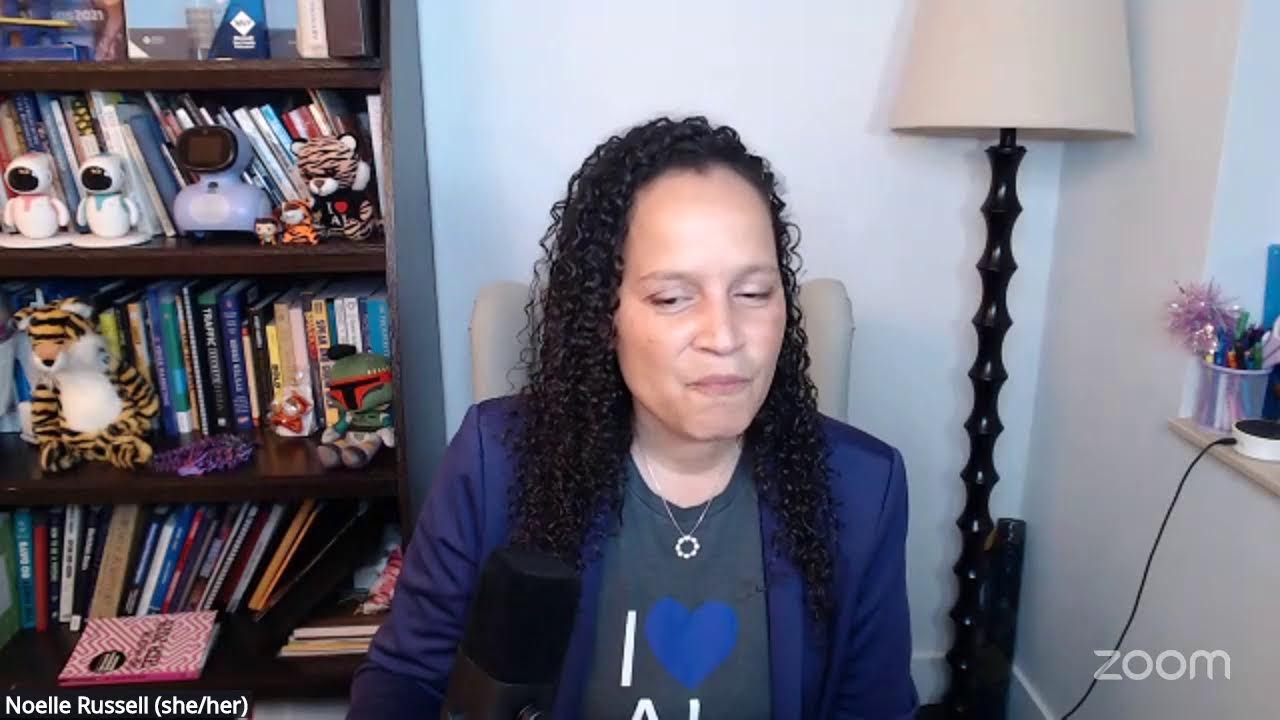
In this live community call Noelle Russell welcomes the I Love AI members, announces the kickoff of I Love AI Week and the launch of I Love AI Month (February), and rolls out a slate of new programs and resources. She promotes a Maven class on "How to Get a Job in AI" (Feb 13) with a 50 % discount, announces her upcoming book launch tour, and unveils the AI Leadership Council – a new nonprofit that funds K‑12 and community‑college AI education through tiered sponsorships. She introduces a Responsible Prompt Engineer certification, a startup accelerator delivered as a Maven course, and shares practical advice on domain/website building (GoDaddy, Namecheap, Wix, Kajabi) and on using generative AI for rapid content creation. A substantial portion of the call is devoted to a responsible‑AI playbook: defining a measurable problem, assessing data, selecting models, and applying a four‑layer safety system (human‑AI experience, system prompting, content safety, infrastructure). She uses DeepSeek as a case study, discusses model hosting (Azure Model Catalog, cloud providers), and stresses the importance of transparency, model cards, and go‑to‑market strategy. The session includes a demo of the AI Leadership Lab where custom GPT wrappers, ad copy, and assets are stored, a discussion on evaluating new AI models with a standard questionnaire, guidance on personal data privacy when using public models, and an overview of OpenAI's Operator tool for automating repetitive tasks. The tone is conversational, enthusiastic, and instructional, with a strong emphasis on community, empowerment, and ethical AI deployment.
Chapters
Welcome, welcome, welcome. It is our— hello, good to see you all. So excited to have you here. Welcome, welcome. Happy Friday. This is my favorite day, my favorite time to hang out with all you fine people. Nice to see you, Edwin and Joe and Julia, Kirk, Leo, Megan. Good to see you. Hello, Non. Awesome. Sandrine, Sherilyn, thank you for being here. Tony, awesome. And of course, people are joining, uh, every minute, every second, so I'll try. Um, yeah, it's been a minute, Joe. I'm glad you're here. Uh, I think I'm allowed to say it for one more day. Happy New Year. Someone gave me some guidance because I like literally was like, Happy New Year, because I hadn't talked to them in a while, and they were like, no, no, no, no, now you have to say— how did they phrase it? They're like, how's your year going? Or I hope your year is off to a good start. That's what they said. I hope your year's off to a good start. And I indeed hope your year is off to a good start. Welcome to the I Love AI community call. Thank you for being here. Got some fun things. Yes, absolutely. It is the Lunar New Year. So happy New Year from that perspective as well. Welcome everyone. So good to see you. So as always, for those of you who have joined the I Love AI community, it is everyone here on the Zoom call. It is an opportunity to meet people that are on a similar journey to you. If you see names you don't know, uh, or wanna connect with, you can definitely either direct message them or you could just drop your LinkedIn. Uh, I always say when I'm on a call, um, or on a open, like a community call or something like that in other communities, I always throw in my LinkedIn and hope other people will do the same. Uh, and so that I don't stay completely distracted, uh, I just click on all the links and then I go review them later and send messages to people. But community is everything, you know, our human-to-human connection. Like, it is so important. Uh, every cool, great new opportunity that I have often comes on the heels of a connection with some— with a human. Uh, and so I'm very excited about it. Uh, so definitely feel free to share. Uh, use the Zoom— or use the Zoom chat to just share your links and feel free to, um, to connect that way. So welcome everyone. Make sure I'm not missing anyone. I always like to— well, yeah, Laverne, good to see Good to see you. Awesome. And Megan, I think. Anyway, so really nice to have you here. So excited that you have joined us today. Awesome. So this is a really exciting moment for us. We are about to kick off the AI Leadership Week. It's called I Love AI Week. It is actually how our community began a year ago today. So all of you are a part of it. Some of you joined us more recently. Some of you have been here since the very beginning. So it's really exciting. February 1st launches I Love AI Month. So we have a whole bunch of content and educational resources, tutorials, guides, lives that we'll be doing every single day of February, all, all day, every day. So hopefully you all will enjoy it. It's really a chance to just embrace artificial intelligence in a way that maybe you haven't done so before. I am about to launch, so I'm gonna give this to y'all first. I need to actually go grab the link. I need to share this with you first, but one of my— the most exciting things that I will be doing this year. Let's see here. I'm gonna go ahead. Oh yeah, here it is. Is that I'm gonna share with you a link, but I have a really cool class, a Maven class that I've been asked to be a part of, and it is literally the number one question people ask me every time I get off a stage or do anything. It's the number one thing people are like, how do I get a job in AI? How do I get a role in AI? How do I leverage AI to do more? And so, uh, a friend of mine, Brian Evergreen, actually created a brand new class called How to Get a Job in AI, or How to Get a Role in AI. Um, anyway, something like that. And, uh, so there's an opportunity for you if you would like. I have the opportunity to give you access to this class. I'm actually gonna give you a 50% discount. Discount code. Again, just for my friends, just for you all. It's not my class. So obviously this is for Brian. It's Brian Evergreen's class. He came up with this idea. I think of, you know, things in kind of two different ways. One, I am incredibly excited to have an opportunity to support people's cool ideas, right? I don't know how many of you have people like this in your life. I am this person where I get an idea and then I just go and I implement it. And so Brian came to me a few weeks ago and was like, I have an idea. I want create a course on Maven that allows people to learn how to get a job in AI. And basically the way you're gonna learn is through the lens of 5 other rockstar superstars in this space. And so you'll see me, I'll be promoting this quite a bit. But as part of I Love AI Month, it's actually gonna be on, February 13th is my session. I'll be kicking off the 5-week series. That series will include not— I'll be the first one, but there are 5 other people or 4 other people including Brian, that will be talking about their journey. And all of us came to AI from different places. I don't wanna steal their thunder, but it is so interesting to find out who, how people have become successful in the world of AI, become industry leaders in the wor— in the world of AI, and how very diverse our backgrounds are, right? Like, so I, I encourage you to join us. It's only, you know, it's $100 with that discount coupon. So I hope you'll join us. I will be, promoting it both inside of our school community, but also externally, uh, as well. So hopefully you'll all be able to join. The nice thing about, uh, Maven classes is that we'll all join a Zoom call on Thursday the 13th to be part of it, but you'll also get access to the community in there. You'll as well get access to all the links and resources that I'm gonna be building, uh, for specifically for this class. So I'm gonna create a shortlist of all of my favorite tools that I use, um, give a guided step-by-step guide on how I built over 100 apps for Alexa, which you can use the exact same guide to build generative models for your portfolio. So just really cool stuff. I'm really excited about it. Like I said, it's the number 1 question people ask me, like, how do I get a job? How do I get into this? How do I get started? So I really want to encourage you to join if that is something that you're interested in, and I've, I've provided that for you. Yeah, Brian is amazing. Thank you, Joe. Yeah, Brian's amazing. I was quoted in his book, um, last year. I'm now launching my book. So that's the next announcement, um, is that I'm actually, uh, I was hoping to get it up by today, but I don't have it ready today. So you'll see me post it and pin it in the community. But we are creating a book launch team. So this is a special group of people. If you are one of them, I hope so. Um, but for a special group of people who wanna actually help me promote my book, uh, and get the word out, um, I'm gonna be going to 17 cities so far. Might be more, uh, over the next 6 months, uh, promoting my book. So that tour is already kind of set in stone. Um, however, if you happen to be in one of those cities, or if you're not, I can add the city. We can kind of collaborate, do a meetup in your city. I could come bring some books, we'll do a book signing and also host a meetup that if you choose to, you can actually lead from then on. Um, and so we're kind of launching this concept of doing little satellite I Love AI communities in these cities and give people a chance to actually come, learn about artificial intelligence, but most importantly, learn how to scale, you know, move from enthusiasm to execution in a world where a lot of us are spending time in playgrounds. But really, the good stuff happens when you finally make it to production and you start generating business value with this technology. So, yes, exactly. Day before Valentine's Day. Absolutely, Joe. And of course, my daughter's birthday is on the 15th, so that's exciting. And Valentine's Day, I think I would— I don't remember when we're doing this, but I think we are, we're doing it in the middle of the day. So like 12 o'clock-ish, but you'll see it. You'll see it in there. But it'll be really great. So every day of February, we'll be launching new content. The week of the 10th through the 14th, we'll be doing special content. We are actually releasing a brand new certification in the AI Leadership Institute called Responsible Prompt Engineer. So if you wanna become a certified responsible prompt engineer, That's going to be taking the Bot Builder concept, adding Agentic AI as a primer, and giving you a sense of how to actually do system prompting and human AI experience design for these applications, for these AI systems. We're going to actually break the content up across 5 days during this week. So I know it's a lot of classes, but it's I Love AI Month. Like, this is the time. I just launch a ton of stuff. It's really fun for me. I hope you'll participate in whatever you can. Some people won't be able to come on Thursday. So maybe you'll join Responsible AI Prompting. You're welcome to do both. All of them have, you know, an opportunity for you to get involved and join us. Anyone who's in the Leadership Institute gets to come to all of it for free. But if you don't want to join the Leadership Institute for whatever reason, you can actually just, you know, tab in or tap into one of these experiences or more than one if you want to. But it'll be really fun, a fun, fun month. Uh, and so it starts tomorrow. I will also be doing short, uh, podcast episodes every day of the month. I did it last year as well. Um, and these short podcast episodes will cover, uh, 30 or, well, 28 of the most common questions that I get when I go on stage or when I am asked to come and do fireside chats inside companies. I've aggregated all of that from 2023 and 2024. Uh, I had, aggregated all 2023 from, for last year's series. And this year I've got 2024, but there's still questions that were from 2023 that are still being asked today. So stay tuned for that. If you are not part of my podcast, you can find it anywhere podcasts are played. It's called Good Morning AI with Noelle Russell. So you can find that as well. And of course, if you have never seen that podcast, you can go find it on my website, noellerussell.com. Ai. So super fun. It's gonna be great. We're gonna have a great month. It's a great time to kind of embrace your inner I love AI vibe. I hope you'll have some fun with us, but I also hope you'll also see it kind of as an example of things that you can do, like just keep excited, be willing to share what you're excited about in your own environment, what you're working on, you know, create opportunities. Like, I love, you know, of course, I'm a Valentine's Day person anyway. As soon as Valentine's stuff starts showing up in stores, I buy everything heart. Let me see. Here's an example, right? So new Starbucks cup came out, a heart vibe. I'm like, oh, I'm all about it. I think I have another cup that I take to every one of my events. And it's, you know, like, this is the cup. What? Oh, so like on stage, like, so it's always fun around here. Everything's, you know, heart. Did you all see the tiger that we got? So this is our new giveaway that we are getting created. This is, this is the sample. But super cute, right? This all started with a generative prompt. My husband, I don't know how many of you know this story, but my husband and I were sitting on a, on an airplane and we were talking about, you know, just, I actually was talking about the effect, effectiveness of my tiger analogy and how many people liked it. And he, and I was like, oh my gosh, it was so good. And he's like, you know what you should do? You should create little like Beanie Babies that you could throw out into the audience. And I'm like, We totally should, and they should have a t-shirt. And so I went into ChatGPT, I think it was ChatGPT, and I typed in a prompt that said, build me an image of a Beanie Baby, uh, that has an I Love AI t-shirt just like the one I wear on stage. Um, and, you know, generate a picture for me. And then we got that picture back and we sent it to, what is it called? Cust— free cust— no, customplushies.com. Custom plushies.com. And so we ended up getting this sent back to us as a representation, and now we're ordering them kind of at scale. But while they wait, I did last week— I think I showed you all last week— I gave everyone who was in my audience a little baby tiger to get started. But, but yeah, it's exciting stuff. So you'll see, hopefully that will be— those will be back in time for our I Love AI Challenge. But one of the benefits when you join the Responsible AI Prompt— Responsible Prompt Engineer program, if you choose to join that program, not only will you get the certification for responsible prompting, but you'll also get a free copy of my book. And if you already bought it, that's okay, you get another one. However, it will give you an opportunity to get the book, to get a t-shirt. It's like a whole package deal. So hopefully you all, when you see that, will be interested in joining us. I tried to do it as expensively as possible to make it accessible to everyone. We will have student prices. We will also have career and transition pricing. Hey, I know I've been there. So we're trying to just make it as accessible as possible to everyone that is interested. So you'll see more about that. Like I said, all of this starts tomorrow. So I'm really excited for it. It'll be really fun. So thank you all for being here. I do always like to teach you a little bit about kind of what we do in the AI Leadership Institute, but most importantly, how do I add just one more tool to your toolbox as you become more enabled in the world of AI, but also as you start to position yourself as a leader in this space. For those of you not familiar with the AI Leadership Institute, we just have a few principles, some core values. One of them is that we learn by doing. So it's so important as you learn and, and hear some of the things that I'll talk about today, that you take an opportunity to actually implement it right away. So I told you all last week that I was misrepresented on a marquee as being the founder of the AI Leadership Council, not the AI Leadership Institute. Now, I like the idea of an AI Leadership Council, so I'll share with you right now what ended up happening. Let me see if I can type it in correctly.
AI aileadershipcouncil.org.
So because that happened, I just share this as a, a mechanism for thinking about things when things happen. So it's literally, it's on my badge, it's on the marquee, my name is up, and it all says Noelle's the founder of the AI Leadership Council. That didn't exist, so I went and created it. I hope I spelled it correctly. I'll click on it and make sure that you can see it. Okay. Yeah, that's it. So I created the AI Leadership Council. Now granted, this has been a long time in the making, and I've been doing doing this work through the AI Leadership Institute. But I was like, what a good idea. So in about an hour, I built the website. I built the, the, the entire framework for how people could support it. But the AI Leadership Council is the work that I do that supports local schools, K through 12, as well as what I call grade 13 or the community college market. And I've done this work from 5, 6 community colleges. I've also done it in, from grade 4 all the way up to grade 12. However, I think we could do it even younger. It's just my kids happened to be in 4th grade when I started, but it ended up being like, hey, how do I, you know, one of the challenges I have is that when I go do that, I actually lose money in my business, right? It's very hard for me to volunteer time, lots of it. So I wanted to create a mechanism for actually raising money to hire people to do those trainings, but also to support me being able to do those trainings. So if you look at the website and you scroll down, and again, this is one to tell you what I do, but also to give you an example of just how easy it is to like pick a thing that you care about, create a compelling website, and then start talking to people. Because I already have attained 3 sponsors from this website because I mentioned it on stage that day. So it's crazy what happens when you just go with the flow, right? Like, An idea comes, in my case, an idea is thrust upon me, right? Because of that error in my name. And I was like, oh my gosh, that's a great idea. So I went out and grabbed aileadershipcouncil.org. I literally bought the domain on Monday. I then set up the website, created the different donation levels. Like when you go to the site, you'll see all these different sponsorship levels where you can become a visionary sponsor or an innovator or a champion. And each one has different financial responsibility, like different financial, contribution levels. However, each one allows me to do more, right? If you wanna be a massive change agent for changing like K through 8 in Miami, Florida, like you can invest and allow us to deliver 25 sessions to local classes there. And so for those of you who are in the nonprofit space, I just wanna encourage you, when you build a nonprofit, it's not enough to just say, here's my GoFundMe, or here's my, you know, Indiegogo. Like you wanna create these levels that tie directly to outcomes. In my case, classes delivered, lives impacted, students changed. And I of course was one of those kids. I was a kid in school that wanted to be a physicist. And my teachers, my advisors, everyone was like, I don't think that's right for you. What? They didn't know nothing about me, right? I agree with Noelle. Um, they didn't know nothing. They didn't know anything about me, about what I could do, about what I'd be willing to do. All they knew was like, people like me don't do that. And, and so they discouraged me and I was discouraged. And I, of course today am not a physicist, but at some point, I don't know, maybe it's the Latina in me, but at some point I was like, you know what? I'm not gonna let them choose for me. So I got into computer science regardless of all of the negative feedback I got on my way there. And then I even today continue to get. So, so I wanna be that voice in so many kids. Have grown up after I've gone and talked to their high school, have grown up and said, when I heard you talk, I realized it was a path I could take and I took it. And I could cry right now. Like I could get very emotional. Like it is literally, you don't have to do anything special. You just have to say that you had the courage to take that path and then they'll have the courage to take that path. And it doesn't matter who you are. You, when they see you and you represent them, they see someone that looks like them, sounds like them. Has their skin tone, has their gender, like is neurodiverse in the way that they're neurodiverse, like these things. It is so impactful to them to see someone who looks like them and represents them do the work that they always wanted to do, but have been signaled very subtly by society that it's not okay or not a possibility for them. And I, so this is spe— this program was built specifically to generate, uh, revenue, generate, you know, it's a nonprofit, but to generate enough income in order to provide these services. And of course, I have so many people that could do these trainings, but they can't do it because they can't not be paid. So it's the perfect scenario in my opinion, uh, for a nonprofit. So, so I just wanna share with you kind of like, right, exactly, Eve. Like, there's so much nonsense. People tell you so much nonsense. Now I've learned like when people, behave a certain way, it's usually not about me. I always check though. If I get weird behavior, I always kind of look at myself and go, all right, Noelle, like, is this legit? Do you need to check in on yourself? So, you know, don't— I always say like, don't immediately presume it's about someone else. Like, kind of do an internal check and be like, is there anything valuable in what they said that I could use to make myself better? So know that when— if any of you ever provide me feedback, Even if I, if you don't see me immediately change to whatever you say, I definitely evaluate it. But sometimes I evaluate it and go, that's just not for me. I'm choosing not to. And for whatever reason, like it or hate it, but I evaluate that feedback, that advice, and then I go, is that for me? Is, is, does that feel like it's for me? And many, many times after evaluation, I will realize It's a little bit for me, always. I can always improve, but it's usually about them. Like they are mirroring something that they wish they could have help with or that they could do better. And so it allows me not to take it so personally because it's not usually about me. It's usually about them, which makes me much more empathetic to people. You know, hurt people hurt people. And so oftentimes when people lash out at me or are mean to me, I usually recognize that they may not be in a great spot. They may be scared, nervous, afraid. Um, and oftentimes right now, especially if you don't have a job, you know, like it just being in a transient moment, no matter what that is, whether you're waiting for new clients, you know, you're, you're, you're getting new clients, but you're in this kind of early stage or whether you're in between roles. Um, or, you know, you're getting pushed out of a role. Like you don't have to say it, but some of us are in that position where, you know, the, like the writing's on the wall. You can sense that something's up. Like that creates really uncomfortable energy in like in the way that you think and how you react to things. Um, and so I am empathetic to that in people. Like I know every, you never know what people are going through. And the reason I know that is because I have gone through a lot of things and no one knew what I was going through when I was going through it. And so I just try to be very empathetic to that. So, so I just thought it was cool to just give you an idea, like if you get an idea, like massive action and, and And it's so important to take massive action to do a thing. Now, what, like in 2 months I might reevaluate this and go, I've got time for that. Like, and maybe what I'll do is I'll assign it to someone in my company, right? I'll give it to someone and say, here, now it's yours. Go, go forth, enjoy, try and make this happen, right? Or I'll sunset it and I won't do it. Um, you'll notice on, on the page, if you go and take a look at the council, like the only thing I'm asking people to do is set up time with me. And talk to me about how they could help me in my mission. But it is a lead magnet, which is why I got on, on the stage. I'm like, if you want to help me reach kids, like, help me reach kids.
Let's go.
Let's do this. I have the talent. If you want to support, you know, sponsor a class, a workshop, a series, you know, educator session, like, let's go for that. And, and like I said, I found out, like, I already have people that have signed up to be sponsors, and I was just like, I'm like, what is— when you're in a flow, like, respond to the flow with massive action, and it will reward you greatly. Oh my gosh, yeah, great question, Jessica. And I don't know who's on the iPad. Oh, I do know who it is. You're always— your, your name always comes in because I think— I don't know why it does that, but I do know who you are. Okay, great. Yeah, so I don't use either Wix or Squarespace because It's differentiated from— anyway, there's a reason why I don't, but I don't. But I— all of my sites are built on GoDaddy, but I, I buy all my domains through GoDaddy. I'm very— I've been working with GoDaddy for— I think I'm in my 22nd year. So I've got a long-term relationship with them. They take care of my domains. I have hundreds of them, maybe. I don't know. I should count them again. Maybe thousands. Multiple accounts. I have accounts with one of their domain registrars that they acquired called Media Temple. So, so I'm a longtime fan. But the reason I like it is because I can create content so quickly. And I will tell you, one of the reasons I can create content so quickly, if you look at that website, I've got lots of content prepared for exactly this moment, right? So I have folders full of all the pictures I've ever taken with kids in classrooms and workshops that I've done for schools. I've got folders full of all the stages I've been on. So it's very easy for me to populate. And then, you know, generative AI can help me do the rest. Now, granted, most of this came from existing content that I had already built. But yeah, the speed to build is done through templating. So Wix is certainly good. I saw someone working on a WordPress site, like, that's not dead. But I use GoDaddy if you're interested in doing that. And whenever you buy a platform, or I'm sorry, a domain. Whenever you buy a domain on GoDaddy, they have a tool called, um, GoDaddy Aero, I think it's called, A-I-R-O. Anyway, and it'll create a generative site for you right away based on your domain, your niche market, um, right away. And it created a template for this that I then optimized. So it was very, very quick. Um, yeah, exactly, Leo. Yeah, Namecheap. I also have some domains on Namecheap just because I was there anyway for a different reason. But yes, 100%. And Namecheap is kind of what it says. It's cheap domain names. Hey, no problem, Megan. Nice to hear from you. Great to see you. Hopefully you can catch the replay for the second half if you can. So great to have you here as well. Awesome. So, so really cool. Let's see. Okay. Oh yes, exactly. Jessica was asking about the startup accelerator. So we are gonna be launching this also as a Maven course. The benefit of that is that we'll have a centralized location, a community, all of that. It will require work. So in Maven, typically they suggest less than an hour of work per week. In the accelerator, the job is to actually generate a business and build a clientele. And so it's a lot more work, like building a website, creating an offer, creating a product set, an offer matrix. Then defining your messaging. Like, so there'll be lots and lots of practical activities that you will be measured on on a weekly basis. Now, I was, uh, I'm partnering with an organization. They haven't yet launched that accelerator, so these may dovetail together, but I wanna do it like it's a beginning of the year thing and we're like at the end of January. Uh, so I'm gonna just launch it as a Maven course and that will be one of the things that happen in the, uh, month of February. So you'll see that come out. Um, Yeah, so it depends. Eve, great question. Whether— why I'm choosing Maven. One, I like Maven's architecture. Maven allows you to build basically an online business with your courses. They handle the collection, like creation of lead magnets, using those lead magnets to get an email list, then a 9-email series that's sent to that email list. They provide the copy of that email for you to entice people to register. So, like, a lot of these pieces that you typically— that I always piece together myself, and I'm pretty good at it. But if it's, you know, if I can use a system to automate some of that, I think it's really helpful. And so the first time I ran my Maven class, I got 500 people on my list. So, you know, I would say, like, look at your list. How many people do you have? Like, create mechanisms for getting people to give you their email address so you can communicate with them and encourage them to join. But once you're inside a Maven class, and I'm taking a class right now called Tiny Marketing Actions. I was picked as a Maven mentor, which means they give you a class for free to take, and your job is just to comment on them, comment on the classes and share people with people your experience. You'll see a LinkedIn post today about my— I just took the first class of Tiny Marketing Actions, and so I'll share with you. But it's so cool because it's a different vibe than like, you know, even AI Leadership Institute. Like, we have a Q&A style. Like in that it's like project-driven. So there's an outcome that you are driving towards. And in this case, for Startup Accelerator, you're driving towards the development of a consultancy that has 3 paying clients. Like, that's the outcome. So all the projects lead to that outcome. My AI Solutions Architecture led to the certification of being an AI, uh, solution architect. So there were projects that you had to do that would quantify that experience. So I really like that. There's not really an easy way to manage projects inside school. It's the only thing that probably differentiates it between me and, and just doing everything inside school.
Oh, good.
Awesome. Yeah, exactly. Exactly. Awesome. Yes. Oh, chat. Great. Now, Kajabi is actually just an older platform. So here's what happens, like, when you've been in kind of this industry a long time, you see platforms kind of come and go. And so Kajabi came and kind of went, and now they've revamped it and done a bunch of AI stuff to it. So it's back again. As a matter of fact, a big company I know invested in it for their next school. I'm taking a class on, on Kajabi right now. So yeah, I mean, I don't personally prefer it. It's kind of an, in my mind, a more heritage way of learning because it's video, like just video, no interaction, no chat. Like you just watch a video and then take a assessment, or you watch a video and then do to download a cheat sheet or a blueprint or a Google Doc. I like the interaction, and that's why I think Maven's doing so well, honestly, is because it provides Zoom calls where you interact with each other, and then a community where you interact with each other, and then a project space where you actually show the work that you do, and everyone in the community can comment on it and provide you feedback, which grows the value of it. So that's why I tend to use it for the classes. Now, once I deliver it inside Maven, I typically copy over all those videos and put it it as an on-demand course in the AI Leadership Institute. So that's why I serve everybody. Not everybody wants to do projects. You know, some people just wanna listen audiobook style. Just wanna listen. But yeah, pretty neat. Okay. So the next thing I wanted to share with you, we're about halfway through. So if you, we have a couple questions. So I'm gonna hop into the Q&A, make sure we always answer that first. Let's see. Oh, I think hopefully I sent it to everyone. I think I answered your question, Eve, about the link, but pop into the chat and let me know if I did not give that to you. Let's see. Awesome. Okay, so let's see how many— I have another question about access, but it looks like you're in, so I guess it's solved. But anyway, okay, so let's see here. Everyone's good. Alright, so next part, what I always like to do is give you a little bit of insight into some of the things that I'm learning and seeing and focusing on in my organization, in my company. And there's lots of different parts of responsible AI. But one of the things that I think is very useful now as we move into the world of like agentic AI, and I think we're starting to see a lot of operationalizing of like prototypes that we built last year. And so last week I talked a lot about the very specific things that change when you go from playground to production., right? We talked about security and we talked about, latency and we talked about tokenization. Like, those very specific things happen when you move to productization. Like, you get new problems, which is good in my opinion because productization is where you get the most business value. But I wanted to share with you a couple ways of figuring out, and this is just a common question that I get around responsible deployment, is how do you measure the effectiveness, or how do you make sure you're doing the right thing at the right time? So I wanna talk you through kind of the architecture of a responsible project and encourage you to think a little bit differently, or maybe even share that you are doing the same thing or in alignment with this when you start to build a new project. So the very first thing when people start to build a new AI project, the first thing I hope they do is kind of think about— and, and this is the difference between getting excited about a, a, a model and just building versus building a responsible, a responsibly built AI system. A responsible system starts with the problem you wanna solve. And it's not just generally, I wanna sell more stuff, or I want my customer to get better benefit information. It has to be very specific. And most importantly, the first question, what is the problem I'm trying to solve, has to be derived from a metric that you can measure so that you can say, yes, I did it, or no, I didn't. It is the number one reason why AI projects fail is that we do not clearly articulate not only what we're trying to do with this model or this solution, but also how are we gonna measure that we did it successfully. So that alone, like, and that's the first step, and most people completely blow by it in order to get to maybe the next step or to get to like, I just wanna see it work. I encourage you to take some time before you actually launch a project to think about responsibly, like, what is this supposed to do and how do I know if it did it? And just that level of introspection before, that mindful leadership before you get going, will allow you to control the scope for what you're trying to accomplish. This is the heart of agentic systems, right, is that when we build a model, when we use a model, to build a solution that we are gonna narrowly focus it on a task. And eventually we might have one model. Maybe that model is focused on answering FAQs on the website, a customer service agent like we build in Bot Builder, right? Maybe it's that. But then what's the next thing that that client would need? Oh, like my pizza bot, right? Many of you know I built Pizza Pals. So it's a, uh, specifically an AI system for pizzerias. So you add your pizza bot that answers questions. The very next thing a, a customer's gonna wanna do is order. Now, I'm not gonna build the order function in my FAQ function. I'm gonna build a separate order bot, like order system, and I'm going to create an action that choreographs the connectivity. Now, my conversational agent on the website of my pizzeria has become the agent that's gonna orchestrate connections to other services. Maybe ordering, maybe communicating to humans, maybe reserving a table in the restaurant. All different systems. But I'd wanna build each one of those with intention. And many of you know this because you've been through my programs, but that intention is harnessed through, um, what I call the 5 Ps of prompt engineering. And I actually got this through a good friend of mine, Ryan, over at Chatbot Builder, right? And like he, uh, over the years they've been, you know, really trying to get like non-technical people to realize there's a huge opportunity in building these little systems. What we're now seeing is that these little systems become big systems as you start to choreograph them and orchestrate them together. And, but if, if you have a bunch of, let's call them mediocre or not intentionally built little machines and you try to choreograph them together, it turns into kind of a baby tiger situation, right? Where your little baby tigers start doing things and then you connect them together that you create a big tiger and that big tiger becomes extremely dangerous potentially to your business, to your customers, to your partners because there wasn't a lot of care taken in building each system intentionally. So I, as we, you know, the first question is like, what's the problem I wanna solve for this task, this unit of work? And then I will likely go through this process for a bunch of different models that are associated with a workflow and then orchestrate them together. And that's what Agentic AI is all about. But let's start first with that first problem. So I identify the problem, and once I identify the problem, I then will have the ability to not just, you know, know the problem, understand the metric I'm gonna use to measure the sol— like that, that sol— that, uh, problem has been solved with this technology. But the next question, and oftentimes people think it's the first, but it's not. Once I know what problem I wanna solve, how I'm gonna measure solving it, the next question I'm gonna ask is about data. What data do I have to solve that problem? How am I gonna solve that problem with that data? How hard is that data to access? Do I have access to it? Is it public data? Is it private data? Is it PII data? Are there compliance or regulatory, uh, requirements around that data? Understanding the, the kind of platform, the ecosystem, the environment that your data that you need to solve this problem sits in is incredibly important because that's gonna decide kind of what you can do. I always say I, I try to, when I build prototypes or samples or demos for clients, I always call them minimum remarkable products. And the reason I call it a minimum remarkable product is because I don't wanna just build a POC to demonstrate capability. I want it when you see it, I want you to be like, like, oh, that's pretty cool. How do we do more of that? Like, I want you to have this delightfulness kind of light up as a client. When you see it, you're like, that's awesome. How do I do more? So when you pick kind of this small subset of capability to build out as you're building this responsible system, you wanna pick something that's not mission critical and that typically is going to delight your customer. Like, what is something that they need to do all the time that if you do this for them, they'd be so excited? But isn't like, I wanna redo the entire workflow for the customer. Like, you, you're looking for something small but remarkable. And it is in that remarkability, right? When you find something that delights them, it ignites like this excitement that draws you into another use case, right? And it's happened to me inside companies as a leader inside a company, as well as, as an entrepreneur helping companies, right? In both those scenarios, I've been able to identify that work and then be able to, you know, once I do a little project, be able to, you know, catch— let that catch fire and turn it into more continuous projects after that. But if you fall flat, if you do something that's kind of okay or something that they feel like they could do in Zapier, like you're not going to get that delightfulness and they'll— it'll be harder to transition them to additional use cases to expand the work that this single use case is meant to provide. Okay, so the first question, right? What, what am I trying to do? How am I going to measure that I've done it successfully? What data do I have to do it? And now my favorite part is what model are you going to choose? Now I know y'all were wondering when I was going to talk about the latest cool model, right? The cool kid. At the table. Anyone care to like write into the chat the latest cool model that may have hit the market this week, or maybe late last week while I hydrate, right? Yo, Eve knows, um, Robert knows. That's right, uh, yeah, DeepSeek. Um, and so DeepSeek hit the market. It is now number 1 in the App Store, um, both platforms, App Store and Play, like taken the world by storm. And it's fascinating to me because the functionality is not that different. I don't know. Um, but it is interesting, you know, in the climate, especially for those of us in the United States. We're just in an interesting climate right now with, you know, foreign companies creating, uh, models, us using those models, you know, the whole TikTok ban situation. I don't know. Um, I always do though as a, again, as a responsible AI leader, a lens upon which I encourage you to look through any of these marketing campaigns. And Deepseek is a marketing campaign, I hope you realize. But with any marketing campaign, you wanna look past the model, like the, hey, use this because it's cheaper, better, faster, stronger. I cannot tell you how many people have done that, sent that to me, given me their benchmark, showed that they were better. What do you actually care about, right? I, in my case, it's kind of what we just said. What does it do? How do I know if it does it well? Benchmarks. But where's the data going? What about the data? So I always look at organizations that I'm willing to partner with, and this is not just true for Deepseek. This is also true for Google Notebook, right? NotebookLM from Google. Same idea. In their terms of service, they're very vague about what happens to the data you supply. In NotebookLM. Very vague. So vague, in fact, I'm like, I'm not sure if I wanna use this, right? So thinking about, again, our job as a responsible leader is to think about this. It's not to say don't use Deepseek because it's, you know, based in a country or whatever. Like, it's just to think about it. Where is your data? How is it being cared for? What happens to your queries? What happens to your results? These are all questions we ask asked when ChatGPT launched too. I shouldn't say we like the royal we. These are questions that responsible practitioners asked, like, where's my data going? What infrastructure are you written on? Or, or built on, right? So, so think about the AI safety system. This is another thing that we talk about in Bot Builder. But in the AI safety system, right, there are 4 layers to AI safety. The first one is the responsible AI, process of building a human AI experience intentionally. What is the human AI experience? You should be thoughtful about that, and you should architect how humans and AI will work together for whatever system you're building. The second, though, is system prompting, right? How can I control through system prompts, through guardrails, through the architecture of prompting at the system level to control what can and cannot happen with that model? With Deepseek, certainly R1, uh, and, uh, Deepseek, the web application and the mobile application, like you don't have access to the system prompt, right? They system prompted that model for you. So thoughtfulness in that, like, what do we think they said? Like how, what guardrails are in place? These are documented. There are model cards. There is a bit of transparency in how they built it, but these are questions you don't know the answer to until you ask the question. Um, yeah, exactly. Well, it does. Absolutely. Every, every system has a system prompt. It's where did it get that prompt, right? So it's just a, I guess probably semantics, Eve. Like every, every model has been told what to focus on. It might've ingested prompts right from, or, So, you know, there has to be guardrails in place somehow. Microsoft had system prompts at first and then evolved, evolved that into a content safety system. And that system now includes not just prompting, but also a bunch of other things. Guardrails, uh, groundedness detection, right? A bunch of other capabilities. But it always starts that way. And this is where we get to the litigation, right? That's happening right now between OpenAI and Deepseek is like, how, if they don't have system prompts, how did the model get trained? How does it know what to do. Where did that data come from? And now who knows? I, I am not a lawyer. I am not involved in this case in any way. I'm just watching like you all. But it is interesting to see these litigations play out. Like, where did you get this? It is possible to not system prompt if you train on system prompted data. Like, like, you know what I mean? So it's interesting. I'm watching, I'm watching it. And I encourage you to watch it as well and use it as an opportunity to flex your questioning. This is what I do when I see these things. I just start thinking about questions like, where's the data going? How is that located? So going back to the safety system, right? There's the human AI experience. There's the system prompt. And I say system prompt, but really it's the architecture of guidance, like the guidance that's provided to a model that will tell it what to do, what not to do, what's right, what's wrong. Like, where is that framework defined and what is the framework? Then the model itself, right? The selection of the model itself and how those models are selected. So understanding the difference between different models that DeepSeq offers, right? That's kind of a company just like OpenAI, and there are a bunch of models that are available. And so you'll want to understand that using a web interface to talk to a model is not the same as using the model itself. So I encourage you, I know some of you aren't coders, and that's okay, but I encourage you to kind of think about maybe potentially taking a weekend class from freecodecamp.org and just take a coding class so you can start to interpret some of the work that's in GitHub, 'cause it's very insightful and really fun to walk through. All right, let's see here. So it also gives you the ability to, so once you've got that, the final layer of safety is in the infrastructure itself. And understanding the infrastructure. And again, this is often, uh, not very transparent to us as end users of a product like DeepSeek's app or web application, but it is a question we should ask, like, where are you hosted? Usually you can find it by doing a little digging. But like I said, I'm not really worried about DeepSeek itself. We're gonna see lots of these models. I mean, Stanford, MIT research organizations, we see models constantly coming to market. Um, it's really cool to see this one. And, and see the momentum that it's gaining and how it gained that momentum. I do a lot of kind of research on how, like, what go-to-market looks like, and this go-to-market strategy has been fascinating to kind of look at and investigate. But that being said, it is important to kind of understand not just the experience that was designed, which you're watching it play out right in front of you. It's so different when you take the lens of like consuming, right? As opposed to just being a consumer and kind of falling into the funnel, uh, that they built for us. Like actually thinking about how did they craft this messaging? How did they come to market? Like what was their go-to-market strategy? There is one. Um, and how did they acquire users? How do they take care of users? Every time I join a product, I take screenshots of like, okay, this is the first email I got when I got onboarded. Here's the second email. If it works and I'm delighted by the experience, then I model it for my own business, right? It makes it— granted, I realize it adds work to every interaction that I have, but it allows me to really kind of examine for companies I'm investing in that I'm giving money to. I wanna know like, how are you doing these things? How are you interacting? But most importantly, what— how are you building your models? How transparent are you in those models? Do you have metrics for responsibility that you're disclosing? Do you have model cards? Like, these are the questions that I ask. Um, and then of course, what infrastructure are you running on? Now, in some cases, that infrastructure is private, and that is awesome. Uh, but in many cases, that infrastructure is hosted on a cloud provider. OpenAI, for example, is hosted on Azure, uh, Microsoft Azure, right? Um, Anthropic, I believe because of their relationship, I don't know for sure, I haven't seen it disclosed, but I'm sure you could Google it. I would imagine they're running on AWS. Um, so So things to think about, right? Like where and when you find out where their infrastructure is hosted and then you see the relationships they build and market, like these things are super informative. As, like I said, I always think through the lens of being an AI solutions architect. How do I envision kind of how do all of these pieces play together and how does it change the way things are delivered to the marketplace? And it does change it, right? If I'm, if I'm OpenAI and I'm deployed on Azure, all of a sudden I'm not seen in some of these other models. Now, Deepseek has actually become a model in the model catalog on Azure. So that I thought was really fascinating. It happened in record time, in my opinion, 'cause Azure Model Catalog typically is saying, hey, well, we will harden these models or at least test these models. But they have an entire part of their catalog that's just based on open source. So all the Hugging Face models are available through that catalog. Many times people misinterpret Microsoft's Model Catalog to just be the models that Microsoft built or that they built through their relationship with OpenAI. But the reality is, is it's actually a model catalog for tens of thousands of models from different providers. So Hugging Face, Cohere, DeepSeek as well. So check out the Azure Model Catalog to just get a sense of kind of how robust your choices are. And that's why when we're looking at that, that AI safety system, right? Human-AI experience, system prompting, guardrailing, content safety, and then model selection. Like your model selection, imagine you're in a world, an agentic world where you have 5 or 6 different AI systems doing different discrete tasks. Each one of them should have an intentional model selection that's done. And this again is day 2 of model development, right? Everyone right now is still pretty much in playground days, but when you go to production, you're going to want to pick the right model at the right time, right? You're going to want to make sure that you pick the appropriate model for that solution. And these are skills— granted, you might be new to it or just getting started with it, but these are skills you can harness and then actually become a specialist in one of those model types, or in even the concept of model selection is a hugely valuable area. Let's see. Yeah, exactly, Char. Yeah, Perplexity as well. That's another one of the platforms that I have spent a lot of time in. And yeah, they're— they focused on solving the problem of really changing consumer behavior to shift away from key, you know, keyword searching and Google and Bing searching to semantic searching and sentence-based searching and reason-based searching. I actually delivered a class on LinkedIn. I think there's like 300 or 400 people who have taken it so far, but it's on online search, like the future of online search. So you're welcome to take it, but it talks talks exactly about this, like how that's shifting, and Perplexity, I think, has done that. Oh yeah, awesome. Yeah, exactly. So cool. I love that. All right, let me just check our Q&A, make sure we don't have any additional questions. Let's see here. Oh no. Okay, we're all good. Okay, awesome. And then I'll check the chat just to make sure. We have just a few minutes left. This is our chance to ask Q&A. So if you have any questions, you can either raise your hand and say hello. You also will be able to watch this entire session if you want to replay it or share it with a friend. It's available on LinkedIn, on YouTube. All of our Q&A calls on Fridays are on YouTube, and they— you can go and look at them and replay them at any time. They also are available through the school channel. Luhaska, hold on. Let's see. Okay, will your, uh, Jessica ask that question again in a different way? I can't understand what it says. Um, but let me go ahead and, uh, unmute and get some, uh, questions up here. And Jessica, you're welcome to unmute as, or I, I can unmute you as well. Trying to find you. Oh, I don't see you in here. You raised your hand, so you have to be in here. Uh, hold on, let me find you. Maybe you're at the top. Okay. Oh yeah, very top because you raised your hand. Oh my goodness. All right, come on up. You may unmute and I'll, um, I'll unmute you too, Jessica, and you'll go right after. Hello, Noelle, how are you? So good, so good. Thank you for being here. Of course. Um, so I'm very interested in, um, taking the Bot Builder certification course, and I know that, um, you had mentioned before that it was going to be made available on demand in the community. I started reviewing the recordings from September, but, and they were very helpful from a learning perspective. But of course, I'm not able to do any of the hands-on work yet. Yes. And I'm not certain how to go about doing that. So absolutely. So yeah, so that's part of our, you know, I just decided to like scoot it into February as part of our I Love AI month. So you'll see that come out this week and it's on demand so you can take it. It'll have you break into, so there's a guide, a PDF that you'll get and it'll have you break into like the lab labs, and you'll do the labs on your own. And then at the end of the class, there'll be just a little bit of instructions on how to get your certification. And really what you have to do is once you follow all the steps, you'll build a bot. So your job is to hop into Loom, or you could do just a voiceover, your screen, and you just have to do a 2 to 3 minute, maybe 5 minute video. Some people can't help themselves. I've gotten 20 minute videos. So you're welcome to do as long as you want, but you don't have to do any more than 5 minutes. It's just explaining what you learned in the class, and, and that's, you know, my hope is that you will find value in learning to like talk out loud on camera about what you've, what you've learned.
So you'll see.
Super excited. So yeah, me too. Yeah, let me know when it's available. Okay, awesome. I will. Thank you very much. Yes, you're welcome. All right, Jessica, you're up. Hey, real quick question. I know we touched on this topic earlier at the top of the hour, For your Maven class on the deep dive coursework, will the backend demo that you showed us for your platform be available? Yes, of course. Yes. And so the platform that, Jessica is referring to is that there's what's called the AI Leadership Lab, which everyone in the AI Leadership Institute gets access to this, but it's also available during that 5-week period to generate all of the assets that you can use. And of course, you can export them out or you can, you can stay as part of the community. Community. But yes, so you'll get the AI Leadership Lab. I will, um, actually let me see if I can demonstrate that, that for you. I'm gonna pull up this, just this, this thing so I can share what, um, is being asked. I hope this is it. Oh yeah, that's it. Okay, so I was like looking at the, the website that I was demonstrating to make sure that that link was working for you. Um, okay, so now let's see here.
I think.
Can I change this link? Oh, boy. I don't know if I can change it. Let me try. Oh, boy. Oh, there we go. Okay.
Okay.
Labs. I can't see it. I have to move it. There we go. Okay. Hold that thought. Sorry. Labs.ailleadershipinstitute.com. So this is me signed in. But for those of you who took the AI Consultancy class, this is the AI Leadership Lab. So these are all the models I created as a result of that consultancy. So every time I was like, oh, you need to go do this, I created a little GPT wrapper to help you do that more effectively, more quickly. So it's everything from the prepare stage. So remember the 5— it's actually, I think, 6, but the 5 Ps of building a successful consultancy in 2025. It's like setting up your business, making sure you can take money, making sure people can contact you. So phone numbers, building a logo, like all of these cool things. I think I might even have some logos in here. Oh no, I didn't play around with it yet. So I have it in my other version of this account. And then let's see, what was the other thing? Oh, I'll show you in the, the images, but each stage, right? So prepare to build your business, then promote your business. You'll see a bunch of different models for building engaging hooks, creating ad copy, creating website copy, creating SEO-optimized introductions. So really cool stuff. And then in the sales, creating scroll-stopping ads, something that's hugely important to just get the attention of your customer. Customers, how to handle objections, all that kind of stuff. And then creating content, which is a huge part of building a business, is marketing yourself, getting your word out there. So this is like creating images. And I don't know if it's in here, maybe image editor. I'll see if we have any. No. Oh, not editing. It was like, it was hyper-realistic images. No, I don't see any in here. Maybe it was way up here. One of these I like played around with so I could show you. Oh, well, I don't see it in here. Oh, Hero Images. Maybe it's this one. Oh, yeah, there it is. Look at that cute guy. Oh, so cute. So I just generated it. So it allows you to generate these images. It gives you a place to store them. And again, all of this is free if you're a member of the AI Leadership Institute or if you sign up to be an incubator or an incubatee or whatever, if you go through that. So just so you all know what that looks like, there's also a set of business operational models that I created as well as some custom models that I created. So usually if you ask a question and I don't have a model that supports, I'm like, ooh, I should just go build a model for that. So that is kind of what I ended up doing. So just give you a sense. So if you, again, you, you could go to this link, but you have to have it log in and only people in the Leadership Institute or in the AI Startup Incubator will have access to it. So you're welcome to ask me more about that later, but I wanted to show you what it looks like. Like. That's okay, Eve. I'll, I'll, I'll message you and talk to you about that. Rule of thumb, don't put personal information into any model.
Yeah.
Well, it depends, right? So if you own the model, you can. But if you don't, if it's a public model, 100%. So just to reiterate, for those of you who can't see the chat, the comment was, and such a good point, rule of thumb, do not put your personal information into like ChatGPT Public or DeepSeek Public because again, with the whole safety issue, we don't know where that data's going. We don't know how they're using it. They don't need to disclose how they're using it. Like, it's just kind of a cool little marketing tool, you know, gets you using it. If you're gonna use it for your business, for your personal use, for anything that's important to you, you wanna create a business relationship with these companies and get a private model, which usually represents like a private instance or a separate tenant. These are terms that they use to represent a, a compartmentalization of your data. So, and usually at the bottom. So if you look at a model, it'll say, this, your data is not being used to train a public model. That's the words you wanna look for. So thank you, Shar, for bringing that up. Such an important point. Awesome. Let's see. I don't know. Oh, Rick is asking a question. What do I think about this other AI model? So there's tons of new AI models out there. I, I don't know. Let's see if we can look at it. Oh no, I don't think you can look at it because it's not being shared right now. But I like testing models out. And usually what I do is I have a series of questions. Some of you know them from Bot Builder, but I have a series of questions I ask every model. And that way I have a sense of kind of commonality, like how verbose are you? So I usually ask it to, based, based on a fictitious company, I'll ask it a bunch of questions like, give me a vision statement for this company, do research on this person. I usually will ask it ask who I am. So I think it's important for you to develop your own list of questions, but create your own list of questions so that you, as you approach a new model, you have the same questions, you know what the answers have been in the other models, and you can see how complementary it is. Um, and I think that is often very, uh, and same thing. Daniel, what's up? I haven't seen you in forever. It's so good to see you. Um, yeah, what about Deepseek? Yeah, we were talking about it earlier.
Here.
But absolutely, Deepseek is the same, right? And I actually have gotten very good, while lengthy, but very good results from Deepseek. So I'm enjoying it. Um, but, uh, I also have, um, really been focused on kind of— that's how I demonstrate, right? I create this list of questions and then I ask every model. I don't know if Leo's here. He was on the previous call, but Leo is really good at this in imaging. So he has like— he used to do these, uh, campaigns. It's sad that LinkedIn does— didn't reward him for this because he doesn't— he stopped doing it. But he used to create images, and in these images, he would take that prompt to create an image and put it on 7 different models and then show it to us on LinkedIn. Like, you could see, like, here's how, you know, Midjourney did it, here's how Adobe Firefly did it, here's how— and each one completely different interpretations of the same exact prompt. And so that's kind of what I'm going for when I use my own prompt repository to ask new models these questions, because it's consistency in the same question that allowed me to kind of expose some of the differences in these models. If the model is free, don't use your personal information. It means it's never free, right? So what you give may not be a cost you're willing to pay in terms of personal data and how they'll use that data. If you're paying for that model, understand the model card, like get details on how is this model used, how is the data used, what is my differentiation, to that dataset. But there's so many more. So thank you so much for posting that link in the chat. I'm not sure how many people are familiar with it. So really appreciate that. Hopefully some— oh, did the link go away? Rick, I don't know what's in there. I clicked on it anyway. I don't know what happened. But I appreciate you putting that link in so other people can also demonstrate it. Check out the community. Don't forget to hang out with us in the community. I'll try here. There. Let's see. I'm gonna go to school. So inside the school community, just keep an eye on these pinned posts. You'll also get them in your inbox, and this will give you a chance to check out. We often will do a post of the day or tool of the week, and so you can share with everybody in the community what you're working on. So amazing. Oh, thanks for doing that, Rick. Do you wanna come off mute? Hold on, let me find you.
You.
I see your raised hand, but I have to locate you, so let me find you really quick. Thank you for keeping your hands raised. Oh, you took it down. Okay, I can't find you if you take it down. Okay, thank you. Um, there you are. Okay, awesome. All right, in our last final minutes, uh, let— yeah, let us know, what do you think?
Yeah, I, I've tried Quinn and it's quite amazing, especially video. It's all free. It has everything that— in fact, it seems to be just the next level of everything. It's made by Alibaba.
Oh yes, of course, of course. I'm super— I'm very bullish on Alibaba, actually.
And the quality is extraordinary. What I'm kind of seeing with all of these, it seems like it's a Tesla moment where Tesla came— uh, Elon Musk said, um, we kept designing more and more tools to drive a car. We realized that roads are designed for human eyes to navigate. So you're able to get rid of 80% of all the junk that was on there that they over-engineered large language models. I think that's what's happening now is that these more efficient models being born of lesser things are getting innovative in how they do it, like mixture of experts and reasoning engines that are built kind of differently. Are we at a moment where it's an efficiency thing and realigning ourselves with what we're actually trying to design by making large language models? Is that—
I think, well, what I, what I've noticed, and certainly this is kind of echoed in some of the research out of Stanford, but that we've all— we've been saying this for a long time, right? Like, purpose-built AI systems are better. But in order to shift the adoption of using AI by— of the world, right, these large language models have been created to kind of entrain chance, like consumers, to use the technology. But in order to actually use it in production, to go from playground to production, it's going to, like, the most effective models in production are going to be fine-tuned models. Many of them will be privately hosted inside a data center that the company owns. Um, we're starting to see, uh, specialized hardware that can be rolled in. Samba Nova is a company that does this hardware that you can roll into your own data center that has specialized hardware. There. NVIDIA, of course, launched at CES, right? Their little $3,000 box that allows you— again, who needs that? People who don't want to use a public model. So I do see that in order to really, like, to play around with it, to get excited about it, to get employees using it, these public models are valuable. But they don't actually— it'll be very hard to get that metric-driven success unless you actually scope the problem. And it's even better.
So, um, there's agents. Agents really do this, right? So they're going down to—
they can do it. They don't do it by And they have to be managed.
Yeah. And connected and built and engineered.
But, I mean, you literally have to architect them. Right? Like, agents, it's just an architecture. So I encourage you, like, just because someone says it's an agent doesn't mean it actually is agentic. Like, it actually has to be built a certain way. But, yes, I agree with you that, like, some of these models that have built— been built against an agentic architecture means that they've been tuned. And there's a homework assignment for everyone. It's called parameter-efficient fine-tuning. So parameter-efficient fine-tuning means you shrink the number of parameters of your model, which sounds counterintuitive in a large language model, which is kind of what I hear you saying, Rick, right? Like, like, aren't we doing— isn't the whole thing like large? Like, no, we're realizing it's too much. Like, it's great again for large-scale attraction, but when you actually are trying to do a specific thing, you want to shrink the number of parameters that you're looking at, and it allows you to be very precise in a very specific task. And that is, I think, what we're starting to see. These other models that are actually smaller smaller, less than, you know, billions and billions of parameters and more in, or trillion parameter models and more in the 75 billion or even, you know, hundreds of thousands. Uh, and that I think is changing.
The analogy I love is you've got 20 people in a class and you have just one kid who's super genius and you ask 'em all the questions instead of finding the art kid that knows about something about photography. Right.
Exactly.
Have him speak up. Up.
Yeah, so it's finding the right voice, ends up acting like a know-it-all and isn't actually deeply expert in any of that. So you lose out on the richness that you get when you actually talk to a model.
Hallucination come from that point, that sort of he's gonna hallucinate because he's been having all the answers all along and he gets a little bit arrogant.
Yeah, yeah, exactly. It has to bluff, and it's very much a human characteristic, right? Like, if you want to be be, you might be very smart about a specific thing, but as soon as it starts to like hit the edge of your knowledge, you start kind of bluffing a bit and making it up. And this is why at Amazon, just so y'all know, if you, any of you go to work at Amazon, one of the principles they test you on in the loop is like, are you willing to say you don't know? Like, they literally will push you, push you, push you. Granted, in, in the roles that I had, cloud architecture, solution architecture, um, they, they were like, I never want you to lie to a client. I never want you to to step out. Like, it's okay to say you don't know. Um, and models though do not have this training, so they don't behave that way. Uh, yeah. So I, I love that. I love that, that perspective.
Thank you so much.
Of course. Thank you. It's so good to see you here. Thank you for being here. Um, and Robert, 100%, uh, small language models is exactly the direction. And I think this year, like, that's like you had said, Eric, right around agentic, like, that is agentic. It's like shifting to this smaller agent, composable, orchestratable architecture as opposed to one model to rule them all. Though I love saying, you know, cool Lord of the Rings.
Yeah.
Um, awesome. Well, really nice to have you here. Thank you so much. And thank you, Robert, for that commentary. Um, oh my gosh, we haven't— okay, then we're done because I gotta go take my kids to do Girl Scout cookies. It's Girl Scout cookie season. If any, any of you want some cookies, let me know. Um, but the last thing of course, is Operator. So OpenAI also did a huge announcement on Operator this year, or this week. Actually, I think it was last week. But anyway, but it, they announced it. It's now available. Any of us can go play operator.openai, I think, or dot. Yeah, I think it's .openai.com. And I always, I like the way they're doing their deployments or their go-to-market because if you already are a member, like a pro member, you automatically, like, you get access to these tools. So it's been very, very nice for me. So I got to play around with it right away. I'm actually struggling because I have been going into organizations for the last 2 years helping them reduce the amount of nonsense, like clicking and web application development, like web application workflows. I've been reducing that with AI in a, in a different way by using AI to actually like completely eliminate that as an interface. Interface. So, so it's interesting because I was like, oh, this is cool, but actually my clients, I've already got them out of this game. And so I think it's a great tool. Hopefully it'll bring a lot more people into the fold of like getting kind of these operational tasks done. But ideally, like, if I can avoid ever even seeing a web interface, that would be awesome. And so I think it's just the beginning for Operator. I mean, the whole point is like, if I know something and I do the same thing over and over and over How do I replace that? Or how do I, you know, not have to do that? And so I think there's a couple ways to solve that problem, but operator is a great tool to play around with. So hopefully you all— oh, Daniel, I see what you're saying. Yeah, maybe that's why. So only pro people can play around with it. Oh well, sorry. But yeah, exactly, exactly. I love it because it does. Yeah, it reduces the requirement to actually stitch things together the way, like I said, I just spent 2 years stitching stuff together. And so I'm like, darn it, I already built that workaround. But I do think it's really cool, so I'm excited. All right, awesome. Yay, Joe, let's go. Okay, Joe asked a question that I think I missed. What constitutes an agent? This is a great question. I will take from my, you know, the group that I work with the most is Microsoft, their definition. It is a bit of one of these terms that create new definitions are created all the time. I'm imagining if you ask 20, uh, applied AI engineers their definition of agentic AI or what an agent is, they might all give you different, slightly different answers. Um, but from Microsoft's perspective, it literally is the concept of autonomous use. Building an agent means can that agent be invoked without a human acting on it? So the inputs and outputs are choreographed could be human interaction, but it also could be a machine or characteristics from the environment. So imagine, for example, that you've built an agent to handle, I don't know, an increase in orders that are coming in. And you know, for example, that orders that are coming in are not gonna be fulfilled on time. So you can create a mechanism for absorb— like, understanding those variables exist and those thresholds have been met. And that would automatically, autonomously trigger an email sequence that would go out to your customers to tell them that that has happened. And no human has to go, oh no, we need to create an email sequence. Like we don't, we need to do this. Like instead we can just communicate to a bot. I don't know how many of you remember we did a hackathon last, I think it was, was it over Thanksgiving? I think it was Black Friday. So Black Friday we did a hackathon with Mystic, Eric's company. I don't know if Eric's here, but we did a hackathon with his team and they're hopefully they're gonna launch soon 'cause I loved what they did. But it, it allows us to, you know, go in and we had these bots and you would talk to them like human agents. And so, but the reason they're autonomous is I'd ask a question and if it didn't know the answer, it could talk to another bot that was a specialist in that and ask for that answer, right? It's in that autonomous behavior. And oftentimes now, like, weak agents use actions. Like, can a bot execute an action without a human? Asking that to happen. That's a good way to get started. And of course, uh, Rick was nice enough to copy and paste some kind of definition for you too, so you could have that. Um, Joe, okay, cool, awesome. Yes, I actually— yeah, I remember you telling me about this a while back, so I definitely think it's exciting. But yeah, autonomous is— that's the word I use to kind of differentiate, because a lot of people are saying they're building agents, and I go in, I'm like, well, that's actually just like a capability, like a Really, this is like, how do those systems exchange inputs and outputs in an autonomous way? And oftentimes, creating an orchestration layer is how you're going to manage those inputs and outputs. And usually, there's a single LLM-type agent that controls that interaction. But anyway, maybe, maybe too much for some brains here, and certainly on a Friday. Well, thank you all for being here. It's been great talking to you all. Great conversation. Thanks for those of you who were courageous enough to unmute and come talk to me. I encourage you all to bring your questions. I'm not the only one that can answer them. We've got amazing people that are doing this work every day in the community, and they are all here as well. So please bring your questions, bring your tools, your concerns, your ideas. This is a great place to talk about it. My goal is to always share with you what I'm doing, how I'm doing it, and hopefully you'll find that valuable. Valuable. I, uh, own the AI Leadership Institute. Um, I now also own the AI Leadership Council. Uh, and we, my goal is to go from the boardroom to the whiteboard to the keyboard to the chalkboard, teaching the world about how to use AI safely and responsibly. So thanks for being part of the crew, part of our tribe, and get excited for tomorrow. February 1st kicks off our I Love AI Month. And so let's have some fun. I'll talk to y'all later. Thank you so much for being here. And of course, course. Don't be afraid. Tell your friends. It's a free community. It's awesome to have more people here. So tell your friends if they're looking for a place, especially if they're in career transition and they're looking for a place to just feel positive and excited about this world that they're in, even if they're not in a role yet. This is a great place to come. So exciting. So great. Nice to see you all. Have a great day. I'll talk to y'all later and have a wonderful weekend.
Bye.
See you next week.
More from Noelle

Take the Unlocking AI Challenge and Get the Keys to Unlocking Time and Revenue for Your Business



Don't Get Left Behind: The AI Executive Challenge #ai #business #fearofmissingout





