AI Leadership Q&A wth Noelle
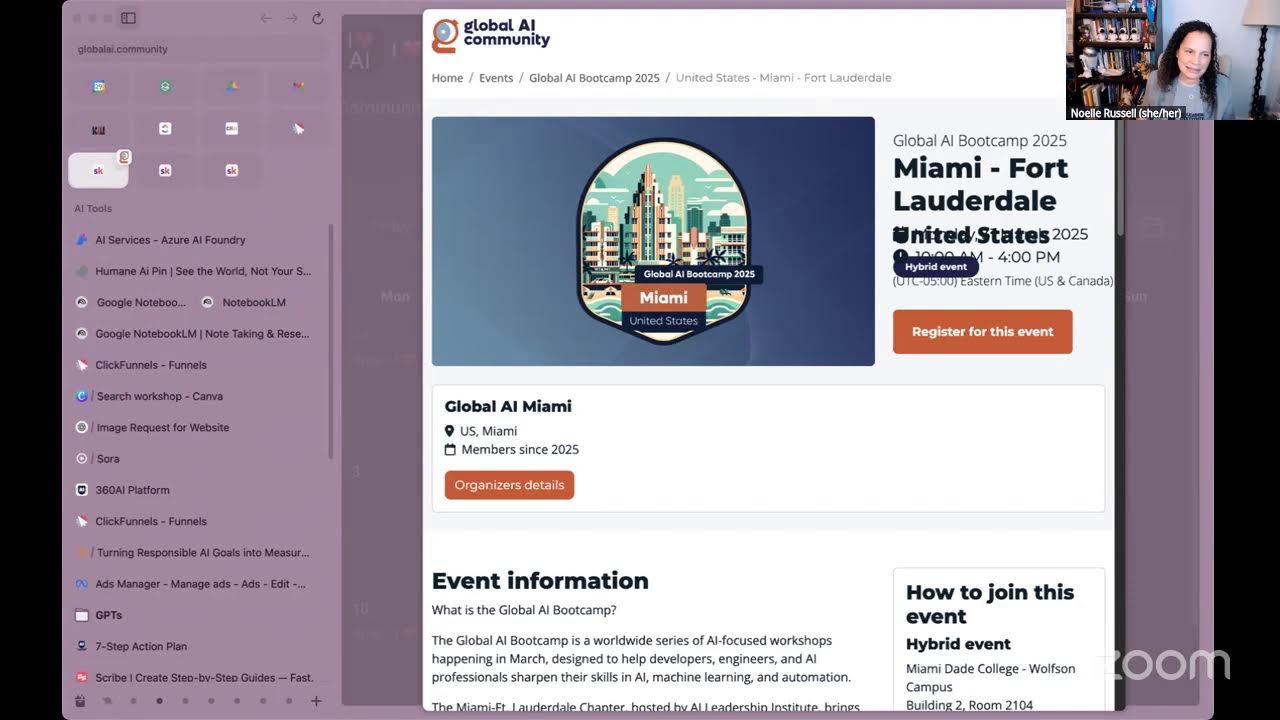
In this 20,000‑token live session Noelle Russell delivers her weekly "I Love AI" community update, blending personal anecdotes, product announcements, and practical AI guidance. She celebrates the launch of her book Scaling Responsible AI, shares a whirlwind tour of recent travel (Lisbon, Vegas, Chicago) and speaking engagements (Boston Consulting Group, Microsoft MVP Week, Responsible AI Forum), and outlines new community initiatives such as the Ready‑Set‑Prompt image‑generation challenge. Noelle explains the AI Leadership Institute’s free AI Leadership Masterclass, the on‑demand Bot Builder bootcamp, and the Agentic AI Agency’s phone‑bot and Instagram lead‑capture automation. She demonstrates prompt engineering with OpenAI’s Sora and ChatGPT image tools, discusses the shift toward “promptless” workflows, and emphasizes responsible AI as a mindset rather than a checklist. The session concludes with a preview of the Global AI Bootcamp (a Microsoft‑sponsored, city‑based, badge‑earning event) and a call for community networking and participation.
Chapters
Hello everyone, welcome in. Hello! Hi! Good to see you all. Happy Friday! It is Friday. Yes. Oh my goodness, so many things have gone on. Such an exciting week for me. Nice to have you all. Welcome, welcome. This is the time of the week. We actually didn't have one last week, so I've got lots of updates. But this is the time of the week where we give an update and do a little Q&A and maybe some hellos to everyone. All for our I Love AI community. We actually had a huge amount of community members join this week because I had a back-to-back-to-back set of sessions and conferences and invited many of them to join us. So really excited to have you all. Welcome. It is Friday. Friday. I was— next week maybe I will try and play around with this music situation. I was like, I should play music. It's pretty funny. I was in Lisbon last week, in Portugal, talking to a company. And while I was there, I got to see my book for the very first time. This amazing, beautiful thing. I got to see it for the first time, but I didn't get to actually take one home because they bought those books and I had never ever seen it. So I got a chance to see it and hold it only so briefly. While I signed them all and then gave them back. And then when I, I ended up going from Lisbon to Vegas, Vegas to Seattle, Seattle to Chicago, Chicago back home, and I finally got a chance to open my book box, which had my own copies in it. So I'm super excited about it. This is like a labor of love, but it's full of such cool stuff, things that I forgot that I wrote down, but all things that I've said before. So many of you who have been following me, engaged with me, connected with me in my— in these communities. Many of you will recognize so much of what's in here. You'll be like, oh my gosh, Noelle says that all the time. So I was really kind of excited. So at the end of our call today, I will randomly select a passage from this book and read it to you to let you know that there is so much just random goodness in this book. But we'll save that for the end unless I forget. But let's save that for the end. But yeah, it's super cool. It's beautiful. It's pretty. I'm just so excited. But yeah, it's pretty, pretty exciting. So April 1st is when it finally launches. So these books are like the trial version. I have quite a few in here. So I have a few here. So now I get to— I know it's funny because people on my leaderboards in my community probably already bought this book, but, but I'm excited because I have a chance to give some of them away and share some of them with you. But most importantly, get a chance to actually give this book to people or, or have people get access to this book who would never have heard me on a stage or on a LinkedIn or a live broadcast of any kind. So I'm very, very excited about it, and I can't wait to talk to you more. But let me give you a whirlwind tour through where I have been and things that I have had a chance to do and talk about. It's been very exciting, and we've got some really cool things that are lined up for even next week. So we'll talk about that as well. So yeah, I had a whirlwind tour. So last week it started on my birthday. I don't know if I got a chance to talk to y'all on my birthday, but some of you messaged me. So thank you for all of that. And on my birthday, which was Sunday the 16th last week, I— Sunday night we ended up on a flight headed to Lisbon in order to spend a couple days there and speak to the Boston Consulting Group and I mean, it's— I don't know. Sometimes you get in front of an audience and they're like your people. They know you. They get your jokes. It was one of the best events I've ever been at because they were so aligned with the things that I— the pain I've been through and the complications and limitations. And just so much of my story resonated with them. So that was a true delight. And I got a chance to meet with them, but also to just experience kind of, you know, camaraderie and community and coming together. And some companies have deprioritized this as, you know, whatever you wanna call it, contraction of the economy or perceived, you know, reductions that are necessary. And they end up cutting out these opportunities that we used to have to get together in real life and meet the people that we work with every day. And I just, I find it so, so valuable, so valuable. In fact, I have committed to getting our community together. But before I go into that, I always like to introduce you. Of course, if you are new to this or if you're catching this live and you are not in the Zoom room with me, this is the I Love AI community. We do this call every Friday, sometimes on a Monday, but every Friday in order to catch up on all things that I'm experiencing in the world of AI through my clients, through my business, and through my role as an MVP for Microsoft and on the board of many different startups, stealth nonprofits, and larger organizations. So through the lens of Noelle's experience, you get to learn kind of how I'm personally pushing the edge of technology, of artificial intelligence, and how I'm seeing it actually implemented and where the biggest needles are moving. So that is the goal of this. We have some really cool stuff that we did this week. I'm gonna show you in just a second. But this community, it's a free community. Anyone can join. The easiest way to join us is just to go to noelle.ai, and you will see an option to join our free community, I Love AI. And we call— we have calls every Friday, so a chance for you to ask questions. If you are on the— if you join the community, you'll get access to our calendar, and on the calendar is a Zoom link, and you join the Zoom call, and then you get to ask any questions you want. So if you are here on the call and you do have questions, don't forget to use the Q&A. Also, a great chance. I mean, my favorite part about getting on a call every single week is just a chance to connect with each other, a chance to connect with each other, to have a conversation, to even maybe connect offline. So many of the people that met through this community end up collaborating together. We have hiring managers that hire people from our community. We have people who end up going to work for, you know, have relationships or, you know, professional relationships with people that, that they meet through this community. And they're like, oh my gosh, I saw you, you know, on a call on Friday, and then they end up being at an event together. So it's, it's a really great opportunity to connect not just to me, but to everyone in this community. We're all kind of on the same journey of using, learning, using, implementing, and scaling AI, specifically responsible AI. And so, of course, My book, Scaling Responsible AI. This is— now that it's out, thank goodness. Now that it's out, I get a chance to really reform a lot of our content around the concepts in the book. These are all of my frameworks that I have come up with, all of the questions I have come to ask myself. At the end of every chapter, there's a set of reflection questions that I tell that I go through myself. Like, I'm a very kind of intuitive, reflective person. So whenever I do anything, I kind of think through, how might I have done this differently? How do I wish I would have done it from the beginning? And then I use that to form the work that I'll do in my next project. And so these are, you know, 10 years in the making. So a lot of them are very refined, very successful, consistently delivering value types of exercises. So I encourage you, as you get your copy next week. So those will start shipping on Monday, on Tuesday, the 1st of April. So by, I mean, I personally preordered my own book. So I would understand the customer experience. So I think I get it on, like, Tuesday or Wednesday. So I'm looking forward to that for you all. But oh my gosh, it's just so much fun. So we right now have in the AI leadership or in the I Love AI community, we have a free course, the AI Leadership Masterclass, which basically is a 5-module course that teaches teaches you the basics of artificial intelligence and responsible AI. I'm very proud of that series because I broke it down in a way that I wish someone had broken it down to me 10, 15 years ago to make it accessible to me. Like, oh, I get it now, as opposed to sometimes I hop on these, you know, classes, or I get into a room where they're teaching these concepts, and it's just either A, extremely boring, or just not practical. Like, I can't figure out, like, okay, I get what you're saying with this, like, you know, this algorithm that you're saying, but like, what is that good for? Like, I was that trouble child in middle school, right? When they started talking about advanced mathematics and I'm like, okay, I get it. Uh, but like, do I have to learn this? Like, do I need to know this in order to do something valuable in the world? Like, I was the one who was like, is this gonna be useful to me? And if it's not, I'm not sure I wanna learn it. And so I really appreciate the practical and pragmatic approach that, that I intentionally took in creating both the content for our free community as well as our paid. For those of you who bought the book, and that means if you bought it in any form on Amazon, if you bought it like this, if you are in the I Love AI community and you purchased the book, you should have also gotten access to our on-demand Bot Builder course. And some of you have taken that Bot Builder course with me. It's one of our most successful workshops that we deliver at the AI Leadership Institute, but I recorded it on demand in studio, and it's $647 typically on the— on our website. But for those of you who bought the book, as a thank you for investing in that book, investing in me, and hopefully taking the time to write a positive review at some point, as a thank you, I am also giving you access to that on that Bot Builder Bootcamp on-demand course. And I've gotten good reviews from it. So like, people are like, oh my gosh, I listened to the whole thing. It's like about 5 hours of content. It is full of like all my best stuff, good stuff. But it does require you— when things are on demand, as you well know, it does require you to actually like stay focused and do the work. I'm not there. Normally we do this in a classroom setting. We— everyone's live with me, and I stop, and we don't start again until you're done with that first step. In an on-demand class, you can kind of burn through all of it and never do a thing. But we believe heavily, like, the, the ethos of AI Leadership Institute, of the I Love AI community, is we learn by doing, right? That we show versus tell, that we're doers, not talkers. So, you know, try to shed that part of you that's like, I, I watch the video, it's good, and actually build an AI system. So in this on, in this Bot Builder course, you'll build an AI system end to end in less than 4 hours. You'll learn how characterize safe and responsible AI systems. It's called an AI safety system. There are 4 different levels of it. You'll also see my perspectives on prompt engineering, the 5 Ps of prompt engineering, how to use the system prompt to secure your model so that people can't easily break it. All of these things, zero code is— or you don't have to code. You don't have to even really be that technical. The most important quality in people that learn this skill is actually your ability to have clarity of thought, to understand what you're trying to do, to have a vested interest in who you're trying to serve with the solution that you're building. And it's a great exercise. So if you bought the book in any form, whether it's online, if you bought the Kindle version, which is now available, by the way, I bought it right away as soon as it came out. In 6 weeks, the audio version will be releasing. I will not be the voice. I know, I know. I wanted to be the voice of my own audiobook, but they told me that it's highly time intensive and like rigorous. And I have to like go into studio every day for months. And I obviously with my schedule can't do that. So there will be a SAG-AFTRA or whatever they're called actor who will be portraying this content. And let's hope it's at least a woman. But I don't know. I'm presuming it's in progress right now, but it's really exciting. So 6 weeks after our launch, we'll see an audiobook come to market. And I, of course, will buy that to support myself and listen to it. And hopefully it will be great. But that being said, a lot of what we're doing inside the AI Leadership Institute and inside the I Love AI community will be shifting just slightly to model what's in the book so that you can get this book and then have a guided live learn-by-doing opportunity to kind of implement what you've learned. I do think every project should be built responsibly, and I don't think responsibility is a checklist you follow or confetti you sprinkle on at the end. It is a way of being, a way of thinking, way of attacking a problem, a way of solving a problem that is holistic, that is inclusive, that is, you know, I have a shirt, not this one, but I have a shirt that says inclusion inspires innovation. And it really is a way of thinking. When you start a project, you instantly notice who's in the room. You instantly notice that you've got gaps in your understanding of what good looks like. And so the more people you bring in, the more diverse perspectives you bring in, the better your solutions will be. So that is exactly— so you'll see those changes coming. I do encourage you, if you are in the I Love AI community, to just consider— we do have a 7-day free trial in the AI Leadership Institute. Every month we do a live learning lab. This month we will be doing my favorite new word. We will be— I will be doing this on Monday, actually, but we'll be doing a live learning lab, meaning fingers on keyboard. Vibe Coding. And so Vibe Coding is a term that's used to represent the vibe you gotta get in from a conversational perspective to have a machine write software for you, build software for you. This isn't about writing code. This isn't about asking a machine to build you scaffolding code. It's literally using your voice to generate a software product that you can then deploy. And so we're gonna do a live learning lab in the middle of April to celebrate the ability for you to do that. And the fact that it's called Vibe Coding, and I I'm totally all about the vibe, like, could not be a better time. So we're going to leverage a couple of different tools to do that. Of course, I want you, if you've never been in, if you've never used VS Code, if you've never used GitHub Copilot, I do wanna give you experience doing that, even if you're not technical, even if you never thought you would do that. It is a cool skill and it's super— I don't know, I feel like it's a huge confidence builder. But the other thing, of course, is actually leveraging a product that allows you to build software with your voice. And that is, I mean, you will see, like, we're gonna come up, I'm gonna give you a couple use cases that you can build for. But if you have your own, you're gonna be able to just kinda go crazy with it, and it's gonna be incredible and really, really fun. Alright, but nice to see you all. If you're in the chat and you would like to say hi, please don't hesitate to do it. Alonzo's in the house. What's up, Andrea? Thank you. And Sherry's here. Woo! Oh, awesome. I'm gonna have to go check out your LinkedIn post, Sherry. Thank you for that. So great to see you all. And, and really great to have you here. Happy Friday. So the— just to give you a whirlwind tour, I was in Lisbon. After that, I went to Vegas. It was very cool in Vegas. I was only there a couple days, but the day that I was there, I got to see Ryan Reynolds live, which was very cool. I am not a I don't even know. I'm like drawing a blank on like the movie. Oh, the like the Wolverine and Deadpool. So I've never seen Deadpool. I always was like, it's too graphic for me. I can't watch it. And then I heard him on stage and he was talking and I, you know, I was so like, it was very cool to hear him just kind of personally talking about his journey and what he values and And then my husband turns to me and he's like, yeah, that's exactly what he sounds like in Deadpool. And I was like, oh, why am I like it then? And so I ended up going and watching Deadpool 3. I didn't watch the earlier ones, but I'll probably go back now and watch it because it wasn't nearly as graphic as I in my mind had made it up to be. But it was really cool to see. So I saw Ryan Reynolds. He spoke about like all of his entrepreneurial journey and vision and the fact that he's like tied into a lot of different things. And much of it is about storytelling and how deeply interested and vested he is in the concept of storytelling, which I am as well. It was super inspiring. Like, I left there, you know, thinking to myself, like, it, it's okay to just wanna do what I do. Because sometimes I get feedback where people, I mean, people are funny sometimes. They will come to me and I do, I get on stage and I absolutely, from the bottom of my heart, love sharing in story how I've built these systems, right? The work I did at Alexa, the nonsense I went through at Alexa, the craziness that happened at Microsoft, the models that worked, the ones that didn't, how we had to, like, politically vie to get certain things to happen, how responsible AI was not, like, an embodied principle until the team was created, which now I'm a huge fan of that team, and I'm like, I love you all. But that wasn't always how it was. And so I like telling those stories and reminding people that at the end of the day, every AI system was built by a human and that those humans are like everybody else, they make mistakes. They underestimate. They don't know what they don't know. And in those rooms, big decisions are made about like who these models are going to serve and who the customers are going to be. And so hearing him say like that the person who tells those stories is incredibly important. And he talked about the fact that like now the, you know, as humans, humanity, society, we crave the opportunity to come together in person. That's why I do these lives, right? Like, we come together in person and we, like, have, like, real connection. We talk to each other, we ask questions. But also these events, like, you come together and there's very few experiences in the world where you come together and, like, have a shared experience. So for me, when I get on stage, it's great. Like, I get goosebumps just thinking about it when the whole audience busts out laughing about something that I said, or they all go, oh, at the same time. Like, there's no feeling like that. Like when you're in a movie theater, right? And okay, I'll tell you something that's true about Noelle. Like, I'm the clapper, though. I'm the one at the end of the movie. This is why I haven't seen Deadpool, probably because I didn't clap at the end of that one. But, um, I'm the one at the end of these movies where I'm like, yes! And then I get my whole row, even if I don't know them, they start clapping. And then the rest of the whole— everyone starts clapping because I do that. That's what I do. But I do that because it's like this shared moment. We all just watched this thing. We all cried. We all laughed. There are so few experiences like that. So when I was listening to Ryan Reynolds talk about the beauty he sees in that he gets to create these experiences, right? Create a movie that people go to and they laugh and cry and have these emotions in this shared environment. I was like, oh my gosh, that's what I get to do with these keynotes that I do. And I absolutely love it. But you'd be surprised how many people come to me and like in this weird side way and be like, so do you just do keynotes? Like, is that what you do? You just, you talk for a living? Like, and that like with that weird like intonation at the end, like that seems kind of weak. And I don't think they really appreciate the difference. I mean, maybe I, maybe they haven't really had an opportunity to see me. Well, I will say that nobody who says that to me has ever seen me speak on stage. But I do think, like, we are in a season where education, literacy, like, there's such a powerful opportunity to bring people together and teach them not to be afraid of this technology. And so as much as I love implementing, which I do just as much, I really felt like, just really good when, when Ryan was like, you know, your, your ability to tell a story, to create a shared experience like that, that is unique and that is special and go forth and, and do more of it. Because it made me realize, like, you know what, what I do is special. What I do is important. And so hopefully you'll find that in the work that you do as well. But I do think, like, community building, this space that we've got in AI Leadership Institute, the space we have in the I Love AI community, like, it's special. 'cause we get to all come together and play. So speaking of playing, so I got to— so Ryan Reynolds was one of the people, but I also got to hear from Jimmy John, who runs a sandwich shop. I don't know how many of you know Jimmy John's. What? Manpreet's in the house. What's up? Good to see you. And we have— so Jimmy John's runs a sandwich shop, extremely successful, billion-dollar enterprise, and talks about his journey. And one of the things that stuck with me about what— about his journey was he said, you know, he got to the end or he got to a point where he felt successful and he looked back and realized that he had kind of missed some important time with his children. And, and of course, that he felt like, you know, that that was heartbreaking for him. And he looked at the audience and he goes, but here's the thing, like, my kids love me. My kids forgive me because I created a life for them that they would not have been able to experience otherwise. And it— so many times people ask me like, how do you balance work and family? How do you balance being a mom and being all over the world? And I will say that when I'm home with my kids, I am the most present, like phone down, do not answer. Like people always, you know, they'll call me and be like, why don't you answer? I'm like, if I'm with my children, They are the number one thing to me. So much so that my children have said to me, like, Mom, you're the most present mom of all the moms. You might not be here all the time, but when you're here, you're more present than moms who are around all the time. Like, you know, I, I, I'm intentional with my experience with them. I hang out with them. I play with them. I love them. But at the same time, I also, as many women and really just people, parents do, we have guilt when we are working really, really hard and not able to be there 100% for our children. But so when Jimmy John's was like, yeah, I realized I put everything into that business. But my kids on the other side, they, you know, they were grateful for that. They thanked me for that. They forgave me for not being there. And it made me very emotional because I was like— and one of my friends who is also in the audience, she's an entrepreneur. She runs nail salons in San Diego. She had to get up and walk out because she was so emotional. And it was because she was sitting there listening. You know, we were in this this, um, kind of VIP diamond experience where we got to meet with these, um, people. And she walked out because her daughter was in the hotel sick and she didn't stay there. She came to meet with these people. And I get, like, it's tough, it's tough. Um, but it was cool to hear a perspective of, like, if you do, you know, like, if you do work that you're passionate about that's driving towards a cause that's financially going to change your— the lived experience of everyone in sphere of influence, like, it'll work out. And so, so I don't, um, I usually don't give myself a hard time about working hard because that's who I am and I enjoy it and I love it. My dad is picking up boxes outside. Don't do that, please don't do that, don't touch that, thank you. Leave it. Yeah, okay. Oh my gosh, he's literally build— like, these boxes are huge. And anyway, if you know my dad— oh my gosh, oh my gosh, I'm gonna have to tell my dad, my, um, Warren, to go get him. Please help my dad. Hopefully you won't hear Warren yell at my dad when he goes up. Oh my gosh, oh my gosh, I'm just watching my my dad. Okay, so this is part of work-life harmony. Like, anyway, my dad is, um, you know, he's a 40-year-old, uh, in an 80-year-old body, so he thinks he can do all these things. But I'm sorry, I'm sorry, I know you want to help, but you can't help. Oh, that was very nerve-wracking. Um, so anyway, as I was saying, um, the— I mean, what was I saying? Anyway, these speakers were really good. But it's so true, especially— I know I won't even say especially for women. As a woman, as a mom, I do feel like sometimes I feel bad, but I'm happy working. My kids know I'm happy working. Like, you know, people are like, you should take time off. You should not work so much. I'm like, but what if I find pure joy in that? Like, what about that? What happens if I'm happy working and I'm happy being a mom? Like, what if I could do both? So, so it was really cool to see these perspectives of people who had made it. Like, these are billionaires now, right? I think Jimmy John's is like $3 to $8 billion. One of the guys who was there, what's his name? His last name's Ham. He run— he basically wrote a book. I'll remember it. But it was really cool because he, you know, he's now in his 80s, but his whole career he was kind of pushing the envelope in gas and energy. Industrial, uh, industrialization. And his whole career, people were like, I wouldn't do that, that's not going to work, we don't do it here. And it was funny because I was like, oh my gosh, that's exactly what people tell me. And they were telling him that in '63 and in '83 and in 2000. And, uh, now me in 2025, I'm like, oh my gosh, that's my experience. People will always tell you, especially if you're like me, and if you're in this community, you're likely at least a little bit like me, Like people are always gonna say, no, you can't do that. We don't, we've already tried that, it didn't work. Other companies have tried it, didn't work. Like it, they'll always get, there's always this friction, but in that friction is the opportunity. And oftentimes I have found huge success in those scenarios. So it was really cool. Who was the other one that I was? Oh, so Jim Johnson. Then the other guy was, what's his name? Mike Rowe, the Dirty Jobs guy. Do you remember Dirty Jobs, that show? It was running for like, 30 years, maybe 20 years. I can't remember, but a long time. I didn't realize how long until he said it, but it was very cool to hear the world through his, his eyes and his experience on doing those dirty jobs and those vocational jobs. And so his, uh, one of the things that came out of his career, which I am moving in that direction as well, is he created a philanthropy around reawakening. I don't know if you know this, but there are 7 million jobs in the world that do not have people that can do them. And many of those jobs are in vocational fields— plumbing, electricity, like electricians, carpenters, general contractors, roofers. Here's an amazing fact I also did not know, that we are extremely underhoused in the United States. 4 million units underhoused. Like, there are 4 million homes missing for the amount of people that need to live there. And we have an extreme shortage of people who can build, people who can refactor, people who can transform those buildings. So it's just really interesting. AI can be an augmentation, but it's not gonna build the house. Like, it still needs a designer. It still needs someone to say what's right, what's wrong, what works, what doesn't. It's fascinating to me. And so, so right now, more than any time ever, I do think that learning artificial intelligence will help us accelerate whoever we decide we wanna be. But you deciding who you wanna be, what you wanna do, what you wanna be focused on, like that could not be a more important quest to be on right now. Like figuring that out. I feel like I figured it out, at least for this stage of my journey, helping people understand AI, making it accessible, making it understandable, and most importantly, making it a little fun. Like, ha, like enjoying the journey of leveraging this technology. And that's what we've seen so far. So let me clue you into some of the fun that we had this week in the AI Leadership Institute and in the I Love AI community. I went from Vegas where I met Dirty Jobs guy and I met Ryan Reynolds and then met Jimmy John's. Super fun. I then decided— Non's in the house. What? Good to see you. I can't wait for you to get it too. I can't wait for your feedback. But after all of that, I ended up at Microsoft. Yay! So my old stomping grounds. This week is Microsoft MVP Week, which is the one week a year we get treated so well. They, they don't fly us. We fly ourselves over there. Pay our own way. We fly ourselves over there, but they set up this whole litany of content and sessions. It's basically like a private build or a private Microsoft event just for MVPs. We get to learn things that I'm not even allowed to tell you, which is my favorite. But I'm not even allowed to tell you. But the second that it launches, I can dive deeper than anyone else because I already have been working on it for a few months. We get early access to models that have yet to come out. We get early access to tooling that has yet to come out. And the purpose of that is that as an MVP, a Most Valuable Professional at Microsoft, they want us to use it, give them feedback, of course, help them make it better, but then help them amplify it once it actually GAs or goes general availability. So It was really fun. I got a chance to actually speak on Monday, and I got feedback. One of the quotes of one of the people who sent it to me in LinkedIn was like, best session of the entire day. Granted, I was on day 1, so there wasn't a lot to compare myself. But the reason they said that was because it was very practical, lots of note-taking. It was really good. Some of you have seen my AI model selection talk, and so it was a white whiteboard version of that that's been elevated and improved to include the new, uh, models that we're, we're seeing now. But it's still, you know, sometimes, uh, in a— many people will say in the world of entrepreneurship, you will grow tired of your own story, of your own thing you're selling. You're gonna grow tired of it way before people even know that you're doing it. Like, you're gonna just get on stages and start talking about it. It will take years. Like, I'm now on year, like, 10 of talking about AI and talking about its usage and talking about inclusive innovation, inclusive engineering. These are not new principles. And so to me, I'm like, ah, everybody knows that already. It's a tendency many of us have that once we get involved in, we're like, everybody knows this. And the reality is, is as I go to stage after stage after stage, nobody knows. Like, I should go back to the things I was saying 3 years ago cuz those people like the whole rest of the world is just now becoming aware of the things that were cool for us internal AI people 3 to 5 years ago. And so I, I say that to encourage you to realize that what you know right now, wherever you are in your AI journey, if you are in this community, you know more than like 90% of the world about what to do with it, how to do it responsibly, safely. So I just encourage you to use the knowledge you have to teach people what this could do, what it could be. So I spoke about that on Monday. I then from there flew to Chicago where I got to be one of the keynotes at the Responsible AI Forum held by AnitaBee. AnitaBee is the organization that is primarily— I'm gonna try not to get in my own way here, but primarily built for women in technology to amplify women in technology. They run one of the largest women technical conferences. It's called Grace Hopper. 40,000 people, I think, were there last year. 40,000 women were there last year. They get about 35,000 call for papers submitted, and they choose like 100 or maybe 50 of those. So I got to speak there last year as part of a good friend of mine, Usha. She's an incredible architect. She works for IEEE essay. And as it was, she built a panel of incredible people and she invited me to be part of it. And I was like, oh, okay. So I got to go and experience it. It's amazing. And so when the team asked me to come deliver this session, I got to do my keynote. And then I also— well, it was more like an interview. My keynote spread out into like a fireside chat. But then I also got to do my workshop and teach people in an hour how to build safe, responsible AI solutions. And it was a whirlwind tour, but it was really fun because a lot of people there, you know, Anita B. did give everyone who attended one of my books, which was really amazing as part of their experience. There were other authors there as well, so it was really, it was really fun, fun time. But like I said, the people, the questions people were asking me were the same questions I was answering 3 years ago, 5 years ago. 7 years ago. Um, and sometimes I just forget, like, I get all caught up in the new, new, new, and I forget, like, half the world— more than half the world is still figuring out day 1. They're not at day 5 or 6 or 10 or 100, um, like we are. So, so I think it's really good to stay aware of that so that you don't— number 1, don't overwhelm yourself and think you're behind, because that's how the world is, right? It wants you to think you're behind. It wants you to think that there's some kind of hustle that's necessary. Every time I get on a podcast, they're like, how do you keep up with the velocity? And I'm like, depends on what you are chasing. I'm not chasing tools. I'm not chasing the newest tool to do a thing. When I get a new tool, I do the same thing I do in the other— in the older tools, right? Prompt engineering. Prompt engineering has not changed. Like, it's still the art of clarity of thought, of identifying how you're gonna measure success, of communicating through chain of thought prompting to get a model to do what you want. Like, That hasn't really changed. Tools have changed, but the process to get a good result has been pretty consistent. So those are the things I encourage you, like, as you feel overwhelmed, as you're like, ah, more tools, that you kind of think, how do I have a little bit of fun with this? But also, in everything that's changing, what's staying the same? Because it is in that, those things that stay the same, that you'll find a lot of value. And of course, you have questions or comments or whatever, just hit the Q&A or raise your hand. I would love to hear from you all today. But I do want to— now that you've got a whirlwind tour of what my last 10 days looks like, I wanna share with you what's happened in our community. So this week I did something fun. I'm gonna go ahead and share my screen. This week I did something pretty fun. I decided to run a little challenge inside of our I Heart AI or I Love AI community. And that challenge, basically, it was called Ready, Set, Prompt. So I'll open it up here. Oh my gosh. And I— oopsie. There we go. Oh, I see what I did. So let me make this a little bit bigger so you can see it. Maybe plus, plus, plus. Oh dear. Click plus, plus. There we go. Right. So we— I ran a Ready, Set, Prompt challenge in the community. It's a reason to join again. You could just go to noelle.ai as a website and you'll get access to joining this community. It's free to join. You can participate in a lot of these.. But as you know, I'm a believer in learning by doing. Put your fingers on a keyboard and build something. So to this week's challenge was about using— I don't know if you noticed, but we've got a little bit of a new overwhelmed industry all around the new capabilities in OpenAI for image generation. So I thought we would do a prompt challenge around image generation. And this was my favorite one. It was actually from Patrick, my absolute favorite one, because it looked like— I'm like, that's me. I take take selfies on stages. So it was really cool. And the nice thing, though, is that you can replicate every one of these images and see how similar or different these are in the models that you use. So if you go down here, I also— this is the one that I built using the new OpenAI model. Super cute, right? Like, what do you think? But this is a little baby tiger wearing my t-shirt and got the cup. And there's a— this looks like— it looks like a shadow box. I wasn't very clear with the prompt on what I wanted that me, but now available. There's my book, super cute. But this is the kind of content that I generate for my clients. So I have a marketing agency and it, you know, it's, it's gone through a couple different names, but the clients have always been the same. But back in the day when it was traditional marketing, it was called Geek Girl Marketing. And so I did, I had hundreds of clients. It was very successful business and then I shut it down because I went and got a like real job. And then, of course, I now, back 2 years ago, was like, here I am again. And so I created an Agentic AI agency. That's the name of the company, Agentic AI agency. And its job is to use agents to supercharge your sales and marketing, specifically your marketing. So today, if you call my phone number, I don't know if you— I'll put it in there if you guys want to test it out. But if you call, like, the number that's on my business card, it will take you to an AI robot. And that robot doesn't sound like an IVR system of old. It sounds like, well, I think I picked Samantha, who is a young adult, uh, a— what did they— a sparky young adult. Um, and there were a bunch of options. There were men, women, uh, gender neutral, lots of different voices. I chose Samantha. Uh, she answers the phone and then she asks you like, what would you— you know, why are you calling? And you say, I'm calling to find out prices of your workshops. And she said, great, a team member will be with you shortly. I just need your name, your email address, and it already has your phone number because you called. So it'll say, I'll just take your name and email address. And then from there it generates a transcript, but it also generates a CRM entry, right? Or yeah, a customer relationship management entry. So it enters that into my CRM. As a new opportunity. And now I get the transcript, I get that conversation, all of that. Like, that's the beauty of an agent. Like, I'm not telling the agent, I'm not clicking a button saying, agent, pick up the phone, or agent, turn that into a CRM entry, agent, create a contact. Like, I'm not doing any of that. It knows the trigger is not human intervention. I mean, technically I guess it's a human, but you know, like somebody calls, a phone rings, the AI system picks up and that agent's job is to turn that phone call into a lead. And that alone is pretty magical. But not everybody calls. Like, it depends on the demographic of your audience. So you want that exact same thing, that same brain, that same Samantha, the same vibe to also answer when people hit you up on Instagram and like your post or comment on your post. Some of us are doing posts that say, hey, If you wanna scale your business with AI, put scale in the comments and I will send you this free ebook that I wrote, right? I have one called The 21 Laws of AI Solutions Architecture, right? So for 2 months, all I did was post content and at the end I'd be like, if you wanna know more about scaling your architectures with AI, I've got a free ebook, happy to send it to you. Just put scale in the comments. Now I don't want to, which is what I used to do, I don't wanna have to watch my comments, wait for the word scale, and go and attach this document and send it to them. And I 100%, like, super vulnerable, I used to do that. And I actually used to have pride in doing it because I wanted it to be human-centered and I wanted to do— I wanted to interact with my clients until 100 turned to 1,000. And I was like, there's no way I can do this. I cannot keep up. So either I I shrink what I can do for the world in order to do it manually, or I scale what I can do for the world by adding these types of automation capabilities. And so now when you say scale, my— the same Samantha bot, right? The Sam bot will get a— get that message and say, thank you so much for your interest. Just to be sure, would you like this document? And this is on Instagram. And then when you say yes, it's gonna write back and say, what is the best email? The beauty of that is as soon as I do that, I, well, first it'll say, can you confirm your name and what's your email? Through that interaction, I'm creating a lead for the business. So now that becomes an entry into my system that I call up and say, hey, I see you were interested in this document. Most people that get this document also want to do this type of work. I can help you with that. That's part of my consultancy. Would you like to hop on a strategy call? None of that has to be me having that conversation. All of that can happen via DM, and all of it can be automated. And so, and, and, and when I say automated, meaning that the process of communication can be automated, but it also can be interwoven with AI systems, generative models that can help the conversation along in a very natural, engaging and responsive way. And so that's what I focus on, right, is how do I help companies that have between 5 and 20 employees that are making up to $100 million in revenue? How do I help them do the good work of just taking care of people when they reach out to them? Most people just forget them. Most people like me, I mean, I just got back from an event, so I, I give myself a little bit of leeway. Um, and I can't even pick them all up. Up. But like, most of them will have a stack of cards when they come back from an event. There's a whole stack there, but they're like laid down and I can't pick them up. But like, they'll have a stack of cards that they picked up at a, an event. Yes, people still have business cards. But now my job is to, as a human, put that information into a system. Do you guys— oh, some of you weren't there, but in the AI Leadership Institute, we, we, uh, had a live learning lab last month, or maybe I guess this month, which was all about building deploying models, AI models through AI Builder. And one of the AI Builder models is a business card reader. So taking a picture of the business card and then turning that into a Zapier zap that sends it directly to my CRM. Today what I do is I still ingest it, but now I still have to do that manual work of taking it from that form and putting it somewhere, either building my own zap or creating my own automation, or what most people do, Nothing at all. And so these, all of these opportunities to actually build relationship with customers who've reached out to you are being lost just out of sheer inability to scale. And so these technologies can be combined to help you do just that. But pretty cute tiger, I think. So we had this really great exercise. I'll just scroll through so you can see some of the other ones that were created. I loved all of them. Hudson Community College, like little backpacks. So cute. Really, really cute. So that was Patricia's. And then Kurt had more like stuffed animals. I love it. Like, oh, he's so cute. I love it so much. And but again, what I want you to notice here is the leverage. And Alonzo's on the call. So here's Alonzo's. That's pretty cool. Baby become— yeah, that's right. When baby tigers become big tigers. Be careful. But all of these, you'll see the prompt that was used. So what I do is I go through and we do this a few, like, maybe 2 months ago, we did another one around prompt of the day where people just put in the prompts that they were using. And so I would go in and just copy the prompt and put it into my own tool. And my answers will be different, especially in ChatGPT, because I've created a bunch of memories for ChatGPT. So ChatGPT will over— will index on the memories that I have in my system in order to solve for the ambiguity in the prompt. Prompt, and that way it ends up changing the result that Alonzo got versus the result that I get. Pretty cool. Yuda did this one. Oh yeah, I like this prompt. It was like a baby tiger talking to a room of enthusiastic baby tigers. So it's pretty cool wearing the t-shirt. But what I like is you'll notice the length of these prompts, like they're not crazy, like lighting and shadow and photorealistic and blah, like you can be, and this is a term that people are, are really starting to use more and more often, is that we're moving into a promptless world. Promptless. Now, I actually don't think we're moving into a promptless world, meaning no prompts at all, but our prompts do not have to be as specific as they used to be unless we're looking for a very specific outcome. Oh my gosh, awesome. I will answer that too. Oh yes, I will also share that with you. Okay. So So just really cool stuff, right? Like, look at this little guy. Oh my goodness. Oh my goodness. He's adorable. I love him. And he's in a diaper, which is clearly articulated, right? Generate an image of a baby tiger smiling in a diaper typing on a laptop. That's pretty simple. And this is pretty good, right? So that's the good news is that as we move to 4.5, you know, 4.5 Omni models, I don't know if you saw on X, Sam Altman is constantly kind of telling everyone like, hey, we didn't know image generation would be such a crazy thing. We had to throttle access. So I have a pro version of OpenAI and ChatGPT and Sora. So I didn't get throttled, so I got to keep building, and I'll show you a little bit about what those look like. But really fun and just really cool. But most importantly, like, it gave us a chance to actually put our fingers to work, like, actually build stuff. When now the only barrier to entry into leveraging AI system to solve a problem is your words. And the better you get at using your words to solve these problems in the form of prompts and asking models to do stuff for you, the better you will be at this. Like, you have to just continuously do it. That is the skill that you need to work on is how consistent can you be in interacting with a machine to get what you want. Want in everything. So everything from emails you want to write to SMS, you know, nurture sequences to supporting content creation, all of that. Like, it's so important to just get in a habit of consistently and constantly interacting. I do want to give a shout out to Kurt. I don't know if he's here today, but he is starting a new job and he was nice enough to throw some love in our direction that being part of this community was a big part of his success. We've had multiple people in our community get jobs um, multiple people hire people from our Community. Um, and so it's just really good to be surrounded by people that kind of have the same vibe as you, um, that are on the same journey as you, that are optimistic and hopeful. Uh, and sometimes not every day we're that way, right? Not every day we're super high energy. Okay, maybe I am, but not every day do we feel like it. But when you're in these communities and we're doing these types of exercises, they help you remember, like, this is pretty cool time to be alive. They're pretty cool things that we can do. One of the main reasons why people upgrade to the AI Leadership Institute is that when you do that, you get access to my Microsoft tenant. So a lot of us, I mean, granted, we are still working through, like, authorization stuff, but 90% of people are able to get their account working and build with a, a, platform that maybe they wouldn't be able to afford otherwise. Right? We also have what's called the AI Leadership Platform, which is a platform of 15 models to help small business owners generate results. It does content creation and all of these types of things. So it goes along with our AI Consultancy Workshop that we did last year. But everything we do, we do to help accelerate your success with AI, whether that's as a person looking for a new role in a job, in a corporate role, or maybe as a startup owner, or maybe even working in a startup. In any of those cases, your ability to learn this, absorb it, and learn it in a safe environment where you don't feel bad asking questions, I think that is a huge part of, of success. Anything else? Let's see. There's some good stuff in here. Whoops, was that— oh, Joshua. I'm very interested. Snake oil, man. AI experts, 100%. So I struggle with this myself as an expert, as someone who's got, you know, years and years and years behind me. It is— it can be a struggle when you find out that there are people that are getting, you know, elevated from a brand perspective, from a voice perspective, to be influential to people, and they've never actually done a thing. Right? Like, they are— they're new to it. They're maybe marketers at heart. It's hard for me. Now, I don't— like, I'm not like, I don't want you to take my biz. I'm not worried about that. I'm a little bit worried though, because they will— it hurts the trust with clients. Like, clients, you listen to the wrong person who doesn't know what they're doing, you'll end up in trouble, and then I'm— I'm there to save you, but you're already hurt by then. I'd rather just fix you right from the beginning. So I do think there's a lot of people out there that are not learning by doing, that are not doers versus talkers. They're just talkers. So this is why I think it's really important for us to harness the skill. I try not to worry about anyone else, like, from that perspective. But I do know what I wanna do is I wanna talk from experience. And that's what these types of exercises can do for you is you can say, oh, yeah, I built these images. I created this outcome. So let me go ahead and share with you the results I got from Sora last night while I was playing around with these models. I think it's over here somewhere. Not there. Maybe over here. There we go. So this— I just did this on the call with our AI Leadership Institute friends. But this is— anyone, you know this guy? He did not read my book. He did not ever hold my book. But I put in a very simple prompt that was create an image of Mark Zuckerberg reading this book. And I passed in an image of my book. What do y'all think? I think that's crazy. But this is just the beginning. So I'll take you through some of the media that I ended up building. So that's the Mark Zuckerberg post. These are my iterations on getting my baby tiger just the right level of fluffiness. And I was testing out— you remember text-in-image models? It's been a bit of a nightmare, right? Like models, like even GPT-4o was not good at text. Like it would manufacture, hallucinate what text would look like. So I just wanted to see what would happen if I created an ad that was 100% text. And it did pretty good. Like I was pretty happy with it. So I'm now really thinking and yeah, yeah, exactly, 100%. Like the whole hand situation, I actually don't think that's better. I'll show you an example in just a second. But, but it, it is getting better and it's even good enough that I would create ads for Facebook inside this tool, which I'm now starting to do for my clients. But here is an example. So this was the original. That you can see here. It has like a whale and a seal, and it— this was a concerned— I think it was a dog, a fluffy white dog. So it was a fluffy white dog who was concerned about climate crisis. And so that's why this all existed, and I changed it all to Baby Tigers. I love AI and my book. But this— yeah, right, Rick? Oh my gosh. Oh, it's good to see you. But 100%, totally a hold my beer moment. Like, Hey, y'all, I've been working on this for a long time. Hold on one second. It's been a great few days to really see the excitement right around this. Especially Rick would know, you know, from your experience, you know, in the whole journey, Midjourney journey of like the nonsense we had to do 2 years ago to even get image creation to work consistently. It was crazy. I mean, you wrote books on it. So So this is pretty cool that we are now seeing simplified prompts, that these prompts become super prompts or meta prompts, and those meta prompts interpret what we're trying to do and match it. Now, Sam Altman also said this week, he said that the OpenAI team was very intentional about the gallery, about putting in gallery prompts that you can use. So none of these I did by myself. All of them I started with a prompt and optimized it. And again, if you're in the business of creating content for people like I am with marketing, like, this becomes gold because I can wait and see if there's something else that I like and then just take that prompt and optimize it. It's also the danger in GenAI and copywriting and all of that, right? Like, none of this is copyrighted. Anyone can take it. I'm an open source person, so I love that. I'm like, use it. I hope you can use it. Use it in good health. But some people are like, what? I took a long time to get that prompt together. I don't want the world to see it. To see it. I'm not that way. That's why in our community, I was like, share the prompt that you use. Let us learn from it because those prompts are constantly going to evolve. That is not the gold, right? The gold is in the thought process, the mind energy that's necessary to create these prompts continuously over time. So let me go back and share with you some of the others. Yeah, this was a good one. Android Mona Lisa. So this is one of my daughters. And this is her. She was wearing a shirt. It's hard to even see. Bruh, it's my birthday. And in that image, I mean, that's not terrible. Now, granted, what I said is take this picture and create a hyper-realistic drawing of this person in the style of Mona Lisa as a glossy porcelain android. Not terrible. Like, I just thought it was hilarious that it grabbed the t-shirt of all things. Let's keep going. I just think it's super fun. So this is one my daughter Jocelyn, or me when I was younger. But this is her. So I'll just let you see. That's her. That's the picture I decided to use. We were at the mall. She got a glittery tattoo. It was not a heart, but she really liked the heart in the generation. So this is the image. It's not terrible. Like, she was shocked that— and she asked me to do this. Uh, many of you have, you know, opinions about children and content. I will let you know, I was able to upload one picture of Jocelyn. Jocelyn did not like this picture and was like, let's do another one. When I went to upload the second one, it realized I was going to be building a pattern of uploading pictures of children, and it would not let me upload another one. So just so you know, there are guardrails in place on these models that prevent certain types of content being uploaded and used to generate. And I'm not gonna say any more about that, but that's a very dangerous part of the world of AI. And so I was very happy to see those. So all of this is Noelle testing the envelope, right? Testing the edges of these use cases. So those— I did get a failure as soon as I tried to upload more than one picture. So after these two, I wasn't allowed to upload anymore. And then And I was given a stern warning that children are not to be uploaded. So, but it did generate this for me. And just to give you an idea. Oh, I miss you too. Yes, Sherry, my mini me. Oh, she's so cute. Anyway, so let's go back. Oopsie. Oh dear. Nope. Oh gosh. Let's go here and click. Go back to the media library. And let's see what else we got here. So this is me. I gave it my picture of me and I asked it to put me on the COVID of Vogue. Completely changed my face. Face. That's not my face. Um, but it's cool. This is where I tried to upload a different picture and it failed. It said content may violate our policies. So yay, policies are in effect and content restrictions are in place. So not that they're perfect, not that they're going to catch everything, but I did test a couple of different things. Now none of this was bad, it was just like kids. Um, and, uh, I can't remember but I think that was basically it. So I uploaded 2 pictures of children, which I don't typically do. Yay! Oh, cool, Donald. That's awesome. This was a friend of mine, so I uploaded her picture reading it. Oh yeah, this is my favorite. Dun dun dun! No, he didn't. He didn't read my book, but he could. And this is like a sign. Padme was so cool. She was like, she's like, you know, don't publish that. But use it as a sign from the universe, um, that, uh, that this could happen one day. Hey, you never know. You never know, right? It's pretty cool. But again, what I— what shocks me is the simplicity of the prompt. Like, create an image. And in this case, I even misspelled it. Create an image or Satya Nadella, but it meant to say of Satya Nadella reading this book. And I passed it an image of my book. And this is the image that I passed it. It. So it opened the book. I mean, it's pretty cool. Like, this is, this is amazing. I'm very excited about the times. But this is how I did it. So all of the content that I build for my clients, I start it here. I might search for content around the topic, but I think the future of advertising, the future of social media content is what you'll see. You'll see a pattern here like this. Do you know this character? Like, there's characters here. Like, oh my goodness. Oh my goodness. Underwater Buddha. Oh, that's cool. So these are pictures. But I'm gonna go and show you images because this is the new capability. Right? And so, like, this is so neat. If I'm building content for a client, and that client— I can take something like this. Okay, not that. Let me keep moving. Thing. But like, there's some of these that are like, like old Zoolander. There's some that are like toys. Oh yeah, this one, like, you— this— I'm doing this. This is next for me, is I'm gonna build a toy of me in a box. I'm gonna go in here, I'm gonna grab this prompt. ChatGPT already knows me. I've got a bunch of memories that can fill in the gaps here. So I'm just gonna for just testing purposes, I'm gonna take this exact prompt, feed it to ChatGPT, and ask it to write me a new prompt with everything it already knows about me. That's what I'm gonna ask. And then it might work, it might not. If not, then I start working from there, right? Leveraging the years I've spent in this model, training it on who I am, what I do, what I care about, how I think, how I talk, and having it model that. So similarly, I did that for a Pokémon card. So these were a couple of— I wanted a baby tiger walking with a robot, but here's a Pokémon card. So I had it build me a Pokémon card. I passed it a picture of me and another picture of a source Pokémon card, and I had it generate. So, oh yeah, yeah, yeah. Yeah. So the good question, Donald. Yeah. So if you're not on Pro, you'll get throttled because so many people are trying to generate images and their machines are overwhelmed. Really what that means is that it's costing them so much money to generate this content for free that's not monetized. So they're throttling free servers and, uh, they are not throttling paid servers. They might even be throttling these a little bit. I don't generate like back to back to back, so I just have not seen or experienced that throttling. But Sam Altman, and you can— I follow him on X. I'm not a huge fan of X or anything related to X. But Sam Altman posts like up-to-the-minute updates, especially on service failures and challenges that they're having. And so it's pretty entertaining. But he just posted this morning that they were surprised and delighted at the overwhelming need for these services, that they actually had to shut down access. Yeah, exactly. Yeah. Premium— any paid account, you won't be throttled. It's just the free accounts that you're throttled for. Oh yeah. So premium. Yes, good point, Sherry. Yeah, premium is $20. I started there. Pro is pricey. Just depends on what you do. Like, I create content for a living. Like, that's, that's what I do for my clients. So it is $200 a month is like worth it to me, like gold to me. I would pay more actually. Don't tell him I said that. But yeah, so it just depends on the use case, right? If you're using it for experimentation, I mean, I use premium for like 2 years while Pro didn't exist until recently. But I use— I always try, especially for these types of services. I just buy the highest level as long as I can monetize it. Let's see if there's any other ones. Oh yeah, this was— I just put— gave it my picture and said voxel art, and this is what it generated. So not terrible, not terrible. Oh yeah, this is Muppet me. So I am a huge fan of Jim Henson, have always been my entire life. I used to only wear like Jim Henson t-shirts for a very long period of my, my life. But if you look like it got my hair really good, really well, like this is how I know, like the model is different because my hair is almost always a challenge for models. Like I will be like long spirally curly hair and they'll be like big afro, such a challenge. This was one shot, one shot. Turn this picture, and it's pretty good, turn this picture into a Muppet. And it did pretty well. So let me answer a couple questions that have come in here. So I've been— the context window, if I have challenges with the context window, I will often go into like Poe.com and play around with it and get it to synthesize it into a 32K, you know, bit of text. But I, yeah, so I don't typically worry too much about the context window here. However, there are models that support— that's why I liked our exercise we did in the community, because different people had massive prompts and they needed to use a different model like a Flux model in order to actually get that prompt to work. So, but yeah, you usually I will grab a big prompt and then I'll synthesize it. But what I noticed with this anyway was Sora and with image generation right inside of Sora. So right now I'm in Sora, but let me also show you ChatGPT. So ChatGPT has within it now the ability to create an image, and that image generation, that's been there before, but it used DALL-E, and now it's using a different multi-headed model. And so that behavior is different. I think I did this already, so I'll just show you one of the things. So I, I put in you know, can you create me an image for my website? Actually used a default temp that popped up in the, the sample. I need something that matches the overall theme and tone. I didn't write that. That's just— I copied the template that they gave me, the conversation starter. And then it's like, great, but I need to know, what do you want? Professional, minimalist, futuristic, approachable, color scheme, subject. And so I just put futuristic, blue, gold, and white, inspirational. And that's what it came up with, which kind of sort of matches my AI Leadership Institute logo, kind of. But I liked it. The only thing I would— I almost went in so you could see create image. I almost went in and changed it to be a woman. That's the only thing I would have done differently. But, but I liked it. So that image creation process is available even though I was in Sora the whole time because I bounced back and forth. The thing I do like about Sora is the gallery. And like I said, Sam Altman, he has mentioned how much time they've spent orchestrating and architecting these gallery examples so that you could go, I wanna build something like this. And you could just take the prompt. It's called Remix, and you can remix it. Here's another tip for those of you who are in this tool and gonna use it. By default, it chooses 2 for everything, so you can have an A/B test. If you're just testing and playing around, do not generate 2. You will eat up your credits. And so So I now intentionally go in and just pick one because I just want to see what it looks like. I'm not looking to A/B test for most of the time. So just know that it defaults to creating more than one, and that takes longer, number one, but also eats up credits, number two. So, but that credit usage thing is also changing. So just be aware of that. I'm gonna go to images. So these image explorations I think are pretty cool because any one of them, like, Creating comic books, like comic strips, like, oh my gosh, it's so cool. Like Vogue, of course I tried that. It didn't work for me. But creating a, a Lego version of me, that's totally possible. I wonder if I could find those images. I won't do it today. I'll post them in the community. But I have like a Lego of me, a Funko of me, and they're really fun. But any one of these, right? Like, this becomes a prompt. The only thing I have to change it like instead of a boy's character position chart, I would say a girl with long curly hair wearing a red blazer and a black t-shirt and jeans. It's so fun. So I just kind of adopt rather than again, people like Rick McCauley on this, like if y'all want to know about like, or creating imagery from an artistic perspective, there's so much nuance to that. That's not me. I don't know anything about that. That. So I'm gonna take someone else's, like Rick's. And Rick was one of the first to, uh, make his prompts publicly available, like huge extensive prompts. The only way I could use them is copy and paste them. I didn't even know the words that were in those prompts. Like, it was like f-stop, blah, blah, blah, blah, blah, other stuff. So I'm glad that we're now at a stage where we can meta-prompt our way to that kind of outcome, but it still doesn't replace those people who know how to create just like magnificent detailed prompts that it's night and day between even what you see in the Explorer here. So pretty cool. I just love it. So anything— yeah, here's an example of a Pokémon card. So any of these things, if you like it, you just take it, modify it a little bit, or modify it a lot in order to accommodate. In my case, I have chiropractors, so I can make a lot of fun. Oh, here it is. This is the one. This is like a toy, right? I can make a fun toy about the chiropractor who breaks backs for a living. You know, it's like just this is what the future will look like from engaging content. People will stop to look at this that says like the, you know, the back breaker and it's a chiropractor and it's an ad to say come see us, you know, and we'll break your backs for you or whatever. I think that it's a really, it'll be a really interesting time. In the future. All right, there were some questions in here. Let's see. Yeah, exactly. Embarrassingly accurate. Some of these models that we've been using for a long time. One of my favorite things to do now is inside a model, and I won't say now, I mean, I've been doing it for a couple of years, but the more I talk to a model, the more I want to ask it like, okay, based on what I've said to you, what do you think about me? What do you think I care about? What do you think my goals are? Are, what, you know, because those, those unsaid, undocumented assumptions that the model has about you will change its outcomes. So you wanna ask a model like, what do you think about me? Like, what do you think I want? What do you think my goal is? And you'd be sometimes shocked at its outcome, but more often than not, you'd be like, whoa, you see into my soul. Depends on how long you've been using it, but it's pretty, pretty cool. Tan, I can't believe you're here. I didn't realize it was you. We have to get on a call. So good to have you here. Are the images reproducible with the same prompt? Yeah, so they can be. However, just kind of based on what I just said, like the context in which that prompt is operating will change its outcome. So I can't take a prompt from here and put it into my ChatGPT and generate the same outcome because I already have instructions in the core of the model that tells it to do things a little bit differently. And that's the whole reason behind generative AI, right, is that it's gonna generate something new every time, but it'll give you a start. I mean, I will tell you that this media that I did, that is almost exactly like the example that I got. You know, it started— I, I think it was Zuckerberg that was reading it, and I changed it to Satya, and then I went back and did it again with this. But this is almost exactly what, what the prompt generated in the, in the Explorer window. So some of them are easier than others. I think it comes down to, to details. Yes, have a great weekend with Sherry. So last but not least, we do have a really cool thing coming up on Monday. I hope you all will be a part of it. If you go into the I Love AI community, You will see on the calendar on Monday, it's in person for those of you who are here on the 31st. If you are in Miami, you can come live and hang out with me for the day from 10 AM to 4 PM. 10 to 11 is gonna be networking and hanging out and having some coffee. 3 to 4 will be Q&A and kind of wrapping up. So, but 11 to 3 will be a what's called the Global AI Bootcamp. This is a Microsoft Sponsored boot camp. We have a ton of content, a ton of labs that we're gonna go through. We're gonna talk about intro to Agentic AI, intro to Vibe Coding, introduction to building models with no code that are not, not Vibe Coding, meaning building software with no code, but leveraging models in AI Builder. Some of these things, it's just an introduction to these concepts because in the AI Leadership Lab, we actually do our live learning labs and build them together. But if you just want enough information to go do it yourself, that's the purpose of Monday is that we're gonna give you a bunch of do-it-yourself ideas on how to accelerate your understanding of these types of solutions. And then if you want help hands-on, you can come and join us in the AI Leadership Institute and actually get certified to use these technologies, or you can go do it yourself and use it in your own models. But the benefit, of course, of the Leadership Institute is that you get access to the software. So you don't have to provision your own Azure account. You don't have to provision your own Power Platform access and Copilot Studio and all of those types of things. You get that as part of your relationship with us. So, so that's coming. It is a link. I'm going to go ahead and copy this link, copy, and I'm going to paste it into the chat. So that way if you want, you can go and sign up, become a part of it if you're not already. And I will click on this link so you can see it. The Global AI Community. I, I host the Miami Fort Lauderdale chapter. I am the organizer for that chapter. They— it is an incredibly cool group. We're mostly MVPs at Microsoft, but not all of us. You are welcome if you find out that there is not one of these in your city. You can become an organizer yourself. Many of the people in the AI Leadership Institute, those members I partnered with for them to create their own chapters. So I, I I encourage you to do that if you want to. But this is the event. It is gonna be at Miami Dade College, which is our local college here in Miami, Fort Lauderdale area. It'll be at the AI Center, and it's gonna be super fun. So we'll be coming to you live on Zoom. So that's why you have to register, because when you register, you'll get the Zoom link. If not, you will not be able to, to play. So, so that is happening on Monday. You can see all the other areas that they're happening in. And like I said, if you don't see one, you'll notice, like, there's a lot going on in Europe because this group was created in Europe. We don't have a lot of representation across the US. So if you're in a city that there isn't one, let's partner and bring global AI community to that. The benefit of it, of course, is that this curriculum that we're gonna go through was actually created by the Microsoft team. So we're gonna leverage that. And there's a, there's a, Of course I'll be doing the keynote, but there's like a video, there's a series of boot camp exercises that you'll get to do. There's a participant worksheet that you'll get, um, or a set of worksheets that you're going to get. So it'll be fun, uh, and most importantly, you get a badge saying that you did it, and that badge is coveted. There is only people who attend get one, and they are specific per city. So if you go to all of the ones, you can actually get badges across all the cities. I have one for. I just did one for Sydney, and they sent me a sticker. I don't remember where I put it, but it was cool. I was like, yeah, because I was at the South by Southwest Sydney this last year. So, so that's it. This is the most probably super exciting thing. I hope you'll join us. Please join us. Encourage us. If you have— if you like being here, you like these sessions, you find value in me sharing all the cool things that we're working on, don't hesitate to say good things about us. Invite a friend. This is a free community. It is open to Q&A. There are 2 questions in the Q&A. So I'm gonna shift to that now unless I already answered them. But I'm gonna shift to that now. But this is a chance for you to ask questions. So, you know, tell people what you're up to and make connections with people who are in the community. So one question was secure tool, secure tool stack for running chatbots from the bootcamp. Up, like Q&A for customers in production, so that it's trustworthy for clients. So absolutely. So the, the tool stack for security, one is that you can run against an API, and it, it, there's multiple layers of security. But one is you can run against an API for your model. I wouldn't, like, when you use Chatbot Builder, Chatbot Builder gives you access to 3 million tokens for which is gold. So for most companies, most startups, most small businesses, they don't need much more security than that. However, what I do for, let's say, a healthcare practice or a chiropractor where they've got HIPAA compliance and they wanna connect to their ERP or connect to their medical record system, I can't run it on a system that's not secured. So then I will move it to an OpenAI platform model or an Azure OpenAI model. The benefit of using Azure OpenAI or SageMaker on Azure or Vertex on Google is that you get the benefit of the enterprise security model that your models sit in. So just be— just by using a model inside of Azure or SageMaker or Vertex, when you use that model inside of that, the security infrastructure, the well-architected infrastructure, so rollback— oh, this is what I was mentioning to you in the chat when we were messaging back and forth is that you get to then apply the RBAC or role-based access control policies that are true for your entire cloud infrastructure now also become true for the models that you deploy. And that is the suggestion, is that if you get to a point where you're working with someone who requires security, get them on Azure or SageMaker or Vertex so that you can then set up security for their entire tenant and all the models that run inside that environment are true. Now, the way that that works with like a chatbot builder if you wanted to keep that Azure front end, is that there is an API integration. So you take the keys from Azure, the, the key to the services that you're using, and you would use those keys to integrate that, that language model into that Chat App Builder. So you would no longer use the, the default model. You would be connecting to your Azure one. So that is, that is like gold answer. Like, not many people do that, but that is how you do it, is that you will delegate all model invocations to an Azure, Microsoft, Google, Amazon tenant, and that the security you apply to that tenant will automatically apply. So hopefully that is helpful. And yeah, I hope that's helpful. And hopefully you're still here to hear it. If not, I will, I'll ping you back because I never got to finish that message that we sent. Rick, Oh, yeah, cool. Thank you. I'm gonna do that. So Rick shared the book, I think, that has all of these amazing images. So please take a look. Here you go. Oh, yeah. Did you put it in the chat? You could have put it in the chat. Oh, you did. You did. Okay, cool. I guess you maybe— yeah, you probably— oh, no, you sent it to me both times. But either way, absolutely no problem sharing it. It's awesome. I've looked at it many, many times. I never did buy it, but maybe I could now. But it's super awesome. Thank you for, for sharing that. It is so fun. Yes. And also, Patrick, as you get further along, like, we could definitely do a deep dive on, like, Azure cloud infrastructure if you get that far. If you want to do it on AWS, we could do it too. Google, I'm not, I'm not a Vertex person, but I'm sure someone in this community is, so we can share the love. But Azure and AWS are, like, where I grew up, so I know those platforms really well. Well, okay, cool. So that's all of our questions. Thank you all for being here. It is so fun. Fridays are my favorite. It is a chance for us to get together, to communicate, to network. Please know that, like, if you are in the chat, you have a chance to network with the other people in the chat. Take down people's names, share your LinkedIn. Like, we are all on the same journey here. There is no scarcity. There's so much opportunity in this space. If we can help each other find a new way to to either monetize something or implement something or develop a solution for someone, I, I'm all for it. And, and I'm always excited to see the cool things that we're doing in this space. The community is the best way to stay up to date. On Monday, we'll launch a new challenge, a new prompt challenge. So stay tuned for that. And hopefully, I will see you all at the Global AI Bootcamp bright and early Eastern time at 10 o'clock. Yeah, of course. Absolutely. Week. All right, so that's it. I'll let y'all go. Thank you for being here, and we'll see you next time. Bye! You're welcome. Thank you. All right, I'm gonna stop our, our live stream if I can stop sharing.
More from Noelle

Take the Unlocking AI Challenge and Get the Keys to Unlocking Time and Revenue for Your Business



Don't Get Left Behind: The AI Executive Challenge #ai #business #fearofmissingout





