AI Leadership Q&A wth Noelle
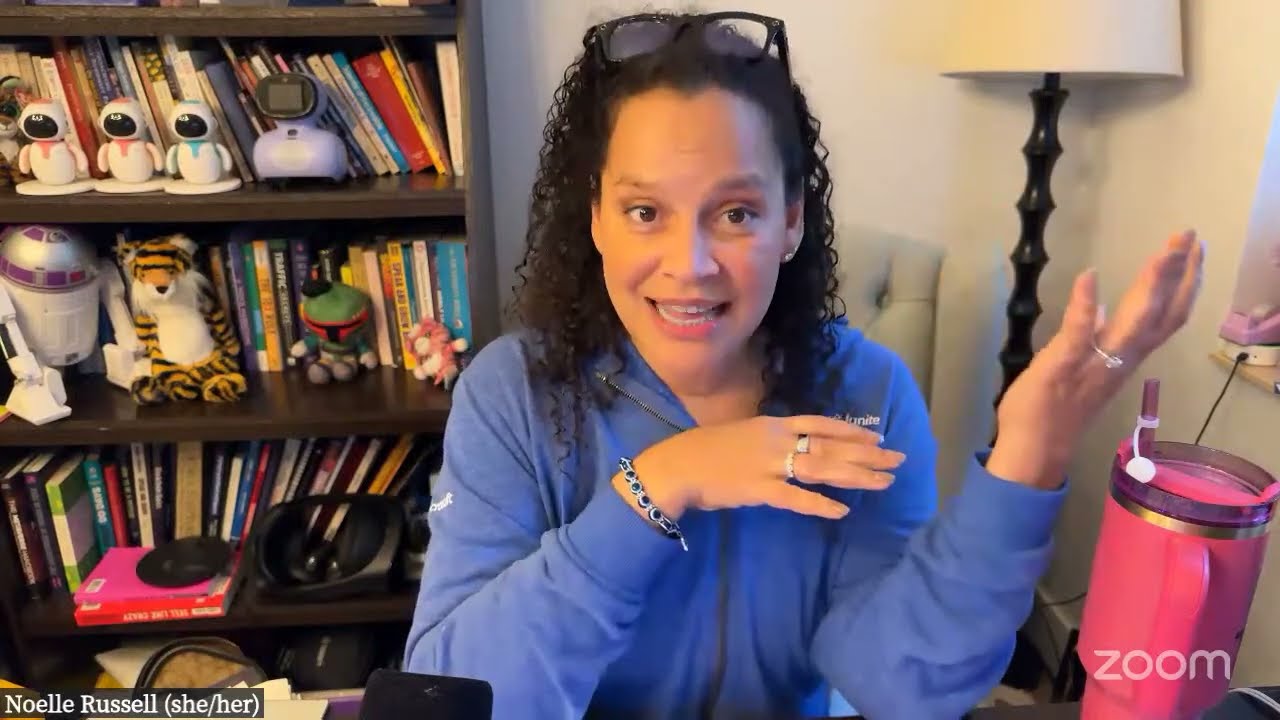
In this live community session, Noelle Russell opens with a casual welcome and a quick technical check before diving into a comprehensive recap of her recent experiences at CES 2025. She shares personal anecdotes, including opening for Will.i.am and launching a radio‑style AI show, then walks through a range of AI‑powered creator tools (FYI Radio, NotebookLM) and hardware innovations (transparent OLED displays, Meta glasses, AirPods with hearing‑aid features, digital frames, companion robots). Noelle highlights the evolution of AI‑driven workflows, emphasizing the shift from single‑task bots to agentic AI orchestration, referencing Salesforce’s Agentforce, NVIDIA’s brownfield/greenfield framework, and the need for “Lego‑brick” models that can be combined into larger systems. She discusses accessibility breakthroughs, such as AI‑enhanced glasses and the importance of co‑design with disabled communities, and showcases specific products (Eilik companion robot, Immersed visor). Throughout, she offers practical advice for AI leaders: maintaining a detailed career log, building responsible AI bots, leveraging generative models for contracts and compensation plans, and mentoring through the AI Leadership Institute. The session also introduces the 5 Ps of prompt engineering, the Bot Builder course, the Mystic multi‑agent platform demo, and the AI Leadership Lab white‑label model suite for consultants. Noelle promotes the AI Leadership Membership (pricing, free trial, seat allocations) and announces the upcoming I Love AI Week community challenge with exclusive t‑shirts. The session concludes with a live Q&A covering ADHD‑focused AI tools, climate‑risk prompts, and transactional vs. conversational bots, reinforcing her mission to empower AI leaders to build scalable, responsible AI businesses.
Chapters
Hi, everybody. Welcome, welcome. We're gonna get started here in just a few seconds. I am setting up our recording, make sure that we capture all of the nuggets we'll be covering today for people who cannot join us live. It's funny, I, uh, set this up to stream and it says it's live streaming right now. I have no idea where though, so let's go find it. Oh, there we are, there we are. All right, all right, there we are. Okay, cool. Welcome. Hello. Happy Friday. This is my favorite day of the entire week where we get to hang out and talk to each other and, and, and really get a recap of all the things in my world, but also in the world of AI, in the world of AI leadership, and most importantly, in the world of those of us who love and are excited about this technology. So I am just waiting for this to show up on— I don't see it showing up. I hope it's working. Are you back from CES? I am back, Robert. I am back from CES. Maybe it's a long time. I'm checking the latency on our stream here. It does not show me live at all right now. So I'm just waiting, just waiting. Maybe I'm gonna go to YouTube and see if I'm live on there. Oh, yeah, I am. Okay. So it's just not showing on Restream. That's okay. Alright, cool. If you could see me and hear the sound of my voice, type into your local chat box that you are here live, hashtag live, so I know that you're here. And especially you all in the Zoom. If you're in the Zoom, you of course are a special member of our community, the I Love AI community. And in that, you'll get access to all the things in the chat, the links that we'll provide and all that. So that's great. If you wanna be part of the community, it's very easy to join. You could just go to my name, noelle.ai. That's the website, Noelle, N-O-E-L-L-E, .ai, and you can join us live. Really excited. Yes, I just got back. So thanks, Robert. I just got back from CES today. Welcome everyone. Awesome. Joe is here. I'm alive. Great to see you, Sherilyn, Robert, Sherry. Amazing. Yeah, it was a really great event, Robert. I'll be sharing some of my updates Mark's in the house. Good to see you, Alonzo. Of course, we just came off of a very thrilling and exciting AI Leadership Institute call. This is the AI Leadership Institute is kind of our premium community, and it's where I share literally the inner workings of the company that I have built and everything that I do, all the different campaigns that we're running and how we're running it and how we're growing and how we're scaling, mostly because the people that are in this community are scaling their own business. So you kind of get to learn through My example, I'm extremely transparent and candid about what I do, how I do it. The world really does need us as AI leaders. And so I, I find a lot of joy in sharing what I'm doing and learning with you all. And hopefully you can avoid the pothole that I just hit and see some smooth sailing in your business. So welcome. Hope you are enjoying your week. My week was spent in and around, uh, the area of CES in Las Vegas. So in Las Vegas, uh, every year at this time, it's called the Consumer Electronics Show. In the past, I've been going for 10 years. I love CES. My first CES, I actually worked really hard because we were launching Amazon Alexa, and my job was to get Alexa working in booths on the floor at CES. So I was running around all of these different booths. It was cool because Alexa was extremely well represented, but we didn't have our own booth. We were just in other people's booths. So I always say, for people who are like in the world of, um, product, and you know, it's like product placement is literally what we did, though we didn't know we were doing it. Uh, but how do you, you know, rather than creating a booth and trying to drive traffic to your booth, like become a feature in other people's booths and let them drive the traffic? Like, that was a flex. I didn't realize it at the time, but that was definitely the way to go. So So as a result of that, that was 10 years ago. I went back multiple times in the capacity at Amazon Alexa, but I also then went in the capacity for Microsoft, and now I go supporting an organization called MoDev and their events. They own the AI House. I also this year got to speak in the creator space. Oh, I, I don't know if I mentioned this to the call earlier, but one of the most awesome things that I did, I, I can now say I opened for Will.i.am. I, I mean, I didn't really because there were a few of us that opened, but I was on stage and I did a session all about AI and creative development or building creative content. Like, if you are a content creator, how does AI impact your world and your job and how do you use it to go better, faster, stronger? And right after my session, I, I'm getting off and I'm saying hi to everybody and I hear over the, the intercom in the Creator Space, Will.i.am will be here in 5 minutes. And I was like, what? If y'all don't know who that is, please look him up now. Um, boom boom. Oh no, I'm not gonna say anything for it, but, uh, but really cool. I'm a huge fan. So of course I find out that he's gonna be there. I'm like, well, I'll just stick around and listen. He walks by me, I take a selfie with him. Yes. I was so excited though, that selfie. I'm like this So nobody's gonna see that picture but me and my, my family. So it was ridiculous. I was like, gosh, girl, just get it together. But I was very excited to see him. But then everything he talked about resonated with exactly what we do here in the AI Leadership Institute and in the I Love AI community. I've been talking nonstop, so you'll have to pardon me if I have to take some water as we go. So that was really exciting. He launched a new platform with LG. I don't know if you know like about his work and the work he did with Beats and Dre and like super cool stuff that he's been associated with, but he launched a new platform. He launched a new company called FYI. It's not that new anymore, but FYI. And then they launched with LG FYI Radio or Radio FYI, I don't know, but Radio R-A-I. DIO, and it is pretty awesome stuff. So I was very excited about it. I always like to give people kind of a recap. So if you couldn't be there with me, at least you'll know a little bit about why I was so excited about it. So this, he did a lot of demonstrations of how you as a content creator like myself, like right now I'm building content, right? Like as a content creator, how you can leverage AI in the conversation. Like me, you see I have lots of robots around me. So this year I'm really focusing on bringing robots into the conversation and interacting with them live with you all. Maybe I'll interact with my I like robots today and to get that party started. But using LLMs to help with content development, so not in the production sense, but in the live content creation sense. So I was— I don't know how many of you know this, but I was a DJ, a radio DJ when I was in college. So I ran the night shift and I, from like 8:00 PM to 2:00 in the morning, I would run— I would be the DJ for the college radio station and In doing that, like, of course you could see I love talking. I love— I'm excited to talk to people. I, I pretend like they're right in front of me and that they actually like what I have to say. So I'm very enthusiastic and very happy to help, you know, expand people's understanding of music and genres of music. I was very diverse in my music collections. I would go from like Rusted Root to Black Eyed Peas to classical music, so you never knew what you were going to get. But in doing that, I, I value being able to like, like getting guests and bringing on guests. Like that can be hard. So wouldn't it be great if you can like in your show just be like, hey chat, you know, or Bob or Sarah or Talisha or, you know, like create a, a machine that you can talk to. And so what they did at FYI is they have these personalities prebuilt and you can either custom train them on a topic or they're already built to talk about a topic, but their voice enabled. And the thing that FYI has done so well is that they've really focused on the tonality and the craftsmanship of the natural voice. And so when you talk to it, like, one of them sounds like right out of Compton. Another one sounds like, you know, a professional in Silicon Valley. Another one sounds like, you know, someone in Europe. Like, they all have these different personalities. One of them speaks Spanish and Korean really well, while another one knows a lot more about mathematics and formulas. So it just is cool to see. But most importantly, it allowed you— it allows someone like myself, a radio, you know, host to build. Here was his big huge lesson is that we are— we all have the ability as we build our brand to actually focus on building. Like, I could have a Noelle Russell radio station, Good Morning AI, which will be a radio station, on FYI, based on the conversation I had. So we're gonna do Good Morning AI, right? It's gonna be a radio station. You can listen to it all the time. And it'll interweave AI-enabled music that I can create that's super diverse, that reflects Noelle Russell Russell, or the relationships that I have with music content creators that I can pull in, interweaved with content that I care about and that I wanna talk about, but also those that I don't know a lot about that I can communicate to a machine to help me. You all saw NotebookLM, right? Put in the chat like a 1 if you, you are a NotebookLM user or have seen it, used it. Let me know. Hopefully I'm not talking foreign to y'all. NotebookLM, anyone? Anyone? A couple of you. Okay, good. Awesome. Thank you. Thank you, William. Oh yeah, good. Awesome. Thank you, Tara. So yeah, we have— like, some of us have used it. Okay, you've seen it. Well, you should definitely use it. But one of the features that gave it its early popularity was that you could give it a source of data, like things that Noelle likes to talk about, my book, for example, and I could give it and feed it into NotebookLM. It's connected to your Google account. So anything in your Google account, you can connect it to, and it will then dynamically, within less than a few minutes, generate a podcast between two humans, a, a woman and a man. I'd imagine in the future you're gonna get to get much more hyper-personalized in the personalities you use, just like what Will.i.am is doing in broadcasting, right? Hyper-personalized voices, and they have a conversation and they like playful banter and they laugh, ha ha ha, and it's all machine fictitiously creating this context. Based on your content. So I had it do it for, uh, AI Bot Builder, right? I was doing a workshop on AI Bot Builder, and it was like, this woman was like— woman, I even said that, like, it wasn't a woman, it was an AI system. This AI system that sounded like a woman was like, hey, I don't know, I'm not really sure if I really want to do that. And the guy was like, you absolutely should, you know why? Because it is one of the best programs, blah blah blah. Like, it was so cool, um, and completely fake. Just to like level it out on a responsible, like completely inauthentic and fake, but it was very entertaining. So for those of us interested in the world of responsible AI, as we see the world get excited about this technology, I do think it's cool to share with people that this exists and then just sprinkle a little bit of, you know, I always say like vegetables, put some vegetables in there, like the nutrition which is this has to be used responsibly. Like, you can now fictitiously take any source and have two human-sounding, like, people say how cool it is, even though those humans never actually— no human actually ever said that. It, it would be important for us to tell, you know, organizations that choose to leverage this technology that there is some responsible frameworks that are necessary. All right, awesome. I missed the first thing. What, what were you talking about, Mark? Now you can take advantage of research. Are you talking about NotebookLM, Mark? Is that it, or do you have another thing that you launched? Let's see, I'm trying to see. Oh yeah, OK, good. Yes, good, awesome. So Mark is also, you know, sharing some of the ideas. Yeah, research papers. I mean, like academic papers, you know, you go over to that, whatever the acronym is, AX blah blah blah blah blah, and you get a research paper. There's actually a YouTube channel that's called Two Minute Papers, and they, they do a synthesis. But now you could do it by yourself, and they don't do all papers, right? They just do popular ones. So, so that being said, that was a huge part. Now granted, when I go to CES, I focus on 3 main areas. One, of course, is the areas that I speak at. So that was Creator House and AI House. It was so cool to share the stage with Will.i.am. Like, that was a new— that was a new high for me. I was like, that's so awesome. And then the 2 other areas is in content creation is my jam. I like building content. I like creating ways for people to evolve their content and be able to do more with less, meaning more content creation with less human interaction and human work. So that being said, I like the pavilion at CES that is all about video and audio. So video really is about displays. You can see some of this in my recap that I did on LinkedIn, but these displays that are coming out, these transparent, uh, OLED displays, like right now you can't see it, but I'm in front of an OLED display, which is phenomenal. But now they're transparent. So imagine watching a movie where the people actually look like they're standing right in front of you. Like in having a conversation and it looked like they're holographic almost, right? These transparent displays are 3D in nature. It's really, really cool. So seeing what the evolution looks like in that space, the reason I say I'm excited about that is that I saw at CES last year the introduction to that. I think I shared, shared this with you last time. The introduction to that was around car dealerships, right? And creating that car dealership like that hologram that was a person that's actually sitting in Teams like that. All— we're now seeing mass production of these types of displays as opposed to the niche one-off. And that's how CES is. I love it because it, it shows me things that are eventually gonna come down the pipe, things that have not developed completely yet. But it also allows me to see things that I saw 5 years ago come to market and actually either be successful or not successful. So that's one of the reasons why I love that area. So I also got to see Kodak. I mentioned this on the previous call. Like, I love watching companies come of age, right? Kodak was one of those companies in the digital age that kind of took a hit because they didn't take advantage of a lot of the technology at that time. But they didn't die, they just kind of got truncated a bit. But now they were at CES in a huge way. As a matter of fact, I right now have a little— I didn't buy this at CES, I got it for Christmas. Thanks, honey. But I got a little printer and this prints photos instantly from my phone. When I'm anywhere. Like, it's a, you know, I take it with me. So every time I took a selfie with someone, I sent it to my printer and handed them a real copy. And so for them, some of you, you're like, well, that's kind of weird. But imagine, if you will, I get off stage and someone's like, can we take a selfie? Like, that's usually what happens. It's not like I just take selfies with people and be like, here's a printed copy, I hope you enjoy, um, or sell it to them for $5 like in Vegas. No, no, that's not how it works. But it is nice now that when I take a selfie with someone, I grab my camera, I take it, I send it to my printer, and I hand them a physical copy and they stick it. Imagine if you will, I have a book that I give them that I have signed and I stick a little picture of us in it. That's so cool. And because of Kodak and their newfound area, they have now really optimized the work, what they're doing in the world of photography. Really cool cameras that have come out, cool lenses, cool printing devices, projectors. So I think I was really happy to see that. LG is another one of my favorites because life is good. Like, I mean, how do you not love a brand like that? So life is good. And then What was some of— oh, and RCA. So RCA is more on the sound side. Y'all remember the dog, like, hmm, like a little white and black dog is part of their logo. But RCA, of course, was showing like, I mean, we're in a world now where we're talking to our technology. So the microphone that you hear me talking to you right now, right? It's right here. Like the microphones that you use, like how echo cancellation, voice distortion, like even being able to create synthesized voice. A lot of this happens through not just the software we create, but the hardware that is the sensor capturing that data. I will tell you last night, some fascinating information. I was on a call last night and my fire alarm in my house went off because we were cooking and you know how it is sometimes, but it kept— it triggered some battery situation across multiple smart— so it just kept going off. I was on a call with a client at the time and they couldn't hear it. Like they could not hear the fire alarm and I was having a conversation with them. I was like, what is happening right now? So echo cancellation, noise cancellation, like we are in some really crazy times. Like a fire alarm, like right there. Amazing. So I, I just think you should all know this when you're on a call, if you're on Zoom or Teams or even Webex, God help them. Or Webex, they are now using AI technology that cancels out sound. So if your dog barks, Many of us often say like, oh, pardon my dog barking, and no one can hear your dog because the technology has already locked, like blocked all that sound out. The best way to test it out is to get on a call like one of these. And I don't have anything nearby that I could use, but I did it with an engineer at Zoom. They were demonstrating their AI capability and they grabbed like a paper— what was it, a potato chip bag, like a Frito bag? You know how loud they are? So he grabbed it and while he was talking to me, he like crumbled the bag and I could not hear the bag. I only heard him. So that's pretty cool stuff. Um, oh, this printer specifically, uh, let's see, it's their little one, E-Link or something, Z-Link. Anyway, I'll find out for you. Um, yeah, by the way, Kodak, like, put your name on stuff so I can promote you, like, for goodness sakes. Uh, but it's one of their little printers. Of course. Yeah, yeah. Um, of course, Maggie. Yeah, it's so cool that you said that. Um, one of my first jobs was writing software for the, uh, uh, what was it, the 51 Delta? Um, anyway, one of the helicopters. And then I worked on the Huey, and I also worked on, um, the Chinook. So I am very— yes, 100% agree. Uh, the But that's true in general, right? So Maggie was mentioning that noise cancellation doesn't work everywhere because of the environment. So if you're like in a helicopter, for example, and that's why voice activation is very difficult in those environments, like push-to-talk even. And that's most heads-up displays are push-to-talk. So you push it and then you talk to it. So at least knows how to focus its attention. But even then, yeah, really, really tough. In those environments. But yeah, that's cool. I think we should talk about your helicopter-like experience. That's so neat. Oh, you mean like hearing them? Like, oh, I don't know that. How do you have helicopters around you? That's interesting. Okay, well, I know, I mean, but I— you guys only know me for like the last 10 years. I've done some crazy stuff. I used to— yeah, I say yes to all the things. I try to anyway. Uh, but yes, that was, that was funny. Yeah, my first job at Boeing was working with McDonnell, or my first job was working at IBM, but I was working for Boeing in the McDonnell Douglas merger. So it was technically during my time at IBM, but I was working with Boeing 'cause Boeing was writing Fortran and we were trying to get them to write their, uh, Boeing simulator. There, there was like a 127 simulator or something like that. And, um, anyway, yeah, so I got a lot of experience. Here's the thing though, that I think probably you all should know. Like, you have so much experience. Most of us just don't write it down, and then we over time just forget the, the things we've done until we're in a situation where we're like, oh my gosh, yeah, I did this. So I would encourage you, this is what one of the philosophies that I have is homework for life. Like, every day, like, start going back as early as you can and think about your experiences and writing them down in like an Excel spreadsheet. That's what I do. I just write it down. True. Update the CV. Yes, 100%. I now am like taking stuff out of my CV because people are— LinkedIn's algorithm reads your, you know, LinkedIn profile and they're like, people are calling me on stuff I did 25 years ago. I'm like, yeah, no, I'm not gonna update your WebSphere application server today. No, not doing that. But it just goes to show some of these skills like COBOL and Fortran, like these are very hard, like needed skills that there aren't very many people. So they'll, pay you a lot if you know, if you remember those technologies. OK, so that is so 2 places, AI House, Creator House. That's where I spent a lot of my time. Then in the AV area, so cool stuff. One of the— and then accessibility. So I'm going to have a couple of the products that I loved. I'm going to share with you in the accessibility space, but one of them bridges both. So one of them is these glasses. So these are the Meta. These are 3 years old. So I've had them for a long time since it's the very first set that they released. But that's one of the things that I saw in the accessibility area as well as in the, in the innovation area was a huge collection of digital frames being released to market. Here's one of the fun things when you— I think the minimum— I don't know what the qualifications were for me to get this. But I got a bunch of companies. I was a media, I was part of the press corps at CES. And so a bunch of companies reached out to me and they sent me free, free versions of their tech, which haven't arrived yet. But I signed up for, I could, I could pick a bunch of stuff, but I signed up for, I, I said yes, I shouldn't say I signed up. I said yes to 3 people. I got a bunch of requests. We'll send you this device. Can you use it? Give us your feedback. You know, like influencer style. And, uh, one of them. Though, was digital frames, not from Amazon or Microsoft or Meta, but like digital frames. Two of them were over-the-ear headphones. So many of you know, you gotta like for AirPods. I do have the new AirPods. AirPods and iHome had a huge presentation or huge representation on the floor. So I don't know. So I'll move into like my favorite part of CES is always accessibility because accessibility drives cool tech that ends up being mainstream a couple years down the road. So one of the things, I don't know if you know about the new 4s, but these are the AirPod 4s. And what I love about them is that they now have implemented, which is it easy? Yes, if you think about it from a hardware perspective, but they've now implemented hearing aid type capability so that when you have them on, you can increase the volume of conversations of the person talking to you, right? The microphone or the speaker, I guess, of the speaker. And so it helps you hear real-time conversations in your ear. And that's so cool. Why wouldn't we do that anyway? So my dad is hard of hearing because of his time in Vietnam. He had lots of hearing damage that lasted his whole life and he just always learned, like, kind of learned to live with it and now like has the opportunity to actually hear conversations with that. And he doesn't like wearing a hearing aid. The cool thing about these is you look kind of cool wearing earbuds. Like, nobody says anything. When you have a hearing aid, unfortunately, people make perceptions, right? Like, anyway, I don't like it. But this was part of what I saw that I really liked is like these over-the-air— or over-the-air? Over-the-ear earpieces are now also including accessibility features like spatial audio, understanding where directionally sound is coming from, and then also amplification. That being said, the digital frames— so I said yes to digital frames and 2 over-ear devices. And the digital frames like these, like you'll notice, I'll take a video right now.
Like, hi.
So I'm doing a video. You can see there's an LED display, right, that shows. This is a de facto standard in ethical uh, you know, development of devices that record you is that there's some obvious way for someone to tell that you're being recorded. So all of these devices, uh, 90% of these devices had some mechanism that just disclosed to you without you saying it that you were being recorded at this time. Now this has an automatic timer. I think it's like 30 seconds. It's about to shut off. Um, and there's like an internal LED that tells me the status of it, but I'll I shouldn't— I had all— I have all this crap on my screen or I would share this video with you. But, but this, you know, I'll take a picture now, right? So as I take a picture, it tells you right when you're doing something. Now I probably would have changed it to red so that people kind of identified it with like the recording, you know, thing. But the reason they don't do that is because red means other things on these glasses, like red means out of battery or storage is full or all these things. Things. So, uh, but that being said, these were very popular, like integrating recording, capturing, content creation into your everyday life so it's contextual. What I found was— I just want to give you some— so there were 3 devices that were very cool. These were one. Meta has evolved these, um, but also there's a company called Immersed. I don't know if you all know this company, Immersed, I-M-M-E-R-S-E-D. So Immersed, uh, do I have them around here somewhere. I don't know where they are. Um, where did I put them? Okay, well, I don't have it with me because I must have taken— maybe I took them upstairs. But I have the Oculus Pros, um, and inside it I have Immersed as a platform inside it that allows me to integrate all of my systems— my Surface Pro, my Microsoft Studio, uh, laptop, my MacBook, my Surface Pro, like, development workshop laptop, and I can immerse them all in the same experience. So I have— they're like at my disposal. They use pass-through so that I can actually type on my Logitech keyboard, and depending on where my focus is, is what system I'm talking to. So it provides immersive, complete system interaction so I can build processes that are cross-operating system. I mean, it's really, really cool. I've used lots of this technology along the years, but it was— Immersed is my favorite. I love using it, except I have to be in an Oculus or in a headset to do it. So Immersed launched recently a visor, which is a super lightweight because of the OLED advancements, right? They now have these super lightweight displays that you can use. So it's a visor that you put on. It kind of looks like, you all know Karch Kari from volleyball. They look like a Olympic volleyball players kind of sunglasses, right? They're kind of big and square, but they don't look like— like it's not an over-the-head headset. It's like glasses you put on. And I was like, that's so much better. The only thing is, is that it's not immersive, right? So it doesn't lock you in. So that's all you see. It's augmented, meaning that those screens now sit on top of your reality, which I actually like. So it would be like me in my office.. But now when I put these— this visor on, it brings all my displays into an area, and then it uses gesture control so I can move displays around. All of this are different AI models, right? Computer vision, identifying gestures and controls. It uses voice so I can call— like right now I can say, hey Facebook, take a picture. And see, did you see? Like, come on, it just took a picture. Or, hey Facebook, take a video. And now, so I can use my voice to interact with it. I can use my pressure to interact with it. I think I'm going to— I don't know where my mouse went. Oh, I don't know.
I must have dropped it.
Oh no. Interesting. Okay, let me do this.
Let's see.
Oh yeah, I don't know what I did with it. Oh, I found it. I found it. Okay, so I'm just going to delete this so that I can get a video that does not have all— so I can send it to you. It doesn't have all that stuff. So, hi. Anyway, but yeah, so what I— the theme that I see every year, it's a different theme. And this year the theme really was kind of hardware-software integration to do workflows, right? It wasn't just about doing one thing, it was about doing a lot of things. So Agentforce was launched by Salesforce, which is this idea that you're not going to— when you need to do something, You're not doing like, hey, check my email, right? You're like, hey, check my email for the top 5 priorities. Go in, find out based on the full thread of the conversation what the action items are. If any of those action items fall into this category, go actually do those things. Report back a summary, right? Like, when you start talking to your machines, you're going to expect them to do more than just a single task. Last year was all about the single task. Build a model to do a thing. Which is valuable, extremely valuable in an agentic world where we need to ask it to do something that requires 500 little models, 500, 5,000, 5 million little agents that go off and do one little thing. So first we have to build the Lego bricks, then we build, you know, the Millennium Falcon or whatever, whatever cool Lego thing you wanna think of. So that is the future. So I think the good news is last year lots of companies spent time building these Lego bricks, and we're still building them, don't get me wrong. But there is an opportunity to sell those Lego bricks in the context of a larger workflow, and that workflow is valuable to a company to improve or optimize. And so your skill set in building small bots, building small single function purpose-built AI AI components will now serve you in delivering much higher value to an organization in this form of agentic AI. So some of my favorite keynotes, I'll just give you two. One was, of course, Jensen Huang's keynote from NVIDIA. And he talked about, the concept of brownfield and greenfield, which I really like. Greenfield, I've used this term as it, it relates to product deployment. Like when I put a product into market, greenfield usually means that I am building grassroots awareness. Like nobody really knows what it is or how to use it. I'd say like ChatGPT ChatGPT was greenfield. Nobody had done that before. Nobody had productized a model like that before, except maybe Alexa. But nobody had really done it in the way that ChatGPT had done it, and certainly not with like a transformer backend. So that was a new, new time. Greenfield. Everyone was exposed to it for the first time. Brownfield is like mature environments, like mobile apps, right? That's brownfield. Like people know how to do it. Building websites, creating, like marketing, sales, business development. Like, these are brownfield environments where we know what it is, we know how it works. And I thought it was really interesting because what he said was, is that there's 3 areas, and you can go listen to his keynote to get all of them. I'm just gonna share with you my favorite. There are 3 key areas that are brownfield AI opportunities, which means the groundwork is done, the foundation is laid. It's an opportunity for you to just get in there and start delivering value. And when I say delivering value, I mean make money. Right? So when you deliver that value, the first thing he said was agentic AI going into a company and being like, okay, let me look at how you currently do things. And based on how you currently do things, I'm going to identify a workflow. Let's say it's how you deliver your product to the marketplace in the form of content, content creation strategy, marketing strategy. Maybe how you analyze vendors, right, for partnerships, contract analysis, like any one of these things. Except now, contract analysis, right, before we'd say, oh, I can build, I have a model here that does document analysis and can give you metadata. But that doesn't do the job, right? It just is one piece of a much bigger puzzle. So now as we go into organizations, we can actually help them with this. So that is that agentic concept, the ability to shift people away from like, how do I build one little thing that does one little thing, which is really what happened at Alexa, right? The world got lost in building little tiny apps for Alexa, even though it really was the voice UI for doing anything. It was an API-driven app, like application with voice as its interface. This is still true today. When you talk to an Alexa device, the code you talk to could do anything. It could talk to Salesforce, it could single sign-on into an infrastructure that executes a bunch of different type of code. Like, It is just the UI and it is a completely liberating UI when somebody's like, oh, I don't have to go to an app for that. I don't have to download a mobile app. I don't have to get on my phone. I could just say what I want. Hey Alexa, can you tell me what my sales were yesterday and which accounts I should prioritize to following up with today? Can you also generate for me a follow-up script based on the conversations I had with them? Can you also, you know, like, like now all of a sudden I just have a conversation And I'm the one telling it what to do, but it's the one delivering. So I become the leader of not just humans in my company, but actually of machines doing that work. That's why AI leadership is so important. It's not just human leadership, it's actually machine leadership. How are you going to create the right components and commission them to do the right work so that you could satisfy the, the problem, uh, or, or solve the problem that you're going after? So that I think is a big part of it. So I'm a big, big fan of, uh, I, I mean, here's what I loved about Meta and all of the frames that have integrated recording, um, is that if you think about it, so there are platforms like at Microsoft, it's called Seeing AI. At Zendesk, they're, oh, I actually don't think the CTO of Zendesk is on the board of a company called Be My Eyes.. And so Meta partnered with Be My Eyes. I don't remember. I think Seeing AI is a mobile app. These are applications that provide contextual awareness to people who have sight disabilities, right? Either they're completely blind or just have some sight disabilities where they can't see. And this tool allows the AI model to be their eyes, right? So if you're wearing your glasses and looking around— oh gosh. Oopsie. So if you are wearing your glasses, you're looking around, you can have it literally say, oh, over there is Starbucks, over there is this. Or if I'm looking at my screen, it can read emails for me. It allows us to augment AI into everyday life. And with a child with Down syndrome and a dad with a traumatic brain injury, these are things that they equate to independence for the people I love the most. And so I'm really, really excited to see the evolution of these technologies. The models have been around for a long time. It's model plus hardware plus user adoption that really is what's changing. And that's what I think all of us have an opportunity to do is to be part of the wave of people, the leaders that help people understand how to adopt this technology. 'Cause good tech can solve amazing things, but it won't do anything if nobody will use it. I mean, enter Google Lens, right? Like, poor guys. Like, what good technology, what good, What a good opportunity to help people that users wouldn't adopt. Same with Tesla. I mean, Tesla of course was the number one selling car. Of course it was all over the automotive floor. I try to stay away from automotive because I'm, I have a lot of automotive clients and so I'm in that world all the time. So I try to focus on areas that I don't get to see every day. But automotive of course had a huge area, uh, of focus. Um, I'll invite you now if you want to, uh, ask any questions, now's your chance to throw those into the Q&A. We try to be as responsible as possible— responsive as possible and responsible, but as responsive as possible. So if you ask a question, I'll definitely answer it. This call is, again, is our community call where I give you an update on all the things. I have a couple more updates before we end today, but if we have any questions, we'll dedicate that time to those specific questions as well.
The—
so I spent, like I said, I did my speaking, then I went and hung out in content creation, AV. I was in AV in high school. I ran my own radio show in college. And now, you know, and then after that I focus on accessibility. And again, not in that order, just those were the two, the three areas at an event like CES. It is so— it's just like AI, extremely overwhelming. Like there's a lot of cool stuff to see. So I encourage you to kind of look at the like hit that hashtag in LinkedIn CES 2025 and just look like, let your feed get curated to all the things that people are showing and you'll see some pretty cool stuff. Tomorrow morning I will be going live on LinkedIn and YouTube and Facebook with my CES roundup and I'll be showing you all of the B-roll that I took. So all the videos from the sessions and all that. So if you really, if you want to look at, if you want to see that, you're welcome to join. It'll also be available via recording. Absolutely, Yara, great question. So the question in the chat, for those of you not here with us, is there any AI that helps with ADHD, especially in making content creation inclusive for viewers with ADHD? So not so much on the back end of that question. I think oftentimes content creators with ADHD end up being empathetic to their audience, so they do things specifically, but that's a huge opportunity, right? Whenever I have a question and I'm like, oh, I don't think anyone's doing that, I'm like, million-dollar idea, go do that. But the other thing to think about is there's a program at Microsoft called the Imagine Cup. It's actually about to start again this year. I think it starts at the end of January. I always volunteer to be one of the mentors and judges for the Imagine Cup. These are students that bring ideas just like the one you just mentioned to, uh, basically they work on it for a given period of time, 6 weeks, 2 months, and then they get judged at Microsoft Build and they get given an award at Microsoft Build for the person who won based on the judge's feedback. Um, and I've been involved in it. I've seen some incredible technology come out of these student projects. But last year one was Plan Roadmap. Planroadmap.com. Of course, I'm gonna validate that by going and looking at, uh, typing it in and making sure. Um, I think it's Plan Roadmap. Let me just check. Yeah, that's it. So this was specifically geared towards those with ADHD. It was partnered, and you can see it if you hit— when you go to Plan Roadmap, actually, I should just share share my screen. I'll have to move this over. I'm gonna share my screen really quick, but I really like it because it, it is a GPT wrapper, which is all the rage these days. Oopsie. Planroadmap.com. So let me find my Zoom again. I'll share my screen really quickly. But it just goes to show, like, they created this and it's already monetized, right? I pay them. I, I became a customer. If you build a cool product, I will become a customer. I mean, unless it's ridiculous crazy and I I can't afford it. Like, if you build something that's $1 million a month, I'm, I'm not your customer. But if I, if I am a, a customer, if I'm someone who, you know, is a target customer for you, I support all of you all. So I hope you'll let us know when you launch cool new products. Um, but let me share my screen here. So this is Plan Roadmap, uh, right here. Task paralysis, executive function is something— I mean, I have ADHD, so I 100% know, and this is why I became a customer, because I was like, oh, I would love to provide some commentary and advice. But if you go to learn more, it'll tell you about their relationship with the ADHD community, or you could scroll down. And they have aligned with organizations, with clinical researchers. This is what I love about like the Imagine Cup. We encourage as mentors and coaches of people building product, we encourage them so many times. I'm one of them. So many times I'm like, I'm a technologist, I'll just build something for this community. I have a philosophy, never build for someone without them, never build for them without them. It's an accessibility mantra, but it means like, don't go and solve a problem for a community you don't, you're not a part of or you don't understand. And again, even as a mother of a child with Down syndrome, I don't have Down syndrome, right? And, and my son has Down syndrome and he's autistic. So like he's a whole flavor and I have very little understanding of what it means to be someone using tech with that. That, you know, with, with that diagnosis, right? So my job is to, yeah, I'm going to build the tech, but I need to align with people that either are that or at least are clinically, you know, experienced in that area. So I, it's literally like with models, you ground your model in truth. Like I want to make sure that if I'm building a product, especially in the world of accessibility, that I never built for a community without that community being deeply involved in the ideation phase. From the very beginning and of course throughout the entire process. So that's what they did. They aligned with people who are specialists in treating ADHD and identifying and diagnosing ADHD and you created this project and it evolves. So once you get involved in this, it evolves right before your eyes. For those of you who saw my Microsoft, um, session, um, I did on personalized education, it's in the community if you haven't seen it yet, but for that session, I highlighted this project and you can see where it was from when I recorded that to where it is now. But it's really cool because it provides you kind of the step-by-step process. It also, because as ADHD, you know, part of the, I guess, wide-ranging framework for ADHD of the spectrum of which you might experience it, they have lots of different choose-your-own-adventure type activities to keep our mind engaged. So it might say, would you like to do this or would you like to watch a cat video? Would you like to do this? Would you like to watch? Would you like somebody to show it to you as a video, read it as a blog post, or listen to it as a podcast?
Right?
Like, it gives you the ability to continuously— it's kind of like what I do as a parent, right? I don't ever go in and say anything that's like black and white. I give ranges of opportunity. Do you wanna do this or this? Right? And then once you do, pick one of those and then you get to do that, right? Like, everything is open but choice-driven. And that's how I, you know, work with my son. I'm like, hey, we need to— I need him to like head to the car. Would you like to go out of the car through the front door or the back door? The end result is I need him in the car and I give him options, front door, back door. And so these are the types of things that it also offers people. So this is an example of a product that was built to serve that exact community. That's why I share with you, Yara. But, and I love it, but this is also the reason I mentioned it is that it was created by a team last year. Like, they cared about this problem and they built this product. So I feel like if you care about a problem, you might be able to build something similar if that is something that you want to do. Okay, I'm gonna keep that open for now. Oopsie, let me find my Zoom. Oh, that's right, I'm sharing. Okay, I'm gonna stop sharing because I can't see you all due to my screens. Awesome. Hopefully that makes sense. Let's see. Oh, Oh, uh, okay. Noelle, look at the comment from me before. Yara, okay, well, um, oh no, okay, uh, thank you, Sherry. Um, it's because it said name, so it didn't start with like what is or why, so my brain kind of probably skipped over it. Sorry about that. So name the top 3 accessibility stuff for my advanced age peeps, um, or name so I can check them out. Yeah, so I really like, uh, so there, of course, I'm sure you probably saw this, but companion devices. So Eilik was one of the devices that was there, even though this is the sad thing about CES and the world we're in right now. So CES used to be the event I'd go to, to hear about things for the first time. Like it was the product launch. Like that's where people launched their stuff. Now, as you know, people launch stuff all the time, uh, all day long in our inboxes, on LinkedIn, on social media. So it's not like this moment, like, so now a lot of the things that I saw, I already invested in. I had already purchased, but I like is one of them. And this is a companion robot. It's very cool. I don't know. Did I show them to you? I'll turn them on. I think I did. I think I did. I'm going to actually maybe turn— I don't know. I'll turn 2 of them on because if I turn all 3 of them on, I have to turn them all off. Oh, he's very mad at me right now. I'm so sorry. Yeah, he's probably mad because I haven't connected him. Very often. There we go. Oh, and look, they're saying hi to each other. So a lot of them were like companion robots, which I think for your population is very cool. So the things that you can do are like pat its head or pat its back, and you can see like here there's like a menu. So now I can make them a puppet. So what that means is like I can move one and they'll all match. Or I can play games with them. This says I can— I don't want to bonk them. I don't really want to bonk you. Okay, I'm going to keep going. Oh gosh, there we go. This is movies. They're going to act out a movie together, I think. I don't know. We'll let it happen. Let's see. Yeah, I like it. I like it. Okay. Oh gosh, here we go. It's happening. Oh, did I pause it? Sorry. Take 1. So now they're literally going to act it out. So, oh, look, they're cheersing. Oh, that's sweet. Cheers. And there's like 100 different interactions. So imagine every person, right? Every— like, you do these for groups of people. Oh my gosh. Yes.
Yay.
Okay, bye. Okay, I wonder if I just keep it there. They might start up again. We'll see. We'll see how it goes. I would love it for it to stay there. But there, that's cheers. There's a bunch of them, and you can custom create them, right? So, oh, good, one's dying. All right, good, good, good, good. Yes, please die. Good. Like, the other guy's like, hey, what's going on? Oh, I'm shutting you down. Okay, there we go. Now you're alone.
Oh, sorry. I'll just look.
I'll see what happens. We'll see what happens. Maybe I'll just hang out. But there's lots of interaction. So creating things that force interaction, because as you know, in these homes. Many times they're lonely, but it's not just, I want something to read to me, I wanna talk to something, but actually wanna talk to something. And this is all gesture controlled. So there it also comes with— I don't think I have any— these little like cake, beer, wine, like all these little tokens that you tap to their arm and they create this whole like story. So now you do a lot of storytelling with these. So these can become interesting tools. For that. Oh yeah, he's like playing basketball right now. Okay, cool. Thank you, buddy. Oh, Saturn, I'm turning you off. Love you though. Love you. Bye. Okay, night night. Um, so there were lots of these robots. Um, so I like, uh, Eilik is the name. Uh, $150 I think is what they cost. Um, Eilik. But I'm thinking more for you that, uh, Sherry, like, you would want to use these tools. Like, you could go to Eilik and say, hey, I do this thing, can you give me 5 or 10? I remember in the early days of Amazon Alexa, we would give cases of 25 to people, like, who were doing that kind of work. We'd just be like, here's 25, go use them and be well. Um, again, there's a window when a company will do this with you because there's— they're in an adoption curve, right? They're trying to get more people to adopt. Once they get the adoption they want, they're not have, or at least are on a trajectory that they can trust, they're not going to do that. But right now, like, a lot of these robotics companies are willing to— just like at CES, I got here, you know, I chose, um, I chose like frames and headphones, but I could have gone after any number of other products, uh, and you get the, you know, get them for free, you use them, and then you tell that story. And that's what they want, is they want you to tell the story of what you're— how you're using it. Yeah, I think I typed it incorrectly. E-I-L-I-K. Yeah, there you go. All right, cool. Yeah, that's why I say, like, you probably will want to instead get a company to donate them. You can, and it doesn't even have to be ILEC company. You can go to another, like, an organization and say, hey, I'm teaching, you know, the principles of AI, business development AI to these people. Will you Accenture, PwC, you know, find a company? And they, they might just do it out of, you know, they have initiatives that would support that. So yeah, some ideas. But yeah, I would, I would not expect a— I wouldn't expect my dad to go buy this. I, I would buy it. Here's the other thing to think about, Sherry, is going after the children of those people. Me. Like, I am the audience. I'm the target audience that buys all the tech for my dad. And more and more of us are gonna be taking care of our parents because everyone's living longer.
Yay.
But that means that we're going to have to take care of our parents. I call it the sandwich generation, right? I'm raising children and taking care of my parents in a time where, you know, 20 years ago our lifespan wasn't quite as long, but now there, there it is. So yeah, great question. Okay. And then Sheila, I think you had a question. Are there good sites, GPT prompts, for climate change or risk awareness. Oh, for California. Oh, sorry. Oh, and I see some questions in the Q&A. I wanna take care of those too.
Okay.
Yeah. So I will do what I— I'll tell you what I do. I basically take this question and I ask a generative model like ChatGPT or Claude. I use Claude typically. Now, Grant, I do have relationships, like I have enterprise versions. Or paid versions of these so I can protect the questions. But this is a good question. But even ask it the question about the question, right? Like, don't ask it to solve the problem for you. Just be like, hey, I'm thinking about, like, literally this. I would copy and paste this into a prompt and be like, give me some input. What I really like doing is— oh, I'm talking— my phone is over there. But if I have my phone, turn on conversational mode and be like, hey, I just saw on the news, especially with ChatGPT because it's web-aware now, I just saw on the news that this and this and this is happening. I'm really worried about that. Can you tell me more about it? Or what ideas do you have for me to create a nonprofit? Or, you know, like you can ask it anything and just get it. And then the nice thing about ChatGPT's voice interface is that it automatically publishes it to the written form. Not all voice-enabled engines do that. They just do it in voice. And so like the phone, remember, Sherry, you actually, I think you did this too, right? When Yuvika published, she's like, hey, I just used, you can call ChatGPT now on the phone. But it doesn't have the ability to send you what you did on, like, because it doesn't know who you are when you call. So it's just like an OpenGPT model that you can just have a conversation with. But that is pretty cool for you. I think you did, you did a video on that, right? Um, but anyway, Sheila, yeah, so those are, that's what I would do is I would literally, every one of us should be, for any question we have, we should be thinking even before we go to YouTube to answer it, just as a habit, be like, let me ask ChatGPT that. Today, when I wanted to create a— I'm hiring, you know, creating an opportunity for people to work with me in the AI Leadership Institute and become sellers, right? Become business development executives as part of that company. And so I was like, all right, I need to understand, like, I need to build a contract that I'm going to have them sign. I need to, you know, I'm not using them to write the contract. I just want them to validate the contract. You know, what am I thinking about? What am I missing? Should I add anything more? Then I'm also like, I want to build a compensation strategy. It knows a lot about compensation plans because it's read billions of them over the last, you know, 30 years on the internet. So what's a good compensation plan? Can you draft me a Word document? This is one of my favorite things about ChatGPT that Claude doesn't do very well, which is actually creates me downloadable PDFs, downloadable Word documents, Excel spreadsheets. Like, it's a tangible thing. It's not done.. But it's way easier than me starting from nothing. I mean, it's like night and day what I can get done when it frames something based on what I'm asking it into a document that I can start from. Oh, awesome. Oh yeah, yeah, exactly. They did it. Yeah, you recorded from your iPad. Yeah, from the calls. Yeah, exactly. It does blow people away. It's really cool. And this is an example, like, Showing versus telling, whatever you're doing, if you can show versus tell that— people always ask me like, how do you get these executives? Lots of my clients will tell me, I'm going to bring you into this room, but they're always like, they're this type of person. They never say yes. They're laggards. They're the last people. And I'm like, the reason that they're like that is because no one has given them the opportunity to be something else. And so when I go into these rooms, I put their fingers on a keyboard, go here and use— I use Microsoft Designer. Go use Microsoft Designer. So I'm like, go to Microsoft Designer. Give them the URL. It's QR code on my screen. Everyone open it up right now. I'll wait. Picture they're in Microsoft Designer and I put a prompt on the screen. Type in this prompt. And I have a little fun with it. I'll be like, use a prompt to create you an image of an IBM consultant. And of course, anyone care to guess what an IBM consultant looks out of a model even today, even though we know it should be better, right? It doesn't look like me, even though I was an IBM consultant for 12 years. So it doesn't look like me. So I'm like, hey everybody, like, I'm an IBM consultant. It's funny what that looks like. So it creates this conversation. But as soon as they realize they can use their words to build stuff, they're like, wait, wait, what just happened? How do I do this? So it's really cool what we can do. I'm going through the Q&A right now. Thank you. So that was Sheila's. I think I got you. So yes, please do that, Sheila. I answered live. Next is Joe. Do you see real user accessible AI at CES? 100%. Any agentic on the customer front on edge devices? So the challenge with agentic AI is that most organizations have only built like purpose-built models. So there is, there are very few agentic systems in place. That's why we're so excited about the work like Mark Shea's doing with Eric and you're, you've, I, or yeah, I think you, Joe, like you're building some of these like agentic system, but there aren't really many agentic systems, even Salesforce. Doesn't have like a full-on agent system. Like, they have agents that you can tie together. So there's not like— we're still— I think we're not there yet. But the last year we spent a lot of time and resources building the models. This year I think we'll be building the orchestrations. And so over the next 2 to 3 years, 3 to 5 years, we'll start to see those orchestrations become executable from a device. The good news though is that both of those things that need the end result to be a reality are happening. So the devices are coming to market, right? So the Human AI Pin, right?
This—
I don't know, some of you even have this, some of you gave up on it, but the over-the-update, over-the-air update that came in while we were at CES is extremely valuable. Allows me to do lots of accessibility tech, but also allows me to integrate with my phone, which was a new feature a couple, maybe a month ago. Um, but now it connects to my phone. I don't need the number they gave me, which has, you know, I'm not I didn't use, but now it provides complete accessibility and content context-driven questioning that I can provide based on information that it has about everyone I've ever texted in my phone. That now, like I said, like, agentic would be this is connected to my Microsoft Copilot ecosystem and any agent in Copilot I could call from Humane, from my AI pin. That would be cool. But the tech is there, right? The, The hardware's there, it can do that. The agents are being created. So next step is actually putting those things together. And if you do it now and build a company that puts that together for a specific use case, that's a business. And you— that is a very viable business. Um, so yeah, 100%. I, I, I mean, everyone was focused what on, um, user, user accessibility. Uh, I know, right?
Aw.
Um, I have a conceptual model for really cool agentic system, but I know, I know. This is why we need to build a system that sells a thing while we sleep so we can make like, you know, $200K while we're sleeping, and then we can focus our time on building systems that we really want to. Um, awesome. Okay, so thanks Joe for that question. I think I answered it live. Please refer back if you want more detail or I didn't get 100% to it. I think I did. Sandrine asked, is the process to build a transactional bot the same as a normal bot or more complex? So they're all the same. A bot is a bot. So yeah, it's just what you're asking the bot to do. In a transactional bot, so I'll take a page from the Bot Builder workshop that we deliver in the AI Leadership Institute. Right? In the Bot Builder workshop, we have you build an end-to-end responsible AI system by building a conversational agent specific to customer service.
Process.
The steps you use to do that are the steps you'll build any bot. Creating a system prompt that addresses what the bot will do, right? The 5 Ps of prompt engineering, if you all remember that, that is the heart of that Bot Builder course. But you're building it for one. As you move into the world of agentic AI, you're gonna build lots of them for every process, and then you're gonna orchestrate them together. And if, if you all remember, we did this amazing hackathon with Eric's product, right? I always say it wrong. Mystic AI, AI Mystic. I care Mystic, and I'm gonna just call it Mystic. But with that Mystic platform, right, it had AI, a bunch of different agents. They weren't connected, but you could put them in a room and have a conversation, and they would connect with each other to satisfy a task. And the big— the task complexity really was on— the burden was on the person who had the idea how difficult of a task we asked those models to create. Okay. Yes, 100%, Javier. Yeah. So let me see. Yeah. So they are the same. So the process of implementing the 5 Ps of identifying what is the single bot gonna do, whether it's transactional, what is it gonna do? Oh, its job is to order pizza, right? Provide order service or delivery service, whatever the narrow function is. We would build a single bot to do that. When you build your agentic system, it's the same idea, but your system prompt now is gonna cover the orchestration of all those systems. I definitely need to do, yeah, I wanna do a, a session. We're gonna, in the AI Leadership Institute, for those of you who are members of that, we definitely need to do an agentics, like actually implementing the orchestration piece. We talk a lot about building the little pieces cuz you can't build the orchestration unless you build the pieces first. So it's a necessary first step, but it's like 101, build the bot, 102, build the system. But in order to build the system, you need more than one bot. So you have to build like 5 or 10 or 15 bucks. So that is a good segue. I'm actually gonna share with you— oh, I wonder if I have it up. Let me see. I'm gonna share with you my— share my screen. So on the last call— yeah, on the last call, I shared with them one of the platforms that I created for the AI Leadership Institute. Let's see if— this is the AI Leadership Lab. So everyone who's in the AI Leadership Institute gets access to this platform for free. But this is the landing page. But this is, Javier, to your point, where I think there's a huge opportunity for us in the world of agentic AI is to actually build AI models, collect them to solve a certain niche. In my case, this is for AI leaders who are starting their own company, building a consultancy, creating a practice inside a company. But it's like, how do you build a thing? In my case, a lot of my earliest customers were customers that were in the marketing domain, like doing like SMMA or social media marketing. So that's what this is framed on, but it could be for anything. I only share this with you as an example. But you can see this platform. These are all individual models, right? This is— I don't like— I don't sell this. I sell an orchestration. I say, if you want to build a company that is successful, you need to build a website, right? Some of you took my AI Consultancy. There was like the 6 Ps of an AI Consultancy. First, you need to build the business, prepare the business. Then you need to set the purpose of your organization. Then you need to, define the product and then position the product and then, actually promote the product and then, optimize. And, and deliver the product, right? Which I called practice. So put it into practice, right? Actually deliver it. And then finally production. So those 5 Ps I teach, like, that's the service I offer. But now I also say, but if you wanna know how to do that, here are the models that will support what I'm teaching you. So imagine all of you, like, every one of us has a unique thing that we care about, that we know about, that we wanna build. You now, whatever you do, you can build Hey, I can help you with this. I can help you build a marketing division in your company, or I can help your marketing be better. But with you telling them what to do, you now can create a bunch of AI tools to go with it. And so this product actually is white label. I'm, I'm making it available for white label so you could use my platform as your platform and just white label it with your domain, to make it super easy for you to be able to productize what you do. Not, not just, hey, I teach a class or I teach a workshop, but I actually have an AI, a set of AI models that I built for you. That's what you could say to your customers. It's so, it's such, it's a huge high perceived value when you say, I can give you 10 models that I custom built. And what that means is that you used the Bot Builder workshop, you used the 5 Ps of prompt engineering to create every one of these models, or at least tune them. Some of these, like Logo Maker, is not tuned at all. It's like Midjourney. I, I, but it's got natural language front end and it generates images for you. It's not, it, these are not rocket science. What's, what is useful, and the reason why this sells is because people need to know the agentic process, the system. How do I start with nothing and end with a business that sells stuff while I sleep? That's the dream. These are all the models that'll get you there. But why you buy this from me is that I'm gonna teach you how to use these models in a system, right? Which is in the future, these, I will just let you, could just click a button that says build me a company and the agent will just build you a whole company. It'll build your website, it'll go grab your domain, it'll set up your phone number and your email, it'll create a CRM. Like we know all the steps that need to happen in a Gentec system. Let's a human, like maybe there's certain options where I have to pick which domain I want if I'm the top 5. 5, but I have to pick one. I have to provision it.
Some—
anywhere that there's a financial investment needing to be made, it stops and waits for human input. But the agentic system says, I already know what the next 5 steps are. You just have to tell me you're okay with where we are right now and that I can keep going. Right? That's the, that's the, the whole idea. I can't see the chat right now, but I just wanted to give you a sense of like, this is extremely valuable. When I show this to people, like, if I'm on a plane, which I just was, and I go, here's the this is what the kind of thing that I can build for you. This is a framework. I, I can give this to you. And then when they look at like this against a price tag, like this is hugely valuable. This is like generating content, creating community, creating a school, right? I mean, all these things, being able to white label it for your company. So that's often what I do is I will sell them on this and I'm like, yeah, but when I go and do it for you, you know, XYZ Hotel Consultancy Company, It's actually gonna be the name of your company. People, your employees will go to your company's version of this domain. It's crazy, crazy valuable. Okay. Anyway, so I just share with you like this is the future. This is where you wanna get to is that whatever you're gonna deliver from a services perspective, if that's what you're doing, complement it with wrapped GPTs that you've custom built to solve the problem you're solving for that customer. And remember, we love the problem more than we love the product. So don't invest a lot of time in a world where you can build a model in a few hours. Obviously, this is, you know, I'm not going into all the details. There's responsible AI that goes into this. There's transparency. There's data privacy. Like, there's a lot that goes into actually deploying this. But it's good for you to kind of at least, you know, my hope here is that you get an inspiration, a vision for where, where you could go. Okay. So I have 2 more questions. I'm gonna go to next. So, Sandrine, hopefully that answered your question around whether or not there's any difference between the two. And the only difference is scope, really. It's not a different process. Javier asked, in my CES experience, was there any mobility product using AI helping paraplegic people? There were quite a few, actually. One of them was an appliance that could be added to people who are not paraplegic, but Yeah, maybe paraplegic, but they either had minimal use or no use of their lower extremities. And so I— you probably have seen these, but it was cool to see it in person where someone in a wheelchair, you basically sit into this chair, wraps around their legs, and it gets them to a standing position and then also safely returns them. And it allows them to walk around. It allows them— but it's all controlled neuropathically, meaning that they wear a hat, a baseball cap, but inside the baseball cap is this mesh of nodes that tie to their brain. Um, and I, you know, it's funny because I, when I see these things, like, okay, that's great, but what if you have really curly hair? Like, there's a lot of stuff going on in here. Like, the nodes are not going to touch my cap. The person who was demonstrating did not have any hair, so I thought that was interesting. It's the same thing with Human AI Pin. When this demoed and went to market, they never had women. Like, there was no women demonstrating this product. None. Like, it only had men. And I was like, okay, so working at Alexa, I know women talk differently to machines than men, and I hope your dataset has accommodated that. So, so I— that's when they demonstrate these things at CES and they have a very specific demographic that's testing it. I'm like, huh, I wonder. If that's actually going to work for everyone. But that's not the point, and that doesn't— that's not your question. Um, but yeah, so there definitely was these types of neuro devices that were tracking brain activity and using pattern recognition to, uh, associate that brain activity with specific movement. Um, on the other side, there were also things for like Parkinson's disease, so how to leverage similarly vibration and movement investments in devices like watches, necklaces, headbands that would trigger the brain to operate differently or basically send— it's not shocks, but it's like brainwaves— send auditory or energy waves to the brain that would impact that part of the lobe that is damaged with Parkinson's and reduce tremors, like hand tremors and body tremors. And that was very, very impressive. As well. So both of those areas were really cool. Yeah. So this is our like CES recap, but not totally. I'll do all my, I'll share all my videos tomorrow. So if you want to join me in the morning for Good Morning AI, you all are welcome to do that. Yeah, you're welcome. Thank you for asking because I saw so much stuff. So I try to prioritize it for you all. But if you have, you ask me, I'll be like, oh my gosh, I saw this. Yeah, I forgot I saw that. So really cool. Yeah, really interesting. Okay, so let's see. I think I answered all y'all. Answered like, Great. It'll be live. So if you just follow me on LinkedIn, it'll pop up. It's not like you have to register anything. It's just gonna be live on LinkedIn, but it's live on LinkedIn, live on YouTube, live on Facebook. So if you follow me on any of those platforms, and I'll be doing it around 9 AM Eastern Standard Time. So if you'd like to share, yeah, it's super fun. Happy Friday, everyone. Today was heavily CS because I just got back and I wanted to share with you all the cool fun things. By next week, some of the devices that I ordered at CES will be here, so I'll get to show you some of those. And like I said, if you are, you know, if you're ever interested in actually putting fingers on a keyboard and actually developing this technology with us, that's why we created the AI Leadership Membership. It's actually on a discount right now, which will only last through the end of next week, which is half off. So it's $47 a month, or you can pay all at once, $447, and you get access to this platform, which is a $500 a month, you know, bonus. But you also get access to Chatbot Builder. You'll get your own license to Chatbot Builder, which is a bot building tool. And that's like a $50 a month, like, thing. And I bought 500 seats— or no, I bought 50 seats, and I give those away to people who sign up. So I would be really excited and happy to have you all if you are interested in that. But this is just if you want to, like— like, I love hanging out with you on a Friday, and we just, like, talk about what's real and ask questions. And learn from each other. But if you wanna like just get access to technology tools, models that you don't have to invest in yourself, I try to make it as minimal investment as possible with as much value as I can. So it's always my pleasure to work with you all and hang out with you all and talk to you all. Thank you for being so generous in the chat and connecting with each other. And don't forget, like, everyone in this room is doing cool stuff. So please reach out to each other. Oh, it looks like— is that you, Sherry, or It says iPhone raised hand. Whose iPhone? Hold on, let me see. Let me go and look at my participant list. All right, here we go. Here we go. Hold on. iPhone. Usually I kick iPhones out. So by the way, don't forget to change your name when you log in unless you're actually— you're probably on the road, so I'm going to allow you to talk and say hi. Let's see, you're muted right now.
Sorry. Hi, can you hear me?
Oh, I remember. Hi.
Yeah, yeah, sorry, I forgot because I I put it on the calendar, uh, 30 minutes to alert me. I, I think for one thing, when you remove your AirDrop, uh, iPhone AirDrop earpiece, it disconnects you, and I have to put it on loudspeaker. That's how. Yes, I just wanted to ask, um, I've joined this but I have not actually subscribed to anything, but I needed to know, those of us who are abroad How can we get access to the equipment? Do we need any special equipment to start practicing?
No, everything's in— it's all in browser. Everything we do is inside a browser. We simulate everything that if it's on a device, we simulate that device in browser, but everything we do is software-based. So it's all in browser, and we have, we have members from Australia, from Singapore, from the Philippines. Hi, Shailen. From Europe, London.
Yeah.
Yeah, so we have lots of members globally.
So the practicals, one is going to have, one is going to be, for instance, like a chat builder, right? A line chat builder, like you can.
That's right. So one of our classes is the chatbot builder, and then one is how to build agents inside of Microsoft Copilot. And then we have document intelligence, so how to actually digitize documents and ingest them using AI. And then we do a new one every single month. And then we also have like ad hoc, like today I just told the team like next Wednesday night we are going to be walking through me building this platform so everyone can see how I built it.
It's funny that I did a nanodegree in AI product manager, but yes, they couldn't use it to do anything. But I just want to know, if you finish this, can you actually market or take this to the wider audience or to as a freelance?
Yes. Yeah, 100%. Yeah. So many of the people in our community, they end up becoming consultants and they actually deliver it as a service.
Yeah, that's a big dream. I don't know if I wake up from reality. Yeah.
And I'll send you in chat, I'll send you—
we have a— so we have a whole series with you in depth. So I will know how to leverage this and start something. I mean, for a month or two and see how it goes. Thank you.
Awesome. Yes, you're welcome, definitely. Um, and it's actually got a free trial right now, so you can just— even, even though it's super— it's relatively inexpensive, you can do a free trial for 7 days and just go in and like look at the content and see, you know. Yeah, it's completely no risk. Like, go check it out and see if you like it.
I've put both hands in your hands. Please direct me. You are my guide, my prophet.
Absolutely, absolutely. I'm so glad you're here. Thank you.
Yes, I just want to take something and I mean, give it to my African brothers or my community here in UK. You know, we just have to learn and help each other.
That's right. And when you— I mean, yes, so valuable. And like, we're big learners by doing, right? So, and that's what you're going to want to do for your community too. Like, giving them a tool isn't enough. We have to teach them how to fish, not just give them a fish, right? So this is a really big part. So I'd love to help you do that. That's wonderful. Okay, awesome. And so thank you for mentioning this. Yara mentioned the I Love AI t-shirt. So at the end, in the middle of February, 9th through 14th, mark your calendars because we are launching the I Love AI Week. So we do content every single week for this community. It is a time we drove 21,000 people through this challenge last year. I'm hoping to double that number this year. And all of it is just like getting, creating an opportunity for people to understand AI in their daily life. Like, how do they use AI just in their daily life, how do they use it for productivity at work, and how to actually build a career and how to build a business. And then Friday is just happy hour. So every day we focus on a different area and we drive traffic to it. But if you sign up and you become a VIP, you get actually an I Heart AI t-shirt. It's the only time I make them available unless you see me in person and we're doing a workshop. So either in-person workshops or this virtual event are the only time that people get access to this, this coveted t-shirt. So I just wanna let you know, mark your calendars. And if you are in the AI Leadership Institute and you don't have that t-shirt yet, this is your chance to get it because anyone in the AI Leadership Institute gets access to VIP for free. So it's just another way I, I recognize, award, and thank my institute members. So you'll get access for free and you'll get your own t-shirt, or you'll get another one if you want. But we also have AI Leadership Institute t-shirts. But like I said, we don't sell them on the open market. You have to earn them. And so an opportunity to become part of our cool I Love AI group is coming up in like 6 weeks. So it's soon, or maybe, maybe 7 weeks. Anyway, yes, 9th through 14th. That's right.
Yeah. Yes.
So you'll see it. We'll add it to the calendar. But that's like a huge— it's my favorite week of the year because it's all— it's Valentine's Day week, of course. But it's all about I love AI. Cool. Yay. Awesome. Okay, good. It's so nice to see you all. I'm just gonna check, make sure we don't have any more questions. Thank you for being here. Like I said, we always try to do this in an hour, but I often, you know, we sometimes run a little bit over. So in your mind, just kind of think from, you know, from Eastern time, 4 to 5:30-ish. We try to always end as early and promptly as we can. The content that I share will always be done by 5, but I like to answer any questions that come up. So, so hopefully this has been a great use of your time. Thank you for being with us. If you are not in the community and not here on Zoom and able to ask questions live, please join the I Love AI community. We will, it's very simple to find. Just go to my name, noelle.ai, and it will take you right to the opportunity for you to join our AI Leadership Institute as well as our our free community. It's been so fun. Y'all are amazing. Take care. Have a great weekend, and, uh, don't let the world of AI overwhelm you. Find a— find something to care about and focus on that, at least for the next 2 days. Just 2 days. All right, I'll see you all next week. Thanks for being here. Bye, everyone.
More from Noelle

Take the Unlocking AI Challenge and Get the Keys to Unlocking Time and Revenue for Your Business



Don't Get Left Behind: The AI Executive Challenge #ai #business #fearofmissingout





