Come Hang out with the I ❤️ AI Community
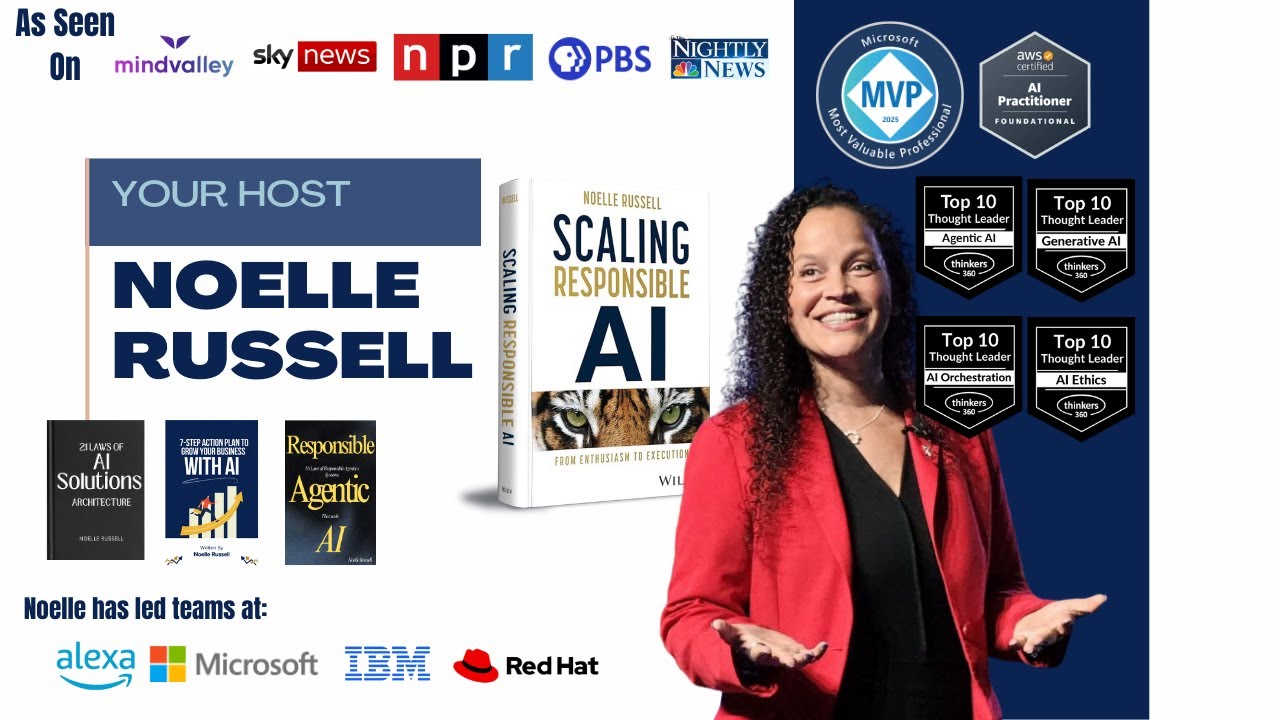
Noelle Russell walks through building custom AI agents on Microsoft Copilot Studio, comparing it to Google Vertex AI and Amazon AI studios. The session covers moving prototypes to production with VS Code and Azure, workflow automation choices, and healthcare compliance for AI systems.
Chapters
Hey, let's see here. Let me spotlight. There we go. So welcome everybody. Super excited to have you here. It is Friday. Every Friday we join together around the 4:00 hour, usually very specifically at 4:00. But today I have had a very busy day. I had the just glory of being able to speak at the Mindvalley AI Mastery program. Earlier today. And then we are running our AI Business Accelerator for founders and business owners. And we talked today all about using AI to help us generate an algorithmic heartbeat for social media. So how are we going to use AI to amplify our own brand voice in many different ways? And now I'm here with you all. So it's, it's a long day. Some of you have seen me for a long time. So thank you all for being here. Welcome to the party. If you wanna join us live and in the Zoom room where you can ask questions and most importantly, get a chance to break out and meet with real people building real AI as well as others on the AI leadership journey, you can do so very easily. Just head on over to noelle.ai. That's my website. It has a link for joining our free community. You also will see there that we have an AI Leadership Institute where you can actually become a paid member and you get access to a bunch of classes and workshops and accelerators. And we also, of course, have the opportunity to help you if you are running a business or if you have a team that needs to get educated. We get requests all the time to deliver training and workshops all over the world. So if you need help, this is the place to do it. But today is dedicated to talking about what's happening in the world of AI. I will give you a quick update on what's happening in my world. I got a chance to speak earlier this week in Atlanta. At an amazing, cool, fun conference with one of our members, actually. Sky, uh, Man Evans, thank you for being there. Came out to see me, uh, which was super fun. So she came out to see me. I got— she came, she sat in the event, uh, we spoke to— or I spoke on stage. I was the keynote of the— it's called NECA, N-E-C-A, the National Electrical Contractors Association. Amazing group. I really was super excited because I don't know if you know this, but they are in a similar situation as like software engineering in the sense that there aren't a lot of senior people in this space. Like, we're not growing electricians anymore, right? We're not growing— like, there's not a whole bunch of people flocking to become, um, electricians. And so there's a really interesting opportunity for them. And of course, AI has made them the cool kids in the room. Right? Data's— everything runs on electricity, obviously, but specifically every model that we use, like, doesn't exist without electricity. Data centers, right? AI data centers. I mean, electricity, fiber, all the things. It's just incredible amount of growth that the, you know, electrical contracting world is seeing. HVAC, plumbing, like these kinds of spaces. So interesting to see their growth, but also the challenges that they have, one, in using AI, to solve their own problems, but also in using AI to attract more people. 300,000 electricians, that's how many people, how many electricians they need over the next 10 years just to maintain like status quo. So if you ever wanted to be an electrician, hey, now's the time. But they can definitely use AI to create better training, onboard more people, get information, you know, be able to extract the expertise of people who are leaving. I mean, they were, we were talking about, I was snapping my fingers, I'm like, This is an electrician retiring right now. Like, every second an electrician is leaving the industry, and there are not that many people coming to replace it. So exactly, electricians, journeymen, plumbers— I mean, I get it, I get it. You're going to want like a robotic MEO to clean. Like, you're not going to want to be a plumber. You want a robot to do that work. But right now, uh, yeah, service-based businesses, home-based businesses. And I— what I liked about my participation there was It's not like they're not going to use— they're not anti-AI. It's just AI impacts them in such a different way. They're not thinking, oh, we're going to lose our jobs. That's not their fear. Their fear is that they're not going to use AI effectively enough to avoid— I mean, their biggest concern is workplace safety, right? Death on the job. My husband has worked at AT&T for a long time, but he works with the power company, you know, phone lines, power lines, all. Very similar. And people have died on the job while he was there, like, due to electricity, due to safety precautions not being upheld. Just, there's so many, so many opportunities for AI to eliminate workplace risk in that specific profession. So I talked a lot about that. I actually had a whole special deck I created for them because I just, I'm so excited and passionate about, um, the world. I mean, the whole electrical contracting world is just fascinating to me. And I feel like I can never get one when I need one, right? Like, my— we blew an outlet in our house, and I was like, can someone just answer the phone, please? So if I can help them build an AI system that just answers my call when I call, I feel like I will have done a good thing in the world. So, so I'm excited for that. But that was great. I did that in Atlanta. I then flew to, to Orlando, where I got a chance to speak at PlanSource's annual convention.
And that—
those are HR benefits administrators, right? People who administer benefits. And I will tell you, I've been speaking to this audience, benefits administrators, for like 3 years, and their problems are— we're not like— the needle isn't moving very fast. And I get it because they're in a regulated industry. This is healthcare. As a matter of fact, I said to them, you know, the, the challenge in benefits and, and insurance, healthcare specifically, is that we're not like negotiating, like, how much market share. Like, if we don't do a good job, it's not because— it's not that the company will lose market share. The, like, people will lose access to medicine if these algorithms don't work right. Medicine, not market share. Like, medicine, the ability to get healthy. And I talked about a lot of AI gone wrong stories in this space. I don't know if you're aware of some of them, but there have been cases where algorithms have been created. I won't name the company in case they ever want to hire me, but there was a company that created an algorithm, and that algorithm, um, basically used old data, uh, to identify whether or not people needed care. And that old data showed discrepancies in Black Americans and white Americans and how much care they needed. And it turned out that the data said Black Americans don't get a lot of care, i.e., they are healthier. That's the correlation the AI model made is if If they didn't get a lot of care back in the day, it's because they're healthy people. They didn't need care. And so the algorithm ended up making future healthcare decisions based on the fact that it presumed people who are Black were healthier because the data said they didn't need as much care. And obviously, that's wrong. And what ended up happening is that 35% of diagnoses were missed. Like, not just people got sick. Like, the worst possible outcome occurred because an algorithm misunderstood the original data, misinterpreted, made bad assumptions, assumptions that we can check. Like, that's our job. So that was the good news is I told administrators, like, they have been knighted. Welcome into the world of AI leadership that, you know, the most important people in these rooms right now— yes, of course, as an AI solution architect, I think I'm— I have a pretty important role to play, but it's not nearly as important as the person who does this job and knows what good looks like and understands the data, understands the business process. Like, oh my gosh, yeah, unintentional bias. Exactly. And no one knew it. No one knew it until bad things, really bad things started happening and those people started suing. Another really, you know, AI gone wrong in healthcare. There's plenty of stories. You can Google them or perplexity them if you'd like to hear more. But Um, but I, I just was, I thought it was good for them to realize like bad AI, well, it's, it's actually never bad AI, right? Like AI that's bad. I think every model starts bad. Every model I've used when I first use it, it might be cool at first, but as soon as I use it seriously, I realize like it doesn't have enough data. It doesn't know the nuance that I'm asking for. It doesn't understand my brand voice. Like it's always broken before it gets better. I always say it's like public speaking or walking. Like, you're not perfect right away. An AI model starts kind of broken. It starts not understanding. And through prompt engineering, through context engineering, through persona injection, we tell it who to be, how to act, how to deliver an exceptional result. That is a human activity right now, today. That is our job. And the best people to create AI systems that benefit The benefits administration people are people who have done that work in the past. And so, yeah, I don't know if they wanted a new job, but I told them they could put it on LinkedIn. They are now the AI engineers. They are now in the role of teaching models through their words what these models should do anyway. So that was really fun as well. Had a great, great opportunity, and it was, it was at the Ritz, which is super fancy, and they, they ended up having a big party at the, at Universal, but I decided to come home and party with my family. Instead. So I'm now, as you can tell, uh, back at home. Um, trying to think of another— I had another announcement I wanted to make, uh, and mention to you. Let me think if I can think of it. Oh my gosh, of course! So big news this week, we launched a book! And I have a really— this is a really cool story. So this book, uh, Creating Custom GPTs with ChatGPT, Don't judge us. It's, it's about building safe, responsible custom GPTs on OpenAI's GPT Builder. It was built with myself. There I am with Yuvika, with Padmini. These are members of the community. So a long time ago, we'll call it a couple years ago, we were like, okay, I will say I thought to myself, I am building a community, the AI Leadership Institute.. And I thought to myself, wouldn't it be awesome if I could transfer some of the good stuff that's happening to me, like an invitation to write a book, if I could take that invitation and invite people in my world to write a book with me? And that's what we did. So I was like, who wants to write this book? And a bunch of people raised hands and a few people got selected, all women, obviously. Um, and then we started writing. It took— it was way harder than we thought, of course. Took way longer than we thought, of course. But we got it done. But the—
I—
what I love about it is that both of these women I met through my community. I drew them in and they became my friends, and now we've co-authored a book together. Is that not magical? So I am so proud of this book. I'm so proud of the fact that community is everything, right? Like, yeah, AI, yeah, tech, Yes, solution architecture, but at the end of the day, it's the humans that we do it with. And that's why this call is so important to me, even though I was a little bit late today. And that's also why AI Leadership Institute, like, it's the community. We are all doing things we never thought we would do 2 years ago. So if you are new to this journey, if you're new to AI leadership, you're just getting involved, you will be a different person 2 years from now. And it'll either be intentionally so, right? You will drive that roadmap. You will build that path. Or you'll be kind of dragged along kicking and screaming. No matter what, you will be a different person. Um, but I'm excited about any— and this is just a testament to my own personal desire— anything I have, anything I do, anything that, you know, that is because I'm where I'm at that I get invitation to, I extend that to you. Like, I'm, you know, I'm like, let's go, more is more, let's all get this, do this together. So really, really cool. It is available all places books are sold. So you can get it on Amazon, you can get it on— it's available on Kindle and hardcover. I just got mine, so I'm super proud. I love the hard copy version, but you'll, you'll like— it's lab-based, so it's like actual activities that you'll do. It's really fun. But my, my favorite chapter is a chapter we all worked on really hard, which is Chapter 4, which is all about building responsibly. Right? Most of these lab books, they don't talk about these things. It's my mission. Like, we infuse into the DNA of a lab guide that you're going to do this special. You're going to add things, testing. I mean, it's really, really cool. Really, really amazing.
Yes.
Do you remember? Oh my gosh. Yes. Thank you, Sherry. Exactly. So, yeah, and we had a bunch of people volunteer. It turned out the publishing process is not what we thought the first time we got involved, but it's all good. It's done now. So yes, exactly. We all have favorite chapters and we have so many authors here and we actually have a couple publishing companies. So I do have a dream one day. We have so many opportunities to just take the information that's in the mind of the people in our communities and help them get it out into the world. And one way is through writing. And so I am super excited to have been part of making that dream come true for Yuvika and Padmni to get, you know, like I honestly think at the beginning they thought it wasn't gonna— like, they're like, there's no way. And certainly in the middle we were like, there's no way we're finishing this. It's not gonna happen. But the joy, the like tear-jerking joy of finishing something you start, like, it's amazing. And for it to be a book, like, what? Let's go. So really, really cool. Thank you so much to both of them. I don't know if they're here today, but I'm very, very grateful for their participation, their support. Again, it was, it was hard, but it was awesome. And I'm very proud of what we've done because it's hands-on keyboard responsible use. And that just, there aren't very many books like this. And what I love about it is it doesn't say it like, it's not like responsible AI, right? Like, no, you're gonna pick this up thinking you're just gonna build a GPT and we're gonna like feed it. We're, you know, we shaved up the vegetables into brownie batter and served it up. All right, so you're gonna eat this beautiful cupcake and get all your vegetables too. So really, really proud of it. All right, so custom GPTs, custom solutions. This is something that I've been pretty passionate about. This is the direction I'll take the next couple minutes, and then I'd love to throw us all into breakout rooms to talk about this or any, you know, any topic of your choosing. But to give you something to think about is that this book really reignited my interest, and I'm gonna share my screen and show you some of the fun things that I'm using. But custom GPTs is an opportunity for you to crystallize some, like, a solution to a problem that you understand inside of OpenAI. Now, however you feel about OpenAI and whether you're using ChatGPT, I'm not here to talk about that. But I, I am gonna say that we started writing this book 2 years ago. So there's that. But this concept of building a custom use case, a custom implementation where you scope the work to something relatively small. We called it a minimum remarkable product, right? That's the, the framing that I used. But it's something small like a concierge or a, a constitutional AI monitor or a, you know, like a, um, documentation tracker. Like it's a single unit of work, an agent, if you will. Now, what I like about this is that it caused me to go and research some really fun models in the ChatGPT, GPT Builder ecosystem. So I'm going to demonstrate to you what this looks like, and I'm curious. One, I think it's a huge opportunity to create value for whatever you're doing in your role as an employee, or even highly, even more so as a consultant, advisor, coach. Right? As a small business owner, it's an opportunity for you to build value for people and bottle it up in a, in a GPT.
Yeah. Why?
Thank you, Christiana. I think you'll like it. It's super fun and it's meant for leaders, right? It's, it's meant for everyone. There are some technical components, but I believe everyone listening to the sound of my voice will be able to use it. But I do want to share my screen and I did this for our, our team before I briefly covered it. But I went in and I started looking for tools that could help me. And there are thousands of tools. This is similar. The reason I like this model is that it's similar to when I was at Alexa, the early days of Alexa, we were building an Alexa Skills Store, which I think is ironic that now we have Claude and Claude Skills. But anyway, um, Skills Store. And so on Alexa, you'd build an app and it would go into a store and it would get categorized. Um, and so my skills were all around wellness and kindness and prayer and meditation. Um, some of them— I have healthcare skills, I have lots of things on there, I have reading skills, poetry skills. I have over 100 apps on Alexa. But in the early days when we started building that, we were building skills. And the reason that they were called skills was because— well, I should tell you anecdotally, we—
the—
some of you might have always wondered, maybe not, but I'm gonna tell you anyway. Um, always wondered why Alexa was called Alexa. And one of the urban legends of reasons why Alexa is called Alexa, it actually is grounded in truth, is that it is modeling the Library of Alexandria. Do you remember? Does anyone know that story of the Library of Alexandria and what happened to it? If you know what happened to it, let me— tell me in the chat. Do you know? So Alexandria, the library, burned to the ground and all of the information in it burnt too. And so Jeff Bezos had this vision of building something that you could teach skills And through the beauty of AWS, it could never get burnt to the ground. The information, the ideas, the humanity that we were building into it could never be lost. And there's something beautiful about that. Now, some of you will hear that and say, you're listening to me all the time. And like, you'll never stop listening. That's true. It's true. But there is like a beauty of how do we build a system that is elastic, sustainable,, you know, basically disaster recovery proof, right? Like, that has the ability for us to build something that never dies. And that something is representative of our, our minds, our ideas, our skills. So that was the idea. And now when you build a custom GPT, basically you're building a little skill, a little application inside using the LLM as your backbone. But now you get to customize it. So this custom GPT has its own brain. It has its own dataset or sets. Right? It has its own tools, its own actions. It's just a small version, or not even small, it's just a, well-contained scope. And so that scope could be big or small, but it's usually a single thing you're asking the model to do. So I'm going to share my screen so I can show you what I built. I think it's around here somewhere. And then just give you some ideas about how, and I'd love for you to think about like, how might you use this? Not necessarily, Custom GPTs. But the same is true for Claude and Cowork and skills. So the same is true. Like, I can build a skill, and that skill connects to connectors. Those connectors are tools, right? Like, I can build this small unit of work that can operate on my behalf and deliver value either to my clients or to myself. Um, we're in— we're moving into a world where agents aren't just like built to do one thing by themselves. We're building Lego blocks, if you will, right? And we're assembling those Lego blocks into, like, workflows. So I'm going to share my screen. Hopefully I'll share the right screen. There we go. That looks about right. And go to— I'll go to ChatGPT. So this is an example of a prompt I typed in. I'm actually going to click away and go back so that We can see it because it resets every time you use it unless you buy it, which is cool. I love it. But you can see this is the website if you want to go see more detail. I just typed in— I'm right now reformatting all the videos on my YouTube channel, and I wanted to create some viral video. I don't know if you know this, but in order for your video to perform well on YouTube, it needs 3 things to be very good. One of them is your thumbnail. The other is your title and the other is your caption or your hook. And so this is a thumbnail generator. So let's just say I wanna talk about responsible AI. So I'm gonna say my video title is Scaling Responsible AI. I should have used Whisper Flow, right? So I'm gonna say Scaling Responsible AI. That's my video title, and now it's gonna generate me a thumbnail. Now, what I wanna do though is I wanna train it on my face. So it's gonna give me some ideas.
Oh yeah, cool.
So it says, is it about governance? I'm gonna say governance, governance leaders for leaders. And my tone, I'm gonna say futuristic, optimistically futuristic.
Right?
I'm just, I'm not gonna type that. Optimistically futuristic. All right. And then anything else?
Oh yeah.
And then I need to add some pictures of me. So I'm gonna add this picture of me, which is me in my hotel room in Orlando or somewhere. All right, there we go. It's for governance. Now let's see what it does, right? So good personal brand, some thumbnail concepts, AI needs rules. Ooh, I like that one. Before it's too late. I like that too. Scale AI safely.
Meh.
Best for my tone. Yeah, I get that. It knows me. I'm gonna go with A because it's bold and viral. So let's see what it does. Right? So this is a very specific custom GPT that a wonderful developer built to help me do a thing where it still requires my voice, my name, my words, to provide clarity. But this part takes me a long time to get right. The creation of the image, right? The establishment of some— like, what do I know about building trending YouTube thumbnails? I don't. And so now it's going to sketch out based on my simple instructions. Took me now, because I'm explaining it while we go, right? That's pretty cool. I like it. I don't know. We'll see. Let me go and show you some of the other ones that I did though. Because it's kind of fun. I did— I think I just did, uh, responsible AI, like, help. Um, so I'm gonna go in and show you this one. This is not my face. I never made that face. Look, I don't even know. I think it might think I have braces. I don't know, I can't tell. My teeth look pretty straight though. But like, it— but that's my— that's my worry line for sure. That's me, but not really me. So it created this Right? I think at that time I was saying something around, um, you know, the tools that I was using and that you're already late if you're not using these tools. So it created this for me right from the same tool. This one's not that super great.
I don't know.
I don't love it.
I don't love it, but, but you get the idea, right? And this allows me now to offload that workflow of building YouTube. And there's more. So maybe I want some viral video ideas. Right? So here I'll say, generate— oh no, no, no. Whisper Flow to the rescue. Generate a viral video idea for implementing safe, responsible AI.
Bam!
And now it's going to do its thing. It knows more about virality, or at least I'm counting on it to. Right? Like, the idea of building these custom solutions is that once you've documented the SOP, which is what this is, Once you've documented the SOP, now you can use that SOP in action. It's not just how to do the thing, it's do the thing. So now you can see I let AI— oh my gosh. Yeah.
Cool.
So guess what I'm gonna do? I love this idea. I'm gonna grab that, right? And put that in the thing.
Yeah, yeah, yeah.
I'm doing that, right? So now I'm gonna say video idea. Yes, this is better.
Beautiful.
Let's see what happens. I like it. And then I'm going to add my photo again. I should have more than one, but it's been working all right without it. Let's see what happens. Let me move this away.
Cool.
What does it say? All right, go with A, B. I'm going to say, oh my gosh, A, but funnier.
I don't know.
Okay, let's do one. Let's see what happens. But you get the idea, right? So now I'm able to start pulling a bunch of these different— and there is right here, if you do Explore GPTs, there's a whole marketplace full of these, a marketplace you can put your content in. And now you can make this available to your clients, to your customers, to your prospects. Like me, I'm very interested. I have already clicked on the link and gone to this company and found out how I could pay them. That's already happened. Okay, that's good, that's good. I like it, I like it a lot. I actually look like one of those twins anyway. Um, but yeah, I like it, it's not terrible. What do you think? It's a little crazy, it's a little crazy anyway, but pretty fun. So this, the nice thing is, is like, you know, it would just take me a long time, a long time to do that. It would take me a long time.
I would—
I don't really know, I don't want to spend time on that. This took me 3 minutes to do this cycle, right? And I kind of like it. It's really, really neat. Really, really, really neat. Really fun. But that's just one. So let me go to Explore GPTs. So this is what our book is all about, is teaching you how to build one of these. I built one called the Fillmore Companion. I read a lot of a specific New Thought author, Charles Fillmore. I was raised on Charles Fillmore's writings. He created a, a Christian-based church called Unity Church. I was raised in Unity Church since I was 6 years old or earlier. And so I built a companion that I use all the time to just brush up on those principles, right? What are the 12 principles? Like, it'll just brush up on. So, so I created a custom GPT. I used an example of some of the GPTs we built in the book. But maybe this isn't something you haven't seen before. Maybe you haven't really gone back to this market. But the same thing, for those of you who are not affiliated with this platform anymore, the same thing is true here in Claude, right? The same thing is true, except now we're— we build them as skills. And you can go in and build a skill that does similar work, build custom thumbnails. The benefit when you go in and you build a skill, which I'll show you here, right? You can create it with Claude or write the instructions. I'm just gonna go to write instructions so you can see what it looks like. This is The definition of a skill, the definition of a custom AI solution that you can build in Claude. Notice here the name, the description, the instructions. Doesn't sound super fancy unless you've, you know, learned from me. Because the instructions are no longer build me this thing, summarize my work, vending machine AI. The instructions are going to at the very least be, R-T-E-C. Oopsie. I'm gonna make it a little bigger, maybe. Right? You're gonna define the role, what you want it to do, the task, the examples of what good looks like, and the constraints in which it operates. Responsible use. You're not gonna ever just write in instructions like, do this for me. You're gonna give it Here's what I want you to do. Here's how I want you to do it. Here's what good examples of this looks like. Here's what bad examples of this looks like. And here are the constraints in which you must operate. Rinse, repeat, iterate. Now, if you've ever heard the term plugins, so when you— let's see if you can do— I don't see here, but it's on Cloud Code and I can't— or Cowork. But when you see plugins, plugins are typically going to be a collection of skills. So you build a bunch of skills and then they're like, I use these 6 skills all the time. You can connect them together into a plugin and use that plugin in Claude. But this is the same idea, same exact idea. It's just for a different platform. So you should know how to do it on all of them is my personal belief. I don't know. I wanna hear from you all. Questions, comments, perspectives. Um, what do you think? Let's see. I'm trying to find my stop sharing button. Awesome. Okay, I see lots and lots of comments here. Amazing. Amazing. Okay. Amazing. Okay, I'm stopping my share so I could see you all again. Hello. Hi again. All right. So what do you think? Have you seen this before? Is it new?
What do you—
what do you— give me some ideas. Anyone want to comment? Oh, good. Can you share the links and the name? Oh, yeah, of course. Oh my gosh. Amazing, Kim. I love it. This is amazing. Oh my gosh. So cool. Okay, which tool are you using for thumbnails? Did I give it to you? Oh, somebody else. Thank you. You guys got it. This is just one though. So my, my kind of idea is like every time you do a thing, like just go see, go look and see, did somebody build an AI for that already? Like, and ideally compensate them for it. Now compensate does not necessarily mean give them money. Some of them just want you to follow them. Like some of them just want you to become a subscriber on their YouTube channel. Lots of people get paid in lots of different ways. Do not think it's just binary. But I do that, right? I went and clicked on the link to their website and saw if— can I buy something from you? I couldn't, but me using it is valuable to them. And so yeah, I really liked it. Oh my gosh, that's really cool, Kim. I love yours. That's really funny. Yeah, you— that's a great question, Christiana, around like, do you need to be aware of how they've done their work? You can definitely ask a model, right? Like, what are the constraints and guardrails that you were built against? Now, they might think you're trying to jailbreak, so you could be a little bit more gender with that. Like, is this safe to use? Literally ask the model or ask the custom GPT, or is this safe to use? Now, ideally, they will have done what we do, which is they will have identified the constraints and told the model if someone asks this. Like, that's our job to build in. But most people who build these things have no idea what they're doing. So the good news is, Cloud is secure. I've shown this to you before, but Cloud has— I shouldn't say— Anthropic has created a long time ago. This is years in the making. Let me type it in. Oh, it actually— I think it brought it right up. Oh no, it's called their scaling policy document. Here it is. I will grab the link and share it with you all. But this document identifies how Cloud has approached it, which means that the skills are in this as well. ChatGPT, OpenAI, same thing. They have a responsible AI policy document. That means that the environment they're running in runs under those policies. Let me share the link somehow. There we go. Click. So this is Anthropic's. For those of you who are listening, you can just Google Anthropic's Responsible Scaling Policy. It was published or republished. The third version came out in February, so it's relatively new. Or updated. So something worth taking a look at. I know, it's so funny. Our tech is not memorable at all. So I call them the 3 Ps, right? The 3 Ps of prompt engineering. But yeah, everyone has their own mechanism for— these are different advanced— it's not original to me, Josie, y'all know. But yeah, there are different advanced prompting techniques, and this is one of them. Is one of them. Yeah, I call it the 3 Ps, like the purpose of the bot, the people who is it going to serve, and the portfolio of data it needs. So yeah, I have a— I need alliteration or something to help me with these things. Yeah, awesome. Of course, I figured you had, Joe. Do you want to talk about your experience or anything? Oh, your hand is up. I'm so sorry, I didn't see it.
Yeah, so, um, I don't use them much anymore because I've been mostly living in Codex these days, uh, but, uh, GPTs are great to play around with because they're very powerful, um, especially if you kind of think like a programmer and give the model a lot of context and instructions. Because you can build those in or you can have— you can use the GPT builder to have it create those instructions for you. But if you structure the instructions and provide it good context, then you'll get really good results out of your custom GPTs.
I love it. Yeah, I also, like I said, I literally was all about it 2 years ago when we were writing this book. It was like the thing I was doing and then it published and I was like, I haven't been in there in a minute. But then I've I realized how fun it was and there was way more stuff in there now and it's better than it was. So I'm happy. It's cool that it came out. But yeah, it's really funny because I totally— it's over 2 years old and I had not gone back in there since. This week was the first time I went back after 2 years. So I'm glad to hear you had the same. But yeah, it's worth taking a look. Like you said, it's worth playing around with. This is not like the mission critical part of your business. Like this is just— it's kind of fun to see how people have built it. It also serves as a great example of what people can do. And if it can alleviate some pain you have, like all the more. I just encourage you, like I'm a believer, like these are all people like us that build a thing, right? And put it out into the world. So if we're gonna—
It's also great.
Yeah.
Also great for demos. Like if you're trying to build something really quick and a proof of concept or something like that for a client. Yeah. GPT can do it like in minutes and it gives them something to show instead of you talking about some, you know, here are the capabilities, blah, blah, blah. Give them something to show.
100%.
And they, they'll, they'll instantly say, wow, that's value.
Yes, exactly. Show, don't tell. Be a doer, not a talker. Like, this is exactly aligned with who we are around here. And I love that, right? Because you can, in the conversation, build a custom GPT right in front of them based on what they're asking you for. And it's not the end, it's just the beginning, but it's It's tangible, it's real, and it's value. And I couldn't agree more. That's awesome. Thank you, Joe, so much. Javier, I see you are up next.
Actually—
Oh, sorry.
I have a question.
Maria asked before me.
Oh, I'm so sorry. I'm just looking at the order. So sorry. Maria, please. Sorry.
So for the GPTs, I've also built a couple more just for personal, like, personal use, also just to put in some training material. But now I'm thinking of it could be a very useful tool for business owners. But I guess my worry is putting their information up into the web, right? I wonder if there is a secure way of doing it because again, I'm just thinking in terms of training, right? Like training. So you need to know their style and then be able to share with their team. But the two things I thought about was like, you know, now their information is out there. That's number one. And then the other one is like, I don't know if there is a way to track like the metrics, like who used it from their team or like you know, that kind of— it's almost like, um, uh, you know, you use and you accumulate data somewhere in the backend so that whoever is the, the trainer can actually use that for monitoring?
I love it. Yes, great question. So there is, um, to the point Joe made just a few seconds ago, there's a lot you can do with this. Um, and so it has the ability to connect to literally anything. I'm just going to share my screen really quick so you can see what the— hopefully, can you see the GPT one? Hopefully you can. So I— oh, maybe, maybe I back up a little bit. So if I go in and I just create a new GPT, this is a custom GPT. This is the simple, you know, like name, description, instructions. But you also have the ability to choose your upload, but you don't have to do it this way. This is uploading it into, right, OpenAI. You can instead offer actions. And when you build an action, you can actually create a connection. And this is why, if you think like a programmer, what is the API? What do you wanna access? How much do you wanna access? You don't need all the data. What data do you need? So you create the data schema of how you want that information interacted with. And this is just one. You could have any number of actions. It could be data-driven. It could be, uh, generating a report. It could create a trigger to an— a workflow automation. Right? So this is kind of your playground to allow your custom GPT to take actions on your behalf. And those actions might be to publish an employee dashboard that shows usage statistics, if that makes sense. Okay.
So there's another part that you can integrate so that it actually kind of funnels results into another portal. So that's helpful. And I think for the first part though, like, do you still feel it's safe for people to put in, like, very— I don't want to say proprietary, but, you know, just more personalized information in there? Like, is—
Yeah, I mean, it's as safe as you are, right? So every one of these models has safety and privacy settings that you can implement. So if you go into, like, the security settings, you have the ability to kind of choose how the model behaves. So if you look at security, if you look at data controls, right? So did you see it said on and then flipped to off? That was very interesting. Wait, I will just have it there. But improve the model for everyone off, that means that your— this is now a tenant that you have, meaning no one— this data that you're using is not being uploaded to train into training data that the model is using. Is it going to use remote browser data? I said of course yes, because I want it to search the internet. But so you can control like the security level, the authentication, the actions that it takes, the URLs that it goes to. So you have— so is it by default? No. But can you create an environment that's secure? Absolutely. There are production systems that run in using OpenAI as their enterprise platform. So absolutely you can. You'll just have to pay additional levels of business. You'll, you'll increase your business relationship to meet the the needs of your organization.
Okay, so Noelle Russell, I can do that for my setting, but for my users, people that are using it, like, is this the part that you also need to tell them? Like, you also should just switch off, you know, training the model for other people and—
100%. Yeah. So similarly, when we get this, and I'll just make it bigger for those of you who can't see, right? See at the bottom how it says ChatGPT can make mistakes. OpenAI doesn't use AI leader. So yours says something different if you are not at the level that, you know, if you're not locking down your data, it'll say something like, I actually doesn't say this. It definitely doesn't say this model is openly training the internet. But what I do is I tell them to look for this statement and if they don't see it, that they want to go into those settings and turn off that. But that's not the only thing you're worried about, right? That's just like the interaction. With your model means that the interactions are being used for model training. They won't want that. What you're going to be even more concerned about is that when you're building a custom model, where is the data actually coming from and where is it stored? And again, Enterprise ChatGPT gives you the ability to own that tenant. So you, just like you would own a Microsoft tenant or a Google tenant, and so that, that's the, the option. This should not be— if you look at these things, this is not for healthcare apps. This is not for, you know, you're not looking to protect yourself against PII, right? Like, um, image generation, video content generation. We just look at kind of the stuff that's in the GPT store, right? You'll get a, a feel for the kind of stuff like Canva. But Canva is a tool, so its security is, uh, logged through the authentication to that tool. So right now I can get access to some bare bones functionality, but if I really want it to work, I'm going to have to connect it to my account. Then Canva owns the security of my account, not the model. So it's all done through proxy.
Okay.
Yeah.
I'm hearing like the tenant is the, I guess enterprises have that as a manner, but for me, just let's say you have a small business. Um, I. Like, do I just upgrade my account to create some sort of tenant environment just so that—
Yeah, I mean, that's why— so I have a business account, but yeah, I would look into both Claude and, or I should say, Anthropic and OpenAI. Look at their business settings, and there are like indemnification, security, data privacy policies that are implemented at certain levels of relationship. So just do a little bit of research to figure out what level you need and then buy at the level that you need, which in my case happens to be the highest level, so I pay them the most.
Okay, no thank you, Noelle Russell.
Yeah, you're welcome. Great question, great question. All right, awesome. Okay, thank you, Javier, for, um, letting me know about Maria. That was amazing. Um, I have to— I'm gonna stop my share really quick and find you all.
There you are.
Uh, Javier, did you have to leave? Oh no, oh no, you're still there. Did you want to ask a question still?
Are you still— my question was, um, Or comment. I actually wasn't very interested on the thumbnail because myself I'm doing this content generation now where I'm really not using my video, but I want to use examples of successful videos.
Yeah.
This, so this actually was pretty helpful because someone else that I'm working with on the content side, just like, I'll just show you. And I was like, why didn't I see this 6 months ago? This was so helpful. And then I literally feel like I'm going to try to build it myself on Claude and got the whole system down. Like, I broke it down in 3 agents and just that was it. Yeah, it was very, very easy.
Surprisingly, did you build it as skills or did you just build it in Claude conversation?
No, our skills.
Oh yeah, exactly. That's so awesome.
Those are the skills. Like, I give one for just gathering the info, scrape it, then to get the format., and then one to just put it together. And then I didn't even use the video. I was like, just get the image and put this and then make it look nice. And then the, the super agent or whoever on the top is basically that merges everything, the orchestrator or whatever. Yeah, exactly. That was very easy, surprisingly, which 6 months ago that was like, no.
Yeah, like we, I mean, it's so fascinating to me now the orchestration levels that are available because we used to have to like have LangChain or Semantic Kernel, and we had to build planners and skill orchestration. And like the amount of work we did to do what I can now be like, enter. Like it's, it is very impressive, but I do also realize how much more we know having done it the old-fashioned way, right? Like it's, I sound like my grandfather, but yeah, like I, you know, I walked uphill both ways with a bowl on my head for lunch and, and that's kind of like I did all these things, but that makes me much more aware of how these systems work. So when they don't work well, I can edit them. But, but yeah, I think it's really cool that it's so much easier and you don't have to do all the plumbing.
I believe also the part that is making this is that you have the conception that cloud code might be the best option for you to do this.
Yeah.
Also, but then like now you're seeing that cloud coworking probably is just as, you know, just as easy.
Yes.
It makes it easier. Than doing it with Claude Go, actually. Yeah, because you're giving probably even more context for just using your words. Yes. So it was like very interesting to see now how it is. And even I try to do it on Perplexity, and Perplexity does a really fine job. Like, when it hits a hurdle in Claude, I just replicate it on Perplexity, and it worked. Oh, I didn't have really any issues, you know, whatever they couldn't do it, I could just do it there. And Oh, I get it. And then this is the info I needed it. Yeah. Let's just, just move it over and it's, you know, get the info. It is very helpful for lead qualifications. I was like very, very impressed how Proplexity has improved too on that end.
So, so tell me, can you share how you're doing, how you're doing that?
Like what are you doing? Yeah, I can share. I can share. I just did that.
You don't have to share your screen if you don't want to, but just describe to us like what you're doing.
So I wanted to— I'm going to a few conferences the next month or so. I'm going to be in Image as a participant. I see that you're actually going to be there. Cool, congrats. I'm gonna go to STAR East, which, uh, is a full-on QA testing software development conference. So a lot of practitioners, and since I'm working with a company focusing on testing solutions and AI solutions, okay, I need to prospect people. So we got a list of leads. We also got conference leads, but they're taking forever. So I was like, okay, I built a scraper and I wanted the scraper basically to access the website if it's available, get the agenda, and from the agenda, give me all the people who are presenting, panelists, et cetera. I was like, scan it all. And I basically very, very specific tasks. Like, you know, if you heard of Huddle, then you can go do this. And then, and it did, and it worked well. So it got me everybody, the role it was listed, their email if it was there, or the LinkedIn, you know, everything. It did it to me.
Sure.
Yeah.
And I did a separate, I did a separate agent that once this is created or generated, um, basically validate it and then qualify based on the prospect people that I'm looking to talk to.
I see. And then it's not like you're not communicating to them yet. You're just qualifying, like, based on the data that you have.
Exactly. Those are the requirements that I'm looking for a prospect.
Yeah, yeah, yeah. That's awesome. And then that's the hardest part, right? Is creating an actual valuable list that's not a bunch of dead dials or dead contacts.
Exactly.
Yeah, that's really cool.
Then by doing that just with the speakers and panelists, then I know who to talk to. I don't need to talk to all of them, so this portion, and then qualify them. That was, that was to me very easy to do. When I hit a wall doing it on Claude, like, I'll move it to Perplexity, and it worked. It was really much better in my opinion.
Yeah.
And I'm trying to do it with image. Image is a little bit more secure as a website, I think, because I did hit a couple of roadblocks and I had to tweak the way I am doing the scanning on Perplexity to do what— to get better results.
And what was that one? What was the last one you were on?
Perplexity. I was using Perplexity, which is basically you can set them as skills. And then I did an orchestrator to just give me a quick report on why these people are the top qualifiers.
That's so neat. There's a commercial about this, I think. Who is it? It's like Nike or something where they like dwindle down the like best football player based on all of the different— yeah, all the data. Yes. And I actually thought there was like some flaws in it from a responsible AI perspective because I was like, that could be biased.
It is.
It can be totally biased.
I agree.
But yeah, it's been very interesting to see how now it's working. I mean, the one thing that I thought it was very interesting recently with Claude Co is that You can now even ask it to create a performance agent of your agent.
Oh yeah.
And is that like, can you do that? It's like, yeah, I can do that. It's like, actually, you find it here, but it'll tell you like, you want something specific, tell me what is it you're looking for and it will do it.
Yeah, like build a task adherence agent that like makes sure your agents stay on task.
Yes.
Yeah, it's very cool.
It's very interesting.
The evolution, right? Like how far we're coming, like so, so, so, so fast. Like don't blink, you're gonna miss it. Um, so amazing. Thank you, Javier. That's super cool. Thanks for taking extra time and explaining that to us. I think a lot of people are, you know, like, we're all like, wait, what did he just say? Um, so I really appreciate you doing that. Um, awesome. All right, Alonso, you're next. I've been watching your socials. I love them. Um, all right, here we go.
Yes, following your lead. So I have been in some tech things, and so I know they're doing stuff with the local AI. Does custom GPT work with like a small— I'm sorry, do you get custom GPT with a small LLM? Like, is there a benefit to it or not really?
Because no, the only thing I could think is if you built— no, not really, because a custom GPT is in like the GPT Marketplace. Like, it's meant to build like a small little component that people could use. So it's more like an app in an app store than— there's no situation where you would like run it on device or— yeah, I mean, technically it's not even a small language model. Like it's built on the model. So it's on a large language model. It's just a fine-tuned small version. So yeah, no, I don't think— it's definitely not a small language model because the model itself is still Cloud or ChatGPT. So you're not—
I know they're doing like the small, uh, LLMs, but I just, I guess custom GPTs, I'm trying to think of the use case would be like if you have like your own set of like documents or things like that and you want it to run more efficiently, but doing it on the cloud, I guess that's like the best use case for it, or?
Um, I mean, so when you build a custom GPT, you, and granted it's OpenAI, so that's that. So the only models custom GPTs can be are OpenAI models. So there's that. A small language model, you can pick from thousands of models, right? Any model, Mistral, Llama, right? Like custom LLMs, you have a lot more flexibility. So custom GPTs are just OpenAI, so they're immediately restricted. They have a couple different model options. So they have some variances on 5, 5.3, 5.4, but then they also have 5.2, 0.3 are all options that you have. So really it's more like if you want to create a— it's almost, in my opinion, it's kind of like building a composable, you know, it's not, I don't know, like a composable capability, right? Or an action that you want it to take. We considered them like custom apps, right? If you wanted to build a specific function capability inside OpenAI, but you didn't want to have to go through prompting, you wanted to be able to create your own space, your own instruction set, your own dataset, your own action set, like the ability to connect it to other actions, MCP it into other AI systems, all of that. That's, that's the, this is OpenAI's offer and market for that capability. So, yeah, it could be used for document intelligence, I guess, but definitely not the only thing.
Thank you.
Yeah. Yeah. It's, yeah, it's definitely, it's specific to OpenAI. So that's why it's so weird.
I, but they have Claude for Claude also because I stopped using OpenAI.
So, I mean, yeah. So if you're on Claude, then you'd be building skills. And skills are just to create reusable SOPs, reusable tasks that you want to execute.
Our skills, they're not custom GPTs, they're different things, right?
Yeah.
Yeah.
So this is, that's the whole thing is that custom GPTs are OpenAI's thing. Skills are Claude's thing. I say that loosely because skills are used in a bunch of different platforms, but, but that is the way that they have gone to market with this capability to create a refined set of functions. I wanna share my screen and show you that both— oh, I, I won't be able to do that actually.
Codex has skills and plugins.
Yeah. And, and Cowork does too, right? So not specifically to Codex, but yeah, Anthropic in general has the concept of tasks, skills, and plugins as their architecture for building custom solutions.
But are they all the same thing? It's just we're calling them by a different name or?
Are these different products, if you will? Right. So on OpenAI, in ChatGPT, it's called a custom GPT. That's how you build this customized work— workflow or workload. If you were in Claude, you would call it a skill. Helen, why should— Oops. Sorry. So, yeah. So you would call it a skill. And I'll browse the skills so you can kinda see some of the ones that we have, but you can see here, right? Skills— plugins are typically a collection of skills. So if I go in here, you'll see usually at the bottom, these are all the skills and connectors that are used to make this plugin work. So if you kind of think about it from the architecture perspective, when you're building something, when you're building a custom AI solution in one of these platforms, not Microsoft, Amazon, or Google, but if you're building on Anthropic or if you're building on OpenAI, This is the mechanism they've provided for building those custom solutions. And so on OpenAI, custom GPTs. On Claude, skills, plugins, tasks, and connectors, of course. This is just like the tools that you have at your disposal to connect to the tools that, you know, to do the work that you need to do. But you'll notice you can browse them here, but like plugins are meant for desktop, coworking, kind of environment.
It won't—
thank you so much. I think— yeah, no problem. It's definitely, um, oh yeah, because it was too big. Um, but yeah, so when you're in Claude and you choose Customize, um, that's where you'll see like the ability to use skills. Skills represent— and the cool thing about this is that you don't even have to— like, a skill sounds I don't know, abstract. And really, it's just a set of instructions. So if I go in here and I say, create a new skill, and I ask, like, this is what a skill is. It's a name, it's a description, it's instructions. Like, now you've built a little component that has a set of instructions. Now those instructions could need actions or connect to tools or talk to other systems. And once you build this, you'll have the ability to configure that. Um, but this is just like a custom unit of work. Uh, and so these are, um, and then of course you can expose that to people. So I, for example, I don't know if you can see it here. Uh, oh no, it's on my cowork. Maybe I'll, maybe I'll share my desktop and let you see it. But in my cowork, I have 6 skills, 4 of which I built myself, 2 of which I got from the marketplace. So I didn't build them. I got them from someone else who built it, and I need I needed. So, so same idea, that marketplace capability where we're all building units of, uh, work that we can now assemble together into plugins and, and utility.
Have to work on this because I stacked on my Anthropic and my— but that's because of you, because you, you showed us Lovable and Marvelism. So now I just, I have to do the work. By the way, congratulations for on your book. So I had told her to pad me already, so well done.
Thank you so much. Yeah, so cool. Well, it's a good segue because we do actually have, we're launching a new challenge. You will hear it here first. We are launching a new challenge in May, the Agentic AI Challenge, because of exactly what we just showed. Like, people are like, wait, what? Like, how do I even do that? So we're gonna build a 5-day challenge that's gonna take you through setting up and configuring agents, custom GPTs, and custom skills on those platforms. So that way in a week you'll have a chance to do all of it. And of course, I will then be encouraging you all after I give you all of that value to join us for our Agentic AI Practitioner in the AI Leadership Institute. But for those of you who don't want to, I'm gonna teach you all the things you need to know kind of to do it yourself. But we will be leading that. That will lead into an actual masterclass. On building a GenTech solution. So thanks for asking, because I think the question you just said, like, we talked about it for 15 minutes, but it's so much better if we are, like, we put our fingers on a keyboard, like Joe said, put your fingers on a keyboard and build something, experiment, test it out. So we're going to run a challenge that does that. All right, I think so. Thank you so much. That was really awesome. Thank you for being willing to come up and talk to us. I think I saw Clyde here. Clyde, did you have a question?
Can you hear me? Okay, so again, okay, great. So yeah, fingers on keyboards. Grandfathers would walk on the snow, in the uphill, in the snow, 3 feet of it, uphill both ways. So you got to get that story right.
Yeah, you're right, you're right. I like, I'm like, you know, whatever that is.
So I'm a grandfather now. I do it every day. I'm uphill both ways. So at any rate, Um, the day will come. Somebody spoke about the trusted adherent agents. Uh, I guess the day will come when we'll be able to have the agents come to even meetings like this for us on our behalf, right? So the agents will all be meeting with each other. There'll be no humans left.
Oh my gosh. So I will share with you that they're not only that, but Zoom. I was on stage in October of last year. It's like well underway. I was on stage with, uh, one of the VPs at Zoom, and that VP was talking about the current thing he is testing, which is an AI agent that sits on his Zoom calls, but he has provisioned access for that agent to do some of the things that he does.
That's crazy.
So he's given it autonomy in certain types of decisions. And so today, his Zoom mini him goes in and sits on these calls, and if the If the thing is within its threshold to deliver, it just goes and does it right on that call. And then it sends him an email or connects with him in Slack, or of course goes into Zoom and messages and says, hey, by the way, um, this thing came up. I didn't do it. You need to do it. Right. But that agent is actually literally, like you said, showing up and delivering value, doing work in the call on behalf of that human. So I 100% see a situation where all of our AI agents with provisioned access to a certain level of work will be able to completely do that work autonomously without us being involved.
That's crazy. That's great. So, okay. So here's the thing for me. I, the question I've got for you, I don't know how much time you've got, but I wanna get this in real quick.
We got time. We got time.
I think everybody will, will maybe be able to relate or, or help one or the other or both. Uh, so I'm a big thinker. I do like, I have no problems with my idea factory. They're like, 1,000 a minute, you know, no, no, no issue. But, um, so the, the creatives kind of have a problem with the, that, that blessing. It's also a bane because I get bored when it comes to implementing it in the detail, right? You are not alone here. So I know I, I, I, I've met folks, lots of us. So, uh, possibly everybody on the call. But so then do I hire, do I hire a GPT expert? I can do handyman stuff in my house. I I, you know, I'm many decades old and I've done a lot of stuff. I pretended I knew what I was doing when I was in college, when I had somebody who had like a lot of properties needed me to, and I actually got really good at it. So I faked it till I made it. But right now I've got 10,000 skills that I can use. There's 10,000 skills here for this stuff that you guys who've been doing this a while have. Should I be hiring one of you to take my crazy ideas and put them into place. I want to create a family business institute where instead of, you know, the people who are kind of borrowing from all of us, had that family, can I, can I, can I, can I, and I will, I will, and they don't and they don't, right? In terms of paying, paying those debts back to you. So, you know, a way to create, to build intergenerational wealth, a way to kind of get people—
family bank. I love that.
Yes. So, um, the, the Family Savings and Loan would be the name of the concept, right? Uh, I think it's got— I think it could be monetized really easy. I think all of us would probably either be using it or, you know, in some kind of way.
Yeah.
Uh, you're making—
with kids, not every— you know, if you've got kids, you're definitely thinking about this at a certain point in your life.
So, yes. So, um, I would love to do that, but I think I'll get bored when it comes to kind of, all right, here's the day-to-day stuff. So do I hire Yeah, only because you know you're gonna get bored.
Ideally, what I say is to build, like, you can go from idea to execution in less time than ever. So at least get the idea to, like, a clickable prototype, like Joe was talking about. Like, build a custom GPT, build a, you know, an application in Lovable. Like, build it up so that it is, like, it basically works. You just haven't hardened it for production. So build it, because you can build it with your words and you can build it in days. As a matter of fact, if you are like me, you and like Joe, like we just, you get lost in the journey like you are in it and then you look up and you're like, 3 days have gone by and you have been building this whole thing. So the good news is, is that the only limitation to you building the thing is your words, your clarity of thought on what you want. You can do all of that. I would do all of that. And then now you've got something that you can either get funding for or you can get early partners for. And then you hire someone to like do the— because now it's going to become twisting knobs and turning levers. And I totally get it. That's when I'm like, I'm— that's when I leave a company is when what I'm doing becomes a lever someone pulls.
I'm like, that's when I grab a cup of coffee, right?
Right.
Yeah, exactly. Like, we're done. Like most— and like you said, not everyone is like that, and it's okay. Uh, but definitely there are a few of us in here that are exactly this person. So I would say build it like because you can. Build exactly what you want, exactly what you're envisioning. You can do the whole thing. You can build a classroom, you can create content, like you could do it all. And then once it's up and running, then you can hire like what we call like a managed service provider, right? Like someone who can just keep it going, keep making sure the AI system is operating well, making sure it stays on task, making sure it's not, you know, lying or doing bad things. But I think you could build it in such a— especially because You're an idea person. We tend to build things very, very quickly with the tools we now have available. It then becomes hardening it for production. That's when I would hire someone. But until you get to that point, I would do it yourself because you're gonna know that vision and that translation. You know this more than I do, actually. The translation of what you're saying and what some GPT builder is gonna do for you, there will be— it will be lost in translation. And so You don't need that. You can talk directly to the model and I would do that.
So thank you. Okay.
Yeah, exactly. My job is done here. Another builder. But no, you'll see. Then you'll be like, maybe I shouldn't do this because it'll— it's going to catch fire. And then you're like, wait, this feature and then this feature, like all the ideas can get ignited now to the point where I mean, yeah, I have to stop myself sometimes where I'm like, okay, I'm not building that. I just wanted to see what it would look like and I'm like all in it to win it. So it's really, it's, it could not be a better time for people with this tendency of like idea to execution. Could it's your time.
Okay.
Have fun. And then of course you do have us so you can come and be like, all right, I need someone to at least look at this and let me know if I'm on the right track. Like that's what I think you, and oh, I mentioned this to Maria before in a previous call. When you go, when you do get to that point where you need someone, I even then think hire fractionally, right? Hire a senior dev, a principal engineer. Somewhere to come and just look at what you're doing, look at the code that's being generated, look at the implementation. You know, you don't need someone full-time, you do, but you do need someone consistently, um, to just— that knows what they're looking for, right? That's the problem with us. We're like, I'm done with that now, like, push it out of the nest. Um, these babies never grow up, they never leave the house. There is no empty nesting of an AI model. Like, it's— you have to take care of it. So you will have to think about fractionally at least, hiring someone who will take care of the model over time. Awesome. Great questions. Awesome. I'm excited for you. Good luck. Let us know. Gwen, I see your hand is up. Are you up for a conversation? Yeah, just real quick.
Thank you.
I mean, congratulations on you on the book.
And, um, I haven't taken the, uh, certification for Microsoft yet, so just to—
that's all right.
I believe in you.
I got Google down this week, so check. But how do you translate skills or the custom GPT concept into Microsoft?
Oh yes. Oh, amazing. So this, it translates to the Copilot Studio world. So Copilot is the platform that's kind of like ChatGPT is to custom GPTs, right? So ChatGPT is just where you go in and you type in, like vending machine AI. Custom GPTs are the place where you can build a custom version of that for a very specific purpose. In Microsoft, you have Copilot Chat, and then custom, or the custom environment is called Copilot Studio. So Copilot Studio is where you can create custom Copilots, and the custom Copilots allow you to do the same thing. You'll notice the screens look almost exactly the same, because all it needs as an LLM is it needs a name, a description in order for you to find it, not for its use, but to find it in a marketplace, and then the instructions. And those instructions will look very similar. The instructions will need, of course, the role, the task, the examples, the constraints, but then it also needs your dataset and any actions you want it to take, any tools you want it to use. So all of that happens in a custom— in Copilot.
Studio.
And for those who haven't seen it before, I'm gonna share my screen and we'll take a quick look at it. But yeah, great question. So good luck. I'm excited for you. Hopefully it doesn't make me sign in too much. So this is an example of Copilot. So I went to— you— I will throw this link into the chat for those of you who've never been in here.
It—
you'll notice I am on— I am currently logged in to not my corporate account, my enterprise account, but my the other one, my personal account. So you can see I'm on a free plan. So you can use Copilot for free, but it will only allow you to do so many things. So, but this is Copilot. The new Copilot allows you to use, like, create tasks. It allows you to do a lot of the things that we see in OpenAI. Now I'm going to— oh, let me— I was going to throw this into the chat if I can find the chat. Hold on, let me see. Where did it go? Oh, over here.
Found it.
Alright, so just in case anyone's interested and wants to play around with these tools, that's one. It's a little confusing because there's two different types of accounts you can have at Microsoft. On the enterprise side, which is what the certification is on, there is M365 Copilot. Oh, I did cloud. Oh well, it went to Copilot anyway. And what you'll notice is different about this, right? Notice the difference. One, the color. But you'll notice here, Shopping, Imagine, Labs. That sounds fun.
Free.
On Copilot, you will have to have a license, but you also get this new capability, which is to create agents. So an agent— and I'll just go ahead and create one so you can see it. You'll notice a big amount of familiarity is that when it opens up, hopefully soon, it will ask us for a name and a description and some instructions. And we also have a marketplace for all these agents. Hopefully this will work for me. Yeah, there we go. Right. So agent name, agent description. Right. Exactly the same thing I just showed you. Knowledge. Where is it going to get its information? The difference here is Copilot has inherent access through Work IQ, inherent access to SharePoint, to OneDrive, right, to your email, to your calendar. So there's a lot of cool things that it has access to, right? Capabilities, Word, PowerPoint, Excel, image generation, right? So this is the equivalent. So thank you for asking because we got to share it with people. Thank you so much for showing me that.
I just have it with just the chat, you know?
Yeah.
Yeah.
So, yeah. Okay. Thank you.
And this is actually agents inside of Copilot. There is a whole Studio platform, but these are just some of the examples of these, you know, connectors that you can connect with. If you wanna go to Studio, which is a slightly different— I'll post this in the chat for you. This is like level 3. So level 1 is chat, no cool functions. Level 2 is chat with agent capability inside the chat environment. Number 3, this one is Foundry, the ability to actually build custom agents that are deployable to Teams, to external sources, to WhatsApp, right? You have a lot more. Capability here. So I, I just— oh, I'm going to scroll down here. Yeah, here you can see some of the examples, right? So document processing, finance, voice, website QA, financial insights if you're like doing financial services, benefits if you're an HR person and want to build a quick agent, IT help desk. What was one of the sustainability citizen services if you're like a, you know, which a lot of federal agencies have. Now you can build something based on all of your data inside your Microsoft environment. So it's pretty, pretty cool. And for those of you in the Institute, if you're in the Institute, you actually have access to Studio. So when you go through the Studio class, which is in the many classes that we have, you'll get— you have access to this when you join, so you can go in and play around with it. So this is where you start to build flows, which I don't have any, and connect it to tools. So it gets much more right? Enterprise-level orchestration. Uh, so it's the next level of depth, um, in, in the environment. But pretty cool.
Cool.
All right, this is great.
Thank you.
Yeah, you're welcome.
Neato.
Uh, yeah, I, I, of course, I'm like, I love it, it's so neat. Okay. Oh yeah, gems are on Google. We could do them all. Uh, let's see, can I get to Gemini? Oh my goodness, let me go to Gemini. Oh my gosh. My screen is too big. Anyway, I won't spend too much time here, but Gemini, of course, and Gemini has its own cloud platform. So they have their 3 levels, which leads you to a platform called Vertex AI, which is where their AI studio is hosted. I think I have it.
Yeah.
So everybody has the same thing. I'll try to open the console. I should be able to log in.
I'm friends with all of them now.
Oh man, it's going to make me log in. We'll see if I can do it. Oh boy.
We'll see.
See if it lets me without mute. Oh good.
Can I say something?
Yes, please. Jump on in.
Yeah, actually, when I learned about Google AI Studio on the bootcamp for MDC a year ago, like I already knew about Vertex. I just didn't know how it clicked.
Yes.
And the moment you started to use Oh yeah, you want to connect Vertex to us? Like, yeah, what is Vertex?
Exactly.
And I was like, that was like a mind-blown moment. It's like, great, I can definitely build an app on this. Yes. Fully on for pretty much free, $300, with $300 of credits or something.
Exactly, exactly. And yeah, so I use credits, which I have not replenished. So that's why I'm like, I'm not adding billing. No, I'm getting credits. So I will go replenish those. But you can see here Nano Banana 2, like these are these apps that you can use independently, but when inside of a Google Cloud environment, they provide that. Remember, some of you, we've asked this question multiple times, like how do you create this secure environment, this secure tenant? This is how we do it. So this allows you to now have an enterprise relationship with Google, Amazon, or Microsoft and build the same— you're using the same models, building the same things. It's just in the context of a secure environment that you the relationship you built with that enterprise provider. So cool, we got a chance to go through all sorts of stuff. It's fun, I like it. I don't know, hopefully it's not too overwhelming for y'all. Um, it's a lot, so some of you are brand new, you might be like, what are we doing? Well, it is so many tools, so many toys, uh, for us to play around with. What's up, Jason? Jason and I were just in— what was it, Orlando? Yeah, Orlando. Yes, Orlando. He was at SoCalm and I was at some other thing, PlantSource, and we got to hang out. So it was really, really— and he's from London. Well, not from, but you know what I mean, in London. Anyway, super awesome. I might be overindulging information for you, so I will stop talking. How are you? Come on, come on up.
Yeah, if you're doing anything on maps, you should use Leaflet because it's only 42 kilobytes for Java, so it'll save you a ton of tokenizations when you're dumping like CSV files that have addresses or lat long on it.
Um, awesome.
So Leaflet.js, totally free.
Yeah, yeah, Leaflet.js for those of you who are— I will, um, grab the link and throw it in the chat for you. Amazing. Great, great, great, great suggestion. Um, there you go. Really cool. Yeah, a little bit of overwhelm, I know. Yeah, that's okay. It's, it's cool. It hurts a little. If your brain hurts a little, we're doing our job. Um, Okay, where are you working from? How are you accessing between different ones? I am in a browser called Arc, um, which is built for people who have brands like mine. Uh, so yeah, so I have all of these tabs organized. But, um, yeah, no problem. All right, Trinity, let's go! Good luck, good vibes. Uh, good luck. I hope you have a great, uh, great interview. Let us know how it goes. Um, I'll be a reference. So just let me know. Good luck. Amazing. All right. Awesome. Okay, so the last 15 minutes, I always love us to just hop into a room, get to know each other. If you can stay, we'd love it. If not, totally understand. But it'll just be 15 minutes. We'll close right at the top of the hour. And we got a little bit of a late start today, so we're running about half an hour late than normal. But I— this is my favorite part, so we're going to do it. If you can stay, please do. This is a chance. All we ask of you is that you just introduce yourself. If you have an I help statement, this is your chance to practice it. We all understand what that looks like, or at least most of us in the group. If not, that means that you start your conversation with everyone with who you are, who you— what you— who you help, what you help them with. So similarly, like, I'm Noelle Russell Russell. I help small business owners use AI safely and responsibly. I do that through the AI Leadership Institute. We host workshops and classes. Um, and this week I had amazing win. You could, you could add that in if you wanted to, which is my book. That was my win this week. So you could do that. It only takes about a minute once you get going and doing it well. Some of us have never done anything in a minute, so just work with that. You know, we'll try, we'll do our best. Um, but, uh, it's a great chance to get to know each other. So just say who you are, what you do, who you do it for, and how you do it. Uh, and if you can get that message down, it's really great networking parties, like communicate elevators. Like, this is a great thing to know about yourself. It's a great way to advertise what you do in a very short sentence. Um, so if you want to use this time to practice that, you are given the— I give you the green light to do that. Otherwise, just introduce yourself. If you have a question, um, likely you'll be in a room with someone who knows the answer, or at least, uh, can help you get there. So feel free to use that too. Uh, it's just a chance to get to know each other and talk a little bit. All right, there we go. Almost there. Almost there. All right, let's go. If you are, um, there are a few bots in the room, so I'll do my best, um, to manage those bots, uh, and put the bots in their own room. I'm gonna do that right now. I do my best. If a bot ends up in your room, likely they aren't listening because they don't do breakout rooms, but I do it anyway just in case.
Just in case.
Um, all right, so you all are good. Oh my gosh, we have less and less bots. Oh my gosh, I feel like it already— oh no, one, one bot. Um, your bots are welcome here though, please don't, don't, don't think they aren't. Um, all right, all right, all right. Oh, connection awaits, I love it! All right, I think we're good. I'm gonna hit the button, we'll come back in about 15 minutes. Okay, call it 14 minutes. Um, enjoy it, have fun, connect with people, you never know who you're gonna meet. So I'll talk to you soon. Click the button! One person is unassigned. All right, everyone on LinkedIn, Facebook, Amazon Live, all the things where this is being shown, thank you all for showing up, being here. Hope you enjoyed the conversation. Hope you enjoyed connecting with people, seeing all this really fun activity that happens every Friday. If you wanna join us, you can do that. All you have to do is go to noelle.ai. And join the free community. There are about 2,600 of us now. We have a great time every Friday, new people every week, and it's your chance to just share what you're doing, learn from others, get your questions answered not only by me but by many of the other leaders in this community. People who just started learning AI a few years ago are now leaders in this space, and you get to learn through that journey if you are on a similar one. So hopefully we'll see you soon. The Zoom is where it's at. So hopefully you'll join the community, become part of this. And of course, if you're looking to go better, faster, if you're looking for help, learning by doing, implementing these technologies, we have the AI Leadership Institute. You'll see it on noelle.ai as well. All you have to do is if you click that button, you can get on a call with one of us and we will explain to you the entire program, let you know the different options available to you. If only if you're serious, it's not for everybody, but for those of you who are really looking to either grow your career or massively scale your business, we can help you do that faster, uh, just by working with us. So feel free to do that. I cannot wait to see y'all next week. Enjoy the weekend and, uh, don't forget, build something awesome. I'll talk to y'all later.
Bye.
See you soon.
Bye.
All right, Kartiki, I noticed you didn't do any of the work in the other thing, in the AI Business Accelerator. You didn't finish the—
I did. I did not, uh, I couldn't find that task list what you just showed me.
Uh, and also, I, I think the only reason I couldn't build your account because I didn't— when I went in there, it just had your name, no email address, nothing.
Okay, no, no, assessment I did not do, but I did, uh, some UI in, uh, available. And also I have started working on N8N workflow. So actually I have a question. So should I use N8N as creating agents or the class you will be teaching, what platform are you using for agent AI workflow? Is it N8N or different?
That's a good question. So I mostly use Copilot Studio and Microsoft Foundry because most of my customers are on Microsoft and you have Microsoft background. So I would do that. So you saw me demo it.
Like, is it free if I go on by myself? Because when I did the training in other institute, they gave us account and I did all my exercises.
Yeah, I think you have an account in my, in my tenant actually.
Do you mind giving me again?
Because I'm going to look for it right now. I have 365 open, I think. Yes, here we go. Hold on, let me go to my admin console. More apps.
There we go.
So it's a matter of like navigate all apps. Oh my God, admin.
There we go.
I'm pretty sure because you've been in these classes for so long, I'm pretty sure you have an account, so I will send you I can DM you the— and it's just, this is just for Studio, so it's a free Studio Power Apps, Power Automate license. But it allows you to play around with it and get comfortable with it.
Yeah, that will be good so I can play around before that class if it is coming in.
All right, I'm going to look for you, Kartiki.
And yeah.
Oh my gosh, you're in here a couple times. Um, okay, here we go. Hold on, let me send you, um, manage— no, let's see, uh, reset password. There we go. All right, so it's kartiki@leadershipinstitute.com. So I will send that to you in a text if that's all right.
I should.
Um, so that is your email. And then let me reset your password. And then I'm gonna give you the password right here, but you'll reset it when you sign in. And then I'll say, I'll give you the, the link too. That's the password. And then it is Copilot Studio. I mean, you get access to Copilot Studio, Power Apps, like a bunch of stuff. A few things, but I'll give you at least the access to this one.
Okay.
I almost sent you to— there we go. Uh, I'm trying to find Studio so I can send it to you. There it is, I found it.
Okay, here we go.
Oh my goodness, I probably shouldn't have sent you all of that, but when you click on it, it should work. Okay.
And, uh, about that task list that, that I couldn't find, do you mind?
Oh, in Hub. So that is hub.ailleadershipinstitute.com. So hub.
An assessment I, I still have to do, uh, I actually—
that's only if— I mean, you're— I think you already have a GoHighLevel account, right?
No, I don't have a GoHighLevel.
That's why. So I can't create it. And you don't need to fill out all the long questions. I just need like your data, like your name, your email address, your address, your like your business details, um, your website, because I can't create the account without that data.
Okay.
Yeah, so you can leave the other things blank. Uh, nothing's required.
Oh, okay. Yeah, the reason I got stuck because I thought I had to be very solid in idea.
So I know, and you're not alone. Nobody, I literally zero people are at 100%.
So even if it is a little information, I should go ahead and submit it. That's what, yes, it's a good exercise, by the way, if you really want to start business, great framework. Yes. I have question though. So I, I think I have come up with the HealthCura AI and trying to, uh, target mid-size healthcare organizations, uh, but in order to actually create that real product, there will be a lot of like security and all those things, right?
So yeah, will that be, uh, I mean, it depends on what, what do you, what do you want? What's the product going to do? Is there an MRP that's not— doesn't require as much security, you know what I mean?
Like, no, it will, it will require because it means the goal is to help administrative staff in that institutes or midsize firm to, to do multiple— because most of the times those firms use different UI for different things, making appointments, finding diagnostic or referrals or in. So my goal is to have one UI that will do all. But yeah, so it's a big project and I would build it on—
I mean, are you thinking about you're going to build it in Microsoft?
Well, I created in Lovable right now, mockup. That's all I have done. And I was thinking to hook up it to N8N workflow, but I think I would love to create in Microsoft.
Yeah, I would do that. Like your Lovable is like your prototype. And now you can literally— I mean, you have the code, so you can move the code. Like, if the code's in GitHub, you can connect it, you know. So there's, there's an opportunity to kind of like port it over. Not completely, you could still ideate on Lovable, but you can actually have the code running in a GitHub repo connected to your Azure account or your Microsoft, you know, Microsoft Azure. And that's very secure, it's HIPAA compliant, like That's how you'll—
okay, I have—
that'll be your production, like production system will be on Microsoft, I would think.
Have to be start there, right? If it is doable over there. Uh, so I have code in GitHub. So when you say Microsoft, what exactly Microsoft means? Uh, Foundry or where? Where?
Yeah, Microsoft Foundry, exactly. And Microsoft Foundry, basically VS Code can connect GitHub to Azure.
Correct. Yes. So I pull that information in VS Code.
But technically you're gonna keep it in, I mean, the code is in GitHub. That GitHub account should be an enterprise account. So you can just buy that so you get the security that comes with it. And then in VS Code, you can connect VS Code to that GitHub repo. And then you can also connect it through an extension to Foundry so that you can build the AI model that accesses processes that code. And of course you have GitHub Copilot, so GitHub Copilot will do that for you. It's just like Codex or Lovable.
Okay, so, and for, uh, Microsoft, uh, can I use Microsoft platform to create agents just like N8N? What should I, what should I use?
Copilot Studio. So if you look, I'll share my screen really quick so you can see what that looks like.
Sure.
So I'm in Studio right now. You'll see you can create workflows and agents. You can even create computer using agents, but this workflow is literally a combination of a— this is N8N ultimately, right? So if I make this a little bit, I'm going to minimize this and reduce this, but like, this is like a huge, right, freeform surface. So it's like trigger and then another box and then another box. This is literally the same thing. You're connecting agents to agent to tool to service.
So do I need to have paid version of this Copilot?
No, you'll see here it says my free trial, and the free trial that you're getting through me is indefinite. So every time it expires, I just re-add.
Yeah. So is it okay if I create in the account what you gave me?
I mean, you can to test it, but obviously, eventually, you're going to want to get it to a point where you can either get funding or get a customer. Customer so that you can then do it in— because this should sit in there.
Yeah, this is a test, but it's for now.
Yeah, absolutely. That's what this is for, is to create like test, uh, like POCs and try, you know, like, um, proof of concept, minimum remarkable product demonstrations. Yes.
So you're saying, uh, instead of Lovable, I can use VS Code for, for doing the thing, right? So same as Cloud Code also, right? Cloud Code is also— yeah, same idea.
So VS Code will have— VS Code is like a, it's a tool, you know, a development tool. So you'll connect it to a bunch of things. So you'll connect it to GitHub, you'll connect it to Microsoft Foundry, you'll connect it to GitHub Copilot. And so GitHub Copilot is the coding assistant that you'll use to help you build the thing.
Okay, great.
Yeah, because you can ask GitHub Copilot to read the code Lovable built. And help you build an agent or an agent workflow to support it.
Okay, I see.
Okay.
Very much worth trying.
About tomorrow's Solution Architect class, is, is that only one session that— because you had in the past series of classes, right? So tomorrow you—
it's basically like instead before we did 1 hour plus Q&A for 5 days. This is a 4-hour straight version plus Q&A. So yeah, it's like it's all condensed into 1 day. But I— yeah, the— so yeah, it's basically a shortened version of that longer class, but people can still go back and of course take the longer class.
So is it the similar thing tomorrow what you did before? Because I, I know there is in the classroom, there is already a course Yeah, yeah, yeah.
I mean, it's, it's similar. The only difference is the technology has changed. So I'm using different technology. Now we're talking about Cloud Code and Cowork, as opposed to, you know, a year ago we were using custom GPTs. So it's just a different technology stack, but the concepts are the same.
I see. So even means tomorrow's class, if I complete that, I still have to do that short video what I did, and then I'll certificate, right?
Yes, that's right. The only thing you have to do is a video, and it's basically a pitch, right? Like, so you're presenting, um, you know, one of the tools. Like, for example, you could do it for this, but like, you use one of the tools— Copilot Studio or Claude or custom GPT— you build a solution for a fictitious client, and then you pitch it to me. Like, I built this to help you do blah blah blah, here's what it does. Like, you're basically demoing that product.
Okay, okay.
But it can be anything, like it doesn't have to be complicated. It's more to just show the art of go learn the technology, then build the technology, then demonstrate the technology, right?
I see.
Yeah, sorry, I'm asking too many questions. So, uh, marbleism and GoHighLevel, all these things, but I don't think my business— I'm not the point to really get started on the business. So do I really need that at this point?
I mean, I would, I would consider right now creating a mechanism by which you can attract, like, like you want to get people's emails into a list that you can communicate to them. That's part of your brand building. That's part of your networking. So yeah, I would definitely consider maybe you don't build a product, maybe you don't build a landing page, you know, that drives people to a sale, but you should definitely consider building your brand using these tools.
Okay.
Yeah, because at the end of the day, your brand will dictate, like, the attention that you can get will be dictated by the brand that you've developed, and that will lead to the people who work with you. So yeah, I would definitely work on, like, building thought leadership in the space.
Okay.
And creating content and sharing information and giving value, right? Yeah, I would do that.
Okay.
Yeah.
And you don't wanna do it one by one. So that's what these tools are offering is like an, a little bit of an accelerator to allow you to go through and build content in bulk as opposed to one. Yeah. One, one component at a time.
If you have a minute, can I show you what I did in Lovable and give— get your thoughts? Is it okay if I share my screen?
I can't find the place. Oh, I found it. But yes, just go ahead and share it.
Oh my God. I—
oh.
More from Noelle

Take the Unlocking AI Challenge and Get the Keys to Unlocking Time and Revenue for Your Business



Don't Get Left Behind: The AI Executive Challenge #ai #business #fearofmissingout





