Come Hang out with the I ❤️ AI Community
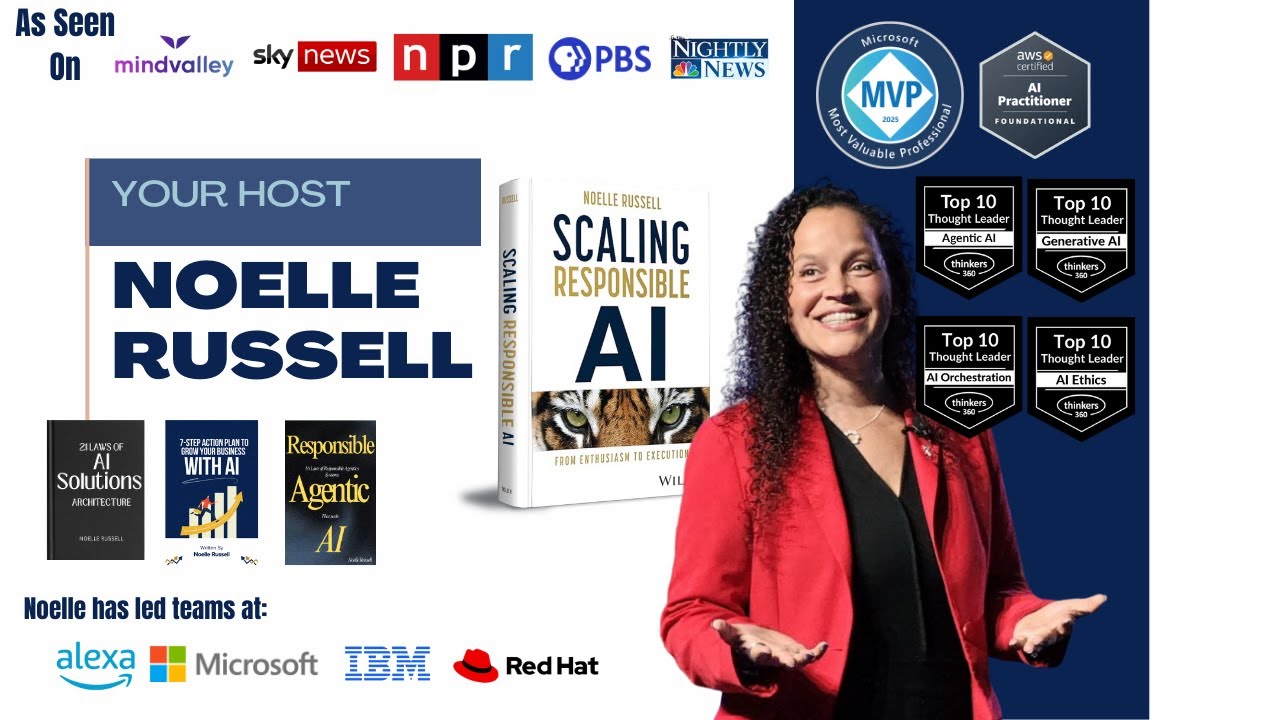
Noelle Russell hosts the I Love AI community call with 2,500 members. The group discusses the shift from Minimum Remarkable Product to Agentic AI, tooling like Claude and GoHighLevel, and the need for an agentic control plane to manage agents across organizations. Noelle shares updates on her AI Business Accelerator program and upcoming speaking engagements.
Chapters
Um, here we go. All right, welcome everybody, we are here. Happy Friday. I know I'm not looking at the camera yet. Uh, hold on one second, let me do this. Pin, pin, spotlight.
There we go. All right, awesome.
Hello, welcome to Friday. Happy Friday, super excited to be here. Um, it is the first Friday of Q2, can you believe it? Q2 is here. So this is the part of our weekly call, we have a bunch of us hanging out. I mean, we are hitting some new numbers, I'm excited about that. We have a bunch of people joining us in the Zoom call. If you want to join us live in Zoom, ask questions, meet people, this is an incredible opportunity to do so. It is free to join. You could just head over. It's super easy to find. Just go to my name, Noelle Russell, and you'll see our free I Love AI community. We just passed 2,500 members. You are vetted. So if you try to come in and you look like a bot or that you're going to sell everyone forex trading tips you might not get accepted. So be very vulnerable about what you're trying to learn in the world of AI. We are looking for people who want to create a safe space for learning, teaching, growing, and as people learn here, they teach back to the community. It's just a beautiful space. So if you want to be here live, you're absolutely welcome. Just head over to Noelle—
that—
Noelle—
or noelle.ai, and you can get access to this community and all the other things that we're doing. Some updates. Cool thing, I was just at MVP Summit, Microsoft MVP Summit last week. Spent the whole week there talking to Microsoft, talking to the product teams, talking about what's new and upcoming things that we're going to be seeing announced at Build. I'm under NDA so I can't share all those details, but I can tell you there are some incredible cool things happening. And so I got a bunch of code that I am testing out, a bunch of tutorials and demos that I am testing. So that when Build happens on the day, June 2nd and 3rd, you will see a launch of a bunch of cool live learning lessons that we are going to be doing. And what that means is that when you're part of the I Love AI community, every month in addition to this call, we host live learning labs, which is just like an open forum for demoing things. I always go a little dark in Q1 because I'm waiting for Build, and Microsoft has been so nice to give all of these really cool things that we can do for free without buying software, even though we're using GitHub. Even though we're using Microsoft, all of it can be done without having to actually provision a subscription or set up a tenant. So that's what we'll be focused on in Q2 when— and of course into Q3. So that was really fun. I got to meet with some of my favorite teams, the Responsible AI team, the Observability team, but also the Azure team. I got to see Mark Russ again, which I watch his session every year, and he just talks about the future of AI infrastructure, and it's often a thing we we don't either research or know a lot about. But I love these conversations because that super technical part of my brain is fed by understanding the underpinnings of how all these AI systems are working and being built. So I'll be sharing a lot with you again as Build comes and goes. I will be able to share a lot more details about what I learned then and when these new announcements come out. So that was exciting. Now, coming up on Monday, I will be in Maine. Talking to family office practices, which is really cool, about how they can use AI to better their experience. And then I will also be headed to an organization called Steelix for their Ignite event. I think it's called Ignite, or maybe it's called Eclipse. I can't remember. But they have an event in Foxborough that I will be speaking at. And then on Friday, I will be at MIT Imagination in Action hosting I will be on a session at 6:00 PM, which is pretty late on Friday. But if you are at that event, please hit me up. I don't talk till late, so I'll be there all day. My book is in the bookstore at MIT Press, which is super exciting. I always take selfies. I'm like, "Look, I'm here. It's a dream." So dreams do come true. So I'll be there for the second year at MIT, and I'll be talking about trust in the age of AI, which is one of my very favorite topics. So that's just next week. I will end my week at an event here in my Miami, the 10X Business Summit. And that business summit is all about helping founders and business owners launch businesses, but do it in a way that has been proven and successful through the 10X ecosystem, which is a Grant Cardone thing. I am a Grant Cardone business coach. I love the topics and concepts, maybe not the way that it's presented, and I feel like my people, my audience, see it maybe a different way. So I take all of the amazing things that help me build my business to where it is, all those things I learned from the 10X ecosystem, and I teach it the Noelle way inside of my community. So I'm excited to go there because I get to talk to more people, encourage. I'll be wearing my I Love AI sweatshirt and my I Love AI t-shirts and my shiny shoes and letting people know that AI is not something to be worried about. It is something to be excited about. So that's a whirlwind tour through next week. Maine, I'll be up in basically New England having some fun, um, and, uh, delivering hopefully a lot of value to the members of that community. Um, so the next thing, uh, we today kicked off our AI Business Accelerator, and that business accelerator is a 6-week program. It's super hands-on, one of the hardest programs we offer. It's only second to our Agentic AI Practitioner course. So for those of you who are in our premium community and you haven't taken that yet, like, heads up, like, that intentionally doesn't happen until after the Business Accelerator is over, but it's right after, uh, but it's pretty intense. Uh, so Agentic AI Practitioner is probably our hardest course because it forces you to think about actually building, scaling responsible agentic systems. And it's actually the The foundation of the book that I just got signed to write my second book with Wiley, and it's the foundation of that book. I did that class last year and Wiley was like, um, we should do that. So for those of you don't know, of course I have a book, Scaling Responsible AI. Please take a look. It contains all the things I always talk about, and sometimes it's nice to have an audio version of something and then a book version. I mean, I'm that person. I buy the audiobook. I buy the physical book, and then if I can, I get in a community where I can talk to the person who wrote it. Like, that's kind of my vibe. Um, and then I do the same thing, right? Like, so I have a community, uh, that I'm in. I wrote a book, there's an audiobook, and there's a class you can take in my community. So same idea. Uh, so that's coming up. Um, and of course I just reminded myself that I really need to finish my first part of that manuscript that's due in May, and now it's already April, so I need to get on that. Um, so I'll be doing that, I'll be doing that. Um, let's see. Oh yeah, so the Business Accelerator, it's a 6-week program. It starts, uh, well now, um, but we follow a paradigm called the 6 Ps of AI, uh, powered businesses. And the first one is to prepare, right? So for some of us, we don't have a business formed yet, but we want one, um, or we have a business but we haven't really like tuned it for getting ready to actually build products that sell. Uh, so we prepare in the first week by setting up our social media, setting up our business entity, Setting up a way for people to pay us, setting up a phone number for people to call us, like all the things necessary to create a business. Then we go into, um, the ability for us to build a product, right? The second P is what are you gonna offer? Who's your ICP? Oh, sorry. Actually, the second P is purpose, which is always what we do, right? So in all of our content for AI model evaluation, for AI solution design, the first step after we set up everything The first step when we go to build something in artificial intelligence, we have to set, you know, set some idea around what we want to do and how we want to do it, right? What's the reason we're doing the thing? If you're building an AI agent, you're going to establish like, what does it do? Who is it for? What role does it have, right? What's the reason? What's the definition of done? What does success look like? These are all things that we need to ask before we start doing the thing, before we start building, before we start scaling. We need to know what are we doing and how are we doing it and how are we measuring success. So that's week 1 actually of the accelerator is focusing on who we're gonna serve and how we're gonna serve them. That way we can reverse engineer a product that meets those people's needs, right? I think it's beautiful. Once we reverse engineer that product, um, we then need to get the world to know that it's a thing. So we get attention for it. We create a beautiful virtuous cycle of, uh, algorithmic heartbeats. And what that means is that we need to tell the social media algorithms— LinkedIn, TikTok, you know, all of these— we need to give them an idea of who we are. So like every day I want content rolling out. I want a post on Twitter, a post on LinkedIn, a post on— okay, a post on X. Anyway, um, you get my drift, right? Post on YouTube. Uh, I don't know if you know, but you can post on YouTube now to your community. So all of these channels, it's really hard for a founder to like sit around and build content all day. So we're gonna empower our, us ourselves by using artificial intelligence to help create brand voice driven. Like we're gonna design the brand voice, but we're gonna let it help us build content and publish it on a consistent, uh, schedule. And so that's all part of kind of the, the promotion process, right? Once we've built the product, we now need to get attention for that product. We're going to do some hard things. We're going to call people and have them— so if you get a call from someone going through this program, please take it, right? Um, you are, you are our friends. Uh, what I, I'm going to, uh, not just encourage but make a requirement is that once you've got the audience, right, who you're going to help and how you're going to help them, and then you've got a product that helps those people with the problems you've identified, the next step is not putting it on the internet and getting a bunch of people to look at it and buy it. The next step is to call 10 people and get feedback. This is what product developers do. Like, we don't just go to market, right? We do alpha testing. We find people that are good candidates. We're not selling it even. It's not even for sale. We just call and be like, hey, so can I show you something? And if I show it to you, would you buy this? Not can you buy it? I, it's not even for sale, but would you buy it? And if they say no, you're gonna give them some really good guidance. You're gonna be like, hey, What would make you buy it? And that becomes the gold that is your, your product suite. So that process is what we'll go through, um, in, uh, week 3 and, and of course into the promotion cycle. So what we've built now, right, has been vetted by people who have told us what good would look like, have validated our assumptions from the beginning of the process. Then the last part, which is probably the hardest, is we actually have to get on a call and talk to people and sell them on the thing that we've built. Um, and so I will be supporting that sales education. My specialty is in go-to-market marketing content, marketing systems, and sales, closing sales. I, for some of you don't know, um, how far this goes back, but like I have influenced billions in AI sales specifically, but also billions over the course of my entire career, um, working as a salesperson. A seller. Now, granted, I wasn't a salesperson per se. I was a pre-sales engineer, but I was still selling, right? A yes from me turned into a yes to the sales guy, and they loved that about me, by the way. Um, but that was my goal, was to get a customer to understand the value I was offering and get them to a yes as fast as possible. Um, and so I don't think of it as selling per se. I think of it as sharing, right? I'm telling them what's valuable And if I've got the right person in the room with the right understanding of the problem, the right gap they're looking to fill, right? And I give them something that solves that gap. I very rarely see them say, oh no, I, I don't like, they're like, oh my gosh, where have you been? Oh my gosh, I've been looking for this. Oh my gosh, I invested in something that was like this, but it failed me. This solves my problem. They're literally, I always tell people my ma, my magic moment. Is when somebody says in a sales call, they're like, how do I buy this? How do I get this? Uh, can I send you a PO? How do we get going? Like, that is— that's the game. And none of that is like a sales presentation with a PowerPoint deck, right? It is literally authentically building value and then doing the homework to make sure you're providing the value to the person who has the gap. And if you you spend time doing this, you end up successful. So that's what we are focusing on. The accelerator, um, it's 6 weeks. They get all sorts of stuff. They get a free GoHighLevel account. They get a free Marbleism account with 6 agents preconfigured. They also get access to a, uh, a hub that I created that allows you to track all of your tasks and, uh, see all of your momentum. And then of course the AI Leadership Institute where many of us are members. So really, really fun. I'm excited about it. Of course, I'll be here every Friday sharing with you the cool new thing we did in the accelerator. So not to develop FOMO, but just to give you a little taste, um, and some of you maybe hear what I say and then you could go do some of it without— like, you don't need to get into an accelerator right away. Um, I'm always a believer in giving you just enough, right? Like, I'm going to show you the wow of what we're doing, and if you can intuitively just go and figure it out, I hope you will. Uh, but if you need help or you want to go faster or you just want to be connected to me and my network and who I can introduce you to, then of course join the accelerator, become part of the party. We had an amazing group show up today. So if you're here from that, thank you so much. Clap, clap, clap. Very, very happy to have you all. All right. Yes, awesome, Javier. Exactly. And actually, so Javier said in the chat, like, AI is all about experimenting. And I often say, like, we're doing research in production. Like, that is the vibe of what we are doing. And so I always like, if you are doing research into production, that means you are testing a hypothesis with kind of an expectation that it won't work, right? Like test as if it's gonna fail and be prepared to use that failure, right? As feedback to the model. Now I say that in the world of AI, but it's exactly the same in business. That's why I actually think those of us who have really enjoyed the process of building safe, responsible AI systems, you are really geared up in the same way that we build a safe, responsible model with reinforcement learning, human feedback, right? Feedback loops. We have the same methodology for building our business, right? Define the purpose, define definition of done, do the work, get feedback, change your implementation, change your product, change your offer based on that feedback, and iterate. It's a process of experimentation and iteration. And then once you stumble upon or intentionally land on a product that's meeting market, like we call it product market fit, right? When you actually land there and people are asking you, right? Like you're not saying, here, buy this. They're like, hey, hey, so I heard you're doing this thing. Um, can I do that? Like, how do I do that? Um, when they, you know, you've hit something and now it's time to go big. And so I'm really excited about all those who said yes to the experience. It's not too late. We're doing another kickoff on Monday because we had a few people join late and couldn't attend the kickoff. So we have a few spots left if you want to join. Would love to have you. It's really, really fun. But I will now move on to that part of our call where I share with you just a couple of things that I have been working on. Maybe one thing that I've been working on, because one of the things that happened last week is that I took a bunch of comments from the, you know, the gallery of amazing people we have here. We never got to break out. So one of my favorite things about these calls is getting to know each other, though I, I right now feel like we're talking and I can see you on the screen and I feel like we're friends. So I selfishly feel fulfilled knowing that we are talking to each other, um, except for the fact that I don't get to hear from you. So these breakouts are our chance to like turn it from a one-way me blah telling all my things to actually building friendships, building relationships, building partnerships. And so many Connections have been made this way, and we have amazing leaders in this community that are going to reach out to you and be like, hey, want to get on a call? You want to, you know, do you need help? So I, and I encourage that. That's part of the amazing, you know, part of being part of this community. But I do want to share with you one thing that I, I'm going to narrow it to one so we have time for hanging out together and getting to know each other in small groups. But the one thing I'll take from something that happened last week during the MVP Summit. It's not an NDA thing, but something that I have realized that I'm doing that I don't really— I don't teach it. Well, I shouldn't say that. It's in the AI Practitioner course. It's actually the Agentic AI Practitioner course, so where we teach you how to build agentic systems. But I realize I don't really talk a lot about it, so I wanted to just share with you my perspective And hopefully it'll trigger some conversation and maybe some of you in the audience may have differing opinion, which I'm wel— I welcome, um, or have seen the same thing. But one of the things that I'm seeing transition, uh, in the last 3 years, I've been very focused on helping companies with what I've called the MRP, right? Minimum Remarkable Product. How do I go into an organization? How do I triage all their use cases? How do we do use case prioritization? How do I pick the right model for the right use case? Right, that process that gets them to building a model, grounding a model, training the model, getting initial outcomes, right? That alpha beta stage of AI development. That is where my focus has been, not because I like that stage, but when I go to a client and I'm like, what is hurting you right now? How can I help you? This is where they're at, is they're like, I have a spreadsheet of 1,000 use cases. Which one should we do first? Or worse. They've already picked one and it's not delivering value, and they're like, we don't know why. And of course, this rubric that we teach in our community teaches you exactly that. So that has become kind of my, um, my bailiwick, if you will, right? Like where I've spent most of my time, my wheelhouse. Um, however, 2 years ago, those companies that I started working with in 2023 started saying, um, so let me think. Um, we now have built a thing, it's now working or not working, but what does the next stage look like? Actually, in the book I call it day 1 and day 2. Day 1 is building your MRP, realizing it's actually working or not working, iterating through it, baby tiger mode. But day 2 is, okay, now I like it enough to grow it up, like have it, like evolve it to its next stage. And the next stage typically represents kind of the world of agentic AI, right? Building agents. Some organizations are leapfrogging the first stage and going right to multi-agent systems, which is like baby tiger mode at scale, right? So now a bunch of different agents. But one of the things that I always say, either in a single model solution or in a multi-agent solution, is you have to figure out what good looks like, right? You still need to focus. The number one reason projects fail is a lack of clarity on what done is, what good is, and correlating definition of done, definition of success to the model output, meaning the model has to know that that is the rule. That is what reinforcement learning is for. It's an opportunity to prioritize positive outcomes. And we can use things like instruction fine-tuning to help that happen, right? Where I go in and I provide examples of like, look, this is what good is and this is what bad is, right? If you go through the— if you're in the I Love AI community, I think we left it for free after the challenge. But there is a certification available called the AI Bot Builder Certification. And you basically build an AI system end to end. It's studio recorded. It's like 4 hours. But one of the things we cover is like, okay, well, like what happens at each stage of the development process? And most organizations fail in doing the entire process, but they usually, the failure starts right at the beginning, which is I am building something 'cause it's cool. I'm building something 'cause a tool just came out, or I saw this on the news, or I saw it on TikTok. They don't ask, like, what does this do? How is it helpful? Who is it for?
Right?
They don't ask those initial questions. So if you want more hands-on experience, you can go actually build your own system inside the free community. It's a free course. You can take it. You can even get a certification from AI Leadership Institute if you're interested in doing the work required. It's not a participation trophy. You will have to actually build something, and we will evaluate it and give you feedback. And then when you get it to a place that meets our requirements, you can get certified. So that's kind of cool. But that being said, when you're building these agentic systems, this process, right, when you're in a multi-agent system, I realized that my rubric for success actually has shifted. I didn't, I guess, realize it, but now I look back at these models and I realize that I'm no longer asking the model, like, are you generating a good answer kind of in Q&A format, right? I ask you for a LinkedIn post. And you give me back— I call it vending machine AI, right? Where I ask it for something, it gives it back. I can kind of evaluate, is that LinkedIn post good? Is it all my brand voice, right? That would be my evaluation, and I would evaluate it based on, you know, it generating something for me. But it now, as we move into Claude Co-Work and Claude Code and leveraging Claude on our own, um, Machine, Claude Skills, right? As we start moving into building agents that do work by themselves, rather than just evaluating the output, like, did you create this post well? Was it a good video? I'm now looking at task adherence, right? So this lens of building out a framework or a, at least, description of task adherence, like, is this model actually doing what it was told? Not is it good, because it might build you something good, but it's not in alignment with what I actually asked for. So you have to be really specific in looking at like the models that you're building and say, what does, what does task adherence look like? And granted, I'm a, I'm a, I'm a parent, right? I got 6 kiddos, so task adherence is on my mind all the time. Like, I'm always like, I appreciate you did that, young lady, um, but that's not what I asked you to do. Some of you probably can hear your own voice or your parents' voice like Like, that's not what I asked you for. Like, I need you to do what I asked you for. So we can build, and I, I leverage a, a concept loosely called constitutional AI where I can build an AI agent that can help me with task adherence, right? Where I customize what the constitution of my business, of my brand voice, of my organization, of the outcomes that I'm looking for. I can build that into an, a model that can look at the process in which these agents are performing, and evaluate task adherence. Now, I built my own model to do that, but I was at MVP Summit last week and was like, oh, we're seeing agents be part of the product. And I would imagine most cloud providers are looking at ways to improve the type of evaluations we're doing because, you know, if you go and Google like AI evaluations, it's a super hot topic. But they are mostly talking about single agent vending machine AI evaluations. And we need to kind of, as we evolve our skills, kind of bubble that up. So I just wanna introduce that topic to you. I'm not here to teach you the whole thing. You can definitely take our courses, join our AI Leadership Institute if you want hands-on agentic AI development that includes this topic. But I do think you could now, which, who was it? I think Joe put into the chat, uh, I hope I'm not getting this wrong, but anyway, I think it was Joe, put into the chat the Learn with Me options. So I think like 5 months ago when the Learn with Me capability on Google was released, I did a post in the I Love AI community. But Joe recently recapped all of them. And you could just take some of the topics we talk about, right? And you might be like, that sounds interesting. How do I learn more about that? And you don't have to like, you could go get a book. I mean, if you get a book, get this one. But you could go get a book. But more importantly, you could just take the topic and be like, okay, Noelle Russell Russell was talking about this topic in the call today, and you could use Whisperflow so you don't have to type it, right? Is a saving grace for me. I mean, the amount of times I like undo type, anyway, I don't leave. I'm trying to, it's kind of like if you're a person who tries to remember phone numbers instead of just use your phone, because you're thinking about that day when phones don't exist and you're like, I will never know, I won't know the phone number. Like if I had a landline, I wouldn't be able to dial anybody. Because I don't know their numbers, or directions, right? You choose not to use GPS because you're like, no, I'm gonna let my brain work out how to get there. And I hope it works out. It works out for me most times. So similarly, I'm actually forcing myself to type in a world where I could just talk, um, because I feel like there's a, you know, neurological synaptic neuroplasticity thing that happens when I ask my brain to tell my fingers to type on a keyboard. So I'm just like, I'm trying to avoid, right? What do they call it? Like atrophied of the brain due to ChatGPT or Claude usage. But I love Whisper Flow, especially for long-form prompting because it's just a lot to type. So, so I will tell you, I do try to type intentionally, but not for everything. So Whisper Flow changes all of that. But I do think that is a, like, one of the things that I would do is go into your favorite LLM presuming it's one of the top 5. And if you drop down the menu items of tools, you'll see like guided learning or learn with me. Like I said, someone, I think it was Joe, I hope it was Joe, put into the, put into the school a post that says, here's all the learn with me options. Every model has one. So use that, right? I love it because what it does is it doesn't give you the answer, right? It's a mode of AI. That does chain of thought in reverse. Rather than you chain of thoughtting it to an outcome, it chains of thoughts you, right? So it'll Socratically get you to the point where you're coming to your own conclusions through education. And I really like that there's a mode of AI for that. Um, interesting, right? Yeah, Joe, absolutely. Um, okay, cool. So Joe, was it you? I hope it was. Um, anyway, I hope it was. I wouldn't just like— somebody else did it. If not, I see you. I just I just can't remember. So hopefully we'll find it.
Cool.
It was.
Okay, good.
Thank goodness.
I'm glad I remembered.
I'll post the link in the chat.
That would be amazing. That would be amazing. So thank you for doing that, by the way. Awesome. And yeah, great. Because a lot of— and when you post stuff, like, obviously, like, it's good, and then it, like, you know, gets lost in the feed. So there is a search feature inside of Skool. So please know, like, you can go in and be like, tools. Events, replays, like whatever you're interested in finding, like just use the search. This is a 3-year-old community. We went from 27 people to 2,500 people, um, and so there's lots of good stuff in there. So, uh, definitely use it to your advantage. Lots of people have created content, created videos, created tutorials. Like, it's just so good. Um, and we re— we refactor it every so often to make it easier to find things, but search is always— it's semantic, so It's easy to find. All right. So now we're gonna open up the floor for people who want to share something, have a comment or a question or anything like that. I see Joe and Andy up first. If you have something, just raise your hand, or you can throw it in the chat if— and I'll try to keep an eye on that as well. And we'll do that for the next 15 minutes or so. And then the last half hour of our session, we will be going into breakout rooms, spending about 15 minutes together in small groups and then returning back. So, oh yeah. Do you like it, Tammy? Is it good for you? So I'm going to answer Tammy's question really quick, but I am using a V-Fine, a Fi-Fine anyway, F-I-F-I-N-E. And I, I will tell you, I will be doing this when we do our Speak to Scale workshop in May. Um, I will be, uh, giving— people who pay for that program will be getting this speaker kit. But when I became a speaker, they didn't pay me, so they were like, what if we sent you a gift? And I was like, okay. And so they sent me— they sent me this, um, microphone, and they sent me this. And this was like 5 years ago. Um, I don't know if I can do this without everything on my desk falling apart, but they sent me this panel lighting, which has been so amazing. I've used it so much. I take— they gave me 2 panels and this microphone, and it's like been the heartbeat of my business. So if you're doing an event and you want to pay speakers, this is not a bad gig. Like, I would do that again. So anyway, so yeah, that's it. Thank you, Sherilyn, for dropping that in. All right, on to Joe and then Andy. Sure.
So It's interesting that you're talking about, wow, that post sounds like me, sounds like my brand, sounds like what I would do. The agents that I'm creating though are so complex in what they're doing that, for example, the one that I'm running right now on this machine, which is not this machine, it's actually in Florida and I'm in North Carolina. Is it's creating 28,800 rows for training of my custom fine-tuned model. So how can I possibly look at 28,800 records to make sure that they're correct and that they're— So I've built in a lot of QA into this Agentic into this agent and it's QA checking along the way and accepting and rejecting and fixing along the way. But the point is, is that there's no way possible that as these things get more and more complex, and this is just one agent in a series of agents. So what I'm doing, having to do is build in QA checks of the, the, on the next in the series of the the one that just ran. So it's like, as it's checking, as it's loading the records from the first agent, it's saying, hmm, is this a good record or is this a bad record? So, and it does that chain through and it traces, has each record that it creates traced throughout the system so that once it gets to the final stage, which is the QA stage, it can trace all the way back to the beginning Yep. And, and see which agent was working well and which agent was not working well.
Exactly. And that's like that, like, I think you probably have seen since 2 years ago, right? This evolution of evaluative work that we have to do. And last year, or last year, last week when I was at Microsoft, they were talking about like the future of software engineering. And what you're talking about, right, is that like, in the past, this would have been a human. Like, you would have a senior dev who's been coding for 20 years or 10 years who comes and looks at your code and goes, So I don't know if you know that's like jacked up and this is, you know, like they go and redline your code.
6 internal sorts?
What are you talking about? Yeah, exactly. Like, you do know the outcome of this is, you know, like, where they can see it like this because they've seen it 100,000 times. But we as a, like, and that's kind of the mode was that we are now all kind of junior devs, right? And if you're not an engineer, you're a junior dev asking a junior dev AI to build code, it is required that you either build a system or I was talking to someone in our, in our AI leadership session yesterday that you, if you don't have that, you can hire, like, welcome to fractional senior devs, right? You can hire a fractional senior dev to look at your stuff and just be like, hey, just look at it, give me some insight from a human perspective. Cause the challenge of course is that you know what to say, but like if you're building this and you're non-technical, you might not even know, like, I don't know that you could say simply, I want the persona of a senior dev to look at this and build an AI agent that does all the right things. I think there is a value, which is exactly how it works now. Like junior devs are going away, but senior devs are not, right? Senior devs are the one who are like, They call it AI slop, right? Like AI is generating a bunch of nonsense and it works and it's faster. So it's almost tech debt you're willing to acquire because of the speed it generates. But a senior dev can come in and just tell the AI, hey, I appreciate what you're doing here, but where you just built 4 web servers, we actually only needed 2. And you didn't use load balancing in the right way. Where the model is, you know, doesn't have that nuanced, um, understanding. So I love that. I think it demonstrates like how you're just, you know, for those of us who have been watching you do this over the last year and a half, like it's pretty cool to see the evolution of like how your systems have evolved, uh, agentically. And you're still all by yourself, right?
Yep, still all by myself. The cool thing is, is that as I work on it, I, I realize that I need more checkpoints and I need more compare, like do research, state-of-the-art research on this particular topic. And I focus, try to focus down to the minimum point and say, what is the latest research in AI on this topic and how can I apply it to this piece?
Yeah.
So it helps because I don't know that stuff. I don't, I don't, I don't follow the latest on, on, you know, specific topics like, how do I check my data to make sure that it's high quality and high fidelity? So—
Exactly.
And that, like you said, that becomes an agent that you actually can build and deep research and like, that becomes another type of agent in your system. Yep. And now we're seeing these like, agents stack up. So just to recap, if you're looking for these terms like observability, task adherence, like these are just terms that'll get you in the right sphere of content related to this topic if you're looking. I mean, our goal is to kind of DIY it in this community, which is what all of the people that you're seeing here, they're doing unless they're in one of our programs. But like, it's kind of cool. We have AI that can help us with this. So it's good to see, Joe, your progress and that you are now trademarked and hopefully we will get to actually see what you're doing soon. Awesome. It's been a long wait. Yep. So I can't wait. Thank you so much for sharing. Amazing. All right, awesome. Uh, let's see, next we have Andy. What's up? Hello. So thank you, uh, thank you for the Accelerator program. It gives me hope, inspiration, and joy. Yay! This previous conversation has me intimidated. So there's a GenTech AI program. Does that require you to be technical to be as a prerequisite to be able to do that? No. Um, so the purpose of it is to demystify by like the hard part. We build— now granted, it will, it'll be hard, like the business accelerator is hard. It will also be hard, um, meaning that it's going to do things like your brain has a certain way of thinking, you've done certain type of work, like especially because you're on like the CMO, right, go-to-market, uh, product side. But it's really valuable for you to know, in my opinion. I think it's nice to know how the sausage is made, even if you don't— like, you're not going to have to write a Python script by yourself, but you are going to run them. And you're going to step through them and you're going to— so I think it's great as a solution architect, right, to know how to see this code in its code format. You don't have to write it, but it's like so many of us, right, probably know HTML, but I don't know if I could write an HTML page from scratch. But if I looked at it, I could kind of figure out what's going on in there. So that's the idea is like, how do we teach you how to see the underpinnings of an agent so that if something bad happens, you're like, oh, I vaguely remember that there's this thing that causes that and let me go look at it. It gives you a little bit more confidence in the systems that you're building, even if you're not technical. Yeah, exactly. I think so. So important, Jill. Yeah, exactly. Yeah. So no, you don't have to be worried. And I will tell you, there is a breakpoint. So we have a couple of required exercises and then those technical exercises become optional because half the people that take this course are like in it for the detail, like they want to go build a model from scratch and build it, like they wanna be in Python building systems. So we have a whole bunch, and these workshops were given to us by Microsoft's Solution Accelerator team. So they're awesome, like super realistic. But like we're gonna talk about the enterprise design patterns as opposed to like, which means that you'll know how it all works. You'll see the architecture of how it works. You can architect new solutions. But I, you know, I don't know. I don't know how important it is to build 7 of those. But I, by request, certain people have gone through the program, were like, I know we don't have to, but can we? Right there, those people are like, on the weekends they build new Linux kernel, you know, variations. Um, so those people I have served by creating additional deep technical, uh, work, like accelerator workshops, but they're all self-paced and you don't have to do them, but you will have 3 hard ones at the beginning just so that you've done it one time. And I think it's super valuable. That's what I did. I was like, I want to build a language model from scratch so that I know what that work looks like. And I think we'll be the last generation of people that do that. So I think we should, we should, and we can teach others to do the same. This is vibe coding plus. Yes, exactly. Vibe coding plus knowing what you vibe coded. Still daunting, but I'm encouraged. Yeah, I think, yeah, you'll like it because it is, It is design patterns, it is how you talk about it, so you'll, you'll like it, but it won't— like, your brain will be like, gosh, it hurts your brain. But I, like I said, I think once a quarter you should have that kind of experience, at least. I seek it out every day, but I— not everyone should do that. Thank you, Andy, thank you so much, great question. All right, next, Dave. Oh good, I'm glad, nice to see you again. Come on up. How are you? Great.
Excellent. I have a couple of questions. One about, because you do so much work with Microsoft, but you also got me hooked on Lovable. But I'm curious, can you actually take a Lovable project? I've already got on Git, I put it on Vercel and I put it on the other one, Net something. But if you have a client that's Azure-based, all Microsoft. Is it possible to actually build a project for them and so they could run something internally on their own Azure system? Because I love Supabase. I am like—
I know.
Actually moving from using ChatGPT to Claude, Claude has actually made me much more efficient with my lovable prompts. My credits are a lot better.
The planning. So good.
So it's like, oh, this is really good, right? So now I'm using less credits because I run out of credits frequently.
Yeah, yeah, you get that message and you're like, yes, but yeah, I have this idea, but for—
and I have a bunch of clients that I've worked with that are all Azure Enterprise, you know, systems. And I was like, well, is there any tool? Like, there's any systems in the Azure?
All of my projects For the most part, like lots, I would say a vast majority of my projects start in Lovable because I just, I love the interface. I like building with it. I'm confident in it. And fast fact for all of you, if you are a Lovable builder, you can go into your profile and add your Lovable stat to your LinkedIn profile as a certification. Do y'all know this? So right now I'm a gold person. I don't know what that means or like, but it will evaluate like how many prompts you've done, how many apps you've deployed, and they correlates. So if you want to get credit— and someone reached out to me and was like, how did you become gold? And I was like, gold what? And they're like, gold on Lovable. I'm like, I have no idea what you're talking about. And so I went to my LinkedIn, and I, of course, I go to my profile and I just turn all the things on minus the security stuff and privacy stuff. But if it's a cool feature, I'm like, I want it, I want it, I want it. And so, yeah, exactly. Yeah, so turn that tag on if you are a Lovable builder, because then you get to get credit. And people see it. Um, but that being said, once you build a Lovable project, you probably know you can connect it to GitHub.
Oh yeah, do that right away because that's awesome.
Exactly. So now it's in GitHub. Now GitHub, you have access, you have the ability to actually use GitHub Copilot in VS Code, and VS Code has the ability for you to add extensions for the Azure CLI. So you can, one, you can build it all out in Lovable, go back and forth, but then it gets— you now have access to it from an Azure CLI to port it over. But what I would do is build it to a certain level, let's say MRP, and then just replicate or fork the repo to them. Like let them fork that repo and now it becomes their repo if you're building for them.
Okay. What about the Supabase part? Because I'm addicted. Supabase is awesome. It's so much better than other databases I've ever used.
Yeah.
So Supabase is actually, I mean, it's code, right? It's connection line.
It's connector Postgres. Yeah.
Yeah, so you're just gonna— I mean, that's part of your GitHub repo. Um, the only difference is, is like the provisioning. So you'd have to provision a new one. Um, so I usually will ask Lovable to export out, like, or I will ask, um, Supabase to export out a script I can use to rebuild this in a different database, because you are going to want to move Supabase to be part of, like, if it's not your tenant or not your customer, you can, um, you could do that. So they have to create a contract, right, a business relationship with Supabase for you to use it for them.
Okay, so they— okay, so the code can run in Azure, but it still has to connect to Supabase externally?
Only if you wanted to. I mean, you like it, so you can, but you could definitely just use an Azure data source instead.
Okay, could I start— but Lovable doesn't start with Azure.
No.
So you'd have to convert it.
Yeah.
Okay. So that part is—
Yeah, that's where you could use GitHub Copilot or you were saying Cloud Code, right? You could use a coding agent to facilitate that transfer much easier than going in and building it yourself.
Oh, okay. Because you have an idea where they want to keep the data themselves and they don't want to have any, you know, cross-pollination, right? So I was like, oh, well, the good news is that that logic is very siloed already, like the architecture.
So that transfer, it's very easy to do that transition and you could point it to any, I mean the data source, you could point it to any database. So, and they have object-oriented databases on Azure. So there's a few options that you can choose.
Yeah, I'm familiar with the, the, the, it's just when I got to move away from Microsoft, it was like, okay, but then a lot of enterprise, they are all Microsoft. It's like, oh, what I'm trying to actually get them to go is like, this is going to run on your system, you get to control it and then you get around all the security because then they do their own security. Security against their own system as opposed to going, oh, third party.
Yeah, so it's a great way to start, but then on, yeah, so once I, once I build it, I connect it to GitHub and then I get GitHub Copilot to push it, like basically to help me manage it in the enterprise side. So I have Azure CLI, I have AZD, which is the Azure Developer CLI. So you'll install these plugins to GitHub or to VS Code. And that will give you, yeah, that cross-pollination.
Oh, that's exciting. Okay.
Yeah. Good luck. Okay. Let me know.
Let me know how it goes.
All right.
Done. Thank you so much, Noelle.
Yeah, you're welcome.
Yeah.
Very cool.
But yeah, and I, I just did it in practice last week in a workshop and I was like, this is so awesome because again, it's that moment from, it's that day 1 to day 2 transition, right? Baby tiger to like, oh my gosh, we're putting this in production. And production, you're not using Lovable Cloud or Lovable AI if you are a Microsoft or AWS customer because you're already paying for that cloud consumption. So yeah, it's pretty good. I think it's pretty cool evolution of problem solving for businesses that they're now thinking about, okay, how do I build this in my cloud infrastructure as opposed to this special external product?
Yes, but what I've also noticed is with Claude and Lovable is that they, they come up with really good ideas. It's like I wanted to send out an email digest that was an AI based system and the AI is going to go scrape the information and they're like, okay, well, this is the tools you use. And it automated almost the whole thing to connect it all together. It's like, oh my God, this is magic.
Exactly.
And then it works. And I got the email and I was like, oh, there's a digest and it's all AI summary.
Oh my God.
Yeah.
And wait, I mean, I connected a platform, um, pay me GPT, and I connected Twilio, I connected my email, I connected all of these systems so that in one prompt on Claude, I could get an entire business system run. And then at the end, similarly, it— I like went into the landing page and submitted my email address. And I then— I mean, only a few days ago did it stop sending me emails from something I did a week, like a week and a half ago. But like the whole sequence was built and it sent me emails every single, you know, like it was a, an email sequence, an onboarding sequence. And but all with one, like a single prompt, it did the whole thing. It built the landing page, it built the website, it built a way, a database for holding that information, it built an email sequence, it scheduled the email sequence, like, oh, and it used Twilio, so it also sent me an SMS every time it sent an email to be like, yo, check your email. Um, it was crazy in a single prompt. Like, it, I, uh, from that realized it's not just, like, it's not the most powerful tool that people need, it's the most connected tool. Like, it doesn't matter how big and bad your one model is, it's how connected is that model to do all the things that it needs to do. That's why now I have a bunch of— in VS Code, I have a bunch of different connected systems and services so that I can do all the things I want to do in a single call because it's just going and accessing the tools directly. Pretty cool.
Well, it's getting me to rethink how you can— when you start, how does this work with anything else that I've built? How does this all connect? I think Lovable now has a tool where you can reuse pieces. Right, that you've already built? Yeah. And I was just like, oh great, so you don't have to keep doing an onboarding. You just have all of these pieces. It's like, wow. So it's sort of, it's training me.
Yeah, yeah, exactly. Oh, it's really cool. And I wanna just give props to, yeah, you're welcome, Dave. I wanna give props to Javier for throwing in some open source frameworks for us on Agentic. So thank you, Javier. I know you gotta go, but I wanted to just give you a little shout out before you had to leave. So thank you for that. Um, and thanks, Dave, for, uh, the question, but also the discussion and what you're using and doing. It's also inspiring because people are like, real people are doing this. Um, so I love it. I love hearing those stories. Um, yeah, so check out the link in the chat for that free open source, um, uh, Agentic AI framework. Of course, uh, in our Agentic class, we go over 3 different frameworks. They're all Microsoft friendly. I'm just saying they gave me an award. I'm their MVP. So it is what it is. Um, so let's go ahead and take, uh, take our next caller. Uh, Sandy, how are you?
Hey there, happy Friday.
Hey, um, so quick, just a quick question. So I was reading, uh, an article and there were, um, this segment how it's so easy to make your own agents, right? So I mean, and then I'm thinking, where is there a way where You've decentralized your agents because, like, because I mean, I have all these agents. Well, I will have agents all over the place, um, but then I thought, okay, is there like, is someone housing them? So it's, it's there. So I don't know if you have any thoughts about that.
100%. And you can kind of, for those of you who've been in technology for a while, this is the moment that we went through with web services in the back in the day where we built web services and then people started building a bunch of web services and then were like, OK, I have a bunch of web services. How do I organize them? How do I manage them? So there's a concept called— in Azure it's called the control plane, agent control plane and agent HQ. And these control planes basically give you an at-the-glass kind of integrative layer so you can see all your agents. This is something that like I built prior to that being available. I built my own control plane, which I'm still using because it's not a developed like control plane inside Azure and Microsoft Foundry. That is a technical— it's for engineers to use to see all their agents. But I'll give you an example of one. I think— oh, I don't think I did it in this one. So let me just type it in really quick. AI.AI, I think, is it? I hope it is. Let me click on it, make sure that—
Now, is that for the only Microsoft environment? Or is that like— but let's say you have agents on other platforms, like, yeah, I'm just giving you an example of the way that one platform has solved for it.
Okay, I think that was the wrong link, so don't click on it, don't click on it. I don't know, it's not going anywhere, so hold on. Delete, delete, delete. Um, okay, uh, so this is what, um, so hopefully, uh, the Assured AI— maybe Sherilyn can find the link and throw it in because I'm trying to talk and type That didn't work out. But anyway, I created a control plane. But yeah, this inventorying process, every model platform has one, and that control plane can have agents. Like, it's not like it only sees Microsoft agents, right? It sees any agent that is in your architecture. It's a cloud platform service. So similar to what we saw in microservices where you might— some of you might remember or know and currently use things like Kubernetes. Uh, Kubernetes is this open-source framework that was developed to create, um, container managers so you could manage all the containers. This is like an evolution of that, right, where every agent will run in its own container. You'll be able to manage them individually, but more importantly, you can manage them as a whole. But you can see them all, they're all registered. Ideally, there's a responsible AI element to that registration, so you've got metadata on the policies that they adhered to, their human-in-the-loop process, right? Like there's all this information that now can be associated. But then that registry you can put an LLM in front of and create semantic search. So anybody in the company who's like, I want to build an agent, the first thing they would do is say, I want to build an agent. And that agent would go to this control plane to be like, is there another agent that can be used to do this work? And if— or part of this work. And so it helps with reducing the amount of bloat that, you know, if you allow your employees to build agents or if you have multiple people building agents, you might have some overlap in capability, overlap in functionality or use case. And so yes, this, this control plane. So Kubernetes is for containers. You can use Kubernetes or like AKS, which is on Azure or There's another one. I don't know, maybe it's— anyway, it's either AKS, or there's one on AWS as well. I can't remember what it's called, but there's a— if somebody is an AWS person, throw it in there. Um, but there's a, there's a Kubernetes service that provides you the ability to see containers at a high level. And if you decide as an organization to map agents to containers, which most are, you could use that. But now companies like Google, Amazon, Microsoft are building control planes specific for agents. The best example of this is Salesforce. So Salesforce created Agentforce, and Agentforce allows you to create this entire landscape of like agent, agents, lists of agents, um, categorization of agents, metadata for agents. So yeah, I think it's emerging because most people are just getting to the point where they're seeing a need for that, but products are available to do that. Um, if you are not on a platform like one of those, I would also consider building an agentic control plane for the specific— like, you can vibe code that. And then just look at other platforms and how they're doing it. ECS, thank you, thank you, thank you.
Awesome. No, thank you. Yeah, no, I'll figure it out. Yeah, no, no, that sounds awesome. Thank you. I know.
Yeah, you're welcome. There's a lot. But that is— yeah, that'll get you on the right track. But I will tell you, it is a bit early. Like, people are just starting to realize, wait, we have 100 agents, how are we going to manage this? And so in the short term, they're using container management to do that, which is— it's good, but great is a custom agent— Agentic platform that allows you to manage Agentic-specific concerns. So that's where like observability, task adherence, right, those things I mentioned earlier, you want— you don't want to build that per agent, right? You want like an overlaying system that's looking at all your agents and providing the same constitutional application to all of them. So that's where these control planes will come in. But yeah, I would Google like agentic AI control plane and see the other people or companies that are offering these solutions. Awesome, thank you. All right, Reina, and then we'll go breakout.
Hey, so I actually have 2 questions, one on Lovable and one on Copilot.
All right, great.
Let's go.
Okay. So the Lovable question I thought of, um, actually I, I think it was Dave who was talking and you're talking about, you know, transferring from Lovable to other systems. I have an app, I haven't touched it a couple months that I've been working on that I've been building in Lovable, um, that I ultimately wanna host on my own website, not Lovable's. But it has a lot of edge functions in it. And I'm just continuing to build it because it's not at MRP yet.
Yeah.
But like in my research, it said, oh yeah, I could transfer the database, no problem. I could use Supabase, I could use whatever I want. But in the code, obviously no problem. But it said you might have trouble with the edge functions. So, and I might not have covered it. I don't know anything about edge functions.
Oh, I see. So how are they hosted now? They're in Lovable?
They're in Lovable.
Yeah. So what I— you will have to, um, translate that to whatever platform you're moving them to. So these functions are— there's different services, just like we were talking about EKS and— yeah, yes, and yeah. So there are different services that are available. So you'll just have to tell Lovable, okay, I'm moving to this platform, and they— and you could even go to a model or go to the documentation, which is probably model-driven. Of your platform and say, I've built edge functions. What is the service in this platform that does that? And then you can give that information to—
OK, that—
OK, that might be tricky, but I'll worry about that later because it's a little tricky, but no, no trickier than if you didn't know how to do database transformation. Like, it is possible. It's just you'll just have to—
you know, it's, it's, it's a web— like, it's— my husband's hosted websites for like 20-some years, and I don't know what the heck system it's on. And it's a word— the main site's a WordPress site.
Yeah.
So it'll get— it'll have to integrate with that even though this is obviously no word.
But that's some good news is that, like, literally, this, this is why we use an agent assistant, right? Like, the, the coding agent will be able to resolve so much of this that you probably would be surprised.
Cool. Yeah. All right. My second question. My second question. Oh, go ahead.
I just wanted to add something. Could I add something to help you?
Yeah, please do, Dave.
Go for it. Because I just literally did this with Edge Functions with and going to Vercel. So I'm happy to take this offline with you, Raina, so I can do that. But yeah, quickly, I use Claude and Claude actually helped me, so I spent more time in Claude and then it told me what I needed to do and then I did minimal stuff in Lovable. So I set everything up from that, but I'm happy to connect with you offline.
Okay, no, thank you. Yeah, no, I've been doing everything where I was using ChatGPT. In Lovable, but I've been planning on switching over to Claude because I've just found Claude to be so much better lately. My second question— thank you so much, by the way. My second question is Copilot. So I just started creating my first agent in Copilot like yesterday, but I'm finding that it's very tedious, whereas like if I do it in Cloud, I can just say I want this and it just kind of builds things.
Yeah.
Am I missing something with Copilot? I feel like it's going to do what I want it to do, but I'm like, I'm sitting there literally like—
What subscription level do you have? Like, which Copilot are you using, I guess is my question.
Hold on. It's— I am using— shoot, hold on one second. That's right, I'm using Copilot Studio.
So in your— you can look this up, but in M365 in the admin console, it will tell you what level of Copilot you have. So in order to get what's called the IQ stack, which is the one that is intuitive and knows how to build stuff, you will need to upgrade or have access to a certain level of Copilot capability because what you're using is the Copilot feature inside Copilot Studio to help you build stuff, right? And so there's like the free version, which is Copilot, then there's Copilot Chat, and then there's Business M365 Copilot. So there's like 3 different levels and you have to be in a certain subscription to get different ones. But that being said, this is— I'm just going to type it in for those of you want to look into it. IQ Stack, and then there are 3 levels to the stack. There's called Work IQ, which is the ability to have the Copilot integrate seamlessly into all your stuff like SharePoint.
Yeah, yeah, okay.
That, but then there's Foundry IQ, and Foundry IQ is what you are hoping for, which is where you have like a coding assistant that's helping you, right?
Yeah, I think. I think I won't probably be able to get access to that as I'm doing some fractional work. Yeah, they are a really small company, but they're on— they love the Microsoft ecosystem.
Yeah, yeah. So then what that means is that you probably have to just reduce the scope.
It's not even— it's not even much of a scope. I'm literally taking your, um, your AI governance card. Yeah. And trying to create a little agent out of it to, like, prompt for questions. Yeah. So it's a conversation. So every little piece of the conversation of having to manually add in there. So, yeah.
Interesting. Yeah. We should do that as a project. That's a good, good, that's a good question. We should do that as a project. But, yeah, it will be Because now I'm thinking like that, do you have access to Power Platform?
No idea. I literally just got like access to all this stuff this week. So I'm trying to figure out what I have access to.
Check out Power Platform and AI Builder because AI Builder can ingest a form and turn it into a conversational application. So yeah, you just might not be in the right vehicle to do, to get to the destination you're trying to get to. You can get there, you just might not be, and this is part of Microsoft's you know, ecosystem is that they have very specific lanes to get to very specific outcomes for very specific types of users.
Okay. Yeah. So I went— because I went to the Copilot chat.
I know they are, but we're not there yet.
Right.
Yeah.
Because I, I was trying to stay in the whole Copilot ecosystem and I asked it in the chat how to do it, and then it gave me the instructions for very step by step. I probably should have just gone in Claude and asked, but I'm trying not to do this work stuff in Claude and—
No, you're right. You should definitely do that. Um, no, No worries, Cindy. Thank you. Um, yeah, and, uh, and not to cut you off, Joe, but yeah, you're right. They are. I just have to be careful because I'm live and I want to make sure nobody thinks I'm saying anything I'm not supposed to say. But Satya Nadella just talked about this, so you guys can, you can Google his latest announcement about how they're improving like the workflows and making it easier for these products to work together. And right now it's a little bit of a mess, but that's the chemicalization before things get better. And so I'm excited. That's why Build is going to be so exciting this year because they're releasing a lot of these new synergies and collections. Thank you so much.
Cool.
Thank you.
Did that answer your question? You're good?
It answered my question. It's just I probably don't have the tools for it to be right where I want it to be yet. I've just become obsessed with Cloud Code and how awesome it is and how easy it is. Now it's like taking a step back. But it's so cool how it connects to everything in Microsoft ecosystem. Absolutely.
I'll put Power Builder in there just so you know, a tool. But you got to kind of think about it back in the day when Gmail came out and all these, all of us got Gmail and then we went back to work and we were using like at IBM just until recently I was on like Lotus 123 if you all remember these days, the Lotus like. And it was recent like in the 2010s like did we, were we still like doing, I think it was actually 2020. Um, yeah, 2021 maybe, uh, that they made this transition from Lotus to Outlook. Like, 2020. Um, so you're— you have Gmail at home, which is our version of like, I can Claude, you know, Claude code this or vibe code it in Lovable. And then at work I'm in Copilot, and it's exactly that same vibe of like, I can do it so easy over here, but I go to work and every—
that's so funny. I never I have never been enamored by Gmail. I hate it. I only use Outlook every day. I'll put my Gmail into my Outlook.
Yes. But of course, you know what I mean though, right? Is that—
I know what you mean. I know what you mean.
You got like collaborative capabilities that didn't— it took a long time to show up in Outlook, and some would even say today it's still not the same.
Yeah, the collaborativeness, I 100% agree with you on. Yeah, yeah, yeah.
As a product owner, like, I get, I get your perspective. I appreciate that decision. All right, thanks everybody. Oh, awesome, Gabriela. Gabriela threw in some details on the IQ stack that was just launched last year at Ignite. We have just a few minutes together, but like I said, I love this part where we get to hear each other and learn from each other. It's amazing. Thank you everybody for sharing. But I do want us to spend a little bit of time, even if it's just intros, just so you know you are not alone in this space. There are people here who can help you, that want to help you. And more importantly, you could help someone. And it's so— I don't know, maybe it's just Noelle's vibe, but it's so inspiring when I get to give someone assistance, help them not fall down into a hole that I fell in yesterday or a week ago. Um, and so, uh, yeah, live Q&A is amazing, but we're gonna now, for those of you who choose to stay, we're gonna stay for about 10 minutes. Um, I'm gonna, uh, build a couple of breakout rooms. We're gonna jump into breakout. And have you all have the opportunity to get to know each other. It's only going to be for a few minutes, just a chance to leverage your— I always encourage you to say your I help statement. Who are you? Who do you help? How do you help them? That might be like you. I'm Noelle Russell, right? I help business owners, right? Learn the power of artificial intelligence through my AI Business Accelerator. Like, that's what I say. It's your one chance to kind of practice saying who you are to the rest of, uh, to someone else. And you can practice every single week if I get to it before we run out of time. Um, all right, so we are about to kick this off. Um, any question? Somebody else had a question or comment? Were you gonna say— okay, all right, so I'm about to, uh, click the button. They will be assigned. Um, and oh wait, first I have to create my, my robot room. So let me put all the robots bots in their place and move them out of these chat rooms. I don't— sometimes they get— it depends on the bot. Sometimes they automatically don't join the room, and sometimes they do join the room. I think it's if my randomization includes the person and the bot at the— in the same room. Um, but thank you. Okay, some people with bots are leaving, so that's helpful. All right, there we go. Um, so this is just enough time for everyone to go around the room. Um, I will say the person with the longest hair If you wouldn't mind just keeping everyone moving. I know it's exciting, but this is a chance to know who people are in the room, what they're doing, and please, just like Dave offered, like, feel free to connect, grab coffee, virtual coffee, get to know each other. Our hope is that you realize, like I said, you're not alone in this space, and that if you get, you know, if you need something, if you are in trouble, if you are stuck, that you get unstuck as quickly as possible and know that Uh, many of us have been stuck along the way. All right, some of these rooms are really big, um, so I'm trying to figure that out. Okay, I'm just gonna do it. I'm glad you all stayed though. Thank you so much for being here. So I'm gonna give you, um, about like— it's a little over a minute per person, so not a lot of time, a little over a minute. Go have fun, get to know each other, and I'll see you on the other side. All right, everybody, I just sent them into breakouts. This is the end of our time live today. I hope you enjoyed it. I hope you enjoyed learning and seeing people who are working with AI every day. We have people who have never touched AI but want to. We have people who are very deep in AI, um, all different types— engineers, product managers, um, user experience designers. And this is a chance for you to just realize, like, there is a great amazing space to join that will give you a place to ask your questions, give you an opportunity to meet people who might be future partners, future employees of your company. Who knows? So much opportunity, but it's really just a place to come and realize any question is a good question. We want to encourage you to learn, to learn by doing, to become a doer, not just a talker. There's so many people who watch YouTube and then go and try and talk about AI. This is your chance to actually put your fingers on a keyboard and build something that helps someone. And that is my hope for you. I hope you'll join us in the next live call. Don't forget, just head over to noelle.ai, noelle.ai, join the free community. We do vet everybody, so if you join and it's not immediate, don't worry. I review them a couple times a day. Um, we have over 2,500 members. I hope you are one of them, uh, coming up soon. Thanks for being here, and we'll see you next time.
Bye!
More from Noelle

Take the Unlocking AI Challenge and Get the Keys to Unlocking Time and Revenue for Your Business



Don't Get Left Behind: The AI Executive Challenge #ai #business #fearofmissingout





