Day 1: I ❤️ AI Challenge - Personal Growth Accelerator
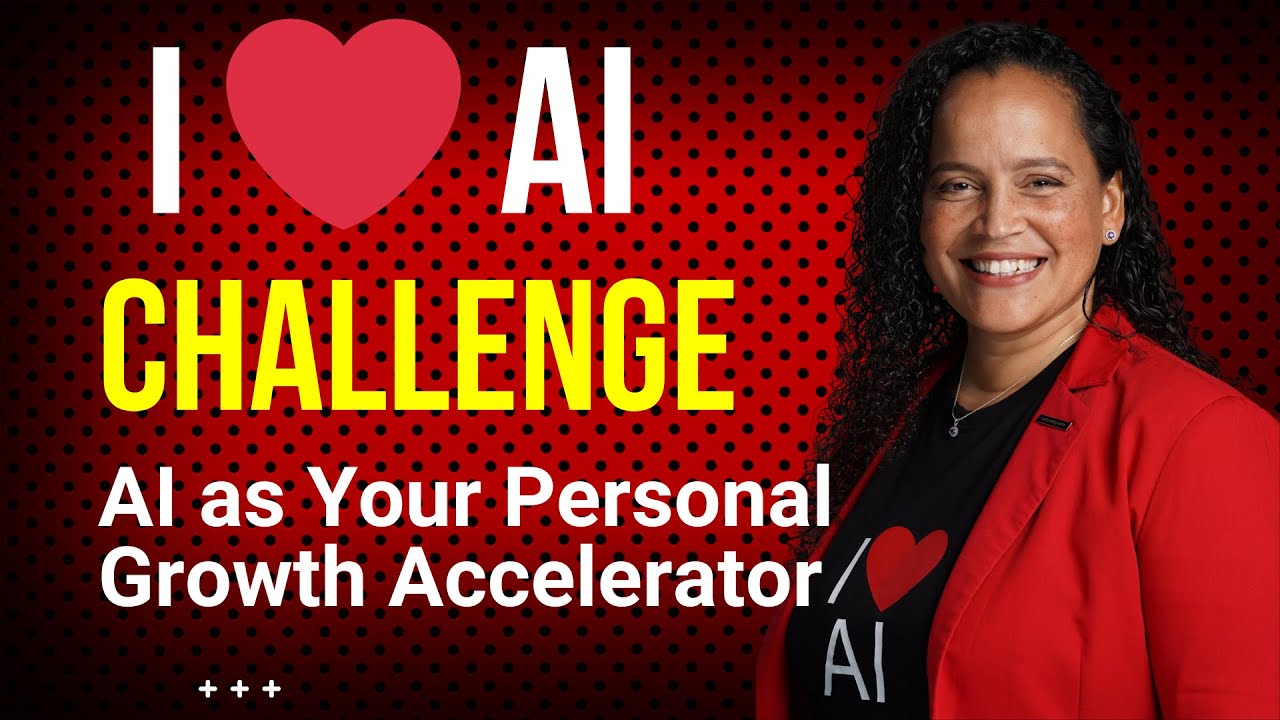
Noelle Russell launches Day 1 of an AI challenge focused on personal growth. The series uses AI as a tool to accelerate self-improvement, though specific techniques and goals aren't detailed in the available information.
Chapters
All right, so thank you for being here. Thank you for your patience as we let other people join us. We are so excited. This is going to be an amazing week together. Welcome to I Love AI Week here with Noelle Russell Russell. I am going to be your host and facilitator, teacher, educator. We have some special guests coming, guests meaning surprise guests that will be joining us all throughout the week, and I cannot wait to, to share them with you and have you ask questions. For those of you who are in the Zoom and you have joined our community, thank you for being here. That means that you get to ask questions live and, you know, feel free to ask as many questions as you want. I will do my best to answer them. The best thing you can do is throw them into the Q&A, though I'm going to do my best to monitor the chat, which is alive and well. Yara is in the house. Good to see you, Sherry. Hello, Tara. What's up? Awesome. Great to see you all. Afua, Kurt, Alonzo. Oh my gosh. I'm really hoping y'all are gonna like this stuff. Grisel, great to see you. Oh, it's good to see everybody. So thank you for being here. If you are here and coming to us live and you're not in the community yet, you can get there anytime you want by just going to noelle.ai. That is the website. You will see access to our I Love AI community, and you'll be able to join us right here in the Zoom room with all of our friends. Uh, Eve is in the house. Awesome. Sandrine, good to see you. Um, oh my goodness, Jordan, good to see you as well. So it's really, really amazing Amazing. I know. So I'll start with a little update. Uh, many of you know me. I'm Noelle Russell. I, uh, created this week last year. Um, I don't know what happened. I think I just— maybe I saw Love Actually and February was in the, in the air, and I was like, oh my gosh. And all of you probably know, and if you don't, you could just Google Noelle and AI and you will see me in a shirt that says I love AI. Now, I know many of you might be surprised that I'm not wearing that today, um, but I have big plans, big, big plans for this week. So you'll definitely be seeing that, and you'll get your own opportunity to earn your very own I Love AI t-shirt. Some of you already have one, so there are some other opportunities for you as well. Um, but we have some huge news. But before the news, I want to share with you my ideas and the education, um, and all of this really cool stuff that I've put together for you. So this week is all about— well, really, I've tried to characterize it very similar to what we did last year. Last year we had over 21,000 people go through this week with me, and it was amazing. Many of them are still following me to this day on LinkedIn. So hello, and I'm so glad you're still with me a year later. Um, but this year we're going to talk about similar topics, different implementation, because we've evolved a bit, um, in the last couple of years. And so I'm gonna share with you a little bit about that evolution. Today, I'm gonna focus on AI in your personal life. And I find that the reason I'm gonna do that is because it is critical as you begin to learn to use AI professionally. The first place it starts is kind of in those moments when no one's looking. Like, how do you leverage AI? How do you make it part of kind of the way, you know, I always say like water in a wave, like it's just like breathing using artificial intelligence. It's just like air. And so many of you, it may not be like air yet. It may feel a little bit like mud, um, and swimming in mud. But I'm going to encourage you to leverage some of the tools I'll talk to you about today to decrease the friction in your life from a personal perspective. So today is all about personal life, how you can do it personally. Tomorrow is how you can safely and responsibly use AI in your daily job professionally. It's not about how to get a job, that's a little bit later in the week, but it is about how to use it to do professional tasks. So this is kind of power user education for those who are using Gemini or Copilot in your daily life. So we had an entire session, actually a certification on power user Copilot training. And so tomorrow you are going to get a 1-hour kind of deep dive in that 5-hour workshop. We actually are condensing it into 1 hour for you so you can get all the same benefit in a much more condensed period of time. Now, what I always like to encourage you— oh, well, first, So today we're doing personal, tomorrow we're doing professional. On Wednesday, I'm not going to call it my favorite day, but it does mirror a session I just did at the HBCU Summit. It actually was HBC Universe Summit. Thank you so much to that amazing team for having me. It was fantastic. I tested out my session that I'll be delivering for you on Wednesday and It was amazing. People were very receptive to it. And so I want to teach all of you all how to grow a business. So Wednesday is about building a consultancy, creating a company, building a business. Most of us have some form of a side hustle. I have learned the very, very hardest way possible how to grow a career in corporate America. And then I realized the value of also in addition to, and eventually solely building a business that could be the lifeblood of what I do and how I do it. And so I'm gonna share with you in 1 hour a crash course, and I did it in 30 minutes. So I get a whole nother 30 minutes with you. I did in 30, maybe it was 35 minutes, uh, on Saturday, and it was awesome. So I'm so excited to share that with you on Thursday. I'm gonna show you, for those of you who aren't interested, or maybe you wanna build a side hustle and a real, you know, big, like a hustle inside a company. Some of us are not ready to just jump into the wilderness of being an entrepreneur, and I totally empathize with that. I was there myself in earlier years. So for those of you not willing, not ready for that, or want to complement a business with a W-2 full-time role, I will be hosting a session. It actually will be following the live session I'll be doing in our brand new Maven class. I partnered with someone named Brian Evergreen, and Brian Evergreen created this program. He called me up on a whim and was like, I want to teach people in, you know, 2025 how to get a job in AI, and I think you would be great for it. He also got 4 other star-studded cast to do this. And if you want to take the Maven class, There is a cost associated with it, but we tried to make it as cheap as possible. And that Maven class right now, I have a discount code that I'll put in the chat and in the comments of the live that you're looking at. We have a discount code for 50% off, which makes it from $200, it turns into $100, and you will learn from the best. That live session is actually happening at 11:00 AM, but we will follow that directly with a session right here. So at 12, I will be coming to you live right after having done that session., and we'll have a chance to dive a little bit deeper, go into things I didn't get a chance to talk about, and maybe even tell the truth about some things, um, that we won't be able to do in the Maven setting because we'll have such little time. So I, I just want you to know, I had some, some young people asking me like, for real, how does, you know, how does getting a job in the real world work? And I just wanted them to know the truth. Should I have told them? I don't know. Anyway, let's talk about it more on Thursday. I would love your your perspective. On Friday, we pull it all together and we kind of have a bit of a celebration. We have a couple different programs that we're launching in the AI Leadership Institute, and it's your chance to hear all about that. But most importantly, get access to some of the— we're gonna be doing some raffles. So for everyone who does the homework, and I'll show you how to do that shortly, for everyone who does the homework every single day, you'll be entered into a raffle to get a very cool prize pack. Of course, I'll tell you more every day what's in there, but it includes an I Heart AI t-shirt. I know there's 3 of you got one, but they're an I Heart AI t-shirt, right? Black. I love AI. I'll share with you in a second. It'll also include, um, the, uh, free access to our AI Leadership Lab platform for those of you not in the AI Leadership, uh, Institute as a member yet. But more importantly, it has technology software licenses to some of the tools that we'll be talking about today. Free credits in both Sora and HeyGen. Um, it has just a whole bunch of, of cool stuff in it that our, our, uh, people that have sponsored this activity has provided to us, and even people that didn't, and I just went and bought credits to give to you. So not everyone will get access to this, but one or maybe two lucky people will get a huge prize pack related to all of the technology that we'll be using today. And who knows, maybe they'll get something very special that I'll share with you on Friday. Yeah. All right. So that being said, we have a fun-filled week ahead of us. If there's anything you wanna focus on more than another— last year I kinda did these, uh, as we went. I didn't really have an opportunity to speak to people before we did the next session. And so I am offering to you, if you have ideas, this is a great place to say them. If you wanna hear about a tool, or I'm gonna be sharing my favorite tools. Um, but if you want to take this conversation in a direction and I can do it for you, please don't hesitate to reach out. You can reach out to me on LinkedIn or on Skool. Both of them, either myself or my assistant Sherlyn, will be supporting that. So wonderful. Javier's in the house. Good to see you, my friend. Awesome. Yes. And I only call out people who put comments in, so sometimes people don't want me to know. So if you put a comment in, that means it's public and I can say that you're here, so I won't call you out otherwise. I do try to make sure. Yes. Oh my gosh. Absolutely. So that is Wednesday. Oh, oh, you know what? I see what you're asking for, Jordan. Yes, I need to put that on. All of them are recorded. They're actually all on YouTube so you can see them there, but it's better if I put them in school. So I'll be uploading those by Wednesday because I'll be telling you all about it on Wednesday. This session recording will also be in a brand new section of the AI Leadership class as well as the I Love AI community. Inside the classroom, it's not there yet because this doesn't exist yet, but right after this session, every day I'll be posting the video as well as your homework assignment inside of there. And every day I will— you'll see, those of you who do your homework, it will be well worth it. You'll get some really fun surprises as we go through the week together. OK, so let's go. Alright, so I'm going to share my screen. Oh, oh, I think I did that. I hope I did it. It says I'm streaming. So hi, everybody all over the streams. I'm gonna go ahead and close this out. And let's see here. Here we go. So I'm gonna show you today is focused on personal development, personal productivity in the world of AI. So how I've evolved the way I do every single thing I do. That leverages AI technology throughout my day. It starts from really the moment I wake up. Um, granted, thanks to Alexa, um, but from the moment— oh, sorry, just kidding. Uh, from the moment that I wake up until I go to bed, I have AI integrated into my life. And so I'm going to share with you exactly what that looks like from my perspective. This is not a prescription for success. You might not feel comfortable with the levels that I've implemented AI in my life. I share with you as an example, hopefully as an inspiration to maybe just increase the opportunities that you can collaborate with technology like artificial intelligence to do more, be more, and have more in your life. I will share with you— oh, you guys could see it over here. Do you see that little thing down here? So this is our— my husband and I, we do a business meeting every year. We sit down and we write down what we want to do. There's actually two different pages here, so I, I can flip back and, and read it anytime I want. But it's a circle. Many of you might have heard of this. Maybe my first tip of the day. Um, is this concept of a Wheel of Life, that there are maybe 10 different avenues in your life that you want to have wholeness or holistic, you know, you want to have running. And so they call it the Wheel of Life because if you don't— if you are not equally distributed in your effort and intention, that that wheel will look a little wobbly, it'll look a little disjointed, and if you tried to roll it down the street, it would basically fall over. And these concepts are like personal, um, professional, and financial goals. So for me, uh, finance, health, love, spirituality, um, social, uh, let's see, what is that one? I can't even see what that says. Business, um, family, uh, so those are my sections upon which I want to make sure that I have intentional goals that I'm going after go after on a daily basis. That was not AI. That was my head to paper. My husband and I sat together and said, what does a good business look like for us? What does spiritual success look like for us? What does family success look like? And we went through and we just jotted it down. I mean, we, we kept, we worked on it for a few hours, I think maybe 4 hours, just kind of thinking and ideating and discussing. And so for those of you who have a partner, I think it's critical that you do this activity together. I feel very blessed and lucky that I you know, have married my high school sweetheart and that we believe in the same things and that we have this, this joint, uh, activity that we do together to get on the same page. Because it's very hard, and some of you have been in relationships like this when you were in a relationship. I've been in relationships like this where you've been in a relationship where that person is not on the same page. They do not understand what you were doing. You don't know what he— you are not helping each other's dreams come true. And then you end up really, it's very hard to stay focused and, and stay together when you live like that. And so this has helped us, helped our marriage, helped our business. I mean, everything got better when we started doing this. And so I share that with you only because this has what is what has driven a lot of the work that a lot of the AI technology that I leverage, the ideation of that came from this work that we did together. So I, I don't wanna dismiss how important it is to actually sit down and ask yourself what you want. What does success look like? As a matter of fact, many of you have taken my courses, and one of the big, you know, when we start a new AI project, the number one most important critical question that you have to ask is not what dataset do I have? What model will I use? It is actually what problem am I gonna solve and how will I measure success? It is the number one question whether you're in AI or in life. What do you wanna do and how will you know if you've done it? It is critical that you ask yourself this question, write it down and look at it every single day. And so that's why that sits here. So every day I can see what that looks like. Um, and, and of course I, I don't know, I, yeah, I think I said all of 'em, but anyway, it doesn't have to be these, but I encourage you, you can Google Wheel of Life or Circle of Life or something. It's in most productivity planners, but most people don't use it. And so I encourage you and it forces you every month. We as a couple and as a family, great. Grade ourselves on how well we're doing in achieving these goals. For every goal, there's a metric, and for every metric, there's a set of activities you have to do to get there. And that's what I think personal growth and personal development and today is all about, giving you tools to help you get there. Part of your goal will be financial, will be professional. But today we're going to focus on how do I become a better human in doing this work, and how do I partner with AI to help me do that? Um, the other activity, which is the page underneath this, that I've done and I do every single year and revisit multiple times a year, every quarter, um, is an activity in, uh, and I call it Be, Do, Have. And what it's basically— and you could do it today, you could literally just take a piece of paper and write 3 columns. Be— the be column, what you want to be in the world, what you want to do in the world, what you want to have in the world. And the haves tend to be pretty materialistic. I want a fancy car, I want a nice house, I want, you know, like whatever, whatever your materialistic goals. It might also be, I want to have, you know, access to something, um, I wanna, you know, what, whatever your haves are. Typically there's a separation between having and doing, right? But here's the, the nuance of this exercise. And again, I encourage you all to do this exercise, to write down everything in, in 2025, but really much broader. This list is not about what I want just this year. My metric is this year,. But this list is about what I want my life to look like. How am I gonna do things today that lead to a life that I'm proud of, a life that I want? And so in doing that exercise, the be, do, and have column, I'm gonna encourage you to focus first on what you wanna have and what you wanna do. Do you wanna own a million-dollar company, a $10 million, $100 million company? Do you wanna have millions in, you know, investments that pay you passively? Do you wanna be on the news all the time? Do you wanna write a bestselling book? Do you wanna teach Do you want to teach millions of people? Do you want to help millions of people? Whatever it is, find clarity in the thing that you want, but list it as things you want to do and things you want to have. And the reason I say it that way is because the B column is a reflection moment where you have to think to yourself, who do you have to become in order to have the things you want? Like, what kind of person do you have to be in order to generate $100 million a year? What are the things you would have to do to, to do that? Like, what, what personality traits, what leadership traits, right? What kind of person owns, you know, has a bestselling book? What kind of— like, this is not for me to answer for you. This is not something for you to ChatGPT. This is like, what do you think in your own, you know, maybe it's something you can ask some friends about or maybe some, some mentors about, but it really isn't a reflection moment to think to yourself, here's what I want to do, here's what I want to have, who am I willing to become in order to get that? And that is an exercise I've done for the last 5 years, and it is like, tra-jection of my life shifted what I ended up being able to do in a year because I was so, so narrowly focused on what I wanted to do, what I wanted to have, and what I was willing to become in order to do that. Now, the reason I also say that is because you all know I'm a very big, passionate believer in responsible use of this technology. And that means, like, am I willing to put, you know, a cheesy offer together on the internet and sell it for a buck in order to make a million dollars? Like, I watch people do things unethically every day on the internet, doing things that are very similar to what I— or say they're similar to what I do. And I'm like, do I want to do that? Do I want to be that person? I don't like— I have like me defining who I'm going to be in order to achieve these goals. I saw it last night. You know, you probably are all surprised I haven't mentioned the Super Bowl yet, but I saw the Super Bowl last night. I'm not going to, you know, say anything about that, but I will talk about the commercials. And I saw this amazing commercial. Did y'all see the— that I could cry about it. The Nike commercial about women in sports. I don't know if any of y'all saw it. Hey, Andrea, good to see you. Lucy, what's up? I don't know if you all saw it, but it basically said you can't win. Like, that was the whole theme, was that you can't win because people are just like, they don't think you can win. You can't win. Oh, Katima's in the house. And it was all about like all these amazing gymnasts, you know, basketball, you know, I mean, all these amazing women, like phenomenal running, like just Olympic champions. National champions, like just amazing women. And it was all about how people just tell you you can't win if you're aggressive and ambitious and if you want things that the world doesn't want for you, if you are a woman, if you are a Black woman, like all these negative— and I feel it a lot. I feel a lot of this. People will tell me nonsense every day about what they think is true for me and how big they think I can be. And I'm like, And so the message in that was like, you can't win because of all this stuff that people say to you, about you, that society says. And then it ends with, you can't win, so go win. And I was so like, ah, yes. Like, people will say you can't. And you have two choices. You listen or you win. And I am all about winning. And I do it every day. I mean, I inspire myself. I hope you all know that. Like, I look back at some of the things that I've done in the midst of the nonsense I had to do it in, and I'm like, good for you, Noelle. Like, good for you. But this is why I love our community. I love us getting together. This is why I love AI, because it does enable us to do more, to be more, to have more, to become whoever we need to become and want to become to achieve success. And that's what today is all about. So I'm gonna share my screen. And take you through just a little bit of what I wanted to chat with you about. Oh my gosh, Matt's here. What's up, buddy? Good to see you. I know you've been busy crushing it out there in the government sector. So glad to see you here. Wonderful to have you. All right, so I'm going to go into my beautiful Arc browser. Lots of people always wonder what this is, so I'll give that. This is one of my huge productivity leaps that I made last year. This is a certain— a different browser. It's not Chrome, it's not Bing. It's called Arc. A-R-C. It allows me to control the craziness of my tabs, and it has provided extreme efficiencies. Extreme efficiencies. It allows you to save certain things that you do all the time. It allows you to bucket them into chunks. So I have one for all my social. Like here, you'll see right now you can see a bunch of tabs on the side. So I was able to preload all the tabs that I'll be using for this presentation. It allows me to create sections. I have one for my business, one, one for every one of these things. It's so cool, right? So personal, professional, relationships. Like, I can segment my life and keep track of it. And sometimes that's a struggle for some of us. Amazing. Awesome. Oh, cool. So cool. Yes, I'm a big believer in jars of awesomeness. So I'm so glad for you, Matt. All right. So here, let me move this around so I can see. So today we're gonna talk about your personal use of AI in 3 main ways. One, productivity. So I'm gonna share with you not all of them because I use a lot, but a few of the tools that I use. And hopefully these are new tools. So some of them I feel like you would know, like the classic tools, my go-tos. I have refined my use. So I do think I've moved into a state in my AI application that I'm very specific and intentional with the models I use to solve certain problems. And I think especially with a browser like this, it makes it easy for me to stack them up so that if I'm building content or I'm building marketing copy or I'm writing copy for my clients or I'm helping them build out their personal brands, like, I have the ability. I mean, now for every client I have a tab. So I, it's always— those links are always open. I can see their Facebook ads and I can see their Google, you know, Google My Business profile. So it gives me the ability to just completely wrangle all of the things that I'm working on simultaneously. So I share that with you. But AI-powered productivity, I've done a couple things that are new, so I'm not going to share with you some of the things I've done, you know, a year ago, 2 years ago. You can definitely see some of my content on YouTube to see that. But I am gonna talk to you about this. If you have more, maybe not basic, but questions about more broadly used tools, I'm happy to do that as well. But I wanted to give you something new to think about based on what I'm actively using right now. So we're gonna talk about productivity. We're then gonna talk about creativity. There's a couple new tools that I absolutely love that I've been using quite a bit. And then decision making and how important it is that every decision you make should be powered with AI only because there's only so much data we have access to in our brain. And even in our resources, that AI gives us the ability to scale our understanding of things. Now, it doesn't mean that we go to ChatGPT and trust it to tell us the answers to our deepest, you know, financial problems. But it does mean that we have an opportunity to partner with an AI system that is custom trained in that problem and get some really good feedback. So I'm going to share with you some of the tools that I've been using. One, and I'll share with you some of my ideas along the way. I do have a tab that is just for my ideas. So every day I get new ideas and I'll share with you some of them. You'll laugh at me because I mean every day and every day I go grab a URL going one day I'm gonna do that. I buy URLs for my ideas, number one, because it helps my brain think that they are done, so I no longer think about them anymore. I can let the idea go as like it's now parked in GoDaddy and I, I will come back to you, I promise. Maybe I will, maybe I won't. But I'll share with you by the end of this why I do that. But it, you know, this random access memory, right? What's in my brain? It's precious space. And I, I sometimes get very, very overwhelmed with all the things that I want to do for all the people I want to do it. And this narrow focus is really important. So I'm going to share with you how I use AI to help me in my decision making and my prioritization. The number one skill. So everyone has a— everyone has a word, or I shouldn't say that. Maybe you don't, but a lot of people sometimes pick a word to represent like their goal for 2025. And if you don't, I'd maybe encourage you to, to choose one if that serves you. But when I entered 2024, my goal was scale. So everything I did was to scale what I was already doing. My executive briefings, teaching workshops, going on stages, and I did all of that. It scaled and woo, we're there now. This year though, I had to really— and I've had to have some very hard conversations already and it's only February, but my word had to become prioritization. And as a leader, this will ultimately become your, your mission as well, or a, a driver of your success is prioritization. How do you prioritize? Some of you remember earlier this year I did a session on how to launch 2025. In a good way. And I showed you this quote, um, but it said, you really have to decide to be in control of your time, your mind, and your energy. And so you're— above all other things, though, that must be your priority. And I love this quote because y'all know me, I want to help everybody, I want to hop on a phone call with everyone, but what we don't realize is how valuable every moment of our life is every single moment. And so though I love hanging out and like, you know, shooting the breeze as they say with people, I'm on a mission. And my mission, if you are not aware of it, is to, is to help a billion people understand that AI can help them and won't hurt them. In other words, that they'll learn AI by building an AI system. And if I'm lucky, a fraction of them will have the, persistence and resilience and determination to actually build a company of their own. That is my, my mission, right? Billion. It's a big number. So please don't get mad at me when I'm like, I can't hang out for 15 minutes because I'm on a mission. I got like, every minute counts. And I, you know, let's just face it, life is short. And so I want to use my time as effectively as possible. So prioritization becomes my key. And I don't mean from just talking to people. I, I prioritize this community, right? The I Love AI community is my priority because you're part of my billion, number one, but also because it energizes me and keeps me going towards the harder conversations that I have to have. So let me see if I can— oops, let me click over here. So the first thing I wanna do is talk to you about how I've leveraged AI to help me with my daily routines, to help me, um, figure out how to come up with cool ideas. And of course, How to make better decisions with my daily routine. I love pen and paper and I love journals. I love books like this. I have hundreds of them. I have so many. In fact, I created a podcast called Noelle's Notebook where I would just go to my shelf and pull out a notebook and I would talk to y'all about something that I wrote down. It's full of ideas, full of ideas, notes, epiphanies. However, in that, I needed a way to turn those ideas into action. And so I started to leverage— I looked for products that would give me the ability to turn those ideas to action as quickly as possible in the form of, you know, AI-assisted project management. Now, I have used quite a few. I got lots of different opportunities to, to dabble in project management tools, but I'm going to share with you the ones that I'm using right now in this prioritization effort. The ability to pick what is— where are you going to spend your time is hinged on— remember the very beginning I said, what is it like? What do you determine is success and how are you going to measure it? Prioritization is that activity of distilling of all of my 10 things. What can I work on today that will move the needle in direction of that success metric that I want? If it's having a positive, you know, a, a loving and supportive relationship, being a good wife, being a good mother, then that means like, what am I gonna do today to make sure that that happens? And how do I make sure I prioritize that over everything else? Now I've got 10 things, maybe it's not 10, maybe it's 7, but I have a bunch of things that I'm trying to do, so I can't do everything every day. So now I have to become even more strategic in my prioritization to make sure all of these things round out over time. That, and this is why, um, I have a leadership principle or a set of leadership principles that are, um, organized through a, an acronym called LAMPLIGHTERS. There's a, a podcast called Lamplighter Effect, um, and a book called The Lamplighter Effect. And the idea of the Lamplighter Effect is that there are 12 leadership principles, basically one for every week of the quarter that I focus on in order to achieve my well-rounded goals. And so the first one, for example, LAMP, L-A-M-P, love, ambition, mindfulness, and purpose. So every week I'm like, okay, what can I do in my business and my family, in my relationships to be more loving, supporting, empathetic? Then the next one's ambitious. How do I drive more ambition in each of these areas? How do I get myself excited? One of the biggest things you can do for yourself is realize that emotions are a choice. I mean, I, I, uh, in my leadership principles, I say happiness is a choice, but happiness is just one emotion. Every emotion is a choice. And while I'm te— not telling you how to emote or how to feel about something, but my ability to resiliently recover from something bad, sad, Frustrating, betrayal, like any of those emotions and being able to almost immediately within 90 seconds or so turn it into, okay, what do I do now? How do I make a plan? That, that process is very much my human process, but immediately is how am I gonna make a plan? Actioning it becomes a part of the process where I invite AI in. So that's what I want to share with you. Yeah, exactly. So overall last year I did 100 Ways to Stay Motivated in 2024. I'm going to do that for you all this year too. I have 100 different ways that you can stay motivated and they're all different. They're for different people. There's, there's a reason there's 100 is because depending on the kind of person you are, you're going to need motivation in different ways. But yes, we need to stay motivated and generate motivation. I'll tell you, I was not feeling well earlier today and I've had a couple of hard days over the last couple of weeks and every one of those days I had to go live. So I'm like, all right, now, like, I don't know if you see on the Super Bowl, you see these teams hype themselves up before the game. They're like, you know, rah, rah, rah. You know, however you do it. I have my own system. And part of it is journaling and writing down what I want. Another part of it, though, is surrounding myself with people who speak the way I want to speak to myself. So I am a Peloton person. Some of y'all know this. Unity Girl is my name on the Peloton. Maybe I'll change that one day, but it's Unity Girl right now. Um, and you can follow me. We'll be friends. But I— there's a couple people that I listen to, but the number one one I will mention to you is Robin Arzon, and she's the head of, of Peloton Fitness. Um, she's like the CVP or vice president, whatever. She's head of all fitness. Um, but she started as a lawyer, similar to me, right? Started in tech. And then decided to jump into AI. And actually, I wasn't even like, you know, like, I wasn't even gonna go into tech until an advisor told me to. Like, I was on my way to customer service and then jump. Now I'm in AI and, and one of the biggest leaders in AI, right? So I, I find I'm very inspired by her because she's constantly talking about the hustle, you know, and that, and she just recently, oh no, I, I, it's by my bedside, I meant to bring it down, but I have— she wrote a journal. It's called An Empowerment Journal. Here's the coolest thing, you know, about the universe. So I was looking for a journal that I could use to kind of get myself hyped up, write things down, um, and, uh, I went online and I picked this journal because it was yellow, and I was like, yeah, yellow is kind of like a go color. I feel bright. All right, sunshine. I pick it, I get it, and open the COVID and it's written by Robin Arzon. And I was like, I had no idea. It was so awesome. Anyway, and so that's mine. I use her journal. I love it. But it's all about like getting yourself hyped. And so stay tuned for that. We'll be doing— and you can go back and look at the one for last year. It's equally— well, no, it'll be better this year, but it's also good. But staying motivated is like a huge part of success is just how do you get up every day and do the same thing, especially when something crazy happened to you the day before or the night before or 2 weeks before? Like, how do you just stay on the task? And so we have content around that. But I use a couple different tools, 3 different tools to help me with this prioritization. The first one is Superhuman. Any Superhuman users in there? Robin, right? Amit? Oh my gosh. Fo sho. I love Robin. Oh, I really do. But if you are a Superhuman user, you might be, might not be. It took me a while to become a believer. Here's what I found over the past year. More and more people were using Superhuman, and the way I knew it is because at the end of their subscription— I mean, sorry, the end of their email, they would have a signature, and that signature would say, from Superhuman, or whatever. More and more people. And I was like, all right. My biggest challenge right now is that there is no AI that can triage my inbox and identify what's good for me to spend my time on and what's bad. So it takes me time to do that triage. Even my assistants. I mean, it's very difficult because all the context for all the things is in my brain. So very difficult. I do feel like I can solve this. I really thought Copilot was going to solve this. And then I use Copilot and it's like, I do not have access to your inbox. And I'm like, what good are you then? But that's okay. It's been very helpful in other areas. But inbox triage, when your world revolves around your calendar and your email, as mine does as a consultant. Like, man, I wish there was a better solution for that. So this is not my perfect solution, but it is the best solution I've used so far. It allows me to leverage artificial intelligence for identifying what's important and what isn't. So it does a bit of triaging in that sense. I still end up with 400 emails a day, which is too much. And so from there, though, it gives me these very quick key bindings for controlling my inbox. It also sits on top of a framework that I believe in wholeheartedly, the Getting Things Done or GTD framework. So it's like you look at an email and you have to decide immediately when you see it, are you spending 2 minutes and handling it? If it's more than that, you're delegating it, or if you can, you're delegating it. If you can't delegate it, you're doing it, you're setting a time. And if you're not delegating it, doing it later, or deleting it, well, those are— yeah. Yeah, then that, like, that's it. Then you're deleting it, I guess, right? But it was, it's like key binding, so I could just hit K, K, K, you know, whatever I need to do to either look at an email and reschedule it to remind me to do it later, like an hour later, a day later, a week later, or I can look at it. And once I start doing this consistently, Superhuman starts making suggestions on my behalf. And so I didn't, as with all AI, right, when it first starts, you're kind of like, meh. And then the more you actually use it, the better it gets. That's literally the concept of reinforcement learning, right? Is that as we reinforce the model with good choices, it starts helping us make better decisions. Most people are not willing to do the work to train the model so that it gets to the good part. They usually use it and then go, ah, it doesn't work, and then they stop using it. And it's the worst thing you can do because models only learn when you tell it it's done something wrong. Just like a human, you can't expect humans to change behavior if you don't actually tell them them how to do the job right. And so same is true for machines. Um, so I like Superhuman. That is the tool. Another one is Hite. I'm gonna actually go and show you this one, um, because Superhuman, I can't get to their homepage because I'm a member, so it automatically drops me in my inbox, and y'all don't want to see that. Um, but Hite is a project management tool, and this reason I like this is because it has, you know, ingested a bunch of project management, not only terminology, but projects, sprints, stories, epics, breakdowns, tasks, all of it's already been trained on kind of how work gets structured. So when you go in and you start typing, you build a project. Let's say I build a project to help a customer generate their marketing strategy, right? I just, you know, got 2 clients last week, and my job is going to be to help them not just build their strategy, but use AI to implement their strategy, right? Get them more leads and close more sales. That's the deal. So I go into Hite and I type in— now I've already got my other clients in there that do this. So I start typing in marketing strategy and it already knows, well, you did that already. So it autofills from previous work. If I want to change it, I can, but in most cases I don't need to because it's literally building off the tech, off the choices that I've made in the past and leveraging natural language to do so. Then when I go in and I say marketing strategy and I go to in to break up that work, it provides suggestions on how that should be broken up. And that suggestion is not like made up, it's based on successful projects. So if I'm new or if it's a new process that I'm trying, I can get some ideation. I'm like, oh, first step. Oh yeah, I actually like doing this first step. I don't usually do this first, but thank you, Hike, for suggesting it. Most importantly, as it leverages my existing work to generate new projects, it's automatically populating everything, you know, kind of like in Excel if you're an Excel user where when you type in one thing into a cell and you go later and you type the same thing, it auto-populates. Except think about this for all of your project work. And so it's super fast. So now I can build out a project plan in a fraction of the time based on my own success, not on what they think is successful, on my own successful projects. Projects. So that has been super fancy for me. I love it. I use it wholeheartedly. I also use ClickUp and for different reasons. So ClickUp, um, has a very cool feature and it wasn't enough for me to move all of my stuff from HITE to ClickUp, but this is a very good feature when you're managing projects for your clients with other people. You're not managing your own work, you're managing other people. And the reason why is because ClickUp has an AI feature called automatic check-in. And what it does is as long as everyone's using the tool to document their work, document the, you know, user acceptance testing, document the, the sprint work they're doing, what they're taking off the backlog, what they're working on, how the, how it's going, providing progress, hyperlinking documentation. As long as everyone's doing that work inside of ClickUp, you can do an auto check-in and it uses AI to do a daily standup for you without anyone getting on the call. And I think this is super valuable for some of us. Me, who get on these calls and they tend to take way longer than a typical standup because people are like, oh, and then this happened and then this happened and this happened. If I could walk into that meeting already knowing what everyone has done in the tool that's been synthesized into a summary in the check-in, which is basically my daily standup results. What's, what, what did you do? What are you struggling with? Do you need help with anything? What's at risk? Right? It automatically summarizes that and gives it back to me. Yeah, exactly. Exactly, Javier. Yeah, I love ClickUp, but like, it doesn't do what Hite does. I mean, this is the challenge, right? Everybody's got their own little niche and features they offer. But maybe I'm like in the middle of making something of my own. But I do. I like them both for this reason, and I just encourage you to play around with them, build a project. They both have free tiers. Hite's really cool. I think you can build an entire project, 50 subtasks, like you can do pretty significant work on their free tier. Which is another reason why I tried them out. I don't really like changing tools very often, and I'll tell you why. When you change a tool or when you change a process, typically you're going to see a 20% degradation in the way you deliver that thing because it takes— like, it's just a hit when you change something like that. And unless you're like— unless what you're doing is going to generate a 20% increase in what you're doing, you're actually going to get a hit on the whole thing. So you have to be very intentional, very specific. And of course, the, the dream is to just have a, a couple of interns or a couple of, um, employees that just ideate about this on like all the time. They're, they're testing out height and showing the value before you ever actually implement it. I don't, I don't do that. So I have, I implement it myself and kind of test it out. But it, every change in process, like a PM tool, will degrade your initial outcomes, like your initial, uh, outputs, by about 20% because you're just figuring out how to use the new tool. So know that before you jump into this, but also know that means that you really need to be clear on the benefit of that change before you do it. And I don't mean just for project management tools, I mean really for anything— going after a new ad platform, going after a new social media channel, Is it worth it to slow your roll while you figure that out versus just stay where you are and blow that up and do well with that, right? And so this is something, again, prioritization. This is how I try to help myself prioritize is I think, is it working and is it worth a 20% hit in the short term to get a bigger outcome? Sometimes it is, sometimes it's 100% gain that I can get or 10x gain that I can get. And if that is the case, then I wanna take that 20% hit right away. Um, but if it's not, if it's negligent, I'm really careful about what I choose to jump into. Oh, right, exactly, Yara. 100%. We are supporting a remote workforce in Tahiti or Fiji or wherever you would like to be. 100%. Alright, the next tool, that I wanted to share with you was another tool that I use called Noteplan. Now, Noteplan leverages AI to integrate a bunch of things. This is basically a a little bit like Notion plus PM tools. But the reason I like it is because it integrates calendaring, time blocking of calendaring right into your own projects. So every single day I go in and I started with a 7-day free trial and now I'm, I'm hooked. It, it, it hooked me. But it starts every single day. Notice here you have it. You can create a template, which I have done, and that template like hardens or codifies my daily activities. So here's what I do every day. Every morning I journal, I meditate, I, you know, have a vitamin and supplement routine. I work out, I drink protein. Like there's all these things that I do in my first 45 minutes to an hour. So I document them and check them off every single day. And then I have my calendar, which you see over there on the right-hand side. It'll show me, okay, what do you have in the day? Then as I write tasks that come to my head or things that come up in a meeting, I write those tasks and I could pull them directly to my calendar. And if my, my calendar's synced up with Superhuman, and it's just a beautiful thing. It's a bit of an orchestration right now. Is Agentic AI in the works to or to connect all these systems together? Absolutely. I can definitely do that. I, I use Zapier to support my interapp communication so that I don't have to go anywhere more than once. But that being said, I'm just showing this to you for those of you who have no tool or thinking about a tool to manage kind of your day-to-day. How do you outline? I used to use— I don't know if I have one here. Oh yeah, I used to use this book. This is what I did last year. Every day I would fill out— I think this is one of my new ones. Yeah, every day I would fill out like all the things that I would do. I'll just show— I mean, it was just like a blank form. Right? It would have my goals on one side and my calendar on the other side. Make sure I'm pointing to it correctly. So now I use Noteplan to do the same thing, except it ties directly to my calendar, which has been critical. Alright, so just a couple tools to get you started. And again, Superhuman, which I didn't get a chance to mention. Now, these tools are incredibly important to me because they help me prioritize my day and segment my time. Once I'm now in those segments of time, I often need to accelerate my creativity. So for example, you all know, um, in over Christmas, I built one funnel a day for 12 days, the 12 Days of Christmas. And I built that funnel, and building a funnel is not a trivial task. It's not just a website, right? It's a website and an email sequence. It's ad advertising, it's, uh, copywriting, it's, uh, creative generation. And so these were some of the tools that I picked up over Christmas in order to help me do that better. And if you know others, please feel free. Oh, thanks, Sherilyn, for putting that in there. But please feel free to throw those in. I will be providing to all of you at the end of today, or at the end of every session, you'll get a link, a list of all of the tools that I mentioned, and links to them so you can hang out and play around with them if you choose to. So I have a couple of these tools that I want to show you as well. The first one, of course, is Gamma. Gamma is amazing. I don't know if you're using Gamma, just say say, uh, what's up in the chat. Uh, you can just type in Gamma or say yes. Um, Gamma is an amazing tool. What— oh, what's up? That's right, yes, let's go! So many of us, right? So this is a time saver because most of us, like myself, do not want to build a PowerPoint deck, um, ever. And it does require you to have clarity of thought on what you want to do and how you want to present it, but it generates a deck. I mean, I'm literally showing you a Gamma presentation right Now, so it, it allows you to see and show and demonstrate results very, very quickly. It can build websites, but I use it mostly for presentation development because that's just the bane of my existence is PowerPoint and messing around and moving things and organizing stuff and things being off. It's just crazy. So I use Gamma for all of those types of, of tools. The next one, which I really like, and I tried to put— Sora is one of my favorite video tools right now, especially for, like, scroll-stopping ads, Sora is amazing. Like, you can ask it. I just did one for a client who is, she's a consultant to the trucking industry, a very specific trucking company. I can't even remember the name, Valera or something like that. Anyway, specific trucking company. So I get on the phone with her in one of our sessions and I go to Sora and I'm like, okay, so tell me a little bit, give me some information about your business. And as she's describing it, I'm writing in trucking company. I wanna, you know, I need a commercial of about a fleet of trucks, different colors. This is the brand of truck. I had never heard of that brand of truck. And I hit enter and it generated a video of those trucks driving in formation, all different colors. And she was like, you know how much it would have cost her to like find these trucks and get them together and film them? Like, she was just beside herself. And so that leads me to another small point, which is please don't forget that we are in a very small silo of the world that knows, loves, lives, and breathes artificial intelligence. What is old to us is brand new to everyone else. And so it's really important to be number one empathetic to that and know that not everyone knows what we know, but also to realize that you, you, the knowledge you are gaining, not just this week, but overall, cuz I know many of you are just looking for this information and researching and dabbling in this technology all the time, that you are ahead of a lot of people. So you have an opportunity to help those people that are right behind you looking for, for assistance. And that's what I get to do every day. So the next one is Iluna, and Iluna is one of my favorites because it allows you to create very realistic and also not realistic imagery. I don't know if you've noticed, maybe it's me because I have a lot of deepfake content, but my feed is full of deepfakes. Horrible, mind you, like you can tell they're deepfakes. Fakes. But it's not about— the funny thing is that it's not about the deepfake, how good or bad it is. It's the fact that it stops the scroll. Seeing Steph Curry— I don't know if you know, uh, him— but like seeing him say that he wants to leave the Warriors and go to work with LeBron, like I saw that deepfake like a couple days ago and I was like, oh my gosh. And he literally is like, I hate where I'm at and all I want to do is work with the King and stuff. It was crazy. Um, but it stopped me, like, and I'm not really a huge, like, Steph Curry fan, but I was like, what's this about? You know? And of course the headline is all catchy, like, Steph Curry says he wants to leave. Um, anyway, and so you listen to it and then you immediately can tell, uh, that it's a deepfake. So, but it stopped me, and now they can tell me something that I may not have ever thought I wanted to hear, which they did. Um, So it gives you an edge when you can create these videos in 15, 30, 45 seconds that will stop someone scrolling, get them to pay attention to what you have to say. It's a, it's a critical skill in the world where we have so much noise and, and our signal-to-noise ratio is so high. So I wanted to share this with you because it just is, it's pretty cool. And I've used it to do a lot of motion graphics, a lot of social media video. And even just add B-roll. I'll create the, the content here and then add B-roll over to my existing content. So pretty cool stuff. So I encourage— I just wanna share that with you if you've not played around with it. Another tool— oh, I didn't put it in here. Oh, is— I'm gonna just put it in really quick, an extra one, Whimsical. And Whimsical is kind of a combination of creative and productivity built together, but it allows you to do storyboarding and kind of Sigma type work altogether. Let me maybe go to getting started so you can see a little bit about what it's good for. Flowcharts, documentation, wikis. But, but all AI generated. So it, it, it's giving you the ability to give a little and get a lot. And I think in the world where we are working by ourselves, as much as we can pull back time as a resource to our advantage, the better we are. Okay. Awesome. So just a couple of creativity tools that I've been using to kinda level up my game. Again, Sora is a big one. I didn't put that on here because it didn't have a pretty preview. Um, but you could definitely, uh, look at that as well. Sora.com. Now, decision-making. Here is what I want to do is just give you a couple tools that leverage data and artificial intelligence to give you better information about yourself. Start number one with this ring. This is an Oura ring. I've been a, uh, fan of Oura since they launched. I think they were a Kickstarter or Go— or Indiegogo, I can't remember, but it was early. And I got their very first ring, which is not— was not beautiful. This one's better because it doesn't have these bumps on the inside like the other ones do. This is their Gen 4. Here's why it's useful. Every single morning when I wake up, as part of my routine, I look at my metrics for yesterday. Those metrics include my heart rate variations, my stress levels, my cortisol levels in my body, how I managed oxygen, All of those are an indicator of how resilient my body is to the environment that I'm putting it in. And let me just tell you, it's a bit stressful to be me. So I do a lot and it's all my— I take full responsibility for it. I do. I'm a driver. I do a lot. And so as a result, some days I handle that better than others. And when I get this data, I can make a data-driven decision about how I spend in today? Do I need to spend time in recovery? I did a— I'm, I'm prepping for, uh, the Disney Princess Half Marathon, which is happening at the end, uh, February 21st. And I'm not just doing the half, I'm doing a 10K with my husband on Saturday and then a 13.1-mile on Sunday, back to back. So I'm getting these runs in. Well, I'm sure you all could tell me, but I am like, I'm gonna do these long runs, I'm going to be very hard on my body to prepare myself for this and I'm going to keep everything else the same. I'm going to work the same. I'm going to sleep the same. And what I've uncovered is over time that, like, there is a bit of a give and take there, right? Like, as I've been increasing the stress on my body physically to prepare for this run, I've not been as energetic in every other area. Like, I'm, you know, I'm having to find harmony there. And that's one of the— in Lamplighters, the H stands for harmony. That sometimes if I wanna do really well in this race, I might have to reduce the level of effort I spend in some other things in order to create that harm— harmony. Um, and Jeff Bezos also said the same thing. He's like, never strive for work-life balance, strive for harmony. And I appreciated that. And the reason why he said that was because there are cycles in everything. Like now I'm in a cycle where I'm prepping for this race. As soon as that race is over, I have a bunch more time now, right? Like, I'll continue running, but nothing like race prep. And so I think it's important to kind of think about life through that lens that you're always going to be balancing. And sometimes my family takes more time than anything. Sometimes my work takes more time. Right now, my personal fitness journey is taking a lot of time. But it's all in a harmonious virtuous cycle in order to achieve my highest self, my best self. So that's why I— oh my gosh, awesome, Sherlyn. Thank you. So that is— I just share that with you. This aura gives me like very, very good— and granted, oh, the other thing is for those of us who are employed or have extra funds in our, uh, HSA, it is HSA and FSA like supported. That's how I bought my first one, is I just claimed it on my, um, health savings account, and I was like, it was like free, or my FSA, where usually I lose money on the FSA every year. So really cool device to give you intrinsic awareness And the AI part is it's predictive as it learns about you. When you first get it, a lot of the data is still very good, but there are about 5 metrics, including resilience and stress management, that are predictive on your own data. So you have to use it for 2 weeks before it can get good again. So many people will not do the 2 weeks of work in order to get the great results. It's true in almost everything, right? Dieting, like anything, you got to do the work before you see the stuff. And so in this case, it's the same. But that data-driven approach has really been helpful to me. Now switch gears. So I believe in personal, professional, and financial well-being. Those are like the 3 lenses upon which I look at my life and my success. Financial is huge. So I wanna point you to a tool that I use that's AI-based. It allows you to pull in— many of us, I don't know, maybe I'll just speak for myself. I have lots of money in lots of places, or a little money in a lot of places, right? Like I've got, I've got 401s. You see my resume. I've been in 6 companies. I have 401s in all of them. I like that are just like straggling out there somewhere. I have money now invested in a real estate investment, 2 apartment buildings that I purchased. I've got— so that money is not tied to this money. I then got my bank account. Then I have my business. I have multiple businesses that I run. All of them have their own P&Ls. Ah, and so this tool gave me the opportunity, and I used to use a different one. This one is called Portfolio Pilot. I used to use Copilot, very similar, but they gave me the ability to aggregate all of them into a single window so I could actually tell my what my true net worth was. And no matter how bad or good that story is, knowing your baseline is a position of power because now you know what to do either to make it bigger or better, right? Um, and so Portfolio, uh, Pilot, it. It's available. It's free to start. I invested in it because I really, I love the idea of giving people financial independence through agency, giving you your own data back. This data is already out there, but how do you own all that data? It was really hard. I mean, I don't have it anymore because I, I did all my filing this weekend, but I had like a stack of papers of all the, the things, like all the, um, prospectuses that I get and all the stocks that I own. Like, it was just crazy. And so this tool really help me reduce the amount of time I spend correlating all my financial information so that I know what my financial status is. That is the biggest thing you should, you know, one of the biggest things that are very important for your success is to know where your financial standing is so that you can build a better financial future for yourself. And then finally, you know, AI and well-being, it's tough, right? I don't know if you've seen, there's a lot of— I don't know if Marion's on the call. Marion's working on a project like this, but But well-being and AI, there's a— you could actually just do a Google search, and there are lots of research papers on the travesty that has happened in this world. There are about 40 well-being apps that are just for practitioners, meaning people who help people. And I think that is a good sign, is that we first help people who help people, and then we use what we learn from them to help people more broadly. However, in lieu of having an AI conversational app that I can talk to to get wellness and, you know, emotional intelligence advice or coaching, in lieu of that, because I, I don't know that I, I would have to do a lot of due diligence on a company to know that I could trust them with my own, like, mental well-being. But I like organizations that are data-driven in their approach, meaning that they they look at how you do something, they record your activities inside the app and change the app. But more importantly, they correlate your data with their entire user base. Amazon and Netflix have been doing this for years, right? People like you also watch this movie. People like you also buy these things. People like you like this type of a meditation. That is that data-driven approach. So if I go and take a look, actually I pulled it up, um, somewhere around here. Oh Yeah, this is the one of the pages that you can go and take a look at, but it's all, it's science-driven. So they use the data to create a better experience for you and to tie you to an outcome. As I started this conversation earlier, the most important thing you can do is figure out what you want. If it's better emotional intelligence, better mental wellbeing, then figure out what's the metric you're going to use to measure that you've done that. Is it minutes meditating? Is it it, how well you feel. I have— oh, it's not within arm's reach, but I have a book. Every day I write into this book my emotion, my emotional state. And my goal is that I want to be able to track my emotional state. I have an app on my phone called Brand New Day, maybe. And every, every day in my morning routine, I go through and ask— I answer a bunch of questions. And the idea is that I want to capture It's called Intelligent Failure Discovery. I want my data to say, hey, before you get, you know, overloaded, overwhelmed, and end up in a pile of tears by your bed, like, before that happens, it's able to tell me, like, hey, based on us seeing this pattern of behavior, we now can tell, like, this is the sign that things are just starting to kind of get off track. And it allows me to do course corrections immediately based on my own data. So I like Calm for that reason. Other tools are data-driven, but not— don't leverage machine learning to actually provide insights on that. So just be aware of that. Headspace is the one I think I'm on right now. I didn't— I think I— yeah, Headspace. And they're the ones that are the most data-driven in their approach and leverage machine learning. Calm doesn't use machine learning, but they do use data. So something to be thinking about. So Aura, Headspace, of course, you can Google emotional intelligence or mental well-being in AI and get a sense of what this market looks like. I think it's ripe for some innovation, but it starts with creating a community of people that are gonna trust you with this data. Headspace has been in this industry for a long time. As a matter of fact, they came to me to buy my Alexa skill. Once. Um, and of course I said no. I wish I said yes, but I said no. I didn't know what I was doing at that time. Um, but these are just some of the tools that I use every single day to kind of, again, take the massiveness of what I'm trying to do and reduce it to what do I do today, what do I do consistently and persistently in order to achieve the outcomes that I want. And now I've, I've consistently gotten what I wanted for the last 4 years since I've really started using technology kind of in my life. And so I share that with you. So just imagine, you know, I always like to think about what my life would look like if everything was frictionless and then break down what could I do today to just move in that direction. So whether it's spending time in a mindfulness app, I also use the Peloton app, though they're not as— they don't— they're not as data-driven as I wish they were because they have a lot of data about me and they don't use it at all. Um, but how do we find tools or build tools if you are a builder or a creator that really help us become better individually so that we can be better communally, right? Like our own indiv— it's the first question I ask people when they wanna work for me or be an intern for me or partner with me. I'm like, what are your personal goals? Like, who do you wanna be? Like, do you, do you wanna just be— are you just stagnating? Do you have a goal? Do you have a mission? What's your personal mission statement? If you do nothing else today, like, write a personal mission statement. That will help you organize your— what you want to have and do and be, right? Like building the circle of life. There's lots of stuff, lots of activities that I've mentioned today, but I'm gonna focus your attention on two of them that I think would be great, uh, for homework. Um, now I do want to remind you that, uh, this is a great day We did launch a brand new or, team. I am launching a book, a new book. I don't know if you've seen, some of you have already bought it. Thank you, Sherry. Some of you already purchased this book, but I'm launching a new program called the Responsible AI Insiders. Now, again, this is not a paid program. It's just a chance to become part of a wave that I'm going to be generating over the next 2 months. We have a huge book tour. We have a huge amount of in-person and virtual workshops that we're gonna be delivering. All to help the world learn that AI is not something you just do to summarize your emails or, you know, summarize a meeting, that it's actually a thread you weave into everything in your organization, just like we talked about weaving it into everything that we do as an individual. And so there is a bunch of cool stuff that's going to be happening. You can head over to this link. I'll actually— maybe I'll copy it for you. And throw it in the chat, um, so you can see it. You can join. What this means is that you're going to get access to— there's a whole separate set of calls that we'll be doing just to update you on progress and, and opportunities. Like I said, I'm going to 17 cities right now. If you're in one of those cities, I'd love to partner with you to do a local event. It'll be really fun. We'll do— after March 25th, which is when this launches, we'll do book signings in those cities. Up until that point. It'll just be a chance to create a community, and if you are interested, you could own that community. Little satellite I Love AI communities all over the world. Um, it'll be really, really cool and really fun. Yeah, some of you are like— I, I presumed you'd be in because you were like, this is who you are. Um, and really spreading the message of what I talked to you about today, that it's, you know, we're not trying to create a fiefdom, we're not trying to create this little world where only we know about this technology and we hold that close because we think it's going to make us successful and keep other people from being successful. There is no scarcity to success. There is no scarcity in the amount of clients that you want. There's no scarcity in the revenue you want to generate. The only limitation is you, is what you want to do and how much time you want to spend doing it. Every successful thing that I've ever wanted to do, and I've now recreated my lists multiple times. I'm now in a new list, but everything I want to do as of last year, I had completed. I wrote it down, I made a plan, and I did the work. And I worked crazy hard some— sometimes, uh, some years, right? Like, there were— some of you were on our call where I very, um, vulnerably kind of shared some of my early years. And there were years where I did not see my kids from Monday to Friday because I was on a mission to support them, and I had to That was the way I solved for it is I became a consultant and I left on Monday, got back on Friday. I saw them 2 days a week for over a year. It was decimating. Like my kids didn't know my name. When they tried to call me, they'd accidentally call me the nanny. It was decimating. However, I did that so that now I could do what I'm doing now. Like it was a necessary step. And sometimes that's why ambition is a big part of being a Lamplighter, big And being part of, you know, having this— these leadership principles are so critical because sometimes you have to do things in the short term to get a huge win that pays back 1,000 times. But many times we don't want to do that work. But I'll tell you something, doing the work is way better. I will do it alone if I have to, but it is way better with people like you all. So it has been a much more fun and exciting journey over the last year Thank you for being part of this. Thank you for being part of the I Love AI community. Thanks for being here on day 1. Like I said, we will be increasing the amount of tools and capabilities over the next week. Today's homework, should you choose to accept the challenge, is to actually— and you don't have to share it with me. You do, however, have to say that you did it. But I'm gonna encourage you to go into the community. That means you'd have to join it. Noelle Russell AI. Join the community. Once you're in the community, I want you to just type in— you'll see a post, it'll say homework. Just type in your homework and say you created, right? Either you can go and build out your circle of life. It takes some time, but at least write a list of what you wanna have, do, and be. The reason I say this is because that list, you then need to pick 3 things, and I'm gonna write this down, so don't worry, but you're gonna pick 3 of those things and you're gonna define a metric that you can measure success by. 3 of the most important things that you wanna do. Like, it might be one thing you wanna do, one thing you wanna be, one thing you wanna have. It might be all things you wanna have, right? Then we're gonna identify what does success look like? Like, it, it might be easy. I wanna have a Maserati. Like, success looks like having a Maserati. Now, this is not an attempt to tell you, you make a list and I'm gonna make your dreams come true. This is just to say it's important to know what you want, establish your baseline, and then we are going to leverage artificial intelligence to reverse engineer that baseline. Today I gave you a bunch of tools to just run your life a little bit better. Tomorrow I'm gonna talk to you more about how to run your professional life. But the last 2 days are so important cuz it's gonna be like either your vehicle to get what you want to be, do, and have, have, that vehicle will either be starting a business or getting a job in AI, or maybe both. And that is gonna be the culminating experience that we get to towards the end of the week. And it's gonna be my pleasure to share it with you. I've had so many hundreds of people who have gotten jobs or started businesses who've come back and shared with me amazing testimonials that have made me cry live on camera when I read them. So I'm not gonna think about 'em too much right now. But, uh, But this is a chance. Like, if you've been looking, asking, praying for like an opportunity to figure this out, I feel like you're in the right room. We have amazing people in this community. These are your friends. We are a family. I'm so glad that you're here. Stay tuned for the post in the community. It'll be in there in about 15 minutes, uh, right at the end of this call. If you have any questions, I'm gonna check the Q&A. Oh, we do have some Q&A. So I'm gonna take the last 15 minutes, which is what I, plan to do every week and just answer some questions. So someone was asking about the journal from Robin and the— oh, yes. So I had mentioned, so last year I used this because I like writing. But this journal is very much like, what you gonna do? Like, what are your targets? How are you going to hit them? And how are you spending your day? So it was more about time awareness. This. The, the, um, the Robin Arzón journal is an empowerment journal, so it'll ask you questions that you have to ask. And here is my challenge to all of you that do this, um, it is so tempting— some of you, I don't— this is not— I'm not encouraging you to only do it this way, but what I have found is that when I go back to my journal, I read it to get inspired, and it's my words that are inspiring me. So even if I'm in a bad place I try to speak to my— like, when I write in my journal, I'm writing from a place of solution. I'm writing from a place of like, this is you on the other side, right? And now I know myself on the other side of all these things. So as soon as I— I'm like, this was awful, this day happened, this guy said this thing to me, it was awful, he's a mean person— I go in there and instead of being like, this happened and this guy was mean to me, I don't write Instead, I say— I'll read some of what I wrote tomorrow so you can see. But it'll say something to the effect of, like, you know, you are intentional. You are a power for enthusiasm and wisdom in the world. You are— you know, like, I create these— I write it— this bad energy, I kind of transform it in my empowerment journal as, like, here's the truth about who I am. And that might be affirmational. It might not be actually true right this second because I'm feeling awful, but I write it as truth. And that way, when I go back and read it, I'm like, yeah, I remember that day. And it's very empowering. It's hard. Like, it's hard to reframe into a positive, empowering state of mind. But this is what helps you stay motivated every day, is taking no matter what happened to you yesterday or even this morning and turning it into fuel. For, for the day. So thank you for that question. Yeah, I do use them both. One's though very tactical. What am I doing today? What is on my calendar today? The other one is much more like it's a journal. So I, I freeform write inspirational messages to myself. Yeah, awesome. Okay, great. And then, and yeah, you're welcome to use them for this class. What I'd encourage everyone to do for this class is just grab like a spiral notebook or journal. I, I always buy a new journal. I do go to events. So this is my new journal for this purpose. I go to events all the time where they give you notebooks. So every time I start a new activity, a week, a project, I just create a journal or I'll get a spiral notebook and I'll dedicate it to that task. And so every tomorrow I'll show you my entries in all the work that I do, just so you can kind of see this as a progression. But I definitely encourage it. Yay, me too, Amit. Thank you for being here. Okay. The other question was, how would you recommend someone get started without feeling overwhelmed? There's so many tools. It feels like there is so much out there and you're paralyzed by choice. 100%. What are some consistent, persistent starting points you recommend? The first thing, and this is the second piece of homework, right? So the first piece of homework is you're going to write down what you want in the world. What do you want? What do you want to have? What do you want to do? Be? What do you wanna have? What do you wanna do? Who do you wanna be in order to get those things? Like, what is that? The second piece of homework is what will help you here. Like, what is your mission statement? What do you wanna do? And if you don't have a mission statement and that seems by itself overwhelming, what problem are you passionate about solving? This is critical. What problem do you care about? For me, 10 years ago, it was accessibility. I wanted to build technology that would shorten the gap between my son and independence, between my dad who's aging and living independently longer. How— like, my problem was, how do I shorten that gap? AI was my solution. So first, what problem do you care about? And as entrepreneurs, some of you entrepreneurs in the house, we know we fall in love with the problem, not the solution. So we find your problem. What is the problem you care the most about that you wanna solve? And it likely will have something to do with, like, the IKEA guy, right? Something to do with is the part of you that is good at something combined with the part of you that loves to do that thing you're good at, that then correlates to something the world needs right now, which is typically an AI lens on that thing. So yeah, I would say the best way to stop overwhelm is to find a problem you can solve and then reduce the signal to noise to the signal only related to that problem to start. You can then seep away, but that's how I'd start. Oh, good. Great. I'm glad. Thank you very much. Yes, iki gai. Thank you, Padme. Awesome. Okay, this is super fun. So check the community. We're gonna have a classroom. It's called I Love— I actually think it might still be there from last year. So I'll have to de— like, put that in the archives and build our new one for this year. It will contain the recording of this for if you want to rewatch the recording. It'll also contain the list of tools that we talked about. And most importantly, your homework. Just respond back to the post that you did your homework so you can get entered to win some very cool prizes at the end of this week. Day 1 complete. Thanks for being here. I hope you all had an amazing time with me. It's cool stuff. So I just encourage you to do a little bit of work to know yourself a little bit better because that's going to help you get a better job or start a better company. It all starts with us, with us. Us. So we're here for it. Thank you. Thank you so much. Yes, thank you, Yara. And don't forget, if you liked this, please feel free to share it with someone else. It is a free week, so invite them to join us. Have the courage to share it with someone you know, and I mean, have even more courage to share with someone you don't know. Show it, show up on your socials, let them know that this is I Love AI Week and we are here, and it'll be a really great time. So thanks for being here. I don't know if I'll be in DC this week. We're watching some crazy weather. I hope to be. So, Sherry, thanks for that. But I will not— if it's in any way risky, I probably will not leave my family to spend a snowy week in DC. So thanks, everybody. Make it a great day, and I'll see you tomorrow, same time, same place for professional use. And I think you're going to love it. Power user training for Copilot and Gemini. Talk to you then. Bye everyone.
More from Noelle

Take the Unlocking AI Challenge and Get the Keys to Unlocking Time and Revenue for Your Business



Don't Get Left Behind: The AI Executive Challenge #ai #business #fearofmissingout





