Happy 4th!! RISE UP AI Challenge -Day 5 Thought Leadership in the Age of AI
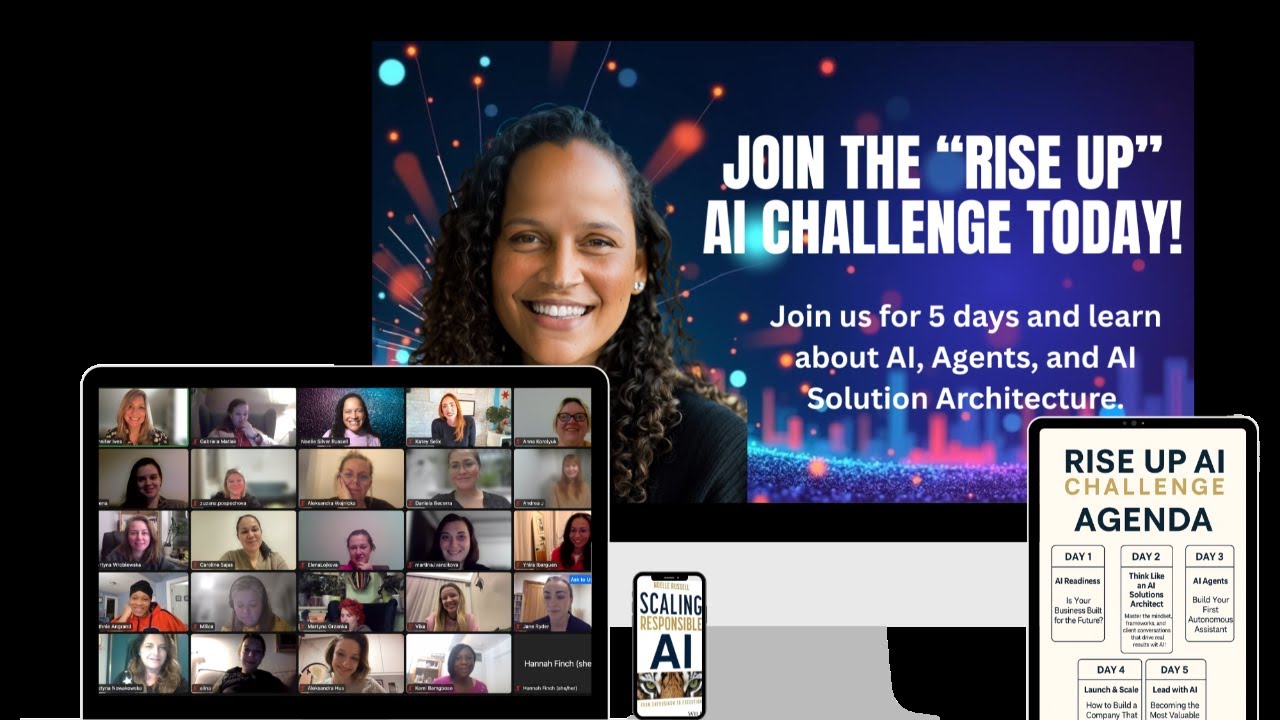
Noelle Russell teaches thought leadership in AI by building a personal brand across five content pillars: professional work, AI leadership, health, family, and community. She shares her 20-year rebranding journey and a practical workflow: pick a topic, produce three formats (blog, audio, video), then double down on whichever feels easiest. Publish consistently, even to a small audience, to build a searchable, trustworthy brand.
Chapters
Hello, my friends. What's up? Happy Fourth of July! Freedom rings! How is everybody doing today? Good to see you all. Thank you for being here. I know it's a holiday, I know, but this is fun for me, uh, and so I'm super excited. I hope you'll have some fun today as well. It is the last day of our session. Oh, good. All right, well, we got some people, but you're driving and that's okay. Just don't you know, just listen to the sound of my voice. I will try not to do anything, you know, crazy and abrupt. Um, but welcome, so glad you are here. Welcome in, welcome in. If you are here, don't forget, go ahead and say hello in the chat. You could do that. We are on, uh, 8 different platforms, so no matter what platform you're in, I hopefully will be able to see you. Um, what's up? Boston's in the house, Chicago's in the house. What's up? Good to see you. Happy Fourth. Absolutely, what a great way to spend a Fourth of July. I know my family was like, wait a second, we're not gonna like cook out. And I was like, it's raining. Um, so I understand. Uh, but those of us who are here, I'm really excited that you came to hang out with me on the 4th of July. I really— I love this holiday for so many reasons. Um, my dad is a veteran. He fought in the Vietnam War. He got a Purple Heart. Uh, he is currently still in the hospital. Hopefully he'll get out here in just a few days. But, um, but he just always reminds me, you know, he's a symbol of just, you know, freedom isn't free. And we have now a choice. Like everything we've taught this week, the reason it's called the Rise Up Challenge is that everything we're teaching here will help you level up your game, whether you're an entrepreneur or an employee, whether you are trying to grow a nonprofit organization or raise funds for a special cause. Like this technology is how you will level up that game and how you will really do more than anyone else in, in, in the world, uh, potentially. This is why we now currently are seeing, you know, some of the first, uh, companies that are single-person organizations making 7, 8-figure, 9-figure revenue numbers. Like, it is, it's incredible. But I will tell you, uh, so far we've gone on this beautiful, amazing journey together. So good to see you all. Happy Fourth, Caleb. Um, what Uh, yeah, finish. Oh yeah, that's right, I thought you were telling me you were running a marathon today, but you're right, might as well knock out this, this wonderful 5-day marathon we have been on together. It is a lot to ask of people, I understand that. It's a lot to ask people to spend, you know, not only on a holiday week, but like one— I mean, 5 to 10 hours with me, like, that's a lot. But I hope you have found it has been valuable so far today. Will be a slightly different perspective, but very much, I think, a critical part of elevating your journey as a leader in AI. Happy 4th, Kim. Good to see you. Nayasha as well. Zimbabwe's in the house. Good to see you all. I'm so glad that you are here. So let's get this party started. I just want to review for those of you who are joining us for the first time or seeing this for the first time. We are on— this is day 5 of our Rise Up AI Challenge. The first day we talked all about AI adoption. We had some incredible leaders from the AI Leadership Institute, Yuvika Sharma, Padmni Soni, both of them were here to talk to you all about how important it was to have a strategy when approaching AI. Even if you've already got a bunch of baby tiger models running around your organization, it's important to really think about how are you going to scale that adoption. And at the end of the day, it doesn't matter how cool your model is. It doesn't even matter how well it solves a problem. If you don't build trust with your users, if your users don't trust that it won't— you're not building technology that will replace them, they will reject it. They will resist it. Um, I don't know. I've got some news today, right? I don't know if you saw, uh, an organization just laid off another 9,000 people, and many of them were in the AI organization. In AI. Oh no, it's hurting my feelings. Um, so we've got some work to do. I think as a society we're going through an incredible time right now. I think the good news is that, um, that economic viability, uh, financial prosperity, abundance— it is equalizing. There is an opportunity for anyone to kind of jump into the space where they are using this technology in combination with your specific expertise in order to help organizations generate more money, save more money, just become more viable companies. And there— I mean, almost every company I talk to doesn't have a really good understanding of what to do and more importantly, how to do it safely and responsibly so that they can scale their organization over the next 5 years. I think there's a lot of very big companies that do have a lot of internal— we'll call it bloat, a lot of internal, you know, a lot of space where they're spending money where they shouldn't, maybe. Um, but I am very worried about us, you know, as a leadership, like, as leadership sits in the world. I don't know that we have the right leaders making the right decisions. Not that they're making bad decisions intentionally, not that they're malicious. I just think they don't really understand the impact of what's going to happen over the next 3 to 5 years. Here's the good news. If you are here, you're learning a skill set that you will desperately need in the future. Whether you are in transition, like I said, starting a new company, whether you're in a company and not sure about like your longevity in that company, what I'm about to tell you today will help you solidify your ground no matter where you sit. And hopefully you will find it helpful. And more importantly, hopefully you will take action starting today and actually begin using what I'm about to share with you. What's up? Elaine is here from Massachusetts. So good to see you. What's up, Detroit in the house? And of course, great to have all my friends in Chicago here as well. We have all the big cities represented. Los Angeles, awesome. Great to see you as well. Super cool. So good to have you all. Thank you for being here. So in a world where, again, I don't want to get myself in trouble, I love, or, you know, I'm a big fan of big companies. I like helping them. I like helping them move the needle forward. But I do think that we're seeing a shift in how companies are leveraging knowledge, how they're building expertise, how they're using expertise to grow their own organizations. Lots of these companies are leveraging contractors, leveraging third-party experts as consultants, as advisory counsel. And so I want to encourage you to just think about where you sit in that world. Cogs in machines, right? Like being a little cog in someone else's machine. Like at an Amazon or Microsoft. I think those days are coming to an end because being an unknowledgeable kind of coasting cog in a machine is just not— it's not the future. An AI system can be a cog, right? Like very easily. So what does that mean for redefining who you are, redefining what you think about, what you care about, what you talk about? And so that is a good segue into what we're going to talk about today. So great to see you. Yes, absolutely. Thanks for tuning in on the 4th. Oh, what? North Carolina's in the house too. So great to see you all. But yeah, I'm very excited about the opportunity that you have today to learn what I have learned over the last, we'll call it 20 years, of building a brand. Now, if you are curious, you can go back out to my YouTube channel, even my early TikToks, though I wouldn't Those early TikToks were during COVID and you know, we are all a little crazy during COVID Um, no dancing, I promise, but there might have been some lip syncing anyway. Uh, but my journey, if you go back and look at my early YouTube channel, like, I immediately realized that social media was an opportunity for me to teach what I knew, but not just teach what I knew, actually also layer in my ethics and my thought process and how I want— how I thought people would really benefit from thinking and doing. And so like 2008, 2000, I think there's some from even earlier than that, you could just see me demonstrating, like learning by doing, showing, not, you know, talking, like being someone who was a doer, not a talker, from way back. Like it's always been in my ethos. That being said, I think there are, there are truths about you that are also just consistent, that if someone looked back at who you were 20 years ago that there's maybe not— I don't know, I'm hoping that there's a shadow of who you were 20 years ago and who you are today. I'm hoping it's bigger and better than a shadow, but there are common themes of kind of who we are as an individual and who we are as a person that permeate through the decades as we acquire expertise. And what I'm going to encourage you to do is to really get in touch with that part of who you are., right? Like, how— like, did you used to, you know, have fun? Like me, I've always been a stage presenter. I've always enjoyed getting in front of lots of people and making them feel like I was talking one-on-one. That was just kind of my vibe. Like, it's always been that way. You might have the same thing. Maybe you are always a good letter writer. Maybe you were a good pen pal when you were a kid. Maybe you've always been really good at writing in a diary or a journal. Like, there are certain themes that have shown up throughout our lives that if we take a close look, will actually give us a really solid place to start when it comes to building our own thought leadership in this space. Now, I want to give you an example. I don't know how many of you know this. I hope you go back and take them. But a while ago, I don't know, during COVID I got an opportunity to be in a LinkedIn Learning class as the subject matter expert for synthesized media. I've been in a few classes since then. But this class was the first one I had ever done. And it was on deepfakes. In the media, deepfakes. We were a little bit worried at that time. There was an election year coming. There was, you know, so much misinformation around COVID and everything. I mean, it was just a big mess. So LinkedIn wanted to create a class that would tell everyone like what's real and what isn't. How do you detect a deepfake? If you go to my TikTok, some of my most viral content is on how to tell if something's real or isn't real. And that was again during A couple of them were during election cycles when people were like, is this really a politician saying this, or is this like a fake AI? Now it's a whole new world, but back then that was the concern. Well, for that, and of course that's all grounded in artificial intelligence. Now what I wanted to do was just share my perspective, right? I don't ever try to say this is how it is. I, I try very, very like specifically to not talk in kind of extremes of always and never. There are a few things in my life that I always want to do and that I never want to do. But when I'm talking about thought leadership and kind of the direction technology has taken over the last couple of decades, I don't— I have not found any value in identifying with a polarized idea. However, for example, ethics, responsible use of technology, That has always been an always thing for me, right? Like, it's permeated through what I talk about. I just don't attach myself to a very specific outcome, a very specific tool set, even a specific vendor, though I have my favorites. I don't— I, I think it's a really important characteristic to think about as you build your thought leadership that you don't want to tie yourself to anything else other than you. And what I mean by that is that After I was at IBM for 12 years, uh, after IBM I went to Red Hat, um, and during this time I was really getting into social media. This was like the 2006 to 2010 time frame, um, and I was like, I really want to build a presence. And so I created— now I've changed this name since then, but I created a name that I did all my videos and all my content under called JBoss Girl. Any of y'all remember JBoss? I mean, it's not dead. But it was quite unpopular back then because WebSphere was like Big Blue, IBM. It's ironic that they are all part of the same family now, but back then it was like IBM, Big Blue, the dark side, and then Red Hat, open source, JBoss, the light side, right? The Luke Skywalker side, Princess Leia side. Okay, so I'm all about that, right? Like, I want to be on that side. So I go from being at IBM for 12+ years, and then I jump over and start advocating for JBoss, and I loved it. So I attached my brand to JBoss. I became JBoss Girl, and every week I would publish content. JBoss Girl says this. JBoss Girl is introducing you to this technology. New feature on JBoss Portal. New feature on JBoss App Server. Like all of these different capabilities, but JBoss Girl was my brand. Now needless to say, my big lesson in that— granted, this was in 2008 and I'm just building my social media platform— needless to say, I'm like, I'm not at JBoss for— I mean, I was there 3 years. Like, I eventually left Red Hat to go to VMware because virtualization and cloud was becoming a thing, and I was chasing the cool new emerging tech. So I leave, and now I'm at VMware, and I'm like, huh. So, and I literally didn't even get it back then. I'm like, okay, so I guess now I become VMware girl, or I can't— oh, vFabric girl, I think, is what I actually named myself. Like, Noelle, for real. But I look back at myself, I'm like, you know, you're trying. Good for you, young Noelle. Like, keep going, keep going. Um, but what I learned in that time was that the only brand worth aligning yourself to is yours. That you will be excited about new products, you're going to get excited about new vendors, you're going to get excited about new opportunities. The only brand worth like embracing, putting on like a jacket, wearing like a comfy blanket, the only one is you. So when you build your brand, build it around you, what you care about. That means that I typically, when I build my per— I mean, I've recreated my brand multiple times. I've changed my name 4 times and the algorithm keeps remembering who I am. So that's good. It's aggregated it all now. But that being said, I identify like what I care about in 5 categories, and I'll encourage you to do the same thing because not everybody wants to hear you selling something all the time. As a matter of fact, dare I say, no one really wants to hear that, right? Like, people want to know what you know, what you've learned, how you've learned it, um, what makes you you, what makes you trustworthy, what makes you personal, what makes you like them., right? So I usually pick 5 categories in which I talk about on social. And if you look at all of my social— LinkedIn, TikTok, Instagram, Facebook— it's a combination of these 5 things. Now, one of them definitely is my family. However, I don't really post about my family very much for many reasons. Um, some of you know them, uh, but I don't post— like, I don't post pictures of my daughter or pictures of my, you know, my, my boys or any anything like that. But I do talk about like Max. I have lots of very successful posts where I'm talking about Max, who's my son and has Down syndrome. I do, you, I do show a picture of my whole family on every stage. So every show, so often my whole family shows up on social media, but I'm pretty selective. But the 5 things I choose to talk about, I mean, you can just guess what they are probably, but, but one of them is AI leadership and Institute. One of those is how I spend every Friday with you all on a call. How I, how I mean, that is AI Leadership Institute is both a B2C offer, meaning you all have a chance to become members of the institute and actually get certified, get aligned with the work that I'm doing at Microsoft, become a potential startup that I partner with. Like there's that part, but also on the B2B side, the business to business side, we have a set of workshops that we sell direct to businesses. Businesses, and those businesses pay a certain amount of money, and we come in and we train their whole team. But those are— they're kind of two separate product suites, if you will, to my AI Leadership Institute, my business side. So that's one of 5 things that I talk about. So every— and I try to circulate it, but sometimes I don't do it perfectly. But I basically want to talk at least about that. That's my call to action. If you do anything, I'm like, join Noelle, come join my, you know, community, all that good stuff. The next thing that I talk a lot about is mindfulness or mental health or self-care. And this ends up being— I talk a lot about doing ice baths, right? That's one of the things that my husband and I do. I just bought him a brand new one for Father's Day. Can't wait. It's not set up yet, but I'm excited for it. It's just a different shape, so it allows us to have a whole new experience, hopefully. But ice baths, infrared saunas, working out, Bikram yoga, like this whole genre of What do I do to maintain my mental clarity? That's a set of topics that I talk about. I also talk about responsible AI, not in the context of what can I sell you, but in the context of if we don't start changing things right away, we're going to be in trouble. And so I communicate about that. That's more of my, I don't know, philanthropic societal impact kind of category. I then also, as I mentioned, Right. So I have AI Leadership Institute. I have my, you know, how I maintain my sanity, my mental clarity, Responsible AI. I also talk a little bit about my family, right? And the importance of things that are happening that are not work related. And the final thing is I just try to celebrate wins, wins of myself, wins of people I know. I look for opportunities to just partner with people. And so 5th of the content that I post will be me on a stage somewhere, me doing someone else's podcast. It's— I want it to not just be about me. I want it to be about who in my circle of influence, who else can I rise up? Like, who else can I— that's kind of nice, no pun intended. Um, but who else can I lift up with me, right? Who can I bring along? And that's— I mean, it dovetails right back into AI Leadership Institute, right? Where I'm like, come join me, be part of the, the Leadership Institute so I can help raise up your voice in alignment with my platform. I mean, if I have a platform, the least I can do is help bring other voices to light with it. Um, and so I share that with you because I think it's really important that you find your own 5, right? Don't think that you have to post about the same content all the time, or it has to be work, work, work, or it has to be sell, sell, sell. If people want to know who you are when they do work with you, when they are looking for someone to work with, the first thing they're going to do is Google you the first thing they're going to do is go look you up on LinkedIn and look you up on Instagram and find out, like, who is this person? And if it's all business, they're gonna want more. They're going to want to know, like, who, who do you hang out with? What do you do? Like, what is, what is your, um, mindset? Like, how— what kind of leadership do you have? Then they're going to go to your website, they're going to look at your team, they're going to try to find out who's on your board. Like, they're going to be interested in these types of facts. So just make it easy. So find 5 topics and you probably know them. I would just brainstorm what are the things you talk about all the time and pick 5 of them. One of them should be what you do for a living, either promoting the work you do as a professional working for someone else or promoting the work you do as an entrepreneur. Either one doesn't matter. I've been doing this a long time. Um, when I worked at companies, it would promote like, hey, I just delivered this talk inside my company, or I just did this EBC. I couldn't say who I was doing it for, but I would let the world know I was doing it. Another word for this is Captain's Log. I don't know how many of you have seen this, but Captain's Log is this concept of just using social media to capture your life in progress. So you can just spend 30 seconds or 30 minutes talking about what happened today, like, oh my gosh, so here's my goals, right? I articulate, I have Captain's Log posts where I just say, here's my goals and here's what I did today. To try and accomplish those goals. Here are the things that happened that I did not expect that were negative. Here are the things that happened that were positive. I do have a, um, I was wondering why my lighting is a little bit weird. Um, I do have one thing that I do maybe that's a little bit different, which is I only tell happy stories. So you— I don't want to get caught up. I, I heard someone tell me once that criers aren't buyers. And I thought that was really funny. Um, then I don't want people to be worried about me, right? I don't want me to do a post of all the nonsense that I've been through, and I've been through some crazy stuff. I don't want to go and talk about like, here's how bad it is right now, I just got fired, I just got laid off. I like to wait. I like to have— of course, life happens to me. I have a philosophy of feel the feels. Like, if something bad happens, get laid off, get fired, you know, uh, relationship ends, whatever it is, I feel the feels, like I try to process how I'm feeling about it, but then I almost immediately try to make a plan. Like, how do I use this, right? Oprah says, from wounds to wisdom. How do I bridge that gap as soon as possible? And that's the story I choose to tell. Again, you don't have to do that, it's up to you, but that's the story I choose to tell, is the story of overcoming, right? I like to tell people like you all, right, the good news about where you are right now, if you're listening to me right now, you have overcome 100% of your bad days. 100% of them you have gotten to the other side of, right? Maybe with a smile, maybe not, but you're here. And so everything you look back on that you struggled with becomes a story you can tell, an overcoming story that is inspirational. And that's some of my best content, often is me looking back going, oh my gosh, I remember when I got pushed out of that organization and how awful that was. But then I got the best job I could have imagined right after that. Or maybe it took 6 months, right? But in that 6 months, I got to spend time with my kids and I, I searched for the optimism, right? I searched for— again, this is Noelle Russell Russell. This is my vibe. I don't want to post content that's in the messy middle, though I do post about the messy middle. I just don't do it when I'm in it. I like to have a vision of the happy ending. So I have this saying that I use all the time. It says, you know, I nourish the world and the world nourishes me. And it's not always linear, but I always get a happy ending. I always get— like, it always works out for me. That is a mantra. That is a, um, that is something, an affirmation if you choose to use that term, right? I say it every day. Like, I— and that's why I do things like this. Like, I'm not getting paid to be here with you all, right? As a matter of fact, this is like my prime time hours of doing, you know, work where I would get clients. But it— but I like doing this because I know that if I help you, right, my hope is that I'm putting out goodness into the world, I'm giving value into the world. I know that I'm gonna get that back somehow. I don't know exactly how, it's not linear. I don't give so I can get. I give and give and give, and then the world nourishes me back in all sorts of ways, and I stay open to that. And that is my philosophy. But I also know, like I said, it's not linear. But I also know that it will always work out. And now I've had some very bad days, and I've had some very kind of terrifying moments where I'm like, I don't know how this is going, I don't see how this can work out, I don't see it. And I will literally just lean back and be like, it always works out, it always works out. I have an internal belief that it always works out, and it does. If your beliefs are different, right, if your beliefs are the opposite of that I would challenge you to just try it. There's a couple of different things I want to encourage you to do today as you build out and think about building your own thought leadership platform. The first one is what I learned when I did that deepfake class for LinkedIn. There was 3— I think we were up to 3.5 million people have taken that class. My, like, deepfake class is crazy. 3.5 million learners have gone through that curriculum. It was with Ashley Kennedy. You can look it up. Ashley Kennedy. I was the subject matter expert. I've then gone on to do another one. Some of you have taken. But here's what happened during that process that really changed the way I created content. The LinkedIn editor came to me and basically said, here's the topic we're going to cover today. I want you to do this exercise. So I'm going to invite you to do the same exercise. I want you to do this exercise. I want you to take a topic that you care about. Or let's say some of you are like, I don't know what to talk about. Go to AnswerThePublic.com. Pick a topic, go to Google Trends, find out what's trending. And he said, take a topic that you want to talk about, and he's— he said, do 3 things. And he said, do all 3 things with no judgment, just do them. And the first thing was write a blog post, right? Write about it, write 500 words about that topic. He said, then put it aside. Do not judge it, do not edit it, just put it aside. He said, the second thing you're going to do is you're going to now audio record yourself talking about it like a podcast. Turn on voice notes and just talk about the thing, and then put it aside. Don't edit it, don't publish it. Like, it's just record your 500 words— in his case, he said 3 to 5 minutes— talking about that topic. And then the next, turn on your camera like I'm doing with you all today. Turn on the camera, talk to the camera, and present the information. So the first one, like you're writing for the Washington Post. The second one, like you're doing a podcast on NPR. The third one, like you getting interviewed on CNBC, right? That was the gist. So I did this exercise and I brought all 3 pieces back to him, and he didn't even look at them. He just asked me a very important question, which I leverage every single day. He was like, what of all 3 of those, which form of content caused the least amount of friction, like, in your soul, right? Like, which one did you enjoy doing the most? And for me, it's video. I love video. I actually, in my mind, I guess it's part of maybe being ADHD, but I like imagine that you all are here with me, hanging out with me. Like, this is literally how I, like, you know, I see your comments and I'm like, it just feels like we're in the same room hanging out together. And I cannot wait till the day we can. If you are in DC, you will all have a chance to be with me in person. I will give you complimentary access, um, to a, a conference that I'm going to be at next week if you're in DC. But for today, I just pretend that we're like in a conference together, we're hanging out in person. So this is a wonderful, casual, like, I don't have to prepare. I just feel like I'm talking to a friend. Not everybody feels this way. As a matter of fact, I think 77% of the United States anyway, in a survey, 75, 77% of people surveyed in the US said that they'd rather read their own eulogy than speak publicly on camera or on a stage, which— so don't do that. That would be considered friction. But you write it, and I'd encourage you, just do this anyway. You never know. But write it, say it, videotape it— videotape, you hear me, 1980s— um, record it on a camera and see which one felt the least friction. Now, the reality is, is you're going to do something that's hard, right? Talking out loud, hearing your own voice, Lots of people struggle with this. It's not about which one feels amazing. It's about which one is the least bad. And once you find the one that's the least bad, that's the medium you're going to go after. And you're going to pick one. You're not going to blog and do a podcast and do a video podcast or, you know, video education. Like, pick one mode, one modality, and focus on that. If you already have a very large following, which there are a few of you who do, if you already, you know, like Sure, maybe you start diversifying. I have lots of tools that help me diversify the type of content that I create. But I will say that primarily I lean into the format that's easiest for me. The benefit of that is that you will be more likely to build more content if you do that. And when you build more content, more people will see it. When you— more people see it, more people will engage with it. And when more people engage, you get more customers Or you are, you build a brand, a brand that companies will want to hire if that's the direction that you're going in. Um, so, oh, thanks, Caleb. Um, so this gives us, you know, a strong foundation. So now you go to Answer the Public on the topic you care about, and it gives you a bunch of questions that the public is asking. You now have a very specific modality you're going to lean into, whether it's writing, talking, or video. And now what I'm going to do is share with you a couple of tips and tools for each platform that will shift the ability for what you do to become much more impactful. Now, for those of you in VIP, we're actually going to go through the 30, 60, 90-day framework that I built for my Women in AI Leadership Masterclass that I've taught, and it allows you to Build out a 30, 60, 90-day. I also created a workbook for VIPs that you all will get access to. I published it in the, um, AI Leadership Institute community for the community members. You guys get first dibs, first access, but it is there for you as well. But what I want to do is just go through each type. So let's say some of you are writers at heart. You just find it easy. You could wake up and write a post and be done with it. Like, it, it's not a lot of friction. If you are going to write, I'm going to encourage you to do a few things. The first is you want to write two types of content. One type of content, which is kind of informational, value-driven, almost like strategy of the day. One, there's a marketer out there, his name's Alex Hormozi. And Alex Hormozi, he does Mosey Minute. Cute, right? So every day I get an email from him, or maybe every day, every other day, but I get an email from him that says the Mosey Minute takes about a minute to read. And in that case, like, that works for him, right? He also does a bunch of other content, but I was like, oh, that's a really good example. So come up with your own version of Mosey Minute. Noelle had, um, I had Noelle's Notebook where, I don't know if you can tell, there's a bunch of notebooks. They might be down there, um, but I have a bunch of notebooks, and so I would just grab a notebook off the shelf and just open it, and I would just write an email or send out a post about whatever was in that notebook because there's I have hundreds of them full of stuff that I've learned over the years. So that, that's like Noelle's thing, right? So come up with some, some mechanism that you can use. So that's the first thing is some piece of content. The other thing is to think about pillar content. Pillar content is evergreen content. It is a macro level of content versus micro content, right? The concept is what can you talk about now that would still be true 10 years from now? And things that pass this test are typically things on, um, business development, leadership, right? These types of skills have held true decade after decade after decade. So how does that leadership apply to maybe the area that you're focused on? But have some content that's pillar-based, evergreen, um, but leadership, business content, right? Relationships— how to build relationships not just with your spouse and your children, but also with your business, uh, colleagues, with your leadership, up, down, right? Sideways, lateral. So talking about these things never gets old. Um, applying it to your area of expertise will give you that differentiated content advantage. The other thing to think about, um, is health, mental health, physical health, how you, you know, that's why one of my 5, right, is me focusing on how do I just keep myself healthy, how do I maintain my own mental well-being. You could talk about that as well. These are pillar pieces of content that people will resonate with you. They will, but they won't go, they won't get old. Someone could find that on Google 5 years from now and still find value in it. And I like those pieces of content because they live longer and they get, you have a lot more runway. They take longer to build because they're usually from the heart as opposed to AI generated. Um, but really important to have both of these types of content. I usually shoot for one pillar piece of content per week and one, um, content piece per day. However, today I do 8 to 10 content pieces per day. So it's start— gotta start somewhere though, right? So start with one. Maybe you do one a week of each, um, but pick a metric that's going to be part of your 30-60-90s. You are going to have to set a target. Remember, we talked about this yesterday. You are going to have to set a target, and once you set that target, that is going to be your goal. And then what, you know, let's say you do it for a quarter, you see how it worked, and you increase that target. That's the benefit of targets. You just keep moving it further and further away so you can do more and more and more. All right. Awesome. Yes, it should be in your inbox, Angel. Yeah, it should be in your inbox. Check your inbox. If not, though, it's also— oh dear, Sherilyn, hopefully you can go into Zoom and grab the link. But I did put it— it's in the— it's in an inbox somewhere. So it's either in your inbox or we will be putting it in the calendar. This is for the VIP call. Um, we'll be putting it inside the calendar inside school. It might take a couple seconds because I might have to go and copy it over if Sherilyn can't find it for me. Um, so thank you for that question. Um, so if you're writing, that's the first thing is pick those two writing content pillars, right? Content that you can share that's not as heavyweight. Usually it's contextual, contrarian, trending topics, and then the pillar content. But then also probably More importantly, pick a platform that can elevate your message. So publish on— I don't want to like trigger anybody, uh, Substack or Medium or LinkedIn as a newsletter, right? You want to get reach. So publishing on your own personal blog that no one's currently visiting might not be the best option, right? Publish somewhere where what you post will get shared, potentially go viral. Right? So Medium, Substack, uh, or LinkedIn. I'm a LinkedIn person, so I'd rather post an article on LinkedIn than I'd post it anywhere else because LinkedIn has, you know, a lot— billions of users. And so that content has much more likelihood to grow. Um, oh no. Okay, cool. I'll make sure. Maybe I forgot to hit send. Sorry, y'all. Um, good question, good question. Uh, okay, cool. I can't believe it. Did I— no, I'm sure I sent it. Check your spam. Um, let's see. Oh, all right, awesome. I wonder what I did wrong there. Okay, so really quickly, I'm going to just, uh, check this, um, situation while we're talking. So that's the, the key, right, is to make sure that you're picking a platform to post your content on that has reach, not that's dedicated to you like your personal blog or your company's blog, but actually on a platform like LinkedIn. That being said, um, I also want you to think about, like, that's the first one. If you want to, in addition to that, think about, okay, so that's writing. The next one is audio. I don't know how many of you know this, but it's very easy to build a podcast. I have dozens of them, too many. Every time I get an idea, I'm like, oh, podcast, because I like talking, right? As maybe you can tell. So I like talking, so I use a podcast. Spotify has a free podcast platform called Spotify for Creators, and it'll allow you to build a podcast, and it will also allow you to stream that podcast to the major RSS feeds like Apple Podcasts, Google Podcasts, iHeartRadio, all of them. So it allows you— and they partnered with Riverside, so they give you the ability to very easily create a one-person production studio where you have background music, intros, outros, B-roll, and advertising. Really cool, all for free. So I would encourage you to start there. Then you can, you know, when you do that for free, then if you choose to, you know, you might improve your setup, get a good mic. I have my first podcast I started, did very, very well, um, Good Morning AI, very, very popular podcast. And I did it with like the mic on my computer, like I had no fancy things. As a matter of fact, the first time I got a fancy mic like the one you see here was it was a gift because I was a speaker at an event. They sent me a speaker gift with the lights you see shining on me and a microphone. Best gift ever. If you ever host an event, give people mics and lights, like it never gets old. So I really like it. Yeah, Raisa. VIP. Uh-oh, I see the problem. All right, let's see here. It says scheduled. What did I do? Um, I don't know when I would have scheduled it for, but let's do it immediately. Update broadcast. All right, I'm gonna see if you guys get it now. It says scheduled, but we'll see what happens. Okay, maybe it'll come in the— in your inboxes while we talk. If you get it throw a note in the chat, let me know that it's out there, uh, for you. I might even— maybe I turn off smart sending and just send it. I don't know. Um, I'm gonna give it a second and see if it, if it goes. Um, but maybe there was a reason why I couldn't get it to go. I don't know. Uh, okay, thank you for that though, let me— letting me know. All right, so we've got writing, publish, two forms of content. Make sure you do it on a platform that can go big— LinkedIn, Substack, or Medium. Video— or sorry, audio— build a podcast, do that podcast, and get it out to as many platforms as possible. It's all about reach when you're building an authority, right? You want many people. You want someone— if they Google you, you want to just pop up. You want to become Googleable or Perplexityable or OpenAIable. You want to make sure that a model or a search engine can find you. And if you don't do any of this, what ends up happening is, is that somebody is going to Google you and other people will show up. Um, or worse, nothing shows up, right? It ends up saying no one. I actually used to be, one of my names that I acquired over the years was Noelle Silver. Um, my family and I, we picked that name by the way. Uh, we just picked it and everyone acquired it and we became Silvers. No reason, no specific, well, there was a reason for it, but no reason that we picked that name. Anyway, I then had to train the model that I was now Noelle Silver instead of Noelle, my last, my other last name. And so what I did is I ended up, I built 2 podcasts and I delivered 12 episodes, which is the magic number, by the way. Do at least 12 episodes. That's where reach really starts to grow. Most people never get to 12, but less than 1% of podcast owners get over 50 episodes. So that becomes my next benchmark, right? Once I hit 12, my next one is 50. Once you hit 50, you really start to see growth. But 50, right? If you do one a day, that's months. If you do one a week, that's a year. So be aware that you may not get traction right away, but that's not the point. The point is algorithmic visibility. So, so that being said, it gives you a chance to leverage a free platform to get your words out. Now, we do have the beauty of an LLM, ChatGPT, to help you create your show schedule, right? Create content for you. Some of my best favorite podcasts are now actually holding up their phone and having a conversation with an assistant they built on a platform we talked about on Wednesday, right? They'll build an assistant specific to the topic they want to talk about. And they're like, hey, Ali from AI Leadership Institute, let's have a conversation. And I would ask it questions. It would answer it. I'd be like, well, that's not exactly right. Like, hallucinations are awesome because it gives me a chance to talk about what I know, and why I know things that even ChatGPT doesn't know. So those are really interesting, cool ideas for you to leverage if you are a voice person. The other thing you can do is audio events. So of course, I don't know if you know this, but Clubhouse is still a thing. So you could do a Clubhouse audio event, but right on LinkedIn, if you're on LinkedIn, LinkedIn also has the ability for you to um, also has the ability for you to do an audio event. All right, it's out. Um, okay, so it says completed, so I'm hoping that y'all see it. Um, all right, cool. Uh, let me find my Restream again. Hello? Hello? Oh good, yay! Okay, so some, some, something must have got stuck. Thank you for telling me though. So I'm so glad you got it. Thank you so much. Okay, cool. Patrick, what's up? Okay, good. Sorry, thank you all for replying because I was worried about it. And, uh, doing two things at once is almost impossible for for someone like myself. So thank you for working with me on that. Okay, so we've got the written form and a couple ways to blow up your content in a good way on that side. The audio form, if you don't know what to say, remember we solved that problem yesterday. Just go out to Answer the Public, or maybe it was on Solution Architect Day, but we go to Answer the Public, go to Google Trends, find out what your customers are asking. You could ask ChatGPT, but I to use sites that do this aggregation intentionally. Reddit is also a great platform to find out what people are complaining about, though I don't like to go to Reddit. Maybe you could guess why, but it tends to be a little on the negative side when I get into a rabbit hole, and I don't like to do that. So I'd rather get it a little scrubbed for me, so I go to aggregation tools like this. There's also a— oh my gosh, I don't think I can remember it, but there's also a news, um, it's called Particle. Called? No, I can't remember. Um, but there is a news channel. If you know it, please throw it in the chat. There's a, like, a news aggregator that aggregates content, and it, it's, it, it uses AI to kind of go out to different sources and aggregate it into an environment. A lot of, uh, podcasters use it to pick, pick what they're going to talk about on any given day. Um, so, oh yes, okay, great. Thanks, Angel. Yeah, so sorry, unless we're friends. So if you get an email from me, please become friends, like, add me to your contact list. I promise it's me. Um, But if you don't, it'll get stuck in promotions because they think I'm like every other digital marketer out there that's sending you an email, but I'm not. So thanks. Good. Yes, definitely. Okay, awesome. So that being said, the audio piece I think is pretty interesting. I would be remiss if I didn't mention that you do today have the option of actually using voice and not being the one who does the speaking, be the one who does the writing, who identifies the topic, but then leverage AI to not only elaborate on the topic and talk about what you want to talk about, but also use AI to be your voice. I personally appreciate talking to humans. I like listening to them. The podcasts I follow typically are like actual people. Maybe they interact with AI, but they're real people. I do like that. I can tell very easily AI-generated content, even. And, and I guess the reality is today is like people don't actually even care, right? Like they're just like, it doesn't matter because I'm pushing out enough content that I'm getting eyeballs. I don't know, I don't believe in that, but you could do that. So that's another option for you as well. I do want to share my screen and, um, oh good, it was a while since Noelle agreed with me. So thank you, Noelle, you're awesome. I'm gonna go in and share this screen, I think, or maybe Nope, this one. Okay, this is, uh, let me see if I can find— this happened to me yesterday. I have to see if I can find the screen I'm sharing now. Let's see where it is. Uh, oh, there we go. Hold on, it's so strange because it doesn't show up on my list. Oh, you know what, maybe it's tab. Hold on, I can't find it. Dang it, I did this yesterday. Sorry. All right, I'll just stop and choose a different one. Let me go here and, uh, uh, there. All right, cool. That's a good idea. And now I'll share the screen. I just want to show you what I, what I do and where these, all these different options are for yourself. I think it would be really valuable potentially for you. Um, there we go. There we go. Okay, cool. It's yellow. Can you see it? I hope you can see it. All right, awesome. So what I'm going to do really quickly is just head over to— let me go to LinkedIn just so I can show you a couple of the options for writing and for audio. Uh-oh, it says it's not sharing anymore. Yeah, that's silly. Okay, I have to choose the window. Stop sharing. It's a new platform. I'm working with it. Window. There we go. All right, share. All right, now I'm like in Inception. All right, there we go. Can you see it? Hopefully you could see it. Yeah. Okay, I'm good. Good. All right, so here we go. Um, this is some cool content, but I just want to show you on my profile some options. So when you go down here to— oh my gosh, let me make it a little bigger so you can see it. There's an option on your, in LinkedIn called Events, and there's different types of events. You can see, of course, all the events that I did. But when you create a new event, there's a couple different options, right? There is a LinkedIn Live, but also an external link event. So you could externalize it to anything, to a voice-only podcast, to a video podcast, to something that you're doing on another platform, to a live feed. So lots of other options here available to you. They used to have audio, but I guess they don't. The other thing, though, is if you're writing— I'm going to go to View Profile really quick. If you're writing and not using audio, I really do like the capabilities that are provided as part of the newsletter feature. So I'm going to go down to my content. Here. That was so cool, Gloria, by the way. That was awesome. Uh, and I'm gonna click on newsletter. I showed you newsletters yesterday, but I want to actually take you into the newsletter, uh, so that you can see— oh, that's not what I wanted. Um, so you can see how to do it. So when you say create a new article, you'll see here you have the ability inside under manage to create a newsletter. When you create a newsletter, the first newsletter that you create, if you're a writer, and even if you're not, if you're a video person, you can put your video here. You could also put your audio and just make it a clickable, uh, video as well. But when you choose Create Newsletter, the first newsletter that you create will automatically be sent to every new person who connects with you automatically. And I don't know about you, but when I connect with someone and I find out they have a newsletter, I follow it because I want to know about what they're doing and I'm interested. So, granted, I connect with lots of people, like thousands. So I have lots of— some people have newsletters, some people don't. But it's such an easy opportunity for you to extend the reach of your content to more people by just creating a LinkedIn newsletter and letting it get automatically sent to everybody you connect with. So as you all know, I have the AI Leadership Institute newsletter. I'm gonna actually go back here, um, and you can see some of the, the articles that I've written. Um, but every time— I mean, now I'm so close to 13,000, um, but I have, you know, 12,000 subscribers. The benefit of building a newsletter is, one, you automatically get subscribers when you connect to people, which I'm going to encourage you to do a lot of. And then, but two, when you do send out an article when you send a new newsletter, it goes to their inbox as opposed to just pinging them on LinkedIn. So I think that's also really huge from a benefit perspective. All right. Oh goodness, let me stop doing that. Oh good, okay, good, good. I'm gonna go back. All right, so the next thing I want to show you is Spotify for Creators. This is the podcast version. Oh boy, I must have hit it wrong, sorry. Oh, I did. I don't know what I did there, but let me just fix it. Oh boy, maybe I did it wrong. I'm just gonna look for it. Maybe it's not called that anymore. Spotifly. There it is. Yeah, so obviously I did something wrong. Um, oh, that's probably why. I'm gonna continue. Hopefully it'll automatically sign me in. Yay, it did! So you can see over here I have, um, Let me just make this a little smaller and make it a little bigger. So you can see here I have a list of, you know, over the years, all the podcasts I've created. One was on work-life harmony because of the whole work-life balance movement. My favorite is our— my new podcast with my husband. He's the man, but she's the boss. We're going to change but to and, but we've recorded quite a few podcasts together just on what it is to live with, you know, in, in the world that we live in, uh, and it's pretty interesting. Lady Coders, Lamplighter Effect, Lovefluencers. Anyway, so, but the benefit of this is, of course, the platform is 100% free. You can create as many of these as you want, um, and I'm just gonna go to the home page. Maybe I was there already, um, but it'll allow you— when you build it, it creates clips for you. It allows you to you know, look, I've had 10,000 streams and downloads. That's pretty good for not trying. Like, I'm like, yay for me! Um, you all are welcome to join and join in and look at it. And I haven't even published my newest ones with the OpenAI executives, so I'm excited, excited for this. But I just— it's one more opportunity to take what you know and surface it. Now here's where I want to just take you to the next piece, which is— oops, I don't want I want to do that. Um, oh, I think— oh, oh, let me see. Let me make sure you all can see this. Okay, could you see that already? All right, it looks like you can still see what I'm doing. Um, okay, so the next thing I want to show you is, um, not just Spotify for Creators, but a platform that I use all the time for these voices. I think I mentioned it to you in a previous one as well. Let's hope I can just log in. Oh lordy, I don't know how this is gonna go. Do do do do. Um, let's see here. Maybe I don't remember how this goes. Um, oh cool, uh, let me try it. I'll try this really quick and see if it works. Y'all are rolling with me. I don't know if that's gonna work. Oh yeah, no, this isn't the right one. But you can see here in your avatars, there's AI avatars, there's AI voices,— this isn't mine, I showed you all some of this before, but you can grab an avatar and you can grab a voice and use those voices instead of your own. Personally, I'd prefer to hear from you, but if you're scared, worried, if it's a blocker for you to get your voice into the world, do this first. Grab, you know, someone that you appreciate and, you know, use them. The reason I like HeyGen is that they actually do pay their creators to become avatars.. So I like that, like this UGC, user-generated content, like these are people that are getting paid. You can find out more about that by researching HeyGen and their philosophy on paid creators. But I don't know, I, that's my ethics. So that's why I use this platform and why I really enjoy it. Um, so the last one of course is video, as we're doing right now. So I'll just give you a couple tips on what I do before I round it out with what I'd encourage you to do what you're going to do next. So with video, there's a couple different options. Of course, you can do a video podcast. You could also, though, do as I just showed you in LinkedIn. You can use a LinkedIn Live and just LinkedIn Live allows you to just turn on your camera and start talking. And if you're in Restream, you can do fancy things, right? You can add— I'll show you some of the cool things. Restream.io is one of my favorite live streaming platforms because it allows you to add things like let's say you wanted to Join the community, right? There is a QR code for joining. I don't even know where it's going to take you. Maybe noelle.ai. I don't know. I can add music, right? Like, let's try my favorite one is Epic. So I mean, that's a little intense, actually. I'm feeling— getting my heart rate up there. But there's also, you know, design capabilities. Some of you saw the designs, uh, that you have, but I have the ability to change my own background, right? You can see it subtly in the background here. That's like a mountain scene. Um, I also have overlays. Let's see, there. Um, breaking news. That's pretty cool. I like that. I'm gonna keep that in there. I'm gonna keep that just in case. But what I like about this is, what can I— how can I use these to tools. Let me go and remove this thing really quick, my QR code. Other things you can do is add captions, right? Get into AI, 50% off, or join me in the school, or see you next time, right? So you can choreograph all this. And this is just me, right? So if I— if you see my podcast, my broadcast in the future, you know that I'm just like, I'm just playing around with these tools. I think it's important to have fun with it. It's important not to take yourself too seriously. And it's also really important to know that statistically your content is actually better the less produced it looks, right? So this is not produced. Obviously I'm adding— I've got like an image and now it says breaking news. That's pretty cool. But like, people like organic content. They like to know that you're just coming to them live from your office. Giving them like nuggets of information. The most important thing about what you say and how you say it is the value that you're giving. So be thoughtful about what you're saying, not so worried about how it's being presented, because people will hunt for what you're delivering. Now, lastly, about video, if you are a video person, I'd encourage you to think about it for one main reason, is that if you are a video person, you're going to want to promote your content on YouTube, when you promote your content or push your content to YouTube, even if no one follows you, no one like ever clicks the subscribe button, it doesn't actually matter because if someone types in the words, I look like, let's say yesterday, for example, we had like 600 people happen upon my content because I said AI for entrepreneurs. So when somebody typed into Google AI or AI mode, right? AI for entrepreneurs, my video popped up because I had the same title. So the benefit of using video is that you get to tie into one of the largest search engines in the world, and it's still, you know, it's not dead. Google's doing quite well. Their AI mode is doing very well. So we're starting to see some really interesting evolution there. But this is the same concept as locking into Medium or LinkedIn for growing your written content, or locking into Spotify for growing your audio content. "Log into YouTube to grow video." And just by creating titles that match the questions of your users will automatically increase your visibility on the platform. There's all sorts of magic you can do. This is just day one, day one, start building content. So let me give you a quick roundup as we move to VIP where I'm actually going to give you all a 30, 60, 90-day plan for how you can create your profile, I do want you to do a couple of things. One is come up with your 5, your 5 categories of content that you want to create on the platform. It should be a little bit about you, right? Who you are personally, who you are professionally, what a favorite hobby, right? A philanthropic idea, right? What, and maybe you come up with 4, it's a, it doesn't matter, but come up with like a collection of topics that you're going to talk about. This will make sure that you always have something to say, always something to share. It takes a while. It is a, you know, it's like a muscle. If you haven't used it in a while, you might be sore tomorrow. But if you— the more you use it, the stronger it gets. And here's the good news: in the beginning, no one's watching anyway. No one saw those 2008 videos of me in my basement demoing JBoss Portal. Like, no one saw those. You know, 13 people saw it, and maybe 10 of them were my mom, right? Like, what are you doing in there? Like, so Don't overthink it. Don't overthink sharing. Don't overthink putting your ideas out there. But it is thought leadership, this concept of you building out who you are, what you think about, what you care about, and saying it publicly. I wear my— what I care about, it's on my sleeve. It's on my LinkedIn. When a company comes to hire me, they know exactly who they're going to get. They know what I do. They know what I say. They know how I work because I'm transparently sharing those things intentionally on social media. So be intentional about your social media presence. I have a whole guide on how to actually grow this. I'm— I work very closely. We have a program on speaking and learning how to harness your own voice, whether it's in written, audio, or video format. But many of you know my favorite form of getting in front of potential clients or talking to customers is on stages, is actually communicating to people by getting on a stage. And it's not for everybody, though I think everybody would like it if you just gave it a chance. Um, but getting on stage one-to-many is such a powerful thing to do because number one, there is no AI for that, right? Like, it is— I actually was listening to, um, I went to a meeting and Ryan Reynolds was speaking there, and he's Ryan Reynolds, you know, the Deadpool guy, and he does other stuff, Adam Project, anyway, wide range. Um, but he said something that I thought was really impactful to me in the work that I do, which he said that, you know, there's kind of this last bastion of human, like, interaction, and it happens either in a cinema. And I had just watched Minecraft in the cinema. There's a few of us who have watched it with kids in the cinema, and it was so awesome because my kids were like yelling and screaming and singing in public in front of strangers, like in the theater. And I was like, who are, who are these people? Like, it's so cool. I love it. Same with theater. Like, I went to see Hamilton and everyone is like, you're engaged at the edge of your seat, singing along, you know, you know, yelling out no at certain points in the Broadway musical. Like So good. And I feel like you have an opportunity, should you choose to accept it, to create a similar experience when you get on a stage in front of people, because you are real, they are real, and you are sharing a space for a given period of time, and it can be magical. And it's a learned skill. You can be taught how to be engaging on stage. And so I think as we move forward, content online will always be a thing. People want to know who you are. They would love to see you. But being able to master an in-person communications, you know, strategy, an in-person way of getting on stage and talking to 100 people. I mean, imagine doing a sales meeting instead of you one-on-one with every single person you're selling, getting on a stage and talking to 300 people or 1,000 people or 10,000 people. I will be in China this August, uh, talking to 10, over 10,000 people at one time. Like, there is no better— I mean, I know some of you are probably like, ah, that sounds nervous, like, oh my gosh. Um, but I'm excited at the opportunity because I wouldn't be able to talk to those people one-on-one. It would be very difficult to scale me one-on-one to 10,000 people in a 1-hour session. Like, I get 10,000 people to hear my message in 1 hour. So that is what I hope for you. That is my goal, is that you will eventually realize that the future, as AI begins to generate a lot of this content, the more you can hone your voice on social when no one's watching, the better you can be when you're in person with people. That's going to be the most important conversations that you have. So I'll leave you with this quote from Chris— I think it's Noth. Yeah, um, he is a negotiator. Uh, he says something I saw in a, in a class that he taught once, And he says the most important thing that you can do is you can practice high-stakes skills in low-stakes environments. And what that means to me— yeah, Noelle Russell Russell— what that means to me is that you want to practice things that are really, really hard, but in an environment where no one's really watching, right? And so what better way to hone your skills than to build content? And here's what I'm going to give you. We have this community called I Love AI. You can post your content there. You can hone your voice there. You can publish. I'm not asking— do not sell in there. We don't want you to come and, you know, sell, but you can go in there and say, here's what I'm thinking. Here are my ideas. Here's a tool I'm using. You could start by just getting in a room of 1,600 people who actually already like you just because you're there. That I think is a really powerful flex that you have that no one else does. You can join. Not everyone can join this community. I, I manage everyone who joins. We've only had to ban a few people because they did not follow the rules. But if you're listening to this, you're my people. And the best thing you can do to start on your journey to getting your voice into the world is to just get your voice into the world. But maybe you're not ready to publish on Instagram or YouTube or LinkedIn. Maybe start with this really small community of people who are going to love whatever you write, no matter what. I started that way. It was super helpful to me. I wanted to give that gift to you. So start by publishing inside our I Love AI community. Get feedback. You can meet people. You can also see how other people are publishing, what's working for them. It's a really great opportunity to expand your knowledge. But the most important first step is to just— the first step. Take that step, jump in, and start sharing your ideas with the world. It's an incredibly important time for you to do that. And the world wants to hear from you right now. So super excited. Thank you for being here. We're 3:05. It's not too bad. For a holiday. I'm going to head over to VIP where I'm going to be walking you all through the 30, 60, 90-day plan. It is also going to be available to all of our I Love AI Institute community members. Don't forget, if you want to be— if you want to join, actually this week, this coming week, I decided I was— I decided to change the pricing to make it easy for people to say yes. If you want to become a member of the AI Leadership Institute, you can go over, you'll see it in a link in the chat for the AI Leadership Institute, or you can go to just noelle.ai and you'll see it there as well. You can join for just $150, like it's $150 a month. You can see if you like it, test it out. If you don't like it, no harm, no foul. But this week is going to be— it's— you have the ability to join for a monthly fee. Typically you just pay for the whole year, but I want to make it easy for for you. And especially if you're in transition and you're like trying to like— I've been there, trying to figure it out. I want to make it easy for you. The benefits though is that you're going to get the chance to become a Certified Responsible AI Leader, a Certified Solution Architect. So the Maven class that's going live, you get that as part of your fee. So that's a $2,000 class that you get for $150 a month. Like, um, and then we also will have the Certified AI Solutions Architect. We also have the certification for Agentic AI Practitioner, which comes in the Agentic AI for Beginners course. And then for those of you who do want to go big, if you sign up for the full year, you get extra access to the AI Startup Accelerator, to our platform, and you get access to my personalized tenant, meaning I'll let you into my Microsoft tenant so you can put your fingers on a keyboard and build something awesome. All I— it doesn't matter if you continue your journey with me. All I hope is that this week encouraged you to continue your journey indefinitely. Learn, be curious, and be a doer, not a talker. Start building, share what you're building with the world. And I'm really, really excited y'all spent this time with me. I hope you found it very helpful, engaging, happy. You know, I don't know. I hope you had fun. I had fun. So thanks for being here. Happy Fourth of July. Freedom. This technology will give you more freedom than you've ever had. I hope you will, you know, like, take advantage, take advantage of the opportunity and get to work. Thanks for being here, all of you. I hope you saw the link. So go to your inbox, look in promotions, check your spam, find the link, and I'll see you over in VIP. Thanks for being here, everybody. Have an amazing, amazing day and happy Fourth of July. I hope you get to enjoy some fireworks. Bye everybody. See you later. Too funny. Bye. I'm so glad. Thank you so much. Okay. See you on LinkedIn. I mean, see you on the Zoom. Okay. Bye.
More from Noelle

Take the Unlocking AI Challenge and Get the Keys to Unlocking Time and Revenue for Your Business



Don't Get Left Behind: The AI Executive Challenge #ai #business #fearofmissingout





