I ❤️ AI Q&A: How Women in AI Can Be Seen, Baby Tigers to AI Success, & Turning Dreams Into Doing
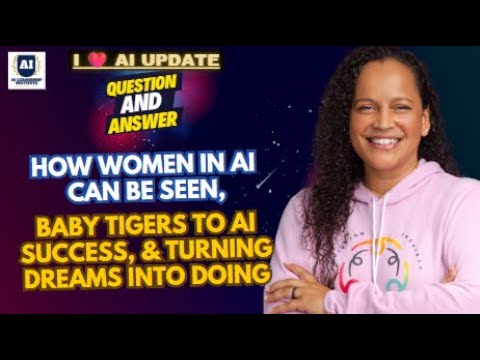
In this live, informal Q&A session Noelle Russell shares updates on her AI community, recent speaking engagements, and new content. She recaps a busy few weeks that included teaching at Harvard, MIT, and Columbia, interviewing industry leaders such as Greg Brockman and Cynthia Stoddard, and moderating panels on AI safety. She discusses the persistent invisibility of women in AI, using a marketing principle of "post as if nobody sees you" to encourage more visibility. Russell introduces her new book, Scaling Responsible AI: From Enthusiasm to Execution, which frames responsible AI as three core pillars—helpful, honest, harmless—and critiques the “baby‑tiger” mindset of adopting AI models without understanding them. She explains how to embed responsible AI into the software development lifecycle, the importance of metric‑driven model selection (citing Stanford’s HELM project), and the rise of agentic AI. She outlines the offerings of the I Love AI community and the AI Leadership Institute, including a 101 masterclass, membership benefits (access to Microsoft tools, custom‑GPT building, sales/marketing workshops), and upcoming in‑person events. Personal anecdotes about writing and publishing her book, goal‑setting, and using mixed‑reality hardware for productivity illustrate her entrepreneurial mindset. The session ends with community challenges (Funko, LEGO, Minecraft) and a call to keep the community engaged.
Chapters
live streamed, um, on every— I don't know— platform I'm on. So Facebook and, uh, LinkedIn, and I don't know where else— YouTube. Um, so we are live on YouTube right now. So just— that's another reason why I will— I will let you know, we will be in a Zoom call and we'll still live stream, but I just want to let you know that anything you say and your likeness and your picture, if it's shown, like, that's all going live on my platform. So I just want to make sure that you all are aware of that and, and interested today, it doesn't matter. But the other thing, so welcome. Hello everyone. Welcome to the amazing, super fun Fri-yay party where we in the I Love AI community come together. I get to share with you some of the things that I'm learning, things that I'm working on building and have spent some time doing this week. Also share some things that you all are doing. So that's happening inside our community and most importantly, tell you what's up and coming so you can make some hands and hopefully join us in one of our sessions very, very soon. But yeah, it was super fun. So this, this last week, to give you a bit of recap, I mean, I did so much I might have to like look up what I did on a calendar somewhere. Trying to see where, where is all my stuff? Let's see. I might have it here. I don't know. But I, yeah, I had a busy, busy week, busy couple weeks, maybe busy life. Yeah, so there is a YouTube link. Yeah. Thank you. It's a brand new hoodie. So every time I go and teach in a new location or a new city, I always, if I teach at a school, so I've taught at Harvard, I've taught at Harvard Medical School, I've taught at Columbia, I've taught at MIT. So every time I go and teach there, I buy a shirt so that when people are like, oh, did you go to MIT? I get to say, wait for it, I taught there. Or I know I was a lecturer or whatever. So it's kind of nice. And I do love the school. So I will be next Friday, I will be coming to you all live from Kansas. And as a matter of fact, next Friday I will be on site in Kansas. So I will be moving our call. So just keep an eye in the school community for the information because I'll be going to the University of Kansas to talk to them in their emerging tech conference. So super excited for that. But I'll be on stage. So in that case, I will I will be sharing a lot on social media, so please follow me on Instagram if you wanna see the story play by play, uh, as I'm at these, um, different events. That is always fun. I try to do lots of stories like, you know, before, behind the scenes, before I get on stage with my panel, just you can kind of get a sense of, of the types of things that I'm doing. But at MIT, I was invited, uh, I've actually got lots of good friends at MIT. Uh, the MIT Media Lab, they were, Really awesome. Uh, have been amazing to me over the years. They gave me an opportunity to interview Greg Brockman, and my dream was to have that, that podcast up on my podcast today, but that didn't happen. So let's hope we do it this weekend. Um, but I interviewed Greg Brockman. This was like in 2018, 2019. So it's a throwback. I was gonna do it yesterday for Throwback Thursday, but that didn't happen. So, um, I will, uh, post that, but it's a throwback, but it's super cool cuz we were talking about early GPT models. And the future that we saw coming. And it's just a really interesting perspective. I also have, um, an interview I did with Cynthia Stoddard, who's the, uh, CIO over at Adobe. And so that'll be going live next week. Uh, and oh, and then I did two CES, uh, moderations, one a year ago. So not the one I just did in January, the year before, like last year, 2024 CES. I got a chance to speak on stage with May Ryder. She's, or May Ryder, May Habib, who's the CEO of Ryder. I mean, she might not be offended that I did that because that's her baby too. But, um, but Maya Beeb from Ryder, um, and, uh, Dimitri, who is the, uh, he is the undersecretary to the Department of Homeland Security. And it was such a fascinating conversation. Like, I get goosebumps just thinking about like the things we talked about. So I done, I have those podcasts ready to upload. Um, so you, you'll have some fun things to think about. And, and the podcast is called Good Morning AI, and you can find it in anywhere podcasts are playing. You can also see, uh, it on my YouTube channel in the podcast area. So hopefully you'll take a look at that. But welcome. I hope you're enjoying Friday and you are not letting the world of AI completely consume all the things that you are doing, saying, and living. But I will share with you, uh, some of the things, the reasons that I am excited about kind of some of the events that I've been a part of. So prior to going to MIT, I was at a Women in AI event And here is, I think, kind of the sad truth. When I was invited to that event because the woman who was organizing it said there are no women in AI, um, and that there are no women on stages in AI, uh, and I would imagine she did some kind of search where I didn't show up. So this goes to show like, um, I, there's a principle in marketing that I've come to know and love that's, uh, basically believe like, kind of think to yourself when you post something, just assume no one sees it. Presume nobody sees it. Um, like keep posting as if nobody sees your content that you were trying to get at. Because I post and I kind of feel like I've got good presence. You know, I had a good nice post that, uh, lots of you, uh, were part of this week about my book. Um, but like I should just assume no one sees it because this woman was talking as if she didn't know any of— I know amazing women in AI, like lots of them. I would say a room full of them at least. And so to realize that there are some women in their careers that feel like they are completely alone, that made me be like, we need to get out there more. We need to let people know. So amazing. Oh yeah, thank you. That is my podcast, but you could also Google my podcast and you'll find it on Apple Podcasts and all of that as well. Google Podcasts, Audible, Spotify podcast anyway. So thank you, Sherilyn, for posting that. And, and of course, hello, Andrea. Nice to see you. I'll say hello to my friends. Great to have you all here. So good. So if you are here and you want me to know that you are here, don't forget to give me a shout out in the chat so I can say something nice about you all and, and recognize that you are here. Otherwise, I don't know because you're, you know, not in the chat and I'm only looking at the chat right now. So hopefully you'll say hi. Oh, yay. Hello, Tara. Awesome. Um, so amazing. So as you, uh, if you have any questions, don't forget there is, for those of you who are not, you know, streaming, uh, on my streaming side, if you are in the Zoom, and any one of you can be, but if you're in the Zoom call, you can either throw it in the Q&A and I'll try and answer it as I see it. Otherwise, to ensure it doesn't get forgotten, put it in the Q&A section of the webinar, and that would be, uh, amazing. Yes, and also Joe started the fanfare. This is a chance. This is what's going to change next week. Um, right now in these calls, there's an amazing opportunity to meet other like-minded professionals, people that are ahead of you, people that are slightly behind you. Like, just a great opportunity to, to meet with people on a similar journey at different stages of that journey. And so often we encourage you to throw the LinkedIn in, into the Zoom so you can, you know, I don't encourage you to go like get distracted by it, but open up all the links and then just go and look at them later and connect with people and create real relationships. It's really important. Many of the members of this community and our AI Leadership Institute members, they end up, you know, getting on calls with people and providing guidance or being guided. Like, it's just such a wonderful virtuous cycle. So, uh, don't forget to do that. But next week when you join this call, we are actually gonna be saving 15 minutes of the call to do several rounds of 3-minute one-to-one networking with members of the audience. So you'll go through 3 different rounds where hopefully you won't get the same person twice. I'm gonna do my best. But it'll allow you to just pair off. I will pair you off into a breakout room, and you'll get a chance for just 3 minutes each to just share a little bit about who you are and what you do. I think it would be amazing. And so that's gonna be a fun thing that we add to our community just so that it's not just, of course, me talking, but more we all share our experiences, our ideas, our journeys together. So the I Love AI community, it was created over a year ago. In an effort to take the enthusiasm and excitement I have about this technology, my desire to put my fingers on a keyboard and build stuff, to harness that in a way that could get more people involved, more, give more people opportunity to see and understand kind of the world through my eyes. And so that's why, you know, you're hearing this, or if you're in the community, many of you saw me speak on a stage, or I connected to you on LinkedIn and invited you. So that is why it was created, was to give you a— and in the classroom, when you go through, you'll see there's an onboarding in the classroom. So you go through the onboarding, it's 7 days. The goal of that onboarding is to get you engaged in the community and realize you have lots of amazing people here that are willing to help you on your journey. But the second thing is that I also host an AI Leadership Masterclass, and it has basically what I consider kind of 101 on AI and responsible AI, and it sets you up for all the other content that we do. There is also, of course, an upgrade path for those of you who are in the I Love AI community. You can upgrade to become a member of the AI Leadership Institute. And nowadays is like so much cool stuff you can do in there. If you're a startup, you get access to an AI-powered sales and marketing platform. If you are a professional, you get access to my Microsoft tenant so you can hone your skills and build Microsoft solutions. I haven't built one for AWS and Google, but maybe I will. But right now, Microsoft has plenty of tools for us to learn. And, and I do feel like I I'm very, I'm certified on these platforms. They're very similar. Learn it on one and you can pretty much figure it out on all of them. But what's different about what we do here is literally learning by doing, like putting your fingers on a keyboard and build something awesome. Like that is, that's the mode, that's the vibe. And so hopefully if you are looking for a place to do that, hopefully you'll upgrade and become part of our, our membership. And if you want to have a call and talk about it, just send me a message and we can hop on a call and I can tell you all the amazing things that our members get. So that being said, one of the cool things that happened this week, so Tuesday night I'm at the Women in AI event. I get to speak with one of my good friends, Seema Alexander. She is fantastic. Look her up, Seema Alexander. She's out of DC. She is one of the, uh, co-chairs of the DC Startup and Tech Week in DC. This huge event, you know, tens of thousands of people. And then, but she also of course is leading a startup that is doing incredible work in this space. So really great person to know. So she was here in my town in Miami, so that was really fun. And then I headed right from there to MIT. And when I was in at MIT, I had an opportunity to be in, and I think this is important for you all to know, the woman who was hosting, moderating the panel, she told me that she had to fight for this panel to exist. And the panel was on like AI AI safety. Like, what, what direction are we going in? Are we doing the right things? And this is true if you go and look at like AI conferences and, you know, all of these conferences and you look, or even ChatGPT the program, and put it into a model. If you look at how many pieces of content, how many sessions are dedicated to AI safety, you would be, I think, I was surprised at how few sessions talk about responsibility and safety. Um, that they're often very niche and they're titled in a way that don't attract everyone. I remember talking, I was at, what was it? Podcast. There's a big podcast conference that I got to speak at. And when I was there, we were talking about algorithmic bias in podcasting. And like, and from a safety perspective, like I'll give you one of the examples, right? We were talking about advertising and I as a Latina, right? Like I post things and I might say something about Latinas and AI. And when, when I, I don't get to choose the ad roll, right? When I say, hey Spotify, I'd like to add ads to my podcast, I don't get to choose who they are. I don't get to say I want this company and this company. I only want Prada and Coach. Like, I don't get to say that. They pick and they pick it based, based on an algorithm. And that algorithm is intensely biased because if they see, like, if they see certain patterns, like, I'm a Latina. My sponsors, even though I was talking about high value, high levels of professionals, the average income is pretty high for the people that listen to my content. They put like, you know, McDonald's, Taco Bell, like those were the kind of commercials that were coming out. I was like, yeah, but, but that, that guy over there, they got AG1 or Active Greens and and they got, you know, Porsche. Like, I want, I want the, I want high-level brands. And they're like, oh no, I mean, these brands are automatically selected. Are they though? Maybe they are, but let's look at that. Um, and I saw it in the clients that I was talking to, is that they would be, if they published something and there was anything about their title, their name that indicated any marginalized community, they got very low-income low, like kind of lower class society driven brands. And I just thought that was so fascinating because obviously, what do you know about what I'm going to say or who I want to target? Like, it was fascinating. And so this algorithm bias was a really big thing. But I was the— I was a— I was one session. And when people came, they came because they saw my name and they're like, oh, Noelle, I want to go see Noelle. And then when I finished, they would come up and be like, like, you need to like get this everywhere. Like, why aren't you talking about this more broadly? And I was like, ah, these— not every conference wants to talk about those things. Um, so that is, I think, a really important, you know, concept to think about is like safety. Like, look at these— first of all, use your voice and add feedback to conference agendas and be like, hey, I'd like to see more on responsible AI. What I've done to accommodate this though is I basically weave of responsible AI into everything I say. It's like I, some of you have heard me say this, it's like not a raisin in a bun or a chocolate chip in a muffin. It's like water in a wave. It's intrinsic into how we build software, how we build AI solutions. But it still doesn't hurt to have content that says, by the way, AI safety is a thing and you could do this. This is a practice you can adopt in your organization. That serves as a good segue. I ended up from MIT doing another event, FemTech Live on LinkedIn, LinkedIn yesterday. I invited a bunch of people from the community, so thank you all for showing up. And that was about similarly, not, you know, not necessarily, I guess it was about responsible AI, but really it was more about like, how do we make sure as female professionals, you know, where are the opportunities? Where, what, what kind of jobs could I get? What kind of roles might I apply to? What kind of areas in industry is there a gap that maybe my consultancy can fill? So that was a really good and fun session as well. You can probably catch the replay on LinkedIn if you want to look it up. It was called FemTech Lounge, so you could do that as well. Yes, water in the wave, exactly. So that being said, of course my book came out 18 days ago. So for those of you who haven't received it yet, I did have a little logistical snafu where a bunch of books were shipped to my house instead of your house, so I'm working through that right now. Like a lot. Um, so I'm working through that. I'm down to where they do not touch the ceiling, so that's good news. Um, but I have a little bunch of books right there that I need to ship this weekend, so you'll get them shortly. Uh, so that's good news. As a result of that, I am actually going to be launching an author-led book study on Maven, um, where we're going to go through the books chapter by chapter. I'll give you the backstory of what I did and how I did it um, and why I wrote the things that I wrote. Because obviously everything I think did not end up in this book. Um, I was edited, as tends to happen in these things. So there's a lot of fun things that I wish I could have talked about but didn't make it to the— you know, got lost on the cutting room floor. So, um, absolutely. So because— thank you, Joe, for saying that— as a result of like the debacle that is my logistical nightmare of books, I now get to sign them. So that's exciting. So if you don't have a book yet and you ordered it for me, um, yeah, you, you will get a signed copy. So I'm signing every book that leaves my house. Uh, so that's cool. Yeah, so that's cool. Um, it wasn't going to be that way because I was sending them direct from the, you know, the manufacturer or whatever, the, the book publisher. But, but yeah, so now that I get them, I get to send 7,500 of my friends signed copies. Um, but super exciting. I'm really, really excited. For it. So I'm glad. Thank you, Joe, for saying that because it makes me feel like it wasn't a total disaster that that happened. I was pretty stressed about it. You all don't see me stressed because I don't come on, on camera when, when I'm like that. But wow, I was like freaking out a bit when every, like every day more books would show up. I'm like, what is happening right now? Um, but it's all good. It's all good. We fixed the problem. So now that's not happening anymore. But for those of you who got caught in that, thank you for your patience and you'll get a special signed copy as a, um, result. Um, oh my gosh, cool. Of course, Andrea. Yes. Um, Andrea, are you in our AI Leadership? So everyone in the AI Leadership Institute also gets a signed copy. That is part of the, uh, benefit of being a member. So if you are in that community, you definitely get a signed copy. But otherwise, just ping me. Of course, I'd be happy to send you a signed copy. And then what I usually do is I'll send you a signed copy and then you could just gift another copy that's not signed to a friend or a stranger for that matter. Or to your local library. Oh, we should do that. We should do that. Um, anyway, really cool. Uh, but yeah, so I'm gonna do an author-led, uh, uh, basically book study. We're gonna go through it all. Uh, it'll be, it'll be 7 weeks long cuz it's 14 chapters. We're gonna cover a couple chapters every, uh, every session. Um, and it's live Q&A. It'll be just like this on a Zoom call except it won't be webinar style. It'll be Zoom style. So you can get on camera, you can talk to me, ask questions. It'll be really fun. Um, it will be like a book study because when we read this, like when you all read my words, different things are gonna happen for you, right? You're gonna think of different things. You're gonna apply it to different use cases. You're gonna have different industries. And I feel like, wow, we would have a really good time if we all got together and, and talked about this book. So, so that'll be on Maven. You'll see that invite come out. If you're in the AI Leadership Institute, you get to do that, um, for free as part of your membership. So it's not free cuz you paid to be part of the membership, but but it is included in your membership, that book study. But for those of you who are not part of the membership yet, don't want to be for whatever reason, you could just join, um, that. Uh, so thank you, Don, uh, for the question. Yeah, so this is the book. This is what it looks like. Isn't it beautiful? They did such a good job. Thank you to Wiley. They did such a good job with the COVID Like when I saw it, I got teary-eyed cuz I was like, it's exactly what I envisioned in my mind. I could get teary-eyed right now. Um, So, uh, it's called Scaling Responsible AI: From Enthusiasm to Execution. And so what inspired me was, and you'll see this in the book, I break the book up into two sections. One I call Day One or the hype cycle, and the other I call Day Two or like playground to, you know, production or execution. And so the subtitle is From Enthusiasm to Execution, which is just Noelle, that's my keynote title. Um, and I wrote this book because so many companies were adopting baby tigers. Which I talk about all the time, right? You've heard me say this, but they're adopting these baby tigers, these baby models, and they have no idea what they're building. They don't ask any questions. They're just like, this is awesome and I love it. And oh my gosh, look at what it can do. And can I just take a moment to talk about agentic AI? Like, I'm just gonna get real with you all. I, I was talking about this. I care. I think I was on a client call and, uh, we were talking about like, we are not great at the olden days. This was called enterprise integration where someone like myself would come in and I would connect two of your systems together so they could talk your ERP system to your CRM or your web application to your database. Like I would integrate the system and I would, I would hardcode them. Like I would write software to connect the systems together. It was called enterprise integration. Um, and I was an enterprise integration architect and I love that work because I liked making, you know, when I come in they're like, it's not possible. And I leave and they're like, I can't believe it's possible. So I love that. I enjoyed it. But we, right now, as a society in the world of tech, we're not great at integrating these systems together. We don't fully understand the inputs. We don't fully understand the outputs. We don't know what happens when they break. And so fast forward to today, and we are all talking about agentic AI. And this is why I'm gonna encourage you to take our new class, the Agentic AI for Beginners course on Maven. But agentic AI is an acceleration of this idea that we are going to take systems that have inputs and outputs and we are gonna orchestrate them together to communicate asynchronously. I have not met many, there are some, but I have not met many companies that have understood the systems well enough to put them on autopilot. And so I'm just like, right now I get called in, like, Tiger team style, no pun intended, uh, SWAT team style to come in and save organizations when integrations go wrong. And that's when we've manually built them. What happens in a world where we are all starting to build systems we don't fully understand, cuz we're using our human language to build them. We don't know the code, we don't know the infrastructure, we don't know the experience that we're designing and we're putting them, you know, some of you in the community, I posted a video of using N8n to build a really cool a calendar inquisition tool. Like, I could just ask my calendar what's up, what's going on, what my next meeting is, when I'm meeting with a certain person next, and an LLM would integrate to my calendar and tell me those details. And, and of course I'm like, ooh, what else could I do? You know, like, you get all these ideas. But yeah, like, I'm a little bit worried that in the spirit— I mean, talk about baby tigers. Now you're not adopting a single baby tiger, you're like getting a whole cardboard box full of baby At the same time, they all do different things, behave in different ways, have different propensities to behave badly. And we barely understand what it looks like when we build it ourselves. Now we're going to buy these things en masse, collected and autonomous? Like, I'm feeling a little, you know, visceral reaction to thinking about a world that does that. So that's why the timing of this book, I think, could not be better, right? Like, I wrote it I wrote it 2 years ago. Um, and it's based on the keynotes I've been doing for over a decade. But I'm so— it's fascinating. You know, some of us, we do things and we don't know why. Like, why is it taking so long? You know, I was very frustrated with the process, but it came out this— at this time because I do think like in the world of agentic AI, that's literally what we need, what we're doing. We're scaling businesses and responsible AI is literally the paradigm shift in an organization to think, think, hmm, how might I do this safer? There's 3 Hs that I learned at Stanford. I'm sure it might not be original to them, but how do I make sure my systems, even autonomous systems, even agentic systems, how do I make sure that the entire holistic experience is helpful, is harmless, right? Is— wait, what's the third? Anyone? I'll ask you all. Helpful. Harmless. I'm like, hopeful, that's not it, right? Helpful, harmless, those are the two that I care about the most, I guess. Um, anyway, holistic, no. Um, someone could Google it. Uh, but I actually even created a website, like I have this URL where it's like helpful— I can't remember what it means. Anyway, this is what goes to show, like that's the human brain. If I was an LLM, If I was a deepfake right now, I would know that off the top of my head. But I'm not a deepfake. I'm human. But like, how do you make sure that your systems aren't going to hurt anybody, right? That they're not going to— like, you're not going to build a system that infringes on the rights of the very people you're trying to help in finance or in healthcare or in retail. I remember, you know, just anecdotally remembering— do you all remember that That case study of the car dealership where they sold a car for a dollar because their chatbot like was like, yeah, sure, a dollar sounds reasonable. And they sold it. Honest. Yes. Thank you, Joe. Thank you. Honest. I guess I kind of was thinking about that in like helpful, but yeah, accuracy, accuracy, helpful, harmless, and honest. And those three Like, that sounds pretty simple, but like when you go and dive into each one of those three, those are architectural choices that you're gonna make. Honesty, how are you gonna manage accuracy in your system, right? RAG, Retrieval Augmented Generation, creating cognitive caching. I talked about all of this in our call earlier today, like cognitive caching, um, using prompt shields, right? Content safety, red teaming agents, like All of that kind of binds into that honesty piece, you know, like harmful, like that, like fairness, you know, again, all those pieces. Like there are systems that you will need to put in place. And I say systems plural that you'll need to put in place in order to make sure that your systems are helpful, harmless, and honest. Um, like, so I just, and so this book in my mind, I'm like, could not be a better time. So we'll go through a book study. I hope you all can join us. You'll see it promoted in the community. You'll also see it on LinkedIn. Um, I think it'll be fun and it is the manifestation of a dream that I had that I would write a book and then do a book study and people would come and it would be fun. So I'm doing it, living the dream as they say. Um, so that being said, I always do, uh, like to teach something, uh, in our, our time together. I did po— I did a post on the book. Uh, we did hit the new and notable section of Barnes Noble. Many of you, you might know or might not know. Um, but I, I always tell people I graduated from the University of Barnes Noble because that's where I learned to to code. It's where I learned Java. It's where I learned TCP/IP. I would go to Barnes Noble, like, early, early in my career, and, and I would go to the tech section, which was vast back then, and I would grab a book. And these books were crazy expensive, like, for me at that time, $79 for a book. So I couldn't just, you know, buy $500 worth of books in order to learn a topic. So I would grab books and I'd buy one, but I would buy, you know, I would go and I would take the ones I can't afford, and I would just go to the cafe and I would learn. I'd bring my computer, I would do the labs in those books. That's why I love doing labs and books, being practical. I think that's the difference probably with this book than what you'd see in others, is that at the end of every chapter I try to think, what did I do with clients? Like, what questions did I ask? What did I wish that they did more of? I'm in chapter 1 right now, like Lead AI, and this is what we're going to do in the book study, is actually just go through all the questions that I asked. So So some of the reflection questions from chapter 1 is, how can you incorporate ethical considerations into every stage of development? Like, how does that become a thing in a world where we're not saying words like DEI or inclusion or equity, right? Some of us are saying it, don't get me wrong. But like, in a world where, let's say, you care about federal funding, or you— and they do. So many organizations do. So many organizations have changed the name of initiatives due to the political climate we're in. And whatever decision you make there doesn't change the choices you have to make about how you're gonna build stuff. That's why I say it's like water in a wave. Like, it has to become intrinsic. You have to weave responsibility into the fabric of your technology. Because another thing I often say is like, you're one acquisition away from the Death Star, right? Like, what happens if you build something and you build it as nobly as possible, you assign a whole team to accuracy review, and then it and it gets acquired and they fire that team? How do you build accuracy review into the fabric of the solution? That is kind of the kinds of questions that I'm asking. Like, you have to think differently now because you don't— you're not gonna just buy the latest checklist. You're not even gonna use the latest agent. Like, you need to have a kind of philosophical shift in your organization to understand, like, these are the types of questions you have to ask and solve for. Another question is, um, in what ways can inclusive design improve the effectiveness of AI systems. And so in this chapter, I talk about how passionate I am about designing for inclusivity and that when you, you know, I have a phrase that I use that's not original to me. It's part of like the accessibility industry, but never build for them without them, right? Never build for a community or for even a business problem without the people who truly understand that business problem right alongside you from the beginning. So what would it take for you to do that? Does it mean you're gonna go slower? Does it mean that you're gonna have more people? Like, how are you gonna manage a world where you're building a system that's gonna serve more people than you ever thought possible? Um, and so I like that approach. I, I, every, most of the books that I are in here that I love and have read more than once, all of them have these like questions at the end, like 5 or 6 questions that make you think practically, how does this work? Like, how am I gonna figure this out? And I would encourage you, whether you are in a company as a professional, whether you are an entrepreneur, like that you actually think through it. Like, this is what I do. Like, I, I have a spiral notebook and I just write out what I would do, how I would think about it. Because when you are interviewing for someone or, or for a role, or whether you are, you know, uh, in a conversation with a future potential client, you want to have thought through these things. Like, do you have to have done it for an external client and gotten a Google review? No, but you do want to have thought through it. And even if you can, Document your thinking, right? Like build out the deliverables that you would have de— delivered for a client. Storm in GitHub. It's as good like this. I don't know how many of you know this, but like cognitive rehearsal is a research-backed thing. Like it is extremely valuable. It can generate exponential improvement on your current ways of doing just by thinking through it, but not just like, you know, closing your eyes and imagining you shooting free throws. Like, it's actually thinking through the mechanics, thinking through, like, going through this process, cognitively rehearsing the thing that you wanna do. So I encourage you when you get the book to go through these questions and cognitively rehearse if you were the CAIO, if you were the chief AI officer, if you were the head of data and head of AI, how would you actually do it? And this is what we're gonna do. Not, uh, we'll, we'll be doing some of that, uh, in the book study. We'll definitely go through the questions, but this rehearsal of real projects projects we're actually doing inside the AI Leadership Institute, which should be fun. Yes, it's so good. And so I am a big believer, uh, you'll see I've got a couple of awards in the metaverse world. It's not dead. No, whoever said that, um, no, I'm just kidding. Nobody said that, but it's not dead. Uh, the metaverse is alive and well. Uh, of course my children play, are in the metaverse every single day. Um, and I like, I like what it does, like what the environment that it provides to them. But rather than call it the metaverse, maybe we call it augmented reality or virtual reality, whatever term, you know, uh, what is the term Microsoft uses? Multi— not multimedia, it's like, um, anyway, something mixed reality, mixed reality. So they use a term called mixed reality, which is both augmented and immersive. Um, so I have an Oculus Pro. I put it— I like when I put it on, I use a platform called Immersed. They're actually, they've got visors that are like, I don't know if y'all remember like those Oakleys, they kind of look like the big Oakleys that I would never wanna wear. But, but they're, the form factor is improving. And I put that visor on, in my case I put my Oculus Pro on and I now get to connect all of my systems in a single at-the-glass display. So I have my MacBook Pro, I have my Surface, um, Design Studio, up. I also have my, uh, PC, my Copilot PC, like all of them, all their displays are up and it uses pass-through. So it has a camera on the, on the outside. So when I start typing, it sees my fingers on my Logitech keyboard and it replicates my typing in, in the environment. So I can go, I don't know how many, I did this before, but I used to use a piece of software that I'd install on all my computers so I could literally go from Mac Mac to OS to Linux, and I could just move my mouse across all the machines at the same time. It has, it has its own challenges, but being able to do that in the metaverse gives me such capability to do so many things across platforms, um, with all of the, you know, all of the different things that I'm working on give me a vis— like a level of visibility that I've just not been able to, to achieve easily other ways. So I think thinking about that, um, the metaverse, augmented reality, like all of these are AI plays, right? I ran the AI I ran the AI portion of the Mixed Reality Airlift at Microsoft a few years ago, and it was interesting to me 'cause I'm talking to people who are building mixed reality environments like Metaverse or Roblox, right? Building out Roblox, and they're not thinking about using models, like applied models. That was not even in the realm of— they were doing everything AutoCAD, you know, like style. Like they were building everything from scratch. And I was like, what if you wanted to, like one of them, let's say it's Roblox and your job is to,, you know, build a stack of blocks. I was like, oh, you know, you could just add in voice. Like you can add in an applied AI model. It's already created. It's just an API call. And you now let people, instead of just using their fingers to move stuff, and I don't know if you remember the days of HoloLens and the days of early Oculus where you had to do very, first you couldn't use your hands, you had to use controllers, or if you did use your hands, you had to do certain pinching like motion. It was it was just not very user-friendly. But now that's all gotten better. So now I literally can put my hand in front, I can type on a keyboard, I can move things around, and most importantly, I can use my voice. I can say, move that block, or take me to the next room, or talk to this person, um, and it'll open up my mic and my camera. Like, it's, it's incredible. And all of this is through the power of AI. So now I've said this to many of you as you've taken my classes, it's really important to think about about who are you plus AI. Like, what do you do right now? Have clarity on like, what do you do? What do you care about? What is like, what line of business are you focused on? What functional area are you passionate about? What industry do you, are you interested in? And what, how can you use AI to accelerate all the things that you do, that you care about, that you write about? Um, I think that's really, really interesting. Oh yeah, right. It's, it, well, it's true for some people. Uh, some people still have the Rift because right after the Rift came the Quest, right? And so, Um, yeah, people still have it. It's just like now I have a Pro. They don't even make the Pro. Last like 8 months in market and they stopped making it. I was like, uh, uh, okay. So that's, yeah, that's the reality of these things. And of course the good news is I do think it was really good for Apple to get in the game and the Apple Studio, what are they called? The Apple Vision Pros. Um, their price point hopefully will change, but here's the sad news is that they have enough customers. Said. There's no incentive for them to lower that price, sadly. Um, but like the visor from Immersed that connects to the Oculus Horizon environment, like $700, like that's accessible for people. Anyway, um, okay, cool. Let's see. All right, so what I wanted to do though is just— I think I showed you a little bit from chapter 1, but I want to just, uh, pick a section. I'm just going to flip through. I'm going to flip through the front. I did this with our team at AI Leadership Institute in the earlier call, and I was like, oops, I picked a really deep concept. So I'm just gonna scan to the front here. Actually have it right here. Oh, nice. Ah, it's a good segue. So responsible AI is the intentional development of AI systems to ensure that these systems are— I should have read this first— helpful, honest, and harmless. This includes ensuring that these systems are transparent, explainable, fair, scalable, and trustworthy. Many times people ask me, you know, you say something like responsible AI and it's really like, it's a very vague word, right? What does that mean? Is it ethical? Notice nowhere in that did I say ethics because I have worked for these companies, Microsoft, Amazon, Google, you know, not— I was Google as a contractor. Um, I just, I talk, I work with these companies and IBM, um, And it's, it's not my ethics that gets to make the decisions, right? When I'm working on a project, it's my leadership's ethics. And I actually think we're in a good spot right now. We've got like NVIDIA CEO, IBM CEO, Microsoft CEO, right? Satya Nadella. We've got some good leaders that are good people, right? Like I am such a fan of Satya Nadella. I, it's the only reason I went to work for Microsoft. Microsoft used to be on my do not fly list. Like do not fly at that. Do no go. Um, but he became the CEO and things started to change there. It's not completely changed even yet, but, but things started to change and I really was like, okay, this I can get behind. Um, but that leadership, right? Like, I don't know, I can't count on— that's one of the reasons why I started my own company is like, I can't— ethics is not a lever I can pull in a company I don't own. So, but what can I pull? Responsibility, accountability, tangible metric-driven in like services. So I'm at, again, like ethics is hard, but transparency I can measure, right? Explainability I can measure. Fairness I can even measure. Accuracy I can measure, right? Honesty I can measure that. So now I look as someone who has worked inside companies, if I'm working inside a company or working with a model I don't own, I look for things that I can measure the outcome for. And that's why I'm such a fan. Many of you know I didn't make it into this book, but, uh, a couple of our members of the AI Leadership Institute, Yuvika and Padmini and I, are writing a book on, uh, custom GPTs. It's actually specifically OpenAI's GPT builder. And so when you build a custom GPT, I'm such a fan of it. I'm like, why wouldn't everybody build a custom GPT? Because it allows you to custom train a model for a specific task. Ask with your words. Like, you don't have to write any code, and it's hosted on a platform, and OpenAI pays for all of the infrastructure. So it's a really powerful tool. But, you know, like, with that, like, building a custom GPT or any of these things, I think it's really important that you have a way to measure the effectiveness of those systems. When you use a model like OpenAI, I want to know, like, how— what is its propensity? Is that the word? Yeah. Like, to to be accurate? Like, is it more likely to be accurate or inaccurate? Does it have a tendency to be sexist or racist? Does it promote self-harm? Does it, you know, like there's, you know, I don't know, 50 different metrics that I'd be interested in a model. So the project at Stanford that I care a lot about is HELM. And HELM, that project, the, the, the HELM project stands for Holistic Evaluation of Language Models. And while they don't analyze all of them, One, they analyze the most popular. So it's good to kind of see who's in the leaderboard for certain metrics, right? If that's the thing you care about the most. But they also created a Helm Lite that you can download onto your own machine and use to measure models that you're downloading open source. So now as I, you know, you've been knighted Responsible AI Leaders, you don't just adopt a baby tiger, like you don't just go grab a model off the shelf. You evaluate a model, you select a model based on knowledge of their metric-driven accordance with these principles, and you don't have to do it by yourself. You can adopt, you can go to, to, uh, to Helm from Stanford and use it. Yes, yes. Oh yes, exactly, exactly. Um, so there's a question, in my opinion, uh, Is there a difference between trustworthy and responsible AI? No. I think responsible AI got a little bit of a bad rap because people built responsible practices that didn't do anything. So when people thought of responsible AI, they thought strategy or even worse, checklists, process. They didn't think of like this really organizational shift that would have to happen in order to build responsibly, that responsible AI is embedded in every phase of the development lifecycle. So some of you know the term SDLC, right? The software development lifecycle. And very broadly, it stands for, you know, like, you start first by identifying the problem, and then once you have— which is a requirements gathering session, right? What are the— what's the problem we're trying to solve? So requirements gathering, and then designing, and then developing, and then testing. Testing, and then deploying, monitoring, and then it starts over. So that's the life cycle of a typical software project. It shifts a little bit with artificial intelligence, but I think you can follow the same guidelines, is that there's a phase when you're trying to figure out what problem am I solving. And then once you've— once you have identified the problem, you can figure out, well, what data do I need or do I have that can solve problem. And then once you've got that, you can go to the next stage of the lifecycle, which is model selection. Now that I know the problem and the data, what model will best solve that problem? There is a right model for the right problem, and most people randomly go like they grab a model off the shelf or use ChatGPT 'cause that's what they were advertised to during the Super Bowl, or Claude. I just took a picture of, uh, where was I? Atlanta, maybe? No, Boston. In Boston on those elevators, there's this huge sign for Claude, and I took a picture of it. It was like, it was awesome. But now I see that as an executive, and I don't know that much about AI. I'm gonna go back to my team and be like, hey, I saw this thing on Claude, go check that out, right? Like, that's, that is the selection process for many organizations. So now I'm giving you this tool that's not mine. I'm just sharing with you a tool that I use to improve the efficacy of that selection process, that it's more than just did I— do they do good marketing? It is how do they rank in this benchmark of metrics of performance? Be data-driven in your approach to model selection for a specific problem. Joe's talking about the, AI SDLC aligning with Agile. I would agree with you. I see new opportunities to optimize. Yeah, explore refactor. I think SDLC has to accommodate, like when you talk about SDLC or a software development lifecycle, has to accommodate all different types of project management styles. So it includes waterfall, it includes agile, it includes iterative, which is usually a little bit of waterfall and a little bit of agile. But you absolutely, yeah, I agree with you. I don't think I, yeah, I agree with you. Um, oh good, yay, awesome, yay, good. I, I, I see you, Andrea. Yeah, so absolutely do that and then share it with— I get— here's a fun side story, we're gonna go on a little side quest. Um, my daughter does show and tell at school, and so needless to say, I'm very proud that I wrote a book. It was a lot. I mean, how many— I, I don't even want to say this, but how many of you watch this? There's a movie on Netflix right now called called The List something. Anyway, it's like about a— it's like instead of the bucket list— oh, The Life List. The Life List. Not telling you to go watch it. I don't watch very much TV at all. I got a lot to do. Um, but someone suggested I watch it, and so I watched it. And this life list was all about like not— yeah, right, it was pretty good. Thanks, Coach. Um, Coach Ray's in the house. Uh, but yeah, so it was basically rather than a bucket list, life list. And, and I love this idea, but it started with this list that she had written when she was a kid, like a 13-year-old kid. And so I have a similar one. I wonder if I have it here. Um, I don't know if I can pull it. It might be here. Oh my God, would that be awesome if I have it here? I don't think it's this one. I might— oh, I can't get it out, but it's this one right here. So I built— I did this I, I used to do, you know, scrapbooking and like take pictures outta magazines. What are they called? Vision boards. And anyway, so I've got this, uh, this book, but I can't, yeah, I can't, uh, pull it out, but maybe I'll show it to you later. But it has a list of like, it's like mark— I'm pretty sure I use Crayola markers to do it. Not, not that, that I don't use Crayola now, but it was 30 years ago, maybe 35 years ago that I did this list. And it was like, I wanna learn to play the cello and I wanna quilt, I wanna I want to make a quilt, and I want to, like, all these things. But one of them was write a book. And I mean, I could get emotional about this. Like, I've had that dream for so long, and it— having that dream developed me in so many ways because I realized as I, like, was going through this list, I'm like, I learned to play the cello. I have a cello today. Um, like, I started going through and doing these things, and when I got to this writing a book thing, I would say in my journal every day, like I have this journal that I write in every day, and I would say my goals, life goals, like I want— I always have 5 that I'm working on at any given time. And one of them was to write a book. For like years, I would write every day, twice a day, in the morning and at night, I'm going to be a bestselling author, I'm going to be a bestselling author, I'm going to be a bestselling author. And fun fact, I did not want to I did not want to write. I would go and I would have it on my list. I'd look at it every day. And then I had a really wonderful meeting with someone that is a good friend of mine and they were like, "So how's it going? How's it going with that writing?" And I was like, "Well, it's not working out actually." And they're like, "Well, great. How much time are you spending writing every day?" And I was like, "None." So I went back and looked at 6 months of my journals that I had written, "I want to be a bestselling author," and I never once carved out time to write at all. And that's when everything shifted, where I was like, if you actually have a goal, it's not enough to just put it on a list. Like, if you put it on a list, you actually have to carve the time out in your life to achieve that thing. Like, you have to make that a thing you prioritize. And so for a year and a half, I prioritized writing. And even in those moments, I didn't wanna do it. I was like, this is so not Noelle. I'm like, get on stage, get in on camera. Like, that's how I wanna write. Great. But that's not how I— that was not how it could be manifested. So, and granted, could I have done a self— but like a self-published book? And I've written self-published books before, but my vision when I wrote that down, I want to be an author, was I wanted to be a best-selling author and I wanted to be a published author, like through a brand I knew, a brand I bought. And I have Wiley Books everywhere. Um, so it— it— but that was the reality is I realized, oh my gosh, I don't I don't— I say I want it, but I don't really want it because I'm not willing to put my time in. I'm not willing to sit in the hard moments of every day and go, I have no idea how to put this on paper. I have no idea how to say this. And worse, the editing. How many of you have been through an editor's process? Like, ow. I mean, thank you for my editor, by the way. She was amazing. But she was like— I remember one chapter, she was like, I don't know what you're trying to say, but it's not good, any of it. She's like, I think you should rewrite the whole thing. I was like, very humbling experience, but I'm coachable, coachable. So, um, a page a day is a book a year. Ah, I believe it, I believe it. I don't know, I don't know. Um, I mean, it's definitely true from, uh, like, like getting the content out, but, uh, yeah, I feel like my, um— yeah, exactly. Yes, yes. I, I, but I, I honestly think it's a good part of the experience. Like, not all of you need to have a rude editor, but it, it was a good part of the experience. Like, it was very humbling cuz I was like, this is how I say it on stage. This is how I'd say it in a webinar. It's how I'd say it on a call. And she was like, yeah, people don't, you can't write like that. And could I? Of course I could. Lots of people after they do what I've just done, go on and write bestsellers that are self-published cuz they could just get it out the door faster. And it's just the way they talk. And people enjoy that, which will be my future. But this first one, it was just fascinating to me that I said for years I wanted to do it and I never actually did it. Like I never set time, I never prioritized it. Something always came up. And so I'm really proud of myself for finishing it and getting it done and it publishing and it having a beautiful cover and us hitting the bestseller list. So we got, I think we're at 10, 10 or 11 right now, uh, in my category. So we're, you know, 18 days in, that's not terrible. So we're trying kind of climb the ladder as we go. Um, but it's really, really special because, uh, and Don asked the question, you know, why, you know, I, I built it because I just had so many stories that I don't think people are talking about. Because most of the people experiencing what I've experienced in responsible AI, they're not the kind of people that are going to get on a stage. They're not the kind of people that'll talk about it publicly. Like, they're heads-down people. I don't know if I've told you all this, when I used to work in Cambridge on the, um, Amazon data science team, I would come in and I'm Noelle and I'm always been Noelle. You can go back and look at YouTube videos of me in 2008. I've always been the same person. So I walk into an office as Noelle would and I'm like, hey, what's up? How are you guys? Everything good? Happy Monday. And the average person would walk into the office kind of with their head down looking at their shoes or on their phone. Like they don't interact at all. I, I had a phone at my desk and the team confiscated my phone. They're like, we don't, we don't do phone calls in the office. And I was like, but I like, I live off like human interaction. And then they didn't talk to each other. Like it was super quiet. It was like a library. But the fun fact about being in, and many of you know this if you are in data science, like many times these are researchers at heart, so they're used to being in the quiet. I'm like like an ad— like a dev advocate. I'm a developer advocate, an evangelist. Like, I'm the opposite of them. And it was really funny because I had people come up to me and be like, just keep it— like, just tone it. What you do, just take it down like 8 notches. Did I? No. But that's okay. Um, but it's really funny because I will tell you, my favorite day was the day I walked in and somebody— like, I— and I do the same thing. It doesn't matter, you look at your shoes, it's fine. I'm still going to be like, hey, it's Noelle, good Good morning. Nice to see you. Hello. Um, eventually the team started to be like, hey, Noelle, good to see you. Frye. You know, like they started to have a little fun with me. They didn't come outta their shell too much, but they recognized that it wasn't like a game. Like it was just who I was. And they were willing to just accept, like, Noelle's gonna look you in the eye and say hi. And so many of them started looking up and looking me in the eye and saying hello. And it was really cool. It took a year and a half, but it was really cool. Really cool. Um, and I don't, it didn't matter if they did or didn't, like, that's not why I did it, but it was nice to see that I didn't have to stop being me. Like I could still be me and whether people were annoyed by it and sometimes they are. Um, they didn't make me feel like I couldn't be that person, uh, until I was fired. No, I was, I wasn't fired for me. I was, um, but yes, yes, yes, yes. People needs. Yes, exactly. Exactly. Absolutely. I agree with you. Yes. Yeah. And I feel like all of us, like, we have an opportunity with the energy that we have to change the landscape of the room, like, change the vibe of the rooms that we're in. That's why one of my, I wrote this book for the AI leader, or no, what was it? The AI Solutions Architect class that we did last year, and we'll do again this, this summer. For the AI Solutions Architect class, I wrote a book called The 21 Laws of AI Solutions Architecture, and one of them is to be the most positive person in the room.. And I think you're right, like Char, and I, I think you would agree that like being the most positive person in the room, it helps everyone kind of see things from a more positive perspective. It becomes energy that people are drawn to. People are like, oh, if I could work with anyone, I just wanna work with someone who's positive. You don't have to be Noelle level, right? I do some, I recognize in myself I'm on a, I'm on a level, but that's just me. But it, but being positive doesn't mean being enthusiastic or zealous. It just means like people are attracted to like someone who's not like, oh my gosh, that's not gonna work. It's never gonna work. I mean, as a solution architect, it's our job to raise the vibe to a place of yes, we can. Not, you know, like when a problem is presented, when a challenge, when friction is presented, we don't say like, that's not gonna work. We're like, how is this gonna work? We come to it from from a totally different frame of like, how do we solution this? How do we solve this, right? Solutions, solving, like that is the vibe. As opposed to many times I walk into a room and they've already decided it's not possible and I'm the one in the room who's like, well, let's just, let's just see, let's just try. And that's what, like, that's the heart I think of a really good AI solutions architect is to get people out of their own way of saying no, it's not possible, privacy, legal, people, data, but all the things that keep you from saying yes and saying, well, what if we could? What if all of that could be solved? How would we start? And that just gets them out of their own way to start thinking about a solution. And then all of a sudden, solutions for those problems begin to emerge. And that's why I think AI solution architecture is so, so powerful and something that I think we all should strive to be. And that's why I kind of wrote that book. So, yes, did I? I think I did that. I did that. All right. And so next week we are going to be, so I'll share with you a couple new things that are happening in the community in case you are wondering and interested. I do also want to— let me move this around— I do also want to very quickly celebrate the challenge, uh, people that we did. I'm going to share my screen and go into our community. We did a challenge this week, we're going to do another one, um, as well. So this is where I go and make sure that you all have the right link. I will be changing rescheduling this link next week to be a link where we're gonna go into a call instead of a webinar, and that will give us a chance not only to communicate direct, but also to do one-on-one networking. So that's gonna start not— and it won't be on Friday because I'm gonna be at the University of Kansas on Friday. So I will be pushing that to the following Monday. So hopefully you all will be okay with that. So keep an eye on the calendar for when I reschedule that. The only time I ever don't do it on a Friday is when I'm I'm teaching somewhere, and so I don't control that schedule as much. So hopefully you don't mind the slight switcheroo. But yeah, let me go into— so I'm in the wrong community. Let me move this around. Oh boy, oh boy, oh boy. Let me— there we go. Oh, here we go over here. So this is the AI Leadership Institute community. Can you see all— can you see this okay? I wanna make sure you all could see it. It. Um, we are so close, so I was hoping to celebrate our— um, we are at 1493, so when we hit 1500, we're having a party, but we're not there yet. I was hoping it would be today, but it's not today. Um, so if you know anyone who wants to learn and hang out with us, join. If you're listening to this and you're not a member, maybe you could be the 1500. I will tell you, if you are 1500, you're going to get a prize pack, and you can't lie like unsubscribe and resubscribe. Don't, don't mess up. Don't, don't do that. Um, but if you're 1,500, you will get something special from me. Uh, but let's go in. This was our challenge. It was ready, set, prompt, action figure, Lego, or Funko challenge. These were the examples that I provided just to give you a sense that— man, not awesome. Like, I did not spend any time on this. I wish I did. You all did a good job. You spent more time in and actually made a deliberate— like, this one I spent a little bit more time on. That was a year ago. That was my Funko. So cute. Like, so cute. I— the only thing I missed was freckles, so I should have done some freckles. And this was my Lego figure. Also cute. New York skyline. That's where I was born. So let's go through. We see here. All right, like this. It's looking good. Oh, so I think this is really cool because one, it represents some brand stuff that Camille is doing. Also though, at the bottom you'll see Embrace his tech with a smile. Like, you had to do some special stuff to actually change the wording. I didn't do that, so I didn't have any of that. So I like it. Ages 4 and up. I like that. What? Um, so that's very cool. Great job. Um, afyong. Oh, what? That's cool. I like this where you're actually like a plat— like a statue that I could have on my desk, kind of like these little guys, right? My little, um, my little Aelix. That's cool. I like that. Alright, awesome. Let's see who else. Tracy also built one, went Funko style. Super cute. I love it. And Funko got— the Funko design got much better in the new version of OpenAI's models. We use— I think different people use different models. So if you're in our community, you can actually go in and see what models they use. You can also see what prompt they use, and you can model that prompt yourself. Which is pretty cool. Yvonne, awesome. Let's see. Oh my gosh, that's pretty cool. Actually really good. Or project portfolio. Why? I like it. I like it. Okay, awesome. And then there were a couple, so obviously I can't go through all of them. We had lots of people participate. Thank you all for that. There was one here that did really well. Let me see if I can find it. I might have shown it to you already. 6, 6, 6, 11. I think it was this one. Hold on. Yeah, so this one was the winner, and I think it's because you kind of went out of the box. So good for you, went out of the box, decided to, you know, take the idea of the action figure but actually make it an action figure, right? This is like a collector's item. This was super fun, Eve, right? What a fun challenge. So thanks everyone for playing. So, Afiyong, I met actually live and in person, so I'm going to post the picture we took at the event in her celebration of her, I will be sending her an I Love AI t-shirt, which I don't think she has. So I'll be sending her an I Love AI t-shirt as well as a signed book. She might already have one, but that's okay. If you win a competition, you're likely going to get a signed book, and in which case, just give the book away if you don't want it. Like, no problem. And like I said to the team earlier, you could also give it to your local library. That would be amazing for this to be in the library for other people to read. So, so awesome. So congratulations. And this was based on upvoting. So for the next challenge, we do this, you know, almost every week, uh, for the next challenge, upvoting matters. So just upvote the ones you like. If there's a tie, I basically will try to like figure out how to break that tie or just give a, give an award to both of them. It's different awards all the time. We gave away robots in the last challenge. Um, so I try to make it fun and exciting. Uh, and so thank you for participating. Super fun. This last thing, we're 5 minutes over, I'm very sorry about that. But the last thing we're gonna do, this week's challenge is a, I don't know if you've all, if any of you have kids, and maybe even if you don't, there's a really cool movie out right now called Minecraft. Anyone seen Minecraft? If you're in the Zoom and you've seen Minecraft, let me know. But we're gonna do a Minecraft challenge. So I'm gonna give you a prompt that I have on Sora for image creation to generate a Minecraft image. Anything in the Minecraft vibes, you're gonna be like a lockbox thing. It'll be fun. Um, but I don't know if you— if you have not had a chance to watch this movie, even if you don't like it, it is very cool. It has become a bit of a phenomenon, thank goodness. I love it. It created— I have 6 kids, as many of you know. I brought my— all my kids. We sat in the back row. We took up the whole aisle. Um, and everyone in the audience was engaged, right? Like, and I don't mean engaged like sitting on the the seat. I mean, like, yelling out things, like mimicking things that were happening on the screen, yelling out some of the memes that have gone viral. They were clapping. They were singing. They were— it was so good. Like, it was such a good experience. It reminded me, dare I age myself, of like when I watched Star Wars, the Star Wars trilogies as a kid, when I watched Rocky. Do y'all— some of you remember watching Rocky in the theater? The first one and the second, and I think there were 5. But anyway, um, but Rocky, like, people would like cheer and scream and like clap, and it was amazing. It was such an amazing— it reminded me of like what theater is, and I'm a theater kid, so it's just so beautiful, so beautiful. Anyway, uh, so if you are— want to just experience that, I encourage you to go watch this movie. I'm— my kids are going again for the second time. Sky saw it for twice, um, as well, but we're gonna go watch it again. It is such a good thing. And so as a result of that, we are actually going to be, uh, I'm gonna be hosting live in-person workshops for the AI Leadership Institute, uh, this year. And that means that we're gonna host it like literally right down my street. And if you want, you can come and you can take a sales execution workshop or a marketing execution workshop or a business development workshop with me. Me here in Miami. Um, you'll have to, you know, pay your own way, but if you pay to be a member, you get the, the access to the class as part of your membership. It's— I just realized, like, I loved being with people and sharing that experience, and so I wanna, I wanna do more of that. So we're gonna do that. Um, so awesome. Thank you very much, uh, for being here. I hope you enjoyed it. Definitely take the Minecraft challenge. Wait to post it. So I'm gonna post, uh, a challenge post that gives you an example, gives you an example prompt, and then go for it, have fun with it, and like the ones you like, and we will award another winner next week. Yes, have a great Easter weekend. Thank you for joining me on Good Friday. For, well, many people that it's very important for, they probably didn't join us, but thank you for joining me on a special day, at least in my house. Um, and so I'm very, yeah, excited to, to enjoy the Easter weekend. It's beautiful here in South Florida, so I'm excited for, you know, we do all the things, Easter egg hunts, all of it. So, you know, 6 kids, it's like a party every night. So we will be doing that. I just got personalized Easter baskets, so I'm really excited about that. They just came in. So thanks for being here, everyone. Enjoy the Minecraft challenge, and I'll see you all next week. Congratulations, Cynthia. A— or Afyong for, for all of that. Yes, have a great one everyone, um, and definitely catch up to the community, and next week we'll get a chance to talk to each other live, so don't forget, uh, join us for that. See you soon, and have fun, and be safe, and build responsibly. Bye. And Don, let's just ping me and link It didn't.
More from Noelle

Take the Unlocking AI Challenge and Get the Keys to Unlocking Time and Revenue for Your Business



Don't Get Left Behind: The AI Executive Challenge #ai #business #fearofmissingout





