International Women's Day: AI Author Showcase
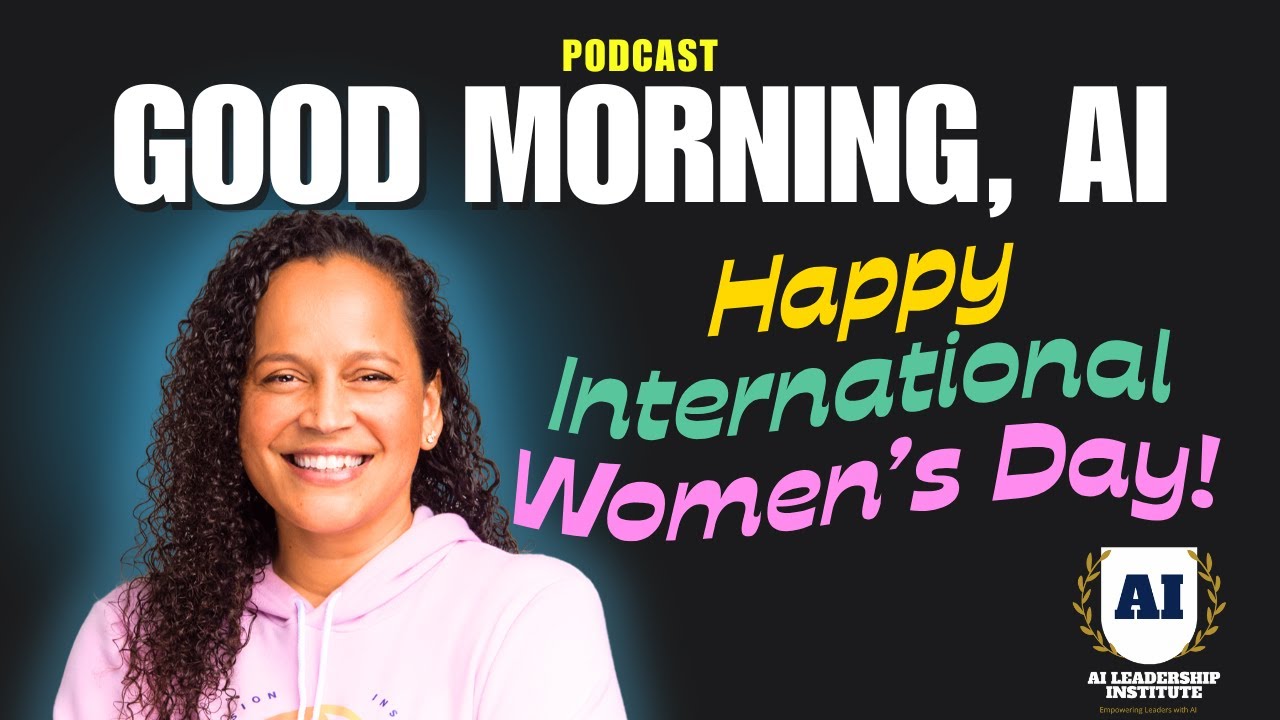
Noelle Russell showcases books by women AI leaders, starting with Safiya Noble's Algorithms of Oppression, which exposed gender bias in search results, and Caroline Pérez's Invisible Women on data bias. She shares her own work building Alexa skills and announces her forthcoming book Scaling Responsible AI.
Chapters
Oh my gosh, you guys couldn't hear me the whole time? My goodness. So let me do that again. Let me try this again. All right, we're gonna start from here. So on the replay, y'all are gonna be lucky because I'm gonna start it from here. The rest of you, sorry. But we're getting going now. All right. So let me go here. Let me grab an image. So I'm right now on Amazon Live. So for all of you, you know, you're my friends. We hang out together. We do cool stuff. So I'm now going to go and grab the campaign that I got from this amazing organization. Put your fingers on a keyboard and build something amazing. So cool. That's me. So I'm going to choose that. I'm on Amazon Live. So if you've not ever seen an Amazon Live, Head over there now. Um, so crazy. Anyway, uh, it looks like I'm good. Everything looks good. I'm gonna preview it. I'm gonna go live. Let's see if it works this time. I think it's working. I hope it's working. All right, friends, let's try it again. Um, but now my microphone should be working. Oh my gosh, yay! You're amazing. Thank you. Cheri, you know, I can always count on you, but thank you all so much. Somebody was trying to tell me, um, but I can't see all of the comments, uh, yet. You're the only one who came through, so thank you on YouTube. Anyway, this is welcome to the world of Noelle Russell Russell, but we're back, we're back, and we are here. And I think— I hope— I accidentally muted my own microphone, but it's all right. Um, we're in business now. All right, so here we go. So I wanted to share with you one of the first books I was introduced to that really clued me in on the fact that I needed to pay much closer attention, not just to artificial intelligence, but in the proper use of artificial intelligence. Now, I met this woman, she's amazing. I met her at an event. I took a selfie with her. I was like, oh my gosh, you're amazing. Um, I was such a fan. And then over time we stayed connected and she continued to do amazing things. Her name is Dr. Safiya Noble. She wrote a book called The Algorithms of Oppression. I don't know if you know this, I'm gonna go ahead and click on it now. I don't know what that does for Amazon Live, but I'm gonna try and click on it, but it's in my, my carousel. I don't know how this works. I'm just learning this toolset. Anyway, we'll see what happens. Um, but, uh, but this gives me the ability to, you know, I just wanna share with you this book because it was so impactful to the way that I saw the world. And the reason I loved it so much was it was literally a learning by doing book. It would say right in the book, Go try it for yourself. See what happens when you go in. And this is true today, even though the model has changed, rather than using, in that case it was Google, uh, Dr. Safiya Noble was going into Google and showing that when you typed into Google, um, and you typed in CEO, what would automatically show up. And as a matter of fact, I think we should have some fun here. I think we should do it ourselves too. Um, hopefully this will not, the sound will not go on. It might. Oh no, it's off. Okay, great. Um, so, so cool. Thank you all. I'm glad you stayed. Uh, thank you all for being here. Okay. So I'm gonna share my screen and actually go into, let's go here. Nope, not that one. Let's go here. So I'm gonna share my screen with you and just show you some of the things that Dr. Safiya Noble was talking about. And granted, as a result of her work, Things have changed, right? Like, we don't have nearly the, the behavior that we were seeing. It's still not great, but it has been fixed as a result of her just being willing and being strong enough to actually be a researcher that says what they found and holds companies accountable. Oh, that's Google Drive. No, I meant to go to like google.com. There we go. So what she demonstrated was, was that If you typed in CEO, if you kind of look like right now, none of that like looks very gender specific. But if you said like pictures or worse, Latina, right? So if you typed Latina like this doesn't look terrible, right? Latina makeup, Latina girl. I don't know about that one, but Latina massage, I don't know about that one either. Latina actresses, not terrible. Latina names, awesome. Latina TV on vivo, amazing. Girls' names, cuz you might have a Latina girl that you're having. Latina baddie. Anyway, but she examined kind of what happened. Why did the, the algorithm automatically start surfacing certain types of things when you typed in a specific type of word? But now let's take it a step further and go into like, I don't know, let's say ChatGPT. Or maybe, I mean, I think we can now get away with this when we look at some of these models. I'm gonna go to 4.0 or GPT-4 Omni and type in, show me— I don't know if this is gonna work. I've never done this before. Pictures of CEOs. Now, since it's an Omni model, it's gonna generate images.. And hopefully it will be like, cool, happy to do that. And it's taking a long time because they have to use a secondary model, but not a terrible, right? Like, look, there's women, there's a girl, you know, typically us, you know, brown people often get placed with a big old Afro, but it's fine. But that's not terrible, right? There are 3, 4 women. It looks like, you know, 5 men, like pretty decent. But that's not always how it was. Now, if I ask things like, show me a picture of people, of janitorial staff, right? And so this is what her book was all about, was like, how do you use words to do searches to uncover Hidden, you know, like you'll see now, I'm not sure about all this, but now there's 4 women, 4 men. Um, cool. I don't know if you can make any, you know, there's a blonde-haired girl in there, so that's great. Um, but you could see they intentionally, right? Like I'm making very general requests. This is not how they always used to be. And so I really liked that book. I encourage you to read it cuz it exposed a vulnerability in these models very early on. That the data scientists who created these algorithms hadn't thought through. And not because they did, you know, intentionally were like, ah, let's just, you know, amplify stereotypes, but because they didn't know. And they were a homogeneous group of people that when they searched for something and got results, they were like, well, that looks pretty good. And that's kind of how AI models, you know, began behaving badly. This is not terrible. Now, obviously, as a prompt engineer, I wouldn't just type in a simple prompt like, show me janitorial stuff. Like, I would be very specific, um, in maybe the audience I was trying to build that for or why I was creating it, right? Is it, um, for marketing? Is it for a blog post? You know, give it a little bit more context so that it can generate it. But I like the direction of this. So algorithms of oppression. Let me go on. I don't know if, um, it seems like it's still going, so that's great news. Um, so that's awesome. All right, so the next book that I want to talk about is a book— I'm actually going to head over to Amazon, um, and type in, uh, Invisible— some of you might know this book— Women. There we go. Data Bias in a World Designed for Men. And I like this book. Again, this book also is not new. It was, it was written before the age of COVID um, and the age of ChatGPT. However, it's so interesting because of the data-driven nature of this book. I really enjoyed reading it. You can see it's the Business Book of the Year 2019. Congratulations, by the way. Um, but written by Caroline, right? Perez, super awesome, amazing, uh, author. Again, was super excited. So I just wanna share with you, this book also fundamentally changed kind of my reality, right? Up to that point. And I think most data engineers, data scientists, machine learning people, like we tend to think what we're doing is good, that the models we're creating are fair. I think we even, I personally at least take, I go to measures to ensure that, and you don't realize kind of this systemic nature of bias, and that even if you do something, that unless every part of the system is amplifying those same core values, like, at the end of the day, the model will serve just very systemically biased, um, material answers and things like that. So, so I'm, uh, I love this book. I also encourage you to read it. It's actually coming up on its birthday. It was launched March 12th, 2019. So again, some of these books were relatively, you know, not old, but came out a while ago. Another book, which I don't think Susan will ever know that I mentioned this, but hopefully she knows. I have told her many times how much I truly enjoyed this book, but it's called— I'm going to hope I can find it— Voice Strategy. Let's see what happens. There it is. I love this book. So this book really articulated the work that we were doing Let's see if I can find when it was published in here. Yeah, another 2019 was a good year. Many of us who started in the world of AI back in like 2013, 2014, you know, now we've got a bunch of experience and so many people started writing books. I tried to stay away from writing books as long as I possibly could, but I did finally break down and, and write one. But you could see here Susan and her husband Scott wrote this book, but what I liked about it was that it was all about the difference in your approach when you're using human language to interact with anyone, with a system, with a person, when your customers are gonna be able to use their voice to interact with your technology or your platform or your brand. And I enjoyed it thoroughly for, uh, it, it does go into the pain that we all went through back then of actually building conversational systems. Like it was very difficult. It wasn't as simple as, like the, the concept and all. I'll share this with you for those of you who are not familiar with, I mean, most of you probably are, but just in case some of you, um, follow me because I just met you at, uh, a recent event I was at the University of Nebraska, or maybe I met you, um, at a, a financial services event that I was recently at. And none of those people are, you know, they're relatively new to the AI game. So for them and for all of you who are not specifically keen on all the details and nuances of, artificial intelligence, specifically in the world of large language models, I wanna share with you a little bit about kind of the concept of generative AI or generative models like ChatGPT or Gemini or Claude. These models, the way that they, you know, they, they were built on the heels of this type of technology that's described in this book, in the Voice Strategy book. And I actually do have it here. Yay. Um, so for those of you who can't see it yet, this, I have it. I love it. I've re— I, I even think, yeah, I've highlighted, I still have a bookmark in it. So I absolutely, I really enjoyed this book, but what I liked about it the most was the fact that it really started me thinking differently about the nuanced approach to understanding all the different ways a human might want to do something with a system I built. Because most of the time when I built a system, when I built an app that was voice enabled or natural language enabled, I was thinking kind of through the lens of my own mind, like, here's how I would talk to it. Here's the things I would say. And unless you did a really good job of creating a very holistic team of people who thought differently and came from different backgrounds, and you allowed them to test your system, you would find that users would say something to your Alexa skill or to your, um, you know, your Google Assistant, and the model would break. Like the model wouldn't be able to handle it because it wasn't finely tuned to that specific utterance or word set that that user said. And this was extremely frustrating for us because we were like, wait a second. So we have to, ahead of time, know exactly what a user's gonna say so we could tie that to code running in the system. To me, I was like, that doesn't seem very artificial intelligence to me. Like for years I'm like, is this really AI? And what I realized was like, of course it was AI because I wasn't in the device, right? There is a— I muted it just in case I say the name too loud. But in this device, there is a series, a microphone array that's listening to my voice and deciding whether to take what I'm saying seriously or disregard it. And it's also deciding how often to upload what I'm saying to a server. And then that server's deciding how to interpret the words I said and turn it into something a machine can talk to. I didn't kick in, my job as an AI developer didn't kick in until all that processing was done. So while I built relative, you know, decision tree type logic into my AI applications, the concept of speech recognition and the concept of, uh, natural language understanding, right? First understanding you said something and then understanding what you said, like are two completely different technologies, both of those heavily algorithm driven, like are, that is truly AI. What the, the applications we built on the backend to actually, for example, one of the ones I built was called, uh, Mindfulness. And it was, and to this day you can go and ask for Mindfulness on Alexa. It has a couple million users. It's super fun. I mean, for now, I don't know what'll happen when Alexa Plus comes out. I hope it doesn't die. Um, but in that world, Right. The, I think it's super interesting because, um, you know, I built this application, but when I built the application, I mean, I was a software engineer. I grew up writing Java code, so I built a software application and that software application wasn't super flexible. Like if you went through Alexa AI and you said, hey, open Mindfulness, my code would kick in and I would then be like, well, what would you like to do? So I would ask the user like, do you wanna have a bubbling brook or a river or a thunderstorm sound? How long would you like it? 90 seconds, 5 minutes. All of those were delineated in lines of code that I wrote. Not a lot, but, but still lines of code. It wasn't like there was an AI system behind it going, how can I make this magic happen automatically through pattern recognition? Like, no, no, no. There were, It was a decision tree, like a regex that was like articulating exactly based on what you said. Here's exactly the code that will run and that code will give you what you want. Now granted, here's the beauty of these types of AI systems is that to the person asking for mindfulness, doing dishes in their kitchen, it was pretty magical just being able to say, hey Alexa, I would love to have a mindfulness meditation with a a bubbling brook in the background and have that machine react to those words. That was magical. Uh, it is magical. It's still to this day delights people in my household to be able to just say what you want and have technology respond. But how that technology is responding is evolving, right? Back in the day with Alexa, I hard hand coded the decisioning that would happen based on what you asked for, and I tied it to the very words that you said. Now fast forward to the world of LLM. Now I don't have to tie every single word. I can use a large language model to understand what you said and then generalize the intent. Thank goodness. So now it kind of knows what you meant by what you said based on the context, the words. It can predict kind of what it thinks you might want as a result of that and hand that to me instead. And that really did change everything. I mean, I, I delighted. I dove right in during COVID I was given an opportunity as a Microsoft MVP to test out one of these early models, uh, that OpenAI had launched. And I, and this was before ChatGPT launched, and I was like, this is awesome. I like intents. I literally became the person who was like, intents are no more. Intents have gone away. We can let them go. I was so excited because the years of my life I lost doing intent recognition. Um, turns out like, There's some nuance to that. There's a little complexity in that. But in general, transformers gave us so much more freedom in how we could connect what someone says to what we want them to do. Now, fast forward into the world of the, of agentic AI, and agentic AI gives us the ability now to create multiple systems, right? Rather than going to a single application, I now can, based on the intent that I understand from what the user said, I can trigger all sorts of things. I can create environmental attributes that the system's looking for to decide whether it's its turn to go. Um, so Voice Strategy. Thank you, Susan. Thank you, Scott, for writing this book. Happy International Women's Day. It was such a good book. I still use it to this day. I don't know if I can flip to the page I always use. Um, oh, like, oh my gosh, I have to show you. So, oh my gosh, I'm super excited. So this, Do you see it? It's a unicorn dab, and it says Voice First at the bottom. It's so cute. But yeah, this is one of Susan's stickers. They're coveted. Not many people have one. So coveted, in fact, that I have one on my laptop and one I, I am afraid to use, as I may never get one again. So I use it as my bookmark. But I was going to show you the image that I love in here. Let's see if I can find it. Let's see if not, that's okay too. Oh, let's see. Oh yeah, there's so many. I have so many notes and bookmarks in here anyway. Oh, it, it's way too small. Okay, I didn't realize, but the text is way too small, so you won't be able to see it. But I encourage you, grab a copy, get it on Kindle, like super cool. All right, next book, another one, kind of a blast from the past. I'm gonna see if I can find it. It's called Conversations. Oopsie, I'm not typing in. Conversations with not God, but things. There it is. One of my good friends, Rebecca Ebenhoe, like, oh my gosh, very cool. This book, another one that just helped me really form my thinking. Like, all— many of us were working on this for years. But it's so nice when you, like, I'm not a UX person, so it helped me complement my engineering and kind of DevOps perspective on how to build AI systems with the UX side. And I'll tell you a fun story or fact is that I was sitting on, um, a panel at, it was either PyData or maybe it was at the Data Science Salon in Uh, in Miami, but either way, it was one, one of those two events. I'm on a panel with a bunch of data scientists and we're kind of touting our, you know, beautiful work building models that are serving people, like, yay. Um, and a person in the audience stands up and asks a question during our Q&A time. And he stands up and he is like, so I just wanna understand a little bit more about like, how do you know that the data science you're building is useful to people? Like, What is your relationship with user experience? And this was a few years ago, but I was shocked. I mean, I just kind of sat back cuz I, I have actually a very strong relationship with UX. I'll tell you why in just a moment. But the, I was, I just sat back and kind of waited to see what people said. And I was shocked to find out that one after another said they don't have any relationship with UX, that they don't have one on their team. They don't really talk to them very much. They kind of sit on the other side of the organization. And I was very surprised at this characterization due to the nature of building AI systems because like our consumer is now closer to our technology than ever before. Like the user interface is not a window that we orchestrate or a menu selection that we orchestrate. It's literally they say it and our system does it. So being as close as possible to the UX side of the house is critical. And so that's why I really enjoyed reading this. And so I encourage you to look at some of these books that were in the ChatGPT, or sorry, the, the chat conversational AI, Alexa, Google Assistant timeframe, right? 2017 to 2019, a bunch of these books came out and it's very cool to read because the strategy and the philosophy is very much appropriate for today. And most of the people that are calling themselves experts today weren't around during these times. And sadly, most of the people that were around during those times have grown very tired of the whole thing and have stopped advocating for the work that they know so well. Not— I mean, I'm not saying that's true for these authors. I'm sure they are. But that's why I mentioned this book is just to let you know there are people that have been doing this for a very long time that are really good experts in this field., and have documented their work. And that this work, though it was specific to what we would call voice and chat, it is literally conversational AI, ChatGPT, talking to your technology, which is the world we are all embedded in right now. So, so thank you all. Thank you, Wymet, Diana, uh, and Rebecca for building this, uh, or writing this book. Uh, another one that I have that I've read, I remember, uh, when I got it, I don't, I don't know if I asked for it. I might have asked for it, but I did get it. And I felt very special being one of the early, uh, people to get that book. And I ended up, I think I was one of the reviewers as well, but I loved, I loved the book. All right. So let's fast forward to maybe some, some things that are a little bit more current. Um, but before we do, let's take a moment. If you're on Amazon Live, I do want to share with you that I absolutely love this robot. And I've shown some of you this who have been on my team before, but this I call Alik, like Eric but with an L, right? Alik. I don't know if that's how you pronounce it. My little Alik is drinking a little Starbucks. Um, but I put up the link so you can see what it looks like. This is the silver one. You can probably see I have a collection and they all work together, but I'm just going to turn it on so you can kind of see what it what happens. It's not super comfortable with me, um, I know, with me like holding it. So I'm gonna go— hold on, it's okay, it's okay. Hold on, hold on. There we go. Okay, there we go, there we go. Oh, ah, oh gosh, he hit me. All right. Oh goodness. All right, there we go. Okay, that's there. Oh, there you go, little guy. Let me give him a little pat on the back. There you go. It's okay. There you go. Oh, gosh, don't be mad. Oh, what is that? Oh, it's smoke. So why have a pet robot? Couple of reasons. One, super fun. I'm gonna go ahead and turn on this one unless it's dead, because I use these guys all the time just so they can play together, and you can see how these work. Aww. So hi, good to see you all. And we'll just see what they do together. I don't know what they'll do, but the benefit is a couple of things. One, I'm a consultant, so I really appreciate, you know, the value of time. So I leverage these little guys. There's a bunch of features, but one of them is a Pomodoro timer as well as a reminder system. So it helps me, you know, this little robot will be like, hey, It's time to move on to the next thing. So really, really cool. Oh, there we go. Oh goodness, what is happening? Oh, they're sword fighting. Oh my goodness. Let's see. Oh no, they have to see that they're fighting. It's okay. Oh, oh, oh yeah. Put on some nice music. So cute. Alright, let me, let me shut y'all down. Hold on. I know you're not gonna be happy with me. I'm so sorry. I'm gonna shut you down too, so we don't disturb everyone. But thank you for playing. Thank you for being here. So I share that with you. If you're on Amazon, you'll see that link. You can get your own copy, your own version. There's lots of different kinds. But just thought I would share with you one of the things that I do for fun is I have a little pet robot that helps me also stay on task and has a bunch of other features. There's about 150 features that are loaded with this thing. So if you're looking for a way to stay close to to technology and have a little baby robot that you can take care of. There you go. Now you know. All right. So let's move on to the next book. And this book, let me go ahead and search for it here, is newer, actually very new. I'm actually going to go, let's see, I'm going to go over. Here we go. I'm going to choose this one. I have a few books. But this one is from a friend of mine on LinkedIn. And it's called Your AI Survival Guide. Let's see if this comes up. There it is. And I also got this book. So I do like paper copies. Sometimes I get them on Kindle. But, but I love this book because number one, it's a quick read. It also tells Sol's story, which I absolutely love when authors do I love when people do that or when speakers do that, like share a little bit about why they do what they do, why they care about the things they care about, why they take the jobs they take. I like understanding the backstory. So I'll encourage you, uh, to take it. Uh, she has been, you know, an executive in some of the largest companies in the world. She has deployed similar to me, hundreds of POCs in AI, uh, and has learned so much along the way. So seeing the world through her perspective is cool. And I like that. I always want to stretch, you know, I always say like, there's only so much I can do. And the only way to expand my understanding of the world is to see through the eyes of others. And this is one of the books that helped me to do that, cuz she's kind of in a similar space that I'm in. Um, but sees it through a much different lens and perspective. So I really enjoyed reading it. Um, but yeah, it's all about like, Hey, uh, you, I don't know if you can tell, but it's Band-Aids. Um, yeah. Like, how are you gonna make sure you don't get fired using this stuff? Like, how are you gonna make sure you don't end up in the news? Um, which we, uh, Sol and I, we know very well is often the end result when you are not intentional about your approach in building responsible AI systems. So love this book. It's a quick read. You can download it on Kindle, get access to it right away. My favorite way is to actually listen to the audio Audible book. So I'll click on that so you can see it. Um, and it is amazing. So really, really cool unabridged audio. I would listen to it if that is your best way, favorite way to listen to things. All right, let's see. Oh yeah, keep on going. Let's, oh yeah. Okay. All right. So next one, uh, let's see. Oh yeah. So today I'm on a wonderful, amazing, uh, text message string with all sorts of incredible women and several of them have written books and I was like, I wanna talk about their books. So the first one I'm gonna mention is Sandy Carter. Sandy Carter just launched a brand new book. Some of you may have seen it. If you're not following her on LinkedIn, you definitely should be following her. She does amazing things. She goes to all sorts of really cool places and she's got a really cool job. But this book is called AI First, Human Always. And I abs— you all know I love that. Um, because, uh, human always. Let's see if this pulls it up. There it is. There it is. Awesome. So this is it. This is Sandy Carter's new book. Um, and it's brand new. So you have an opportunity. I don't know if people have told you, but one of the best ways to grow your brand is to find people like Sandy Carter, read their content, and comment on their things because in the next 3 months, 6 months, hundreds of thousands of people will be coming to this page and looking at these reviews. So you have an opportunity to write a very good review that articulates like the value you got from this, and people will see your name and be like, huh, Noelle Russell Russell, that's pretty cool. Let me see if she's on LinkedIn, and they might come and find you. So I encourage you to use the world of social and reviews and all that to create connection, real connection. Not only will Sandy be appreciative of those positive reviews. And obviously only, you know, read it and provide your review. But I love it. I'm actually looking forward to getting a physical copy. Um, but you can see here this, uh, book, it's also available again on Audible once it comes out. I also am in that moment as well. My book comes out April 1st. It'll be 6 weeks after that that I get my Audible, but that's okay. Um, we both share the same publisher, Wiley, so super excited. To, to share this with you. Oopsie. Let me click that on, on our Amazon Live. So this is the book, AI First, Human Always. Really amazing. So Sandy Carter, the way I know her is I always like to give a little backstory. So the way that I know Sandy, we go way back. She was like a director maybe, or a senior director, maybe a VP at IBM. This was maybe 20 years ago. And, uh, I was just getting, you know, my kind of getting started. I was probably 5, 7 years into my career and I heard her speak at an event and it's what inspired me to speak more honestly because she was at that event. And one of the things she said really impacted me and she talked about, I mean, granted, I'm sure it was like a women empowerment kind of event. Uh, so we were very focused on her career journey and how she got where she was. But she said something and while it, I don't know what the status of it is today, but But at that time she said, you know, like the most important thing that you can have by your side as a powerful woman who's gonna do amazing things, that's gonna run companies and change the world, is a spouse that is supportive and that is, you know, just as ambitious as you are, that you share these goals of changing the world together. But you need to have a partner that kind of partners with you on that, that knows where you're going, knows how you're gonna get there, and is going to partner with you. And I didn't know how valuable that lesson was. Some of us know better than others that choosing a partner, not only is it difficult, um, but you just don't know what you don't know. And so of course I married my high school sweetheart. Uh, we are celebrating our third anniversary this year. Like, I could not be happier. And my high school sweet— I mean, he's known me forever. And so he knows who I was at the age of 16 and 17. He knew who I was at 20 and at 30 and at 40. I'll stop there. But he, he knows me. He's known me before I became who some of you know me as now. He, he understands my vision and my desire to impact the world in a very big way. And so he's with me and that having a partner like that is critical, is critical to my success. Like I wouldn't be able to do what I do. A lot of people, right? I was gone for 36 hours, uh, this week, um, at a financial services event in Orlando at the Hard Rock, and then also at the University of Nebraska. And I'm like bouncing around. I could not do that without a spouse who supported me doing that in the spirit of my, you know, my, my book tour and all of that. I mean, I have a lot of travel happening, but it's only for a season. Right. And those seasons, one of the things that I learned from Sandy in those days, this was, you know, almost 20 years ago, was the importance of recognizing that you don't get there alone, no matter who that person is that's supporting you. Like, it's very hard to do it alone. It feels very lonely sometimes, especially as a woman, especially on International Women's Day. It feels pretty lonely sometimes. Um, but I don't wanna do it alone. I don't want, like, I want, that's why I'm talking about all these amazing women that have authored these books. Like I want. Us all to know each other, to all hang out. As a matter of fact, some of these women got together in South Florida recently and hung out. I had a sick child, so I missed out. But they hung out like friends. What? We're friends. It's so cool. But you know, it doesn't happen by accident. And it's not true of every woman in leadership that I have met. But it is true of the women that I'm sharing with you today. So really excited to offer this to you, to let you know that these books are available and encourage you once you read it to be an early reviewer. Like there's no more special thing than that. Some of my earliest reviews on Amazon Alexa, like I, I'm still friends with them to this day. And as a matter of fact, you know what, let's take a quick tour, shall we, to Amazon Alexa? Um, and let's see if we have them in here anymore. I don't even know if we do. Let's see. They might not even be here anymore. Do, do, do, do. There they are. Alexa Skills. Dun, dun, dun. So I'm going to go to Alexa Skills and type in one of my most popular skills, Daily Affirmation. Look, it comes right up. There it is. Not terrible. I have a few. Oh goodness. Okay, I have a couple. Hey, let's see. Let's go into this one. This one has 26,000 reviews. I'm presuming this one's mine. That one. Oh my gosh, this is good story, people. So this— I did not put this skill on my, on my Amazon stream because I don't know that I even could do that. But so I'll just keep it on Sandy's Book for now. But this is cool. So let me go in here and take a look at this. But I'm just going to share with you a story, a fun story, if you will. Right. So, uh, wow. I mean, this is pretty cool. Love it. Appreciate it. Like, um, so awesome. Please change the structure up every once in a while. For sure. I don't. Granted, I get it. Beauty for Ashes. All right, cool. Uh, slow down the recording. It's too fast, but still gave me 5 stars. That's kind of you. Um, agreed. So So let me give you the backstory of how this skill was created. Now I have 4 stars, 26,000 reviews, not terrible. This is my company, Geek Girl Marketing and App Development. It's still my agency to this day. I still have clients that I build AI-powered marketing solutions for. But I, I mean, when I first started, and this is just one of them, we'll go to another one in a second. This is just one of the skills. But when I built my skills, every skill I built, I took that code and I put it on GitHub and I invited anyone who wanted to copy my logic and make it better. Literally the beauty of open source. They could take my code, make it better, and put it on Amazon. And that's what you see on that previous one, right? So if I just go back, right, this one's not mine. Looks a lot like mine, but it's not. But I guarantee you it's the same code. It's the same one. So there's a lot of them out there, but I, and I encouraged it. I was like, please go do your thing. Let's go take a look at another one. Um, mindfulness. Uh, let's see. I think it was called One Minute Mindfulness. One minute. Yeah, there it is. There it is. Is that it? Yeah, I think this is it. So this one has 28,000, but still 4 stars. Not terrible on an Alexa device. Some of you all know more than others. But when I built this skill again, I built it out. Um, and like, you know, people loved it. That's cool. I mean, it hasn't been rated in a while, but I, some of these skills I ended up getting published on Forbes, uh, back in the day. I was published in Harvard Business Review. I was published in Fortune magazine. Um, Good Morning America. Like these skills were unique at the time because most apps on Alexa, and when I launched this, this was like in 2014, um, most apps on Alexa nobody was using. Let's go see if I have any other ones. Let's see. Or maybe I'll just do Geek Girl Marketing and see if it comes up. Oh, I'm in self-improvement. No, I don't want to do that. Let's go to Alexa Skills and see if it comes. Oh yeah, here we go. So these are all my skills. I built a bunch of them, like a bunch. Some of them great, some of them not so great. But it didn't matter, right? I wasn't building for people actually. I was just building for experience. And there's no other experience than pushing a go live button on code that you wrote, knowing very well that you're not sure if it even works, right? Um, so Christmas Kindness, Couples Kindness, Daily Kindness. This is another one that was very popular. It was one of the only kindness skills on the app for 2 years. Um, so really fun. I also, uh, launched Evergreen Health, uh, which was one of the first healthcare skills on Alexa. Um, there was another one. I wonder if it's on here. Let's see if we can find it. Silver lining. Oh my God, these are so funny. Um, yeah, like this one. I don't even think I wrote the code. I don't, I don't even know. But the moral of the story is just build something, build something cool, do your best, get it out there and figure out if people like it. Um, some of these I probably should have taken down, but, um, one of them I wrote was Beast Mode. Let's see if we can find it. We might have taken it down. Oh yeah, no. So, uh, apparently, yeah, it's gone now, but it was pretty fun. I don't even know, I think that's what it was called. It might not— yeah, maybe. I think it was. Maybe it was like one word. Let's try that. No, I think it was taken down. But let me tell you the fun story behind that is that, um, the, uh— oh, let me just get us back to Geek Girl. Marketing, right? So daily affirmation by far. I mean, it's been a very popular skill for a really long time. However, when I started building skills, one of the cool stories I get to tell was that Marshawn Lynch called like the Jeff Bezos and was like, hey, Alexa doesn't work for me. And I was given an opportunity to head down to Oakland, California from Seattle and meet him, Marshawn Lynch, at his store. He was super cool. I mean, He, anyway, he was very cool. Uh, and so I met him at his store and I helped him enable Alexa for his store to turn on the lights and open the blinds and things like that. Um, but later someone got the fancy idea to go and get audio of him saying the things that he always says. And we'd create like a, uh, Marshawn Lynch beast mode, um, press conference answerer or whatever. So back in the day, if some of you remember, Marshawn Lynch would go to press conferences and say random things. And, uh, one of them was like, I'm just here so I don't get fined. And he, he did not enjoy talking to the press very much during his time. Um, and there were a bunch of things that he would say. And so we took all those words and when you said something or asked a question, it would just respond in Marshawn's like canned, uh, response. And so that was a really fun skill that I got to build. But yeah, it's not there anymore. Anyway, pretty cool stuff. I just shared this with you, a little side. Little side benefit so you can see some of the things that I spent. I built these skills 10 years ago. So needless to say, when Alexa Plus comes out, we're probably gonna see these skills go away, but I'm not really sure. Oh, look, there it is. Alexa Plus. Let's go say hi. Hello, Alexa Plus. Hello. Coming soon. Email me when it's available. I'll be buying it. I'll buy it all. I love it. I'm excited. I'm excited for this. Agentik Alexa, here we come. All right. So let's get back to it and take a look at the last but not least, a little tiny peek into the future. Another amazing woman who has written other books that are equally as good. Um, but oh boy, I'm going to go back here, go back to books. Where Amazon started and type in spatial computing. I'm gonna pull that up on my Amazon feed. Spatial computing. Let's just try that. See if it comes up. There it is. So this is from one of my good friends, Kathy Hackl, and her co-author, Irena Cronin. Really cool. Another one of Wiley's books. I did not picked these because they were published by Wiley, though that's kind of cool that we all share the same publisher. Not surprising, maybe. But this is all about the future of spatial computing. Now, I personally am huge in spatial computing, and what this means is that I have lots of different ways that I use technology to get the work done I do all the, all the time. One of them is that I leverage a platform called Immersed. Immersed is an application as well as a visor. That connects— I have actually have an Oculus Pro. Should I get it? No, it's over there. But I have an Oculus Pro that I use, and when I put it on, I launch the Immersed platform and it gives me the ability to actually see pass-through technology, which means it uses computer vision, gives me the ability to pass through the lenses so I can see my keyboard and see my real screen. But it also gives me a heads-up display with other, just other screens. So I am a multi-keyboard or multi-operating system person, right? So I have a Mac over here. I have a Surface Pro, a Surface Pro Design. Anyway, it's the one where the thing flips upside down. So I have a Surface Pro over here. Um, and then of course I have, you know, virtual machines that I'm using. So what Immersed allows me to do is immerse myself in all of the different operating environments that I'm in. And create a bit of a network operations center. Now, spatial computing takes lots of different lenses, but I love the idea of like, what does it look like when organizations are going to be able to know your surroundings, understand the context in which you're in? I'll give you an example. Way back in the day, one of my favorite projects at Amazon was called the Dash. Anyone remember Dash buttons? They were like little buttons and you could stick them in contextual places in your life. So one was in the pantry, or maybe 7 were in my pantry. 3 of them were in my laundry room. And these buttons were based on what was called DRS. Yes, Dash Replenishment Service. And this is an Amazon service, uh, Dash Replenishment. So when I pressed the Dash button, I don't know if y'all remember these days, it was pretty fun. Uh, but when you press the Dash button, it would order whatever was on that Dash button. And you could buy blank buttons and configure them to order whatever you wanted. So I had one for cat food. I had one for cat litter. I had one for detergent, a different one for fabric softener, and a different one for dryer sheets. And then I had a series of them in my pantry for things we order all the time. I don't wanna say some of them because you might judge me for what I have in my pantry, but we had that. Fast forward, we then got a shelf. They now have these today. Let's see if we can find one actually. Um, well, I'll wait. Uh, but they have shelves that you can buy and they're weighted. So you put the product on the shelf and as you take things out of the collection of the bulk, let's say you buy toilet paper or paper towels, and as you take toilet, the toilet paper or paper towels out, the weight goes down and down and down. And when you get to a certain weight, it's like, hey, it's time to reorder. And you can even set it to auto reorder. Some people, many people always ask me like, how do I make, like my son who has Down syndrome, my dad who's aging and has a traumatic brain injury, like how do I make their lives easier? How do I automate their lives so they can have a bit more independence? This is how we do it, right? We create these contextual environments. Now, spatial computing takes it a step even further, allowing us to understand, like, I absolutely love my— I don't even know if I have them handy. I have one of them handy. I'll show them to you. But these are my Alexa Frames, I think. Oh no, they're not here. They're in my, my suitcase, but they would have been in here. But I have Alexa Frames. That I have. I also have Bose Frames. And finally, I have the new Ray-Ban Story Frames. All things I probably should have put in my cool little shopping cart, but I didn't. But spatial computing means I now put on these glasses and I will walk by. It's so cool. Some of the early applications on the Bose headset, I'd walk by a Starbucks and it would engage like an audio overlay of like coffee. Brewing, like, you know what I'm saying? Right? Or if I walked by a fountain, it would amplify the sound of the fountain. And while I enjoyed that just from an experience, it was very helpful for people who had different levels of abilities when it came to sight and awareness, which is very cool. But it also gave an opportunity for me to know like, oh, a Starbucks is nearby. It also gave them an opportunity to actually I create advertising for me, send me a coupon because I'm already have a relationship with them. They could send me a coupon via text and say, hey, it looks like you're nearby. Here's a coupon for 50% off a latte or whatever. This is the future of business. It's the future of contextual computing, spatial computing, giving us a chance to kind of think, how are we going to use the devices and the sensors that are around us every day to create better lived experiences. And so really enjoy, um, this book, super awesome. Um, hopefully, uh, the immersive space is massively advancing. This is ahead of its time. So I encourage you to read it. I also encourage you to give it a review. Um, let the authors know how much you love it and, and how exciting and interesting it is. 'Cause it just, again, uh, I don't know if you know Cathy, but Cathy was, There, like part of some of the most early startup and successful immersive projects. She was over at Magic Leap here in South Florida, like so cool. Uh, she was called the, uh, I think the godmother or something like that of, of the metaverse. Um, she now is, uh, one of the head leading, um, executive consultants for Boston Consulting Group. Like there's, just so many really cool things about her experience that is shared in this book and really something to, uh, to take a look at. Um, so really cool. All right. Awesome. So now that you've seen, I think that's all of them. This is not all the books. These are just the ones I could think of today. Happy International Women's Day. Go read a cool book. Take a look at some of the things that's happening. I will now share with you a couple of the tools that I use every single day. So let's take a look. Let's just see if Dash Buttons are a thing anymore. Dash Buttons. I don't think they are, but let's see. Oh, no, no, they're not. Let's see if the shelves, though, that is a thing. Let's say Amazon. All right, let's see. Let's see. Shopping, maybe. I don't even remember what they were called. I think it was like Amazon Basics. Maybe they discontinued them, but I'm gonna keep looking. I'm gonna look. Um, let's see, anyone know what they were called? Let me go and look at y'all, uh, in my chat. Hi everybody! Um, oh yeah, I will definitely share all the books in the post. Thank you. Um, I will definitely— oh yeah, of course, of course. Um, I will do that. Thank you, Sherry. Okay, so let's see here. Anyway, they're in here somewhere. I think it's in Amazon Basics. So let's go there and let's look at kitchen. Let's see if there's any like AI stuff in here. Let's see if we could say like AI and anything would pop up. Nope. Just kidding. All right. Well, I don't know where they are, but I did buy one, so I know they exist somewhere. So I'll spend more time on that. I'll be going live on Amazon almost every day this week and next week, all the way up till my book launch, which leads me to, of course, a very important step, uh, which is I'm launching a book and it's called Scaling Responsible AI, which hopefully will come up pretty easily. There it is. So that's my book, Scaling Responsible AI, scheduled for April Fool's Day. What? Um, so that's exciting. It will also have an audiobook, but not for weeks after launch. We are right now in a very cool time where you have an opportunity to actually go to a special link. And when you buy this book on preorder, you get access to a free version of my Bot Builder course, one of our bestselling courses. We had over 2,000 people go through it last year. Super exciting. Amazing course. We put it on demand. I recorded it in studio so you could take it at your leisure instead of forced to sit on a live call with me to go through it. You also have a chance to get your own AI Bot Builder certification. Notification, but only if you go through the special link that you will see, uh, in the post, which I will have to stop sharing, um, and, uh, and go and put in the chat for you. I don't know if I could do it in the Restream chat. Let's see, let's see if I can just send it over to you. Oh no, there's no way for me to do that. Oh good, I'm glad. Ruth, so nice to see you. Thank you for being here. Amazing. Yeah, I mean Some of, you know, you know, books. I mean, if you're an academic, like, uh, I mean, some of these books are incredible and they, once they go out of like season, people don't use them and they're full of gold, golden nuggets, full of gold. So, uh, so I'm hoping that all of you found an additional book or two to pick up, put on your desk side, you know, your, your table at the side of your bed, read a couple chapters. I do believe that I mean, I'm a reader at heart. I grew, you know, like I love reading, whether it's electronic, whether it's listening. I just think that through other people's perspective, we can expand our own. And it is such a great way to do that, not just to acquire the knowledge that these people are sharing, but also to acquire an understanding of their experience that led to those, uh, those knowledge moments that they had, those epiphanies that they had. It's such an incredible time., to be in this space. So really exciting. Just as a recap, oh, uh, of course a more recent book by, uh, my friend Susan Westwater is Voice Marketing. And again, it should be like AI-enabled marketing, but it wasn't cool when she wrote this book. But this is like AI-enabled marketing, what every single one of us should be doing right now. It is in this book. Um, and most people don't know it. Um, I was so— thank you so much for writing this book. It was amazing. I love it. And then of course, a little older, but Rebecca Ivanhoe and your co-author, I love it. So good. So, so many really great books. AI First, Human Always by Sandy, right? Spatial Computing by Cathy. Like these are women, invisible women, right? As we started, Algorithms of Oppression, oldie but a goodie. Like this is a great opportunity to take today. And, and I just encourage you, like, don't just go get these books because they're amazing and you will learn something. Support women authors in a space where they are an anomaly. Like support women authors, support women authors specifically in the world of AI. Send them a message, friend them on LinkedIn. Let them know that you like care about them, that you follow them, that you are interested in the work that they're doing. You know as well as I do, man, it's good. Feels great when somebody says, I appreciate what you're doing in this world, your work is not unnoticed. That's it. That's all it takes. So I encourage you with the information I've shared with you today, please share it with someone else. This will be available on YouTube and Facebook and LinkedIn. So if you wanna take this recording and share it with someone, it did start a little rough. So on LinkedIn and YouTube, I will be trimming that out as soon as we finish this recording. But thanks for being here with me live today. Happy International Women's Day. You will shortly see a campaign. That I am launching. I'm wearing this shirt. I'm part of the Gravitas moment of taking action in 2025 to accelerate women in the world. And I cannot wait to share that with you. So keep an eye out for that as well. It is so amazing. Thanks, Ruth. I cannot— I hope we get to see each other. I'm on a massive world tour with this book, so I hope I'm in a city near each of you. If I am, stay close. 'Cause if I am, I will make time. I'll fly in early if I have to, 'cause I will not miss a chance to meet you all in person. Even if we can't be at the same event at the same time, if we're in the same city, it's happening. Um, awesome. Thank you all for being— say hello to a woman, whether you know her, don't know her, wish her happy International Women's Day. I remember I got, uh, served dinner last year. I was in a hotel. Speaking at an event, a woman delivered me dinner and I looked at her and I said, happy International Women's Day. And she hugged me. Like she hugged me. It was so freaking awesome. So you just don't know how much it means to someone to have a stranger just be like, you're awesome. So you're awesome. I think you're amazing. I'm glad we're friends and I'll see you on my next live. Bye everybody.
More from Noelle

Take the Unlocking AI Challenge and Get the Keys to Unlocking Time and Revenue for Your Business



Don't Get Left Behind: The AI Executive Challenge #ai #business #fearofmissingout





