Microsoft AI 30-Day Cloud Skills Challenge: Day 5 Introducing Azure Machine Learning
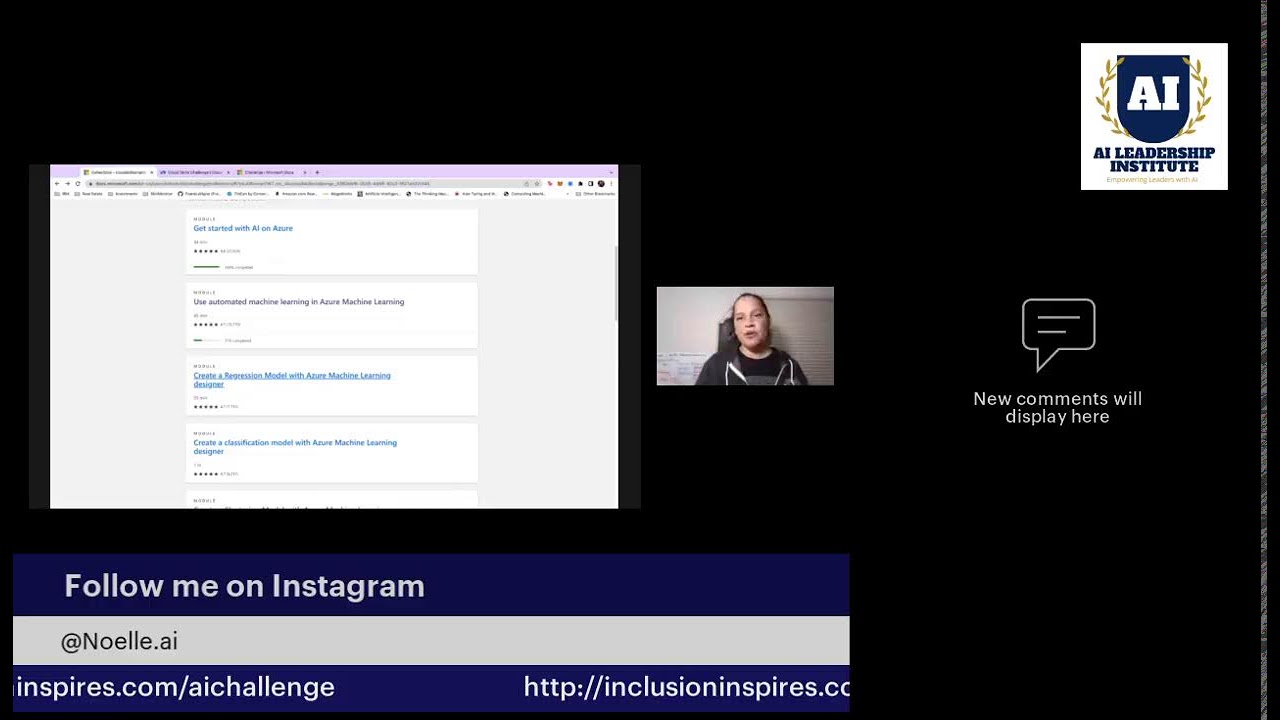
Day 5 of the Microsoft AI 30-Day Cloud Skills Challenge covers Azure Machine Learning and the machine-learning lifecycle: data exploration, model training, and deployment. The host demonstrates the low-code AML Designer for regression modeling and emphasizes responsible AI, including ensuring datasets are inclusive and representative. She shares her own journey from cloud engineering to Alexa development to encourage underrepresented learners.
Chapters
Good morning everyone, happy Monday! This is the first full week of the challenge. We are doing a 30-day challenge to get you Microsoft AI certified. There's a bunch of different things that you can do. There is a cloud skills challenge, cybersecurity— well, it's security and, um, I can't remember, privacy. Anyway, there's another challenge around that. Um, there's a challenge around Power Apps, but we are focused around the AI Skills Challenge. So over the next, I don't know, 20-something days— we'll see it in just a second— we are going to go through and learn all about Microsoft AI and learn enough about it in order to get a certification, which you're going to see me live go into the certification and and hopefully come out with a happy face at the end. So fingers crossed, let's do this thing. So over the weekend, last week on June 2nd, we started this challenge with the introduction to Microsoft and Azure AI in general. So if you went and started the challenge, if you didn't, you can head over. I'm live right now on YouTube, Facebook, Twitch, Instagram, Instagram and LinkedIn. So if you would like to, you can head on over there. There's a website you can register to, to get all the links. It's a free challenge. There is nothing you need to do other than go register. It's part of Miami Dade College here in Miami, Florida. We are working with them in order to help more people get exposed to AI and realize that they can change the trajectory of their career by by just getting involved in technology. So hello, good to see you all. So amazing. Thank you so much. So as you join in, don't forget you could hashtag— I already see you all on Instagram. So you don't have to do this. But if you want, hashtag live if you are here live, hashtag replay if you're here on replay, just so I know that you came and saw and hopefully got a little bit inspired. This is a long challenge. It's 30 days total. We are actually on day 5 already. Over the weekend we did day 3 and 4 and focused primarily— well, actually, why don't I go and take you into Microsoft Learn? So if you head on over to that, the website that I sent you all last week, and if you don't have that link, don't worry. Oh good, wow, you registered for all of them. We have a challenger who registered for all of them. You actually could do that. I am gonna focus on AI, but you could definitely register for all of them, get 5 certifications at the end. Oh my gosh, I'd have to buy you something if you ended up doing that. That would be amazing. So I just go in and I, I really just Google Miami Dade College and Microsoft Skills Challenge and their press release comes right up and then it'll give you access to register for the challenge. We are in the Azure AI Fundamentals Challenge. It's going to prepare you for the Azure AI certification. It's called AI-900. When you register for it, and it'll tell me right now, actually, let me go ahead and share my screen. Let's pull this apart. Let's see if this works. I am on a different computer, so let's hope for the best here. There we are. Share. Oh yeah, there we go. Cool. That is the challenge site. We have 24 days, 14 hours, 43 minutes, and 18 seconds to get this done. So every day you're going to have a chunk, a little chunk of work to do. We basically, in order to do this challenge across 30 days, I'm basically taking half of each module, right? There are 16 modules. I'm doing half of one every day. That'll get— bring us to about 32. So maybe we'll have a little bit longer one at the very Once you sign up, there is a leaderboard. Go ahead and show you— see, show you that. So if you scroll down, you can see the leaderboard. Look, already 2 people have completed the challenge. I actually don't think you should blaze through this stuff. There is a lot to learn, and now you're doing it. So take your time, absorb it, and most importantly, practice, practice, practice, which is what we're going to talk about today. We've got a bunch of people on the leaderboard. Right now we have 50. That was my goal to get 50 people in the challenge. So we hit 50. Let's shoot for 100. If you know somebody who wants to learn about AI and get started, this is an incredible opportunity for them to learn for free. And I'm just gonna show you a couple of the things that make it exciting and also share some real-life use cases of the kind of work you get to do if you move into this space and really start seriously considering a career in technology and specifically in AI. I'm going to go ahead, join right now. You should be seeing me inside the Azure AI Fundamentals Challenge. You'll also be able to see Get Started on Azure. We completed that. That was day 1 and 2. Over the weekend, we will have taken a look at using automated machine learning. Now here's the cool— this,. All you have to do is register. Oh yes, I will. Good point. Um, Mr. Cook Fix It, let me hook you up with, um, a link here really quickly. Hold on. Oh, I know what I could do. Wouldn't that be awesome if I could? Uh, I'm just gonna take a second to make sure all of our challengers have the ability to participate because we definitely want you to. Um, and then I'll pin it for anyone who joins us later. Oh dear. Oh dear, uh, sorry. Yes, um, oh, that's a good idea. Yes, you could also join me, find me on LinkedIn. You'll actually see, um, the link on LinkedIn Live. You'll see the link right there on the page so you can join us right away. But I'm going to try and copy and paste it in for you as well. Ctrl+C. Let's hope that the MacBook does what I— yeah. Yes, that was like MacBook to phone copy pasting, one of my favorite features of the iPhone. So there you go. I'm going to— oh, awesome, Microsoft MVP in the house! That is amazing. Cool, welcome. So there you go, head on over, join the challenge, it'll be fun. Um, hey, who knows, maybe as MVPs we can hop on together one morning and chat it up and see how things are going. All right, so you are now looking at the, um, the challenge page, let me go back and walk through the actual components that you're going to be working with. In this day's challenge, let me find it, hold on. Oh dear, there we go. I'm going to go into Azure AI. I think I was already there. Automated machine learning over the weekend and what we were learning, you'll see I went through some of it and then this is what I do. I get so excited about being working with a model, as soon as I got into my workspace, I just started playing around and I forgot to come back and actually do the learning piece. But I have gone through it before. But I got excited about it, as you will too. Here's one of the best parts about this challenge is that you get to go in and open up a machine learning workspace, exactly the environment if you're working at a company that's using Microsoft to fuel their machine learning activities, you will use the same toolset. You'll also see that it's built for a couple different types of users. If you are a machine learning expert, you probably aren't listening in on this challenge. But if you are a machine learning expert, it helps you do everything you know how to do even faster. But if you're new to machine learning, it helps fill the gaps. So if you get to a point where you're not sure what to do, there's tutorials, help, contextual help to help you build a model that accomplishes the business outcome that you're looking for. It's really cool. There's what we call the machine learning lifecycle, which starts with data. So you'll notice once we get into the 4th module or so, I— this was like around Saturday, you get to explore the data that you might look at or look at in order to determine what kind of business outcomes you can derive from that data. Here's a really important tip. When you are looking at data to get a business outcome, this is Noelle Russell Russell's responsible AI hat coming on. You're going to want to make sure that that dataset is inclusive of all the audiences that you want to serve with that business outcome. Sometimes we are narrowly focused, right? I remember in my early days on Amazon Alexa, I was narrowly focused on building a kitchen device. And so sometimes we lost sight of the bigger picture when we were so narrowly focused on that. Outcome. I ended up building skills that I hoped would help kids in classrooms and people in nursing homes, and they did eventually. But at the beginning, it was like going against the grain to kind of think outside the box. So I encourage you to do that as you go along. Woo-hoo! Hello, Maritza's in the house. So great to see you all. This is so cool. My friends are here. So great. Thank you very much. So You go in, first step of the machine learning lifecycle, you need to look at your data, figure it out. I will tell you, I go into many companies and I talk about the dream and amazingness of artificial intelligence. And then we look at their data and we're like, you have some work to do, right? The data is the fuel for these models, the fuel for artificial intelligence. So if you don't have a good data story, if you don't have good clean data, data that actually is helpful and purposeful and intentional, then it'll actually be really hard for you to use that data to solve a real problem. So that's why we spend some time there. We then train our first model. It's something I tell everyone to do. If you're interested in this, if you're interested in artificial intelligence, just go and build a model from scratch one time. Just see how it works. You can do this on any number of platforms. You can actually do it right within this toolset. We're going to help you out a little bit because this is a fundamentals challenge. So we're going to give you some things to get started and build a model on top of resources that already exist. But I encourage you, once you go through this challenge and you've got a bit of momentum, go build a model from scratch. Maybe not a natural language model, maybe not a computer vision model, but maybe if you're ambitious. But there's lots of different types of models, um, hundreds of them that you can build very quickly and see how it works. At the end of the day, some of my favorite influencers in AI always say, like, at the end of the day, it's software engineering meets math. The good news is if you're good at software engineering, you can use the math to your advantage. That's what I do and it's what we're going to talk about. By the end of this module, which was yesterday or today, you can go through it pretty quickly and catch up, you will be able to build your first model and deploy it, make it available to others to use. This is the heart of Azure ML. Remember Azure ML or Azure Machine Learning, was built for kind of with two personas in mind. One, the new data scientist just getting started, needing some help contextually to figure out the gaps in our understanding of how things need to work. And also though, for those who know and love and work with data science every day to help speed up things that they do that just take a long time. So it ends up being an accelerator as well as kind of a contextual helper to those of us who need it. So that is the end of Module 2, I think. Let's go look. So looking at that— oh yeah, there we go. Right. So that was the end of Module 2. In the next module, we get to do a little bit more exciting work. So today and tomorrow, and I will demonstrate— I don't want to steal your own thunder or my own thunder or whatever you say that. I want to make sure that you get a chance to do this and then I'm going to show you kind of the cheat codes. So I will show it to you tomorrow and we'll do a live demonstration. Today, yes, today we're going to do a regression model. So in machine learning, there's lots of different types of— I mentioned to you before, there's hundreds of types of models that you can build. In a regression model, the nice thing about this is that it's going to allow you to build something inside a tool, the Designer, that's kind of low-code, no-code. Now I say that with a bit of hesitation because anytime you build machine learning models, including Amazon Alexa skills, without any code, the reality is you still need to know how it works. You still need to know the variables that are used to create the model, how the data impacts them. Like, you can't get away with— just because it's low-code doesn't mean it's low knowledge, right? So you're going to really need to spend a little bit of time understanding this. I also encourage you to read up on examples. You could just Google regression models in the wild and you can see how other companies have used this. Like I said, I'm going to do that work next week, or next week, tomorrow. So today is the first half of this module. Tomorrow we'll finish this module and we'll demonstrate how to build a regression model inside the Machine Learning Designer tool. It's really powerful because you're going to get to see, I mean, it's something that many of us probably think to ourselves like, I'm never gonna build a machine learning model. I'm not gonna create AI, you know, myself. Like maybe I'll use it. And the reality is you actually can and it's not nearly as hard as we sometimes make it out to be. It's oftentimes why, you know, women, minorities, people of color do not get into this space 'cause we're like, ooh, I'm not sure if that's for me. And I will tell you though, it's some of the most rewarding work that you can do, especially because we, meaning a person like me, a Latina, curly hair, brown skin, I have a different life. I come with a completely different perspective than most of my peers in the industry. I mean, let's face it, right? It's a homogeneous, we'll say homogeneous group of people that's building most of our tech today. And so our perspective matters. And it's the reason why spending time in this challenge and doing more than just blowing through the content, which you can do, spend time in the tools, do a little extra. I will tell you as I close, just a fun example of exactly what we're doing in this challenge. Number one, what I would encourage you to do as well is when I was starting at Alexa, I asked to do it and I knew nothing about natural language, which is what Alexa is based on, right? Nothing about natural language understanding, nothing about speech recognition, none of the things that I now know quite a bit about. But at that time, I knew nothing. I was coming from cloud technology. So at least I had a technical background, but I had no AI experience. Then what did I do? I actually just started building. And I went through exercises just like this one. I did hundreds of them. They yielded 100 actual skills on Alexa, which yielded 5 very, very high-performing skills on the platform. I have over 2 million users right now. Like, every day I go in there and I'm like, I can't believe that many people called my function on Alexa today. Like, it just blows my mind because that's just not a world I came from. So please believe that this skill set can be yours if you want it. You can get a job in this space. You can change the trajectory of your career and your income by just being willing and open to learn. So like I said, don't blow through it, spend some time in it, play around with it, break it, fix it, break it again. That's how I learned. And I hope you will take the time to learn it too. So tomorrow, we're gonna spend 30 minutes. I was a little late today. Sorry about that. I thought I was gonna have a meeting anyway. I usually come online somewhere in the 9 o'clock hour. And I do have lots of kiddos. I have 4 kids. We just started summer. So it'll be fun, a fun month together. Um, but I do promise you to share with you my journey as I go through this exact same challenge. You'll go with me to certification at the end of the month. If you're in Miami, we could all go together. It'd be super fun. Um, and we'll celebrate and, you know, give you high fives no matter how well you do. Uh, but I think you're gonna do pretty well if you do the work and stay committed. So super excited, love you all, so glad you decided to take this journey with me. We're we're doing regression models today. Tomorrow, we're going to talk about 5 of the most common regression models you may not have known existed, as well as walk you through the work that you did. And then, yeah, let's just get started and have some fun. Okay, I'll talk to you all soon. Let me go on over here. I apparently did something wrong with the comments because none of my friends— but that's okay. I'll fix it. Every day I do something new with my my platform that I'm using to stream. And every day I mess it up a little bit. That's okay. I think it's part of the fun. Also, if you would like, share your journey. Other people would love to know that this is accessible to them and you might be their key to a future that they've always wanted. So share your journey. Talk about doing this challenge on your own channels. Post about it on LinkedIn. Like, let's get more people aware of this. I think it'll be really fun. Okay, talk to y'all later. Thanks for tuning in, and we'll see you soon.
More from Noelle

Take the Unlocking AI Challenge and Get the Keys to Unlocking Time and Revenue for Your Business



Don't Get Left Behind: The AI Executive Challenge #ai #business #fearofmissingout





