[Pricing and Product] AI Consultancy Mastery: Building a AI Thriving Practice
Noelle Russell discusses scaling an AI consultancy, from qualifying clients to pricing models. She recommends positioning your time as a monthly retainer, bundling services like AI training and sales support, and building custom AI agents for clients to capture conversation history and extend value.
Chapters
going here, but I will start with a recap. So if you're brand new to this series, don't worry, all of them minus last week's are recorded and hosted in our community. All right, here we go. So I'm gonna close that out so we don't hear the double Noelle. So I'm gonna go through that. Oh my, awesome. Thank you very much. Oh my gosh, thanks, Leo. You're amazing. So we are a fun family. Welcome, welcome to our AI Leadership family. Uh, my name is Noelle Russell. Of course, I know all of you because you're connected to me on LinkedIn. I don't do any advertising. I don't go after strangers. We might be kind of strangers because we maybe met once, or I followed you because you did something cool and we never actually connected and talked to each other face to face. But most of you I know because, well, I've known you either a long time or we've been connected on LinkedIn a long time. So that's why you got invited to be part of this. Eventually, I will probably make these into classes. I will drive ads to them. But for right now, it's just us. So this is part of a 6-session series, and the 6th session is actually kind of a recap and an opportunity to really understand what's gonna happen in our incubator. For those of you who really want hands-on support, I'm gonna talk a little bit about that today, too. I'm gonna give you an opportunity to go and apply if you wanna be part of that incubator. I'll talk to you more about it at the end. But I— the reality is, candidly, if you go through all of these sessions simultaneously and a little bit faster than I typically speak to do it quickly, you actually can implement. I mean, it's very much a DIY approach. Like, everything I tell you, if you implement it, if you build your, you know, what we've talked about, if you create your business, create a way for people to contact you, a way for them to pay you, you identify your purpose, you create a product that resembles the service, the value you wanna bring into the world, right? All the things that we've talked about so far, you'll be able to achieve success. Today we're gonna talk about what happens kind of in the sales conversation, but into post-sales. So it's kind of like sales. I didn't— I wanted to just touch on it a little bit more based on last week, um, but then really focus in on how do you deliver. So we have characterized this as the 6 Ps, though now we're up to like 10 or 11 Ps because every P I duplicated, I created 2, 2 principles. Um, but the first, uh, P was prepare. And so for those of you who were not part of that, the first thing you have to do is create a framework for your consultancy to exist, which means you have to establish a business entity. Again, I'm not a lawyer, I'm not a CPA, but there are definitely advantages to doing that. So you'll want to contact your local legal tax professional and get them to set you up in an entity that limits your liability as a consultant. Now, I have not— knock on wood or plastic or whatever— have not really had people come to me and be like, you cost me tons of money giving me information that was wrong. I mean, granted, I, I don't think any of the information I give is wrong, but, but no one's ever come after me and hunted, like, tried to, like, take the livelihood I have for my family. Like, no one's ever done that. However, it is entirely possible someone could try to do that. So I have very strategically created entities for my business, more than one, to protect anyone from coming and trying to take my house or my cars or whatever, trying to sue me personally. Everything I do is in the context of my business. And so I encourage you, as your first step of preparing to do this work, to become a consultant, to own your own consultancy, is that you need to kind of do that maybe less exciting work of building the business. Now, once you have that entity defined, I have mine in, in a C Corp LLC. Uh, but again, that's totally up to you and your specific environment. You might even be fine with the sole proprietorship. Maybe, I don't know, look it up, definitely figure that out. But the second thing, once we've done that, of course, in conjunction with that, you need a way for people to find you. Great idea to build a website. You could also just create a LinkedIn company to start. What I'm most concerned about today with people is that we come up with so many reasons to get distracted from the most important thing you can do as a consultant, which is sell your time. Like, that's the most important thing. You don't need a website. You don't need, uh, ads. You don't need marketing. You only need what value you offer, the journey that you can take someone on. Here's where they are. Here's where you are, and you can carry them, be a bridge to them to get to where they want to be. If you have clarity in that, you can just start talking to people and say, hey, I can help you with that. Um, I have proven that you could do that with zero marketing. I now, of course, do some marketing because I I take money that I make in revenue from my customers, and I put that towards advertising. I reinvest 75% of all of the revenue I make. I reinvest into my business. And that is just good practice in the first couple of years. Again, some of us might be needing to pay our bills, right? So do that. We had a really fun— oh, I don't know if I told you all, but I definitely put it in school. In the I Love AI community, we have a little section, in the classroom dedicated to this webinar series. And we talked— so we, we have, prepare your business, right? Create your entity, set up your website, get a phone number, create a PayPal or a Stripe account, create some way for people to pay you. Then we defined our purpose. What are— what is it we're gonna do? How do we— what, what's the service we wanna offer? What's the value we can provide to the world? And every one of us has value we can provide, whether you know it right now or not. Your lived experience creates that value, and other people who are on your path but a week behind you, a year behind you, 10 years behind you, they will find— so many people I talk to on the phone, or we get on a call, and they're like, I don't know, like, I've— and I'm like, yeah, but where were you 5 years ago? Those are your customers. Where were you 10 years ago? Those are your customers, right? How do you find people who who are just like you, but just happen to be a step behind or a chapter behind you. Those are perfect candidates because you know exactly where they are and exactly how to get to where you are today or where you know they can go. So huge value there. But that process of defining what you do and how you want to do it really is tied to the core values of who you are. At least that, that is how I run my business. The third thing we did. So now we're— we have prepare, we have purpose. The third thing we did was figure out— oh goodness, not pricing. Pricing was fourth, right? It was something else. Anyone remember the third? Oh wait, I wrote it down.
Oh yeah, yeah, yeah.
Oh, it's product. Product and positioning. Oh yeah, this is a fun one. So the third one was product and positioning. And this was talking about how do we position ourselves in the world of, in the world of building a consultancy, of creating ourselves as an expert, as a, you know, thought leader in a space, as someone that someone would look at you and go, oh my gosh, you've done really cool things. You obviously know what you're doing. I need help. I would like to pay you to help me. Now, there are 3 ways that you can position yourself, and I actually do all 3. So it's up to you if you wanna pick one path or multiple paths. There are different levels of valuation of the value you can expect to bring as a result of each path.
Let me see.
Oh, I do have it. Okay, cool. Let's see if I'm in the right. So the first one. Oh, yeah, we got this. So the first one is you can become someone who provides advice but doesn't actually do anything for them, right? Which means that you're gonna provide a do-it-yourself. How many of you, if you have seen my 12 Days of Christmas, we're on day 6, I think today's day 7. If you've seen that, will you throw in like a hi in the chat so I know that you're here and that you've seen it? I mean, some of you might have unsubscribed from my list. Because you saw it.
Hi.
Okay, good. Hi. So good. I would ask you to go find a Christmas tree emoji, but when people ask me to do that on a webinar, it takes me so long to find the emoji that I just give up. So I don't want y'all to do that, but hi is easy, right? So those are literally do-it-yourself things, right? And they're valuable. Like, this is like how I do my business. Lots of people get worried for me. They're like, are you sure you should be giving that away? Here is a, like, super secret hack is you want to give your best stuff away to acquire leads into your business. Because the reality is that the leads that I want, right, are not the do-it-yourselfers. Like, this is just my business, is that if they see, like, an ROI calculator, they're going to be interested for about a second, be like, oh, I could do my own ROI calculation. Let's do this. And they'll do the numbers. They will very quickly, right around minute 12, be like, huh, I don't know if I want to do this. I don't know if I know enough about all the things to do this well. Who gave this to me?
Noelle.
Noelle could probably help me. So DIY is a really strong position to have as you're educating the market on who you are and what you do. So find— this is, like I said, I do all 3 of these, but this is basically my top of funnel. So if we kind of think about it like this, right? And this down here is my very best customers, right? I'm gonna call them dream customers, right? So as the funnel, DIY ends up being like what I would call my lead magnets. And every— oh gosh. Every single one of my things— well, I shouldn't say that. Sometimes I just give stuff because I'm a giver. Um, but 2 or 3 of the Christmas, uh, newsletter articles that I've written, 3 of them I think, drove you to a landing page. And they were only interesting to people who own businesses, right? So one of them, for example, was, uh, the very first one was a 90-day marketing checklist. AI marketing checklist, and it's literally like, here's all the things I do for my clients. It's an anonymized version of exactly what I deliver as a deliverable for my clients, right? And I mostly deliver sales and marketing and customer service type capabilities as like AI Leadership Institute in our consultancy. That's what we do. So we have an organization. I actually just created it while we were doing this webinar series. I was like, you know what, maybe AI Leadership Institute shouldn't just do consulting. So I spun off a new company called AI Leadership Consulting, AILC. And in doing that, now these leads are being tagged directly to that consultancy business. Those people that are seeing this, I mean, some of you are seeing it, obviously.
Hi.
Oh, you found the Christmas tree and a cactus. I see you, Kate. Um, uh, but yeah, that's great. So these lead magnets have the ability, especially the more value you give someone, the more likely they're gonna be like, well, I want that, and they're gonna get it. But now you know who they are and where they are in their business. The reason you know that is because you will handcraft these lead magnets to speak directly to your dream customer. So if your dream customer is an executive, you're not gonna deliver to them how to write code that blah, blah, blah, how to build an agent from scratch. Executives, that, that's not the question they're asking, right? So, but if you wanna build a B2C, you know, consulting firm for small tech founders where the tech founder is typically the person who's also writing the code, right? It gives you the ability based on what you're willing to give in your lead magnet, you can target a very specific audience. So the first one I gave away was a 90-day AI marketing checklist. The second thing I gave away was— feel like it was an art— it was something else. Oh darn, I don't remember. I gave away so many free things. I should share them with you. Oh my gosh, I'm totally gonna share 'em with you really quick. Now here's what I— the reason I want to share them with you and talk to you about them is because it took me less than 15 minutes to create these with the power of artificial intelligence. Now, granted, I mentioned this to some of you over the past 6 weeks we've been together. I have heavily trained the models that I use. They are custom built for me, on me, by me. They understand the way I talk, the books I've written, the articles that I've written. Anything that I've done has been fed into these models so that it knows what I do. All my sales tactics, my strategies, everything is built into these custom models inside of my AI Leadership Institute tenant. And we have a few. Most of them, though, are in Microsoft. But they're not Microsoft models. I have Hugging Face models. I leverage Meta's models. But it is inside my Azure tenant. That being said, though, these lead magnets are driving traffic to people who are basically on the path that I'm on now. I'm an AI executive. Like, I, I'm not— I'm not the one in the weeds. Building the marketing campaign. But I definitely want, as an executive, to know what marketing campaign needs to be built and how do I encourage a team or an AI system to build that successfully. So that's where my content is targeted. And this is a big part as you go from building and selling what you do and what you know to delivering that results for your clients. The clarity starts with the very first conversation you have with them, which are these lead magnets. So do-it-yourself tend to be lead magnets. These also could be what you guys— what you all are all in right now, right? Webinars or YouTube videos or Instagram Reels. Like, this is things that you're willing to share. And again, could you create do-it-yourself content and sell it? Absolutely. The challenge with that is that there's not a whole lot of value in the checklist. There's value in it in the sense that, like, I might be interested in seeing it. I'm willing to give you my phone number, my email address, but I can't— if I have to do all the work, I'm gonna quickly lose, like, interest. I'm gonna be like, whoa, wait, I have to do all this? No, I don't wanna do all of it. So enter this second piece, which is some of you are in this world with me. Done with you. And this is where many of us will shine in our consultancy, which is that we use do-it-yourself content to draw people to us so that we can say, hey, you client, I can help you. Here's what I typically do. Oh, do you like that? I can help you with that. Here's my done-for-you program. Done or done with you? Done with you are typically things where you're sitting side by side with the customer and helping them. This is What I have really honed in on over the last 3 years is doing workshops, events, right, where I'm sitting inside. I go into a company. I was recently at Guardian Life. And I went into Guardian Life, and I talked to the executives that they were doing an executive day. I went in and talked to those executives. And then I pulled aside— like, 3 or 4 of them pulled me aside. And they're like, OK, now tell us what to do. And, and here's our computer, and you know, it got very detailed. So I'm working with them. It's not like they threw it over the wall and said, hey, Noelle, build this for us. That's the last one. And the last one, which is done for you— done for you is, of course, you might imagine, where the money's at, right? So this tends to be the way that it's priced in my world. Right? So I might have like a $97 Bot Builder class. But once you take that, if you're a comp— if you are an executive in a company and you take my Bot Builder, the next conversation I'm having is, hey, can I come into your organization?
Right?
Oftentimes on stage, when I do a do-it-yourself, I get on a— I do a keynote, right? So a keynote is up here too, right? So I do a keynote and I tell them, here's all the— here are the things you need to do to be successful. I just tell them what to do. I do that in the keynote. And then after, on my last line of the keynote is the most common question people ask me when I do these things is, Noelle, do you help companies like mine? And this is me talking to my audience. And I will say, absolutely, of course I help companies like yours. Come give me your card and we'll set up a call. As early as next week. And so now the conversation I will have is, okay, I gave do-it-yourself, I gave you a list of things you can do. You came and gave me your card saying, I'd really like help with this. So now I'm going to say, well, here's how we could do it together. But sometimes in the context of that call, people are going to be like, you know what, I don't even really want you to do it with us. Can you just do it? And that's a beautiful moment because this is normally And again, this is very much personal for Noelle. That's why we're doing this. I'm just telling you how I do it. This is a 10x difference. So if I charge $10K, which I do for my Done With You workshops, I would charge $100K for me to do it for you, meaning that you give me the requirements and I deliver to you a result and you don't have to think about it. And that, that $10K is an easy valuation for people to do in their minds. Like they're like, yeah, I'd pay $10K for that. And I usually will ask them that in the sales call, right? So these are the 3 ways you're gonna think about delivering your products. And it also will give you some insight into how you wanna price your products. But if you all recall, last time we talked, we talked about price, or I guess maybe 2 times ago, we talked about pricing. And pricing, I'm not a big believer of like looking at what I do and putting a price on it. I could do that, but I— what I would prefer to do is start with how much money do I personally want in my life? How much money do I want my business to generate? And I work backwards from that. There's a phrase, you can actually Google it or you look it up on YouTube, called million dollar, and you could spell out dollar math. But what I did is I created a calculator that would allow you as a consultant, and this calculator is available on the website. If you go to the web, my website, aileadershipinstitute.com, I should probably show it to you. Let's see if I can do something here. I don't even know how many tabs I have open. Oh Lordy, it's a lot. Okay, let me not do that right this second. I'm gonna go, oh, I have caps lock on, see. So I'm going to flip over to this tab and hopefully, let's see. Oh, yeah, I'm in Zapier. So that's good. I'm gonna share my screen really quick so I can give you some insight into what I do myself. Alright, so I'm gonna take you over to AI Leadership Institute. This is my website. You can see based on one of our earlier webinars, I have a very clear message of what I wanna do for people. This is called the big promise. I have a big promise. I can absolutely do this. I have high confidence that I can. I have lots of proof that I've done it for others. And you'll notice here above the fold, the first thing that I give them is the ability to click a link and give me their information in exchange for something that they would think is valuable. Again, usually when I say double your business, like, I'm talking to somebody who considers the business theirs. So it automatically kind of elevates me beyond people who are kind of working for someone else, a cog in a machine, which I've been for many, many years, versus someone who owns the business or is an equity partner in a business. That being said, though, I'm going to scroll all the way down to the bottom. And I feel like— oh, let me accept my cookies. I feel like— oh yeah, there it is. Is that the right one? I think that's it. Let's see. Oh, yeah. So I built this calculator. I'll grab the link and throw it in the chat for you. For those of you who missed pricing, you can go back and watch that. That video does exist.
Oh, boy.
Let me see. Control V. Oh, I apparently did not copy that correctly. Oh, and I only sent it to hosts and panelists. I hear you. Someone just told me, don't forget to change. There we go. So you can go check it out yourself. And this fun fact is an artifact that I built inside of Claude, right? Claude, I think I was using Sonic inside of a Claude model. I asked it to build me. Now, granted, you might, if you took that class with me, you'll like, I didn't just ask it, hey, build a general calculator, right? I gave it the calculations and asked it to build me a widget. So the thing I asked Claude to do on my behalf was not actually build the calculator. It was to embed the calculator so that I could quickly copy and paste it and stick it in my website. And it allowed me to do that in a record time. It used to— it would have taken me, with my inability to stay focused, it would take me days, if not weeks, to get that on my website. So it took me less than an hour. But you could see here, I have you estimate some of the things we did in that workshop class where we talked about personal expenses, business expenses, miscellaneous expenses. So make that up. And then how many days of the week do you wanna work? I personally wanna work 4 days. How many hours per day do you wanna work? I wanna work for 4 hours. So 4 hours a day, 4 days a week. And then how many meetings per client do I want? So every month, how many meetings per client do I want? And I usually say I'd like to talk to my clients. You could talk to them every day if you want to, but I wanna talk to them twice a month, right?
Every other week.
And then the time in those meetings. So let me just put this in here. Let's say $20K and $20K. Hopefully I won't mess this up. And $20K. It's probably more than that because I add in taxes, but we'll just do it for the sake. What did I say? 4 days a week, 4 hours a day, 2 meetings, and the time per meeting is gonna be 45 minutes. I actually scheduled them for 30 minutes, but I need a 15-minute buffer. So I'm gonna say 45 minutes, and I say calculate, and it tells me your total monthly expenses is gonna be about $105,000 a month. Your total work hours available are gonna be, um, 64 hours. Uh, I can get as much as 42 clients because I would duplicate that over 2 weeks. Um, and that means that in order to make $105,000 a month, a month, um, and work 64 hours a month— are we, are we getting this? Um, I would need to get 42 clients, and they would have to pay me $2,500. But Million Dollar Math would tell me, okay, well, what if I don't want $4,200? $2,500 is pretty darn good for my expertise. I don't know if you think that about you, but I, I think that's too low for anyone on this call. So what if I double that to $5K? That means I get to decrease the number of clients I get to 21. What? 21 for $5K? And then what happens when I charge $10K, which is my current price for consulting, right? If you want me as an advisor on your team, you'll pay me $10,000 a month. It's a retainer. You get 2 calls a month plus my— me thinking about your business the rest of the month. And if you are that customer, like, I only take 11 ever. Because I don't want to be on the phone all the time. I used to tell people I hate babysitting. I don't want to give you instructions and then you never do them. So I'm very, very closely connected with the companies that I become an advisor to. But as you could see, right, you could see how you can play with these numbers to figure it out. It's very cool. Oh, am I not sharing my screen? Oh dear, I thought I was. Am I sharing my screen? Well, someone Tell me.
Hold on.
I feel like I am.
What screen am I sharing? Oh, okay, good. Thanks, Char. Thank you. I'm like, I don't see my green box that I normally see. Okay, good. Another moment for audience participation. Save Noelle from like freaking out. Okay, great. And you see the calculator.
Okay, good. Awesome.
So that's just that to give you an example. Let me quickly now, since I am sharing my screen, I just want to show you some of these tools that I built very, very quickly.. And I think I put them in a tab. I use a new browser, not new, new to me, called the Arc browser, and it's super nice because it saves tabs in an organized way. So if you're interested in— it's very good for me. I'm ADHD. I struggle with attention. So this keeps me focused and I'm not constantly— I mean, I don't know if you have this problem, but I'm one of those thousand tab people. It's crazy. So this has really, really helped me. Yeah, pro tip. Oh my gosh, true. Pro tip, if you join my, my, yeah, you're gonna, or join on a phone so you can play around on your laptop. Absolutely true.
Alright.
So these are some of the things that I built literally the day. So today I'm gonna build another one. But as a result of this, this is the first one I did, I think. Nope, this was the second one. So the first one I did was the checklist, 90-day marketing checklist. I went into Canva and I built this image. Looks like an iPad. You basically go and type in ebook cover, and this was a template. You'll see it in there. I type in my title. I now have an image, and then I type in mockup, and it'll give you a bunch of different device mockups. And I take my ebook cover, I throw it in a mockup, and it turns it into an iPad.
Poof.
And it looks good. Like, people are like, wow, that looks nice. The rest of this is super simple. I have a headline and a button. Like, don't make it hard. The most important— the least important thing is gonna be what, what you have on here. The most important thing is the value that you're giving to that person in the form of whatever you're giving. So this checklist is like a legit checklist. If you go into it, you'll see it's got Noelle written all over it. I mean, I've got responsible AI stuff that no one does in their marketing, but it's important to me. And it also ensures that my customers, when they do that work, they don't get into trouble, which is increasingly more valuable to organizations. The second one I did was the— this one, you'll notice it's exactly the same thing. Oh, yeah, no problem. I will throw— thank you for asking. I'll throw the links right in here into the chat so you can go and you can go through. This is what I call funnel hacking, right? So What you could do is just see how my funnel works right now. They're super simple. The only thing I'm trying to do is capture leads into my business. As a consultant, this is the bloodline of your business. You have two choices. You can go through your Rolodex and call everyone you know and hope some of them say, yeah, I'd love to work with you. Or you can create value in this level, right? Do a webinar on something that you know or that you are going to be delivering. A keynote, a, a YouTube video, like, build something valuable.
Oh my gosh.
And if you can't think of what, like, the, you know what value you have, but you can't think about an asset, enter generative AI, right? Again, you're not gonna say, hey, what random asset can I build for this client? You're gonna say, based on who I am, What are some ways that I could express who I am and the value I provide through a lead magnet? Like, use your skills in prompt engineering to create really very cool stuff. I mean, this, this is work I actually do, so I can back it up when I get on a phone call or somebody pings me on Instagram. They're like, oh my gosh, what about this step? Like, it's not, you know, I didn't make it up, right? I didn't have a model make it up. I had the model frame it and put it into a PDF file for me, which was very nice, saved me huge amounts of time and energy. But the asset itself came from me. And so that's what you wanna do. You wanna start collaborating with AI so that it can take what's in your brain and these unique frameworks that you think about and create mechanisms for getting them out into the world and using them to draw in leads to you. But there are two main ways you're going to get prospects. You're going to get people to do business with you. One, as I mentioned, is you just call everyone you know, friends and family. Have you ever had a friend or a family member tell you that they joined a new network marketing company and tried to sell you vitamins or shampoo? It happened. It's happened to me my whole life. Like protein shakes, you name it. And I actually try to support them because it's hard to ask your friends and family to do business. Like, it's hard. I personally prefer not to go that route. So the other option is I create something of value like you're seeing on the screen, and I put it in front of my dream clients. Meaning my audience on LinkedIn, my audience on YouTube or Instagram, or even I do a $5 a day ad and I tell Meta exactly who my audience is. And I say, go put that in front of people on Instagram. And if people— if it works, again, it's $5 a day. So I let it run for 3 days. If it's getting traction, I add more money because I'm getting more customers. If it's not getting traction, I kill it and then I build something else. You'll know instantly. It's called direct response marketing. You'll know instantly if it's working because people will say, I want that, it's free. If they don't want something free, it's because you aren't giving them something worthwhile. So I have gained about 600 leads over the last 5 days on just the free stuff that I've given out. So it's pretty awesome. But that's the trick, right, is that you create these lead magnets to get people to give you their information. Now here comes the hard part. And I know, I know it's hard, but here I'm going to help you with this. Not today because we don't have that much time, but I am going to help you with this. But the next thing, you get a lead. Your speed to lead is critical to your business. As a new consultant, you need to shorten the amount of time between when somebody gives you their information and you call them or email them. You don't have to call them. As a matter of fact, I have a— I don't, I don't provide it here, but in the Incubator I have a 30-day sequence of texts, DMs, and emails that you send to your new clients. You don't over-inundate them and be like, blah, like text them every single day until they respond. But it is— if the conversation is going well, you're going to architect a 30-day sequence that you can continuously add value. Here's the key. I know I keep saying it. But if you give someone value, they're not going to be mad. The only reason they're going to be mad at you is if you give— don't give them value, or if you're talking to the wrong person, right? If you've got the wrong person on your list, they're going to be like, why do you keep sending this to me? I don't want any part of this. And that gets— let number one, let those people go, right? Those aren't your people. But number two, it also could indicate that you don't have a great asset that you're giving to them, right? Like you're giving them something that they don't see as valuable. Once you start getting these leads though, I would encourage you on the conversations, like in the calls that you have with them, to do a lot of investigative reporting, right? Get in there and be like, so what do you do? What are your problems? What are your biggest concerns? You have ChatGPT, sure, but it's way cool, better, faster, more accurate to actually talk to your customers and ask them what are the biggest things they're struggling with right now. And poof, you have an idea for a new asset that you can put at the top of the funnel. So the more people, leads that contact you— and granted, I'm friends with most of you all— but as leads contact you, you want to use that information as quick as possible. It's called speed to lead. The second thing that happens that most consultants fail at— so that's the first thing: you build something of value, really good value, something that people would pay for, like buy a book, right? But you give it to them for free in exchange for their email. You contact them right away within 5 minutes, you get an 80% likelihood of them to respond to you. Here's the sad news. If you go just 5 more minutes, 10 minutes, that response rate drops by 75%. So if you do not catch someone in the first— and you know this, you are these people. I'm this person. If you don't contact me within 5 minutes of me doing a thing, I will have forgotten I even did it. I don't even remember the stuff that I downloaded yesterday. Right? So you have this very important window that— and this is why. So when someone signs up for my list, I get an email immediately. I get a text message. Go contact this person. It's critical. Oh my gosh. Such good data on this, Lisa. Like crazy, crazy stuff. So that speed to lead is a critical part of your business. The next thing though, which again, it's hard, but it's easy to solve for. It's follow-up. Most clients that I work with, and again, I have a pretty wide range of prices, right? Many— some of you are in the AI Leadership Institute. It's the cheapest thing I sell. It's $100 a month. We have an executive version of that that's $12,000 a year. We have our— that's our DIY. They just get access to a bunch of classes I've recorded. I'm putting those in the, the, um, institute while over Christmas. This is my plan. Um, but I have that $12,000 is like an executive membership. Membership to all this training that I've done over the years. And then, and then we have our done with you, our done with you. The first done with you is $75,000, the AI Leadership Accelerator, where we just work with the executives and we go from the boardroom to the whiteboard to the keyboard. Then we have our MRP, which is our Minimum Remarkable Product. Some of you know this because I talk about it all the time. But when you build a minimum remarkable product, that's $100K. Or yeah, $100K. So these are the value ladder is what we call it, right? But it's the value stages that I let someone go through if they like what we're doing for them. And then my goal, of course, is to start someone— I mean, $12,000 to an enterprise making $100 million or more. And that's my sweet spot, is mid-market, $100 to $500 million in revenue every year. When I go after that market, like, $12 grand is nothing. Like, they're basically like, okay, let's see what you can do. But if I do it right, I easily get access to a budgeted $75,000 for their executive team to get it, to get educated and implement their first model. Then once we implement their first model, they're like, well, this is my goal. Most customers say, oh my gosh, give me more. Like, that's literally what I'm going for. And when they say that, I need to have more to give them. So it's critical as part of your plan to not only have You want to have prices for everybody. You want to be able to have a conversation with anyone and have something you can sell them as a consultant, right? You want to be able to say, oh my gosh, yeah. So many of you, I'll give it the— I'll give you this one too. This is my TopMate, and I've had a bunch. I actually just made the top 5% of people on TopMate, which is crazy. So it's called topmate.io/noelle. I was one of their earliest members. And when you go to Topmate, you go to my thing like these are little done for you, done with you type services. But it's all, you know, like it's not super expensive, but it's also not super cheap, right? So if you want me on your podcast, or I have a lot of people that want me on their product podcast, which means I'm going to say nice things about their product. So if they're going to make money on it, I want it. I should make money, right? Product reviews. I get product review requests. All the time. People are like, hey, can you— can I pick your brain on your product, on my product? Can you use my product and tell me what you think? I'm like, absolutely. Here's the link. You can pay me for that. This is really important to think about. And again, I share this with you not so that you would become a customer of this, is so you could see the different ways you want to offer the value ladder you want to offer your own clients. Like, hey, if you don't know yet, if you're not sure, why don't you just do— here's— I have a pick my brain session. I have, and I've had people in our community take me up on that. But I do a business readiness assessment. It's a 39-question bespoke assessment. They answer it ahead of time, and then I talk about them. I talk about their answers on a call, right? That's pretty cheap for a business assessment from someone like me who has a lot of experience in this space.. But it's a lead magnet. It's a lead magnet where I'm making money to acquire a customer. And that is— I mean, that's the— that's where I wanna be. That's what I wanna do. Okay, awesome. So, so just to give you some ideas again, hopefully you'll think of these as hacking, right? Go in and look at what I do for one-on-ones and digital products. And some of these I don't do at all because I don't want— I mean, if everyone came to me and booked time here, that I get paid way more per hour than this, so I don't want to do this all the time. But if I run into a client and they're like, oh, I'm not sure, I want to be able to— if I'm in an elevator, be like, oh my gosh, I'd be happy to talk to you about that.
Bing!
Here's my link. And it's instantly going to convert them from being a conversation, a friend, a colleague into becoming a customer. And that transition to customer is so important. So I usually try to make it very easy. I used to have a $1 call on here because they'd have to pay a dollar. And here's something that I know for sure is that the first dollar you get from someone is the hardest dollar, right? Because so much has to happen in their brain to pay you. So give them an easy ramp to pay you a little bit to get a lot of value because that's going to drive them. Now, granted, your job will be to drive them down your value ladder, right? To encourage them to ascend through all of your products. And you'll want to be thoughtful about what that ascension looks like. But if you are thoughtful and you give them a price point that's right for them, which means you need to have a lot of them. So based on your conversation with a client, you can be like, okay, I hear what they're saying. It looks like maybe a $12,000 product would be good for them. In the beginning, you can literally just make it up. You can just make it up on a call. And then go and build it. And if you get in trouble, you can call me and I'll be like, hey, let's build that. But like, one of the benefits of being in the AI Leadership Institute, uh, which many of you are in, is we've got this huge ecosystem of people that do all sorts of different things, right? I definitely have kind of cornered the market on executive education, though I don't like doing just executive education. I also love doing like workforce education. But that being said, I also now have partnered with someone who does really great assessments. We've got TPMs in our organization where their job is to do, you know, look at, uh, projects and be able to figure out how to break those big projects up into smaller chunks and set up sprints, right? These, this type, you don't have to do this by yourself, right? Being a consultant means that you're going to be the tip of the spear. You're gonna drive that interaction, but most importantly, you have an ecosystem of different partners that you can bring in to grow value for everyone. And that's what I, I'm doing, that at least. And it feels great. I love bringing in other smaller consultancies, boutique shops, to come and white label in a larger deal that I sell with a big client. Um, so just something to think about. Okay, so, uh, before I forget, I always open these loops and sometimes I forget to close them. So I want to make sure I close the loop on the two things that you want to do when it comes to your leads. So one is follow up on them quickly, right? Speed to lead. You want to get there fast. The second thing is to make sure that you follow up a lot. The average individual needs to be followed up between 8 and 12 times before they make a buying decision. That means— and, and I don't know if any of you are in the world of calling customers. Anyone want to take a guess? Put a number in the chat of how many times the typical salesperson follows up with a client, like with a lead? Anyone want to take a guess? Go ahead and throw in a number. I like what you're saying. Yeah. Oh my gosh, 17, 20.
No.
Okay, you might know some good sellers, but it is very rare that a, a seller might call 19 leads in a day, but for them to go back and call the same lead 19 times is very rare. Like, I'd say top 5 percentile of salespeople. Now granted, those sellers make a lot of money. And if you— I mean, that's good, I'm glad to hear that. But the average salesperson— and there are, I don't know, what, 2.3 million salespeople in the United States alone— um, the average salesperson reaches out once, one time. 3 times is in the 90th percentile. Any more than 3, you're in the top 2%, right? So those It's a huge gap. So, and the reason why is because we usually think that we should contact more leads and one of those leads will convert. And what we don't realize is that we could actually contact less leads more often and get much higher levels of conversion. It's a little tiny subtle difference, but it is massive to your business. So if you're looking to get clients to say yes to you. It's less important how many you contact. Like, to, you know, I have a 52,000-person email list. It's less important for me to email 52,000 people once a week and more important for me to contact the people that reached out to me, gave me their contact information, call, call them or email them right away. And then if they don't respond because they're busy, I call them back. And I am more likely to get a conversion off of somebody who reached out to me that I continuously communicate to up to 12 times to get a, a, a buying decision. I'm much more likely to get that to happen. But it's hard. And people, let's just face it, the reason why that metric exists is because we get, we make up these excuses in our mind. Like, if I call someone, I don't know, like, if they don't answer the phone, maybe they don't wanna talk to me. And then I call them again, or I text them and they don't answer. Like, this is 3 now. We're up to 3 touches on this client. They've not responded to any. Do you even want to keep going? Most of us, I included up until a few years ago, would be like, they obviously don't want to talk to me. I have now realized when I actually get to the buying decision and I have the courage to ask the person, so hey, yo, what happened? Like, why, why did it take us so long to get here? And they'll be like, oh, I was just busy. That was the busiest month of my year, right? Or, oh yeah, I just, you know, like they don't prioritize it because they don't see value yet. But when— and here's the other thing is every touch, you're not just calling clients to be like, hey, what's up? I want to sell you something. Every time you contact them, it's called value-driven contact. Every time you talk to somebody who is a prospect, you give them value. Like my 12 Days of Christmas. Every time you get a newsletter, there's something in there for you. A checklist, a book, a video, a workshop, a webinar, a coupon, something. But I don't ever just reach out to you to be like, hey, what's up? I got something to sell you. I always lead with value, and this is huge.
All right.
And yes, timing, timing is everything, but don't let timing keep you from like continuing, right? Like most of us will just quit because, I mean, I have someone who's been trying to sell me for months, and I will buy from them. Like, I've already made the buying decision. I will buy from them, but it's just not the right time right now. I'm not going to do it now because I don't want to start the project now. I don't want to kick it off right now. I'm in the middle of other things, but I'm definitely going to buy what they're offering me. And now it's just up to them to keep me on the hook, like to make sure that when I'm ready, they're the name that pops into my head to get that service. And that's our job as consultants. Our job is to stay in top of mind. Right? When somebody goes, huh, responsible AI, who should I call? They could Google it, but I want them to automatically be like, oh my gosh, I get, I get stuff on that from Noelle Russell Russell all the time. I'll call her. And that happens to me now, but I've been doing this for like 10 years. So I've got some stuff, some time behind me, but that's the energy you kind of want to go for. Now, that being said, this process I think, I mean, my goal, once you've sold something, so let's say I go through this process, right? You've now seen, let me click on the other 2. So I showed you the checklist, I showed you the book. That was day 2. Day 3 was an ROI calculator and impact assessment blueprint. Some of you know, one of the products we have is an AI impact assessment. It's also $12,000. And that AI impact assessment, we go in and we kind of assess assess your business processes and figure out where AI could be most valuable. We give them a 90-day plan, but we don't implement it. They have to upgrade, right, to the $75,000 implementation plan if they want to do that, or they could do it on their own, which I allow them to do. But this is literally the assessment process that I use. It's not fully detailed. It doesn't have all the tools and resources that I use, but it's like generally the process that I use. So if— and I'll just go through it so you can see it. I first ask you to provide your information. So I say, hey, I'm Noelle Russell Russell, and don't worry if you ever fill out my forms. My, my— I have a CRM. It's quite sophisticated. It knows who you are. If you're already in my CRM, it doesn't create duplication. So feel free to like go and test these out if you just kind of want to see how these are built. But all of these took me a few minutes because I just copy and paste them. You'll see they're very common. When I start driving traffic, I'm going to say Noelle Russell. Uh, let's see. I don't know. I can't remember. Okay. And then I'm going to consent to being contacted. I don't SMS you guys yet, but maybe I will.
Oops.
What did I forget? Oh, maybe I have one too many numbers.
Oh no.
Let's try it again. Oh, darn it. Maybe that's not real. 9. Oh yeah. Wait, wait for it. 954. It should work. Oh my gosh, what is wrong?
954.
Oh, maybe I typed it in wrong. There we go. All right, I was typing and talking, can't do that. So now it takes you— notice it takes you to a page on my website. So as soon as you give me your email address, it takes you to my website where you get this blueprint, which is a download. It's a Word doc turned into a PDF. This is a cover from Microsoft Word, and it is my blueprint. It's basically, I took what I currently do for clients and I just deleted all the details and I just left the high-level topics. But I've already gotten really great feedback on this. But that being said, there's that. And then there's this cool ROI calculator, which I built with Claude as an artifact, and I embedded it here. Now you'll notice here, I can also load an example. So if I'm on a call with a customer, I could say, let's just imagine we're talking about a front office worker, and their labor cost per hour is $50. And they're gonna spend, you know, let's say we can save them 10 hours per week, right? This is me, and on a call, I can use this tool to show them what the value is. So in this case down here, you'll see I'm gonna charge you $50,000. Actually, after I built this, I was like, ooh, I should make this the exact same price as my tool. So I'm gonna change it. But if you, um, you invest $50,000, you'll get $74,000 based on this equation. That's a 48% ROI, and we can deliver it in 8.1 months, right? And it's a conversation starter. This isn't the exact ROI calculations that I do for my clients. It's much more sophisticated, but it's enough for people to be like, oh, interesting. How did you get that? That's literally the question I often get. Which is a hook. I got you. Like, if you email me and you're like, hey, how'd you come up with that? Let's hop on a call, otherwise known as a sales call, right? Like, that's, that's the whole point. Awesome.
Oh, yay.
Thank you, Sherilyn, for dropping that in. All right. So these are just some of the examples of how I— and all of your lead magnets should provide hints on how you're going to deliver value to your clients. And that's kind of the moral of the story, right? Is that how—
at all.
It's like if you read these at the end of all— by the way, if you like, this is exactly what I do. Like, I'm not making this up. The themes in these are all very much the same. You'll— it looks like Noelle's, sounds like Noelle, right? So that when no matter which one of these you get, they all lead you to the same value ladder, the same ascension process. And the only decision that I help a client make on a sales call is where to start in the ladder. Where are you? And the way that I do that is through, well, really incessant questioning. Like, I'll ask them, what's working for you? What isn't working for you? How big is your team? I have an entire sales script, actually, and all of these scripts will be available. So in our last a few minutes here. First of all, did you find that helpful? I hope a little bit. Let me know in the chat if you thought this information was new, maybe, or validating in some way. If you thought it was helpful. Awesome. Happy holidays. Yeah, of course. Happy holidays. Okay, good. Awesome. So for those of you who want to, this session was the 6 Ps. Now there's like 10 of them, but each one of the processes that we went through from entity creation to product definition to sales and marketing, all the way to delivery is what we're hosting inside of an incubator. However, it's a different type of incubator than you probably have ever been in. Number one, because it's hosted on site in— if you are in the DC area, you can actually go on site in— oh my gosh, what's the name of that city? Arlington. In Arlington at an organization called Unstuck Labs. So we're launching this AI startup accelerator. I'm actually gonna go to Unstuck Labs right now so you all can see it. I don't— don't post this URL as I play around with it. Let me move that so I can see. And it's not Unstuck AI. I actually thought Unstuck Labs built Unstuck AI, but it's not. Unstuck—
oh, goodness.
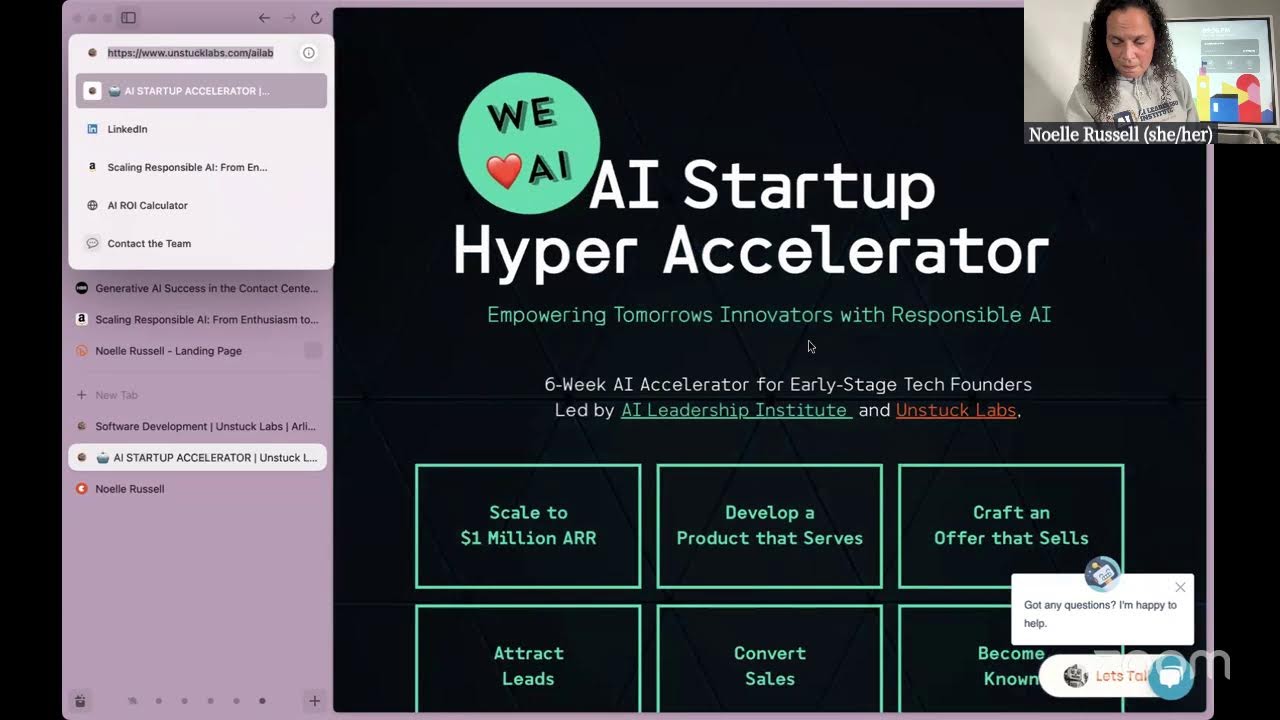
Unstuck— there we go. Unstuck Labs. There we go. So Unstuck Labs, and there is— I'll show you the URL in just a second, but it's called— oh dear. Right here. So this is batch number 1 AI startup hyper accelerator because we're doing it in 6 weeks where we typically do it in 12. But that's because you have a beautiful moment in 2025 to kickstart your practice. And so if you want to kickstart the practice, this is what we do. We're going to help you scale to $1 million ARR in your first year. My goal is that you never have to do the things that typical startup people do, which is spend all their time crafting a pitch that they will give to a venture capitalist who might say yes. It is so much wasted beautiful energy. I'd rather you use that energy to acquire customers and let your customers pay you and let that payment serve as the fuel to grow your business. That's how I've done it. I've built 3 businesses. All of them I built it's another word for that is bootstrapping, basically by— however, in the olden days, bootstrapping meant you used your own money to fund your business. We're gonna use our clients. We're gonna deliver something of value. We're gonna find people to pay us for it, and then we're going to scale that motion. So yes, 100%, too much pitching. Yes, Lisa. I mean, it's a, it's a shame. So I'm a believer, but granted, we are going to teach you how to pitch VC because some of you are gonna want that money. Some of you are maybe even well positioned to get that money, but a lot— some of you also may not. And I just don't— I've watched so many great ideas die in a VC room where people just dream squash you when, you know, for whatever reason. And it's entirely possible. All you have to do is have conversations with clients that you have created a lead magnet for and attracted to you. They already have said, yes, talk to me. It's so much better than the pitch process. So, so that's what it is. Um, of course we're going to take you through all the things we went through in this program, but it's done with you. So you'll spend 3 days. Now, if you don't want to go into Arlington or you don't live in DC, we are offering a virtual session. You'll get the exact same thing. You'll just be doing it virtually. I'll just tell you straight up, it's hard to do because you have to be disciplined and my Again, we're, we're committing to multiple organizations, including venture capitalists, that we're gonna grow these companies. So you do have to apply. You'll have to speak to 3 people. I will be one of them. Weil, who owns the Unstuck Labs organization, he will be another, and we'll be evaluating not only your idea, but also your purpose and your vision, because it takes a special person to build a company. And I don't know if you know it yet, whether or not you're that person. But I definitely think it's a great process to go through to understand, are you ready to be an entrepreneur? Are you willing to do what it takes to pay the price now so you can pay any price later? Like, that is the goal, is like, how do we create companies that employ people? We're not building a single-employee company in this startup. We're going to teach you how to scale to when you hit $1 million ARR— ARR, that means annual recurring revenue, that means that you're going to have at least 6 employees. So you're— the goal of this is to actually build a business that will scale. And so if you're interested, you can head on over. I will grab the URL. Yay, thank you. Oh, you're so nice, Sonia. Thank you very much. Yeah, it's fun. Like, I'm telling you, like, you all haven't been in an accelerator with me, but I'm like, it's no joke because I know that you can make money. And most of the time when people start, they don't think— like, they kind of are like, yeah, it could work out. But I am— I have no question in my mind. I am 100% certain that if you follow these steps, you will find your customers. Most of us just don't have like the wherewithal to do what it takes. So that's why doing it in a group is really nice. So if you're in Arlington, everyone sits in the same office. We're taking 15 teen startups in Arlington. And if you are gonna join us virtually, when you join us virtually, that is, um, gonna happen in a platform called Gather. And I've been testing it out with my team, and I absolutely love it. You get this cute little, like, um, I was gonna say Atari. Does that date me? But like this little Nintendo emote, like little Bitmoji person that looks like you. You get to set up your office space, and we get to like literally jump up into a room at any time and have a conversation. We can do one-on-ones. It's so amazing. But yes, so we'll do 15 in person if you're interested and in the DC area. I hope you'll join us if you want to go virtually or you just want to experience getting interviewed. This is very much like a, a hyper accelerator, like Y Combinator, Techstars. If you have a vision of being in that, it's a great opportunity and you get to meet some incredible people. There is an investment. It's a, it's a bit negotiable depending on where you are. Um, but it's $3,500 to play. Again, that's discounted by 70%, uh, because you all are my people and I really want to create an opportunity. If you have trouble paying, uh, to be part of it, you could also pay with equity in your company. And this is also a sign that we 100% expect to grow your business. So That is an option as well. You can either pay $3,500, you can pay half and do 3% in equity. You can do no cash and 8% in equity. All up to you. Um, and of course I'm getting ahead of myself, but you should definitely think about it if you really want to grow your business and you think it might be helpful to have an organization around you and high-energy people like myself, 100% committed to your success. It's only 6 weeks.. But it will be probably really hard. I'm just telling you because I don't want to like— it's not going to be easy. I work hard every single day, but it works. Like, it works. So I want to share all of that with you all. I think— let me copy the URL because that's my biggest thing. We're going to be doing another Q&A as well as recap when we come back right before this accelerator starts. So if you all want to join us, please feel free to do that. I don't know what is happening. It has K. Oh, there we go. All right. Oh no, I think I copied— that's not a link. I copied the text.
That's too funny.
All right, here we go. It's coming. Here we go. Right. Oh my gosh.
Yeah.
Like, there are so many things you could build. I built a founders platform on a, on a, a Replit. Do you guys know that one? Replit is an incredible tool to build AI software. There's so many cool things that you can do. All right. So I don't see any questions here at all. Oh, yeah. Where's my Q&A? I don't even see the Q&A. Maybe there is one and I just didn't see it. Oh, yeah. I have one question in the Q&A I'm going to go over. Someone in the chat asked. Oh, yeah. So someone was asking about the CRM that I use. I use a flavor of GoHighLevel. It's pre-stacked. It's got an AI system built into it. GoHighLevel by itself does not. I'm happy to suggest it to you. It's a bit expensive, so depends on where you are in your business and whether or not that's useful. I do all of— everything is in there. I build my funnels, I create my emails, I collect my contacts, I manage my sales, I manage my pipeline, my opportunities, the sales process, all is in that single interface. I used to have a tool for everything. So if I go back 5 years, I had Mailchimp before it was acquired by Intuit. I had ClickFunnels, which was my funnel building tool, and those 2 things were integrated. I was— it was a bit messy. And then I had like TweetDeck or HubSpot. Anyway, I had some social media tool. So now I do it all inside of, inside of my current tool. It's called Scale CRM, but it's a, a thing. Yes, awesome. Tony, thank you. I'm so glad you got to stay. And I see a question. Jessica, you are here. I hopefully—
I don't—
I might have to unmute you. Hold on, hold on. Let's see here. Let me try and find you. Oh, Adam's in the house. What's up? Oh, Grisel. Oh my gosh, Grisel. Go night. So nice to see you here. I'm just now getting back into the chat. All my good friends. Hello, everyone. Okay, hold on. Oops, I passed right by you, Jessica. Hold on, hold on, hold on. Let me find you. Are you still here? Oh, yeah, there you are. Okay, there we go. If you have a question and wanna ask, the rest of our time is gonna be spent in Q&A. I hope you enjoyed the session tonight. You will see this posted. You do have to join the I Love AI community in order to see the— which is a free community. It's super fun. A lot of us are already in it, but That's where you can go to the classroom and see all of the recordings. And just remember, probably Saturday around 10 AM, I'm gonna be rerecording week 4 because I accidentally didn't record it. So if you wanna join me, it'll be LinkedIn Live, so you can come and join me if you'd like to. Otherwise, that will also be available in the classroom when I'm done. Alright, Jessica, can you— are you unmutable?
I am unmuted.
Can you hear me? Okay.
Yay.
Okay. So, all right, this will be two itty-bitty little questions. So your CRM system, does that enable you to answer the email questions or have the autoresponder within 5 minutes?
Yes.
And it sends me— so I like to personally respond to people. And it's funny because when I do this, people are like, I know this is an AI bot. And I'm like, no, no, for real, it's me. And they don't believe me. So I'm like, battling the AI. But so I have it text me and email my team. And I also have a sequence that gets triggered, but that trigger happens after I just do a quick touch like, hey, it's Noelle. I'm so glad you signed up. So glad you're here. Like, it's within 5 minutes that I send them a message, but it's not like driving them to do anything. Then they get added to a 9-email sequence. Some of you all have been part of that sequence before. Um, I have lots of these sequences depending on what ascension level you're in. So each level has a different set of emails that take you through to purchase.
Nice.
So the CRM system handles those email sequences too?
Yes, extensively. I have probably 30 different sequences, and some of them are as short as 9, some are as long as 42, and they include in the same sequence It might be an email, SMS, or DM on social media, and that's all contained within that sequence, that like platform.
Okay. And the startup accelerator, is that all day for 6 weeks or—
No, it's like 9 to 5, uh, 3 days a week.
Okay. Yeah.
And it'll be the middle 3 days of the week because I will be flying into DC. For those of you who end up being in DC, I'll be flying into DC, uh, to do it every week. Uh, and I won't be there all 3 days. I will only be there 1 day, but I commit to actually being there with you. Otherwise, we have, uh, the rest of it, uh, Unstuck Labs will be doing the more startupy stuff like building your decks and creating your asset, um, and service menus and like things that are more tactical. Um, but the strategy, the sales, all that stuff I'll be doing live in person.
Is—
how much different is it compared to what you do on these calls out of curiosity. Oh, it's great value.
Yeah. So this, I just tell you what to do there. I literally, it's kind of like what we do in our Live Learning Labs except to build a business. So in Live Learning Labs, I only talk about tech, but this is like Live Learning Labs for startups. So I will literally sit with people until it works, and I will build sequences with everyone. I'll give you a bunch of templates. So it's kind of like, yeah, what we do in the, um, AI Leadership Institute, just compressed into 6 weeks and specific to startups. So my goal is to— which is why we have a fee associated with it— is that we're gonna help you generate revenue, where again, in the AI Leadership Institute, we don't have that commitment. Thank you for clarifying.
I was wondering what the difference was. Sorry to ask multiple questions.
Oh no, it was great. I'm sure other people had similar questions, so that's wonderful. Thank you. Was that all of them?
I always have more questions, but I don't want to hog you because I know—
All right, so I'll take these two, and then if you want to— Oh my gosh, Sima's in the house. Okay, so I'm going to go in the order in which these showed up on my screen. I hope they're the right order. Laura, you are next. You can unmute and say hi.
Hello. Thank you for this. I can't wait to see session 4. I was actually pitching last week at Next Raise. I don't know if you know them, also DC-based. Which was super fun for Citron Angels. Still have more work to do though. So for my— I have a startup and then I've been thinking about if I want to do a consultancy on the side, or if I just want to get the startup going. So my question is, would a consumer startup that does need AI components— I don't have them in yet— would it be an appropriate use of the accelerator's time and My time, it certainly fits in there, but it's not—
I mean, honestly, I would combine the two, right? Product plus services is a really beautiful thing.
This is true.
Yeah.
So I would— I mean, of course, you can focus when you're doing the product roadmap. You can focus on whichever products you want. You won't be able to do all of them if you have a large suite of services you want to offer, products you want to offer. But I would definitely use the accelerator to craft. How do you— because especially even in the early days of your product, right, how do you compensate for whatever your product doesn't do with time and make sure that you're valuing that time and positioning that as an offer? Yeah, but I think it's both and, not either or. That's at least my personal perspective. This is driving me crazy. Sorry.
Um, and do, do the, uh, folks in the accelerator have access to Unstuck Labs at all hours or just for those 3 days or?
Yeah, so there is, so Tuesdays is available because they already are. I don't, are you familiar with Unstuck?
Yeah, I've been, I've been there.
Yeah. So you get access on, I mean, Tuesdays they're already open. So now you'll get Wednesday and Thursday. Um, I'm sure if you need more time there, but the idea is that you're gonna be like, kind of heads down for 3 days, and then it's up to you how you choose to use the rest of your week. But Tuesday, Wednesday, Thursday.
Okay.
And it's kind of cool because you will get to share your progress on the Unstuck Tuesdays in the Unstuck Tuesday session. So you'll be spotlighted every week.
I haven't taken advantage of their general setup before, but I've been to the lab a few times.
Yeah, it's fun. I mean, their new, their new place, which is like, I guess, a year old now, is really— I'm— I love working there, which is why we just, we decided to do this. Like, I wouldn't mind working there one, one day a week. That would be amazing.
That's the one in Roslyn, right? Or—
that's right.
Yeah.
Okay. Yeah, this is, this is exciting. Noelle, I'm definitely I'm, I'm, I, I actually am gonna have some time in the next 2 weeks to do stuff like this, so I will. Yay, good!
Okay, well definitely hit me up if there's any, you know, you want to like brainstorm or talk through anything. I would love to because I'll be also doing that myself. Okay, awesome. Yay, thanks Laura!
Awesome.
All right, thank you.
Yep.
All right, Joyce, I have you next. Oh, sorry, I have to allow you to talk. Okay, Joyce, I think you're good to unmute. Oh, thank you so much. And I think I may have missed it, but I wanted to know when it starts. Oh, it starts, uh, we haven't picked the actual date because we want to interview a bunch of people and kind of, you know, figure out when the best date is. But it'll be, it'll be either the second or third week in January, so pretty quick to start.
Oh, okay.
So when we fill out the forms, we are not making the payments today? No, no, you're just— we just want you to know that that conversation will happen. I mean, you might not even, you know, like you might get to the end of that conversation, be like, well, I'm not ready for all that. But we want, you know, I'm a big believer and you set the price and you should do this in your sales conversations to everyone, like say the price as early as possible because if someone's completely not available, like don't waste anyone's time. Like so many of us like go, oh, I don't want to say the price because maybe they'll say no. Like, I hope they say no so I can get to somebody who will say yes. Okay, so, uh, yeah, so you will not have to pay until you are accepted into the program, which will be after your call.
Okay, okay.
Yeah.
All right, thank you so much.
You're welcome.
Awesome. Uh, and Sima, good to see you. Oh, it's awesome. Okay, I think I have allowed you—
Noelle, can you hear me? Yeah. Hey, it's so good to see you. I love— you know me, I love you so much. You're like, to me, the queen of AI. Noelle was a keynote speaker at DC Startup and Tech Week, and Appreciate you so much.
Tell everyone a little bit, just a little bit about who you are.
Oh no, I play two hats. I'm the co-chair here of DC Startup and Tech Week, which is the largest entrepreneurial community and conference in the DC, Maryland, Virginia area. We do our big tech conferences in October of every year, which is like 5, 6 days, thousands of entrepreneurs, investors, all the things. And AI is a big, big focus of ours. We did an awesome AI track and Noelle Russell was our keynote speaker, and so grateful. In the second part, and this is a good question for you because, you know, we started Virgin AI really helping accelerate adoption for AI in businesses in January of this year. And we really want it to be a big play, not only in the DMV, but globally, you know, globally, but for now heavily focused in this region. So I like, you know, we did a lot of like I've done a lot of market research. We've gotten a lot in the marketplace. I guess for you, I have a question for you because I think we've gotten clear on our ideal client, which is really the midsize marketplace. And in a sense where the enterprise are all going after COTS solutions, small businesses, startups are subscription-based. We do work with growth-stage startups, different conversation for a different day. But my question to you is around the mid, that mid-level. Our goal is, I'm doing a lot of talks, I get in front of presidents and CEOs and stuff like that. And it's been good in terms of like getting into the conversations, but What, what have you seen in terms of a best practice? Like our first initial goal is to do discovery with them, try to identify the highest impact, highest value, lowest effort AI opportunities and kind of help them roadmap in their functional areas, then product, then innovation. I'm gonna stop there, but I'm just curious if you think we're doing it right.
I'm a little contrarian. Um, and I think you could do both cuz there are some organizations that like to do that. But I do think a lot of companies, especially in the med space, have been burned by bad consultants. So that's just the reality that they're like, yeah, I don't want any discovery. I don't want to pay for that. Like, you instantly kind of put them on the defensive when you use these terms, which I'm sure your research probably showed too. So what I do, what we do instead is kind of deliver a, like, a 90-day accelerator or a 90-day you know, something where it's 30 or, you know, 3 months. And at the end, they get a model. And as you know, like, building a model today is not super hard. The hardest thing is gonna be like identifying the scope, which you'll do in the context of those 90 days. But what you're selling is the delivered custom model for sales, marketing, back office, invoicing, whatever area that you uncover in the call with them or on stage with them. Right? When you break out and you talk to them and you're like, oh, so what's your biggest challenge? It doesn't even matter what they say because you can build a model for that, right? So once you know what that is, now you're deli— now you're gonna position, or again, this is what I do, is I position like, I can build you a custom model for that. And that, that's the first thing we do. Now, in the context of that 90 days is our AI impact assessment, our discovery sessions, our roadmap, our planning, our blueprint, all those things that set us up are like week zeros, but it's in the context of a delivery. And that model that we pick is directly correlated to something, some business value metric that we can clearly identify. We've made at least, like in our case, it's a $75,000 investment. Yeah. So just like you saw with that calculator, we only pick use cases where we can generate at least $100,000 in either time saved or revenue generated. So if we do that, we win, but we also train the client to start thinking, hey, I just have to break even on costs. Like, that's what they're kind of— by the end, they're like, oh, if I could just make sure we don't lose money on investing with you, like, they give us $75K and we make $100K for them, they're willing to do the next project with us with the $25K extra that they— it's not like— if you think about the math, that's not how it works, but this is their mindset. Is it opens them up to the idea that, hey, I'm gonna pay you in advance of forward benefit. And those value benefits that you can generate are pretty simple in the— in specifically, that's why I, I say this to you in the mid-space because Accenture, Deloitte, McKinsey, they ignore this space. It's a completely forgotten space. So they have no help and they're a big mess. And so you can find, especially the first 5, 10 projects, can be really simple, hard for them because they're, you know, what do they say? You can't see the picture if you're in the frame. Like, they're so close to it, they can't figure it out. But it is finding— I call it a minimum remarkable product, right? Finding that one thing and then selling it as an accelerator that includes the cost of discovery. Because as soon as they hear discovery, my experience has been they kind of go, yeah, well, I mean, we had discovery and, you know, it just takes them. It That's the other way. Yeah, yeah, yeah.
It's— it— yeah, no, no, that was a really helpful, um, concept. Everything outcome-driven, value-driven is, is the key. We, we just find—
and I know you do that anyway, but I think even from go-to-market, like, because that's something like, I don't know, I think there's a lot of habits we have just from big consultancies of like doing a deck pitch and, you know, like all of that, which all can go away when we can just show up with a model that already kind of works to do the thing we want to do. It's extremely persuasive, as opposed to showing up with a 20-page deck with really small print, you know, here's all the things that you can do.
Now, yes.
All right.
That was helpful. And I'd love to see you when you're here. And we got to get you on my pod. Like, I can't wait.
But oh my gosh. Yes. It's definitely overdue. But I'll let you know when I'm in town, which will be the first week we start this off. And then we got 6 weeks we can hang out.
Awesome. Look forward to it.
Thank you so much. So good to see you here. Thank you for joining us. Awesome. Did I get everyone? I think that was everyone. Let's see. Sima, Jessica. Jessica, you have a couple more questions, maybe. Are you good? I do.
I just didn't want to be a hog.
No, we're good. We went through everyone else. You're welcome. Awesome.
Yes.
So it's your turn again.
Now I'm shy.
No, I'm sorry.
Should I be afraid of applying for the Unstuck Lab stuff? Because it's new to me and I'm like, no. And as a consultant, is that something that they even look at?
Yeah. No, 100%. Like, this is built for— I did this webinar series specifically because we built this for us. So no, 100%. And like I said, whether you want to or don't, it's certainly if you have an idea that you think you might want to have a conversation. Number one, because you don't— and Sima knows Wael. If you— Wael is worth meeting. He's worth having a conversation with. He will, in just the conversation of applying, he's going to teach you things that you haven't thought about for your business. And every time I talk to him, I learn something. I mean, we, we learn from each other, which is the best way for it to work. But he knows how to grow startups. So he has, he has helped, I don't know, 30 startups launch and become profitable. He has taken 2 or 3 of them to exit. It's like, that's— he's more of kind of like that, that startup incubator vibe, which I'm— which is awesome, and you're gonna need that from him. But of course, we wanna leverage AI as much as possible in the development of all of the things that he would manually.
Awesome. Because I was worried about the constructive criticism part because I'm used to car salesmen. So I'm like, oh yeah, how constructive is the feedback? It's not like, this is stupid. It's like, hey, this is good, but this would be better.
Yeah. And, and honestly, I think it would be more like, here's some— we invite you to think about it this way, you know. Like, that's— he's very, um, you know, he's, uh, he's very passionate about kind of social justice and equity and inclusion and making sure that everyone's way of thinking is validated. You know, it makes me feel better. Yeah, I mean, it's why I work with him, because he just— I don't know, he's given me— and we've done it to each other, right? Where he would be on a path and I'm like, all right, that's not exactly— and I would just invite him to consider a new way of doing it. And at the end, he'd be like, okay, I see what you did there, because I was definitely going down the wrong path. But we like, you know, we don't say, oh my gosh, that was dumb. Why did you do that? We literally have them, you know, we can help coach you down a different way of thinking temporarily, and then hopefully you just see the light. And if not, all lessons are good lessons. But yeah, no, it's definitely not tough love from that perspective.
That's what I was worried about. I'm like, yeah, I don't know if that's—
no, not maybe without me, but not with me being part of it. I mean, you'll see like on the website, You know, he's like, we love AI. I was like, that was a nice touch.
It's cute. It's like a Christmas ornament.
It really is.
Yeah.
He added that just for me.
Thank you. Because I was feeling really good about where I'm going. But then the call today, I got a little overwhelmed.
I know. Sorry.
I do have—
Oh, no.
It's not that. It's nothing to apologize for. It's just my brain processing, like, it's kind of like I was doing good, doing good, did doing good, not scared, no scaries. And then I'm like, uh, scaries.
Yes. Yeah, I mean, but this is like, we're, we're like about to do the thing, so that's appropriate, I think. Uh, and it's just, I think safety in numbers, right? The more people you can have doing the same types of things that are kind of equally scary. And it's so refreshing when you look around and you're like, oh my gosh, everyone's a little bit nauseous right now. Like, you don't feel—
pretty much that, that's where I was going with that.
Yeah, 100%. So much better because it allows you to just go, okay, I'm feeling this, and then I do it anyway, right? And that's why we— and especially, you know, like being in a room, whether it's virtual or in person, where you're just like, you have people next to you that are doing the exact same thing and we're comparing notes. It's really, yeah, it's very invigorating because otherwise you can get stuck and never do the thing because, well, it's hard.
Thank you. I, I appreciate it. Uh, thank you for calming me down a little because I'm a little squirrel too sometimes, and there's just so many things. It's a little time. That's why I was really excited you answered the other person's CRM question because I'm like, ah, thank you.
Absolutely. And as we— I mean, of course, all this starts in one place, and as you scale, uh, people always say like the things you do to start and get your company to a million are gonna be not the same things or even the same people who will scale you to $25 million or $100 million or $150 million. And all those are achievable results. Um, I've watched companies do it. So, uh, it— but what you do right now is all you need to think about. And those are—
that's where I'm looking at it, is I need the mentor for the next 2 steps ahead or 3 steps ahead, not 10.
Yes, exactly, exactly. Awesome.
Great.
Well, thank you, and thanks for asking questions because I think it gave everyone else a comfort level of asking questions. That was amazing. Okay, so Laura asked a question. I think you came on, but just in case, about how we qualify a client. You'll see the qualifications in the application, and don't worry if you don't have a deck already. We're just— the application is just to gauge where you are. So on the maturity curve, we can decide how far you need to go to achieve the goal that we're trying to establish. We also have a question. Virtual program similarly structured? It's the exact same. You will just join us virtually versus remotely. I will be in the virtual program the entire time. I will only be on site in DC for a single day. So everyone will be— even the ones in DC will be on the virtual platform in the office. Um, but, uh, but yeah, so it's exactly the same program, same timing, all of that. Um, and, uh, this is why we haven't set a date or timeframe, because we're gonna try and be very respectful of the geographical locations of people and time zones that they are in. Verole had a question about my experience with, um, uh, what are— is your experience with clients' enthusiasm? Verole, I might have to let— are you still here?
Let me see.
Nope. Oh, I remember he had to jump, but I don't know what he's talking about. I mean, I generate a lot of enthusiasm. Oh, there you are. You are here. Yay. Oh, I'm sorry. I scrolled. I didn't see you. Okay, let me go up and unmute you.
Oh, where—
you just unraised your hand. Are you good? To go find you again. There you are. Okay, hold on. Don't unraise it. Hold on. There we go. All right, you are, uh, okay, you can hear me now? Yes. All right, yes. So the question I was asking, because, because as I said to you before, I'm not a salesperson and you don't want to feel like I'm bombarding you. You know, I speak to someone and maybe I need to do follow-up, but you don't want to feel like, oh, am I, am I, are they gonna get frustrated with me? Yeah. Like what I was saying about value, right? So you'll want to be just very— and you may not follow up. Like, I definitely think you want to hit the lead that contacts you immediately, but maybe you follow up with them that day. And if they don't reach out to you, maybe you give them a couple of days, right? You can choose the frequency. You just need to know that the definition of the length of the sales process is determined by how frequently you connect with that client. So if you choose to not, like, do it once a week, it could take you 6 months to close that client, right? Because it's just gonna take time. You could condense that time by communicating more frequently. But I think the most important thing, the reason that we feel that way is because salespeople have done that to us, and they did not provide value when they contacted us. They provided zero value. They just wanted something. And so that is the difference is, like, if you can provide value every time you talk to your client, Here's the thing. This just happened. This news just came out. This product just launched. I just did this Loom video. Like, every time you reach out to them, you're giving them something that you genuinely think is going to help them. That people don't get mad at that. Like, even if it's not super helpful, if they think you genuinely care about helping them, they won't get mad. They won't, you know, yell at you. That is very much in our own mind and usually out of this, the unfortunate treatment we've gotten by bad salespeople. Yeah, it takes— we'll be better, we'll be better, of course.
Thank you.
Okay, awesome. Um, Sky asked a question about product ideas. Um, so some of the product ideas, I mean, it depends on which way you want to go. So I'll start with, as a consultant, your product is you. Uh, so you have two things that you can do. One, Uh, you talk, so that is, you know, basically phone calls. That is a product. Um, I would suggest you sell those conversations in buckets, either number of conversations or length of time. Now, my preference is just to do a monthly retainer. If you want my help, here's the value I can offer. So I would list out all the benefits of working with me. I can help you with sales, marketing, AI-powered workforce, AI executive training. Like, depending on what question you ask, I can answer. Like, these are all the things that I have an expertise in. You get all of that for the bargain price of $9,000 a month, right? Or if you look at the calculator, right, $2,500 a month, which is a steal, by the way. Um, and, and any of you could start pricing at that point right now, but it's a function of all the things that someone could ask you about that you've documented and shared with them and said, here's where I can help you. Now, ideally, you will have talked to them already and know where they need help. And then you can craft like, hey, you need help in this, and I happen to be an expert in this, and this is what you're going to— so the, the product is your time. But I don't want you to go and say, like me on TopMate, you can buy my time for half an hour. That is not valuable for me because I want to get to know my clients. I want to be able to derive long-term value for those clients. So instead, I converted that to a monthly, um, cadence. So there, it's a monthly retainer. They get 2 calls per week plus unlimited conversation via email. And that's why I only want to take 11, because that's a lot of conversations. But you can do up to 40, especially with AI. You can manage lots of clients. So that being said, um, that's one product, right, is your time. I typically would call that, um, like, that's, that is my consultancy, right? If you want to, uh, become a client in my consultancy, I have one product. It's me. You sign up and that's what you get. But other things to think about, uh, oh, one of the things I love, which you'll actually get to experience inside this incubator, is you can create a product to go along with your services. So I created a product called the AI Leadership Lab, and I basically built 15 custom models. I'm still testing them. Um, hopefully I'll be done sometime over Christmas. Everyone in the AI Leadership Institute, you will be my design partners, so you'll get to use it, um, ahead of time. But my clients get access to that, and it allows them to have a CMO, a CTO, a CRO, a revenue or growth officer, um, CHRO, for human resources. So one executive— and I basically went and trained these models on all of the public documentation, articles, books that I could find from the top 50 C-suite executives that I know. So it's— the list is disclosed, it's very clear. But now if I'm a, a business and I can't afford or don't have time to go curate my own advisory board, I now have this AI advisory board that's based on 50 different executives per model, which is great. So that becomes part of my value add or a product I can offer. I don't offer that product by itself. You can't just buy the advisory board. You have to— you get me and the advisory board is a bonus that you get as part of it. But I could easily sell that as well. Just a couple of ideas there. Let me check, make sure. Okay, cool.
Yeah. Oh, thanks, Andrea.
All right, do, do, do, do. Next question. Yes. Okay, I think we answered that one. Startup accelerators for people making software and SaaS products, or also— yes, I think we answered this, but yeah, no, this is for anyone. It's a startup accelerator, so it's not just for products, it's products and services. And like I said, My goal actually is going to introduce you to the idea of doing both, that with your services as a consultant, you create— and this is what Joe— I don't think Joe is still on the call, maybe, but Joe Blately is doing exactly this. If you're— I don't think— I don't see him here, but he was on earlier today, and he's in our I Love AI community. Great person. You can reach out, find him on LinkedIn, but he created a consultancy and built products to accom— like, to, uh, accompany his services. It's a great model, especially in a world where you just have to know how to talk to build software. Like, literally all those models I built with natural language. I did not create— like, we just did an agentic AI workshop inside of, um, the AI Leadership Institute, like, what, yesterday, day before yesterday? Well, yesterday, I think it was. Yeah, yesterday.
Yeah, yeah.
And so when we built that agent, right, we like that, you could just build agents for your clients, um, uh, and you could actually build an agent that's based on every conversation you have with your client, very specific to that client conversation. So you put all your notes in it and you put in all the questions that were asked and all the blueprints you gave them and all the guidance you gave them. And so that way, when you're not available, they could just ask the bot for, uh, information about anything you've talked about so far. So this is huge value that you can add to complement the services that you'll be offering. So I actually think every company will be a product and service company. Um, that is my belief, and it just creates more value for people. They'll be willing to pay higher prices, which we welcome. Um, awesome. Okay, I think I did— I think I got them all. Um, that was for all. Okay, Sky, yes. Uh, let's see if any other questions, or if you enjoyed it, uh, don't forget you can always throw a testimonial. I always am looking for people who have not heard me do my thing or had an opportunity to learn from me. And the best thing that we can do— thank you so much, Sherilyn— is we can generate testimonials so people can go, oh my gosh, this was fun. And it doesn't have to be super serious. It's not gonna, you know, I'm not like framing it, putting it on my wall, though it is framed in my heart. But it really is just to encourage other people. To learn something that maybe they thought they couldn't do before, and your words could literally help them do that. Um, oh my gosh, you're well— oh, absolutely, Lisa, it's so great to have you here. Thank you. Um, yes, of course. Yes, yes, yes. Uh, thank you so much. Oh, it's amazing.
Thank you.
Okay, awesome. See you later. Thank you so much. Happy holidays, happy New Year. I will be around, so please reach out. Um, definitely keep up in the community. We'll be live on Friday, both for the AI Leadership Q&A call and the fun I Love AI community call. I will see you all there. So great to see you. Thanks, Amanda. Thank you, Verole. Thank you all for staying so late. Those are our links. See us there. I can't wait to see you. And enjoy the day. Enjoy your evening. Talk to y'all later.
Bye.
More from Noelle

Take the Unlocking AI Challenge and Get the Keys to Unlocking Time and Revenue for Your Business



Don't Get Left Behind: The AI Executive Challenge #ai #business #fearofmissingout





