RISE UP AI Challenge -Day 3 Building Agentic AI Solutions
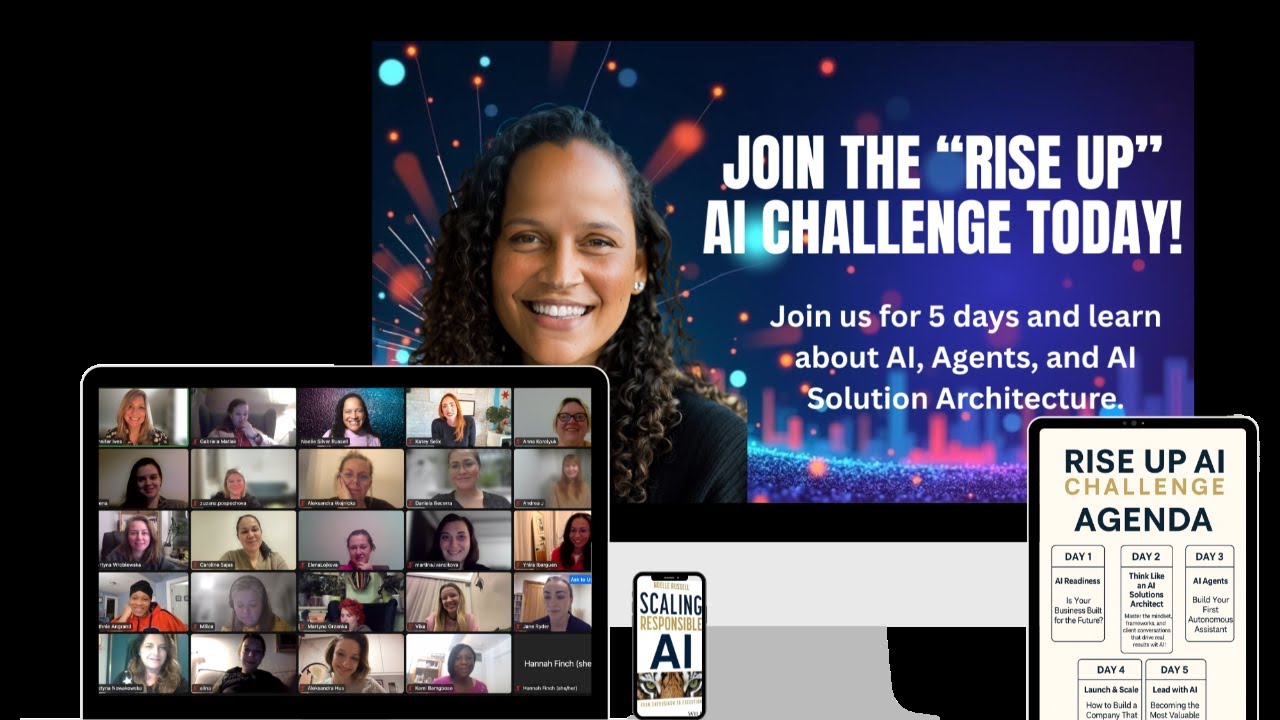
In this live session Noelle Russell opens Day 3 of the Rise Up AI Challenge, moving participants from AI adoption and solution‑architecture concepts (covered on Days 1‑2) to the hands‑on creation of an agentic AI system without writing code. She explains the business context—helping small local businesses (e.g., a pizza shop) with a conversational agent that handles customer‑service queries and lead generation—then walks through the end‑to‑end workflow: (1) defining the problem and Minimum Remarkable Product (MRP); (2) selecting a model using leaderboard‑based safety metrics (Azure OpenAI, Google Gemini, OpenAI GPT, Meta AI Studio); (3) building a system prompt using the “5 Ps” (Purpose, Audience, Portfolio, Perfection, Audit); (4) configuring the agent in a no‑code platform (Chatbot Builder, Azure AI Foundry, AI Studio); (5) adding retrieval‑augmented generation (RAG) or external tool‑use patterns for data privacy; (6) deploying the agent to a web‑chat widget and testing it live. Throughout she stresses AI safety: human‑AI experience design, guardrails via system prompts, model toxicity/accuracy checks, infrastructure transparency, and audit trails. She also promotes community resources (I Love AI community, VIP program), her book (which unlocks a free sandbox recording), and future sessions on scaling an AI‑driven business. The session is interactive, with live chat, audience introductions, and a quick demo of building a pizza‑shop chatbot in under ten minutes.
Chapters
What's up, my friends? Hello, welcome, welcome! Super excited to be here. I am home. Yay, home in my office! I literally just landed. I don't know how many of you are aware, on the East Coast there was some nonsense when it comes to weather, so we tried to get home a couple times yesterday. I was on one airline, flight got canceled. I'm like, no problem, I'll just book another airline in a different airport. So I booked another one head on over to that new airport, it gets canceled. And we finally were like, all right, let's just call it, we'll leave first thing in the morning. So here we are. So glad to be home though, very excited. I got a chance to hug my kiddos right before I hopped on, so really exciting to be here. Welcome to day 3 of the Rise Up Challenge, and today is a culmination of what we have done so far. And if you haven't had a chance to catch day 1 or day 2, don't you worry, you will get a chance to catch those replays. They are available in our community, the I Love AI community, and I'll be sharing those links with you. I think, yes, we are live across 8 platforms right now. So if you're hearing the sound of my voice, so excited to have you here. Thank you for spending some time with me. Our first hour today, we're going to focus, as I mentioned, this kind of a culmination of what we talked about so far. On Monday, Padmini Soni and Yuvika Sharma both joined us leading the discussion on AI adoption and the questions and concepts to consider as you kind of move into this directional, into this area of artificial intelligence, but more specifically, like past kind of day one. You know, most of us have POCs or small models that are kind of doing little novel things in our organization, something I affectionately call a baby tiger. These little baby tiger models are— many of us are probably implementing them, but it's really important to kind of think about what happens next. Like, how do we get the company to adopt them? How do we get workers, employees to use AI safely and responsibly and to help the business when, and especially if we're not super clear that the AI they use will not replace them? So skills anxiety and being able to build, you know, a, an ecosystem of people inside your organization or in your vendor ecosystem, or even as an entrepreneur with a collection of people in a community like the AI Leadership Institute, how are you going to approach this and what is the best way to do that? So that's what we did on Monday. On Tuesday, yesterday, we talked about all about AI solutions architecture. And in our session, I gave you some of my tips. I also, hopefully you got a chance to go check out the 21 Laws of AI Solutions Architecture. Architecture. That is the book that I wrote at the end of last year to kind of facilitate and help a bunch of solution architects and a bunch of people that are AI interested, AI curious, but also technology, you know, knowledgeable about technology, but really needed, you know, there's, there's a bridge to cross when it comes to leveraging AI safely, responsibly, and profitably for businesses. And so solution architecture, one of my favorite topics, we spent some time on that. Both days we had an incredible opportunity to connect with the VIPs that signed up and joined. So welcome everyone. If you have not received an email from me, please don't hesitate to head on over to your spam and become friends with me on email. We might be friends on LinkedIn, but if your inbox has never received an email from me, it's likely that it will file it away. And so go into your spam, go into your filters, and make sure you not only say that the email isn't spam, but also just add me as a contact so that you can get other future communications from me and my team. So today we're focused now, right? We talked about how do we figure out where to go first from an adoption perspective, then how do we architect a solution? That was yesterday. Now we're presuming those steps have happened. You've figured out a path to adoption, you've created an architecture or decided on a problem that you wanna solve, and now we're gonna actually build an agent, build our first model. Here's the good news, is it's no code, no limits. In our hour today, I won't have a chance to actually walk you through fingers on keyboard, though that is ultimately my goal. But there are two ways for you to do that. One is you can join our VIP program. It's never too late. It was in the email that you received earlier today, but it was also available to you, um, in Oh, it's also available to you if you are part of our I Love AI community. You'll see the VIP link there as well. You can also just DM me or DM my team at AI Leadership Institute. We're happy to help you get access to VIP because today we're going to talk about what it means to build an agent. I'm going to build one right in front of you demonstrating the steps that I encourage you to use. But in order to build it, well, you'll be on your own if you are only part of the challenge. In other words, it's DIY. I'm gonna tell you exactly what to do, but then you are on your own. Now here's the good news. Most of you are DIY people. I'm a DIY person. As a matter of fact, I always tell people I got my degree from the University of Barnes Noble because back in the day I just went to Barnes Noble and learned, you know, TCP/IP and HTML and how to build websites and how to create Java applications. And I learned Visual Age Smalltalk and Visual Age for Java IDE. Everything I learned from Barnes Noble. Very few things I learned actually in university. So that I use to this day. So if you are like that, you will enjoy the next hour that we have to spend together. You'll get a chance to see the instructions. This will also be available on replay so you can step through it. But if you are not— if you're not able to join us in the VIP session where we're going to put our fingers on a keyboard and build together, you can also alternatively— and you're not in VIP— you can alternatively— right now we actually have a campaign running for my book. So if you buy my book through a very specific website, it's basically I'll put it in the chat, info.aleadershipinstitute.com/book. And if you go to that website, you will see that you can buy the book and you'll get the recorded version of this workshop for free. So that is two different ways that you'll be able to get guided support. But I am— I'm a big believer that I can talk you through this and you can safely and responsibly go build a system on your own. We'll see. We'll see how it happens. And in any case, of course I'm here for you. So many people in the chat are here for you. If you are on this journey for the first time, or you're on this journey for the first time in a new capacity, we are all here for you. We've all been around, been doing this a while. I'm going to open up my chat. This is the time in the chat. What's up everyone? Great to see you all. I didn't have it showing, so I couldn't see all your amazing people. Um, so good to see you. Let me see, I might be able to do like, oh yeah, an overlay. So let's see. Oh, oh, there we go. Look at all those nice people. What's up? Um, oh yeah, we can definitely link it there for sure, Sherilyn. Um, uh, oh, site isn't available. What? Oh, oh, school? No, school's definitely available. However, maybe it's a regional thing, so reach out to me, let me know. Um, I know, can you believe it, Tony, we're on day 3. Super exciting. So great to see you all, great to see you all. I won't keep this— I don't even know how it's choosing who to show. So as you type it in, um, but we— it is always really cool for people to know where you're from. So if you wouldn't mind just really quickly and showing me you're here, engage in the chat and just say where you're from, where you're coming from. You don't have to give like the address or nothing. You could just say like South Florida if you're from anywhere in South Florida. Um, there's a couple of us that are a little, a little security friendly. Um, so awesome, here we go. When— happy Wednesday, good to see you. So as those come in, you'll see them show up. You'll also then exhibit, uh, the delay that I'm under right now, which is about a 15-20 second delay from the time you hear it, uh, and the time I start to see it, which is fine, no worries. So happy Wednesday everyone, so nice to see you. Heather, Nicole, Arissa, so cool, thank you for, um, contributing today. Uh, Jacob's back in the house, good to see you. Elaine is here, and of course I said hi to Tony. Knitting, my friend Knitting, is here as well. We've got people from Washington, Colorado, Massachusetts, Nigeria. Amazing. Um, So awesome. Vancouver. I was just in Vancouver. I hope we got to say hello. Michigan's in the house. Nairobi's in the house. What? More Nigeria people. West Chester, Pennsylvania. So exciting. So thanks for being here. That's just a few. I just decided to list them out, but so great to see you all. So happy to have you here. So thanks for being here. Let's jump right into it. This is probably— did I say yesterday that yesterday's was my favorite? I might say today's my favorite. They're all awesome. Literally, this 5-day challenge is a collection of my favorite topics. And for those of you who don't know or weren't here on day one, just as a little background, I built this challenge a couple weeks ago. You should do— you should spend more time doing it. I threw it together and I was just like, it's Fourth of July week, it's about freedom, it's about like our independence, you know, in the United States. What can I do to like embody that? And that's why I created it. I started off, it was called the AI Freedom Challenge, and then I took my son to New York and we saw Hamilton and I was like, oh no, oh no, we are calling this the Rise Up Challenge. So that's how this name, this challenge was born. It will not be the last time we do it. I do though think that the skills you're learning in the next couple days, but also over the course of the entire week, they will level up your career, your business, right? You as an individual, no matter what your role is, you are just by yourself. You are a professional services organization, right? Just you, you LLC, you Inc, right? Noelle.com. I am my own professional services organization. So all of these skills I am teaching you, no one can take away from you and they can only help you get better. So I'm so excited and we have such amazing people here in the chat. So definitely reach out to them, definitely connect with each other. This is probably the most powerful part of this challenge is the amazing people that are here learning along with you. And a lot of people in the chat in the challenge are not necessarily learning this for the first time. They're here to support, here to encourage, here to help everyone rise up in the age of AI. And I am so excited for it. So I've given everyone a chance to get here, so hopefully we are good to go. Welcome to day 3 of the Rise Up Challenge. I'm so happy to be here. All right, so I'm going to go ahead and share my screen. I don't typically do this, but I have— uh-oh, which is All right, we're back. Did y'all see that? Did you see it? My whole computer died. Thank goodness for Restream. Restream kept me going live and well. All of these windows are coming up. All right, I'm gonna check the chat again. Y'all see me? Am I here? Can you see me? Um, all right. Oh, like Noelle thinks I'm here, so that's awesome. Welcome back. I hope everyone's here still. Okay, it says my stream is still live. I'm gonna need one of y'all to throw it into the chat that you can still see me and hear me. Um, welcome back. Thanks for having me. So cool. And I see even more people. What, Robert? Oh yeah, no wonder we've met before now that I think it. Matthew's in Homestead. Good to see you all. I'm just making sure we're still good. Um, let's see. Okay, I'm going down to the bottom. Let's see. Uh, yeah, it's coming in right now. Okay, so we're on like a few-second delay. Yay! Okay, cool. All right, someone just told me I'm amazing. That's cool. Okay, good. Slight delay of game because everything shut down. Like my whole computer rebooted. It was a Mac. It was lightning fast though. So I'm pretty impressed. Um, but I'm so glad. Thank you, Restream, for being a decent platform. Okay, cool. I see y'all. I see y'all. Okay. So let's start again. All right, here we go. Let's just do the hair. Um, and, uh, and get this party going one more time. I'll cut this. This part will be edited in post. Um, but so, oh yeah, I was going to, oh my gosh. I wonder if it's going to happen again. I was going to share my screen. That's the button I clicked when all heck broke loose. Okay, I'm going to say allow. And here we go. Okay, it seems to be letting me do it. So let's see what happens. I'm going to go on over to Chrome. Oh, maybe Chrome crashed. See, there are all sorts of good things. Oh no, it's here. Alright, so I'm going to share my screen really quick with you. I'm actually just going to share my whole screen, which is very dangerous. Do not be overwhelmed by the sheer I'm like, number of things going on on my screen. Oh yeah, I remember. Okay, hold on. Um, so I'm gonna share this screen and move. I have a very large display, and so I want to make sure you all get a good resolution, uh, for what I'm about to show you. It's pretty cool. Now I do use AI for, um, all the things. I am a one-person show. I don't know if you know that. I have an amazing assistant, Sherilyn, who, I work with who helps me like connect with all of you and send messages and emails. But when it comes to like production and like doing lives and my podcast and all of the content creation, I do by myself. Um, so have empathy, uh, number one, uh, in, in that. Um, but also I'm just trying to find my little screen. What happened to it? Oh, there it is. There it is. I found it. All right, here we go. All right, we're in business. Okay, cool. So now I'm going to share my screen and you'll be able to see what I'm seeing, or at least what I hope to show you. Uh, it's not working. Why is it not working? Okay, hold on, hold on. Delayed. This is why I don't use slides. I just go right to the whiteboard. There's no technology, there's nothing I have to worry about or deal with. Um, but I appreciate y'all. Okay, here we go, there we go. So let me go in. I'm gonna try clicking this button again. It seems to think I'm already sharing. Am I already sharing my screen? I don't think so. Okay, I'm gonna move this around. Why? Why? Okay, let's see. I'm gonna do a little click. Oh, there, I found it. All right, I found it. Share. Cool, we're good. We're in business now. We're in business. All right, I see it. Oh yeah, there it is. Okay, let me put this in presentation mode. So I used Beautiful.ai a long time ago, maybe over a year ago. And created a presentation. And it was funny because it took me a long time to remember where I put this because I haven't taught it in so long. But this is what we call our AI Agent Accelerator. But this is like light speed acceleration. I normally do this in a day at a client or a half day if they're really pressured for time, or more maybe like now in 2 hours, in our case, 45 minutes. So we're going to go pretty quick. I'm going to talk to you about it and then I'm going to go in and I'm going to try and build one before we're done here because because it's so cool. I'm going to move this around a little bit so that you can see both options. What's happening? There we go. Let's see if I can get them both showing. Oh yeah, there we go. Oh, I think I want to do this. How about this? That's a little better. There I am. So I'm down at the bottom. I'm going to go ahead and share this with you. We delivered this. That's actually me in that photo delivering this this, um, for— I'm gonna go ahead and put it maximize. There we go. Uh, I delivered this in DC. I've delivered it now a two dozen times across the United States, internationally in Portugal. Um, I'll be going back to Portugal hopefully delivering it again. So there's a lot, uh, I've done this quite a few times and it's evolved constantly as we go through it. So I'm going to share with you, like, the goal of this session is to help you understand how easy it is to build an agent. And there's— I'd say 40 to 60% of what I tell you is true for all types of agents, but there's a little bit that's true about the first agent I encourage organizations to play around with. Now, I do typically tell companies, organizations— I will tell them, when you build an agent, when you build an AI system, it's really important to start by building with an internal system first, meaning help the helpers, help someone who, you know, like build an internal automation capability. I'm going to go against that guidance because it's not nearly as fun as building something that's externally facing. And the reason for that is that I am at the architect stage, right, where I've built something, I've designed something, and now I want to present it to somebody. So it does need to kind of be externally facing for that to happen. So the goal of this agent that I'm building here is I actually want to build something I can demonstrate to a stakeholder or to a client and get them to go, ooh, I want that, right? Consider it— remember yesterday some of you heard me talk about MRP, or the Minimum Remarkable Product. This is a guide to how to build minimum remarkable experiences that person on the other side of the table is going to go, well, that's pretty cool. How do, how do I get that? Can I get that? Can I get more of that? What else can we do? That is the response we're looking to do when we build these systems. So that's about 20, we'll call it 25% of what I'm about to share with you is building a remarkable solution. The other, it is our, what I call the AI safety system. It is the framework for building all agents so that they're safe safe, responsible, and profitable. And so I'll go through that as well. But we are going to take on a bit of a persona. So all of us, I'm going to encourage you to do this. Do you have to? Absolutely not. There's some of you that go rogue on whenever anyone gives you instructions, right? You just go rogue. Um, so it's up to you. But what I'm going to guide you to do, um, and this is what we typically will do with an organization where we say in 4 hours start to finish you're going to build an end-to-end responsibly built AI solution and deploy it to a website. That is the goal. Um, my husband was just signing to me from outside the door. Um, so yes, uh, so these are the steps that we're going to take in the next 40 minutes or so. First step, we are going to identify the problem. We did that yesterday, so if you didn't watch yesterday, go rewatch it. We talked about the problem. However, there are some use cases that I think are really good to go after first, so I'm going to share some of those with The second thing we're going to do is train the agent, train the capability, create the knowledge base. The third thing we're going to do is we're going to test it out and figure out if it is using its training and behaving properly. And then we're going to put it on a website and actually optimize it for performance. And that's where we'll talk about deploying and monitoring and optimization. So have a little empathy for yourself as well as for like the delivery of this because it's typically a much larger, larger timeframe. But I still think we can get to the most important things in the time that we have together. And for those of you who are in VIP, we're going to take from this, we're going to go right into building together. So I'm going to walk you through the lab exercises for this, which we definitely can do in an hour. I just take usually a lot longer to teach these concepts. Alright, so the very first thing we need to do now, first, I want to explain to you what an agent is in case you don't know, or you maybe have your own definition. From my perspective, I've been building AI systems for a long time, right, over a decade. And these AI solutions, they're like little autonomous capabilities. And now enter the world of LLMs and model selection. I can pick a model to solve a problem. We talked about this yesterday in VIP, right? The, the first thing we do is figure out the problem. In this case, I'm going to give you a problem. Your problem is to go to a local business for a local company— pizza parlor, dentist, florist, you name it— a local business. You're going to look at that local business. You don't have to call them, don't worry, don't get scared. You don't have to call them, you have to talk to them, but you're just going to pick a local small business in your own hometown, in your own backyard, and you're going to say, first, do you have a website? Let's hope It's 2025. Let's hope they have a website, right? So they're gonna build— you're gonna go and look for their website, and whether they have a chatbot already or not— some of them do, they're not great, but it doesn't matter— we're going to build a conversational agent to support them. And that conversational agent is going to do two things that this small business currently struggles with. It's going to answer questions that typically someone would call the pizzeria and say, do you have pineapple pizza? Do you put broccoli on your pizza? Do you have a kids menu? Like all these things that people typically would just call for, this small business is gonna now have an AI agent to do that work. And you can extrapolate that, right, to so many use cases. In addition to that though, we also want this agent to do something that's outside just a typical chatbot. We want it to also collect information, lead generation. And so now we can enlist another service,— it's called the tool use pattern in Agentic AI. I can enlist for that single service. It now can go and grab a tool like, I don't know, Gmail or, uh, Google Sheets or SharePoint, and it can collect user, you know, the user, the, the name of the client, their email address, their phone number, store it, and even trigger an email sequence to be sent to them to get them to come in and spend their 50% off coupon on a single up, right? That is the goal, is that we want to build a conversational system that has some level of understanding of the context of that business so it can answer questions, customer service first, but then also provide the just desperately needed service of generating leads for that business and driving traffic to the company. That it— I mean, and you could do this as a whole business by itself. So that's the problem we're solving, is we're helping small businesses. You're going to pick one, and I encourage you to play along. Like, it's just a game. Play along, pick a small business. I have a pizza place that I love that I have yet to sell this chatbot to, but I think it's pretty good. But I have a pizza place that I love that we'll maybe build for, or maybe I'll pick a different one. But pick a local company that probably doesn't have someone like yourself who is doing this work and learning this content to help them build something useful. And you're going to build for them a chatbot, a conversational agent And it's not just a simple chatbot. I mean, ChatGPT is a chatbot. It's a little bit more because of the connective tissue that it has to other capabilities. That's what makes it an agent, right? What differentiates an AI service from an AI agent is its ability to communicate autonomously to other systems, other services, other capabilities, not just datasets, right? Datasets is what we talked about yesterday by creating a retrieval augmented architecture, a RAG architecture, right? When you build a RAG architecture, you're creating a separate dataset, and I'll show you that as well. But that's not what we're talking about when we say building an agent. An agent means I'm gonna call out to another service and invoke that service to do some work for me. All right. So now we are stage 1, step 1. The first thing you have to do before you even get here is what we finished yesterday talking about. Which is you must identify the problem. What is the MRP you're going for? I just gave you that context, just play along. Let's do that, right? So I've identified a local business, Del Vecchio's Pizza in Weston, Florida. They're awesome, my family eats there every Friday. We are good friends, we love that place. I've identified a local business, now I know what my problem is. I'm going to solve for customer service and I'm going to create a lead generation agent for them. It's going to do sales even them, right? I'm gonna maybe even connect it to a booking application so they can get people to make reservations, right? Like OpenTable. So I— that's my goal. And now I need to pick a model to support that communication. So there are a bunch to choose from, so many. I'm only going to give you a couple, maybe a few, right? Azure OpenAI. Some of you know I'm a Microsoft MVP. I am up for renewal, so pray July 10th is when I find out. So I hope I make it another year. This would be my 5th year as an MVP. So fingers crossed I do this well and they accept me and give me another award. But if not, I still love them and I still definitely leverage this service at scale. So Azure OpenAI Service, it's basically the productized version of OpenAI. Productized, meaning it's not OpenAI's model, not in OpenAI's infrastructure. It runs as a service on your tenant. One of the key kind of focus points when you're worried about security and privacy and data leakage. So that's one. Another one is Google Gemini. Google just launched AI mode, so y'all should check it out. I was a beta tester on it, so I like to give it a shout out. Go take a look at that. But you also can leverage Google Gemini in your Workspace ecosystem if you're a Google Workspace user. There's also OpenAI's GPT builder, custom GPT builder. We are writing a book and Yuvika and Padmini, who hosted day 1, they are working tirelessly on building out the rest of our book. Hopefully it'll be out in just a few months. Thank you so much. And then, so this is a huge, a very cool capability. I'll tell you more when we get there. And then Meta has its own AI studio. All of these things allow you to build a dedicated AI system to support these tasks. I, of course, am going to use ChatGPT. However, I don't— I want this— I don't know if you saw at the beginning, there are some words that said no code, no limits. I don't want you to have to learn how to write code or even read code in order to do this work. So we're going to leverage a testing harness provided by a company called Chatbot Builder, ai. Ryan runs the— he is the CEO, founder of this company. We're good friends. We were on a podcast together. We have some friends here. Kim is here. Some of you know me through that podcast that we did together. We are both on the same side of, you know, we're both fighting the good fight of getting everyone equalizing access to building with this technology. He runs the platform. I don't build platform. Well, I shouldn't say that, but but I don't build platforms for like everyone. I build platforms for customers. So I leverage his platform to do that. So for those of you meeting me in the VIP session, we're going to use this platform to build it. It's very easy to do and it's free. He gives you a free sandbox indefinitely if you need it, but at least for 14 days, which is plenty of time to do what I'm about to show you. Now I do want to— did I say I was sharing my screen? I think I did. So what I want to do right now is actually share with you a couple of these tools. Azure OpenAI service has a tool called AI Foundry. I'm currently right now in the agents playground, but there are lots of playgrounds that you can leverage. There's a video playground, images playground, audio playground where you can build your own neural voice, speech playground. Oh, that's the one actually. Audio is where you can create audio sounds. Language, which is where you can do a lot of translation services and natural language capabilities. And the Assistance Playground, which that's an interesting one. We'll have to do a Live Learning Lab on that one because it's really cool. But today we're kind of focused on building systems. Let me go into the Chat Playground and see if my capabilities are still in here. Let's see. I think I actually did it in the Assistance Playground. So let me go back real quick. I think I built a bunch of assistants just to give you a sense of what this looks like. So— oh no, it's not here. All right, maybe, maybe they'll— oh, you know what, it's not in this one. All right, anyway, so this allows you to— assistants basically are these little agents that you're going to reuse, and that's— I actually built mine in OpenAI. Sorry, but you could do the same thing here. The capability is the same. What I like about Azure OpenAI is the fact, and most people don't know this, is that there is is a model catalog of thousands, tens of thousands of models that you can leverage. Tens of thousands achieved through Hugging Face because they have so many models to choose from. When you're choosing a model, remember yesterday, y'all, I talked about leaderboards? Here it is right here. So it's showing you the models that are performing well in leaderboards. I won't go into the details because we talked about that a little bit yesterday with HELM and the Holistic Evaluation of Language Models, a project released by Stanford. But now, Azure OpenAI service as well as, or I should say Azure Foundry, as well as NVIDIA, both integrate leaderboard information into your model selection. Before you pick a model, know where it sits on the leaderboard, know how well it performs. I'm going to give you the model. We're going to make that assumption. I'm going to pick it for you. But this is a choice that you would make when you're building an agent. Every agent should have a level of thoughtfulness on the type on which model you're going to use to support that agent's behavior. You don't want to just like— it's not like you just grab a baby tiger out of a cardboard box, doesn't matter which one it is, I'm sure it's fine. There is intentionality there. There is a series of metrics that are measuring success of that model. Is it accurate? Is it prone to creativity? Is it prone to hallucinations? Is it prone, most importantly, to sexism, racism, toxicity? Like, You should know that before you adopt the tiger, right? You should know what its behavior is before you get there. And these models, these leaderboards give you the ability to do, to do that. So I'm in Azure AI Foundry. That's pretty easy to find, ai.azure.com, but you can always ping me or someone else could write it in there. The next one I wanted to show you is AI Studio. This is out of Instagram. Let me go to my AIs, but you can notice here you can create an AI from scratch if you choose to. I'm going to tell you how you can use any one of these tools to create a safe, responsible, guard-railed model in any of these tools. It's very cool. But I just want to give you a sense that this toolset, there's a bunch of different ways to do it. It's a bit ubiquitous these days. I think I have one, maybe. I'm going to go to your AIs. Oh yeah, there it is. Nearly Noelle. And I don't know if you'll be able to see it, but it created this.. My son had a really— thought it was quite entertaining because I asked, I gave it who I was. This is NearlyNoelle, so it's basically all trained on me and my data and my book and my content. However, it auto-generated a picture of me and it kind of is okay except it has big gold hoop earrings. No bueno, my friends. No bueno. But that's okay. I won't yell at it today. We'll talk about that in, you know, a bias-specific, uh, discussion. So you can build an AI. I'm going to teach you exactly how to do it, but this is another platform. This, I think, is where I ended up. Oh yeah, so here I'm in platform.openai. This is actually Chat— or, uh, OpenAI's platform for building assistants. You can see here. So here, I think I'm gonna— fingers crossed, hopefully— oh yeah, you'll see them. So here you'll see these are all of the different prompts I've built for my clients. I've anonymized those— that data. But I have like clients in mortgage, cyber, hot tubs, roofing, insurance, and of course my own, Ala Ali, which is AI Leadership Institute, my own bot. Now when I click on one of these, you'll notice there is a whole bunch of stuff in here. Now it's not even that much because this is actually just an example I use to pitch clients. But I do want you to see how valuable potentially using ChatGPT, or in this case, the assistance architecture, either in OpenAI or in the platform of OpenAI, either in, sorry, AI Foundry or in OpenAI as a platform, you can create these systems that have these behaviors that you can then live demonstrate in a call with your client. So solution architects, like, this is magical when you are, when you're doing your thing in front of a client and sharing your ideas and, and presenting your proposal. If you can dynamically talk to an AI system that knows that client and can give them personalized outcomes, it's a bit magical. So I'm going to encourage you to do that. Um, and then finally, ChatGPT— oh, I have to log in again. Uh-oh, it's because my system rebooted. Oh dear, I'm probably gonna have to go into my auth to do this. Um, oh, awesome! Thanks, Sherilyn. So Sherilyn did just post into the chat the, uh, the podcast I did with Ryan from Chatbot Builder, which is where we're gonna go next. Um, but if you'll allow me, I'm just gonna head over to my authenticator and authenticate to OpenAI. Security first, people, security first. Um, there it is. Let's see if I can get it in before I time out. Um, It's not my code. Let's hope it works. Yay, I'm in! All right, awesome. So this— I'm gonna go to Russell Ventures. You'll notice I have a company, uh, enterprise account, and I have a personal account. Both are pretty cool. Um, so over here, uh, oh my goodness, where is— there we go. You'll see the ability for you— I'm now here, um, in Russell Ventures. And you'll notice over here I have GPTs. These are— when I go to GPTs, it'll show me a bunch of GPTs that have been created, which is great. But you'll notice here I can actually create my own GPT. So you could do this. You do have to be a paid, whatever, subscriber, have a license to ChatGPT to be able to do this. But what I'm about to share with you next is critical. Like, you have to have a platform. The platform I like the most is one where I can demonstrate it live on another website, and that is going to be this, um, this environment. I'm actually gonna go— I think I created like a Rise Up AI Challenge one. Yes, there we go, right? So this, I'm inside of Chatbot Builder. You can go, you can do this with me, but this is, this is where I'll be kind of building it out. Now, in order to build it, I mentioned to you briefly before, I use what's called an AI safety system. I heard this presented for the first time in academia, but then the first time I saw implemented, like legit implemented and it worked, was at Microsoft. Microsoft, you do remember yesterday, some of you heard me talk about, I think I did this for VIPs only, but this three-legged stool. Microsoft was the one that demonstrated to me how valuable that three-legged stool was. And that stool was on how do you build good, safe, responsible AI systems at scale? You kind of need three lenses that you're looking at the world, right? One is through the lens of academia, giving you research and hypothesis and like all of this momentum in the area of curiosity, which is what research offers you. Then have someone who's leading policy and regulation and legislation. So you have a lens into what, what rules are coming down the pipe and where is the organ— you know, where's your organization, your company, your government, state, local, and federal? What is the legislative organ? You know, what is the direction legislatively for the software or technology you're trying to implement. And then the third one is product. There are some really cool companies pushing the edge of AI product development. And I don't mean startups, though you can definitely look at them. I mean these companies that have billion-dollar budgets that they're spending on innovating in this space. If you're gonna follow people, follow them, right? I follow Sarah Bird. She runs, uh, Responsible AI Product in Microsoft. I follow Obviously engineering teams at NVIDIA. I follow engineering teams at Amazon. So it's really important to kind of find your people. And if they are demonstrating work that's happening in these big companies with these big budgets, we can leverage that, right? Build on top of the shoulders of giants. Oh, yes. So I was just seeing somebody was trying to play around with AI Foundry. AI Foundry does require a subscription, but here's the good news. If you're an AI Leadership Institute member, you actually get access to a subscription as part of your membership. So one more reason to join us over there. So let's take a look at the AI safety system. The top level is all about the human AI experience. And what that means is that, right, we've gone from adoption discussions to solution architecture to now solving a problem. The first thing we need to do is really think, what is the human AI experience going to look like? Now, I don't know if if hopefully Padmni is here. And Padmni, if you want to throw in the Hacks Toolkit link, and Padmni is an expert in this area, she has gone through and researched all the things that are in this toolkit. I have as well, but she has a cool, you know, like, just, she loves it, a huge passion for it. And I always like to give people their flowers when they're really great at something. And so Padmni, you know, has talked a lot about the human AI experience and how important that is to the the process of building solutions, AI solutions specifically. And I always will tell my clients when I'm talking to them in a workshop, I will tell them, or if we're building, you know, implementing something, I'll say that AI doesn't come and take anything, right? AI doesn't come out of the sky and go, I'm taking your job, right? It takes what we give it. It is a human-AI experience. Like, we decide what that experience looks like. If you haven't made an intentional decision about the human-AI experience, more likely than not, you have given away unintentionally quite a bit of capability to AI because you haven't thought about where is that line drawn. So human AI experience is a framework, a policy, a set of processes, a set of use cases that you can go through to actually examine how are humans and AI going to work together in this problem. In our case, Right? Remember our use case. We are helping a small business do something they may not even have people to do, right? Answer common questions, be around all the time during office hours and non-office hours. So that human AI experience is really so, so very quickly. Yes, exactly. Right? Yes. AI takes what we give it. And it's funny because people are surprised. Like, they're like, oh, you know, they're just surprised, I guess, that they, that we all have have a high level of agency when it comes to describing to an AI system what their role is and what it isn't. But most of us do not take the time to describe that to the system directly. So you might ask yourself, well, how do I implement that design, right? When I've decided on what is human and what is AI, what are each side going to do in building this workflow and developing this process? Once I've made that decision, how do you implement it? And there are a couple ways to do What we're going to focus on today is the meta prompt, the system prompt. You have a huge level of control in models that you don't own. If you don't own the model, a system prompt is all you have. But you have a lot, 375,000 characters to tell a model how to behave. So I'm going to share with you exactly the framework I use to describe to a model its best behavior and what has worked very well for me for years, 5, 7 years, maybe 8 years. Years. And only because before that I was kind of haphazard in my approach and I got much more specific as my AI systems began to scale. So system prompting is what we're going to focus on. But if let's say you own the model, let's say you're taking an open model and you're implementing it, or you built a model from scratch, or you have taken a model and created a small language model version of it. In any of these cases, you actually do have— remember we just talked about model selection. So in choosing the model, there's a new level of safety that comes in. Like, do you know where that model sits on the leaderboard? Do you know how good or bad it is at different types of questions and answers that it provides? Are you aware of its accuracy and recall? Are you aware of its levels of toxicity? That is your job when you get down to, I'm going to use— I'm going to build a model, I'm going to use a model. When you select the model, if you get that choice, which many of us will. But sometimes you get into a company and they're like, our model is Copilot, which is fine. But if you get into that situation, you don't get to choose Copilot. It's already been chosen for you. If you are an architect or if you are in a position of leadership where you get to choose the model, make sure you choose it safely and responsibly. And now with the help of leaderboards that are publicly available to you and people like Yes, reach out. The last one is infrastructure. This choice that you make, again, maybe you're up in the— maybe you're using ChatGPT and the only thing you'll have is the system prompt that you can use to change how the behavior of the system. But if you're picking the model, one of the first questions you should also ask is, hey, I'm going to use this model. If you don't own where it sits, in other words, if that model is not sitting on your infrastructure, your first question should be, where does it sit? And I personally like to ask questions in alignment with not only where does it sit, but what is your carbon neutral, carbon negative approach? How, how, what is your ESG strategy, right? If I'm partnering with an organization like Microsoft, Amazon, Google, Nvidia, they have documented this, they've made it very public what their strategy is to accommodate infrastructure scale. OpenAI specifically is very public about their direction, energy usage. The only one who's going to ask this question is going to be you, right? Because now you know, right? So it's so important that the deeper you get into the AI system, safety goes all the way to the bottom, to bare metal. Like that safety architecture means, and safety almost always is someone in the room willing to ask hard questions. Where is this? How are we cooling it? I just heard Sam Altman say last week, he was speaking at Y Combinator and he was like, how, how long will it be before we have so much infrastructure that needs a certain temperature? We won't be able to do it on Earth, right? Without dramatically impacting the Earth's atmosphere. So what's next? And what he had mentioned, it made so much sense to me, but he's like, yeah, likely we're gonna have to move all these GPUs into space. And we should know, right? We should be asking questions. What's your future with this infrastructure? How are you growing it? How are you managing the, the infrastructure costs? Not from a financial perspective, but from an economic perspective, as well as a, um, kind of a climate perspective, right? Like, we should just be willing to ask those questions of the people that are hosting this That's your responsibility stuff. Oh, thank you, Sherilyn. Sherilyn also put in the Hacks Toolkit link, so please take a look at that. It is a whole framework all on its own. Now, we— many of you have control over models at different levels. I'm going to zoom into the one that almost every one of us has control over, which is writing a good system prompt. I will encourage you, this is what we're going to do in VIP. We're going to go in and we're going to open up a chatbot account. It's free. You get to keep it forever. So do that. We're going to pick a model. I'm going to pick the latest ChatGPT model. We're going to do a 4. I'm going to go with like one of the Omni models, right? So 4.0, we'll go with that. And then we're going to choose how we're going to interact with it, though it's omnichannel based, but we're going to choose how we're going to interact with it in order to get to the next step, which is first we have to build the agent, then we have to configure its brain. Right? So now we have to train the model. That is the next step. So I'm going to walk you through the 5 things I do to make sure a model is trained well. And I mean specifically an LLM. An LLM I don't own. So yesterday, for those of you who were in VIP with us, you remember me talking about like, you have 2 options, right? You can do RAG, Retrieval Augmented Generation, to change the behavior and build the brain of your agent. That is true when you don't own the model. If I own the model, I could actually do parameter-efficient fine-tuning. I could actually fine-tune the model, but we're not doing that. We've got to scope something. I wish I could do all of it for you all in less than an hour, but I mean, my brain would hurt and that means your brain would definitely hurt. Let's try to stay focused on what can we do. Then of course, we do live learning labs. All— every single month we do a new live learning lab inside our community. So you are welcome to join us. And we— live learning means you put your fingers on a keyboard and you build. And that is what we're going to do in VIP after this. So here are the 5 Ps. I'm going to go through them quickly and then spend a little time on each one. And then I want to save 5 minutes for me to build an agent for you live. And, you know, I don't know, some of you know me, but building live is like super dangerous. Like, you never know what you're gonna So let's just see what happens. All right. So here's the 5 Ps. The first one is purpose. You want to be able to set a purpose statement. What does your bot do? This is the intention, right? The problem statement we spent time on, not only in adoption, but also yesterday in solution architecture. What problem are you trying to solve? State that as a purpose statement for your system. Your job is to do this thing. Your job is to be a customer service agent that also generates leads for your for this client. Then you're going to set your audience. That's the next one. People. Who is going to use this bot? Who is the audience? You want your bot to know who it's for, but also who it's not for. Then the portfolio. The portfolio piece is where you build the portfolio of information the bot's going to use to generate good answers. It's not just the Retrieval Augmented Generation, you know, data source. It's actually more about What information do we want it to use? But also, what are questions we want it to answer? What don't we want it to answer? Talk more about that in a second. Then perfection. I know this sounds strange. I often say this to people. I will say, do not— you know, what do I say? Like, perfect is the enemy of good. And I say that a lot when it comes to like content creation and getting yourself out there and building your persona or building your personal brand. In AI systems, perfection is the goal. And the reason I say that is it will keep you incessantly committed to looking at your machine, your system, your service, and looking for ways to make it better. Perfection is the goal. It actually is the desired outcome. We want it to be perfect. It will never be perfect, but that's the point. Our goal is to constantly monitor it, constantly improve it, and know that this baby tiger never grows up. That it might get better, maybe becomes a teenager, but it will always need supervision, always need someone checking for fairness and explainability, checking to make sure that the model is answering correctly, accuracy, making sure security policies are being adhered to. It will always need that human on the loop of that behavior to make sure that that is happening. And then finally, every single system you build should have the ability to be audited. I don't know if you know this, but some agents, when you pick them, some models provide no audit capability, meaning you cannot see the thought process, you cannot see the conversational chain. Even in OpenAI and ChatGPT, it's kind of hard, right? We can audit our conversations because in ChatGPT it stores— let me see if I have it up. I don't even think I pulled up ChatGPT. Oh yeah, I did, right? I did. I did. I did. Here. Oh no, no, this was platform. Let me do that really quickly. Oh no, not that one. No, there's Ryan. Chatbot. Oh my gosh. Chat.openai. I think that's it. Is that right? Yeah, that looks like it. All right, here I am. So you can see all these conversations right on the side. Like, that's my audit trail. If I want to go back and I, of course, I also preserve information this way, but this is my audit trail where I can tell like what were all those conversations. That's a little hard to manage in custom GPTs when you build using a custom GPT, which we were talking about here, and you go and like build a GPT, like it's hard to manage because it sticks all of those audit trails. You can see how many times I like play around with this, but it sticks the audit trails right in your conversation history, which is kind of hard to track. So that's why I make a point of like persistence. You want to create a mechanism to manage the inbox of conversations because like at Alexa, I mentioned to you this, I think on yesterday, one of the biggest things that we did to improve the efficacy of the model was to do a sampling of live utterances and say, is it doing a good job? It's hard to sample what you can't wrap your arms around, right? So create a mechanism for doing that. Sometimes organizations just create a cache and they just store utterances coming in or conversations coming into a database that they can use purely for this purpose. Purpose. Um, yeah, oh yeah, true, Tony. Ocean for infrastructure. Sorry, just keeping, keeping an eye on things. All right, so these are— I'm just going to dive in a little bit more deeply, maybe for 2 minutes, and show you. So the first thing you're going to do in the prompt, first thing you're going to do is not do prompt editing inside a SaaS product. So I would encourage you not to write your system prompt inside of these different areas that I showed to you, right? Do not write it in here. Do not write it in here. Do not write it in here. The reason why is because SaaS, y'all know, SaaS can go down at any time. I witnessed it just earlier today. SaaS can go down at any time, and if it does, everything that you've typed in could go away. Ask me how I know. Um, I've been burned by this. So what I'll encourage you to do is actually build out this in like a Notepad, right? Open up Notepad, TextPad, Word doc, Google Doc, and just write it out. I also like to use GitHub, so you could go out to GitHub. I don't think I'm going to be logged into GitHub, so that'll be a challenge, but I'll just show it to you. GitHub.com. Maybe it'll log me in. No, and then I have to like authenticate. I've got time for that. Let me see. I'll see what I could do. Let's see if I could do it. Oh yeah, I might send me an— oh, SMS. Okay, that's not terrible. I thought it was going to make me go to my authentication I got that. All right, this isn't bad. I feel like that was the same one as— anyway, I feel like I typed that in twice. So this is where I go in and I will document my system prompts, right? So this is for a platform called JusticeGPT. You can kind of see some of the ideas, um, that I've put in here for this prompt. Um, I don't know if I even have other options, but, but this is what I'll do. I'll just create a repo. And then I'll add my system prompts in GitHub and that way I always have it in case I want to reuse it or leverage it in a different way. And I'm Unity girl. You can make presumptions about why. I won't tell you this history too much about it, but I'm Unity girl. So if you want to go and check it out, you absolutely can. I want to go take a look at my— oh, there they are, my repos. All right, let's see if I can find another one. Do, do, do, do, do, do, do. No, I think we're good. Okay. Okay, so that's one way to do it, is to just open up, like, you can edit live into chat, into GitHub right from here, save it outside the SaaS product that you're using. And when I say SaaS, I mean ChatGPT, GPT Builder, Azure, or AI Foundry, AI Studio. You just don't want to fall victim to, like, all of a sudden everything that you wrote being gone. So just back— this is like an old, maybe a Y2K engineer showing my spots, but these are things, these are little superstitious things that I do to make sure I don't lose my work. Because in, yeah, back in the day, I used to lose my work all the time. All right. So now you'll notice, oh, let me go back and make sure. Yeah, yeah. Okay. So I think, did I just do this? I feel like I just did this. I'm gonna keep going. I just showed you all those. So purpose, it's much more than just you're a bot that solves customer service issues. Issues. This is where, remember the problem statement we defined as a solution architect? That's what you're going to define. You have to tell it what its problem is and most importantly, align it with the business objectives and give it a metric for success, even if its job is not to do the metric. Say your job is to get at least 100 leads a day. So fascinating what happens to the behavior when you do that. Identify your target audience. This is again not just who it's for, but who it's not for so that when people who are not the target audience try to talk to your bot, this is one layer of control you can add to ensure— no, you didn't. That's funny. This is— oh, sorry, I was just looking at something. Do I recommend using version control? I do in the context of like GitHub or if you, you know, use VS Code. Like I definitely would, only so that you can keep and evolve, right, these prompts over time. It also depends on your role. Your role might not be to re-leverage or create prompt repositories. As a consultant, I build prompt repos all the time. I have them for retail, healthcare, finance, every— I mean, manufacturing, distribution. So every industry that I have clients, I build a repository of prompt guidance that I will— and mostly it's all responsible prompts, like what are the types of attacks those specific industries get, and I do store those. And absolutely you can get the deck, absolutely. So I will put this deck as a link in, um, I Love AI, in our, in our classroom in I Love AI, or I should say, um, Sherilyn will probably help me do that. Um, but yeah, thanks for that question, David. Okay, um, oh my gosh, I'm running out of time. Okay, so portfolio, this is where all the magic happens. This is where you go to the website and scrape scrape all the content from the website. This is a small business, remember? So they probably won't have a SharePoint or a bunch of data. They won't need RAG. This is just like go to their website, scrape everything, and feed it into the engine of the system. Most importantly though, there are two things that I do that change my bot's behavior versus my competitors. One, and I'm sharing this with you— oh gosh, anyway, it's fine. I don't believe in scarcity. There's 30 million small businesses in the world. They all need this. So go for it, go spread it to the world. The one thing, one thing I do is identify a section in the system prompt for desired, uh, conversations. So I will put, here are the conversations I expect you to have, and I give 5 to 7 examples. This is machine learning, reinforcement learning. Here are the 5 to 7 examples of good behavior that I want you to demonstrate. I will also give it, you know, various different ways to answer. The second one, maybe even more important, is what are the conversations, what are the behaviors that are not good? So I call it undesirable behavior. So I will put what are undesirable conversations. I don't want you as a bot for a pizza place. I don't want you to answer questions about the Louvre, meaning the museum. I don't want you to answer questions about the post office. I don't want you to answer directional questions. Recipe questions. I just give it a couple examples so it gets the gist right. Remember, this is an LLM, so all you have to do is give it 5 or 6 examples and it will get the idea of what you're trying to avoid and it will then generalize that at scale. So I don't know if you know how important these two things are. It's just giving it guidance on what good looks like and what bad looks like. And this section is the section I optimize the most often. Is as I see— remember the, the last P, right? So perfection. I'll go through this first. You want metrics for measuring how well your system is performing. You want to capture how relevant are the answers to the customer. There are products that do this for you, but at least know that these are the questions you need to be answering, right? You need to know, was it coherent, right? Is it concise? Is it a good answer? Does it actually answer the question? How accurate is it? What are the metrics you're using to measure the successful outcome? Is it emotionally intelligent? Is it being kind? Here's the good news. You can build LLM as a judge or LLMs as a challenger model that can look at the answers coming back and give you a very deterministic number like it's 70%, 92, 88. Like you can actually use AI to help you generate an understanding of how your model models performing. And of course, we're vibe coders now, right? Like, you can literally do this without ever writing a line of code. So cool. Yeah, so RAG is gonna solve— I just saw a question. I can't see your name. That means I must know you, but sorry for that. But there's a question in that says, do, do, do, do. Oh, let me go. I gotta— there we go. So there's a question here. And it, see, it says LinkedIn user, so I wish, I'm sure we know each other, so I'm sorry for not being able to call you out specifically. What can we do for small businesses who want to protect their data and not pull information into a model? So this is where you can actually use retrieval augmented generation, right? They can own the data source and you just link to that data source from your model. So there is a feature inside, oh my gosh, I shouldn't do this. This, but real quick, no, I shouldn't do it. So I have an entire class that I taught on how to build agents inside of Azure AI Foundry, and there's a cool little capability called Azure Data. It allows you to connect to an outside system, and because it's on Azure, and this is also true for AWS, Google, and NVIDIA, and yeah, and other big cloud providers, there's others, but that communication, it happens like it is encrypted in at rest and in transit, meaning that it's encrypted in their source, then it's also encrypted as it crosses the wire. So that'll give them that protection. I think the biggest thing is, is that if you can describe to them what's happening, that it is encrypted, and that that connection to that RAG system is what is providing them that decoupling from the model itself, that will give them a lot of comfort. Most people who sell these solutions cannot explain how that works. So that is it. That's why AI solution architecture is so important, because it's not enough to just say, look at this cool thing. It's so much more valuable if you can actually explain to someone how it works to give them that confidence that it actually is not going to hurt them at scale. So awesome. Great, great, great. Okay, so here is what we're going to do. I'm going to go in and build a model really quickly. I know we're 3 minutes over, so if you got to run, Catch it on the replay. It's pretty good. I'm gonna take, I don't know, 3 to 5 minutes and build this really, really quick. Um, okay, so let me go over here. I'm gonna add a chatbot. I'm gonna call it— I'm hoping— I did not test this ahead of time. I'm hoping that my, um, oh goodness, Rise Up Challenge. I'm hoping that my own website I built has the ability for me to do this. We'll see what happens. I hope it works. Um, you'll notice here— oh, I guess I could put it as an authorized website. I'm not going to, I'm just going to leave it. I'm going to use a default welcome message, um, which is part of this. Uh, I'm gonna then say save. I've now got a web chat, perfect. But in order for this to do anything, all this is is like a window that I'm gonna stick— it's like a, a testing harness that's gonna go on a website, doesn't do anything yet. So what I need to do is actually create a system. So I'm going to go into settings and I'm going to pick a model. I'm going to encourage you to do exactly as I'm showing you, to just build an MRP today, right? You're going to go into settings when you get here, and you can watch this on the replay. Um, you can go into, uh, in this case— hold that thought— um, you're going to go into channels. This shows you all the channels this single agent can be available on, which is pretty cool. I just built the web chat for simplicity. We're gonna go into integrations and notice all the AI models you can pick because you're not gonna pick one model to rule them all. See what I did there? You're gonna pick the right model for the right use case and you might call on other models for other use cases and then orchestrate them together in an agentic solution. I'm gonna have you start with my favorite, OpenAI's ChatGPT. The reason it's my favorite is because this platform gives you 3 million tokens. For free as part of your sandbox. So use them. So I will go ahead and jump in here. It doesn't have anything, but you'll notice, um, oh goodness, they've increased the system prompt. 300— oh, maybe it's a little decrease. 312,000. No, wait, 3 million. Yeah, it's 3 million tokens. Um, oh, okay, well, in this case it's not tokens, but 3 million characters in order for you to tell the system what to do. I encourage you, if you— first thing you should do is go in and look at that system prompt. How much space does it give you? And use it all. And the best way to do that is to build the system prompt using the 5 Ps. So I'll go in and say, right, what is the purpose? I'll then say, who is it for? I'll then say, what's the portfolio of information I wanted to solve for? I'll then say, um, uh, desirable desired and undesired for the conversations. And oh gosh, I spelled that wrong. Desired, right? So that's the chunks of information. You'll notice down here, I also, oopsie, also have the option to change some model parameters. Not all of them. There's a lot, some of you know, but it does allow me to control how creative the model is going to be, right? And how many tokens I wanna use in the output, which will also control how fast I burn through that 3 million in a test environment. Functions allows me to leverage an Actions design pattern. This is an agentic pattern that allows me to call out to another capability, another call to another function, a method, a piece of software that's gonna do work for me. Maybe it's an API call to, a personal, you know, a personalized help desk, or maybe it's the call that calls Twilio and actually phones in the receptionist sitting at the pizza parlor or whatever. So that is one option. But you'll also notice the ability for me to integrate assistants. Assistants allow me to trigger agent capability, meaning I might have a Salesforce agent or a Gmail agent or a calendar agent, or maybe I'm going to go to OpenTable for my pizza parlor, right? I can build assistants that will assist me in connecting to those system services. Today, though, I'm just gonna stick with this. Um, let's see. Oh my gosh, I did not really think through all of this. So I'm gonna go to Del Vecchio's. Let's see if it remembers that I've been here before. There it is. Yay! Hi, Del Vecchio. It's good to see you, my friends. So usually what I do is I just Ctrl+A, Ctrl+C, copy the whole darn thing in there. And I'm just going to do this for as an example. So that would be in my portfolio, all the information, copyright, the whole menu, all of it. For a small business, again, remember, I'm building an MRP. This isn't production, this isn't the final version. It's the first thing that I'm gonna, I'm gonna show to a pizza parlor owner and go, what do you think? It's pretty cool, right? But what will, what will secure it, what will make sure that it's safe and responsible, is not the portfolio pieces, but actually these desired and undesirable conversations. So now I'm gonna have to head over to— hopefully I'm signed into school. Let's see if I'm in. Yeah, I'm in. Okay. And oh my gosh, we're cutting into my, my time here, but it's all right. I'm gonna do it really quick. So I have a classroom. Let's see where it is. I think it's down here somewhere. Do, do, do, do. You can see all the classes we have in here. I think it's in here. I hope so. Oh gosh, it's not in there. Ah, um, where is my— oh, you know what, it's actually not in this one. It's in I Love AI. It's in the I Love AI community. Um, oh look, there's a person waiting to be let in. Okay, uh, so let me go back to the classroom and then there's Chatbot Builder. Here we go. And it— oh no, that's the on-demand course. Dang it. Hold on, there's another one down here. There we go, this one. And so when I first taught this, I created this content And let me see if I have it here. Yeah, yeah, ah! Here we go. I think it was part 2— build your session. Oh my gosh, I don't even see it in here. Dang it, where is it? Some of y'all know what I'm talking about. Um, uh-uh, maybe Five Peas? Nope, it's not in there. Dang it, where is it? Okay, I'm gonna have to just make it up. So really quickly, let me go in and say, um, this is like documented, I'm just making it up because we're live, you know how live is, um, but I'm gonna say, you know, like, um, what's on the menu? And, um, do you have a kids menu? Cool, right? And then for undesirable, I'm gonna say things like do my taxes? And I'm gonna put an exclamation point. I'm gonna say, answer— do not answer— there's a much more specific way to do this, but do not answer questions that are not related to the pizza business. And I have like— you'll see this in the VIP session, which we're jumping into in like 2 minutes. Um, you'll see I have this actually all drawn out. So rather than copy and paste it in, I'll give it to you. I'll give you my guidance for how I build this. But it's just so you can see how it works. I'm going to keep, um, there's the Nano. It's best performing, so you can keep it. They give you a couple different options here if you want to use it. I probably should add way at the top something about, uh, being a customer service, um, agent that also generates leads for the business. All right, and then I'm just gonna take this part out because I kind of said both, and I'm gonna say save. So this is like 3 minutes. Please spend more time doing this when you build your own. Room. All right, so now I've done that. Now what I'm gonna do is I'm going to deploy it. I don't even know if this could work. Um, so let's see. I'm gonna go to Settings. Oh no, I'm gonna go to Marketing. Where is it? Oh, it is maybe. Um, Pipelines, Functions. Where is it? Web Chat Tools. I'm gonna go to this tool, it's called Bot Simulator, and I'm gonna deploy it. I'm actually going to take The Del Vecchio's Pizzeria place, Ctrl+C. I'm going to copy that. I'm going to go back over here. I'm going to say put it on this website. I'm going to grab the Rise Up Challenge bot that I just created. I think I did it. I don't know. We'll see what happens. All right, so it just generated a link for me. I'm going to paste it into a new thing. And you'll see down here, see that little chatbot? Oh, my face is in the way. Hold on. Oh my gosh, there we go. Hold on, I can't get out of my own, um, window. There we go. For goodness sakes. There we go, there we go. All right, there we go, I found it. Okay, here we go. All right, so now you can see this little chatbot, right? Oh, I forgot to unshow that. Thank you for that question, by the way. Um, so here's my little chatbot window. I click on it. So see what I did? I was able to— oh, I'm not clicking on it. So I was able to like— now granted, you'll spend more time in that training, but I was able to like train it. I'll be like, what's on the menu? Let's just see what happens. I mean, this is like crazy. Yeah, I did. Sorry, Joanna. But right, so you can see like it generated. No, I did nothing. But, you know, but now I can go to this pizza place and show them, look at this minimum remarkable product. Now let's see what happens if I ask it to do my taxes. Well, good. Yeah, I would agree. Definitely you should. Now ChatGPT will do that on our behalf, but it's better if we, you know, basically provide additional guardrails in the system prompt to control it. I'm also going to try— oh my gosh— speaking to it. Let's see. Oh, I don't know if I turned this on. We'll see. Oh, good. Okay. Allow this. Allow. Sure. Allow. What's on the menu? I don't even know if that worked. We'll see what happens. It takes a second because it's, you know, minimum remarkable product. Oh, oh yeah, I heard myself. Can you guys even hear it? You probably can't even hear it because I might not have turned on sound. Um, anyway, we'll see what happens. But like, this is why I think it's pretty cool, right? You get the— oh, there it is. So it actually is speaking. I don't know if you can hear it because I don't know if I turned on the sound. Do you hear it? If you didn't, if you can't hear it, it's like saying Parmigiana as Parmesan, but that's okay, it's cool. Parmigiana, Parmigiana. But these are things that we can change and improve. So my hope today was to give you two main topics. One, build in the context of an AI safety system right? Build the human-AI experience, deliver a system prompt that guardrails the behavior of the model, make model selections that are intentional and built on leaderboards that are published by reputable organizations. And for goodness sakes, ask about where your infrastructure is being hosted and what those companies are doing to protect us all. And then once you get into actually building the system prompt to protect and guardrail the application itself, use the 5 Ps. It'll give you just a nice framework for remembering all the important things to help protect your system, um, from— yeah, it was speaking back to me, Joanna, but I forgot to hit the little thing. You'll definitely see this in VIP if you are in VIP with me. I did a crash course because I so wanted you to do it. Okay, so I gotta go because I— these VIP people are waiting for me. We are gonna head over there. If you do not know the link, it's in your inbox Check your spam, head on over there, right? It was pretty exciting, Elaine. It's kind of like flying on the seat, like the seat of evolution. So it's pretty cool. I like it. I do have an entire 4-hour class if you would like it. Just send me a note and I'll send you over the link. All you have to do is get my book. If you already have my book, give the book away. But it is a relationship I have with my publisher that I'm going to try and give my book to everyone. And so I'm giving my AI Bot my AI Agent Builder class for free in exchange for purchasing my book. So cool. I'm so glad you enjoyed it. Thanks, Nicole. I know it's very fast, but we have an hour. What are we going to do? So thank you all for being here. This is amazing. Y'all are amazing. You can catch this on the replay as soon as we stop going live, so you can rewind it and take a look at the fast things that I did. But it's kind of cool, like a chatbot on a pizza place that I just built just now. I did this in less than 7 minutes. Imagine what you could do with 15 minutes. Imagine what you could do with an hour or 4 or a day. Like it's, it's pretty incredible what we can do to help small businesses today. So I hope you will, you will be inspired and, uh, and use this skill to make the world a better place. Thanks for being here, everybody. I will see you in the VIP if you are there. Otherwise, I will see you live tomorrow back here. I am here for the rest of the week. Week. So I'll see you tomorrow. Tomorrow we go right from here to what happens if you actually want to build a business doing this kind of stuff. I'm going to share with you how to start a business, how to scale a business from $0 to $1 million in annual recurring revenue, uh, with the way I've done it for myself. So if you're interested in that, I'll see you tomorrow. Thanks for being here. All right, talk to y'all later. Bye! See you later.
More from Noelle

Take the Unlocking AI Challenge and Get the Keys to Unlocking Time and Revenue for Your Business



Don't Get Left Behind: The AI Executive Challenge #ai #business #fearofmissingout





