RISE UP AI Challenge -Day 4 AI for Entrepreneurs
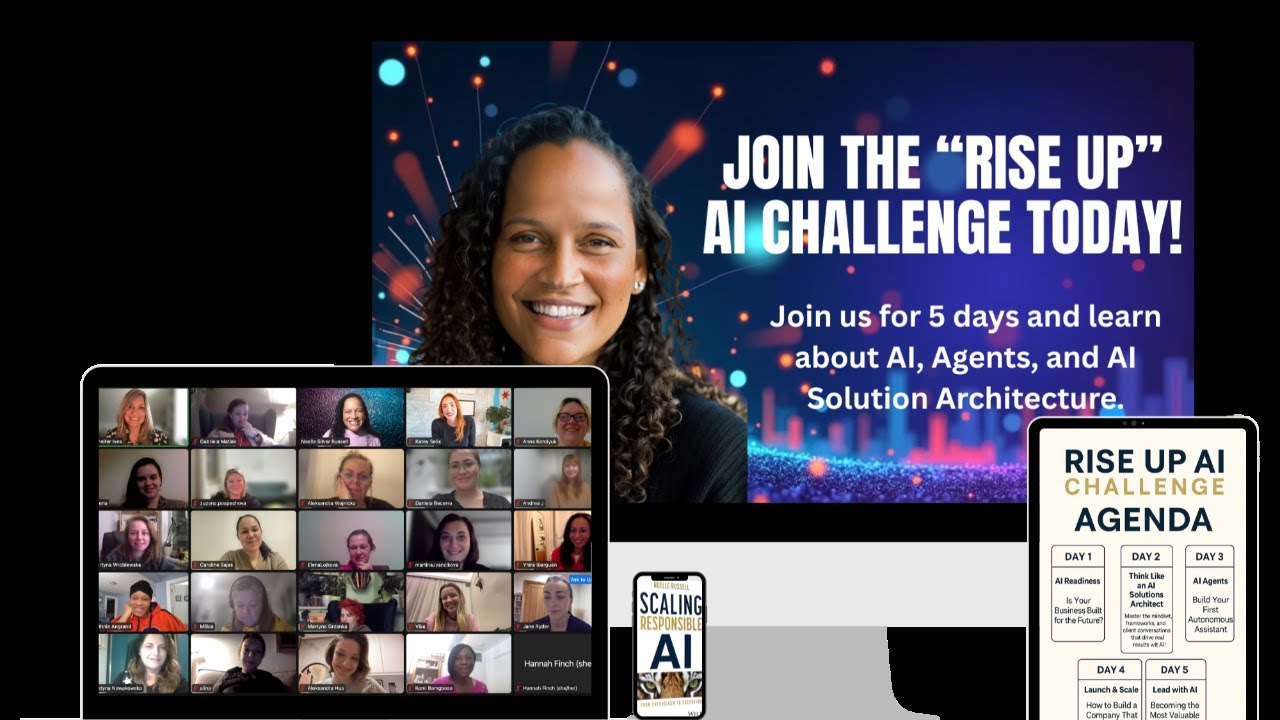
In this live session Noelle Russell guides entrepreneurs through the mindset, principles, and practical steps needed to turn expertise into a scalable AI‑enabled business. She opens with a personal story about building a thought‑leadership platform for Independence Day, then outlines her "LAMP" leadership framework (Love, Ambition, Mindfulness, Purpose) and how it informs her entrepreneurial decisions. Russell explains how to identify a problem‑driven idea, set concrete revenue targets, and validate demand before building a product, using tactics such as wait‑lists, social‑media algorithmic drumbeats, and lead‑magnet funnels. She shares a detailed offer‑creation equation that balances dream outcomes, perceived effort, and speed of delivery, and demonstrates pricing by reverse‑engineering desired annual revenue. The talk also covers her AI Business School background, the AI Leadership Institute, and a case study of her AI automation agency (Agentik) that monetises dormant lead databases with a no‑up‑front, revenue‑share model. Throughout, she emphasizes a "do‑er, not a talker" attitude, rapid iteration, and the importance of social proof and testimonials. The session ends with a call to action for participants to join the VIP workshop, the AI Leadership Institute, and upcoming giveaways.
Chapters
What's up, my friends? Hello, welcome! I was messing around with the stuff going on in my office. How's it going? Welcome! And it is Thursday. Some of you are, you know, prepping for the long weekend. I'm gonna be here tomorrow. Y'all don't have to come, but I'm gonna be here because I love doing this and it's my favorite thing. Um, and tomorrow is probably Did I say this yesterday? That is my favorite topic. But tomorrow is when I get to talk to you all about how to build your own thought leadership platform. And what better day to do it than on Independence Day, right? A great opportunity for those of you in the US to celebrate your independence by learning how to promote the ideas and thoughts that you have and get it out into the world. I have demonstrated this in my career. Many people who knew me, you know, 5 years ago, maybe 10 years ago, certainly 15 years ago, or like my husband, you know, 30 years ago, um, it was crafted, right? I created, um, a bit of a name for myself. So I want to share with you exactly what I did, how I did it, and that is what we'll be doing tomorrow. So I hope you'll join us. Welcome in everyone! Don't forget, this is our favorite time where you can come in and say hello. Thank you for being willing to start where I ended yesterday, um, not only say hi, but also let us know where you're coming in from. We got so many cool people in the house today. What's up? I'm gonna actually show you all so people can see you, if I can remember how to do this. Mm-hmm. Overlight. There it is. Found it. What's up, my friends? Good to see you. What's up, Boston? Chicago's in the house. Good to see you. Hi, Nicole. Uh, what's up, Kim? Good to see you. Sandrine, my friend. Um, Washington is in the house. Diana, good friend of mine. Welcome in, welcome in. A few of us From Chicago. Can I— oh, good point, good point. Let's see if I can do that. I don't know if I can, um, but it's a good idea, good idea. Let's see if I can mess around with this camera angle at all. I don't think I can. Let's see, let's see. Anyone know, uh, video? I got it. Why, bam, someone's on it today! Thank you so much for that. You're all awesome. Y'all love me. Back for day 4. What's up? Caleb's in the house from Maryland. I was just in Maryland, Caleb. I'm gonna be in Maryland next week, 9th, 10th, 11th, and 12th. I think 9th, 10th, and 11th. We should hang out then, unless you're like— I think anywhere in Maryland we could probably hang out. So let's do it in person. Wouldn't that be awesome? I'd make up for all the things. Um, so that would be amazing. Let's do that. Welcome. I see Sean from NYC. Vancouver's in the house. We got a few people. From Vancouver and Charlotte, North Carolina, from the nation's capital. Yes. So I will tell you, as we wait for people to join us today, um, thank you, Kim, you're awesome. I'm such a fan of you. Thank you for helping. Um, so one thing, uh, my husband and I have been to DC so many times, and I speak in DC at least, I don't know, 2 or 3 times a quarter. Um, I'm there all the time. What's up, Dan? Good to see you, my friend. Welcome in. Um, For real, Caleb, let's make it happen. And so we were in DC and we've been there so many times. We walked Monument Mall. Two things we've never done, and I've lived in DC. I used to live in Bethesda when I was a VP of digital over at National Public Radio and loved our time there. But it was COVID, so everything shut down. So we never got to go to those amazing museums. I mean, one of the main reasons we moved to DC was because I was like, oh, my kids, museums, it's gonna be great. Anyway, we never went to a museum, but the other thing we've never done is the Capitol Building walkthrough, like the tour. I don't know if you know this, you can just walk in, they give you a sticker, and you get to take a tour. It is all— I mean, maybe I'm just in kind of Independence Day vibe, and I'm just feeling like understanding the founding fathers and their flaws, but also what has come to create the nation I live in right now. Very cool stuff. Um, not like— it allowed me to become completely decoupled from whatever nonsense is happening today and kind of the origination of democracy and where Congress comes from and Senate and all of that. It almost made me want to run for Congress, people. Who knows? It could be in my future. Uh, so great to see y'all here. Oh my gosh, it is a great tour. Thanks, Joanna. Yeah, Oh my, I loved that. We'd never done it before. As a matter of fact, I'm a gift shop person. So I thought the gift shop was under the, you know, the awning, the walkway you have to go to to get to the Capitol. So I was like, let's go to the gift shop. We get under there like, wait a second, there's stuff going on here. It's a whole museum. It was awesome. So we got to see our own museum. Yes, right. Yeah, exactly, exactly, exactly, Kim. It is our house. I didn't know, but it was awesome. I had so much fun. I got to hear, you know, just how we like manage democracy and diversity of opinion and like, oh, it's just so cool. So I just want to share with y'all, if you haven't been, you should go. If you're in DC, it takes, if you want, less than an hour. We took about 2. Oh, it was so worth it. It was so worth it. And of course, when we were there, 90% of the people there were not American. They were like from all over. The world, but it was so cool to find out that the reason they were there is because they were so curious about democracy that many people don't get to experience a Senate and, you know, a Congress and how they make decisions and how laws come to be. So, so cool. Thank you so much, Diana. Yes. So, and thanks, Kim, again, my friend. But yeah, this is my cool shirt. Today is the day. Welcome, everyone. So glad you're here. I am going to go, go full screen on you. But so glad you are here. Such an exciting day today. Today is when we shift our mindset from all the things we can do with AI, from adoption, right, to solutions architecture, to building AI agents and applications, to being able to now move into, okay, how does this actually transform businesses? And I have a very soft spot for businesses like my own small businesses, businesses between zero and let's call it $100 million in revenue every year. So I really think, and there are millions of them, tens of millions. I heard some big technical person, I won't name their name because I don't, they weren't right, but they were like, there's hundreds of millions of startups. I was like, I mean, maybe, but those that qualify in this little area of actual revenue-generating businesses Right? We don't— we want— I'm talking to the entrepreneurs, those of us who want to build a business that makes money, not wantrepreneurs, right? Not the, the wantres. The— we are the entres, the one who actually go into a space and solve a problem. You've heard me say certain things throughout the entire week, like, um, fall in love with the problem, right? Find a problem you can solve. I've been very problem kind of aware or problem focused because that is the opportunity today, whether you are— and I will tell you, I only I've always been an entrepreneur. However, going on my own has always been difficult for many reasons. For many of you maybe who have this like interest in solving problems and being innovative and pushing the envelope of what is possible. But I have kids. I mean, y'all know I have 6 kiddos. You know, like I got family to support. I was— I'm the breadwinner. I can't just go off willy-nilly and not have healthcare, not have like these, these securities that are often offered by a W-2 employment opportunity. So So I was always drawn to how do I get into a company? So for the first 20 years of my career, I would go into companies looking for those entrepreneurial opportunities and they are there if you are looking. There's actually this beautiful concept known as the reticular activation system and someone in our community, who was it? Jill? No, I think it was Carol. So Carol wrote into, I think it was Carol. I apologize if I'm wrong. But someone wrote into the community that they said, you know, like, what do you do to kind of keep yourself going? And I wrote a practice. So I'm going to start today by sharing with you, I think, generating a— building a revenue-generating business that is either selling AI or definitely using AI. And you want to be an entrepreneur or even build a small, innovative practice inside an existing company, mindset is such a big part of that. Now, today is not all about mindset, but I would be remiss if I didn't actually mention it because I have— I probably spend more time developing my mindset than I do any other skill. And that, I think, helps me to acquire new knowledge quickly, to know when to stop and know when to go, to know the impact of certain decisions on my velocity. Like, all of that comes with the level of self-awareness that I've developed in myself. Um, but at the end of the day, I will tell you that my mindset is focused on building generational wealth for my family, on like cash flow, right? Like, how do I build a business that, yes, of course solves a problem, but does it transactionally? That I will trade you a solution in exchange for a financial outcome for myself. Now, it doesn't always necessarily mean cash. It might mean a subscription payment, it might mean quarterly payments, it might mean vested interest in a company equity, right? So I've done all of these things. I've, I've got a very healthy, diverse portfolio of assets that I have today, but I want to share with you, I think probably the fastest growing asset I've ever built has been Noelle Russell, right? My personal professional services organization. How do I create a product of what's in my own brain and share that with the world. And so today I'm going to share with you the philosophy behind that. Now here's the good news: if you sell an actual product, I'm going to encourage you, no matter what you do, if you are a consultant, an advisor, a strategist, today more than ever you can adopt a product to go along with you. So I'm going to give you some examples of that. Um, but exactly, like, you have a chance now to not only just say who, what you what you think, what you know, all the knowledge you've gained over your career. But you also have a chance to actually build something tangible that you can give along with it. And that couples with what we did yesterday, right? All of a sudden now, as a, a person, as an entrepreneur, not only do I have the services I can offer, but I can now build products better, faster than I ever could before. And that product might simply be a mechanism for understanding the strategies I'm delivering. Better, easier, right? Creating different conversational capabilities for a client. So I'll share all that with you, but it does first start with a mindset. And many of you know, I already see it in the chat, my mindset is very much— well, there's a couple ways I phrase it. I've already mentioned it a few times over the week. One is I'm a doer, not a talker. I always lean towards building. It's better for people to see it to believe it, and I've seen this echoed through every sales conversation I've ever had. If you can demonstrate value, like literally show it on a page, on a screen, in a demo, it's so much more better than just— it's so much better than telling someone, I swear it's good for you, this is going to be great, I promise. Like, here's a picture of it, I'm sure it'll look like this. And what I've noticed over the course of my career, I mean, we're going on 30 years now, It's never what I say, what I see in the picture. I never get that thing. It's always change ordered and modified over time. So what you can demonstrate becomes reality. And CEOs, executive decision makers, stakeholders are all hungry to actually get real value from this technology. So the sooner you can demonstrate that, so being a doer, not a talker, it doesn't mean don't talk. It just means de-emphasize knowing the PowerPoint and emphasize knowing how it actually works and building something useful for people. The second philosophy that I have is show, don't tell, which goes very nicely with doing and not talking, right? Is that I want to always demonstrate building demos. This is why in GitHub I am constantly forking repos or taking repositories and rebuilding them, giving myself the the, the mental flexibility of building something, even if I don't know what it does or how it's working. I just work through it. It's what we did. We actually just recently launched an Agentic AI for Beginners course and we got a bunch of code. And of course, Agentic AI, we're teaching a brand new course on a brand new topic. And the code that we were leveraging was changing up from underneath us because the products were evolving right out from underneath us. So the code almost never worked.. But that wasn't really the point, right? Is that as you begin pushing in the direction of learning something new, it is in the journey of continuously working at something, right? Like, that is the muscle that I flex every day is not necessarily did I get a good outcome, though those are nice, right? I like to get a good outcome, but it is the exercise of continuously trying, trying, failing, trying again, right? Ask Okay, you can't ask him, but, you know, Thomas Edison, Albert Einstein, they all had these— and Michael Jordan, right? They all have these incredible stories about how hard things were until it became easy. And so I, I don't want you to think again from a mindset perspective. I heard Mark Cuban the other day in an interview say the most important skill when you're building something, whether inside a company or as an entrepreneur, The most important skill is resilience. And so I developed a, actually, leadership principle called LAMPLIGHTERS. Some of you know it. LAMPLIGHTERS is an acronym. I have a podcast called The Lamplighter Effect. There's a book. It's a whole thing. But LAMPLIGHTERS, it actually came from reading the autobiography of Benjamin Franklin. And at the end of it, he gave a 12-week guide. And he identified that if you study a single principle, let's say you pick 12 12 principles, like the apostles, uh, pick 12 principles and every week study those 12 principles. By the end of the 12th principle, you will have completed a quarter of the year and you start over. And if you spend a dedicated week on a single principle, right, you now are going to do that 4 times a year. You're going to get exceptionally better at that thing. And so these principles lead how I build companies and why I think they become so successful is because I'm not going to teach you, I'm not going to tell you all of the Lamplighter principles, but I'll tell you the first 4. LAMP. And it's basically, I lead everything I do, I lead with love. And I don't mean like ushi-gushi love, I mean like agape love. Like, I just unconditionally love and respect all of you who are listening, but anyone who's not listening, people who argue with me. I'm just an unconditionally loving person. That does not mean that I will let you stomp on me. I am Puerto Rican, so ask my husband. Like, It doesn't mean that I'm going to be like, you know, a doormat. It does, though, mean that I approach everything from the perspective of loving kindness, which is a principle I learned as a child. The second one— so that's love. The second one is ambition. And these are interesting because many times they don't often sit well together. But these principles are meant to live in a bit of tension. But I am ambitious. I am numbers-driven. I am metric-driven. I want to achieve a number. So I set a number for the number of people that we would get in this challenge and I ambitiously go after it. I set a financial number, I set a person number. And so this, this is everything I do. I set a number for, I set what I call a target for. And then so ambition means that I'm driven by targets. I don't just do something to do it. I do it to achieve an outcome. And I think that ambition translates very well to AI systems, right? It's because I'm never going to build a system just to build it. I'll always be like, you all heard me over the last 3 days. Why are we building it? What's the reason? What's the metric? How are we going to measure it? Like, that is my ambitious nature saying, I want to know when I triple, quadruple, or 10x my number. Like, I want to know that you give me a quota, I'm going to blow it out of the water. That is my philosophy. And then M stands for mindfulness. And this, of course, was the, the one of the most successful skills I built on Amazon Alexa 11 years ago. But I'm very big believer that mindfulness will help keep companies together, keep partnerships together, keep marriages together. But mindfulness is not an external activity. It is an internal self-awareness activity. So you've got this kind of external, you know, loving kindness outcome. You've got this ambition, which is also pretty external. Mindfulness is internal. And the fourth one, P, is purpose. And purpose is also internal. Now, granted, in the last few years, I've made it very external what my purpose was. But my purpose has been evolving for decades. And for many of those years, I never told anyone what I wanted, what I was going after, why I was doing the things I was doing. But I knew. And so I think it's good to have these like leadership principles, intention. You might develop your own, but those 4 like have driven a lot of the behavior I have in my organization, right? Like I want to make sure everything we do comes from a place of love, means That means that I'm very intentional about what I go into. I'm also very ambitious. So we set hard targets, big, hairy, audacious goals. We also, though, are mindful. We take a moment to think about what we're doing and make sure we're doing things safely and responsibly. Taming the baby tiger. Did y'all see me on TikTok? Did y'all see that video? You got to go over and check it out. Noelle Russell on TikTok. I think I also posted it on Instagram and I'm also Noelle Russell on Instagram. But it's cute. It's like this picture. CapCut created a new AI filter, set of AI filters anyway, and it's a big tiger comes over. It's so cute. And it's a still picture that I used to create that video. So go check it out. It's pretty cool. But absolutely, yeah, purpose definitely, definitely evolves over time. So I think it's such a good— like those 4 are enough. But just to give you a sense, right? Leadership, imagination, right? Gratitude. Honesty, right? Harmony, I think, is the H I use, but harmony. Let's see, H. Oh, T is trust. E is enthusiasm. I mean, yo, right? R is resilience and S is success. I am constantly— I have it written on my wall. I have a t-shirt that I have 12 t-shirts and each day has a different leadership principle in bold. Uh, so I take it really seriously, but I think it also very much drives the direction of the companies that I build, the practices that I create, the people that I hire. All of it is surrounded by this ethos of principles that I've created. So I'm not saying you have to use mine. If you want to, you're definitely welcome to read it and see if it serves you. But it was a very important moment in my life when I could create those leadership principles for myself. And I think it's a big part of what success looks like for you is identifying what are your leadership principles. Amazon has its leadership principles. I think they're at 14, 14 leadership principles. It's how they determine how Amazonian you are, right? And I love them to this day. I mean, I always say the most successful people at Amazon are people that were Amazonian before they even got there. And that would definitely describe me. Like, a lot of those principles were my principles already. Like, bias for action is my learning by doing, right? Is right a lot. That's kind of my ambition. Like there's quite a bit of overlap in my own personal goals and what Amazon was identifying. But that I think is critical, right, is be curious enough to ask a company, maybe not directly, but go research what is the ethos of that organization, what are their leadership principles, and do they align with yours? And an organization that has very simple leadership principles, probably has a lot of complexity in its interpretation. So I just encourage you, if somebody comes, oh yeah, here's our 3, I always am like, well, how are you going to solve for the rest of it? That means it's all kind of the Wild West when it comes to implementing. The more clarity someone has in how they're deriving value for their clients, but also how they're running kind of the, the internal ethos of an organization, I think the better. So that's why we have 12. It also gives me the ability to run 12-week mentorship programs. So that's not why I built it, but it's pretty cool. Um, awesome. Oh cool, I'm glad a few of you got to see the video. It was pretty cool. I mean, it's very simple, 6 seconds, uh, but TikTok loves 6-second videos. Pretty awesome. Yeah, absolutely. Um, there is a similar principle called, uh, ikigai. Uh, it's Japanese. There's a lot of— there's also kaizen. There's a lot of different Japanese philosophies that I resonate with very well. I encourage you to just— which is what I did. I went and did a bunch of kind of research on my own way of thinking. I did an Enneagram. How many of you are Enneagram people? If you've ever done that, I did CliftonStrengths. I don't remember all of them, but I will tell you, anyone want to guess my number one CliftonStrengths? Yeah, it starts with a P. It's Positivity. Shocker, I know, I know. But it was pretty cool. I had Futurist in there. Strategist. Anyway, there's really cool stuff. So I like learning about myself, and these tests often give you the ability to do that. Of course, Myers-Briggs, right? ENFJ in the house. That's me. You can let people know what it is. It's helpful because people are like, oh, I see. I could see that. And, you know, like, it helps people understand you. And I think that's probably the biggest gift we can give people is a way to understand who we are and how we think. I'm an Enneagram 3, by the way. But again, you might have been able to guess that if you knew that philosophy. So awesome, awesome. Oh yes, so I will be starting a new Maven, a set of new Maven classes, but I'm not gonna steal my own thunder. So what I want to do today is I've done my job. I've given you, you know, a little mindset lesson that is critical. I write my goals down every day, twice a day, once in the morning, once in the afternoon, once in the afternoon, evening. Um, I don't do it by my bed because my husband would tell you I have a 3-minute latency between the time I get in bed and the time I'm sleeping. It's awesome, I guess, but it means I can— I cannot pin anything to being in bed because I'll be asleep before I can do it. So I do it before I leave my desk instead. But writing it twice— most people only write their goals once or twice a year. If you start writing your goals, and I don't mean like your goals for the day or your goal for the week. I mean, like, who do you want to be, right? What do you want to have? What do you want to do? Like, what is your goal? And write all that down. We do have a leadership class that we teach inside the AI Leadership Institute that goes through all the things that I do to keep my brain doing what it does. But today I'll encourage you to just find out, like, determine what you want. Pick something that you want to go after. Write it down every single day, once in the morning, once at night. And you'd be surprised how much faster you get there, because that goes back to how I started this conversation with this concept of the reticular activation system. When I write down my goals, all of a sudden this reticular activation system is basically— you've, you've heard this before, maybe not exactly called this, but it's that, that, that thing that happens when you like buy a new dress and you think you're the only one, or you get a new car and you get it in a color you don't think anyone has. And then all of a sudden you roll that car off the lot and you're like, I see them everywhere. My husband and I, for example, we're just talking about Back to the Future and DeLoreans, and we've now seen two on the road. Like, what? How is that possible? We were having the conversation. I'm like, does— is Instagram that powerful that they could change? No, we were just having a conversation and now we've seen two, but it's because we were talking about it and now our reticular, meaning our eyes, are now focused on seeing the things that we're talking about. So that's why it's so important to write down your goals, to think the thoughts of what you want, to say the words of what you want, and then to take action in the direction of what you want. Because your brain, your mind is going to draw into your experience things that are going to get you there and you won't even know. And that's how I got into Amazon Alexa. That's how I started the AI Leadership Institute. So let's go there. I started the AI Leadership Institute in 2016. However, I didn't know exactly what I was going to do with it. I just knew executives needed help. Leaders needed help. It wasn't just— AI wasn't just technical, it was a business outcome. And in 2016, I recognized like leaders were going to need help. So that's why I created AI Leadership Institute, training leaders on how to use AI. Fast forward, I then get an opportunity to, at Microsoft, get an opportunity to be in what's called the AI Business School. This opportunity presents itself like many, many offers in my inbox. I could have said Yes to anything else, but I saw this email and I took it. And I believe I saw it because I set the intention for I want to build a leadership institute. And then this AI Business School opportunity comes in. I go in, I become an ambassador, and they give me an AI Business School in a box, like literally all the decks, all the content. They didn't have any training, uh, they didn't know how to teach it. That was kind of the problem. But, but I know how to teach, right? So it launched my business. And I mean, some would call it lucky. I would just say I was perceptive. I was aware. I was open to the opportunity for things to help me out. And that, I think, was a mindset thing that started me on a journey of teaching executive briefings and doing that kind of work. I kept— I needed health care, so I kept working for companies while I was doing this work on the side, this educational work on the side. And then fast forward to like 2 years ago, I decided to go off on my own and go in full time because, of course, Everyone's talking about AI and not everyone's really great at it. And so I was a little bit worried. I started to get very concerned that my expertise was desperately needed, that I was actually doing a disservice to these companies that were hiring people who had no idea what they were doing. And I think this is true for many of you. Like, you have expertise in a domain complemented by an understanding of AI that gives you experience that no one else has, but If we don't talk to those companies, if we don't get in front of those companies, we don't talk, like let them know that we have services that they can acquire. There was a, I don't remember what movie I saw it in, but they're like, if you don't give them water, they'll drink sand. And that's what I'm watching right now is like people are just drinking sand when it comes to AI. Like they don't even know that it's not hydrating. Like they don't even know what good is and what bad is. And that is why it's really important that you decide what you're going to do. Again, you can do this inside a company or you can do it externally, but that's a big part of it. Now, part of the ecosystem— I'm going to see if I can pull up my— oopsie, my computer does not have this open, so I'm going to open it up really quick while we're talking. But I want to share with you the cycle of business growth, and this is what we're going to dive into in VIP. We're actually going to build out, like fingers on keyboard, build out an offer.. But for you all, I'm gonna talk to you about what it takes to build an offer and DIY. You can take what I say and then go do the work. You can even join the I Love AI community, which most of you are in. You can go to the I Love AI community and we'll talk about this every Friday except for tomorrow cuz we're doing this. Um, but every Friday for at 2 o'clock we have an, uh, AI Leadership Institute call and at 4 o'clock we do the public call and you can bring all your questions and we can answer it together. And it's not just me, it's all these amazing people. We have so many incredible leaders there as well. Okay. PowerPoint's asking me some crazy information. All right, here we go. Let's hope it opens. Oh yeah, we're here. We're here. All right. Awesome. So here, let me go ahead and share my screen real quick. There we go. This is— hey, that's me. All right. Let me see if I should probably put it in presentation mode. Let's see if I mess it up. Oh boy, I can't do that. I'm just gonna show it like this. You can take a picture of it. This screen, right, this, um, diagram represents the cycle I have used to build 4 businesses. Y'all might be surprised to know that a long time ago, before I had children, I launched a yoga studio in Morristown, Tennessee, where my mom still lives. Um, And I use the same process, right? So the very first thing— remember that problem we talked about yesterday? The very first thing you're going to do when you're building a business and you want that business to be successful and you want it to be profitable— cash flow, we want to be profitable— the very first thing you're going to do is you're going to identify, number one, what is the idea? That idea must be linked to a problem you know people have. This is the most important thing, is we could get— I get ideas all the time, but unless it actually— to the, um, to Nitin's ikigai comment earlier, right? If I know the world has this problem and I happen to care about that problem, I know I have a match. So it's not just any idea we go to market with. It's an idea that's been validated by the fact that someone's been like, man, I wish we had this. Some of you heard me the other day. I was sitting on the plane next to a woman and her husband, and they own a construction company. And they were like, can you help me with this? And they gave me a very specific problem they wanted help with. And I, as an entrepreneur, my mind was like, okay, that's an agent I could build. How many other construction people could I sell that to? So I started asking a bunch of questions, but the idea was born, and it was born from a customer actually telling me they wanted it. So I got to work. So that's the first step, is that you have to— maybe I'll make it a little bit bigger. Yeah, um, the first thing is that you have to have an idea. The second thing is you have to have a target. How much money do you want to make from this idea? What is your revenue target? What is your user target? If you're not going to— like, let's say you're a nonprofit, maybe it's how many families are you going to impact? How many soldiers are you going to save? How many— whatever it is, um, how many farms are you going to support? Like, but it's very important you have this metric for the exact same reason why it's important to have an AI metric. As well. So this idea is only as good as the target you assign to it. You can't go forward without it. You have to pick a metric to measure the success of your idea. For me, my idea was I want to do a Rise Up AI Challenge. I want to get 500 people to join us in this challenge. And then I 10xed it. See, myself agrees with me. Um, then I 10xed that number in order to change my behavior But that was my goal. And then now I've got my idea, run a challenge. I don't have anything to do it yet. I have a target, which is 500 people. The next step, which is critical, and most people get this wrong in an entrepreneurial endeavor, inside a company or outside a company, you do not build yet. You do not laser focus on the product development. You focus first on finding out how many people in the world are willing to join you. This is— has been beautifully crafted at companies like Anthropic, OpenAI, Microsoft. They create what? First, a waitlist. How many of you have joined waitlists for products? I just joined one for a new feature on HeyGen. For all I know, they haven't even built the feature yet. They're just trying to see, is it even worth building? If they get 100,000 people to sign up for the waitlist, it's probably worth building. If not, what's gonna happen? I've forgotten the waitlists I've signed up for. Like, I'm not putting that stuff on my calendar waiting for it, right? So you can do polls on LinkedIn. They're very successful, right? Hey everyone, I'm thinking about building this thing. Not gonna give too much information, but is this a problem you need solved? I could do that for the construction use case. So now you've got your idea, you've got your target. Now you need to grab attention. Attention is social media these days for the most part, or like me, and this is what we'll talk about tomorrow. You could also take the stage, right? I don't— I do a little social media. I mean, y'all are here because of my social media, but, um, but I don't do a lot. Like, I don't spend hours a day. I spend 2 hours a month on my social media, pretty much. So, and it shows. Like, I'd have a much bigger following if I, like, leaned into that, but I don't do that because my clients come from the stages I deliver. So, like, in June I did 16 keynotes and workshops. Shops. So that's how I get attention for my ideas, is I get on stage and I tell people about it, and then I say to them, if you're interested, sign up here and I'll let you know how it goes. And then I get a bunch of people, hundreds, thousands, that say yes, they're interested, and now I know to build it. And I'm going to give you an example of exactly me doing this just in the last two, maybe, months. A month ago, got an idea, decided to put out some feelers and see if people wanted it. I have 5 clients now in this specific work, and now I'm going to scale and that scale will mean I'll take it from right now, I don't know, $25,000 a month to $100,000 a month. That's my goal. Always my goal is to go from prove that people will buy it, then get to $83,000 a month, which is a million a year. That's when you know that you can grow that business. At least you've got some room to grow that business pretty significantly from there. Very few companies get to $100 million or $200 million or $500 million or a billion. I've worked at many of them who've gotten there, but very few companies get that far. But here's the reality is most of us probably don't need more than a million a year in a business. Um, we don't need to take home more than $500,000 a year to, to feel pretty good about where we are and to be able to save money and generate wealth for our families. So that attention piece is critical. Social media is how we do it. I— and we have a— we just actually graduated. You all see them in my LinkedIn because I'll be promoting everyone pretty soon. Um, but we just graduated, uh, a class of the AI startup, um, AI startup accelerator. And in the accelerator, I go through 6 different levels of building a business. And the very first level of the business, of course, is to be a business. First thing you have to do is figure out a way to get paid, figure out a way for people to find you, figure out a way to communicate to your clients. Um, so you gotta have that established, right? You need a bank, you need an entity, you need to be legal, you need to have a way to pay the IRS, like all that. Then after that, once you're established, the very next thing is attention. How are you going to get the world to know you exist? And the way we do that is what I call an algorithmic drumbeat. You have to build an algorithmic drumbeat that tells the algorithm every day you are a company, you do stuff, You do very cool things. And so I have a set of prompts that I gave to our founders that help them build 30 days of content in a little under 2 hours. 30 days of content, just that drumbeat. Every single day you're on social media telling the world what you're doing. I do enough stuff that I can just post what I'm doing every day. But for those of you who are just getting started, you're gonna need to build. And here's the coolest part about that. You're not selling, you know, like, hey, buy my tchotchke. Hey, take my class. Like, All you're doing is providing value. Here's what I've learned. Here's a tip. Here's a resource. Here's my thoughts on a trending topic. Like, you get to take 2 hours, build out 30 days, and you do that once a month. And now the world starts to recognize. I actually have gotten incredible feedback from the founders that were in this accelerator that were like, oh my gosh, like, I've never gotten this likes before. And they watched every post got more and more, right? It's an act of like algorithmic, like when you're looking at the algorithm, once the algorithm realizes you're serious, you're consistent, you provide value, it starts opening the funnel of who it shows your content to. It's a bit unfair. I'll tell you, algorithmic bias is a thing. It's unfair. Right now I have lots of followers, right? Tens of thousands of followers on LinkedIn. And many of them are like, why can't I see your content? And I'm like, because the algorithm hates me. But not really. It's just because they're— it's looking for a very specific level of interaction from the people who follow me. And if you don't interact in a certain period, it will drop you from my list. Like, it will not let you see my content unless you come and get me. And so that's why you'll see me every so often, I get into the DMs and I'll send you a message and say, interact with me. And that will— again, it's one, because I want to provide you value and I want to give you an opportunity to work with me.. But 2, so that I tell LinkedIn, we are actually real friends, we do talk to each other, and it's worth you sending that information. Just this week on the attention side, when I started doing this challenge on Monday, the biggest boost I could do on LinkedIn was 58,000. Tuesday it went up to— oh yeah, it went up to like 60,000 or 70,000. Today it was 160,000. $60,000. So my boost capability increases the more engaged my audience is with me. And I think— and the only way to drive engagement is to create this algorithmic heartbeat. So that is one of the, the challenges you'll have to solve for is how do you get what you do, who you are, the value you offer into the world. And I very much think you'll want to leverage AI to support that work, not do that work. I will tell you, AI-generated content is not awesome. I, I can see it a mile away and customers will be able to see it too. They want to know, like, and trust you even. And it's getting even more so in the future where these younger buyers are going to come into the market and they're going to want to know who you are, who's on your board, who works for you, what hiring decisions are you making, what's in your 10-K, what's in your 8-K, right? They're going to want to know who you are as a company before they transact with you. With you. And that is why we want to be very value-driven in our approach. Let's actually help people by helping them, and through that relationship, get the business. And I've— again, this is all Noelle Russell Russell's perspective and what I've seen work for me. I hope— I, I think it will work for you too, but, you know, feel free to test. Feel free to test. So once we get attention, once we've got this algorithmic heartbeat going, the next step of this is to then get people to raise their hand and say hello, raise their hand and go, hey, I'm interested, Noelle, that's pretty cool, I see you're doing workshops, I— we need a workshop, or hey, I noticed you were just doing this keynote for an association I'm a part of, can you come to the— my company and do this keynote? I need a way to get them to raise their hand and give me their information so I can communicate to them. So this is called lead generation, and it is a struggle. It is actually the area of the market I try to support companies with. Lead generation means that you have to build something valuable enough. And here's the key: you want to build something that you actually could charge for and give it away for free, like a book, a web class, a challenge, right? Uh, like all the things I'm doing now will be bottled up, hopefully edited, but bottled up and delivered as a valuable free resource to someone that they can take anytime. My AI Bot Builder Bootcamp, I've sold it for $1,000 a person. I've sold it for $25,000 a class, and I give it away for free when people buy my book. And the reason that I do that is because I now know when they get that value, they're gonna be like, oh my gosh, this is, this is way more than like I should— they almost feel like something's wrong. Like, they're like, wow, this is a lot of value that you've given to But now I'm on their side of the table, right? I'm there with them going, yeah, of course I want you to be successful. Now let's talk about how we exchange value, right? How do we exchange what I know and what I can help you with, with the money that's in your bank account, right? So lead generation is the art of hand raising. How do you get your audience to raise their hand? I will show you. Some of you know this if you followed me before Christmas. I did a lead gen challenge to myself. This is how Noelle rolls. I woke up one day and I'm gonna, I'm like, I'm gonna do a new lead magnet. I built from scratch a new lead magnet every day for 12 days. If you're in the I Love AI community, you can see this. It's called the 12 Days of Christmas. I don't know if it's enabled or not, Sherilyn. Well, we'll have to enable it again so people can see it, but it's 12 different lead magnets. So let me go, um, right now and I'm just going to share this with you. This is the hardest part. Now notice all of this is before we actually build anything. This This is my philosophy. I sell it, then I build it. The reason I can do that now more so, I mean, I've always been this way. I sell, I buy it. I mean, I sell it and then I build it, mainly because I want to custom build things for my clients so that they get the highest value possible. That was hard to do or harder to do 3 years ago, 5 years ago. Today it's very easy to do that, right? Because now I can vibe code my way to a solution, an MRP, a minimum remarkable solution. And then I can create a much bigger contract to take that solution to production. But to get in the door, the first dollar you get from a company is the hardest dollar you'll get. Once they give you money, in other words, once they've transacted with you, they now in their mind have said, this person is trustworthy enough for me to give them my credit card. Now from then on, those dollars will be easier because they have to actually validate that they made a good choice that first time, right? And so they will be less likely to kind of combat themselves and be like, oh, I don't want to buy this. Like, they've already bought from you, so it's an easy— easier— I won't say it's easy if you're doing nonsense. No shenanigans, right? If you're, if you're doing things that are not valuable, they're not going to just give you money. But if you're doing valuable things, it's going to be less of an obstacle to get them to do further transactions. So that first transaction is so critical to building the initial trust with your client. It's, um, 4 percenters. What does that mean, Dan? Did I miss it? You have to tell me. Write it in there. Um, let me see if there's anything else in here. I'm just checking the, checking the, the comments here. Um, oh yeah, cool. Oh good. Oh yeah, Enneagram, what? Awesome. Okay, I got some friends in here. Oh yeah, yeah, of course. Um, all right, cool. Uh, and oh man, um, Nitin mentioned, uh, some content on here. He's doing— he's got an Ikigai piece of documentation, but he's also doing really cool stuff in his company, so y'all should check it out. I saw him live and got to see a demo of his products. It's so cool. Um, I'm not gonna take our time, but we should do like a little showcase of some of the amazing leaders that are using AI in their businesses, um, in one of our sessions. Uh, but yeah, lead generation, it is, and it's critical. I will tell you that leads and sales, it's the blood of every company. Every single company that exists is is— it exists because a client is paying them to do a thing. The pipeline of the sales team is going to be like literally the bloodline of the company. As soon as that pipeline dries up, you don't have a business. People stop buying from you. So it's really, really critical. Um, all right, so let's see here. Where did I want to go from this? Oh yeah, lead gen. So let me just share with you a couple things. Doing good on time. Uh, let me stop sharing this screen. And I'm gonna go and share. I'm gonna go with this one. Oh, let me go here. Yeah, let me go here. So this is, um, my website. So I'm only here because, um— oh, I don't even know where this is actually. I, I picked this screen because I was like, I know where that is, but I don't know if I do. Uh, what screen am I sharing? Maybe I could click on it. No, I can't. All right, hold on, hold your horses. What screen? Let's see. Okay, this happened to me yesterday too. There we go. Okay, I found it, I found it, I found it, I found it. Um, is it not in— oh my gosh, watch it be something totally different. Okay, just kidding. Hold on, let me go to Chrome. I have way too many, um, Let's see here. All right, I quit, I quit. I'm just gonna share a different screen. Sorry, stop screen sharing. Let me screen share this one. Day 5 of AI Consultancy. I just can't even tell. Oh, here we go, I got it, I got it now. I found it. Share. Okay, cool. So this is actually my beautiful presentation because I wanted to add the presentation to our school community so you can go and check that out. Um, this, let's go into, um, oh, actually, you know what, let's just go to LinkedIn. Oh, look, um, what's up? Uh, that's one of my friends. All right, so I'm gonna go to my profile so you all can see it and show you some of these posts, um, and some of these lead magnets that I've generated. So let's go down here to These are my posts. I'm going to go to activities. I'm going to go to the newsletter, um, show all newsletters. So I have a newsletter, I have a couple of them. Um, this one has 12, almost 13,000 subscribers. That's exciting. I should use it more often. Uh, but let me go and show you this newsletter because it's where I captured a lot of these, um, a lot of these, uh, Christmas, uh, lead magnets. So if you go in, like, I'm gonna scroll through all of them on the 5th day of Christmas, 4th day of Christmas, 2nd day of Christmas, right? So this is the 12 Days of Christmas, and every day I gave another tool, but lead generating, right? So this is a 90-day AI marketing blueprint. About 3,000 people downloaded this. I'm gonna go ahead and I give a little synopsis of it, but I'm pretty sure I give you the ability— I hope I do give you the ability to click on it. So let's see what happens. I hope it's in here. Oh boy, I didn't put it in. How did I not build a link for that? That's kind of funny. All right, it's got to be in there. I must have just missed it. I must have just missed it. It has to be there. That's the whole point of the thing. Cue the music! 2x ROI. Anyone other— I don't see another link in here. Oh, there it is. Sorry, I put in the comments. So for those of you content marketers, LinkedIn does not like it when you put links to things inside of the post, they will promote it more if you put your links in the comments. So that's what I did. So this is what you'll see. This is a classic lead gen tool. I am very good at building these. I can— takes me maybe 15 minutes to build a net new one. Um, everything from the image— this is an iPad with the ebook that I created in Canva overlaid. I use, um, ChatGPT to create an engaging— actually, I might use Claude to create an engaging headline. Then you click on it and it asks for your information. It also, very important, will ask for consent to allow me to continue to work with you. This lead gen capability, when I get this email, here's what most people do. Lots of people do lead gen, lots of people create landing pages. What happens the second someone gives you their name and their email? There is what's called speed to lead, and when you do what's called speed to lead, That means that your requirement, when somebody gives you their email, they are the most likely to do business with you within 5 minutes of them typing that information. Likely because they're on the hunt for something, right? So they're going to give you this information and they're going to keep hunting. And chances are, if you wait more than 5 minutes, they will find another solution. So you need to engage and catch that lead within 5 minutes. It is even better if you can catch them in the first minute. So anyone care to guess maybe how we're gonna do that? Like, how do we— if we're not gonna sit by waiting for people to sign up for this, right? This is where AI and automation systems come in. This is where we can use something like GoHighLevel, which is what the— that is the platform that I give to every startup that joins the accelerator. I give you a GoHighLevel platform that allows you— now you've got your algorithmic drumbeat, but now more importantly, you create a landing page, and that landing page, as soon as someone signs up, you're going to send them an SMS that says, well, in this case, I didn't get their phone number, so I'm going to send them an email immediately that says, hey, I see you, I hear you. Here is a Typeform survey or a Google Form. Fill this out. Let me know what you need, and I'm happy to get on a phone call with you. Right. But you immediately engage. So some of these, I started getting very creative with all of these forms. So let me go back. Right. That is my 90-day checklist. Backlist. The next one I have, I'll just go into any of these. Oh, this was actually me being— these were my tenets of responsible AI. I think I wrote a book on this. Oh yeah, this is the one where I was like, become a certified responsible AI insider. But let's see here. I think I put it in here. Yeah, let's see, see where it takes me. Oh, this was a lead to my AI Leadership Institute, right? So this becomes My lead magnet, when you say, well, I'm already joined, but when you say join, it then of course is going to have you come into the thing, right? So this is another lead generation tool. And I can actually, of course, I have a metric that I'm measuring for how many people click on that link and come to my page. Let me show you another one of the lead magnets, um, that I built as well. Let's see, there was some pretty cool AI in education, mindfulness, ah, mitigation. Yes. Risk Mitigation Toolkit. Number 1 question. Oh, I have a really cool thing I wanted to show you in a second, but here's my Risk Mitigation Toolkit. So here, protect your investment. Again, it's not beautiful, but it's good enough. Um, so I create a little book. It's called Risk Mitigation Toolkit. You get access. Notice now I get smarter on this one. I want your phone number because I want to SMS text you and be like, hey, I got you. Let's, let's talk. Would you like to get on a phone call? Here's my calendar, right? I don't do that. My AI system, Allie, does this on my behalf, right? So I sign in, I'm just going to consent, and it's going to then take me to the Mitigation Toolkit, which is actually just a blog post on my website. But there's a lot of cool stuff in here, a bunch of hyperlinks, a bunch of resources, high value. People usually are pretty happy with it. But notice here, I didn't gate this, right? Like I didn't say, okay, here's a PDF, you have to download. I just put it on my website. Because I actually don't mind if they have this. I don't even mind if somebody happens upon this. The most important thing I have is their phone number and their email address so I can call them and find out how can I serve them. And that, I think, is critical. So this is lead gen at its best, right? Like, build a valuable piece of content. You want to get in the mind of your customer and answer questions they're already asking. How, Noelle? How will I do that? There's a couple ways. One, you can go to Google Trends and you can look at what's trending, what people are asking about. Or you get 3 free questions that— on a website called Answer the Public, which I'm just gonna hit enter and hopefully it'll take you there. There we go. Now, Answer the Public is pretty cool because you can type in a question like AI leadership AI leadership, do a search, and it's going to provide you a bunch of concentric circles to let you know what people are asking about. Now, this is pretty specific— AI leadership. If I just put AI, it would be a little bit more crazy. But you'll see here, like, how does AI affect leadership? Will AI replace leadership? If you are curious about what content to create, here you go. So I will copy this into the chat You get 3 for free, but you can of course sign up for more, uh, if you want to. Oh, thanks, Sherilyn, for sharing those. Definitely, you all are not the audience for like my, my lead magnets, unless you are, you're welcome to get it. Um, but that's not why I'm sharing. I'm just trying to give you ideas for how you do the hardest part of growing a business, which is getting customers. I do not fully believe in— I don't believe at all in going to VCs before I've generated revenue myself. I'm not a believer in the unicorn methodology of I will go and get millions of dollars. I'm also a woman. I'm also a person of color. I also am not in the upper— I, I don't even think we've broken 10% of available funding given to my demographic of people. Not to say I've given up on it. I just know I can wait— I can make way more money just delivering value to my customers and letting them pay me for it. So don't be afraid of that. I think a lot of us are are like, oh, I'll just— I'll build the plan and I'll get someone to fund the plan before I do the thing. And I'm just saying, be a doer, not a talker. Like, don't spend your time building pitches and pitching VCs when you can actually build something that's valuable and get customers to become design partners and fund the very thing that you're trying to build. Um, all right, cool. Yay, thank you! Oh, oh, I did that. Oh, so I put it— I think the only place my links go is YouTube, so sorry for that. Hopefully Sherilyn can throw and answer the public that link into the chat for you as well. Or if you see it— what's up, Asta? Asta's in the house. So cool. Good to see you, my friend. Awesome. All right. So these, all of this helps you identify, get into the mind of your customer, deliver value to the customer so that they call you and go, hey, I see you're talking about my thing. Or better yet, they just raise their hand, download a free guide that is all about one of these topics, right? Let me scroll down even more. Um, these are some of the other questions. Who's leading in the world of AI, right? Create a leaderboard, like top companies and your specific opinion about them. This is why I created a podcast called, uh, Good Morning AI. Every morning, I'm a Stephen A fan. I don't know if y'all know, um, but, uh, but he has a show called First Take, and I'm like, I'm totally doing a First Take AI. But I couldn't do First Take because it's taken. So I decided instead to do Good Morning AI, but same idea, right, is that I would just get on and talk about these topics that were trending. Um, and I do it all the time. I've now had, um, Greg Brockman from OpenAI on my podcast. I've had, uh, Cynthia Stoddard from Adobe on my podcast. I've had— of course, I've been on other people's podcasts that I put on my podcast. So it's been a really, really fun, fun ride. Okay, so Now we go back to, right, we've now got our idea, we've got a target of who or how much money we want to make. Let's call it $1 million. We now start generating attention. We start publishing to the world. We're doing this, creating an algorithmic heartbeat. We now have some lead magnets, and as many as you want, because you've got to catch the wave of the question in the mind of your consumer or your customer or your client. And that means that you're not going to catch it the first time. You might not even know what they're asking. So you just keep pushing content out It's like a TikTok video until one goes viral, and it will, it will happen. You just have to be consistent. So once you're consistent, you start pushing out these offers of here's value, here's value. Once you find something, which is what I'm about to share with you, now you start building. Now you're like, okay, I've got 300 to 500 people who said this is good, they need this. Now I start talking to them. The third, uh, project in our AI Startup Accelerator is that once you've identified what you're going to offer, you get on the phone with 10 people, not 10 buyers, but maybe, but, but just 10 people, and you talk to them and you say, hey, I am building a new offer and I would just like to run it by you, just like to see how it goes. I think it was you, Diana, right? You had good success with this, right? You just call people and say, hey, can I run by what I'm building? Can I just share with you what I'm doing and get your feedback? Back. If you are on to something, right, Noelle Russell Russell, um, if you're on to something, those people are going to come back to you and go, well, I mean, I know you were just explaining it to me, but maybe, like, maybe I could be your client. Like, maybe I could take advantage of this. Some of them are going to say, that's cool, I want in. Some of them are going to say, no, that's not even valuable to me. But that's not the point. The point is that during this conversation No matter what they say, yes, that's awesome. No, it's not. Your job is to then say, what would make this a no-brainer for you? Well, what would make me just— what would make you say yes to this? And you get their feedback and you write it all down. It becomes features of your product. You put it on a backlog. But you do this to do some market research. And I will tell you, this is the part Jeff Bezos, Andy Jassy, like all of the leaders, Scott Guthrie, like all of these leaders that I've worked for. Scaling the unscalable is this moment where you personally figure out what is going to work and you do it with personal conversations. Gary Vee is also a fan of this mode, right? You just reach out to people, get them to talk to you, use that to derive your product, and then build that. Do not build out of something in your mind you think people might want. Have a frame for what you think they might want, but then go to them and help— let them help you validate that frame of reference. And then build from there. And start small and iterate. That's the beauty of vibe coding today. Start small, start with an MVP, an MRP, right? A minimum marketable product, and scale from that perspective. All right, let me stop sharing this one. All right, cool. So now we're at the point where, I mean, I can't talk— I mean, sales is its own conversation. But all— now you've got like the momentum is growing, people are raising their hand, Now you'll probably need to, you know, do a little bit of work on how you present your offer. I want to give you an equation to create an offer for a product. Um, and we're right at 3 o'clock, so it'll take me like 3 minutes. Um, and then we'll go into— we'll actually build this offer based on this equation together in our VIP. So I want to leave you with the equation that I have used to build— I don't know, let's call it 4 7-figure products, meaning I was able to generate at least 7 figures with these offers. And here's the equation: it starts first with the dream outcome of your client. So that means you need to know who they are. Who are they? Are they business owners? Are they entrepreneurs? Are they leaders of teams of 10 or 20? Are they executives that lead teams of teams? Who is your client? And you do have to pick one. You can't be general. You have to pick. Client? Who is your audience? The persona. It's not your only one, but you do need to pick one to get this going. Once you've got a persona, what is their dream outcome? What is the thing they wish would happen above all things? Is it revenue generation? Is it cost optimization? Is it happy employees? Is it happy vendors? Is it a safe, secure environment, right? Everyone will have the thing that would make their lives better. And this is where these conversations come in. That's gonna be a question like, What's the magic thing you wish you had? What, what, what's one thing? And now more than ever, we can build the one thing better and faster than we ever could before. So ask those questions. So what is the dream outcome? Now you've got the dream outcome. Now if you could give that person— let's say their dream outcome is to make a million dollars, like maybe some of you, uh, you want to make a million dollars. Great. If I could prove to you that I could get you to generate a million dollars immediately if you do one thing, you would just do the one thing. Like, you would probably pay a lot to do the one thing. You might even pay $500 grand to do that in order to make a million if you knew it was immediate. So the value equation is when you get a dream outcome, when you understand the outcome of your client that they want— they want to have it immediately, they want to have it with no friction whatsoever, they want to have a low perceived like, uh, level of effort, right? So they want it to be easy, immediate, and free. That is like the dream. Like, if they could get their dream immediately for no money and without any effort, they would do it. Call it like the super diet, right? Like, if I wanted to lose 30 pounds and you came to me and said you could lose it by tomorrow and you don't have to change what you eat, you don't have to work out, and you don't have to pay anything, like, I'd be like, done, let's go, right? Like What? There's no, no, no problem. So that's the, the dream outcome. Obviously, that's not how you're going to build your offer, but what you're going to do is put this on an equation to think about, okay, what can I do? Like, let's say I'm going to charge a certain amount, and I will encourage you, when you set a price for your products, it is not based on the cost of you developing the product. It's going to be based on the value it has for your clients. I usually, in our consultancy, we reverse engineer our prices. We say, how much money do we want to make this year? The target, $1 million. And what are the different ways I can make $1 million? Turns out I can get one client who pays me $83,000 a month and I'm done. Yay, right? Um, but maybe I— maybe that's hard, right? And so now it's two clients that pay me $40 grand a month, or 4 clients that pay me $20,000, or right, like, and it's called million-dollar math. But notice that pricing isn't based on what I'm doing or how I'm delivering. It's just based on that's how much money I want to make, so I'm going to figure out a price point and number of clients that I'm going to go after. Once you have the price, so for me, let's say it's 1,000 people paying me $10,000, right? I think is my goal. If I have 1,000 people that I want to pay me $10,000, or 100 people paying me $10,000, or whatever, Now my job is to find out what can I give them that's worth 10 grand? How do I create something that's valuable enough that they'll pay me 10 grand? And here's the trick to this, is that it won't be 10 grand. I'll need to give them the value of like 15 grand or 20 grand or 100 grand, right? If I give you 100 grand in value and you only have to pay me 10 grand to get it, that's much more likely for you to say yes, right? So that is kind That, that's one challenge. But once you set your price, you now figure out how can I give massive value for that price. Now you've got one part of your offer. Now the next two variables are complexity— how hard is it to do? So make it easy for them. You won't be able to make it like no effort, but make it easy. This is where you add things like checklists and blueprints and frameworks, right? You can add those things to decrease the perceived level of effort for that thing. And then the other thing ends up being time. So shrink the scope to an MRP and put a time on it. 30 days, 7 days, 60 days. This will give them a higher perceived level of delivery. It will be less expensive because the scope is smaller. You'll have a solution architect, right? You'll have a longer, longer tail of work that you'll do after it. But it's this magical equation of dream outcome combined with a low perceived sense of effort, right? How easy is it going to be for me to get this done, and how fast can I get it done? So low perceived sense of effort, meaning I make it easy because I'm going to give you a bunch of tools to make this easy, and I'm going to do it very quickly. So you're going to get instant gratification, well, as close to that as possible. The last and final piece of building an offer that makes it irresistible, right, that people find it very hard to say no to, is not only I make it easy, not only do I make it, you know, high value, right, so I'm giving you your dream outcome for a fraction of the cost, but I also now need to think about How do I— like, the last variable is how do I encourage that person to believe that they can get that same outcome? And this is like, ties into my philosophy, being a doer, not a talker. It's receipts. If you can demonstrate that you've gotten this super amazing outcome, made it very easy for them, they can do it in less time than they ever thought, and now you've got 5 or 6 people that you've actually got that outcome for, it's very hard for them to say no because they're like, I want it to be easy, I want it to be high value, and I want to know that I'm personally going to be successful doing this. I'm not going to get fired, like it's going to work out. And when you put all those 3 things together, that's what we do in our Offer Creation Workshop, right, is that we give you the tools to go in and say, okay, My dream outcome is that they want to build a responsible AI strategy. It's hard, so we're going to give you a bunch of templates, and we actually have a kickstart toolkit that allows you to do it in less than 30 days. But more importantly, here are the 5 clients that I have that have already done it. In order to get those 5 clients, you might decrease your cost. You might even do it for free, right? To get the reps in, to deliver with excellence for customers that will then say, Noelle's awesome. Okay, you're awesome. So that is how I do what I do. I always start free. AI Leadership Institute, 30 members were free, the first 30 friends that I had. And I invited people who didn't even come, but that wasn't the point. I wanted to deliver value. I wanted them to say nice things. I do free content all the time and ask people for reviews. Those reviews are not so people think you're good. Those reviews are to prove to a client that you know what you're doing. Me. So it's very intentional, very intentional approach. Once you have that equation, you'll be able to start closing clients, and then it's just a numbers game. How many people are you willing to talk to? How many hands are you willing to get raised through lead magnets? What's your target? And you can choreograph your success. This— success leaves clues, failure leaves clues. What I'm sharing with you today is based on not just my success, but on the success of billionaires that I have replicated in my own practice practices and proved that what the nonsense that I thought they were saying actually does work. So, um, oh, thank you. Oh, y'all are amazing. Um, so, so that is, that's the end. That's how you build a million-dollar business, is that you first set your target at a million. You then create an idea that you can sell that's worth the amount, the price that you can create for that. And then you build an equation of value you make sure that you've got the tools to make it easy. You have a framework that allows you to do it in a refined period of time. I'd say 60 days or less. Doesn't have to be the whole outcome. Just what can you get? What, what checkbox can you check for them in 60 days or less? I personally like 30 days or 7 days. Like, what can you do in 7 days? I can get an MRP vibe coded in 7 days. It's super powerful. Powerful. So the last thing I want to share with you— I know it's 3:09, dang it— all right, last, last thing is the, the agency I built. So I got this idea. This is Noelle Russell Russell. I wake up in the morning and I get crazy ideas. So I got this idea. Is that it? No, we'll go here. And I started an agency and I just wanted to test it because people said it was possible. So I created Agentik. Agentik. I did this during um, our startup accelerator, because I was like, I don't want to just say that I did what I did. I'm going to start a new startup and do the things that we were doing. And I did exactly this. So agenticaiagency.ai. And I don't want about. So this is my website. It's an AI automation agency, um, but I'm gonna go to services so you can see what we do. Uh, but basically it is an automation that I built. It's called database reactivation. It's a series of ChatGPT models at different levels of engagement in the lead gen process, because most people don't like lead gen. And I was like, oh, what if I could come in and take your old leads, meaning you've already given up on all of these leads in your database, you're not making any money from them. I'm like, you just give me those old leads, and if I turn them into sales, only then do you give me half, right? Half of— like, right now they're not making any money on those leads. And they've forgotten about them. They're like sitting dormant in a database. And so oftentimes people are like, half, that seems like a lot. And I'm like, I mean, but right now you've got half of nothing. What if I could give you half of $100K or half of $500K? I recently had a friend of mine close $1.7 million in leads, like, and those leads were dead to that firm that did it. So this is a great offer mainly because I don't need anything up front. I have a lot of confidence that I can do this. So I'm like, I will take on the cost to SMS people. I will take on the cost of all the LLMs. I will host all the LLMs. I'll do all of that work. The only thing you need to do is give me a sales team that can close. So if you have a company that has a sales team that can close, I'll just take my AI agent, which is my IP, which you could build yourself. This is what I meant earlier when I was talking about product. Build your product. And now I sell it to companies. And I just book time on their calendar with closable leads. It's— everyone wins, everyone wins. So I got this idea, it's super simple website, right? I also have a Speed to Lead agent. So this is another LLM that's going to make sure that you respond to people, um, within 5 minutes. Remember I talked to you all about that? Out of hours, right? So what happens when somebody calls on the weekend? If you're a roofer, you don't want to miss those leads. So this is an out of— off— out of hours agent that just pings people gets people on your calendar while you're sleeping. And then I have a Google reviews agent because people do not understand the power of reviews. So I, I add this in, but usually I just call this agent as part of my solution anyway. So I just wanted to give you an example. You all can go and take a look at this website, see how I've built it. It's— I mean, it sells itself because there's no money down and it's leads people don't have. If you want to get into a business like this, I'm happy to help you. There is So many companies that need this help, um, but at the end of the day, it's LLMs, it's what we did yesterday, it's building agents to support these businesses. Um, so it's pretty cool, uh, and if you find a niche of a service that people actually need and you can do it very like in less time and high value, you begin to see how easy it is to win this game. And I'm here for it, I'm here to help you, I'm here to be with you all. We're going to head to VIP and actually build some stuff. Bring your ideas, bring your companies. If you were in the accelerator, please bring your companies too and your success. And we're going to spend the next hour over in VIPs talking about how to actually build this fingers on keyboard. If you want more of this and you are not in VIP, you can always join the AI Leadership Institute. We are going to be live tomorrow. I'm going to be giving away some cool stuff. We're going to randomize everyone who's attended the sessions over the week and give away a robot or two. I don't know if you've seen, but I have some robots. So we like to give those away to people that have joined. So I hope you'll join me tomorrow. Happy Fourth of July either way. Thanks for joining me today. I hope you all enjoyed it. Yeah, I hope you enjoyed it. And don't forget, this is available on replay. So at any time you can go back and watch it. I know I do talk fast. I know, but it's okay because you can go back and you can replay it. You can either replay it at half speed or you can replay it for the gangsters out there. You can replay it at 2x speed and see Noelle speaking really fast. So anyway, take time. I hope you learned something today. I hope you found it exciting and new, and I will see you all tomorrow for the last day of our challenge. It's been amazing being here with you. I'll talk to you later. See you all at VIP. If you are in the Leadership Institute or I Love AI, I put the links in the calendar. So go click on it and I'll see you there. Bye everybody! Thank you everyone, see you soon. Bye! Peace, love, and cash flow. Okay, bye.
More from Noelle

Take the Unlocking AI Challenge and Get the Keys to Unlocking Time and Revenue for Your Business



Don't Get Left Behind: The AI Executive Challenge #ai #business #fearofmissingout





