This Week in Applied AI with ElectrifAi (Retail!)
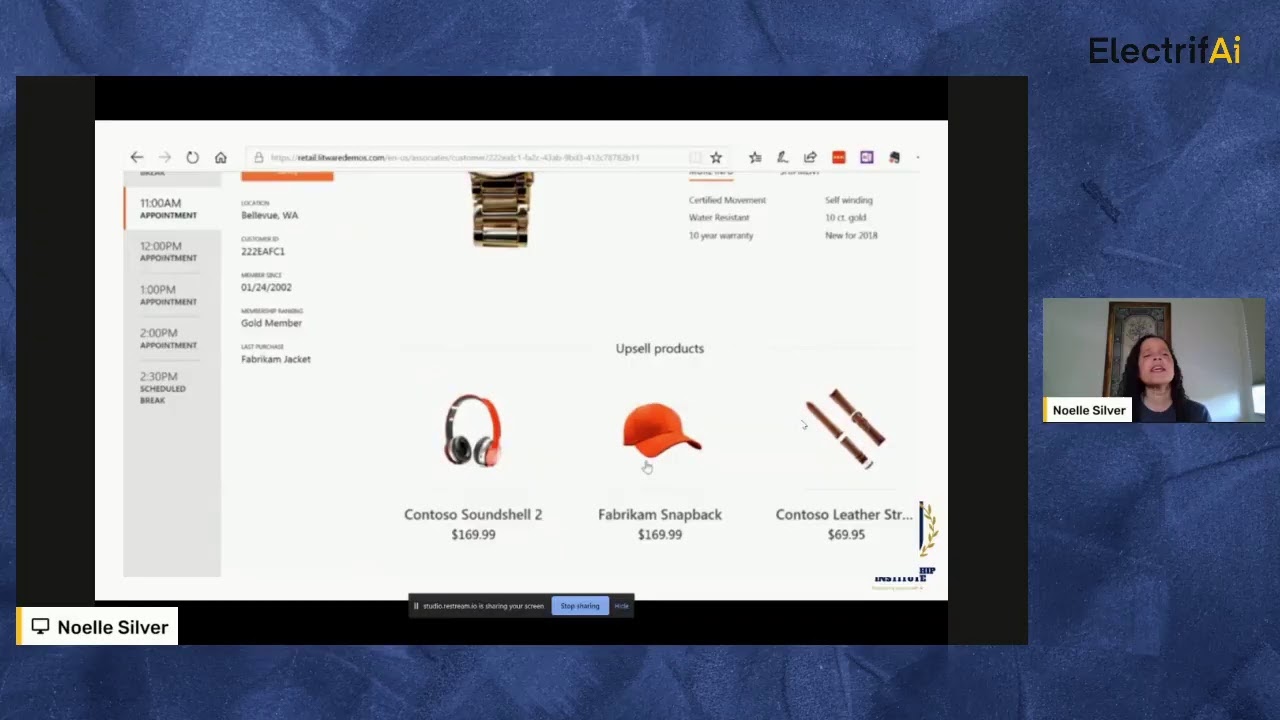
Noelle Russell from Electrify.ai shows how to deploy machine learning models without building your own R&D team. The company's Model Factory packages pre-built AI for retail: chatbots that recommend products, visual search from photos, appointment booking with the right associate, and dynamic pricing. Start small, measure results, scale one model at a time.
Chapters
Hello everyone, it is Noelle Russell Russell. Great to see you. We are starting to get this habit underway. So welcome to This Week in AI with Electrify.ai. We are going to talk about applied AI today. So I'm so excited. Thanks to all of you who are joining. If you are, whether you are on Periscope, Twitter, whether you are listening in on YouTube or on LinkedIn, just say hello. Send in a chat or two. I'd love to know that you're listening and watching, and I will certainly try to respond if you have any questions about what we're about to show. Or if you catch this on the replay, we had hundreds of people catch this on replay last week, so really excited. But thanks so much for joining us live. This is always a lot of fun. So I am going to send a note out to all of you. And just say, "Chat away." Great to see you. Just so you can see that this chat is live and operating, you're welcome to chime in and I will try to— I will be doing a couple of different demos today, so I'll try to bounce back and forth and see you live. Thank you so much for joining us. Every week on Thursday, 3:00 PM Eastern Daylight Time now, we are going to take a look at an area of applied AI. For those of you who are not familiar, Applied AI is the kind of section of artificial intelligence for the rest of us, right? For those of us in organizations where we want to leverage the power and capability of artificial intelligence and models, but we don't necessarily want to invest in the research and development and resources that are needed to build a ground-up organization to support that. So applied AI is something that many companies are involved in, in different areas of the ecosystem. I work for Electrify, I'm actually so excited to share with you kind of the, the process that we use at Electrify for bringing applied AI to our customers. Another term we often use is machine learning as a service. And it's the idea that we have a bunch of models that are available to anyone to be able to use to exemplify, create more value, be able to take advantage of AI without building it from scratch. And there's a whole lot we can do there. But today we're gonna talk specifically about retail. I'm gonna go ahead and open up my screen share. So let's see if that works. And then I'm gonna flip over to our PowerPoint presentation. So again, welcome This Week in AI episode 2. Super excited. Thank you so much for joining me. And today we're gonna talk a little bit about retail. Now I've had the luxury or joy of being able to work with very large retailers on how do they bring AI to their customers to create a more frictionless experience. And that's what I'm gonna talk to you about. Not only reducing friction from the perspective of the customer engaging with you, especially in the time where we're still dealing with a pandemic and lower amounts of foot traffic in stores, but then also how do we reduce friction with the sales associate and their processes and with the contact center or customer service center that might be handling issues with sales processes that have gone wrong or with products that didn't meet the customer's expectations. How do we make all of that frictionless? And so I'm gonna talk through that with you for a little bit. Before I get started though, I mentioned this last week, I always start off with this. You know, one of the things that excites me about Electrify is this concept of being the machine learning model factory to the world, right? If you, chances are, if you wanna do something with AI and you're not heavily invested in this industry already, you're probably thinking like, how can I do this? What are the types of things I can do? And one thing we've seen with our customers over and over again is the beauty of starting with something small. And some of those models I'll share with you today, but start with something small. Start with something like, you know, master data management, getting an idea of what kind of data you have and figure out what kind of models you can use. Something like churn analysis, customer profiling. Like I said, we'll talk about some of them today, but there are certain models that are good starter models, good models to start your journey into AI AI with. And we of course specialize in those areas as well as some of the more elaborate models you'll see as we move to, you know, further along our journey together. But the Machine Learning Model Factory is really your ability to look at a sea of solutions and pick the ones that are appropriate for you and appropriate for your business and grow with that AI competency. So super exciting. I mentioned last week, speaking of competency, last week Electrify announced its partnership with AWS. We are listed as one of their top AI partners, specifically in the area of applied AI. So, um, really exciting to see that partnership going. And of course, we are cloud agnostic. We work with everybody. Um, but it's nice to have, uh, that recognition from AWS. So thank you so much. Another thing I always like to start with, uh, in addition to our journey, is what is that actually look like, right? So I'm going to talk to you about a bunch of models, and at the end you might think to yourself, well, that's cool, but how do I do one of those? How do I get started with one of those? So I, I don't ever really spend a lot of time here, but I wanted to talk you through if you wanted to start. It's really not that difficult. The hard part is in us figuring out what's that KPI we can drive, and then how do we keep that KPI building and building and evolving within your organization. So we do that in 5 steps. We spend time with you identifying your data, figuring out where that data is, what your data estate looks like, aggregating that in, then collecting all that information and using that data to train the model. That model is a pre-structured model, and I'll talk to you about a couple of them a little bit later. But those pre-structured models mean that we're not giving you a canned model that's been pre-trained on someone else's data. What we can do though is we've built so many of these models, we've now got this reusable IP that you can now take your data and train an existing scaffolding, an existing model, but it technically at that point becomes yours. The data you provided helps that model perform to the best of its ability. So we have all of the domain expertise, all of the, you know, deep understanding of how this model has worked for other companies, But when you get this model, it's yours. It's a Docker container that's ready to be trained with your data. That also gives us a really great opportunity towards the end in the model training and results part of this process to look at and see how can we make this model perform even better with the data that you have. Here's the other benefit. Our data scientists inside the model factory that we give you inside of this Docker container we deliver to you, the cool thing is, is that they've done more than just orchestrate a couple of algorithms together. They've thought through what are the most common problems with certain industries' data. All of us know we either overstate that our data is in good shape or we admit it, that it's not in good shape. But all of us have a little bit of work to do in getting data to be useful to a machine learning model. And so what our data scientists have done is they've actually added into the Docker container common things like data quality checks and integrity checks to make sure that even mediocre bad data can be turned into good data with very little work on the client side. Something definitely worth talking more deeply about with you if it's of interest. Certainly something you can do. You just head on over to our website and submit an email to us and be like, hey, I'd love to see this custom, you know, to our company. And it's something that my team and I do every single day, and we'd love to, to do that with you. But let's talk a little bit more about these enterprise use cases. That applied AI is good for. So this was actually a study done by my friend's amazing team at Microsoft where they, they asked a bunch of companies, hey, what are you thinking about? What are you worried about? How do you want to use AI as an organization? And these were the boxes that came up, right? If we all were in a room in the good old days doing a workshop, right? And we're all in a room and we are asking everyone, what do you want to use AI for? Right? We ask 100 companies and we put up a bunch of Post-its. This is how they laid out. But here's the one cool thing about that is that we then ask kind of a more specific question specific to retail in this case. If you're in retail, what might you do in the next 6 months? What might you do if money was no object? If you didn't have to build a team from scratch, where would you invest your time? And these were the 4 boxes that those organizations chimed in with, and we found it to be true over and over again in these retail organizations. So one, everyone needs to know more about their customers. You can't be hurt by that. And I'm just going to flip back and make sure that you all can still see me. You can. Yay! I always like to check halfway through. But one is everyone needs to know more about their customers. So customer intelligence, customer profiling. A lot of us have many data systems and there's a little bit about our customers sprinkled all over the place. So how do we use the information, especially in social media? How do we use social networks to get the information, as much information about our customer as possible so we can serve them in the best way? And along with that, of course, comes a recommendation engine, and I'll show you that in a demo in just a second. Another thing is, of course, retail intelligence. This is just simply how do we get a better retail experience for our customers? Everything from upselling, cross-selling, right? How big is their, you know, what's their lifetime customer value? These are all models that Electrify.ai has built already, right, that you can infuse with your data and be able to leverage in your own organization without having to build a data science team of your own. Pretty exciting. Okay, so another thing is intelligent search. Wouldn't it be great? I know many of us, right, I could just say like off the record, many of us go to our company's like website and we, what would we do if we want to find something on our own company's website? We often will just go to Google or Bing, right? And search it there because those search engines are so much more powerful. Well, that's not the case anymore. A lot of these organizations have open sourced or at least made productized their search engines. And that's also a model that we offer is the ability to get a better understanding of the information you have so you can find it easier. That's oftentimes a lot of the friction, especially in a customer call, is just figuring out where to get the answer and that it might take too long in a conversation with a customer. And then finally, on the backside of the house, right? So far I've been talking a lot of front of the house, customer-facing, but what about just our internal processes? How can we improve the way we operate internally? Whether that's, you know, improve using classification models to improve the decision-making of our legal team, of our HR team, of, of anyone of our customer service center. A lot of different models are available in this applied AI fashion that'll just improve the ingenuity of the people already in your company that are doing this work every single day. Single day. And that's where applied AI shines, right? Is how do we look at someone's day-to-day job, find out where's the most friction, and apply— if it's applicable and it works— apply machine learning to alleviate some of that, uh, lifting that that person has to do. And that's where we've seen AI work and generate value for customers over and over and over again. So today what I wanted to do though is drop you into a retail demo. You'll see this is a custom demo for me, but I wanted to show you and talk through different things that you could see that are related to, you know, what applied AI models you might be able to use. In other words, none of the models I'm about to talk about you have to build from scratch. They are available and actually they work beautifully when we work together and figure out what orchestration, what series of models could help make this conversation go as simple as possible for a customer. Let's take a look. This is just a simple fictitious retail example. For those of you who know me, you might remember I did a demo very similar to this at Microsoft. I think it was Build, maybe it was Ready a couple of years ago. I was in one of the keynotes and it's such a powerful demonstration, I wanted to share it with you today. But you'll see here we're on a retail website. You go into this retail website and there's an intelligent agent. Many of us have gotten on the intelligent agent bandwagon. We figured out, okay, conversational AI is definitely easier than trying to find a dropdown list or a button somewhere to click, right? Having someone just talk— I should probably mute my device— like with Alexa or Google Assistant, just talking to your tech. So of course, way easier. So I take that a little bit further. But the first thing you'll see here, it's a little grayed out, But the first thing you see is actually a recommendations engine, right? This is the bare bones commodity you must have if you are not— if you are in retail or in a place where your customers are acquiring things from you, recommending what they might want based on what others like them have wanted is something we've seen, of course, for years through our big FAANG companies. But it's something that's accessible to you now. This is a model that is available as applied— an applied AI model that we can definitely support you in. So hopefully as we go through this demo, you'll think, oh, we could do that. Oh, we can do that. And really the biggest, I think, takeaway is you only have to do one. Just start with one, see it bring value, let it wow your, you know, leadership in your company, and then go and do another one. That's how applied AI works, right? One model at a time. Okay, so here we go. We are— I'm going to go ahead and, you know, go into the chatbot and say, hey, chat, sure, I want some help. And the chatbot says, Noelle, how can I help you today? And I, of course, respond. But I'm— I don't know if you all know this. I am a Latina. I'm Puerto Rican. And I might on any given day speak in Spanish or maybe not, or maybe I'll do both. But you'll notice here what the chatbot allows us to do, and these are some applied AI models that are available, is language detection. What would it be like if you could speak in the native language of your consumer, especially in a global retail marketplace? Right. How many times do we have things lost in translation? Literally. Excuse me. Right. Literally. So what this allows us to do is detect the language on every chat message and then translate that every chat message. So as you can see here, I go and I communicate in Spanish and it responds to me in Spanish. But then the next time I talk in English, very much like the Miami that I am, and it also responds to me in English, it reacts to exactly what I'm doing as the customer. Frictionless, right? Reducing, right? My— I can communicate the way I want to, and that's what we want to do. We want to lean into how our communicate— how our customers want to work with us and then align to that. And this is an easy way to use applied AI to do that. Now, another thing, the next thing I want to do is I'm there for a reason, right? So I as a shopper want to go in and I say, I want a new watch, right? You can see it here. And it then automatically, based on my profile, right? I'm a smartwatch person. Based on my profile, it pops up something and says, oh, Oh, here's a smartwatch. Great. You probably like one of these. You bought one of these just a few months ago and the new version's out. But actually I want something a little bit more special. So it gives me a couple options. Do you like what you see or would you like something else? And I'm gonna say, no, this actually isn't what I'm looking for. So it's then gonna ask me, and this is where again, applied AI models really shine. Is wouldn't it be great if rather than me having to explain what I want, right? Rose gold. And if there's diamonds, that'd be cool. And if maybe, maybe, I don't know, the clasp is a lobster clasp. I don't actually know much about jewelry, but I have these specs that I want. Wouldn't it be better if I could just ask the customer, you know what, if you have a picture of that somewhere, why don't you do that? And so in this case, I just went out and grabbed a Shutterstock photo. But you'll notice there's a lot more in that photo than a watch. But we use computer vision and we have the ability in computer vision, right, to tag photos and identify what a watch looks like, train a computer vision model that, hey, this is what a watch is. When you find that watch, isolate it. So I pass in that watch and it automatically then is able to say, oh, we happen to have something just like this. And maybe it ends up showing a bunch of different watches from even maybe our competitors, right? It might show a collection of watches. But the important thing is, is I've reduced the friction of the user having to explain to me what they want. They can just point to a picture, upload a picture and poof, I now know exactly what they want and I can use computer vision to help me align a watch, right, to an entity, a picture of a watch to an entity that then can match to a product in my catalog. Pretty exciting. So you can see here after that I maybe start asking questions, right? I'm like, oh, I like that watch. Well, you'll see my question here. You can— I think I say, what's your return policy? And I even spell it wrong, but it's okay because it's kind and it understands that sometimes I don't spell things correctly. So it says, "Oh, no problem. You can return unworn items for 7 days." And then here is another really nice thing about NLU models. Again, a prebuilt, and this one is actually pre-trained model. I say, "Okay, well, what about after that?" Now notice that's very contextual, right? The bot has to remember that I just asked about returns so that it knows the 7-day limit that it answered is actually the "that" that I'm referring to. And it does. It says, "Oh, no problem. After 7 days, you can return." you can return it for a store credit. So it gives us the ability to not only leverage natural language, which is definitely in the applied AI realm, but also, right, have the ability to then provide contextual support, which is really special. Now the next thing I say, I'd love to try this on. You know, nowadays all these stores are appointment only, or at least the stores I go to are appointment only. And so I want to set up an appointment to go in. Now here's where again, some technologies can be used in order to make sure that we align that user, that customer with the appropriate person who knows the most about the thing they're about to try on. Right? How many times have we gone into a store and gone to an associate and been like, oh great, do you know much about this watch? They're like, no, no, I actually work in the lighting department or whatever. Right? So wouldn't it be great if we could use a system smart technology and expose that to our customer, use a machine learning model to go and find the right resource at the right time, near the right location, accommodating a bunch of different variables and sharing that back with the customer. And it says, oh great, I found a perfect expert who's only 5 miles from you. Are you cool with that? Yes, I'm cool. Here's some times, pick a time that's available to you. I say, great, I'm booked 11 o'clock showing up. Frictionless, right? I love it already. Now it asks me to take a selfie so that I can use computer vision to detect you when you come into the store, and we'll get to that in just a moment. So I take a selfie. This is me at Build. So I thought I'd reminisce a little bit, but I take a picture and now hopefully the store will recognize me when I get there. But I take, you know, a picture. It then generates for me a map that says, Here's the directions. We'll see you soon. Awesome. Now, the next thing that happens is I walk into the store. Again, here is a kiosk. Many of us have seen this. There's a couple different things that happen in the in-store experience. One could be the use of dynamic pricing. I don't know if you've seen, but there are certain stores now that actually have digital kiosks that price everything in the store. And so as you're walking through, that price is digital, could change at any time. And so leveraging machine learning and digital and dynamic pricing, which is a specialty of Electrifyze, you might be able to see like, wow, at this time of the week, or more importantly in this season, right? Whatever it is, whatever variable you choose to iterate on gives you an opportunity to get closer and closer alignment with what the customer wants at the time that they want it. So I'm at the kiosk. It says, hey, it asked me actually to take a picture of me so that it can detect me, right? Because Computer vision is only as good as the opt-in that the customer has to being part of it. So I take a picture. It then says, "Oh wow, I know you. It's Noelle. I've seen you before. I recognize your peace sign. How can I help you today?" And this is a voice-activated kiosk. So I now can press this button and start talking to it. So I say, "Hey, I'm here to try on my watch." It knows who I am and then says, "No problem. The place to try on the watch is at the back of the store." However, last time you were here, you wanted a couple of graphic tees because, you know, that's what you wear. And it actually can use computer vision on the day that I arrive. The day I arrive, it looks at me and goes, oh, you're in yoga pants again, right? And it could say, we happen to have yoga pants 30% off. Don't forget to drop by, right? We can be extremely hyper-local, hyper, like, context-sensitive to what the user is doing at the time they're doing it and guide them to things they already want, which is again, part of a magical experience we can create for them. So we tell them, hey, you like graphic tees, don't forget to head over there, buy some. And I then I walk, I'm walking through the store, I'm like, ooh, graphic tees, nice. I'm headed to the watch department. At that time, an alert goes out to all of the sales reps on the, on the floor that says, Noelle Russell, she's a gold member, like she's here, she's here. And for those of you who might know this, there's certain industries that people actually like being known, right? They like it when you walk in and you know their name. Hospitality, travel, casino, gambling, high rollers, right? Shop, high fashion shopping. People like to be like, "Miss Silver, how are you today? Great to see you again," right? And this gives us the ability, once I check in at that kiosk, to alert everyone in the store that someone important is around. Obviously, they have to opt into that, but I have found that these customers often do. For the wonderful experience they get as a result. So now this alert occurs, the associate— remember, we picked a very specific associate to talk to this customer. We show them and we say, great, right? Here is what this customer is here to do. Noelle's in the house, and here's what she wants. She wants to try on this watch. She— here's where her appointment is. Here's how many times she's seen this before. And by the way, we really think she's tuned based on a cross-sell or upsell model that we've done the reason, you know, we've got a machine learning model feeding this information into this dashboard that says, pitch this, right? As the sales rep, go for the hat. I know it sounds crazy, but she's definitely up for a hat based on the machine learning that we've done and other people that have bought this watch or whatever. But it does give us a lot of information that we now can populate to that sales associate so they can have a better experience with that customer. And the same thing is true for customer support, right? So when they come back, the customer support person, let's say I call and I'm like, oh my gosh, my watch, it's not working, or it's, you know, not the color I expected, or I just don't like it. Everything that that customer has done and everything the sales associate has experienced is all documented in this At The Glass integration dynamic profile of the customer. So when the call center rep picks up the, you know, has that call, they are well educated about everything that's come before. I don't know about you, but as a customer, I'm often frustrated how many times I have to explain myself in a series of a single call, right, as I get routed crowded from system to system. They're like, "Great, how can I help you today?" I'm like, "Well, I said the last 3 times—" in a nice way. But how great it would be, right, to create a single source of truth about who our customer is and make sure everyone interacting with that customer knows it. And that's what these applied AI models can do for you. So I just thought it would be cool to kind of show you that journey. I know we did a whirlwind tour, But it's exciting. There's so many things we can do in retail. And this doesn't even really go into any of the specific data or any of the specific use cases around just marketing departments and their interaction with a customer or just understanding. And it's not just retail, right? A lot of what I just talked about was really just good customer experience. And many of our companies actually can adopt to that and benefit from that. So really exciting stuff. Thank you so much for joining us and thank you all for joining on the replay. I always like to be really mindful of your time. We take 30 minutes every week just to update you on some of the latest and greatest applied AI solutions. I don't know what it'll be next week. Check Twitter 'cause I often put up a poll, ask you what you wanna hear about, and you can choose your own adventure on This Week in Applied AI. So thanks for joining us. We'll see you next time. And at any time you need to, just join us on LinkedIn, send me an invitation if we're not already connected. I'd be happy to talk with you about anything that we talk about on this episode. So thanks so much. We'll talk to you soon. Have a great rest of the week.
More from Noelle

Take the Unlocking AI Challenge and Get the Keys to Unlocking Time and Revenue for Your Business



Don't Get Left Behind: The AI Executive Challenge #ai #business #fearofmissingout





