This Week in Applied AI with ElectrifAi (Video Computer Vision)
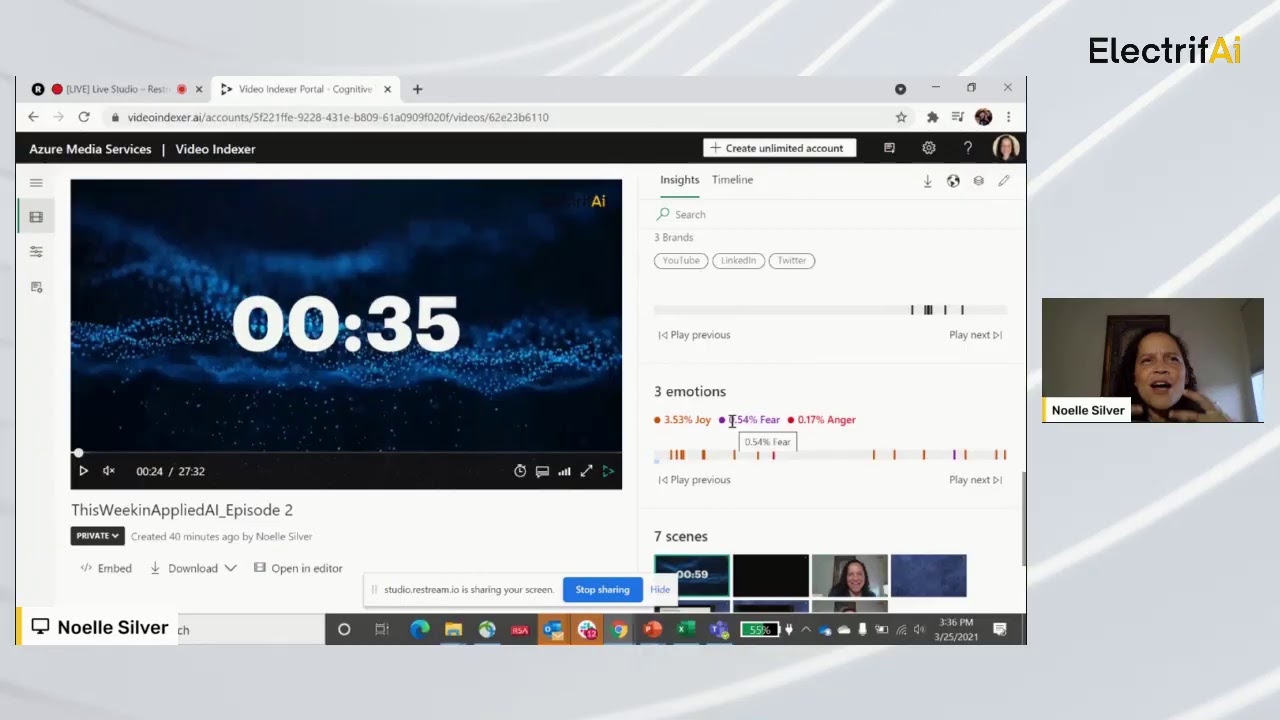
Noelle Russell demonstrates Electrify's video computer vision platform, showing how pre-trained models can automatically detect objects, classify attributes, and identify emotions in video data from cameras and drones. The platform tags entities and extracts insights in weeks instead of months, with use cases spanning manufacturing quality checks, produce freshness detection, and surveillance safety.
Chapters
Hello everyone, so great to see you. Thanks for jumping in. I started this live at 3:16, so for those of you just joining, that's my birthday. So it's a good time to start, a little late, sorry about that. But welcome to This Week in Applied AI. I am your host, Noelle Russell, super excited to see you today. Thanks for joining in. We are going to— what's up, Jerry? Dr. Jerry is in the house. Great to see you. So many fun faces. Nice to see you all. Thank you for chiming in. If you are here and you are watching the live presentation, go ahead and say hello. I can see your comments whether you are connecting with us on YouTube, whether you are connecting with us on LinkedIn or Twitter or Periscope. Just let me know. Say hello in the chat. I would love to see that you are here. Hello, great to see you. So many friends. All right, let's do this. So today it's gonna be pretty exciting. We're gonna talk all about computer vision and more specifically about video analytics and what we can do in that space. There is so much we could do. I mean, we only have 20 minutes. I try not to take a lot of your time in the middle of your day on a Thursday, but we are gonna have some fun. So I'm gonna, Hey Lucien, I am going to go and share my screen. Hopefully it won't be too terrible. Let's see where we are. There we go. Okay, sharing my screen now. I am, for those of you who don't know, I leverage the Restream platform. And for those of us content creators out there, you know, we're always trying to find the very best tool we can. So I do the best for you as I can here. Let me go into presentation mode. So once again, welcome to This Week in Applied AI. All my friends are here, so thank you for watching. Today we're going to talk about computer vision at scale. What are you going to do with all of this video content you've been storing? This is just one of hundreds of use cases we focus on at Electrify. Um, Electrify, just to remind you, is a— basically, we're the machine learning factory for the world, right? We want to be able to help you deliver machine learning value in your org without necessarily having to build it from scratch. We work with incredible partners to help do that for you. So if you don't currently have an SI or a partner that helps you do digital transformation or, you know, cloud adoption and now machine learning, that now's your chance. Go and ask them like, what are you doing with Electrify? Chances are they're already doing something, but if they're not, we can get that conversation started. So let's talk a little bit about video analytics, or more importantly, computer vision. But before we do, I always like to talk about the journey that almost every company is on. I remember doing the same type of talk years ago, like, I don't know, dare I say a couple decades ago, when we were going through this whole e-commerce, right, process of companies having to make a decision about do I go digital or don't I? Do I go cloud or don't I? And those that did saw success and stayed around. Those that didn't went the ways of Blockbuster and Borders Books and Kodak, right? Their whole world changed. And so what we're trying to do now as Electrify is really help you stay competitive. And one of the most competitive landscapes today around being able to do more with less is in the area of applied artificial intelligence. In other words, build on the shoulders of giants, take the work that we are doing and building with our machine learning teams and leverage them as RESTful web services for your own organization. So today we're gonna talk about a couple of them. Oftentimes I encourage us to just think about it as a journey. AI, machine learning, it's never an easy button, right? If someone tells you that you just press this button and poof, it happens, There are asterisks and fine print in there. Please go read it because machine learning is hard. We've done the hard stuff. Now you, your company gets to take advantage of that by leveraging the work that we've done. And so we found that it works for a lot of different customers. We focus on BFSI, telecom, entertainment, retail, consumer, and healthcare, and so many interesting use cases in those areas. So today I wanted to just revisit, um, what it takes to do one of these projects. The nice thing about Applied AI is what we call time to value. You can implement an Applied AI model, get a custom model trained on your data, and actually start seeing results within a month. And that is what you want. You don't wanna spend 6 months building a model and realize you picked the wrong one or chose the wrong feature to engineer. Right? Leverage our work to do that so that you can get results fast. And that's exactly what we do here. Now, one thing I do wanna talk to you about, because this is specifically interesting and unique for computer vision, is that there are 3 types of applied AI models. There is a pre-trained model, which is a model trained on existing data. I'm gonna actually demonstrate a pre-trained model for you. We at Electrify also have pre-trained models. That means that when you get the model, it's already trained on understanding what a person looks like. What a chair is, what, you know, a light fixture is, right? It already knows certain things. Same with language, right? We can pre-train a language model on the English vocabulary. The nuance and the value of applied AI comes in when we can custom train on top of that, right? Where we can do what's called transfer learning. We can transfer our learning from one of those models into one that's specialized for our use as a customer or our use as a someone trying to solve a very specific problem. And I'll talk to you about a little bit of those now. So pre, pre-trained, they're nice because you don't have to do a lot of work to use them, but to get real value from them, you have to custom train it. And that's where we've got a definition of a term called pre-structured. And pre-structured means that we get to go in and now rather than getting a model that's trained on data, whether it's open data or other clients' data, right? We're in the age of GDPR and PII and compliance and data privacy, we want you to start with nothing. So we take a model that we've built, we know the algorithm work, you know, we have mathematicians, statisticians, right? They can build the algorithm, but what makes that algorithm fly is the data you give it. And, and that way you focus on your core competency, that data and the problem you have, and we come in and provide the math to get it done. Um, it's really a great kind of collaboration that we can offer. And of course, there are pretty cool use cases that have never been done before. I'm working on one right now in the area of gaming, and there's cool stuff that we could do that no one's ever done. And so in those situations, we might even go on an adventure with you and build a new model from scratch. But that's not really what we do every day. Every day we want you to leverage work that we have done that has been successful so that machine learning isn't a research project for you, right? It's not a science project, it's not a test. It's something that's proven and has, you know, an ROI that we can show. And that, that's what I like about it. So I showed you last week and I show it every week. These are a collection of use cases where AI is a good idea. We at Electrify have different models, lots of them, hundreds and hundreds of models that we have built over the last 15 years, and they fall into a bunch of these buckets. But every week I've just been focusing on one or two of them. This week I'm focusing on two specific areas. What do you do with all of the data that you've collected when you're doing surveillance or security or in order to improve predictive maintenance? I've worked with some really cool customers in the area of manufacturing and been able to use applied AI to use Custom Vision to detect right, how well things are going through the line. The nice thing about that is I actually don't have to touch the line. I don't touch the production line. All I do is watch it, and then I can provide very useful insights to that team on what they could do to improve its capabilities, right? How do we use a computer's ability to see things that are super hard for our eyes to see? How do we do that? One of the other things about computer vision that's really interesting that I have found is in the area of like produce. Right? We know when we look at, let's say, an orange, I look at an orange and I can pretty much tell when it's bad. But I don't really know how bad until I open it up. Computer vision actually is much better at this. At the pixel level, it can tell when deterioration has started. And with the value of data and predictive analytics, I can actually create a path. How long will it take? A piece of fruit from the time it's put on a truck to the time it gets into a store, and what does it need to look like at the beginning to make sure it can sell at the end? And that's a problem that machine learning and AI can solve, has solved. I mean, this is something applied AI is used to do this from some of the biggest manufacturers and producers in the world. So let's take a look at just a couple different areas where this content can come from. To give you an idea of what this is, it's kind of a fun use case for me. I'm gonna actually show you something I did just today, super fast with a prebuilt model. It's a little embarrassing, but I'm gonna show it to you 'cause I'm that way. I'm authentic, I'm real with you, I tell you how it is. So here you'll see lots of different places this comes from, right? The advent of mobile devices, iPads, iPhones, all the Android devices in the world, everything that has a camera can now take video and pictures. And so there's so many sources of this kind of content. Video surveillance also, Edge, devices that have cameras, drones, right? All of these types of things increase the amount of video that we might have within our organization that's worth analyzing. Of course, in robotics, the ability to use cameras to analyze a production line, right? Be able to analyze manufacturing. And then also we're producing content every single day. I don't know how many of you are streamers, but you know, WandaVision, like there's, there's shows made every single day. And in those TVs and movies, we've got new types of content that we you might be able to use. And then of course there's my personal favorite section, gaming, right? What can we do with gaming and live streaming? You know, we're creating content all the time on platforms like Twitch, which I am broadcasting on today, right? All of this video, what do we do with it? What can we do with it? So I wanna share a couple of different use cases with you now, and then I'm gonna show you a demo, which I, I thought was hilarious as I built it just a few minutes before we got going today. So the first one, of course, is being able to go through all your video and look at the objects that it's detecting, right? So detecting all the objects that's in it, whether it's people, animals, places, machinery, whether it's, you know, what kind of entity it is. And then once you have an entity, let's say a human, then identifying attributes of that human, right? Are they wearing the right safety gear? I can train a computer vision model to say, here's what a safety vest looks like, Here's what a little, I don't know what it's called, like a little meter that they have on their hip to detect voltage. I wanna make sure every one of my people have one of those on their hip and I can use video to detect that and alert me when it's not there. Right, so identifying properties of the things that we've detected, then recognizing specific people. Again, going to the safety side, I wanna know, are you supposed to be here? Are you allowed to be here? Right, why are you there? You're not supposed to be there until 4 hours from now and get It helps bubble up things that would be hard for me as an individual to see, but easy for a computer to identify and send an alert on. So recognizing people, actions, the events, things that are going on. There's a lot of surveillance video in large cities and they can tell when groupings of people are collecting, which might give some insight into, wow, they're gonna need some support with that many people. And then one of my favorite sides of computer vision is semantic analysis, right? Being able to use real-time information information to detect activity. So let's say, for example, in robotics, right? Being able to— one of the coolest robotic demonstrations I saw was in an Amazon distribution center, and their robots dynamically choose which way to go based on the context and movement of other robots on the floor. It's fascinating. I think it's on YouTube. You can go take a look, but really, really fascinating. And so with These types of situational awareness, right? If we can create video analytics that does situational awareness and bubbles up that awareness to the watcher or to the person needing to make a decision, that is incredibly powerful. And something, like I said, that augments what we could do by ourselves or even what a team of us could do. I could share with you another example specifically around analysis using a computer to see what we can't in the area of A company was focused on building motherboards, right? And when they built these motherboards, humans, engineers would look at the motherboard and say, yes, it's good, or no, it's not. A human with their eyes looking at all of these connections on a board and say, yeah, that's good, no, it's not, and then move it along. Computer vision is uniquely qualified to do this so that the only thing now these engineers, right, rather than spending 60% of their day manually reviewing content, or in this case motherboards graphics, they now can say, just show me the stuff that looks like it needs attention. And computer vision can surface problem areas as opposed to me having to look through 500,000 images myself. Huge opportunity for, um, you know, basically what we want to do is take someone who maybe is doing a lot of these manual type reviews and augment their ability to do their job. I've never had, you know, sometimes people say in artificial intelligence, right? Oh no, it's taking all of our jobs. And what I have found is when AI is used in the right way, especially, you know, applied AI, we help augment people's jobs and it's usually the part of their job they're most frustrated with, right? They, they're like, please take that away. Please help me not look through 500,000 pages of a PDF in contracts. Right? Please help me see where the word risk shows up in these contracts. They want that help. Tears happen, but they're normally tears of joy. So lots of opportunity there to help people do the job they want to do, the job they love to do, as opposed to a lot of this rote and routine kind of capability that machines are really good at doing. So here's just an example of what— I gave you a graphic because I'm going to show you a video example in just a second. But this is an example of, you know, looking at a video surveillance. Maybe it's a traffic camera, maybe it's surveillance on top of a vehicle. But what's interesting about it is the detection capability, right? It can instantly put what we call bounding boxes around all the things that it identifies and then label it. The benefit of using an applied AI model is that these labels come with the package. So One applied AI model, a pre-trained model, is pre-trained on what all the boxes are, and those pre-trained models are often not editable. You can't add your own boxes to it. So that's where some of the limitation is in, in pre-trained models, is that you're going to get them pre-trained, they can give you instant analysis, but it's kind of a box and you have to sit in that box. The value really comes in what happens if I could take that model and that and take the structure of that model and all the learnings of that model, but now I want to train it on my specific city or my specific work zone or my specific, you know, whatever, um, produce line, right? Or manufacturing area. And now all the bounding boxes are chosen specifically for your company. The results of that model become much more relevant and generate much more value. So that's kind of the, the, the impetus for moving beyond what you could just go online and test, which I'm about to show you, and looking at an organization like Electrify who can help you or work with your SI partner, you know, and Electrify can help infuse a custom model to solve this, this job. The good news is we don't have to build that custom model from scratch. We already have the model. We add your data and magic happens. So Let me now take you into this. Oh gosh, good luck to me. This very interesting demo that I have. Let's see, I think it's over here. Sorry for the inception moment, but oh gosh, look at my face. Anyway, what you are looking at right now is an existing applied AI model. For most of you know, I'm an MVP in the area of artificial intelligence. I'm most Value Professional awarded by Microsoft. And so I'm very familiar with the AI models that Microsoft has built, and I love them, but they're a little limited. But I just thought I'd give you an idea of what this looks like. So I ingested my video from just last week. It says I have two people, one because I detected this, or I went back and looked, I'm like, why does it think I'm two people? But just like you see me now, there's one version of me that's little in a box and another version of me that's this big face here. And it shows me how often I show up in the video, which is cool. But let's get down to some of the more interesting pieces of data. And this is— I did no custom training whatsoever. This is just out of the box, take my video and spit it out. This is pretty cool stuff. So it was able to identify I talked about, and I actually am very happy I talked about the cybernetics. Like, that's pretty cool. I talked about 13 topics. And it also shows me where I talked about it. I also mentioned 30 keywords and where in the video I mentioned them. It also provided me some labels, some named entities that I mentioned, right? And here's the fun part, emotion. Look, I was 17% angry. What? I can't, I don't believe it, but it's in there. I'll go find it out. But look at that, 3% joy. I believe that. 0.5% fear. I don't know. I'm pretty expressive. Maybe there was a moment of fear. I don't know. Maybe it was right before I started to go live. That happens. But how interesting is this? Imagine what you can do with a model that you custom train on the things in the video that you care about. This is just taking public data, public interest, topics, keywords, emotion. What happens when I can now train it on a specific lexicon, like the words in real estate if I'm building a real estate solution, or the words in manufacturing, or the words in healthcare or retail? I can actually custom train that solution. That really is the power. Oops. Oh gosh, I think I was already there. Sorry. But that really is the power of doing this, of building a solution. Like this is that it gives you a chance to take a model that's already worked, that has already been feature engineered based on years of domain expertise in a specific area, and now you get to just build on top of it. So awesome. Hi, Carlos, nice to see you. Betty, my friend, so great. Sorry I didn't say hi right away. Sometimes I can't see my chat when I'm sharing my screen, but it's so great to see you all live. Thank you for joining me today. But yeah, this, this, I'm right at about 20 minutes, so I want to make sure I am respectful of your time. But what a fun little whirlwind tour through video analytics. And the most important thing is that if you have video, companies like Electrify can help you gain insights into those videos really quickly. Projects that I do are, you know, between 2 weeks and 2 months, and we generate value. I mean, that's the whole point, right? Is if I can show you the value, Maybe you'll get another model. That's, that's what we're trying to do here. And, and really the world needs what you have to offer, right? The world needs what your company is doing. And if you don't start thinking about how AI can infuse the ingenuity of your teams, of your engineers, of your data scientists even, you know, you could get left behind. So, so this is a great— I thought it was super fun. I will tell you two things before I sign off. One, thank you for all of you who, um, participated in my poll. I ran that poll on multiple social platforms, but every week on Tuesday I send out a poll asking you what you want to hear. We had three options. Um, one was customer churn. It came in number two, so I'll be doing customer churn next week. Um, and really it'll end up being customer engagement, so there's a few different models. Churn is one of them. And then The other one that came in third was loan prediction, right? Being able to identify whether or not a loan will— like, I think it's risk analysis, but whether or not a loan will go into default. And that's more fintech-focused, and I have less fintech people, so— but it did get some serious votes. So thanks everyone for participating. Please chime in. Let me know what you want to hear. We are also super excited to announce that we have a an email that is available for you, ama@electrify.net. Ask me anything. It's not just me. I have a whole team of incredible, amazing solutions architects, and we are going to be sending out videos that answer your questions. So if you have questions about applied AI, about any of the areas that I listed earlier in this presentation, please let us know. We would love to help just close the gap and demystify artificial intelligence. You know, I always say this is artificial intelligence for the rest of us, right? If we're not doing it as a research project and we're not in a FAANG, you know, huge tech company with billions of dollars to spend in research, now then what do we do? And this is really something that I hope all of you can kind of see the value in. And, and we're happy to help, happy to help educate you, uh, inspire you, and hopefully empower you to do more. So thanks so much for joining me this week. It was a really I think is a fun one. I'm looking forward to next week where we talk about customer engagement and how we can do more with the customers we have. So thanks so much for following, watching. Please check us out on all of the social channels. Electrify— oh, I have a cool thing I could do. Wait for it. Wait for it. Kabam! Follow us on Twitter. You'll see our polls listed there and you can also subscribe to our YouTube channel. Which is where you will get notified every time we do one of these and we post them for replays. So thanks again. Have a great week. And yeah, it's been awesome. Have fun. Bye.
More from Noelle

Take the Unlocking AI Challenge and Get the Keys to Unlocking Time and Revenue for Your Business



Don't Get Left Behind: The AI Executive Challenge #ai #business #fearofmissingout





