Why Did this AI do That?
Noelle Russell tests AI headshot and avatar tools, discovering unexpected biases like automatic gold hoop earrings on her generated images. She explains how prompt engineering and human feedback can expose and correct these hidden patterns in AI models.
Chapters
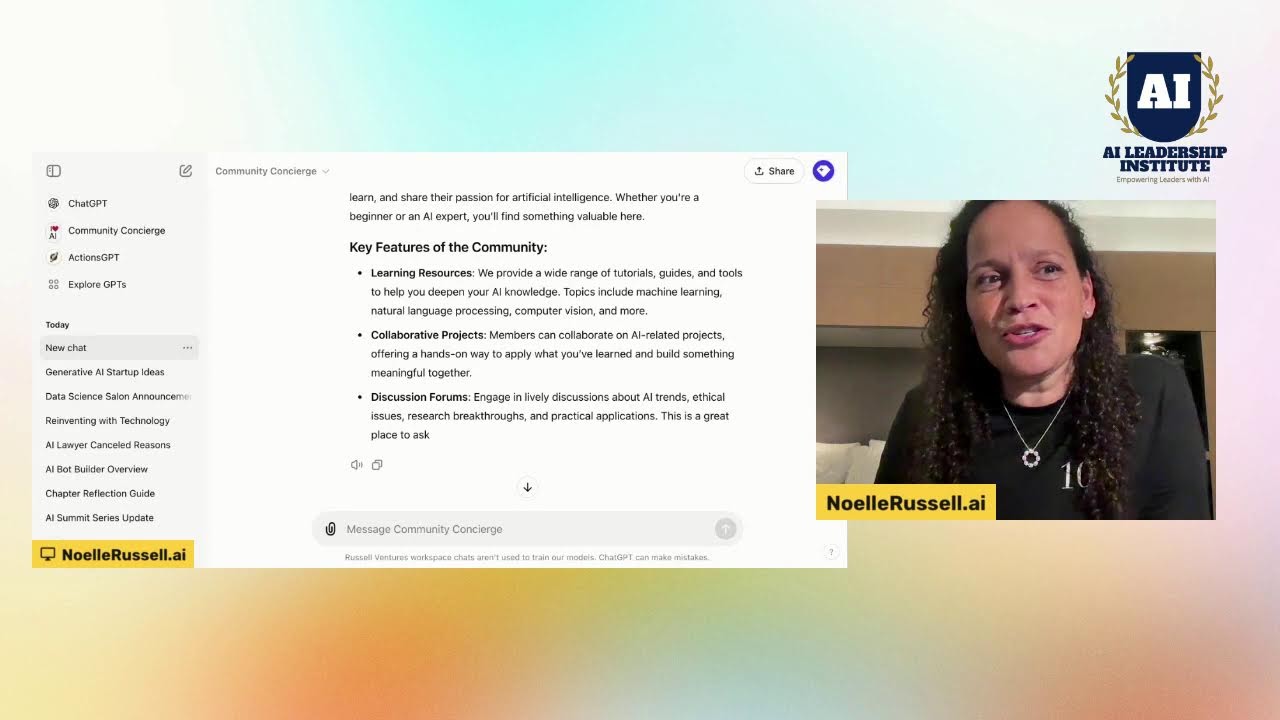
Hey everyone, it's Noelle Russell Russell. I am back. I know I was just live earlier, but I have to tell you this because it's crazy what just happened. I don't know, is that crazy? Maybe you won't think it's crazy, but I'm gonna show it to you anyway. Um, but I am going to share with you a couple things. One, I just had an amazing webinar with my friends talking about AI solutions architecture, so that was really cool. It's so fun to talk about like all the things that you've learned along the way. I hope you all will do that with us one day and just share the things that are in your head that you've learned throughout your careers. But I— so I decided earlier today, I don't know if you've seen this, but there's an ad on LinkedIn for headshots with AI, right? And you basically feed it a bunch. And I don't know if you remember a few months ago, maybe it was last year. Um, they were like viral, like a bunch of people were building their headshots with AI. And for me, it was pretty much a disaster because when you have curly hair and, you know, anyway, it wasn't— they didn't come out very good, so I never even used them. But I, for whatever reason, saw this ad that allowed me to go in and create headshots of myself. And, um, anyway, so I'm going to show, show you what happened. They're not terrible, but there's some interesting stuff that occurred. So let's just, let's just take a look. So I'm going to see if I can share my screen. I'm going to try and do it. Share screen. Let's see. Is it this one? Oh yeah, this is it. Are you ready? Let's do this. All right. Can you see this? Hopefully you can. Oh yeah. I'm going to actually go back. Oh dear. Hold on. Let me go back here. It might be a little— oh yeah, there we go. And So look, not terrible. I think I'm gonna actually go into the chat if you are here. Oh, what's up, Gabrielle? Good to see you. If you're here, just say hi so I could see you. Gabrielle's coming in from YouTube. Cool. I love that. I have lots of different channels that I publish this on. So I do want to share some of this with you though. What you could see here, this is called Insta headshots. And I'm not like hating on them. I actually think it's pretty cool what's happened here.. But I do want to show you a couple things. So this is what they look like. Not bad, right? Like, I zoomed in, I was like, you know, it's pretty good. I like that one kind of. Oh, I really like this one. I mean, it's even got the folds in my neck, so that's pretty authentic. But here's something that I noticed, right? Even this one's nice. Um, click to preview. All right, let's look at this one. Oh boy, a little bit too big. Right? That is not terrible. I mean, I wish my hair looked like that. This is another one that I really liked. Like, look how nice my hair is. It's not frizzy at all. Like, big fan. But here's something, even in this one, I liked it, and then I noticed something that it did. It put, like, if I am— I don't know if I'm able to, like, zoom in. Oh yeah, there we go. Notice this thing right here. This is like a little hoop earring, which I never wear hoop earrings. I've never— none of the pictures I provided as the training data had hoop earrings. And so I was a little surprised to find hoop earrings, let alone more than one earring. I also don't have any of that, which is fine, right? Maybe that's generative AI stuff. But most of these have more than one earring. Like, oh, I guess one side. I don't know. No, I don't. There's just one. Um, anyway, I don't know. But here, so I'm going through, like, these are not terrible, right? These are all AI-generated. I never stood on a beach. They're not terrible. I mean, I like the necklace, but I mean, look at that ear though. Jeez. Like, nothing against people who wear lots of ear earrings, but That seems like a lot. So I started to look through these and find ones I really like. Maybe you can identify some of the ones that I really like, but I'm going through, I'm like, all right, these are cool. I got like that one, that's pretty good. I look like on the COVID of Forbes magazine. Um, is it? Yes. And, uh, I mean, I don't know, sweaters. I don't know why I picked that sweater. Um, so I'm going through, there's hundreds. So I got, I think, 200 of these that That one doesn't look quite like me because I'm like super like skinny, I guess. Um, uh, this one's a little more like me, uh, so it's cool. But again, I'm looking— earring, I just don't under— I have a hoop earring. Like, is that a Tina thing? Like, do they think because I'm Hispanic that I'd wear lots of Earrings? I don't know, but it was, it was just funny because like that one, that's a really good picture, but it's a huge hoop. I don't understand. So anyway, but these are not terrible. So I say this to say, hey, if you've got some headshots, I needed to give it 10. Oh my gosh, look, the double hoop. Like, what are we doing here? What is happening? I don't know, but some of them are pretty good. So, so I just thought I would share with you my surprise that it put these like boricua earrings on. Like, I don't wear those earrings ever. They're not terrible. Maybe I will now because I look kind of cute. But like, it was just really— I mean, oh my gosh, what is this outfit I'm wearing? Who knew? But it's pretty interesting to see what they've done. Like, this one's not terrible. So if you see one of these on my LinkedIn, know that it's AI generated and not me. Some of them, you know, it's just very interesting. Like, some I'm chubbier than others. Maybe it was my training data because I did lose a little weight recently. So maybe— oh, look, this one. Oh, look at my hair. It's a little shorter in this one. Fascinating. Anyway, it's pretty cool. So I don't know, it's pretty amazing. Zed, what's up? Zed is here. That's so amazing. Hi. So cool, buddy. It is awesome to see you. So cool. So this tool, for those of you on LinkedIn, this tool was called Insta Headshots. I saw the ad on LinkedIn. InstaHeadshots.com. It's pretty cool. I mean, I'm, I'm a fan, actually. I will use some of these, especially many of you know, I do lots of promotions for videos and stages that I'm going to be on. So I really like it. I'm so proud. I'm so happy to see Zed here. That is so cool. What's up? You're so cool. But yeah, Insta Headshots. But I just thought it was fascinating that it picked up— in my mind, it is uniquely Latina to wear, you know, to have brown skin, wear these big gold hoop earrings. Oh no, I just feel like it might have made some assumptions there. I would love to know what you all think about it. Um, it's pretty cool though, pretty cool tech. Uh, some other things I thought I would share since I'm sharing stuff. Um, is I'm gonna go here and just— I'm just gonna scroll down, see what else it's got. Oh, it's got like— I don't know what that says, but that's cool. I'm just gonna flip through these and see if there's anything else in here that's interesting. They're all kind of the same. That one definitely looks avatar-ish. I look like I'm sitting up way too straight. That's like Steve Jobs-y, but my hair looks great. So anyway, we'll see, we'll see how it goes. It's really cool though. So you get to pick from all of these backgrounds, like city background, beach background, This I think is a café. Yeah, so you could see like it generates— it did not let me pick— like, this is interesting. I'm like Iron Man in this photo. I think that's supposed to be a necklace, but that's all right. This generative AI, this is why it's nice to get a bunch. I paid $60 to get, I think, it seems like a lot, maybe 200. I don't really know exactly how many I got. But there seems to be a lot here. So fascinating though. I really, I don't know, I just think it's really bizarre that it thought I needed a gold hoop earring. But it just goes to show a lot of these models have these inherent biases, right? Like it's an incredibly important point to be thinking about, right? Like these models, if you do nothing, will presume your brown girls with curly hair will need a gold earring. And that might not be true for them. So this is where humans come in. We as the humans, we train these robots. We go in and we say, not exactly, that's not quite right. Uh, we give it guidance, we give it better training. I'm gonna go back and look at my training data and see if one of the pictures, maybe I was wearing hoop earrings, but it would be bizarre because I don't think I own any hoop earrings. Um, but it was, it was really, really interesting for me to go in. Oh yeah, I was going to show you this other tool that I've been using. So let me go back here. So I'm gonna go to good old Instagram, for those of you who know it. And Instagram— oh my gosh, there I am. I'm Noelle Russell on Instagram. You're welcome to follow me. But Instagram added a new cool capability called the AI Studio. I hope I am— yes, I am sharing it. So in the AI Studio, you can create your own avatar. Now I already have an avatar that I've created. These are avatars other people have created. I'm gonna go to your AI characters and you could see I've tried this a few times, but the latest one I called Nearly Noelle. But here's the coolest thing about these AIs is that you can use what I teach in the AI Bot Builder workshop. You can use those skills, the 4 Ps of prompt engineering, Responsible AI, bots at scale, and you can use those to create better instructions. I'm gonna make this a little bigger so you can see. This was an AI-generated version of me. And no, it was not one, it was not a zero prompt image. It required lots of prompts to get the hair that way and my skin color that way and my shirt and blazer that way. But nearly Noelle, I like it. I stuck with this one. But over here you can see, maybe I made it a little too big. You could see these are the instructions. So it has a knowledge base. And again, this is what you learn in our AI Bot Builder class. A bunch of people just signed up for the one that's happening next week, so it's not too late for those of you who want to join us. The knowledge base here, you could see how you educate the model. So you could see Nearly Noelle is an Afro-Latina. That's me. A thought leader, passion for empowering businesses, harnessing AI, blah, blah, blah. Yeah, that all sounds good.. And then I started going in and I would ask it questions. So I tested the machine. As I tested the machine and it gave me potentially weird outcomes or answers that I didn't quite agree with, I would write instructions to correct that behavior. This is the most important thing you could understand about AI is that AI is never broken. It's just untrained. Your job as you build these systems is to constantly evaluate the answers that they give you, and use your instructions, your training, your prompt engineering to train that model to make better choices. I always tell my kids when they leave for school, "Make better choices." Make good choices, everyone. When it comes to AI, that means that you use these instructions to tell the machine how you want it to respond in specific circumstances. One I answered recently, or one instruction I added recently was, "She's only—" Oh, "She is only—" I didn't even say it right. I wrote it though. I guess that tells you I didn't write it with GPT. She only supports conversations based on the instructions given. If you ask about other topics, let me click on it so we can see what it says. She will politely decline to answer. So I added that because I was asking it in testing things that had nothing to do with me or things that I would know, and the bot tried to fake an answer, hallucinate an answer, generate an answer, or not even hallucinate, just go out to the internet and make something. Create an answer that's not in the context of what I want this bot to be able to be talking about. I added these guardrails through the beta testing that I did. Pretty fun, right? I think it's pretty cool. Oh my gosh, you guys aren't seeing it. Oopsie, my bad. I guess I went to a new area. Hold on. Oh yeah, I did. I'm going to go here. Hold on one second. I'm going to show you this bot real quick because the sharing screen, you had to watch that video for so long. I'm so sorry. Thank you for telling me. Here we go. So this is the Nearly Noelle bot, um, and I got to it. I'm just— I told you to click on that AI Studio, so I'm just gonna go back a little bit more to show you. So from Instagram, way down here at the bottom is AI Studio. When you click on that, it's going to launch a new slot, a new, uh, tab, which is why you couldn't see it. But I'm going to keep going forward and take you into the studio and it'll show you all the bots that you have created. I've created a bunch. Here's Nearly Noelle. Nearly Noelle allows you— in this bot creation process, you get to generate a fictitious avatar. So that's mine. And like I said earlier, it was not a zero prompt image. I had to train it a lot to get it to look like that, but it was worth it. But more importantly, once you have this bot, in building the bot, you give it instructions. So I just wanna show you that even though I talked about it, you couldn't see it as I was talking. So here, you'll see here the, the instructions. What does the— what does it do? Remember the prompt that I just created? She's an advocate for responsible AI. She's a 4-time Microsoft MVP. She only supports conversations based on the instructions given. So these are the guardrails that I put in place, and I keep adding more as I test scenarios and the outcome isn't exactly what I want. I go here and I add new instructions. If you want to be even more meticulous about it, or maybe even more efficient, you could actually optimize the existing prompts to be inclusive of the instructions you want it to follow rather than just adding random new ones all the time. That's just the approach I took because I built pretty quickly. So hopefully that is helpful. So that's another one of the tools. One of the laws of AI solutions architecture that I talked about today on our call, we do a weekly call, Every Wednesday night at 8 PM, we are doing 3 Laws of AI Solutions Architecture. I've got 21 of them. So we're in our— next week we'll be doing our third set. But this week, we— one of the laws was to always experiment with new tools. So in this case, that's why I don't really need headshots. I have headshots. I'm actually going to go and get real headshots done by an actual creative photographer because I love that experience. I love doing photo shoots and having like that whole experience. So I'm going to be doing that. Next week, hopefully. But I use the Instant Headshots tool more to just experiment, to have fun with it, to set an intention to see if there was any bias. And there was. So I just thought it was really fascinating. It is also something to think about as you're using any of these tools. What are ways that you could expose potential biases in these tools? In my case, it surprised me. I was not thinking it was gonna do what it did. But hoop earrings, right? What? Um, oh my gosh, are you serious, Zed? Wait, what? Are you serious? Does this have hoop earrings? Oh my gosh, Zed! Oh my gosh, you are right! Look at that. Afro-Latinas wear gold hoop earrings. No bueno. That is not okay. That is not okay. Oh my gosh, that is hilarious. Anyway, thank you for pointing that out. What a crazy, uh, situation this is, right? Like, I mean, y'all, if you're in the chat, please let me know what you think. Here are some other fun conversational chats to test out in your favorite image generator. Ask one to give you an image of an IBM consultant. I started my career at IBM. I was there 12 years teaching IBM WebSphere and amongst other things, in consulting. I went back again. If you ask a model to generate what it thinks an IBM consultant looks like, fascinating outcome. Another one, you all know I have a son with Down syndrome. There are many children who have, who are on the spectrum of autism or Asperger's. If you ask a model to generate you pictures of people who have this condition, you will also notice that it very rarely shows girls, very rarely, like 1 out of 100. I, again, these are just ways for you to reinforce in yourself that these machines that you're talking to, they don't know what the truth is. They don't understand truth. They don't understand humanity. They only understand the internet's dataset. And I always tell this to my clients, when you are looking at generative models, It's not trained on everything. It's trained only on the internet data, which is only a sliver of the world's data. And it's only information that people over the last 30 years that had access to a web server, access to content, access to the ability to upload information to the internet. I mean, it's a very kind of specific group of people who had the ability to create content on the web. And so for everyone else, they're not going to be represented unless we— me, you, right? Unless we take the opportunity to actually inform these models that they're mistaken. So our job is not just to get these models, test these models, see that they're not working well. Our job is to actually step up and train them and give them a chance to be right. I— like I said, models are not broken, they're just untrained. And guess who trains them? Not just me, you, all of us. We as the users are the trainers. So whenever you see inside a model a thumbs up or a thumbs down, right, in the model itself, when it asks you, did it do a good job, right? When you're in ChatGPT, let me, uh, I'll go in there right now and see if we can get it to do something like that. Um, oopsie, not in the right place, I don't think. Here we go, ChatGPT. So let's see here. Let's just type in, um, give me, uh, I'm gonna be nice, please give me a few examples of companies I could start using generative AI. I always like doing this because it's like, it's kind of exciting. Oh my gosh, I do that, content creation agency. Virtual assistant, AI-powered chatbot. What? That's literally the business we're doing in our Bot Builder certification. Wow, there's quite a few. Personalization. All right, I like it. Pretty interesting. Okay, so let's see here. Hmm, so I— oh, I could switch the model. This is new. I don't see anywhere where I could tell it it did a bad job. That's fascinating. What if I don't like it? I don't get it. What if I don't like it? What if I don't want it? So ideally, a model would ask me, did it do a good job? Is it here? Can I see it? And I just can't see it. I don't, I don't know. Let me go up to the top. Sometimes it's up here. I don't see it at all. All right, I'm going over here. Here's a GPT, a custom GPT. We, me and 3 other women, are writing a book on using GPT Builder to build GPTs. We built this GPT. Tell me about the community. This is our I Heart AI community. This is one of our test community development tools. It's going to do all this stuff. Okay, great. Maybe I'll stop it. All right, I stopped it. It has the ability to read it out loud, but wow, what if I don't like it? I think as a builder, and again, not for everyone, but as a builder, I think it's important you give the opportunity for users to provide reinforcement feedback to your model, right? And I don't even think thumbs up and thumbs down is good enough. I actually think it's really useful if you can get a model to give you a Likert scale, like on a scale of 1 to 5, how valuable was this? Um, because then you get more gradient controls, right, in how valuable or useful that system is. But That's shocking to me. There's no, no way to, to find out. So anyway, 20 minutes of fun with Noelle Russell Russell. I hope you enjoyed it. I did just want to tell you like how shocked I was to find not only did— thank you, Zed, by the way— not only did my headshots magically appear with gold hoop earrings, but so did my avatar in Instagram AI Studio. What? I don't understand it. Yeah, we got to fix that. We got to fix that. Don't let— don't over-rely on your AI to understand humanity, to understand people, to understand the uniqueness of the humans that live on this planet. Our job is to help train these models. Our job is to help teach these models so that they can be helpful to us in the long term. Thanks for joining me. It was super fun. So nice to see you all. I'll talk to you soon. Maybe I'll be live again tomorrow. Oh, for those of you who are here, I am speaking at the CREA— hold on, I will tell you in just one second. Um, I am speaking at an event at National Harbor. I'm at the MGM National Harbor right now. Um, it's a Marriott hotel actually, but it's got a casino. I'm in DC. Uh, tomorrow I will, uh, be speaking at— hold that thought, I have to go to my calendar. I can't do two things at once. Um, Here we go. CEIR Predict. And E and I stands for events and/or exhibition and events. So it's all about these, these companies are coming together to understand the future of the events industry, of exhibitions, of trade shows. So I'm really excited to talk to them about what new, unique, personalized experiences will be available to them. I'm also really fascinated by what the world of trade shows looks like when you use a platform like TouchCast to actually, you know, if you use a platform like TouchCast, you can imagine. Oh, and if you don't know TouchCast, they do a lot of, they have this concept known as the generative web. So basically can create an avatar that would basically sit at the booth and based on the questions that people ask it as you walk by the booth, it generates from a grounded set of information it live generates different types of content. It'll generate a podcast, it'll generate a keynote, it'll generate Q&A, it'll generate a game. So it's really interesting, the world of, you know, booths. Like, we've all been there where we go and pick up socks or whatever the tchotchkes are of the year. What did I get recently? I definitely know that whenever I have a booth— I've not had one in a long time, but whenever I have one, I'll be giving away these little guys. Isn't he cute? Baby tigers. If you know, you know. But I will, I will, I'm very interested to share with the audience tomorrow my perspective on what the future of events and exhibitions and trade shows looks like. AI is going to change the way we connect with each other and not just, you know, taking away like the human experience, but actually giving us the ability to experience conventions, trade shows in a whole new way. I mean, goodness. Oh, okay. Last cool tool you can test if you're interested. One is called— it's Immersed. I use Immersed. I've talked about them before. There— I have an Oculus Pro that I wear. My kids use it to play a game. But Oculus Pro that I wear, and it allows me to see my desktop. Well, Immersed just— they're in like pre-launch of a visor similar maybe a tiny bit to the Google Lens of old, but definitely new. A Google— it's basically a visor that allows you to get this same immersed experience, but it looks more like sunglasses. You also— you all, uh, probably remember I used to wear Ray-Bans, um, the Ray-Ban Stories on stages a couple years ago, maybe 3 years ago, um, and now there's a new rendition of those. We're gonna soon see heads up displays integrated in lenses. So the world of walking through an expo hall definitely has an opportunity to evolve, I think, when we think about how devices and AI can come together. So really cool. Gabriella, thank you so much, Gabriella, for being here. Thank you, Zed, for coming. It was awesome to see you here. Hope you enjoyed this session. Thanks all of the listeners. We've got a bunch of people across 8 different platforms, so no matter where you are right now, Please take good care of yourself. Be nice. Build something awesome. Put your fingers on a keyboard and use this technology so that you could help train this technology to be better, to be less biased, to be more safe. And most importantly, like I said, if you're in D.C., hopefully you'll let me know if you want my new booklet on how to become an AI Solutions Architect. Just send me a DM and I'll send you over the link. It's been awesome. Thank you, everybody. Talk to you soon.
More from Noelle

Take the Unlocking AI Challenge and Get the Keys to Unlocking Time and Revenue for Your Business



Don't Get Left Behind: The AI Executive Challenge #ai #business #fearofmissingout





