Deal Deep Dive for the Robin Hood Village Resort - We Closed!!!
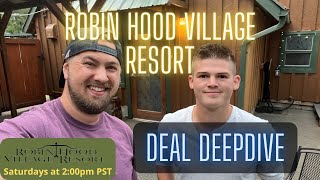
Cody closed on the Robin Hood Village Resort, a $4.5 million property with $1 million down and seller financing. The deal promised $20k monthly cash flow but dropped to $2k after accounting for principal paydown. He's growing it by renting empty units, buying an adjacent triplex, and funding it through relationships with private lenders rather than traditional banks.
Chapters
Hey YouTube, this is Cody. Welcome back to the channel. This is Robin Hood Recaps, and if you're new to the channel, appreciate you checking this out. Today we're talking about a deal deep dive on our very largest deal that we've closed to date, the Robin Hood Village Resort over in Union. And if you want to check out the Robin Hood, robinhoodvillageresort.com, come book a stay. This is the honeymoon suite. This is the nicest of the units that we've got. And I really can't do it justice with the photos or the video because I can't swivel it. However, what I do want to do is invite you to come stay. It's very beautiful here. Tons of trails, tons of history. That's what I want to share with everybody today. It's fun to buy really cool real estate, but that's only part of the equation. And if you've been following the channel for a while, you know there's two steps in actually doing the real estate game. You got to solve for how do you buy it? Which is important, but the easier of the two steps. And the second step, which is critical, is how do you never lose it? It's really cool to buy this. However, we have to make sure that it makes sense. We have to make sure that it can make enough money to warrant owning it. Because if we just go out and buy all the cool real estate, all the fun things we want to buy first, our odds of losing it go up. And it revolves around cash flow. Now, I can't just give you advice on exactly how to structure your business, but But what I found been successful for mine is not caring about appreciation and focusing solely on cash flow. Now, do I want both? Yes. However, I buy based on cash flow for equity growth and I never sell. I've sold a flip before and looking back on it, was it the right decision? Yeah, I needed cash. However, when it comes to the multifamily, when it comes to the actual investing side of it, not just speculating, buy for X, sell for Y. Everything revolves around cash flow. And so looking at this piece of real estate, I was like, oh, this is really cool. Christian had to talk me into it. He's like, I got a resort. I'm like, resorts aren't our main business model. It's like, yeah, but it's going to be really cool. And so it ended up actually being very cool. He had to get me out here twice to convince me on this, but absolutely beautiful. If we bought this just because it was beautiful and just because it would appreciate, we would lose it. And I don't encourage anybody to try and buy anything with the idea of, okay, I can just lose it. Like, we don't want to do that. We want to figure out how do we buy it, how do we never lose it? And it revolves around long-term fixed rate debt that you can afford to pay off and cash flow. And so on this, we bought it and here's the number deep dive, bought it for $4.5 million. Now that's a big number. That's a lot bigger than anything we've done before. Our last deal that we bought that was somewhere close to that was $2 million. We're getting it through. That's the 38-plex that we've been sharing on the channel for about a year now. And today it's worth about $3.5 million, just a little south on appraisal. But we've done some more right now, so it's closer to $3.6. But this is quite a lot bigger than anything we've done before. And we're looking at like, okay, well, what's the down payment? When we first heard about this, by the way, plug to Dion, we appreciate you. Dion McNeely's YouTube channel, he sent this over to us, who got it from Michael Zuber. We really appreciate you guys sharing this with us. It was a little too active for them, so we're going hands-on. When this got pitched to us, it was zero money down, seller financed, and the cash flow was going to be about $20,000 a month. Well, that sounds like a great deal the way that we were pitched. And so what do we do? Christian and I come over, we meet with the owner, we learn about their story, we learn about the property. There's a lot of history here that I still have to learn a lot more on, but we're like, okay, it's $20,000 a month. Well, how do you buy it if it's zero down? We can buy it. And if it cash flows $20,000 a month, we can hold it. Those are great numbers. Come to find out that it was $1 million down. And I'm going to talk about that today because a lot of people watching the channel, probably not starting with $1 million. We didn't start with $1 million. And so I want to show how we actually get to the point of putting something like that down. But it ended up being $1 million down. The actual cash flow was about $20,000 a month last year. They did $600,000 $20,000 in income. It's a lot of income, but it's also got payroll, there's utilities. And so the net income, if you look at real estate, you've got gross scheduled income, you've got operating expenses, you got vacancy. The net income on this asset was right around $400,000 a year. And the reason that they were able to keep their expenses so low is there's a pretty cool camp model here where the people that are working on site also get free stay. And it's a beautiful place. This was deemed one of the top 20 most beautiful places in America. So make sure to check it out. But the net income was $400,000 a year, and our debt on this was $150,000 a year. So if we do the math on that, we had to put $1 million down. We're going to talk about the million dollars in a minute. $400,000 net income and $150,000 of debt. So if we subtract those out, we get a total of $250,000 a year in cash flow, $20,000 a month. Great deal. If you figure $250,000 divided by your million down, that's a 25% cash-on-cash return. And yes, this was seller financed. The hard part is we also want to pay off our debt. And so we went to the owner and we structured an additional down payment every single year of the loan of $225,000. Now that's going to kill the cash flow. I mean, that's, that's basically going to wipe it out. We're going to cash flow $25,000 a year. $2,000 a month. We took it from $20,000 to $2,000. Now, why would we do that? We want to not be comfortable. And a lot of investors, they finally hit that number and then they get comfortable. $20,000 a month. If we didn't want to pay off the debt early, we just ride it and we'd be fine. And it would just be in addition to the income that we have coming in. But we want to put pedal to the metal and we want to stay focused on improving systems. It's one thing to return. You can redo the cabins. You can replace the things that need fixed, but at the end of the day, you have to rebuild stronger than the prior owners and rebuild stronger than yourself yesterday. You got to get better each day. And if we just sit comfortable on cash flow, we're not really going to be incentivized to grow. And so we said, okay, let's just do $225,000 in additional debt paydown at the anniversary of closing. Until they're paid off. And so that wipes out most of the cash flow. We're going to keep saving it up as if we were cash flow in $20,000 a month, but we're going to write a check at the end of every year and that forces us to optimize. We have to improve the systems, open up new opportunities. Speaking of new opportunities, one thing that the deal never had done before, the previous owner never rented out this space. It had never been done. This is the honeymoon suite. We've got the pub suite over there. It's got a beautiful backyard, got hot tubs, got a creek. There's tons of deer out there. I accidentally walked out on 3 deer earlier and spooked them. Oops. This has never been rented before. And now it is a new opportunity for people to make history and a piece of history because this has never been rented. And so we want to open that up. But this becomes an opportunity to get that cash flow up. We're focused on optimizing, offering new opportunities for other people so that we can improve the systems here and then pay off all the assets. A little bit quicker. Another thing that we're also focused on is we're buying the triplex next door. We're going to make that the Robin Hood Village Resort Lodge. And the Robin Hood Lodge is just going to be an addition. We're going to put in frisbee golf, we're going to put in bridge, put in some more trails. But the main thing I want to share with folks is, yeah, we figured out how to buy it and I'm going to talk about the million dollars. I promise how we came up with that after that. We talk about this, but I want to share that we sacrificed cash flow to pay off the debt. So that we are 100% focused on growing the systems, optimizing, and becoming better operators. We need to focus on that top line income so that we can still get the cash flow. But we don't want to be comfortable because everybody wants to get comfortable, and as soon as they get there, they typically stop growing. We don't want to stop growing. We want to make this an amazing place. We want to share the history with as many people as possible. And to do that, we have to build out more opportunities for people to come visit and enjoy. So let's talk about that million dollars, because that, that's the million dollar question right now. And it's funny how that actually worked out numbers for numbers, one for one. There's real estate equity, there's cash flow, and then there's social equity. And most people don't know about this, and the people that do, do. But your real estate equity is the asset value, the stuff you own. This is math. You got your assets plus your liabilities.. And now you've got equity. It's not usually liquid, especially in real estate. It's typically illiquid. However, that's net worth. That starts building net worth. And then on the other side of the table, you've got a cash flow chart. So you got your equities and your liabilities on one side, and then you've got your cash flow and you can have a statement of cash flow, but it's just the income you have coming in every month. It could be from your job right now, could be from the government. If you're living on the government, it could be your businesses. If you have money coming in every month, it could be from real estate. That's your cash flow. And that's great if you have enough cash flow to just put money down on stuff. Wonderful. But when I was starting out, I didn't have any of it. I didn't have equity and I didn't have cash flow. So what you have to lean on is social equity. And now I'm not just saying other people's money. OPM. Everybody loves to talk about OPM, but that's not what I'm talking about right now. The relationship is worth more than the real estate. And the story is worth more than the real estate. You build social equity when you build relationships with people and you truly understand the story behind what you're working on. I was able to understand the story of the Robin Hood and I understood the story of people in my universe that I didn't know 3 years ago. When I went out and started meeting with people, started meeting with owners, lenders. I ended up stumbling upon a little private money firm, very small, called Flynn Family Lending. And something that I try to do, and I've said this on the channel for a long time, is I want to put relationships before everything else. Forget the deal for a minute. I want to go build relationships with people. And so when this property popped up, what had happened in the forefront of all that for the past couple years is I had been building up relationships with other people, and especially in this situation with Flynn Family Lending. And I had just been there, I'd shown them what I'm working on, I had learned what they were working on, we had worked together on stuff, collaborated on stuff, and then I just brought the opportunity. I was like, hey, I, I want money for this. I have equity in my real estate and I want to go buy this. It's a million dollars down and I've got more than a million dollars in equity in my stuff. And some people are going to say, well, I don't have $1 million in equity, so I can't do that. I didn't actually end up putting a loan on my real estate to buy this. This is again back to the social equity. When you build relationships with people, then you get new opportunities. Because when you could take it private, meaning you're not going through a bank, you're not going through an institution, you're not going through a lending company, you can get deals no one else can get. If you're watching, you just got this far, you're probably thinking, oh, he probably just loaned the money from them at 12%. I didn't. I didn't put a loan against any of my real estate. I didn't put a loan against this piece of real estate. They're a debt company. I got money from them as equity. It wasn't debt, it was equity, meaning they're giving me cash without loan payments. And I was able to do that because I built relationships with enough people to— and especially with, you know, them, and then with different property owners to where I can make a phone call and get the money. In the beginning, it's really fun to just focus on, okay, I need to go out, I need to buy some deals, get my track record. Instead of just focusing on your track record, you should focus on who the people you're hanging out with are and if you actually understand where they're coming from, where they want to go, and why. That story is worth way more than the real estate, and the story behind the Robinhood is worth way more than the actual Robinhood itself. It's worth more than the $4.5 million. It's probably a broken record when I'm just saying this, but I came up with the money just from the fact that I reached out to people that I had worked with in the past, made a phone call, shared the story of what I wanted to do, where I was going and why. And because it's a circle drill, because I had done that with them years ago, I had figured out where they're coming from, where they're going, and why. When I brought my pieces to them and I conveyed that, hey, I understand this, they wrote a check and we got the deal done. So I just want to put that out there. You can build your cash flow, you can build your equity in real estate, but along the way, make sure you're building up those relationships. This is why it's so important. One phone call, one coffee meeting got me here, and it was the combination of a whole bunch of coffee meetings before that that got me real estate equity. And real estate cash flow. So if you get one takeaway out of this Robinhood Recaps, I want to put it out there that you can go build your little empire, but the way that this type of deal gets done— there's deals like this all over the world— is through social equity. And if you can start building those relationships, that's how you get this stuff done. So that's it for Robinhood Recaps. Make sure to check out the rest of the channel. We appreciate you. Following along this far. Probably going to be 23% of following that got this far, but we appreciate you. Like, comment, subscribe if you haven't already. And if you want to book a stay, robinhoodvillageresort.com.
More from Christian



Speak with authority to turn broker rejections into deals - boost your confidence #RealEstate

Turn Broker Objections into Closed Deals - CRE Negotiation Tactics #RealEstate #Negotiation

How to Get Multifamily Deals Under Contract Without Having All the Cash | Objection Series Ep. 1

How I Scaled 500 Apartments in One Texas Market in 12 Months #RealEstate #Multifamily


Turning a $12.2M, 200-unit mess into profit - live multifamily turnaround update #Investing

Day 10 Update: Turning a $12.2M, 200-Unit Apartment Complex Around in 80 Days #RealEstate

Day 10: Before Time Runs Out | Saving a Failing 200 Unit Apartment in 90 Days (Ep. 3)

How 2 Direct Deposits Generate $70K/Month from 224 Section 8 Units @ 99.4% Occupancy#RealEstate