Does size matter? Rentals properties and Unit Count
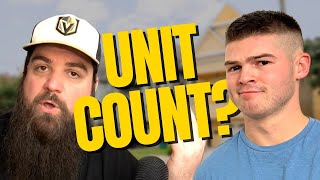
Matt the Lumberjack Landlord and Cody argue that unit count is a trap. What matters is cash-flow margin and fixed-rate debt structure. A smaller portfolio with high margins beats a bigger one with thin ones.
Chapters
What is your ultimate metric? You mentioned margin, but what is like the ultimate metric if you had to pick one for winning the real estate game?
What's the, what's the meaning of life, Cody?
Hey YouTube, this is Cody. Welcome back to the channel. And today is another episode with Matt the Lumberjack Landlord. Matt, welcome back to the channel.
Super pumped to be here, Cody. Thanks for having me.
Well, I'm super stoked to have you here because you about 5-upped me on your unit— 6-upped me on unit count. I got 131 rentals and you got 137. And that's the topic for today's video: unit count's irrelevant. That is an unnecessary flex a lot of people like to talk about because it's cool to have 100 units, cool to have 1,000 units. But I want to talk to you about that today. Why does unit count not matter? Because we've got the same amount of units. But I would say your financial backing is a little bit stronger than mine. So what are your thoughts on that?
So, I mean, I think that— so certainly time, right? Time. Never compare year— what, 4 for you?
Yeah.
Year 4, year 5. Never compare year 4, year 5 to year 20. That's, I think, the first thing, because it's— as you're in the real estate game, that 30-year fixed rate debt is really— you really want to have to start to take take effect. For certainly a lot of smaller investors that are just starting out, you're getting a 30-year fixed-rate debt, or if you're doing some sort of seller financing, likely you're not talking about anything changing in that seller financing deal for at least 5 years, if not 10. So I think kind of the, the idea is, is that as, uh, as inflation continues, the idea is, is that the money gets more and more and the expenses remain lower. As a percentage. So I think the most important thing is it's really margin. It's really doing great deals that get you great cash flow. I think that's the key. I would much rather have a smaller portfolio with killer margin than a massive portfolio with almost no margin.
So I mean, that also kind of comes down to delayed gratification because a lot of people like to flex the really cool stuff on the internet. I got 1,000 units, I syndicated my way there, or I got 100 units in a year and this is how I did it with no partners, or I did it with a whole bunch of partners, but maybe they don't have the cash flow to back it. I mean, what is your ultimate metric? You mentioned margin, but what is like the ultimate metric if you had to pick one for winning the real estate game?
What's the, what's the meaning of life, Cody? You know, I think, I think that's a great question. I think that For me, it's doing great deals that create margin. I don't account for appreciation. Nothing in my spreadsheet or my formulas, I account nothing for appreciation. I account nothing for principal paydown. I don't care. If I have to look at principal paydown on a deal, it's not that good of a deal for my returns. So, I want to see great deals that create great cash flow that quite frankly, My first year is always going to be my worst because I'm going to have fix-its that I didn't know about. I'm going to have things that the old landlord didn't take care of. And so my worst year always is going to be my first year. So I think the people that are long for the game, I think people that really understand, uh, how to operate a successful business, it's about margin and debt structure.
Okay. And as far as like building out that long term, because The argument online is, well, if I own a very small percentage of a lot of units, my odds of doing better are higher. But, but you've played this game for decades. I haven't yet, but you have. And you didn't have to go to the 1,000-unit mark to absolutely crush it. What would you say to folks who say, well, it's better to own 10% of 1,000 units than 100% of 100?
Yeah. I mean, I think at the end of the day, for me, I want to own my stuff outright. I want to own my portfolio. I want to be in charge. If I want to upgrade a bunch of units because I see the opportunity in the market to upgrade them and then increase the rents and take it from a C property to a B+ property, I want to be able to do that. And I think the other thing too is, is that that's what will help you grow as an operator. That's also what helps you gain those relationships with banks.
Yeah.
And even, and quite frankly, even seller financing. They want to know that you're credible. They want to know that you've been there and done that and that you've got the t-shirts to show it. And so I think the key there is, is that you can never get that level of credibility if you're not actually operating. You— how can you? If they say, well, give me an example of something challenging that you overcame. Uh, yeah, I don't have one. Like, you need to be able to walk somebody through that, a prospective seller through that. Because they're entrusting that you're going to be able to execute. And that's, I think, one of the key magic pieces to seller financing is they have to feel comfortable with you. They have to trust you. They have to trust that you know what you're talking about and that you're going to be able to perform, right?
Yeah. Oh, 100%. And like in the beginning, they didn't ask me any questions. I'm grateful that nobody asked. That was very helpful for getting my first million-dollar seller finance loan. But that was also on the market for for a while, so that might have played into it a little bit. They just wanted to get out of their partnership. But yeah, definitely now having the credibility, it's so much easier to get these loans. And it's not me flexing the 1,000 units, it's just say, hey, I built the cash flow base, my debt coverage is close to 2. Yours is over 2, which is just phenomenal considering you did a whole bunch of cash-out refis, which we talked about in a prior video. As far as folks who are watching this video and they're maybe looking for a mentor in the space, we talk about how there's kind of this red flag of flexing the unit count. Are there any other red flags that you see people doing online that the people doing it think it's, it's cool and it's the way to get attention, but it's not really a good indication of success?
Yeah, so there's a lot of those guys that flex out there. They flex the unit count, um, and, and so for me, that's just completely broken. I think the other ones are the ones that literally talk about how they figure out a deal and they think they actually target appreciation and they target principal paydown. Horrible. Do not follow those models. Those models will ensure that you get crushed. I actually know of an investor that was buying up everything and they were, they were paying crazy prices, $100,000, which is, you know, 20% over ask, 30% over ask. Buying whatever they could. And they were literally saying, I don't care, I make $50 a door. $50.
Yikes.
A door. And I said, show me the math. And he goes, see, I make $50. I was like, no, no, no. How— what do you— what else are you— what else are you counting on that's going to give you any level of return on capital? Because I, I will not do anything for $50 a door. Literally nothing. And I said, well, show me what it is. And he was counting principal paydown and he was counting appreciation. Well, so some of the deals that he bought in 2020 are okay. Some of the deals he bought in 2021 are okay. Some of them aren't. Some of the— almost all the deals he bought in '22 are not going to be okay. So I kept track of the ones that he bought and I'll be looking to basically get him out of those positions because he way overbought them and he was accounting and accounting for things that should never be accounted for when you're looking at actually building a healthy business. It's just absurd.
So basically anybody who doesn't align their business model with just looking at cash flow, I mean, there's extras to the business, but like people that don't just prioritize cash flow are flawed.
I think it's— yeah, I think it's— I think it's also debt structure. So cash flow is important, but You know, if you're getting into like one of the big things that really hurt a lot of investors back in '08 was they were getting into liar loans. And when you got into a liar loan, you might be getting a nice 2% introductory, but in 2 years it was going to go to 7%. Well, what's your debt structure then? And so I think one of the things that you guys accomplish brilliantly in your strategy is better and better terms and a better understanding of debt structure. When you have phenomenal debt structure and even if you know that in 5 years it's going to float up 2 points or it's going to be whatever. The other thing too is in 10 years, maybe it's 10 years out. When you look at debt structure, it gives you the ability to better understand what you need to accomplish in the next 5 years. This might be an asset that you say this asset makes money and this asset makes a good amount of money. But because of what our reset might be in 5, 7, or 10 years, we need to spend more money on principal paid out on this deal than we normally would. Is that, is that an apt scenario that you've seen in the past?
I, I have studied a lot of mentors that have gone broke on the appreciation and the debt reduction model. It's an absolute bummer to see them lose it all. And again, I didn't see it firsthand, but it's through stories that they've told me through '08, and then they do it again. And in between 2010 and 2020, which just It's ridiculous if you're losing real estate during that time. It seemed like everybody could make money when the market was doing what it was doing. But people that didn't build it off of cash flow and they just tried to, to grow as quickly as possible without the good business practices of the long-term fixed rate debt. I mean, I haven't taken it as far as you with the 30-year fixed rate. I only have one 30-year fixed rate mortgage and it's 6% interest. But it seems like those are definitely key pieces to people crumbling and breaking their portfolio.
Yeah, that, that, that 6% deal that you have, 30-year fixed rate debt, that will be probably your best property ever cash flow-wise because of one reason and one reason only. It's because you look at 30-year appreciation of the dollar and not talking about internationally, but just wages. If you look at that number over a 30-year period, I look at it over a 10-year period. I have rent. I have units that I was renting for $1,200 that now rent for $3,000.
That's, that's pretty ridiculous.
10 years from now, are they going to be $5,000? No. But what if they're just $3,600? Did my debt go up that much? No. I have 30-year fixed rate debt. That's why that 6%, 30-year debt that you have, is going to be an absolute crown jewel. It really is. And you know what? In the next couple of years, if we get rates in the 7s and 8s consistently, now not only is the property worth what it's worth, but now your debt is actually an asset too, because it's 2 points under market.
Yeah, the— in the beginning, I love that it's amortized and it's paying itself off over time and the property value has gone up 60% through optimization because I you've done a lot of the resi stuff. I did the mid-sized resi commercial, so it's valued on the income. But like, I bought it for $1.1 million. I owed $1.1 million and a quarter in the beginning because I 100% leveraged. Now it's down to $961,000 and it's worth $1.7 million. But even if none of that margin happened, it's cash flowed every single month since I bought it. And if I had a variable rate, which is what a lot of people did, I'm seeing a lot of syndicators losing their pants right now.
Oh, yeah.
If I had a variable rate, it wouldn't cash flow today. There's no chance.
Nope. I mean, look at Ben Mala. Ben Mala, one of the biggest investors, you know, on YouTube that talks about it. You know, Grant's pretty big. Ben Mala is pretty big. But Ben, the mistake that he made was he had the opportunity to lock in at 3.5 and he's like, nah, I'll keep the 3.5 at where I'll keep it at 3 instead of, you you know, fixing it for, and now he's paying 8.
Ouch. I didn't know that.
Yeah. Ben Mala is getting crushed right now by debt because his debt became so expensive. And he even says it in a few of his last videos, the biggest mistake that he made was not fixing that debt. And so now he's literally spending millions of dollars a month in interest payments that he didn't have to spend.
So it even happens to the big players that have got the huge counts of properties.
Yes, absolutely. It often happens to them even worse because, you know, they were— I had guys that had 3% debt and they were just like, we're just going to keep 3% debt and we'll just refi at the end of the year. I go, eventually that's going to disappear. They're like, no, we don't see it. Eventually it's going to disappear. Now we don't see it. Okay, sounds good. And they just had to refi at 7% and it just made a bunch of their properties go to negative amortization.
Ouch.
Yeah, not pretty.
So just to recap for those, we've talked about the good, bad, and the ugly. We talked about bad practices just to focus on unit count because it's a quick way to lose it. You don't want to just focus on the debt paydown or the appreciation. That's a bad model, flawed business model. And you need to really, on the good side, you need to fix your cost. Is there anything else you'd like to add in there as a best practice or a worst practice to look out for?
Yeah, I think the next best practice is you got to become a great operator. And that is, as you own the asset, I think your strategy now is, you know, basically acquire and then stabilize and then optimize and then, and then debt hammer. I think that that's a brilliant strategy because people often get it to stabilization and then they don't take it to optimization. And when they don't take it to optimization, you can find that in very many cases, I'm actually coming out with a video on my channel which actually talks about should I buy the next property or should I rehab a few of my units? Yeah. And so I looked at it and I just rehabbed those units and that return on my capital is going to be almost 30%. And there's no deal I can buy right now that's going to make me 30%. So I think people need to look at what I call the BUCK method, which is the best use of capital. I think if people deploy that, they look at cash, they look at creating cash flow, and then as they create cash flow, what's the best way to become an operator to then best use of capital that cash flow? That's really key. And that's where kind of your, your course really teaches people how to acquire the asset the best way and cleanest way possible. And kind of where I pick up from that with my course is how to better manage that asset to ensure that you have processes efficiencies in place that allow you to grow, but more importantly, better optimize to get the absolute best return you can on your units.
Love that. Well, Matt, thank you for joining the series. This is really awesome. I appreciate that. Christian really appreciates you joining our channel. Where could people find you? Just to recap everything, because we can show people how to buy a whole bunch of stuff creatively. You own the bank game. I mean, you know how to play that to the max, and you're a far better operator. Where could people people find you for more information?
Well, I appreciate that, but it's only because you've only been doing this for 4 or 5 years. You'll do— you'll be awesome. So, uh, Lumberjack Landlord on YouTube, Lumberjack Landlord on Instagram. We share a lot of the stuff that we do in the field. But yeah, when I was at that closing table breaking my arm, patting myself on the back thinking I just got rich, I became a landlord, I then realized, oh shit, I'm a landlord, now what? I didn't have a lease. I didn't have contact information for the tenants. I had nothing. And so the best position that people can be in is understanding how to use a course like yours to acquire the asset the cleanest, least expensive, lowest risk way possible, and then how to then become an operator. It's by watching what I've done for 20 years and how to create those efficiencies and manage your business the best way you can so you can get optimal growth. And more importantly, like what we talked about, It's not about flexing about doors. It really comes down to what's my cash flow and my margin, because I know guys with 20 or 30 units that make more than guys with 100 units. And I'd much rather be a guy with 20 making that money than 100.
Oh yeah.
And trying to keep my head above water. Right.
Love it. Well, Matt, thanks again. And, uh, I'm sure we'll see on our channel again.
Sounds good. Look forward to it, Cody. Thanks so much.
More from Christian



Speak with authority to turn broker rejections into deals - boost your confidence #RealEstate

Turn Broker Objections into Closed Deals - CRE Negotiation Tactics #RealEstate #Negotiation

How to Get Multifamily Deals Under Contract Without Having All the Cash | Objection Series Ep. 1

How I Scaled 500 Apartments in One Texas Market in 12 Months #RealEstate #Multifamily


Turning a $12.2M, 200-unit mess into profit - live multifamily turnaround update #Investing

Day 10 Update: Turning a $12.2M, 200-Unit Apartment Complex Around in 80 Days #RealEstate

Day 10: Before Time Runs Out | Saving a Failing 200 Unit Apartment in 90 Days (Ep. 3)

How 2 Direct Deposits Generate $70K/Month from 224 Section 8 Units @ 99.4% Occupancy#RealEstate