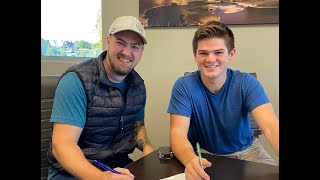
Christian Osgood shares rules for finding the right business partner: complementary skills, aligned motivations, and comparable time commitments. He uses his partnership with Cody as an example of how different strengths create a multiplier effect, and recounts two failed partnerships that cost him six figures and emotional pain.
Chapters
Hey YouTube, it's Christian and I'm back this week for part 2 of partnerships. If you haven't seen the first video that Cody did, go back and watch that one. It's fantastic. This is my follow-up to that. I'm going to share more about what has worked, the rules that I have for having a successful partnership, and some of the things that have gone wrong for us in partnerships because both Cody and I have had difficulties and I have a couple stories to share with you. So first of all, with partnerships, it's impossible to have a perfectly even partnership. I had someone ask me recently, well, is your partnership even? Turns out there's no such thing. It's impossible to have people who have the exact same motivation, the exact same amount of time, the exact same goals, and perfectly complementing skill sets. It's just not possible. So what you can do is find a partner who has similar drive, doesn't have the same skill sets. You want people who can add something. The goal is when you take 1 1, it equals 3 or greater. You do stuff that if you did twice as much yourself, it wouldn't be as great as if you had that partner on your team. When you can start multiplying skills like that, that's where partnerships become excellent. They are very, very hard. So the first thing you do, don't rush into a partnership. Super easy. Cody shared this story before, but he had me buy a duplex in his market across the street from his 6. He has a gorgeous little 6-unit right down the street from me. First duplex I ever bought in Central Washington, Moses Lake. We became property neighbors before we were business partners. He showed me the deal. I went in and bought that deal, and then we started collaborating back and forth on marketing our units, things that we learned. I shared my contractor with him. We got together and started driving back and forth to Moses Lake and building our portfolio separately until we found the 38-unit where we needed to partner to take it out together. By that time, I already knew how we operated. His skills, which is very, very heavy in sales, raising capital— Cody is phenomenal at building those relationships. That is where he shines. Myself, I'm really good at the admin. I can schedule the contractors. I can track the money. And while I have complementing skills to Cody where I also can sell, Cody is the best at bringing in the fish while I'm the best at making sure we have a big enough boat to haul in the fish. So this analogy we love to use, but with the two of us, we can achieve something far, far greater than what either one of us can do. Now we're roughly the same motivation. We have roughly the same financial goals. But that is a partnership that works. And that doesn't mean that we don't ever have conflict. Cody and I have had conflict many times. Sometimes I want to go a direction Cody does not, and vice versa. You have to be able to weather that storm and know that there are going to be conflicts. If you're someone who cannot handle that, just don't partner. It's not going to be worth it. You have to be able to communicate and work through those things. So that's something that's worked in our partnership. And Cody's drive is just unbelievable. Unparalleled. So having someone like that on your team is amazing. If you have someone who does as much as Cody does, you need to be able to make sure that you are willing to work that hard. Another thing we've seen, sometimes one partner will get frustrated because they do too much. The other one can be frustrated because they can't possibly do enough. You need to make sure that you both know how much time you're willing to allocate and how much you can really do, because your other partner can burn you out. Fortunately, it's not something that Cody and I deal with. I've seen it tons and tons of times when you have unequal partnerships that are particularly unequal. One partner will be very, very frustrated because they feel like they're doing all the work. The other one will be very, very frustrated because they can't possibly keep up and they feel drained. So you need to have similar worth, work ethic, similar time, similar goals. There's a lot going in there. And then you have to have complementing skills. I can sell. Cody can sell. Cody outsells me typically. So we put him as our forward-facing person. I'm a little bit better because I have a great memory. I can run the back office stuff because I remember everything we have to do for every property. Between the two of us, we build big stuff. Now, things that have gone wrong. Early in Cody's career, he had a partner who got him started and helped him out. He could not have started without that partner. That being said, it was very, very, very expensive because it was the wrong partner. They ended up having different goals, a different place to take the money, and it cost Cody multiple six figures. That same person cost me some money too. So you really have to be careful that the goals align and you know the character of the other person. Another thing, and this was, I think, combined, probably Cody and my biggest failure. We had a partner on a deal that we did a while back, and we thought we had perfectly identified what they want. They mentioned unit count, cash flow, growing. However, in every interaction we had with them, they mentioned how excited they are to be a part of the team and to be doing something. Turns out, months and months down the road, they called and said they wanted to dissolve the partnership, and that was a blow. And as we got to dive into what went wrong, they didn't really care about the cash flow and the equity growth. The money was never what it was about. It was about being part of a team, growing together, feeling needed, and we missed it. If you followed us for any amount of time, you may have heard of our circle drill where we divide all communication between people into significance, into a clear goal, and to the reason, the why behind what you're doing. We missed their why when we were listening to their story. And that's something that you need to map out with every single partner. What do you have together that's relatable? What is a shared goal that you two are gonna do together? And what is each person's why behind what they're doing? You need to have these things mastered and you need to have it down correctly. If you miss this, it's gonna hurt. It was a huge blow to both Cody and I to learn that we misdiagnosed the relationship. And it ended up costing us the relationship. We were able to move it and everyone was made whole. The separation is smooth. We're able to cash them out. And it just, it doesn't feel good when you miss the mark. And more partnerships fail than succeed. And that is just reality in all parts of life. You meet people, friends come and go. If you're going to have a strong business partnership and you involve money, it gets a lot more sensitive and can get a lot messier. So, rules for investing together with partners. One, know everyone's why, what their goal is, and the pieces that make them want to work with you specifically. That relatability to the goal and the significance behind the goal are the most important things to know. And make sure they know yours. If you can stack those two things together and they line up nicely, you're likely on the path to have a good partnership. Next thing you have to look at is skills. If you have the exact same skills as your partner, you're probably gonna have big holes in your game plan 'cause you're probably gonna share a lot of the same weaknesses. So find someone who complements you, isn't just the exact same clone of you. You guys are gonna make the same mistakes in the same way, it's not going to add anything bigger than what you could do by yourself. So find someone whose skills complement. Second, make sure they have the time to invest and that you have clearly communicated this is the expectation going in. Different expectations will cause problems down the line. Lastly, know that you will have conflict. Conflict will happen. You need to know ahead of time how you are going to handle that conflict. There's going to be times where you disagree. There's going to be times where you're upset with each other. You need to have a clear game plan of what that looks like and how you're gonna handle that. If you can communicate clearly through everything, partnerships are gonna work out. So, it's just a little bit about us. I wanted to share the second video to really nail home things that can go wrong. It can get weird over money, it can get weird over goals, it can get weird over work ethic. You need to know all those things. Line up your circle drills. Know your relatability, your significance, and your goal. And know their significance, their relatability points, and their goal. Line those things up and you are on the course to a wonderful partnership.