In this episode of the Multifamily Strategy series, Christian Osgood addresses the common objection that a broker’s valuation conflicts with an investor’s own underwriting. He argues that investors should first build solid algebraic underwriting skills and use a bank‑standard model—targeting a Debt Service Coverage Ratio (DSCR) of at least 1.25—to determine the price a conventional lender would accept. Rather than sending detailed numbers to the broker, Osgood advises presenting only the price that satisfies the bank’s criteria and stating, “If the bank’s in, I’m in.” The broker can then either present the offer to the seller or refer the investor to another lender. If the bank‑based price is rejected, the investor can introduce creative‑finance solutions as a secondary negotiation tool. Osgood also explains how consistent, bank‑aligned offers build credibility with brokers, leading to early access to off‑market listings. Throughout, he promotes his SKOOL community and a downloadable calculator to help investors practice underwriting in their own markets. The overall message is that mastering conventional underwriting first, and using brokers as deal‑flow conduits rather than valuation arbiters, enables investors to close more multifamily deals.
Chapters
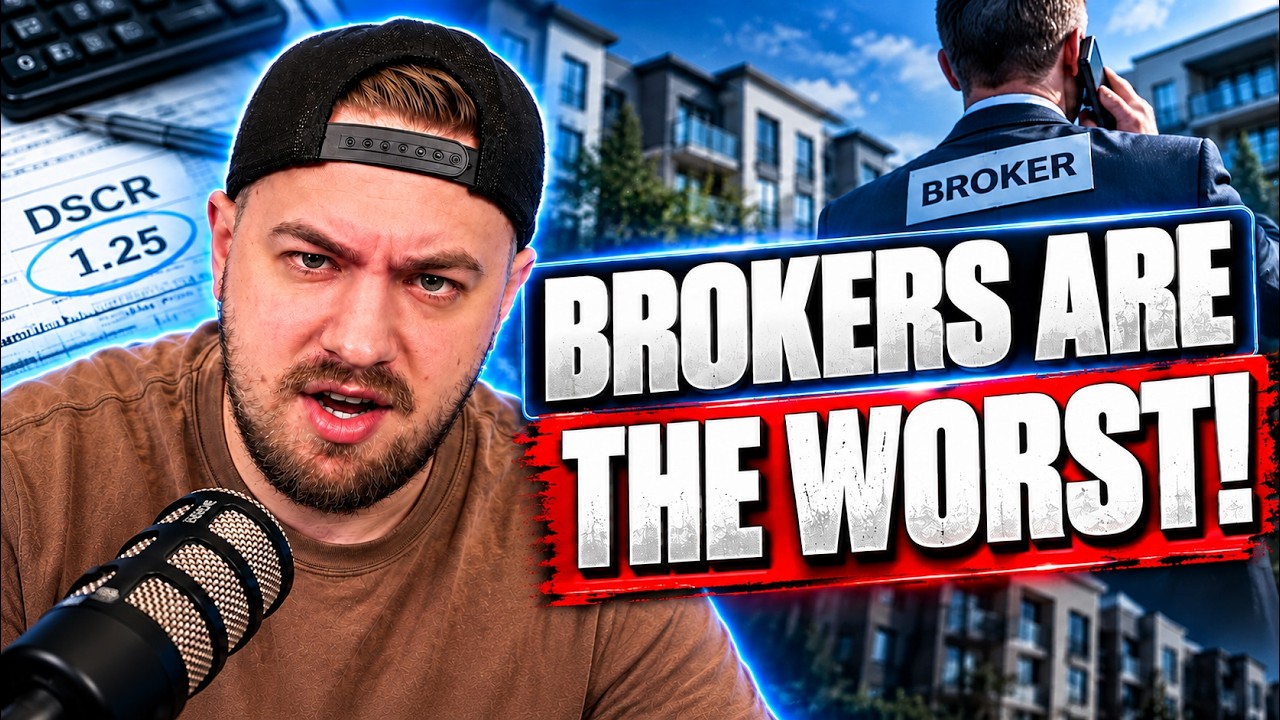
The broker doesn't agree with my analysis. Do not send your numbers to them. If the bank's in, I am in. Buyers are liars, sellers are worse, and brokers are the worstest. You're solving a them problem because it is better to be an owner than a broker. There are a lot of things you're going to run up against when you're trying to get a deal under contract, and there are some sticking points almost everyone hits. We are in our series of overcoming the most common objections, and one of the most common ones that we see Come up. The broker doesn't agree with my analysis. My math looks totally different than the broker's. How do I know my numbers are right? More importantly, how do I convince everyone else that my numbers work and that we can go under contract at this price? We're gonna share exactly how to overcome this on today's episode. Oh, by the way, welcome back to Multifamily Strategy. I own just under 1,000 units, multifamily units, as of the filming of this video. I have coached hundreds of people across the country for hundreds of millions of dollars of multifamily transactions. I know a thing or two about getting people unstuck in their real estate journey. I myself was stuck for a significant amount of time doing the 9 to 5. I did the college, 8 years of sales, saved up to buy 2 duplexes. I learned that buying duplexes had nothing to do with being in the multifamily business. My mission in today's series is to help you get unstuck in your business, starting with the math. So the first thing that we have to do is you do need to build the basic math skills, Algebra 1, To get through and know how to analyze a deal. If you want an awesome version of a calculator that I use for all my deals, you can join our school community. The link is below for our school community, S K O O L. It's like two dollars a month. It's an amazing community, and there's tons of downloads, including calculators that you can practice in your own market. So the first thing you need to do is you need to have a model that you underwrite to, and then you just hop onto crexi.com or loopnet.com. in your market and just start underwriting the listings there. There should be numbers on the listing or a downloadable offering memorandum or an OM. Find the numbers for the deal and practice filling out your calculator until you are in a position where you are confident that you are looking at the numbers correctly. Now let's get on how we actually present these numbers. Huge mistake people do. They send their underwriting to the broker and they say, hey, look at— here's my numbers. This is what works for me. What you are setting them up to do, they are a salesperson. You are giving them an objection for them to overcome. So they are then going to come back with their underwriting and say, "Well, we're underwriting to this, this, this," or the seller thinks this, this, this. There's going to be a back and forth. You're not trying to invite a back and forth. You've done your underwriting, and you know what you want to offer on a deal. I do not want them to sell me on something else that is a pointless drill. So I let them know, "Hey, I did the underwriting, and I underwrite to a standard of where a bank would underwrite," which means essentially you need to get your debt service coverage ratio or DSCR. To a 1.25% or higher. When I present to them, I go, hey, I've done my underwriting. This is how the banks are looking at this as well. If the bank's in, I am in. Let's move forward on this. Now they only have 2 responses. Either say, okay, let me get in front of the seller, or they go, I am really sure that we can get a higher price. Let me connect you with another lender. If I have a lender that can tell a different story, that is much different to me than the broker. So I will let them refer me to a lender who's interested in the deal and will size up the deal with me. I am not interested in the broker telling me their opinion of value. There's a common saying in real estate: buyers are liars, sellers are worse, and brokers are the worstest. That is English, specifically when you're speaking about brokers. They are often the worstest because they are there to sell you the deal. They only get paid when they sell the deal. They usually are not that good at the math because if they were that good at the math, they would buy every good deal themselves. If they knew how to play the game that you were playing, they would stop being a broker. Which is what happened to me. I was a broker for 2 years. I learned how to play the game. I got out of brokering because it is better to be an owner than a broker. Instead of getting 3% of the deal, you can get the other 97%. That's the part that I like to own personally. So when you pitch, pitch them against the bank. This is how this deal works conventionally. Now you may be wondering, Christian, you do a ton of creative finance. How do I pitch creative finance if I'm telling them where the bank is going to look at it? This is my favorite part of negotiation. We start by finding the price that would work for the bank, that 1.25 DSCR with a conventional debt product. Why? We're underwriting every single deal the same way. If my deal looks the same as another deal, as another deal, as another deal, as another deal with the same assumptions, I get very good at underwriting very quickly. I will present against the bank. If they go, well, that's not going to work for us, you're no longer solving a you problem, you're solving a them problem. Oh, okay. Well, if the bank's not going to lend on it and you really want this price, what do you suggest? I don't know, how can we get there? Either the seller or you will then be able to pitch a creative solution to make everyone happy if you give them the price that the bank is willing to play at, because everyone else is going to have the exact same constraints. You have an added bonus to this. On every deal that creativity is not an option for and the seller does not accept the price that is going to work, it's It will do something crazy. It will stay on market for a long time. And you can go on CREXi and you can see deals right now that are on the market for like a year, 2 years without moving. It's because no one submitted an offer that got accepted and the seller wasn't realistic. So it just sits around forever. At some point, these trade. But what you train the brokers is that you reach out, you ask questions about a deal, you submit offers, and your offers actually do make sense. A magical thing happens. Even if you don't buy the deal you called on, there's one thing I know about great brokers or great real estate agents in any market. Your best brokers are going to have more listings. And guess what they do when they get a new listing and they have someone who has submitted reasonable offers on multiple properties? They know that person's a real buyer, and they will now start sending you deals before they list it on CREXi and LoopNet. Your goal is not to get on their email list. It's not to become their buddy. It's to get first, second, or third look, be near the top of their list, For ready, able, and willing buyers. That is what you're trying to do. If you're going at the goal of I want to buy every single deal and I'm just offering whatever price I think would work, you're probably not going to go under contract. Maybe if you're really lucky, after hundreds of attempts, you might get one under contract. The way that a professional does it is you establish that you are a ready, able, and willing investor. You negotiate starting with price, and if it doesn't work, then you introduce creativity. For context, about 60% of the deals I've done have used creative finance. I love creative finance. You get creative only when you know how to play conventionally. Like any great actor, they can only improv after you've mastered the script. You have to do the blocking and tackling. If you do this drill and you know your basic numbers and you can consistently present them to a broker— and I'm talking like do this once a week— you're getting at-bats and you're getting offers out. You will get deal flow, you will get opportunities, and eventually someone will say yes and you'll go under contract and you'll close your next deal. It is so simple to get over the math piece, but the major pieces here— do not send your numbers to them. It doesn't matter. Give them the price. Tell them this is where the bank is interested in the deal. This is where I think conventional lending is going to come out on this property. And if it is rejected, you can start introducing creativity at that point, and it's now not weird, and you're now not acting like a broke person pitching creativity before creativity is needed. Simple stuff. If you apply this, you will buy more real estate. Hope this helped. Again, if you're looking for that calculator, check out our school community, S-K-O-O-L. The link is directly below on this video, and I'll see y'all in the next episode.