I'm Buying an Office! (Probably) - Check out the deal live and let me knwo your thoughts
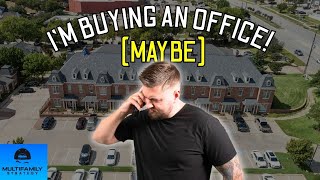
Christian Osgood walks through buying a 22,000-sq-ft office building in Keller, Texas for roughly $3.7M after discovering a hidden $51,000 annual condo fee that killed the original deal math. He re-underwrites to hit a 6% preferred return and 18.5% IRR, targeting a $5.4-5.6M exit that could double investor money in five years.
Chapters
Hello and welcome back to Multifamily Strategy. I am Christian Osgood, your channel host, and we finally got the whiteboard setup done correctly. So you should be in a glare-free environment as we talk about the office that I'm probably acquiring. I'm going to go through how you actually underwrite any deal. This works for multifamily, which is everything we do. But right now we're in a position, the company is, where property management, the podcast studio, I'd like to have an actual home for it instead of being in my house. We're actually trying to open up my space a little bit here., which means it's time for an office. PM needs a home. Multifamily Strategy needs a permanent home, and I want a cool place to host some events. Stay tuned for those. Also stay tuned. I am launching book one this year on creative finance. We just finished the editing. It's coming out soon, but stay posted for that. I am super excited. There's been a project I've actually been working on in the background for a few years. It's finally about to come out, so stay tuned for that. But right now today, we're talking about the office, the underwriting, and I've actually come into a little bit of a snag. So I'm curious, your opinions on today's presentation. Again, being joined by the Smartboard today, which makes this so much easier. Also, this is live, so I'm going to talk about today's topic, then we're going to break into questions. You guys have any questions, ask them. We will post them on the screen and then I will answer said questions. So super excited to dive in. Let's get rolling. First of all, this is the building that I'm looking at purchasing right now. This big, beautiful 22,000 square foot building. It has about 18,000 square feet of rentable space. And the reason that we're doing this is we're essentially doing the house hack strategy. There are enough tenants in this building. It's 85, about 85% occupied, where I get 3,000 or a little over 2,500 square feet to start my companies. I have room to expand over time, but we have a whole bunch of other tenants who are actually paying their rent, which makes this a good investment on its own. Now, this was listed for $4.95 million. We're under contract for $4.1 million, which is where the deal worked for me. I'm going to share on this video a little snag that I'm running into right now, and I'd appreciate your feedback on should I buy it or should I not? So we'll dive in. I'll actually share how the underwriting went and we'll go through 3 or 4 slides. So if you're ever wondering, like, how do you do this financial due diligence? It seems like this big arduous thing. It is, but I'm going to show you how it works and why it's relatively simple once you narrow, narrow it down. So here's the building. This is what it looks like. So this is the second floor landing.— but actually, like, high ceilings, fantastic woodwork throughout. It actually gets really nice as you go through the doors and go into different offices. Here's your main entryway as you come in before you hit the elevator. And here's the actual main office space where I'll be headquartered out of in the side unit of the building before we expand and take over. So this is what we're looking at purchasing. It's built in 2006. Really, really cool office. And this is in Keller, Texas, which is about 20 minutes from where I live. Awesome, awesome, awesome market. Awesome location. We'll see if it'll let me switch to the next slide. If it won't, then we'll kind of mess with my numbers here. Let me dive out of presentation mode. Not everything's always perfect every single time. But let's see if I can swap. So we go here. Aha, there we are. So I'll dive into this really quick. So goal is to move into the actual office. Downsides of being live. Moving to the actual office. So Multifamily Strategy, Brazos Asset Management, my property management company, and my friends at Origin Studios are actually likely to move in. So we're actually going to have a podcast studio built in there with an existing company. I'll have some of my friends able to work out of the office with me, and of course, we'll have a way cooler studio, which means great things for the Multifamily Strategy Podcast and the Owner Meeting Podcast. So as we're running this, we are expected to be 100% occupied at the day we close. This is a special advantage I have taking a building priced where it's currently a little bit vacant. I can fill this with myself and some of my friends, which is a huge help. So I won't dive into all of this too much, but I want to show you the first thing that I do. So when you're underwriting a deal, I want to know what is our actual day one income. I put in orange what I am adding, but I am personally going to lease the space. So here's all the different tenants and their various rents. I'll be leasing the space at $4,500 base rent and a triple net, which is essentially Fees that are billed back to the ownership for taxes, insurance, maintenance, everything is billed back to the owner essentially. So it's an expense-free model of $1,611. So total rent for the space for my companies will be $5,909 per month, which I was able to add to our net operating income. All in all, and again, I'm not going to dive into all these numbers too specifically because I'm not going to bore everyone. But we come up with a $494,000, basically $500,000 total operating income. So that's what I used for my underwriting throughout the deal. That's the first thing to do is decide, first of all, how much money is actually going to come in day one versus the books that they have today. So that's my magic number there, $494,000. Here is what was originally advertised. So you guys can see what we made our initial decision of a $4.1 million purchase off of a $403,000 starting income. It's actually a little bit higher than that today with triple nets and total operating expenses of $143,000. Remember this number here, $143,000. Now, one of the reasons I like the smartboard here Actually draw on my slides. That number was very, very important to me as we were moving forward in this transaction. All decisions were made out of this. I verified this is our actual expense. Now, when you see listings, oftentimes brokers will be a little bit generous in the expenses. So you assume this might be a little bit off, but generally speaking, looked about right. The bank also underwrote this and said, hey, this actually makes sense. We like this deal a lot. This is a reasonable expense load. Let's take a look at reality. It's still in drawing mode. So now you get to the fun part. You actually have to analyze a P&L. Now in this entire profit and loss, this is a whole bunch of stuff. All these little notes off to the side you see here are all expenses that aren't actually part of the P&L. This is really kind of a complicated thing to read. So what I had to do is the old handwritten way. Highlight which things are actually not expenses that we're going to have in our operating, which things are. There was one glaring line item that I found. This was not included: a condo association fee for $51,000 per year. Now notice that showed up Nowhere in our expenses here. When I am looking through the initial underwrite and all of the decisions that we made in our negotiation, $51,000 was never given to us as an input. I often see people skip the financial due diligence and go off stated expenses. What are the first two things we did? We underwrote for what our actual income is going to be, and then we went in and audited And I did this for 2024 and 2023 as well to make sure that we're consistent. So what does it actually cost to run the building? This is what it means to work off actuals, not stated actuals, not a listing, an actual set of math. And so here's what we found overall, because I'm looking at this and I'm like, well, you guys have $367,000 of expenses and yes, there's about a hundred and some odd thousand dollars here that are not actual operating expenses. So when we get down to it, here's what I found. Expenses in reality ended up being starting $220 a month. And I thought I was actually pretty generous to them. There's a few expenses I actually think we might incur that will be a little bit higher than this. If you do your math at expenses being $143,000, when you write a contract or negotiate a deal and you find your expenses are actually $220,000, that's pretty expensive. This is a full list of everything that I found. Here is our $51,000 that was missing. I'm going to have to spend a little bit on marketing to keep the building full. There'll be some unit turns, actual gas and electric, general admin. That includes our property management fee, which we're paying to ourselves. So I can control that one. I know what that will be. Our insurance, which we got quoted, legal fees that we'll need to just go through general contract. That's about right for the size building. We're putting together a little bit more than that as we establish the LLC, but there's always recurring legal fees and administrative fees. Current real estate taxes, which were listed a little bit low on the listing. Repairs and maintenance on average every year was about $27,000 per year. So I I don't think it was that aggressive to say we're going to budget for 30. I did an extra $5,000 here as our deposit to capital reserves, just saying like, hey, this stuff may come up, but if it doesn't, we're still going to set aside $5,000 every year. And if we scrolled up a little bit before I took the screenshot, I also factored for an additional 5% of vacancy to account for unit turns. All of this comes together to create a net operating income of $554,000. $400,000. Well, the initial underwrite was going to have us closer to $300,000. This materially changes our deal. So what I am going to have to do now, and this is where y'all can weigh in, I re-underwrote this. Where do we actually get enough cash flow and enough rental upside to make this deal a deal? Now that we found another $80,000 of expenses, the income is set. We made our decisions. We had a really good deal at 4.1 on the old numbers. I hate renegotiating. All we have to do is work the equation. What I plan to offer investors is a 6% preferred return. And we actually have a ton of upside on the rents here. We have a lot of upside and a 5-year window. I have a pretty good idea what our valuation is going to be, and I don't know how well you guys can see it on the screen here, but I'll, I'll read it for you. At year 5, we are expecting— right now we appraise at a 7 cap. So I do go a little bit up and down depending on how it adjusts. Cap rates are compressing, but we're looking at about $5.46 million at the end of this. We have a couple million dollars of upside, just about. This is pretty darn good if we purchased at 3.7. I just kept testing to where can we actually cash on cash return above 6, above 6. It drops a little bit in year 5 because our interest-only terms disappear. A lot of our biggest leases, the ones that are at the lowest rent, are 3-year leases, which means in the next year we actually get to lease at market and all of a sudden cash flow goes to 10%. And then up to 11.2. We need to save enough money this year in these first 2 years to continue to make our 6% pref in year 3. But this is my absolute minimum number where I can offer 6% cash flow on a deal and then we can still hit our maximum upside. Overall, this deal is going to have an internal rate of return of about 18.5%, which is really strong for newer build office, especially in a premium area like Keller, Texas. And then I get into, uh, other slides that I haven't finished editing yet. This is what I'm looking at in office deals though. When I'm looking through what is our starting point, what can we actually offer, and how are we going to meet all of our obligations— this is why I always, in pretty much every video, say price does not matter. I'm not negotiating. Their listing price for this was $4.95 million. We went under contract for $4.1 million. We'll see what happens. And if they can show me that I'm wrong in some of my math and there's a reason that I'm not looking at it correctly, I always give them the chance to do so. So I'm not going to come to them with an ultimatum. I'm going to come to them with exactly what I think it's worth. I also had my lenders look over this, so we're going to get back and say, hey, this is what the bank said and this is what I need to make this deal work. This is why due diligence— do due diligence, but this is what it actually takes to make sure that you know what you're doing. It's just What are the actuals? How much is it bringing in day one for sure? How much is it bringing in? And what are the actual expenses that it's historically taken to run this building? Let's not assume that we can just drop a whole bunch of expenses. That HOA fee for $51,000 did not show up in any initial underwriting. We had to wait to get the full books. I also want to note that it's okay to go under contract and find this out in your due diligence period. This is what that period is for. I wouldn't have had a shot to look through books in this much detail either way. I see some people try to over-negotiate this or they just wait for all the data to come in so they can do everything all at once. You're not always going to have all of the information up front. You do a deal based on the information that you have and you give yourself a period to prove your assumptions are correct. In this case, this was a rare occasion where we found our assumptions were materially incorrect by $51,000 per year. That's quite a bit. So up to you. If I can get these returns, if I can buy a deal for $3.7 million, I think that's the number we're going to say. If I can get to $3.7 and we can get to the target value of $5.4— I knew that was going to happen— if we can get our target value of $5.4 million and pay ourselves 6.5% cash on cash the first 3 years and double-digit cash on cash returns the back 2 years, Is this a deal we should do while also providing an awesome office and space for the companies? I'm kind of thinking yes, but I do value everyone's opinion. Now we're at my favorite part. You can either register your opinion in the comments or continue to ask questions. I'll answer your questions here live. This is Multifamily Strategy and this is our potential headquarters. Bri, do we have any questions in the chat today? No questions yet. Well, if you guys don't ask any questions, I won't have any to do, but this is the main thing that we will always do. On our lives. And I have the whiteboard here behind me so I can continue to answer questions and illustrate everything. But this is basically the decision-making that you are making when you go under contract for any deal. It has to cash flow day one, and you need to be able to offer a return if you're raising capital. That's all we're doing is where are we at today, where are we going to be in the future, and between those two, how much money is available mapped out clearly using my whiteboard here. There's two sets of math we're doing. So what you just saw me do was an abridged version of day one for real estate. I need to know where are we starting. We have X amount of cash flow and Y is our equity. Now in this particular deal, we would be buying it for about what it's worth day one. It's pretty much 1 to 1. If we, if we end up getting a $3.7 accepted based on its numbers, it's worth about $3.7 today. So we would have our down payment in this case, 30% down. So I would have 30% equity in the deal. So 30% of $3.7 million, whatever that exact number is. Would be our total equity. That's how much money we have initially in the deal. We compare that at the end of this. I am going to buy the building from the investor, so I am the exit plan between property management and multifamily strategy. Our game plan is to use an SBA loan. If we fail to do so, we'll just sell the building normally on market., but we're looking at that $5.6 million valuation as our benchmark for what we would like to buy the building for at that time. That's in 5 years. So end for this deal is year 5, and we will now have— we'll call this future cash flow and future equity. That new equity, whatever we've created between our purchase price and this future equity, that's how much cash is available. In this case, we're doing a sale of the building. A new entity is going to buy the building. So the equity that is left in the building is the delta between what we owe, which is going to be about $2.8 $8-something million, I believe, and what the building's worth, which is $5.6 million. There's actually quite a bit of cash available there. In addition, we have a cash flow that's going to average through the life of the deal at around 8%. If you count the 6.5s, then go into 10 in the back 2 years. I add all of that cash flow and all of the equity. That is the total amount of money that I have available to pay myself and to pay investors. That's your entire pool. That's how we do this math. So what I did today Does it work day one? Do we have cash flow? Yes, we do. Is the price reasonable? In this case, yes. Green lights there. The only other thing that you would do in your math, which is I have done but not going into in all of today's video, is we just put our future inputs for where we're going to be. Does it have enough future cash flow to refinance, pull the equity, or do I have enough cash flow and value in the building to actually get the sale price that we're projecting? If yes, and there's enough money to pay yourself and your investors, you're a go. In this case, we can more than double everyone's money in the 5-year period because we're offering again over an 18% internal rate of return. Mathematically, this deal would be equivalent to putting your money in a bank account at 18.5% interest compounding for a 5-year period, which is a pretty darn good deal. I really do like that deal. It's a very, very high return. You can invest at 18% per year on average. You're killing it. This is a fantastic deal in a fantastic location, as long as you trust that the operators can actually do what the math is. So final check to see if you have any questions. If we don't, we'll call this a live presentation and call it a day. Bri, any questions? Not a question, but you do have a compliment from Dave. He says you have a beautiful building and whiteboard. Well, thank you very much. I do like the whiteboard. Originally, when we started Multifamily Strategy, Cody Davis and I called these Whiteboard Wednesdays, and I literally had a whiteboard that we would hold up and write on. It's fun to bring the whiteboard back into multifamily strategy. So I'm glad that, I'm glad that's appreciated. I do my best to keep the quality of everything that we do up as much as we can. And if that is it, guys, have a fantastic Wednesday. You are invited if you want to learn how to do creative plays and buy— like, this building is literally supporting all the creative deals that I did. Over 500 units. I'm running a webinar tonight on how to do this, exactly how we do it. Uh, you can go to multifamilystrategy.com/workshop. It starts right at the top of the hour. I'll be in my studio right down the hallway, and we're going to be talking about how this works, the pieces of creative finance, creative equity structures, how you can buy with bank financing, still $0 out of pocket like I'm going to do with this building. This will cost me exactly nothing out of pocket. And I'm going to show you guys how you can play the game and get paid to buy the building. So I'm going to show you guys multiple strategies and exactly how it works with real deal examples of getting paid hundreds of thousands of dollars to buy deals that pay you every single month following the same rules of day one cash flow. So if you'd like to get paid to increase your income and not spend any money doing so, you only need to succeed like 2 or 3 times a year and you'll end up with a ton of real estate. So Follow that model. I'm going to share the entire model on that budget for about 90 minutes, and I'll see you guys there.
More from Christian



Speak with authority to turn broker rejections into deals - boost your confidence #RealEstate

Turn Broker Objections into Closed Deals - CRE Negotiation Tactics #RealEstate #Negotiation

How to Get Multifamily Deals Under Contract Without Having All the Cash | Objection Series Ep. 1

How I Scaled 500 Apartments in One Texas Market in 12 Months #RealEstate #Multifamily


Turning a $12.2M, 200-unit mess into profit - live multifamily turnaround update #Investing

Day 10 Update: Turning a $12.2M, 200-Unit Apartment Complex Around in 80 Days #RealEstate

Day 10: Before Time Runs Out | Saving a Failing 200 Unit Apartment in 90 Days (Ep. 3)

How 2 Direct Deposits Generate $70K/Month from 224 Section 8 Units @ 99.4% Occupancy#RealEstate