Over 100 Rentals!!!! - Different Real Estate Strategies and Markets
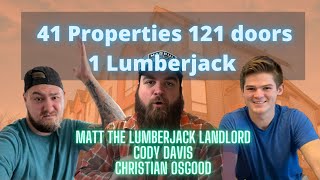
Matt went from dropping out of 9th grade to owning 121 multifamily units across New England by house-hacking, using owner-occupied loans to bypass bank limits, and renting to college students. He moves into each property, renovates it himself, then refinances or sells, and plans to reach 250 to 350 units.
Chapters
Hello YouTube, welcome back. It's Christian and Cody, joined today by Matt, the Lumberjack Landlord. If you haven't followed him yet, there's a link below to his channel, but fantastic content. He shares a lot with our friend Dion, uh, Michael Zuber. They make up the Three Amigos. Really, really excited to have you on today, Matt.
I'm super pumped to be here. You guys are in a completely different space. Forget about different part of the country, but completely different space than me. I'm here to learn, so expect questions.
We can do that. Now, I'm really excited to have Matt on today because he has more units than both of us, and he's done it on duplex, triplex, and fourplex. So Matt, can you tell us a little bit about your investment journey, where you got started, when you got started, and what you've built so far?
I think you're the only one on YouTube that was younger than me, Cody, because I started at, uh, I started at 20. I started at 22.
Wow.
Yeah, I started at 22. I was young. Um, seller financing wasn't a thing then, you know. They're like, you want me to do what for you? I was like, it's a good idea, I promise. Look at the tax structure. Yeah, no, you're gonna buy it from me. Okay. Um, so I started at 22. I started, uh, I'm a 9th grade dropout, so I had to figure out how to make life work. And I got into software. I was in software for a while and got really good at selling software and then said, I'm making money and I hate the stock market. I think it's completely rigged. And so I'll take the slow and steady. So slow and steady is real estate. And so, you know, started learning, understanding, looking at a couple of markets around where I lived. One of them I thought was a pretty good fit. I started investing there. But my very first deal was a house hack condo deal down to where close where my job was. Couldn't afford the condo on my own, so I recruited a roommate and they said, yeah, you're going to live with me. You're the least obnoxious of my friends. And then I had him move in with me. I bought the place, had him move in with me and did that for a couple of years and then house hacked a house again further away, then bought a triplex, then bought another triplex, and then and then bought another, then bought a single family. It was on the water, which was going to be kind of like a seasonal rental, Airbnb before Airbnb was a thing. And then the Great Recession hit. So I've been investing that long. So the Great Recession hit and thankfully we didn't lose any property. My market fell probably about 30%, 30 to 35% is how far my market fell. But we kept it going. But kind of our path was in August of '08, we had 8 paying tenants. In September of '08, we had 3 paying tenants. And in October of '08, we had 1 paying tenant.
So you mentioned we— are you doing this with a business partner?
So I say we now. You guys, when you guys get married, you'll see that everything becomes we. I wasn't married at the time. I was actually single at the time. Now it's we. I've been married for 15 years and been together for 17, but I've been investing for 21. So this, the business predates her. And about all that I'll steal from Grant Cardone is I told her when we were getting married, I'm not selling my houses. I said, we're going to keep on growing this business. It's about all I steal from Grant because I know he told his wife the same thing. But yeah, built, built the, built the portfolio. The challenge, the biggest challenge that we had to overcome aside from the Great Recession was the fact that banks took away your ability to buy. You no longer could get 10 mortgages. You can only get 4. I was already at 5. I was done unless I could find another way. And so again, seller financing, I tried it, it wouldn't work because it was just not a thing then. You know, now there's 1,000 channels, you guys do a phenomenal job with it, but seller financing just wasn't part of the norm then and it wasn't mainstream. And so the only way that I could do it was owner-occ. And so I did owner-occ loans. I moved 9 times in 13 years.
Wow.
And so I lived in 9 of my 13 I lived in 9 buildings in a row until I finally hit the day where I was financially free enough where I could start buying them and not have to move into them and rehab them when I lived in them. Because I learned how to, I learned how to figure out and figured out how to do pretty much anything in the house. So I did all my own construction and weekend warrior stuff. I did all that for the first, I don't know, 5 to 7. And then after that, I was thankful enough where I could start to give some of that stuff up. And then just kind of became the continuity guy. So yeah, I built the portfolio from in 21 years from 0 to 121 properties and 41 roofs and 400 tenants.
Wow. That's, that's pretty remarkable.
So it's a sharp stick in the eye.
Yeah.
I mean, which is also landlording. So yeah.
So to get over those loans eventually, did you just start paying off your properties? I mean, did you go commercial? Are you still having loans on your properties? What's that look like?
Yeah, that's a great question. So I am— I will never pay off a property. I do not believe in that. I want to leverage. I want healthy leverage. I don't want Dave Ramsey 1985 leverage. What?
I want loans. Aren't good.
Yeah, not that I've— not that I've ever experienced. Usually the guy that comes up to collect usually has some sort of a club on his hand, you know?
Yeah.
So, yeah, so we— so the goal, the idea, the goal, the most powerful asset that any of us can get in the beginning is 30-year fixed-rate debt. It's the most powerful asset that you can get. It's phenomenal where you can do creative financing, but that's going to not be every one of your deals. There's still going to be great deals you can do that they just will not do creative financing, no matter how good you show them the numbers are, no matter how great your pitch is. They're just going to say it's just not an emotional fit for me. I'd rather lose money. And I literally say to them, so you rather pay more money in taxes, not have the same level of, of attachment to the asset and still have the continuity of payment even though you're not landlording anymore? You're really dead set on paying. I mean, you're a patriot. I appreciate you paying all those taxes, but that's just one of those things that, again, really it's deal structure. And so in a lot of cases where that doesn't work, You know, we were just basically owner-occupied. Those are the only kind of loans I could get. So I could still get a 5% or 10% down owner-occupied loan to move into something. And I would rehab it with my own time and my own dime over the course of the next year. And when I would finish, I'd shop for the next one and I could refi out if I could because there was enough value increase there. And when you were buying stuff in 2010, '11, and '12, it was really an awesome thing because you could get stuff that had been just— it was, you know, horrible condition, but the banks were letting them go. And so, but you could spend $35,000 and get $100,000 worth of equity because people were only buying done properties. They weren't buying all the dead foreclosures that were sitting there and just rotting. So, so yeah, that was the, that was the idea was continuously do that owner-occ. So every, every 12 to 18 months, I moved. And so I would literally just go one to the next to the next to the next. Every single one, I would just literally— I'd move in, fix it up, move on to, you know, try and refi out if I could. If I couldn't, that was fine. Then I would move into the next one because the rule was you could only have 4 mortgages if they weren't owner-occupied. You could keep on getting another deal if it was owner-occupied. So I started working instead of working with big banks, I just started working with smaller banks. Local banks. They have a charter, and you want to align yourself with large organizations that have a local charter. Their local charters are in the community, for the community, of the community. So because those are those local bank charters, that was a fairly straightforward sales pitch. It's your charter to lend out in the community. I'm in the community, and I can give you an asset where I will live there, and you have the opportunity to be able to do that.
Love it.
So, yeah.
And you mentioned you specialize in 2 to 4 units. Is a fourplex the biggest property you've bought to this day?
So far, the largest, largest property that I've purchased is a 12. That's, that's the largest. Yeah. So we have a— I have a 12. I have a couple of sixes. I have a 9. I think I have an 8 in there. So, yeah, it's, it's it, you start to diversify, you know, that way you're not stuck in one asset class, that way you're not stuck in one area, you know. So we, I do a little bit, uh, I'm in 3 different towns, um, but nothing more than 20 minutes from my front door. That's the rule. So I kind of centrally located that way if I need to show up and fix something, I can show up and fix something.
That's great.
Um, so yeah, that's, that's kind of the, that's kind of the model that we rolled out and that's what we'll kind of continue to stick with.
Love it.
That's awesome. One thing that we figured out really early that, uh, sounds really familiar is, uh, when we talk about, hey, the tax benefits of why you would sell or finance, or we try to go on an information or benefit approach, we got the exact same thing over here. Uh, people generally are like, well, I'm not comfortable with that.
Yeah.
What a lot of people will do is they'll go after like, oh, I see some low-hanging fruit here, I'm gonna try to get this deal. We went a totally different route. The only way I've been able to figure out to make it work is you just form a relationship with people who played the game for a while. So when we seller finance, it's usually with someone who doesn't care as much about the tax benefits as we've got to know them. They're invested in us as individuals and they're like, well, to help you guys get into the game, I trust you. I want to be a part of your journey. And so more than the money pieces, they'll invest in us, seller finance, let us in the game. And that's been a lot of help. Most of the people we've seller financed for, have been our mentors through this whole journey.
Yeah, we're working on a— it's the biggest deal we've ever done and we'll disclose more. We're hopefully getting the contract today, but we'll see. It's exciting. But we went and lived with them for 3 days straight, so had to do a lot of that. But doing the conventional approach of just trying to ask for it, I've not done very well doing that.
Yeah, it's tough. I think the other thing too is in my area, It's a lot of legacy wealth. And so that's kind of even more challenging. There's, there's kind of the two challenges. Legacy wealth, they're not necessarily connected to it, but then when it's gone, they've never actually created anything. And so the concern is once that pays, where am I? And so they have all the infrastructure and all the architecture that's needed to continue the business as it is. And that's what they feel comfortable way. Then there's the other side where it's guys like me who built it themselves. They're like, dude, I'm not— no, no, I'm going to get the one big fatty check and walk.
I never really thought of that. The coast-to-coast difference. You do have a lot more new money in Washington, California.
Exactly.
Big difference. I believe this works everywhere, but I can see where you're working with someone who's never really built it. You're going to have trouble on that relatability point of, hey, we're starting, we're getting in the game. That's probably not going to be the exact same story that resonates with them unless you swing it as a long-term note.
Because in that case it's easier to pass on a note than a whole bunch of properties.
100%. That's what we— that's one of the things that we really try and push them towards is, guys, this is a financial instrument. You can do with it whatever you want. If you like collecting money, awesome. If you're like, you know what, I hate collecting money, sell it and collect a whole bunch all at once because it's a note. So we talk about that a lot too. I think the interesting thing here that I see most often is that The average age in the two meetups that I go to is probably 60, maybe 62 years old. It's old. So I'm going to have older for a landlord. So the cool thing is I think I'm going to have 5 years where I'm going to do a lot. I'm going to do a lot, a lot. Like we're probably going to go from 120 units to where we could easily go to 250 or 350.
Because why would you do that, though?
Why would I do that?
Yeah. Like, why, why go past where you're at?
Because I'm not old. Why not build it? You know? So it's like, I'm— it's when you spend 20 years getting elite at something like Jordan didn't want to stop playing, you know, you get too fat. So thankfully you can be fat and be a landlord. So I kind of like that. So it kind of works for me. But yeah, I think, you know, once, once you get the processes and the systems in place, you guys see it. There's a massive economy of scale. And so being 100 units or 200 units, really the main difference that you'll find is you have more money in your account. That's the main difference between 100 and 200. So long as you're not— the biggest issue I think that we've had in the last 18 to 24 months has been, has been unit absorption into our model because I bought a lot when rates were ridiculously low and everyone said I was an idiot for buying during, during You know, buying during the pandemic, I did 10 deals last year and I did 9. I've done 8 this year already. I've done 18 deals. I love those deals. I will likely never see a 3 in any of my deals ever again, but I got a bunch at 3 and those are going to print money for the rest of my life because rents are only going up. And even if they go flat, I don't care.
It doesn't matter.
So yeah, it doesn't matter. I got flat rent, whatever, don't care. Okay, if it's flat for 5 years, Sounds good. That works. My debt's flat for 30. So what do I care?
Yeah, that pandemic, that was a, that was a Cardone-ism that I was, I was willing to adopt. Expand when others contract. I love that when everyone sits on the sidelines, that is when we partnered about a year ago.
I bought like once.
Yeah, yeah. I bought my first duplex at the end of 2020, so everything shut down and I was like, okay, we're going to print like 40% of the currency that's ever been printed in this country. I'm, I'm pretty sure that's good to be holding assets, not cash. So yeah, it seemed like pretty easy economics. I was like, well, no one else seems to be doing this save a few of us. So well played. Get a whole bunch of properties.
I'm a 9th grade dropout. It's over my head.
So, well, having dropped out of high school and having bought the house, bought duplex, triplex, fourplex, 6, 12, Would you do it all the same if you started over?
Would I do it all the same? I'd probably get me some liar loans when I started because I had all real legit loans, so I didn't have any ninjas. I didn't have any no income, no job, no asset. I didn't have any of those loans. I wish I had. I had all really boring 30-year fixed 6.5 to 6.95 debt. Um, I think that I would have— I would have picked a different area. The area that I picked, I listened to the noise of you want to be in a city that's 100,000 or greater. That's stupid.
I agree with that statement.
I, I also concur.
It's dumb. I mean, the 3 cities, the 3, and they're only by law cities like they've incorporated. It is 30,000, 15,000, and 3,000. Those are the 3 places I invest. So combined, they're not even 50. All 3 of them combined aren't 50, but I own 121 units in a 50,000-person population. Now I've got a reputation. If you do it right and you build your brand and you, and you are good relationally, You know, not one person, maybe one person. They deserve it, though. One person would say they had a bad experience with me. They, they started the bad experience. I just finished it. And so the rest of them, they all have great relations with relationships with me. And so they continuously, like you guys, it's relational. You know, I have guys that call me and say, yeah, so we talked about that deal 3 years ago. And I was like, yeah, we did. You want to talk about it again? I'd love to. I'll even buy you lunch. Let's talk about it. So I agree 100%. It's relational. And that's the bigger challenge, you know, then you get to know some of the bigger guys, you know, so I'm decent size in my market, but there's guys with 500 to 700 units. So they kind of— they're, they're really big. And eventually they'll start to transition. And when they do, I've already had conversations with both of them. About assets that they have that I would love to continue the legacy. And thankfully they're both in their 60s. So I know that they're getting to the point where I don't think that they're going to pass it on. I think they're going to say, you know what, time to take some exits on some of this stuff. But then the big stuff that's like really appealing to larger investment firms, larger investment firms don't want a bunch of duplexes. No, they just don't. They want, they want 3 or 4 properties that they can put their flag in front of that they're excited about that, you know, might be anywhere from, you know, on the low end, probably 100 units that go up to a few hundred units. So I'm more than happy to pick it off one, one duplex, one triplex, one quadplex at a time. I'm happy to do that. I like those assets. They're liquid and the buyer pool for that asset is significantly larger than the buying pool for the other. And usually when that those larger commercial assets, when that buying pool is stressed at all, usually almost all of them are stressed. It's very rare to find a couple of guys in there that aren't— that their assets aren't stressed where they can just say, you know what, fine, let's let it go. They'll just say, yeah, I'll just wait another 5 years for the peak to come again or 7 years for the peak to come again. Right.
Have you ever sold any of your buildings?
Yes. Yep, I have. Yeah. When an asset for me starts to feel really overvalued because I know the market— we had one. I never ever sell duplexes because they're my lifeblood, but we had a deal that we did. It was kind of a unique duplex where it was really like a single-family home, 4-bed, 3-bath, but then it had a 2-bed, 1-bath apartment right off the back. No shared walls, no shared entrance. So it was a different— it was really, truly like a separated— like you could live your own lives and truly a single-family house, two-car garage. That asset was a great asset, but I bought that thing fast. I bought that. That was part of my million-dollar challenge. The deal was spend $250,000 on one asset and within a year turn it into $1 million worth of property. That was my million-dollar challenge. And so I did that. I bought that asset for $250,000. And within a year I put $65,000 into it. I sold out of it to $550,000. I took a 1031 on basically that $300,000 worth of gain. I turned that into 2 more properties and then sold one of those and turned that into another 2 properties and got to a little over $1 million in assets from one deal in 12 months.
That's awesome.
So that's kind of— that was a fun game. Accelerated. So for people that say you can't do it, of course you can do it. But it was a lot of work. It was a lot of time. It was— and it was also being skilled up. You guys are skilled up. You guys can look at a deal like that now and you can do it. If you said, I want to do a million-dollar challenge over the next 12 months, you'd do it. You win. You'd get there.
Yeah, we could probably, probably find a way to make that happen. The easiest way for me is buy a 40-unit building and then Raise $100. Yeah.
And that's, and that's the thing is it's like, you know, for us, those buildings just never come available. They just never do. And when they do, they're always back office deals to other massive guys, right? So it's like trying to get in that room and those guys don't want to share their secrets. Some of them you can maybe get one, maybe get two. You just need one guy to get to the table. And here it's such old money, it's just not going to happen. I wasn't born with the right last name, landlord.
So yeah, it's definitely, at least for us, it's— we set up this goal of, hey, let's try to meet with at least one new owner in our target market. And granted, we're in smaller markets.
You're—
no matter where you are in the country, you're going to have a little easier time in a smaller market because you'll have less whales that you're competing with. Yeah, but come in just like, hey, if you own the duplex next door to me, I want to know you. If you own the 50-unit across the street, I also want to know you.
Absolutely.
One of them a week. That's 52 owners a year. If you're in a small market, say 10,000 to 45,000 population, you meet an owner a week there. Everyone in that town knows who you are. Every player in that market absolutely knows you, knows your goal. And if you're actually listening to what they want, I, I truly believe anywhere in the country there's someone, that one person you talked about. It might not be everyone, but there'll be that one person who gets you in the door, and then once you're in, they introduce you to a friend. And it's harder to work in, in an established market, um, but that's how we've done. We just have that one, uh, one owner a week principle, and that's worked really well for us.
Yeah, usually the bigger players aren't playing in the smaller markets, usually. You know, in ours, you know, they had recognized. So when I, when I was doing my research, so I'm right in the border between New Hampshire, Massachusetts, and Maine. You can get from the southernmost tip of Maine into Massachusetts within 15 minutes. So I live just a few minutes from that kind of main corridor. And so I had the chance to invest in Mass, chance to invest in Maine, a chance to invest in New Hampshire. And so I was doing a lot of research. I spent a lot of time looking at the areas where I wanted to be. And Massachusetts was very anti-landlord. Maine was extremely anti-landlord and New Hampshire was not. New Hampshire was where I was from, but I was like, it's kind of nice that it's not anti-landlord, but the others were very anti-landlord law and in New Hampshire it wasn't. So I said, okay, so I had the right state. Now let's look at the areas. And so I looked at this one area and I just said, in this town, just one town south, The properties are 4x what they are one town north. I was like, that can't stand. There's no way that continues. And so I gambled on the one town north. I mean, gamble as much as you can when you're valued at 25%, right? And so that was the start of the journey. And then I really started working with college kids because there were tons of amazing college kids that couldn't get a place to rent because every college kid is allegedly an idiot. They're just not. There's plenty that are, but there's plenty that aren't. And so we started working with a lot of college kids and we started renting out and they were, you know, from nice areas with nice homes. So we would redo our places, granite countertops, custom cabinets, you know, refinished 180-year-old wood floors, all new electrical, you know, all the systems that they would want to see in a place. And it was like home. And for them, $750 a month per room wasn't a big deal. Their option was— I built the calculator. I said, you can live on campus, it's $14,000. When you live on campus for 14 grand, you're there for 7 and a half months. You have to go home for a month for winter break, and then you have to go home for the summer. Let me know how that works. And I said, after you've had a year alone, I said, or you can spend all 12 months here, and I'm going to be 50% or 40% off what they're going to charge you. So they love the math.
That's amazing. So you went from 9th grade dropout to renting to college students.
Yeah, it was a niche. It was the market niche that was needed. Most of them, it was like it would be advertised as college housing. It was because it was disgusting. It was like you could not find anything more gross than that housing that was being offered to them. And so we kind of brought that type of product to market where it was, you know, all the things that we would gut and redo on a place. Where you could— everyone could have an AC plugged in if they want to and it wouldn't pop a fuse. You know, it was actually circuit breaker, but it was all updated so it wouldn't pop, you know, it wouldn't, it wouldn't trip your breakers. So all sorts of things like that. And then literally it just got to, oh, hey, my friends are looking for a place. Oh yeah, you know, I'm moving on with this group of guys, but that group of guys is staying the same. Or, oh yeah, this, this house, the boyfriend and girlfriend, they're going to stay together and they're going to have 2 roommates, but I'm splitting and I want to go somewhere else.. And so it was just the pin action that we got from that where for years I didn't even have to advertise units and I can just tell them, oh yeah, by the way, it's not going to be $2,200 this year. It's actually going to be $2,400. Oh yeah, that's no big deal. I agree. It's no big deal. How about $2,500? But no, really, $2,400. So it was a great opportunity to get pin action and just become a network where people constantly wanted to be the guy that knew the guy who had an awesome place that they could stay.
That's huge. You can't, you can't beat that.
Yeah.
I mean, reputation, you guys know, you guys are relational. And so we are too. You know, we don't look at our tenants just as like the nudge that's bothering us with a text. I think landlords that do that have it wrong. If you have that great relationship with other owners and you can have a good relationship with your tenants, good relationship does not mean doing everything they ask because they still saw the place before they moved in. I'm not changing the color of the cabinets. But at the same time too, it's relational, which is when they're contacting me, it's usually, usually it's something that's of concern to them. So it's a matter of just addressing the concern and letting them know that while it might not be the priority that I'm going to drop what I'm doing right now to get over there and do it, we'll put it on the list and it should be taken care of in the next 3 to 5 days. So that mutual respect works.
That's fantastic, especially in some of the smaller markets. A lot of the landowners just don't take care of the properties. I have seen so many more slumlords in the small towns than I have in large towns. Not that they're not everywhere, but when you're the one guy who does that, there's two things that I, I really like that you said. One, you saw that pricing was 4 times greater right next door. When you see a market imbalance like that, I think people get scared to act on that. That's everything. Like, for me, it was— I saw COVID and printing money, I'm like, this is a market imbalance, we need to get in real estate.
And we borrowed, I don't know how many, $7 million, $6 million together.
Yeah.
In a year. And I found, I found someone in that market who knew how to manage 30 units before we bought a 38. I had renovated 2 and had a few employees, and Cody's like, oh, I need somebody who knows how to renovate and do project management. Like, well, 38's a little bit more than 2, but we got to have some overlapping skills. Let's do it. Just a little bit more. Yeah, but you take a huge leap like that, right? Like, I went from 4 to 42 units in one shot. Uh, you went from, hey, I see a market imbalance, I'm just going to go all in on this one market. Then once you're there, you treat those properties like something that you would want to live in. It's not that you have to move into the little studio college apartment, right? But it's, hey, if I was in college and I had all these crappy options, I would live here instead. And then you made that happen. That's exactly how we operate. It's not only ethical, it's just— it's way more fun. You feel great about yourself as a landlord. You're actually providing a valuable service. As opposed to here's my LLC. Yeah, exactly.
Well, I've had, you know, I'm not sure if you guys have gotten there yet, but we get the, you know, occasional bad tenant that will then, you know, call the city. And they're not bad because they called the city. They're bad because they're a lousy tenant. And then they decide that they don't like what your answers are. So they call the city on you. And so it was really funny because they called the city and they're like, okay, yeah, we have to come out and do an inspection.. And so they didn't notify me. They went out, they did the inspection, and the inspector actually called me when he got back to the office and he laughed. He called me and he goes, hey, yeah, this is the inspector, blah, blah, blah. And I said, okay, what can I do for you? And he goes, I was just over at this place. I go, oh, is there an issue? He goes, no, there's not an issue except for you have a bad tenant there. I was like, exactly. And so you can't buy that level of press, right, with the city officials and things like that. That's why you want to Handle it, handle your business, do the right thing, be responsive. We just got into some Section 8 tenants this year. We'd never done it before, but we had a policy which was anytime we get a list from one of their inspectors, we have it done within 48 hours. And they would just be like— they were— they were completely flabbergasted. They're just like, this is unbelievable. And now we get referrals not only on tenants from them, but we also get referrals on buildings that they have heard are selling, where they're like, yeah, we were just notified by this landlord that they're actually going to be selling the unit, so we have to find a new place for these tenants. I was like, okay, I don't have anything available right now. However, I will look and see what I might have coming available. That said, can you put me in touch with that landlord? Like, well, no, but here's, you know, this, and there's the address. Worth its weight in gold. That's, that's a network, you know. For me too, I think, um, digital business card was a game changer for me. I'm not sure if you guys have them, but digital business cards are an absolute game changer. How many paper cards do we have? We throw them out.
So I have a little QR code that we have on the business cards. That's as close as I got. You can scan the business card. Don't, don't store it. But I do need to get one of those little tappable.
Yeah.
So you can actually get brandable ones.
Oh, that's cool.
That's the Lumberjack Landlord digital business card. So it's got the QR code, but it's also got an NFC. You can just tap a phone and it's all in.
It's done.
Well, that's good. And then the cool thing is, is that you can— they can literally press a button and you can get all their info.
Wow. So I think I know what I'm doing this evening.
If you want, you can check out a video. I've got it on the channel. I do because I'm so hands-on. We know that one of the biggest struggles that landlords have, certainly earlier in the game, is product selection. And I'll actually go— I have friends that I got on the landlord path and we'll go and I'll say, listen, let's go. I'll do this once with you. We go shopping for the things that they're going to get for their house and they start touching things. And I was like, put it back. I was like, are you picking up on the theme? You're buying all crap. It's— it doesn't cost you any less to put in a $100 faucet as it does a $300 faucet. You know what it does cost you? It costs you more because that plumber is going to get you for $115 and he's going to be back in 3 years replacing that thing again because it's such a piece of junk. I was like, and have a level of quality in your units. People will pick up on the quality and people will stay because then it gives them no reason to leave. Well, I'm going to find a nicer place. No, might I find a cheaper place? Yeah, but I don't want to have a not nice place. And so I started doing landlord reviews on all these different products that we use in our units because I found a way to basically do remodels for between 7% and 12% less than my competition. Wow. And so that means sometimes I can pay exactly what they pay or a little bit more, but I can beat them. I can get the deal and I can still finish it faster than they do. And I push the envelope more on rents because I can always take the rent number down. Not a big deal, whatever. Yeah, not an indictment on me as a bad landlord. It's the market isn't there for that at this point. So I change it, move it down. But yeah, right now we're kind of crazy. We've got, you know, everything that we post ever for a unit is probably 100 inquiries within 48 hours.
Wow.
So that's a lot. It's too many.
It's too many.
But you ran a little bit.
But only— well, the problem is, is that we— so we've gone up and down on that. And so the issue that we're having is we might have, you know, 100 applicants, but then when you find that only 12 of them qualify, that doesn't give you much of a pool, right? Still fairly— still a fairly small pool. I like to see that kind of, you know, 12 because 7 of them are getting a DQ because you found out something in the process that they weren't telling the truth about. And then 5 of them are actually truthful or maybe underrepresented how strong they were. And then you have some people to actually then choose from. And so we've kind of kept it at that. The other thing too is, is that we like being towards the top of the market. We don't need to be the absolute top of the market. The, the nice guys that are building all the Class A stuff around us have taken care of that for me.
So I'm just like, I always look at here in Washington, you don't always get a choice if someone just squeaks by and then you have someone who does way better. If the person who just squeaks by is first, you rent to them. Sure. Otherwise you get sued.
I mean, here, the way our plan is, is that we handle it much like a house sale, which is we don't take the first offer. We tell them everybody's going to see it, everybody's going to have a fair chance, everybody's going to apply. What we will tell you is that speed does matter. So the faster you apply, the better. But we are going to look at it. And then when we get to that point, we'll come back to you and say, would you like a 2-year lease or a 3-year lease? Takes me the same thing to evict somebody after 1 as it does 2. So why not get 2 years where I then guaranteed no rollover? I'll take the 2 and then I've got stability. You know, in some of these units, we've got units that are up to $3,500 a month. Wow. So if I can get 2 years, that's $84,000 that they've just committed. House is only worth $450,000. Yeah, that's great. I just got 20— I just got a 20% down payment. They're gonna pay for my next down payment on the next house I'm going to buy. So it kind of works out nicely. But yeah, I'm with you guys, it's all relational.
So cool. Do you have anything else for—
No, you know what, I think that is it for what I had here. And that's about the right time for our audience. If you've watched through the entire video, first of all, good for you because all this content is worth it, man.
It's amazing. Only 27% of people make it here.
Yes, that's right. We just looked at our statistics this morning. So if you're one of the lucky 27%, thank you so much for watching. Do yourself a favor, share this with a friend, get the word out there, because coast to coast, this works. You can be an awesome landlord, find awesome assets in any market. You may need to tweak your strategy a little bit for where you are, which is why we have this channel, Multifamily Strategy. We share different routes to get to the same place. I'm going to ask one last question we're going to close on and then we'll wrap. Matt, when you got started, what was your original goal? I want to know what got you started on the journey to the 121 units you have today.
Yeah. So I think what got me started was I didn't think Social Security was going to be around when I was 65. I wasn't counting on anybody else for my retirement. I didn't feel safe in the stock market because I think it's a rigged game. I think that the people— imagine being in a building, those people sitting in that building all day long. Chatting about what's going on, seeing people out at lunch. You know, that's a thing. That's absolutely a thing. And so I don't have a leg up because I don't live in Manhattan and I don't work on Wall Street. So I will take my chances and I will be more than happy to be able to understand and learn something that's local to me. I can always put eyes on it. I can always put hands on it. And it also gives the opportunity to be a part of the community. And it's not just about me. It's about creating not only an area and a nice place that's affordable for folks, but also a legacy for my family. All of my kids— I've got a 4-year-old, a 3-year-old, and a 1-year-old. Every Saturday we go out and we drive and see and look at our properties. And we also go and we will dial for dollars as a family in the minivan because I'm twisted like that.
That's awesome. Stability is a fantastic reason. To get into real estate. That's, uh, that was my main reason for taking an interest in real estate. And for me, it was retiring my wife, and again, family. For Cody, retiring his mom. Um, but yeah, when you define your why and you know what you're doing, this is where you end up. 5 units, 95 units, 121 units— no matter where you're doing this, this is possible. So everyone, enjoy your week. Privileged to have you on, Matt, and we'll see you guys all Next week.
Thanks, guys. See ya.
More from Christian



Speak with authority to turn broker rejections into deals - boost your confidence #RealEstate

Turn Broker Objections into Closed Deals - CRE Negotiation Tactics #RealEstate #Negotiation

How to Get Multifamily Deals Under Contract Without Having All the Cash | Objection Series Ep. 1

How I Scaled 500 Apartments in One Texas Market in 12 Months #RealEstate #Multifamily


Turning a $12.2M, 200-unit mess into profit - live multifamily turnaround update #Investing

Day 10 Update: Turning a $12.2M, 200-Unit Apartment Complex Around in 80 Days #RealEstate

Day 10: Before Time Runs Out | Saving a Failing 200 Unit Apartment in 90 Days (Ep. 3)

How 2 Direct Deposits Generate $70K/Month from 224 Section 8 Units @ 99.4% Occupancy#RealEstate