Ridiculously simple Multifamily Real Estate Method- live in Portland
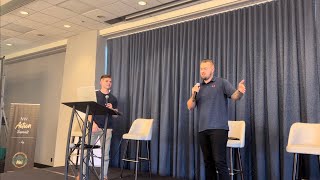
Cody and Christian Osgood show how they built a 150-unit portfolio using seller-financed deals and minimal down payments instead of traditional bank loans. They use Google Maps to find multifamily buildings, negotiate directly with owners, and structure fixed-rate debt that cash flows from day one. A 60-unit acquisition with 10% down instead of 35% shows how creative financing dramatically improves returns.
Chapters
Today we are talking about ridiculously simple real estate, and we'd like to just start off with a little intro about who we are for those who aren't familiar. My name is Cody. I got into the real estate space about 4 years ago as a college dropout, first generation in the space, thinking I was going to make a bunch of money because someone online said I was going to make a bunch of money. Fast forward 6 months, I made $0.00. So that was about the start. Fast forward 4 years, Got about 150 rentals. We've got a seller-financed resort that was built by the Disney crew way back when in the '30s on Hood Canal and did it all without a bank loan. Met this guy about 2 years ago and that's where our journey began.
And for me, I started the opposite way. I went to college to get a job, get a second job, get a third job, get a fourth job so that I could save up to invest in real estate. I knew I wanted to invest when I was really young. However, I did not know there was another way to play the game. So I went through a whole bunch of sales careers, ended up at the CoStar Group. They own LoopNet, Apartments.com, basically the internet for commercial real estate. Going through that, I bought two duplexes and my primary residence, and I did this really cool math. So that's my two duplexes paid for the mortgage on my house, my real estate bought my real estate, and I was like, this is really cool. It took me 8 years to build that. I don't have any money left. I'm going to have to start over and save up for another 5, 6, 7 years to build the next 4 units. It didn't move me as far forward as I hoped it would with that amount of effort. That's around the time I met Cody. Cody at the time was 21 with 30 units, and I communicated a goal to him. I'm like, okay, I know how to run some businesses. I know how to do sales. I've been an employee, so I think I know how to employ people in theory. But I don't know how to get to 30 units. I'm 28 years old. I want to be at 30 units by 30.
And Cody's response was, well, I can't help you because I'm looking at a 38-plex and then I put you at 42. But I was a little worried because when I first met him, he had 2 units in a house. I found a duplex I said he should buy. It was right next to a 6-plex, and we like to play Monopoly on the same streets. But he was a little ways off. And we ended up going to a 10x Growth Conference, one of Cardone's events, and we set out this big goal. What if we bought 100 units? And what if we did it in 2 years? And then we got back and we're like, oh, that's kind of hard. But there was this deal that sat on the market since I was 8 years old. It got listed 13 years prior. We said, what if we bought this? And he said, what if we bought it? And then we did. Zero money down, seller finance. And that was the start of our journey.
So everything we're going to be talking about today is going to be very, very simple. Our goal is that it needs to be repeatable. If you're going to scale to 100 units or 200 units or 50 units, whatever your goal is— it could be 10— whatever you are trying to put together, you identify your goal and you're going to do something that is simple. Because if it's simple, it is repeatable. That is the most important piece of any business, is that you have to be able to repeat successes again and again and again. We have only a few rules. And if you follow the rules that we have for all of our real estate, you will build a portfolio, you will hit your goals, and every single time you transact, you will have more income to buy more deals, period.
Now, one of our rules, and really our most important rules, is don't add steps. A lot of people say you gotta start with wholesaling, then you gotta jump into flipping, and you gotta build your money up, and then you can go buy a whole bunch of real estate. Our thought was, well, let's just go build relationships with people who play the game. And then buy the real estate. You want to buy multifamily, go buy multifamily. Don't ask Seth. And we're going to talk about how you do that today. Part of our mission when we were getting started, we buy over in Grant County. This is one of the buildings that we bought. Our process was let's buy the ugliest buildings in town so the city knows exactly who we are and we'll fix them all up at the same time and start building that relationship. And this is a map of the portfolio. So this is Washington State. We went all the way from the Hood Canal through Seattle, through Bremerton, Quincy, Moses Lake, Tahoma, but primarily in Central Washington. And, um, just to keep resuming, you can see the map, and those, like, all those little pins are the properties that we picked up. And we try to keep it as simple as possible. You find one location, you set out your goal, and then you just find to hit the target.
And so we partnered together, we picked up the 100 units. Most of them are right here in Moses Lake, so So we started filling out our map and it was getting fun when you check the map and you have pins everywhere and it's like, okay, we're starting to expand, we're putting properties next to each other. And then we ran into a seller finance resort. Funny enough, it was actually Dion who I think he called us or maybe we were shooting a live with him, but we came in and he's like, hey, I have a cabin resort you guys need to check out. And my immediate response was, well, we don't do cabins or resorts. But then Dion said, hey, it's zero down. I'm like, well, zero down, that's his budget. Uh, turns out he was correct. Uh, the deal was zero down. It had a bunch of zeros and a 1. It was actually a million down, but we did it anyway.
Seller financed, and we were a million dollars shy, by the way, but we found a way to buy it.
And then $950,000.
So this is the, the Robinhood. If anybody hasn't heard the Robinhood, it's on the Bit canal. Whenever you want to go buy any piece of real estate, we're going to get into that in just a couple slides ahead. But the first thing you have to identify is what do you want? Because everything you want, somebody else has. That's the simplicity of the game. You want money? Well, buy the real estate because the people that own the real estate have the money. It seems to be consistent. But we wanted to buy this as soon as we walked it. Dion mentioned, hey, this is a zero down resort, which got us interested in checking it out. But we got there and it's just a whole bunch of history that we got to experience, which is nothing like anything we've done before.
You know, 20 cabins, waterfronts, kayaks. We bought the adjacent property, expanded. But the message here is that when you learn how to do this and it's repeatable and simple, you get the power to buy absolutely anything you want. We will get deeper into that because there's some strategy around that. Once you have that power, what actually gets you towards your goal? So let's talk about our two rules, because there are only two criteria that we have. So people talk about the buy box, and they have all sorts of things. Okay, I want this, these are cash flow, X per door, I want to see an IRR of this, and DSCR of this, and the whole alphabet soup. Only two units, four units, we throw all that out. It's okay, let's figure out what we actually want to acquire, and let's answer two questions. You can answer these two questions, you can buy absolutely anything?
I love the first question, uh, how do you actually buy it? So that's the big thing. How do you own the real estate? People add so many steps to this, but if you can just solve how do you buy it, you got a new problem. A lot of people are worried about, well, I've got to figure out the debt, I got to figure out the money down, I got to figure out the management, you need to figure out the legal, I have no idea how I'm going to get rid of the tenant who hasn't paid in 11 months. A lot of issues, but the biggest issue right now is you don't own the real estate. So once you identify the opportunity, we're going to jump into that. Um, your second question is how you never lose it, and that piece is a lot harder than the first. When you start going down this rabbit hole, you're going to find— Jeff was talking about it earlier— but you can buy basically whatever you want with the seller finance piece. It's super simple. Figure out how to buy it. Now you gotta figure out how do I end up with it.
All right, so let's dive into how do you actually own the real estate, keeping it in the correct order.
Deal, debt, equity. That is the simplicity of the game. You find a deal, doesn't matter what it is. Could be a resort, could be this hotel, could be a 100-unit apartment complex. Phenomenal. You've established you want to buy it. That is the only objective on your plate, and you're going to go until you hit it. Well, there's two types of money you have to line up. And that's it. Then you can buy any piece of real estate you want with debt and there's equity. Everybody seems to want to go in the reverse order and actually get it all out of order. They say, I need a down payment, I want to find the down payment, then I'm going to find a deal, and then I'll find a loan to buy the deal. Well, it's a lot of work because if you have money, there's so much money on this planet, it is so easy to go get money. If I raise my hand and say, hey, I got a great deal, 20% cash on cash, or you substitute collateral and Do that 1% interest loan. Anybody could find the money for that deal. Anybody in this room, regardless of your connections right now. But people get it out of order. If you find something you truly want, you craft a little story around it, you share it with the people in your sphere. There's a rule of 6 degrees. In 6 degrees, you know everybody on the planet. Everyone you know is first, everyone they know is second, you go down the, down the line. You can get anything that you want, but you have to line up what's the opportunity share with the people in your space. Then you line up the debt because you have to be able to project for stable cash flow. That's, that's the biggest name of the game. You have to have predictable cash flow. If you don't, you will go to zero 100% of the time. Doesn't matter how much money you have in reserves. And only after you get that and you can project for the cash flow, then you can look for the equity. You can look for the debt, and that can be in the form of debt if you want to borrow the down if the cash flows If it doesn't, you might have to take on an equity partner.
The part I want to reiterate here is it is all about finding the deal. People add too many steps to it, which is what gets you all messed up. It's like, okay, I'm going to let everyone know that I'm doing this. I'm going to try to figure out who's going to raise capital. You don't know what deal is right for the right investor yet because you don't have the opportunity to line up with the next person. If your goal is to find an opportunity to invest in and to move forward in real estate, The deal dictates everything about what the debt is. If you have an equity partner, the right person will depend on the deal. So when you set this up, the most important thing is to take everything off your plate. It doesn't matter yet. You're going to believe that you find the debt and the equity, but just look at the opportunity. We've knocked out almost everything we purchased seller financed. We have purchased everything creatively financed. We've never worried about the debt before we have an opportunity. We look at the opportunity, we go, do we want to buy this? Does this move us forward? What does the other party need? Now let's start figuring out how you put this together in a way that we will never lose it. Which brings us to how to never lose it. So the simplest way to buy whatever you want and to keep it forever is long-term, fixed-rate, cash-flowing debt. Unless you can buy it in cash. But assuming that you cannot, long-term, fixed-rate, cash-flowing debt. We break these down one at a time really quick. It's a pretty self-explanatory. Long-term, that means long-term, over a 10-year period or more, real estate always goes up. There is no span of time where that has not been true. Long-term means that you need to focus on getting a debt and giving enough time so that if you're wrong on anything, you can move your pieces around. That's all. Fixed rates. This is the most important of these to me because I think it's the piece that most people miss.
Variables.
Will kill you in this business. We just had interest rate spikes. This is a really good time for this thing, our mantra. When interest rate spikes, you can't control that. If your cost of debt doubles or triples, you may no longer cash flow, which violates the next one. The goal is to buy properties with cash flow day one, keep that cash flow over a long-term, long period of time, and you get paid to buy every single deal that you buy forever. That's it. That's the entire game. We had a mentor really early on who broke this down really simply. It's like, say you have $2,000 a month extra that you can invest and you buy some deals, great appreciation areas, but on the onset they negative cash flow $500 a month. How many can you afford? I'm like, okay, well, $2,000 divided by $500, okay, so I can do 4 deals before I'm out of money and I have to wait for those to rent increase and then I need more time or I need to make more money. He's like, okay, now what If each of those deals cash flow $1, how many can you afford? Infinite. Every time I buy, I make more. Now, you should have more margin than a dollar, but for illustration's sake, that is all you have to do to buy real estate and hold it. A lot of people focus really heavily on, hey, I want to broker my way to get enough commissions to spend it on real estate. Or for me, I'm going to take my sales job, I'm going to save, save, save, save, save, and go buy real estate, or wholesalers. All those things take away from the actual goal, which is I want to be a real estate investor. The only way to be a real estate investor is to buy and own real estate. This is how you do it, and this is how you keep it.
If you can just solve for these two pieces, you'll be way better off in the future than you are right now. A lot of people are focused on the little minute details. They're trying to get the best location that's going to go up the most. It doesn't matter. If it goes up, phenomenal. If it goes down, it also doesn't matter. If you can figure out how to buy cash-flowing real estate and hold it forever, the price is irrelevant. And we're going to jump into that in just a minute when we get into the math.
So our tool that we've used the most, this has been creative finance. And there's a lot of different types. Seller financing has been the tool that's been most effective for us, though there's a lot of other ways to do that. Let's define what creative finance is very, very, very briefly and then dive into why we use it and why it's our favorite tool. Tool for acquiring real estate. Basically, if this is your box right here, that is considered conventional. That is, I go to a bank, I get a loan, I buy a piece of real estate, or I pay cash and buy a piece of real estate. Like, that's in the box. Anything outside of that is considered creative. Seller financing has been our tool traditionally, where essentially the seller just acts as the bank. The only reason that this has been so effective is, one, we started without any money, which means we don't qualify for a bank loan, so that's already off the table. But two, you don't just negotiate on price. When I see a deal, there's so much you can negotiate. You have price, the interest rate, the term of the loan, and then a plethora of special clauses that again, you need to keep simple. But you choose the four things that hit their goals, hit your goals, and again, give you long-term cash flowing fixed-rate debt.
If you can do that again and again and again, you can borrow whatever you want. And there's no cap on this. And just for an example, a real-life example, I turned $10,000 into well over $25 million in real estate in less than 4 years. Anybody in this room can do that. That was without a bank loan. That's just— I mean, it's almost funny. Seller financing, you sign a promissory note and equity just appears. It is the most ridiculous thing, but anybody can do it. You don't need a credit score, you don't need cash, you don't need partners. It just takes one rental and then you keep scaling it and start learning how to repeat it over and over. Before we move to the next slide, is anybody in here a math person? Just a show of hands. Okay, we have a few people. If you buy an asset for $1 million and sell it for $2 million, what's your ROI?
Anybody have it?
Feel free to yell it out.
100%.
How so? Because what if you put $100 grand down? Now you turn $100 grand into $1 million. What if you put $250,000 down and I turn your $250,000 into $1.25 million? So you start to look at the ROIs. We've got a few ways that we play this game, but we only buy based on cash flow for equity growth. Some people buy in cash flow markets, some people buy in equity markets. They're both in the US and you can do whatever you want, but we do both. And the way that we've been able to do that is through creative finance. Because when everyone's putting their 30-40% down, if I put 10% down, my returns are just 3-4x better. And if you can figure that out and just do that little bit of math in your head, the ROI question— what is your ROI? Well, it depends. So if you put a fraction of what everyone else in the marketplace is putting down, you get the same exact returns. You're going to flourish in any market regardless of the conditions because your return is just so much better.
So let's break these 3 down real quick.
Price.
The price. This is actually really relevant right now. Because if you're in our current interest rate market, price is really hard. Everyone wants last year price. If I'm gonna use a stock market example because that just seems to be easy to illustrate. Stock market, everything goes up and up and up and up and people hate to sell because they're like, oh, it's about to go up, it's so good right now. And as soon as it starts going down, people panic and go, oh no, I missed the top and I need to sell now but I can't get those prices. Well, in real estate, you get to choose the price. The market doesn't just tell you like, oh, it's worth exactly this. You have to start negotiating for it. What sellers want is, I want last year's price when it was at the peak. A lot of creative finance. I can give you your price on last year's interest rate exactly where it worked last year. The bank's not going to do it, so we're going to have to come up with something. Seller financing can be as simple as that. Like, price can be whatever. Cody has a saying I absolutely love, and I'll let you deliver. Okay.
If you're going to write anything down today, you write this down. Price and money are only a sticking point in the absence of value. That's it. People forget this. They say, well, I can't pay that. Of course you can't pay that because you don't have any way to predict or project into what the value is going to be. What's the opportunity? The best deal we ever bought, we got the value of 75% in 9 months, and it had sat on the market for 13 years. Nobody wanted to buy the deal. It was a negative cap rate. There's some people that are haters on YouTube that say you can't have a negative cap rate, but they live in this thing called pro forma land where everything's sunshine and rainbows. In real world, the asset was losing money and the owner owned it in cash. Terrible place to be. But we found an opportunity. And so I'll say it one more time, but price and money are only a sticking point in the absence of value. If you're looking at an opportunity, it doesn't matter if it's been on the market for 13 years or 13 days. There's an opportunity there, there's a value add there that people are not seeing. And if you can just find that or build that out because you understand the simple math, how to buy it and how to never lose it, you can buy any piece of real estate you want on planet Earth. If you can cash flow it on long-term fixed-rate debt with margin, you will never lose the real estate.
Now, on that same deal, you get what you negotiate for. So we have a deal that loses money operating day one. So there's no debt products on planet Earth except for, I guess, a negative interest rate where they pay you to take it, which we did not get. But there's no product that would make this thing make sense. However, we had issues that we could immediately address. They had a major collections issue and this was right in the middle of COVID where there were tons of programs we already knew how to use to help get people caught up. So we were very, very, very, very confident day one, we can come into this, we can fix some of the collections and we can get enough money to get this thing rolling. However, not as much as it needs to. What the seller needed for this transaction, and no one in 13 years asked him this, is what do you actually want to do? They wanted to retire on $10,000 a month. They had— they actually had, I think, $200-ish thousand debt. They have a teeny bit of debt. Pay off the little bit of remaining debt and walk with a $10,000 a month salary. That's all they wanted. Well, instead of just raising the interest rate to make their payment really high, we just went, okay, well, let's borrow at— I believe that one was 4% flat, interest only, and we'll just add the rest as principal. However, while we're getting started, we can't afford to do that. So we actually had a lower payment for the first 6 months. Give us time to get some, you know, the units fixed and leased. Give us some time to get more people on government programs. Let us operate at a lower cost, and in 6 months, bump it up to your $10,000 a month. Very, very easy to get what they want. They said, I want $10,000 a month in my mortgage payment. Yes, we can do that. Give us 6 months to get you the, uh, the $10,000, but we'll sign, sell for $2 million, and we're gonna make it happen. You get whatever you negotiate in this, and it can be very, very simple things. We've done some complicated deals. I super, super recommend do not do that. Um, keep it really, really simple. A little clause like, look, it's going to take me time to get the income up, so let's make your payments go up. Over time to match our project. You're a seller, that makes sense. Okay, so you guys have to do better operating the property to hit your targets or I take the property back. I think you guys are probably going to put in a lot of effort to make this property better, to hit these benchmarks. When the targets align with everyone's goals, that is where you're going to get a yes every single time on what every proposal is. And it was as simple as that. What do you want to do? $10,000 a month? Yes. Now figure out how we're going to get there.
And to the extent that you can simplify your universe, it will become repeatable. If you can't figure out a way to make this thing simple, it won't be repeatable. If it's not repeatable, it's not worth anything because then nobody can replicate it. If you can just figure out how to take out all the unnecessary steps and just line up deal debt equity for the acquisition, make sure you don't compromise on long-term fixed Straight debt and cash flow. Whenever you're negotiating this, you can't just do this with a bank, but on the seller finance front, you just have to negotiate these pieces. If you don't skip these steps, it is very difficult to lose in this game.
So cash flow is pretty easy to math for. It's income minus expenses, and if you have positive cash flow after all your expenses, that's your cash flow. However, one of the great parts of seller finance or creative finance is that you can have some influence bonus over the down payment, because again, you get what you negotiate for. For the math people in the room, multiplying money is astronomically easier, as Cody illustrated earlier, if you put a lower down payment. A deal that we're working on right now, creative finance versus if you had syndicated through a bank, it's going to look way different. I actually brought the numbers here on a slide. Cody, walk us through this one.
So this is a seller finance deal that we're buying, 60 units It's over in Eastern Washington. It's in actually in a new market. We haven't bought in this market before, but I think we should go for it. Buying it for $8.3 million. Now there's a lot of different ways to buy real estate. You can write a check, you can partner, you can syndicate, you can pay cash, you can do whatever you want. We're going to buy it self-financed. And what a lot of our competition is doing when they're looking at these deals is they're saying, well, I'm going to buy it for $8.3 million. It needs a $400,000 exterior renovation. When it's done, it's worth about $12.5 million, and I'm gonna have to put 35% down. So I've got $2.9 million plus my closing costs plus $400,000 renovations. I'm in at $3.3 million, and I'm gonna make like $3 million. I can double my money. That's exciting for a lot of people. They say, well, that's a great syndication. You can go in, you can buy your deal, and you can double your money in 5 years. That's a That's an opportunity. Well, we're working on doing it a little bit less down, but if you do seller financing, 10% down, I'm in at $1.2 million, and $1.2 million is going to turn into like $4.7 million. The ROI is just significantly better. It's the same exact deal except for the returns are all significantly better. On this specific opportunity, another fun part is we have someone funding the down payment because We're short about $1,230,000 of that. But the tax benefits that we're going to get— some people talk about cost segregation studies. We get the same exact write-offs with a third of the down payment. I mean, imagine how scalable that gets. If you don't want to pay taxes, if you want to trick the government, like, this is a phenomenal way to do it because you're going to get the same write-offs everybody else gets. With a third of the down payment, you can buy 3 times the deals, get triple the down— or triple the write-offs, and never pay any taxes. Save 40% of your income. It helps you buy a lot more deals in the long run. So you do get an increased cash flow, you get the increased equity multiple, but it makes it so easy to not pay the government any money.
And it gives you more options of how you stack things together because you're raising less money. With the same upside. So when you're doing this, you talk about finding investors for this. Your options for how you put this together—
is it debt?
Is it equity? Do we have a higher buyout? There's a bunch of pieces to negotiating these. But at the end of the day, when you're dealing with less money, it's just easier to stack your pieces. You have more options, which means you can align your investors to the deal correctly. There's going to be people who want to multiply their money, and that is their only goal. Or something where we're multiplying the money several times over like this, much, much easier than doing a conventional deal. There's also going to be enough cash flow on this deal where you could just stack it as a second debt product. You just do deal debt, debt, the deal debt equity.
Yeah. And now the biggest concern that people have when they're worried about getting into this scheme is, well, you're borrowing a lot more money, you're overleveraged. It's quite easy to get overleveraged because you can borrow literally as much money as you want. You can overpay. There's no appraisals. There's no banker looking over your shoulder saying, hey, you need to watch for this. Look at the bank statements, otherwise you're going to find out that they're not paying any rent and you're going to lose the asset. There's no one looking over your shoulder to make sure that you're going to be okay. When it comes to over-leverage, people think of it as an LTV. Does anybody know when LTVs actually matter? The only time is when you have to get new debt. That's it. You can purchase super high leverage. The only time an LTV matters is when you have to get new debt, and you have to get new debt if you're negative cash flow or you have a balloon. If you've got a 40-year debt product or a 50-year debt product, your LTV doesn't matter as long as you have positive cash flow margin. If you've got those pieces, you can get over the fear of being overleveraged because in the beginning you put 10% down, 80-90% leverage, you get it to be worth the million or the $12.5 million, you've got $4.5 million in equity or so on a $12.5 million deal. You're fixed and you've got time and you've got cash flow.
A lot of the deals we do are 30-year, 15-year, 10-year seller finance notes. Many of them 5% to 10% down. We've gone as low as zero.
And that's not a tiny home.
That was not a tiny home. We shouldn't have bought that. That was the first buy. I wanted to do something zero down. They siren song to me. Hey, you can seller finance this zero down. I was like, we gotta do this. It'll be good for the channel. Um, it was not. Oh, we still haven't renovated that. But, uh, we've done like larger deals that were 3%, 3.5% down that were fantastic. So you can do this any amount down, but the whole thing is just long term. You can overpay for a property because in 10 years it'll be worth more. You have to do some math and make sure that you will in fact be able to get you that, but it gives you so much time to do value add. A lot of these projects, not all of them, some are completely tricky, but you have value add instead of using a debt product that's time sensitive to, you know, 6 months to 2 years. Like, we have projects that we're working on that I have 9 years to complete the project. I am highly confident that in 9 years we can move the pieces to increase the value of these properties with or without the help of the market. And we'll keep printing money, which will devalue my debt along the way.
Yeah, 9 years ago, as a freshman in high school, So that's a long time ago. As far as our sayings go, because there are some that we do like, you can buy anything you want. You just have to remember, just because something makes money doesn't mean it makes sense. This is something that a lot of people tend to forget when they get into this game. There's a lot of special clauses in real estate, and in the beginning, a lot of people tend to gravitate towards those because it's sound super cool, and it is super cool, but just because it could make you some money doesn't mean it makes sense for what you're trying to build. Christian has a little analogy here of pressing buttons in a casino. I'll let him share that.
This is the whole reason that we do the whole fixed rate debt thing, because this is really important when you are making a decision on how to do this. There are a lot of people make the decision, hey, it could make sense for me to buy this deal if I go with this little lower variable rate. And this should work as long as the market does what I think it will do. If you have two buttons in front of you, like, I don't know, who enjoys slot machines? I'm not a big gambler, but like, who has a little bit of fun occasionally tossing a little bit of money?
Good.
Not many hands. So I'm going to use the button now. These are real estate people. I know, because we want to control our variables. That's the whole point. So you have two buttons. One, you have a high probability of making a million dollars. High probability. Let's say 80%. 85%. But if you lose it, you lose it. And the other button, you will make half a million dollars and it will score 100% of the time. Now there are some people who are like, well, 80% chance, million dollars, that sounds pretty good, I'll take the gamble. With real estate, you get this cool thing, especially with seller finance where you're not limited by how much money you have. You can hit the buttons as many times as you want. So now if you want a million dollars, just hit this button twice. When you're making decisions here on what you want to do, just do good deals. With the right debt, the cash flow and long-term fixed rate debt, every time you buy, you'll get more money. And I'll say this a million times in the speech, the long-term cash flow and fixed rate debt, because that is actually all there is to buy and hold real estate.
And you will not lose it. It sounds funny, but there's a lot of syndicators that we saw on Google recently that are losing all their stuff. The reason is they got the short balloons. It's the short debt that's variable rate. It is so simple. All the people that win in team, fix their variables for very long periods of time, and eventually they write a check for their debt. They'd be out of money before they pay it. But there's so many people right now that are losing thousands and thousands, tens of thousands of apartments or rental houses, for those who like that. A lot of people that are losing their real estate because they violated this rule. It's just the unspoken rule of game, but you fix your variables, and to the extent you can do that, you simplify your universe, and it makes money and it So other things to think about with this: just because it makes money doesn't mean it makes sense.
An excellent example for us would be that tiny home that we mentioned. If we rent it out, it actually does really well because it lives at our resort and it'd be very, very easy to lease it up and we're full for the summer. So an extra spot, like, it will do insanely well. However, if you don't fix it because it's a really small project, you don't have time for it, doesn't make any sense. There's also deals that are just too small. We're not single-family guys. My first investment ever was actually a house-hack condo in Renton. I moved to a house, I rented it out, and I hated managing a single-family apartment. It didn't make enough money for me to enjoy actually doing the project. Fast forward a few years later, I buy a 38-plex with Cody, and I learned that there is no condo that I've ever seen— maybe in upscale New York there might be some— but there's no condo that's going to out-earn the revenue of the 38-plex because there's just not enough top line for there to be enough bottom line. So if you have huge goals and you factor for what you're actually trying to hit, like for Cody and I, like our financial goals are met, we can cash flow significantly on 100 units because the original math was if we each get 50, we're there. So 100 together, same thing. We put that together and the decisions we made were how efficiently can we get to 100 units?
Does anyone know the most efficient way to get to 100 units?
Hey, there you go. There we go.
You got a math person.
Okay. And then if you can't do that, then a couple of 50 units is a pretty efficient way to get there. It also doesn't always make sense for everyone to buy a big building. If you don't want a big active project, our 38-punch would have been horrible for you. There was only a few things wrong with it at acquisition: the roof, the electric, the plumbing, the septic, and the tenants. And so when you do these projects and you don't want to be super active, that's probably not the right deal. If you're on the Dion strategy where you're like, hey, over a 10-year period I want to pick up 10 to 12 rentals and that'll be my financial freedom, buying duplexes to 5-unit buildings is fantastic. You don't need to buy the Robin Hood Village Resort to get there. If you have huge goals, just make sure that whatever you're buying aligns to what you're trying to do. I see a lot of people buying one house after another, getting stuck and bogged down on fix flips where it's like, oh no, I had a negative project that's going to put me back years. Just make sure that what you're doing makes sense. A mistake that we made— and don't get me wrong, Robinhood makes money as a fantastic purchase structured really well.
It just follows this rule, right?
It violates this rule right here. It makes money. But had we stuck with what we're good at, multifamily, and kept building that, what we ended up doing as a company is we placed our best players from the multifamily management side and we had them focus on hospitality with us. We would have been 5 times further on our core business had we not had 2 businesses that do pretty well. I'm grateful for the Robin Hood. I love that campus. I love being there. But on a business standpoint, was that the choice to move us closer to our goal? No. Exactly. So there's a lot of things that make money. And what creative finance allows you to do is I can buy things without money, which means You can buy whatever you want. If your goal is to own a bunch of multifamily, don't buy tiny houses and don't buy resorts. Buy the multifamily that you want to buy on cash-flowing, long-term, fixed-rate debt. And yes, I said those out of order, but buy those assets and stick with those until you hit your goal. And then come up with a new goal. And then maybe the resort makes sense then. Maybe that's the new project that you want. Hey, I want to live on-site more. I want to fish more, and I can do that at this resort. This deal would have made sense for us probably 2 years from now. I think Robin would be just fine 2 years from now.
Yeah, and that— I want to just make a point that the opposite of this saying is also true. Just because something makes sense doesn't mean it makes money. Some people talk themselves into ideas because it sounds like a good idea, and it's not. I was talking to some people here and then just out and about earlier, and they're saying they're getting into wholesaling because they want to stack cash, and they're They want to stack cash so they can start flipping, and they want to start flipping so they can buy multifamily. I mean, that makes logical sense. It makes sense to have money that you can actually invest. But why not just spend all that time, all that attention, figuring out how to get a loan to buy the multifamily? Skip the unnecessary steps. It does make sense on a conventional front to do that. That doesn't mean it's going to make money, because all the money you're going to be making, you're going to be blowing time for. And once you own multifamily, your time becomes worth a heck of a lot more because passive income scales what your time is worth. And until you get there, you're going to be stuck way down here on the value of your time. So make sure that you understand, while things, uh, could make money, doesn't make sense all the time. Even if it makes sense, it doesn't even make money.
The last part of this is for the W-2 people, because I was there for a while. There is some value to being in a W-2 if you are in something that you love doing and you're learning in that environment and that is moving you forward, there is a time to do certain jobs and that's okay. For Cody, it never made sense for him and that's fine. What I did wrong is I overstayed in the W-2. I stayed there too long for me and my goals. I wanted to be an entrepreneur, I wanted to go into real estate. I learned what I needed to learn at the company I was at and I hung around there too long. And then I meet Cody and at the time he's 21 years old, he's doing everything that I want to do. I was like, oh my goodness, I could have left a while ago. I had 21 and probably didn't have the discipline, but I could have done this a long time ago had I just buckled down and focused on what I want to do. So for those in the room who are doing a business model to get to real estate investing, if your goal is real estate investing, the easiest way to do that is to go buy a property and to hold that property, period. And you can do that. We came in, I had no income when I left the group we were at. We were working for the same brokerage. I know Cody had no income because I was at the same brokerage as him and we weren't really brokering much. It's not our thing. We have no income and we went, okay, well, can we buy enough multifamily fast enough to just earn the money through passive income? And I think there's one refinance in there that capitalizes one time, but we're not selling our assets. To date, I've sold one duplex because it was the wrong fit for my portfolio. That was the only reason. But we don't sell real estate. We buy it, it stays in there, it is a piece of our retirement. And if we need more money, the fastest way to do that is to go and buy more cash-flowing real estate because that moves us towards our goal.
Now, before we wrap up, just our whole thing is keeping it simple, practical application, making things repeatable. If you have a goal to make $10,000 a month. Your goal isn't $10,000 a month, it's $2 million paying 6%. In real estate, you earn dividends based off the equity that you've got. If you want to get to $10 grand a month, you need $2 million paying 6%. Or if you're in Gary, Indiana, then you need to buy like $200,000 real estate paying a million billion percent because the cap rates are ridiculous. But you just have to figure out where you're buying. What is the objective? Like, if I want to get $10,000 a month, $120,000 a year, if I'm gonna get 6% on $2 million, I'm done. What's the best way to get to $2 million other than maybe winning on some crazy slot machine that you hit 4 times and you get your guaranteed half a million dollars? In the real world, you borrow $2 million against a hard asset and you let your tenants pay it off, and you have a long-term fixed-rate debt that allows you to project into the future that you can actually do that cash flow. If you can figure that piece out, you're done. If you want to get to $4 million and you're making a quarter million bucks a year, or you want to get to $10 million, you're making $600 grand a year, $50 grand a month, it doesn't matter. It's all just zeros at that point. But you have to figure out where's the debt coming from, and before you get there, you have to find the deal. That is the simplicity of this game. And if you'd like, it costs the same amount of money to follow YouTube as it did to buy our whole portfolio.
So we appreciate it. Now, one thing to close on, the whole presentation here has been and is designed to be about how simple it is to buy the real estate, to actually get these relationships, and how we actually got started. I think it's a story worth sharing. I saw that earlier slide in the earlier presentation. It is all about relationships for seller financing, and how we actually did this is the most simple and most repeatable way I've ever seen to do it. So Cody, where do we find all of our deals? You found a cool map online that actually shows every single property on the planet and all the details you need. Google Maps. Perfect.
It's actually right over here. This is the map that I looked at to find my deals.
You can go through this map, look for the large roofs. That's it. You're just going to look for long roofs in residential areas, and, uh, if it's a big enough roof, it's very likely it's multifamily. You can look up that address, you can go Google it, see who owns it. There's a— we have a 4-minute YouTube video on it, super easy to follow. But everyone's phone number is online. All you do is you choose a market, you meet the people in that market who've done what you want to do— in our case, I bought 50 to 100 units— and we just go, hey, I'm at 4 units today, you have this beautiful 24-plex. They're like, well, I'm not selling. I'm like, I'm good, I don't have any money. However, I do want to know how you got there. How did you put this together? And people will usually open up and talk a little bit. You book a coffee meeting and you just get to know them. You can do this in 5 calls a week. That's what I was doing, one call every business day, just reaching out to an owner. I was like, oh cool, I have a coffee meeting. Well, you do that every week for a year, you've met 52 owners in your market who've done something you want to do. There is no one more qualified to teach you how to do what you want to do than someone who's done the exact That is the whole thing. The people who taught us how to sell our finance, every special clause, every creative idea, have been the same people who got coffee with us, taught us how to play the game, plopped us in their truck and drove us around their portfolio. This only has to happen to you a few times before they hear about a deal that's not right for them, they give you a call and they go, hey look, I ran into this deal, you should check this out. Built a relationship with Dion. He gives us a call. Hey, there's these cabins. It's not what you guys do, but I think you'll have a lot of fun. And we have had a lot of fun. These are just basic relationships, and it's not this grind of slogging out phone calls and having to knock every single door in town. You can do that, and it can work, but the easiest and most repeatable way is if you want to be a player in this game, meet with the players of the game. Stop trying to buy their stuff. They're not sellers. They're owners. Just network with them and be a person. Learn how they played the game, implement it. And then lastly, whatever they teach you to do, do the thing, and then thank them for teaching and tell them how you applied it. I don't know why, but no one does that.
Everybody forgets. There's this little 12 o'clock, somebody's like, if anybody's ever in Washington, we'll drive you through and show you the whole portfolio. We bought all this with literally no money in our pocket, everything on this map was zeroed out. But we met from people, and everybody that we met with— there's like 4 people that sold us all this stuff. If you Google their names on real estate, they own the railroads. There's just a whole strip across Washington State that they own. It's ridiculous. And the commercial districts, the residential districts— we just had to grab coffee with them. And like Christian said, they threw us in the truck, drove us around town, Everybody's truck had butt massage. It was the weirdest thing. I didn't even know that was a thing. But after we did a deal with them, there's a point where you can get transactional in a relationship, but it always starts with the relationship. There's someone who told me, you need to put a new roof on this building. I said, great, I don't have any money to do that. I just gave you all my money, and it wasn't my money. I borrowed it from an investor at 12%. But I gave them the money. I said, look, I'm out of cash. He said, I know, but when you have money, put a pitch roof on it. It was a butterfly roof, and for those who don't know, in areas that snow, butterfly roofs are like the worst because they actually go down into a valley and then the snow builds up, and then you've got thousands of pounds of weight on your 1950s roof, and that's not good. But after 2 years, I was able to get a private hard money refi of the put a roof on it, and then I took it to bank and got my bank loan. And I started not just being a seller finance person but getting bank debt. I called him up, I said, hey, I put a roof on this building, I did what you said, I remember what you said. And he said, you know what, Cody, let's meet up. And he said he sold finance his whole portfolio, and his whole portfolio is worth a lot more than mine, and mine is still multiple 8 figures. So You can imagine how big that is. He's working on building a 100+ unit, 3-story walk-up complex right now, and his whole thing is building cash so he can seller finance. But that, that's the type of stuff you get when you build these relationships and you keep them in mind on the back end. You don't just say thanks for the deal, goodbye. You gave me advice, I'm going to let you know that it worked because that in essence is is the best and most efficient way to build trust with anyone. Get a takeaway, apply it, you let him know it worked, and that'll tighten the relationship up faster than anything else.
There's another gentleman in the same market, also drives a big truck. I don't know why, that just seems to be what you do in Central Washington if you own real estate. You get a big truck, put this on. It's just a thing. But we talked to him, his motivation, because this is the whole thing, you're just lining up what is their motivation,? And how do I hit their goals? Because every proposal you give that hits their actual objectives is going to be a yes. And so we're talking to him, and, uh, I'm in my 70s. This guy happened to be older. You can do this with people in their 30s. But it's like, look, my kids cannot handle this real estate. They're not interested in it. It's not their thing. I'm trying to convert this whole thing into notes. And we had— we were scared to make this pitch because this was early in our career. But I'm like, what if you just sold it all to us? Christian started over talking, and guess. Secondly, Charles is like, get set, round 3, quest. But we just asked the question, what if you just self-financed it all to us? And he's like, he has a super deep voice, that is exactly what I would like to do. And it was 2 octaves deeper than that. Yeah, I can't do it. But now we say that all the time whenever there's a great deal. He was like, you want to do this deal? That's exactly what I want to do.
It was the best line we ever heard because we were so nervous walking out here shaking.
That is 2 relationships in 1 market that will get us well over 700 multifamily units.
Yeah, hundreds of millions of dollars of real estate without any bank loans because they don't want any money.
I have friends who've tried this out of state. They're, uh, California investors. His name is Caleb. Tried investing for the first time in Texas. Took him a lot more phone calls because He's building a relationship over the phone. It's not quite person to person. Bought 28 units at 20 years old with no money, with no— with literally no money. He had $300. He was DoorDashing and he asked so many questions. Eventually I was like, we got to charge you some fee for the time. But the fee bounced because he didn't have any money. He literally did this with no money, no experience, no sales skills. His first pitch for a phone call, like, use your story. Like, what's unique about you? This is what I told him.
So I pick up the practice call. Hello?
Hi, I'm Caleb. I'm 18 and I would like to meet you. That was it. That was the entire pitch.
He's refined it. I don't know if you're soliciting, man, but go away.
He's refined it since then, but it is that simple. You call, you share a piece of relatability, you build a relationship, and it takes one or two of these to absolutely take off. And people like to overcomplicate this. They like to overpitch this. The way that you ask for creative finance on deals, you build a relationship, you talk about an opportunity when they bring it up. I've never asked for a deal. People just go, hey, I have an idea, I have this property. Okay, let's talk about it. I ask about the property, the location, the tenant base. We talk about the deal. I'm not bringing up the fact that I don't have any money yet because it's not relevant. There's no deal yet. When we like the deal, you ask the question.
I love the property.
Would you hold a contract? That is it. There are no secrets. There's no magic to this. It is you have a relationship, you understand their objectives, they understand who you are, and you just ask, how do we want to do this deal? And for us— and we're young, we don't have all that much experience, we've been partnered for a year and a half and change— we get yes pretty much all the time. It's just, we're just realistic. We're not like amazing salespeople. It's just we ask, we build the relationship, and roughly every 45 days we buy something cool that moves us forward and cash flows on long-term fixed-rate debt.
So that's it for our, uh, our talk. It's a little bit simple, but Google Maps, big groups, call them up, coffee, and then, uh, if you just learn from the people that own the real estate and the market that you want to own, and not just real estate, but the type of real estate you want to own. You learn how to pivot, you repeat the steps, you let them know it works. You can buy whatever you want if you just line up deal, debt, equity, and then you get to play the fun game of how you never lose. But we appreciate, uh, Kurt for letting— we appreciate everybody, really. But, uh, thank you, and, uh, really happy to be here.
I'm like a details guy, so basically we would all be meeting in the parking lot next to my Jeep if it wasn't for Jennifer. Carpooling, right?
What's that? In your Jeep?
Everybody's carpooling?
Anybody? You guys can hop in.
You gotta let it engine off the truck, but we can't fit everyone. There's no butt massagers. Yeah, but one thing I did— I got two things out of this is there's a secret. It's called Google.
Don't tell anybody.
Google Maps. And butt massagers.
Why don't you have cars with button sensors?
Or it's just not there yet? Oh, you want to sell a financial? I'm kidding. Okay, well, we all need to level up. Thank you so much, guys.
More from Christian



Speak with authority to turn broker rejections into deals - boost your confidence #RealEstate

Turn Broker Objections into Closed Deals - CRE Negotiation Tactics #RealEstate #Negotiation

How to Get Multifamily Deals Under Contract Without Having All the Cash | Objection Series Ep. 1

How I Scaled 500 Apartments in One Texas Market in 12 Months #RealEstate #Multifamily


Turning a $12.2M, 200-unit mess into profit - live multifamily turnaround update #Investing

Day 10 Update: Turning a $12.2M, 200-Unit Apartment Complex Around in 80 Days #RealEstate

Day 10: Before Time Runs Out | Saving a Failing 200 Unit Apartment in 90 Days (Ep. 3)

How 2 Direct Deposits Generate $70K/Month from 224 Section 8 Units @ 99.4% Occupancy#RealEstate