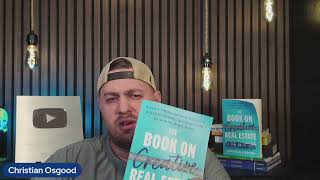
Christian Osgood's new book covers creative real estate strategies he used to acquire 600 rental units, a resort, and multiple property-management firms. It focuses on practical deal structures like stair-step clauses, the Hommel hack, and partnership models that let investors enter with little cash, skipping theory for what actually works.
Chapters
There we go. I started a ton of books in my real estate investing career, so the book on creative real estate was specifically written, uh, to go through practical examples. When I read Rich Dad Poor Dad as one of my first book into just like the general business world, it has a lot of stories which I appreciated, a lot of concepts I appreciated, and and no actual practical application. It was a bunch of stories to communicate concepts. What I did is I actually went out and over the last 5 years I bought 600 rental units and a resort and built multiple property management companies in multiple states. I actually built the business and I made a ton of mistakes and had a ton of successes along the way. I shared what worked and what didn't work in this book. So what you will not find in the book on Creative Real Estate, you are not gonna get— go into this book and you're not gonna find like a bunch of like theoretical things that I haven't executed on. You are not going to find the one method that is going to unlock all of real estate for you forever. That is not what this book is about. That is not what the design of the book on creative real estate is. You're also not going to hear a book that's only about creative finance, though you better bet we cover it in here. It's the simple structure that I often talk about on YouTube, but deal, debt, equity, each piece, how you negotiate it. So I go through the creativity of deal making. How do you actually negotiate and find a deal, build the relationships? We go over the debt piece. What are your creative options? What are the creative clauses that we actually use? Not the theoretical ones, not the— oh yeah, the BRRRR method or subject to. In fact, subject to does not really show up in this book at all. It's a model that is not a fantastic or excessively usable, scalable strategy. But I do go over what does work. So what can you expect? Examples of like the stair-step clause, if you're not familiar with that. An interest rate step up. Hey, I— you want to sell or finance your building, the interest rate doesn't work. I need day one cash flow. We've agreed on a price, we've agreed on the building, we like the operation plan, but we can't agree on interest rate. If you're doing a value-add project, start the interest where you want it, end it where they want it. Build a path where as the building does better, you pay more to the seller. It works for them and it incentivizes you to actually hit the performance. As a seller, I love that model. I am so much more comfortable saying, hey, you're going to have to do better and better and better on the property, which is my collateral to make the escalating payments, but I'm gonna give you time. How do you identify and negotiate the pieces for creative finance though? I go through the actual deals where we use that. I go through the Hommel hack, how you can actually buy a deal with no payments for an extended period of time and the deals that work there. Reverse AMMs and much, much more. I think more valuable, and I could not find any books on this, so I believe this is the book on this. There's a ton of books on partnering. There's not a lot on how you do creative equity. And I find that is the hard part for most people. Sure, you can find the deal. Sure, you can find the debt. And I think most of us can conceptualize that, even though this has a lot of pieces in there that I think are really helpful. Everyone can conceptualize, okay, I can, I can find an opportunity and I can borrow money. Where does the down payment come from if I still don't have the money? And let's assume we're not getting magical 100% financing. Where is it all coming from? Well, that is exactly what this is designed to cover. I go through actual partnership structures, an accounting principle. This is actually probably the only thing I ever used from college, um, but it's called FIFO— first in, uh, first out accounting. I will do that with investors. How can you come into one deal with one partner own 100% of the building eventually, but cash them out first. Can you get into a deal that pays you day one to close the deal, allocate cash flow, allocate future refinance to them until the property burrs itself? They're in the deal for no money, you're in the deal for no money. There's models in this book for effectively free real estate. If you find people who have capital and have a little bit of time, you can get their money out of the deal. You never put money into the deal. There's structures like that and much, much more. I think most importantly on this launch right here, which you can grab on Amazon right now, just, you know, you can literally just type my name into Amazon, Christian Osgood. It should pop up pretty much immediately. eBooks, $3, the physical books, $20. But you can use these strategies right now. I think the most important thing in here, I go into in depth the mistakes that I made. The biggest thing with creative real estate is that with creativity, you can get anything accepted. You get to skip a lot of your limiting factors. So you could get to skip the qualifications, skip having the down payment, skip the underwriting, the experience, the credit checks. But what does that actually mean? That means that you have to know exactly what you're doing when you structure a deal. I'll talk about deals that I structured with the wrong partnership structure or the wrong debt structure. Where we lost money on the course of making millions and millions of dollars. Ultimately on this book, and why would you actually buy this book from me, is I actually did the thing that I'm talking about. At the end of the day, I did make a lot of money and I successfully have held every single apartment that I've purchased. Granted, I've sold an RV park, but I talk about how you can actually buy and hold the real estate. It's a business model that actually worked for me. This will actually work for you. Available on the Amazon store. You guys can check it out anytime, but just wanted to officially celebrate that here. And what easier way to do it than to jump on and do this quick live?
So I appreciate you all and hope you have a fantastic week. Pick this up on the Amazon store— the book on creative real estate by Christian Osgood. Costs less than a black coffee at Starbucks if you want to pick it up on Kindle, or it's $19.99 on Amazon. It's launch day. If you get the book, review it. I appreciate— I want everyone to have all of these. There are no secrets in real estate, but if there were, these are the things that felt secret to me that I've never read in any other book, and what actually worked to build my portfolio, for my friends and mentees to build their portfolio. It is all here. I hope you enjoy it. I appreciate you guys very much, and I'll talk to you all soon.