Ultimate Guide to Exit Stratagies - Creative Finance Live
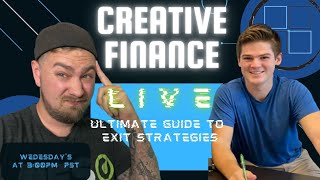
Christian Osgood and Cody break down five real-estate exit strategies beyond selling: cash sales, refinancing, equity restructures, converting equity to debt, and paying off the note directly. They emphasize that relationships and storytelling matter more than tactics when sourcing deals and raising capital.
Chapters
I am still ambiguous to exactly the second we go live, but I believe that we are live.
I'm going to say yes.
Welcome back, YouTube. I'm Christian. This is Cody. And today is Creative Finance Live. Our featured question, which is going to get to just a couple of minutes into the call, is going to be a conversation on exit strategies. We've been told a bunch of times, hey, your options are sell or refinance. And we talk a lot about, okay, well, what do you actually do when you analyze a deal and how do you do the— we have two steps. How do you own it? How do you never lose it? How do you actually manage that? How do you never lose it? Is that exit? So we're going to deep dive that, and that will be just a few minutes into this call.
And would like to say exiting does not get limited to refinancing the debt stack. And selling. There's a lot more to do.
Mm-hmm. And actually, yeah, the main thing is the exit does not mean you get rid of the property. An exit is an exit from the existing debt on the property, and that could be more than you likely think. I'm going to pull up some questions from the chat in YouTube, but we did start with a question on YouTube.
David, thoughts on buying a property in an HOA? I wouldn't do it. And the reason I wouldn't do it is you're gonna have some people that are gonna head up the HOA. And most people, at least if you're a good operator, are not gonna be as good as you are. And I don't want other people managing the premises. If you get what's called a special assessment where they're like, oh, we manage money poorly, we need more money, everybody gets whacked with a bill. And I don't know about you, but I don't like unexpected bills. I've gotten a lot of them. I don't like them. So I, I'm not a huge fan of that because when it comes down to managing the complex, you may own a portion, could be a large portion, not sure. However, in your specific deal, if you have just a portion of it, you are working with other people to manage that complex. And I am not a huge fan of that because most people are not as good at managing money as I am. And I'm not saying that just to toot my own horn, but you look at society today and most people are not doing well. And so I don't want to be essentially partnered. You're not partnered on that one deal, but you're partnered in that community with a bunch of people that don't know how to manage money. Yep.
I don't think I can say anything, uh, anything else to add color to that. I'm just going to say yes. Uh, we have a question from the, um, uh, from our YouTube videos here that I wanted to share. I actually love this because this is one of your OG videos they posted on. It's a video of you where you look like you're 13, but really I was 14. But this is you next to Grant Cardone. That's that one 3-minute video you did, but in there you reference selling stories. So the question is, what do you mean by selling stories? Can you give me an example? Funny enough, it's before we partnered, and that's really what we built the entire business off of.
Yeah, so you have your main business model, whatever that is. Some people wholesale, some people flip. What I found is that we're all in the real estate business, but the real estate business is actually the people business. And nothing connects people deeper than stories. People love to share stories. And if you look at your life as just an A to Z, you start here and eventually you end up here. Most people are going to look back and say, oh, I'm so glad I own all this real estate. They're going to be, I'm so glad I had all these stories along the way. The real estate was a vehicle that helped create a lot of stories, but the story in itself was worth more than the actual real estate when they got to the end of their life. And I've seen that again and again and again. And so the way that we prioritize everything— you talk about selling stories, it's not really just selling stories. I'd have to rewatch the video to see how I worded that. However, the actual story is worth more than the real estate. And so I put that at the forefront of everything. The story comes first, and the story that you build for yourself and with others comes from the relationships you build with them. The relationship's worth more than the real estate. The story is worth more than the real estate. And so we're talking about selling stories, we're talking about creating stories. I want to create a memory that someone can latch on to for the rest of their lives, say, that was awesome.
And relationships are built on stories. One of the first things that I see that people mess up on, on finding deals, raising capital, is they don't open with a story. The entire business is built on your ability to effectively communicate to others. If you come in and start with I found an opportunity. It makes some money day one and it makes more money later. And I want to split this with you 40/60. You just start with numbers. What am I investing in? Why am I interested? If you can come into a capital raising conversation with, I found this building, it's 3 stories in this awesome market. I want your help looking at it because I think this is one of the cooler opportunities I've ever seen. Has a really good mix of 1, 2, and 3 beds. I have a little issue on the front end, but I see a ton of upside. Can we look at this together? That is different than, hey, look at these numbers with me. Same thing, completely different based on the way you tell the story. Stories equal relationships equal opportunity for you and for others.
All right, from Dividend Dave. Hello gentlemen, I'm now in North Carolina. Hey, nice. Great market. All righty. Love the shirts. Appreciate you, David. From Jacob Lopez, just curious question, Christian, how do you balance your focus on work and spending time with your wife? I often find myself sacrificing one or the other. Am I doing it wrong?
It is not super easy to do. This is not something that Cody has to deal with yet. So, um, yeah, I will, I will take the question. Um, How best to put it? So for those who don't know, um, I've been married to my wife for 5 years. So before I started the business, we both had separate jobs. I have found that having two separate jobs, or you're away from each other most of the day, then you come home, you already— most 9-to-5ers spend a lot of time away from their spouse. For me, what has happened is I actually retired my wife through our companies and she now helps us run the companies. So this studio, I, I get the feedback all the time that this room is way smaller than people imagine when they see this room. We're in a tiny little room in the side of my house. My wife is working two doors down. So I actually got a lot more time with my spouse because we're both working in the same business. Now, if your wife has no interest, or, and this for anyone, so if your spouse, significant other, whatever, has no interest in your business, That doesn't mean you can't run the business and get more time, but ultimately the goal of everything you do is to have control of your time. So if you are running your business like a business, you should have the ability to direct your time here and there. One more thing I will add, because I don't think you're doing it wrong. I sacrificed everything for about 15 months on the front end of this, and I actually tried to start another business. And so for like 7 months prior to that, I also sacrificed all my time. I had about 2 years of time. I didn't go to family events. I missed birthdays. Believe it or not, I missed a few weddings. Like, I— no social life, no friends, less time with my wife. Like, I spent everything focused on buying my time. And here I am 2 years later, and I have the time with my wife that I wanted. So if you're on the front end of your journey, I'm not saying my way was right, but I sacrificed all my time on everything to fast-track where I am today. You can probably afford to balance that and spread what we did in the year. I think most people would be very happy doing in 5 years, and it's probably gonna be a lot easier. Cody lost hair, I gained weight. It was not, uh, it was not without stress. Um, so doing it right or wrong is really up to you. But that is a great question, and I don't think anyone has ever asked me that, so I want to give that the time it deserves.
From Ben Porter. Hey guys, Cody, thanks for always getting back to me on Instagram. You're one of the select few. I try my best to reach everybody. All right, how would you suggest I find a good real estate investing meetup near me? Well, there's a tool called Google. I use that for everything. And if you can't find a real estate event near you on Google, I'd check Facebook. It's probably gonna pop up on Google if it's on Facebook though. There are some areas that actually have no meetups and therefore you could start one, but that'd be it.
And then you just become the guy.
Yeah.
Or gal.
Or gal.
Before we read the next question, I do want to jump into our headline question. I wanted to make sure we have enough time for people to actually join the meeting before we go into it. But I wanna do the ultimate guide of exit strategies. We have had this question all the time. So I'm gonna bring it up. Now, how do you guys— people get the beginning. How do you own it? We talk about creative finance all the time. So like putting together the deal, if you watch this channel at all, I think we've covered that pretty dang well. The how do you never lose it? We try to explain as much as we can, but there's been a conception that you have two options: sell or refinance. There are actually a lot of different options, and I want to go through like 5 or 6 of them here. Let's do it. So just spend a little bit of time. You guys keep posting your questions. We will catch up to them. But I really want to deep dive on this because this is misunderstood.
Let's talk about the first ones that everyone seems to know.
Yeah. Well, first, a disclaimer. First disclaimer, when we say your exit strategy, that is an exit from your existing debt. We said this at the beginning of the call, but I want to make sure for everyone—
or partners, if you have partners.
Yep. How do you exit from the partners? How do you exit from the existing debt? It doesn't mean you're selling the property. The exit just means if you had a 5-year note, you either need to change your capital in some way, get out of that existing note, pay off that balloon, extend that note, sell the property, or a list of things that we're going to go into.
But, and it really should just be called the transition period.
Yeah.
Because it's not an exit. I mean, it's an exit from where you're at, but it's really just a transition from where you're at to where you want to be at some point in the future. Whatever gets you from where you're at today to where you want to be will not be what got you where you're at today. So you should constantly be looking around the situation, seeing if you need to adjust things. Now, here are a few ways that you can do that.
So you hit the end of your balloon. Let's start with the most simple, just clear-cut one. You can sell the property. Cody, what do you do if you sell the property? You get paid 100% cash out.
Yeah, because whatever you sell it for, top line, less your expenses, less your mortgage, and you just get to keep cash, and then some of it goes to the government unless you 1031. Yep.
Now, if you have partners in that deal, that's split between the partners. Um, it is the most simple and clear-cut of all of the exit strategies.
So let's say you can't sell though. Nobody wants to buy right now. What, what do we do next?
Well, you can refinance.
Okay, what's that mean?
Now, granted, a lot of banks also don't want to refinance.
Okay, but let's say you find someone who can refinance you.
So refinance is exactly what it sounds like. You have your existing financing and it's new financing. It's going to be a new note. Now, this can just be a direct replacement. Say over the life of the note, you reach the end of your 5 years and you still owe $1 million. A straight refinance would just be getting new debt for the million dollars. You just replace it on a new note with a new balloon. It can be interest only. It can be amortized over any length of time. Be a whole bunch of different structures, but you're just doing a new debt structure and it can either be with the same lender or any lender. But that's what a refinance is. You can also do a cash-out refinance if your property has increased in value and you find someone who's willing to actually give you money out. In addition, you can get paid in tax-free dollars. Granted, it's still debt borrowed, But say we bought a property, I'll use easy numbers, for a million bucks and it's worth $2 million today at the end of our note.
Ta-da!
It would be very reasonable to find a bank that would go 75% LTV and we could pull out half a million dollars from that property, take out half of the new equity that we just built. And now that's just money that you can use to grow, to pay off, maybe you have a partner on the deal you want to pay off, but that's another option on the refinance.
So let's move on from refi. Let's talk about restructure. And this is where it gets really fun. We bought a building and it's a 38-plex. We have less than $1.7 million in debt on it. It's worth upwards of $3.5 million today on appraisal. It was $3.4 million. That was a few months ago. We've done more improvements. We're pushing rents up here shortly. But for round numbers, $3.4 million. We owe just south of $1.7 million. Christian and I own that without any partners. We have $1.7 million in equity, $1.7 million in debt. If we wanted to become a debt-free org, if we want to play the damn Dave Ramsey game— oops, uh, Dave Ramsey game— we could, uh, go find an equity partner that wants to buy 50% of the LLC. We could JV with them after the fact. We'd have our CPA and our attorney draft up all the docs and make sure that we're all square, but they could write a $1.7 million check. And so most people are like, "Well, if there's only $1.7 million in equity, if they're doing 50%, why would they write you a $1.7 million check?" Well, I'm going to use the $1.7 million and pay off the $1.7 million debt that I have, and now I have a free and clear portfolio. I have no debt on a 38-plex, and they're going to get their cash-on-cash return if we own it in cash, which is what we do. So it'd be just a 6% return. If they're happy with that, now we own a 38-plex without any money in it. If we had a partner in the 38-plex that we needed to cash out, we got the value up from when we bought it for $2 million. We could sell it a little portion of the LLC to, to a friend or an investor on just a buyout agreement, give them up a little bit of the LLC, have our attorney draft it all up, and we use that cash to pay out the old partner. We can cycle things and you can restructure anything you want. But the main thing is, once you have an idea, If you want to restructure anything, you get the idea. You ask your attorney, how could we make this happen? What are the regulations we have to fit to make it happen? And then you just have to pay them. They like getting paid. Yep.
And so that's just an equity restructure, right? You just bring in a new person, new money, cash out the old money based on the new value.
And that's a way that you can pay off stuff really quick. And then people are like, well, now you have a partner.
Okay. Now, if you're interested in getting really creative, this is the point. Where you share this link with a friend and you invite them into this chat, 'cause everything from this point on gets even more creative.
All right, what's next?
Okay, converting equity into debt. Say you have another partner on it or your own equity and you just want to get debt. When you started on the project, maybe you didn't have the cash flow to service debt, so you brought on a partner. So in this scenario, let's say, hey, I have an exit from a partner. I told them that I'm gonna pay them X amount in 5 years. I have found I'm coming up to that 5 years and I actually don't have the capital to pay them out. So I need to figure out something. You can renegotiate with them, which a lot of people will do. This is why I recommend being very close with your investors and not investing with a lot of people. You can probably just explain the situation, renegotiate. If you can't do that, can you convert equity into debt? And what would that look like?
Well, you could take it private for one. You go find a hard money lender. That's the most expensive way. Not a huge fan of getting a whole bunch of hard money at over half a million dollars in hard money at once. Painful. And, uh, so don't recommend having a lot of that. However, you can go get a private lender. It can either be a hard money company, it can be private individuals that just place direct placement loans. There are people out there. You just have to make sure you're going through your escrow company, getting your attorney involved. Again, I'm going to keep saying this over and over because you need to have your good board of directors that will help make sure that everything is tight. There's some people that operate in the gray space and you don't want to go super gray. You don't want to break free from the rules. So, uh, you go get a loan, there's a promissory note, deed of trust, you cash out the partner, and now you can make your payments. You converted it from an equity partner who doesn't have loan payments. Now you get all the equity back, but now you have loan payments. So the goal is go into it Maybe with a partner in that situation where you don't have to make cash flow payments, you get the cash flow up. And once the cash flow's up, you can borrow new money to cash them out. Mm-hmm.
And that works especially well when there's still more upside in the project. So you can cash them out partway through the project, turn it into debt, the property can sustain, and now you might actually get a cheaper buyout than had you run the project all the way as equity. Now, okay, what else can we do? So we can sell. We can refinance, we can restructure, which is as creative as you want to get. You can do a partial of any of those. You can do a little bit of equity, a little bit of debt, a little bit of private money. I mean, you can get as wild as you want in the restructure.
And sometimes if you want to restructure, the partner may just want more cash flow. They don't need the equity anymore. They're like, okay, we trust you. You've done what you said you're going to do. And I've done this before where they sign over their equity for a promissory note backed by real estate. So they basically seller finance their equity to me.
I Equity became debt.
Yep. So just sign a promissory note, back it by a piece of real estate, and boom, you get your equity back and you just have to make more payments. Now it is more debt. Whenever you add debt, you add leverage, you add risk. And so we're not a proponent for just borrowing to borrow. That's why we keep our cumulative loan-to-value below 60%. We want to make sure that we're not just leveraged to the hilt forever. However, there are times where you should want to get equity back. And so in situations like that, if we can't just write a check, which is going to be the last little bit of this, you just earn it, pay it off. You can restructure it as debt, whether it's from someone else or it's just with the person who gave you the money in the first place.
And I was going to say that is a masterful transition because there is a last thing you can do, which is you can just write the check. A lot of people forget this one. It's not just seller refinance. You can also just pay it back.
How do you pay off debt?
With money. And a lot of people—
how simple it is, it's just money.
A lot of people get really caught up in the fact that we've bought almost all of our stuff zero money down out of pocket. That doesn't mean that we don't invest our own money in those projects.
All the money we get, all the money goes back into the projects. We have spent so much money on improving the buildings. We've used the story to keep expanding, and we use all the dividends from everything, all the companies, all the real estate to improve the real estate.
The model is the real estate buys the real estate, which is why we buy cash flowing deals and we look for things that have upside. But when we make money, what we do not do is spend it on expensive meals. Well, except for a couple times. There's one time in Dallas, but we don't spend it on expensive food all the time. We don't drive crazy cars. I am in a tiny little house in a, dinky little suburb of Seattle. Um, Cody lives in a nice resort, but the resort makes money that covers Cody being there, and Cody works his butt off at that resort, uh, for his, his cost of living. The way we have structured our stuff is that the real estate perpetually reinvests. We have something called the debt hammer, uh, originally coined the debt cannon, but I like hammer better. But essentially what we're doing is we are saving up in a side account all these cash flows when we don't reinvest directly in the building, in a side account that grows and grows and grows. And if you want to lower your risk, hold a boatload of cash, because in real estate, in your business, your problems can be solved with a check 99% of the time. Your personal life, maybe not as much, but in real estate, money will solve most problems. Your risk goes down and down and down until you have enough money in the side account to completely eliminate one of your mortgages. And then you write a check for the mortgage. We haven't done this yet, but I'm imagining that feels pretty darn good. Those are your exit strategies: sell, refinance, restructure, which is a huge category, or write a check. Let's get into our questions because I'm sure we have a lot. And I can delete one of them because it looks like an inappropriate spam.
Oh yeah, hide user from channel. Then they're just gone forever.
Oh, I like that one even better.
Yeah, I've done that for some annoying people.
That is now gone. Okay, now to the appropriate questions. I believe Charles was the first.
Uh, we already read that.
Oh, perfect.
Oh wait, no, we didn't. How do you guys balance leading with relationships and just going after a deal? Well, we just do the relationship game. We're not going after deals. Brokers now send us deals. We don't have to try. As hard. But in the beginning, it's just go build relationships. I know the people that I work with, like what's going on in their life. I know their birthdays. I go hang out with them. I just focus on building relationships. I met up with one of them yesterday, sent a birthday text to a really close— now it's almost like family, uh, but didn't know them 4 years ago. And so I've built relationships and gotten really close with people, and now I care about them, they care about me, and we're just hanging out and stuff happens. But in the beginning, you should just build the relationship, put the relationship before all else, and stop trying to buy real estate. Everybody's trying to buy real estate. If everybody's trying to do it, it's probably not what you should be doing.
Yep, you don't want to go exactly the same direction as everyone else. There's blue ocean, which is just free and clear, and there's red ocean where all the sharks are. We don't want to compete with that. I just want to create relationships. The other thing that's really fun with this is when you just go for the relationships It's no longer a job. Going after deals is work. If you don't want to be in the 9 to 5, don't give yourself a stupid 9 to 5. Going after deals is a dumb 9 to 5 job, and it's more than 9 to 5, it's 5 to 9. You hammer that. I know a lot of people who just knock door after door after door after door. That does not sound fun. I would rather have a desk job than do that. When you go after relationships, we're just getting coffee and getting to know people. It is just a social laid back, not that hard activity that we enjoy doing that I would do in my free time. So the way we prioritize it, I have still to this day never asked to buy a property. Just when I reach out, Cody does a lot of the deal negotiation. Every deal I've done, someone's either reached out to me or after a whole bunch of meetings, someone called and said, I would like you to buy something. And they're like, okay.
Yeah.
Um, and I don't think since we've partnered, I don't know that you've ever asked to buy anything. No. The only time Cody's asked to buy stuff is when he's learning how not to do this, which was, uh, and it didn't work.
And then I switched to this and just deals flooded.
And thank you for the 2 years of hard work that you did doing it wrong so that I don't have to, Cody. I appreciate it very much.
Yeah, I dug the trenches. All right, from Lavon: How many calls do you have to make to get one deal?
One.
One. Because I mean, what are you quantifying as your deal, right? I mean, if you're quantifying that as buying a piece of real estate, I would still say one because a lot of the one phone calls that I made resulted in deals. However, I didn't try to buy them. What's your goal? My goal is to learn how people played the game at the highest level. And a result of that is I learned from a lot of people how they played the game at what they thought was the highest level, and I combine it. And then now I go meet with them and not all of them understand how I went so fast. They've said that, like, we've never seen anybody go as fast. It's like, well, we did exactly what you told us, and then we took some pieces from other people. And some people try to pick sides. And if you look at Cardone and Dave Ramsey, someone who's debt-free versus someone who is going to leverage to the hilt to get cash out, then you're not going to know what to do. Typically, it's very hard to decide. But what I want to do is take the best pieces from Dave and the best pieces from someone who likes to leverage like Kiyosaki and use it to build a huge snowball and then debt snowball it all. Get a whole bunch of problems and then use the cash flow to pay it off. So I take the best piece from both people and eventually end up debt-free like Dave, but I got there using the best pieces from Kiyosaki or Cardone. Some people pick sides. If you get the best pieces from everybody's story, because you learn their story, you go a lot faster.
Uh, from Jacob, I think for the inside, guys, I hope I can meet both of you in person, uh, in January for the next meetup. Ah, not a question but a shameless plug for us. Uh, we're gonna have a meetup in January, and we're probably gonna start doing this every other month. Might slow down in summer months when we do, uh, weddings at our resort, but it might be monthly depending on how many people want to book.
I mean, we had a— we're hosting a real estate event where we're talking about business management, business setups, creative finance, asset management, just building out your business and your operations. Because a lot of people want to know just how do you go quicker. We filled that within 1 hour. And so we didn't think we were going to do one in January, and then it filled literally in 60 minutes, the whole resort. And so we're going to do it again in January, date to be released, but hope to see you there.
Yeah, we will keep growing that. As many of you want to come, we will Oh, wow. Yes.
Dividend Dave, $10,000 in equity, another $10,000 in savings. I found a great property, but I don't want to spend most of it on down payment. Well, what's the money for? Right? I mean, if you don't want to spend it, like what? It doesn't do you any good just sitting there. So the main thing, if you want to keep scaling, most people get stuck in the fact that they run out of money.. And when you run out of money, you either go get new money, that's where most syndicators go, or you learn a new way to play the game. Those are the options. You either go get new money, could be in the form of debt or equity, or you learn a new way to play the game without it. And you're not in that position where you have to learn a new way until you run out of money. So that's what I do. I always go to zero. Like today I went to negative $600 and then we paid ourselves. 'Cause I loaned money to one of our companies and now I have money again. But you don't have to get creative until you go to zero. And so I would take the cash, which isn't worth as much as the real estate. I think it's a pretty fair argument to make. Get the real estate and then find a way to either get new cash or play the game in a new way without money.
We can do these zero down, but when we have money, we spend it on real estate. Like we share all these zero down strategies and when we're out of money, We go zero down. I've invested— granted, we bought $20 million in real estate, but I've invested over $180,000 in real estate since we started partnering. Like, I had money in and then it goes out.
And I've spent just this year because I had to do adjustments in my equity position to do cash out. Now I've spent over half a million dollars. So if you get money, invest it.
Yep. And some of that half a million he spent was half of that. $180,000 went to Cody, which then he spent on real estate. So it flows through, but don't be caught up over $10,000. If $10,000 is not your goal, don't worry about protecting something until you're there. Like, I have just reached the point where I've retired my wife, I own my time— well, the businesses own my time, we're fixing that— but financially I own my time. We've actually built something worth protecting, so our strategy changes to more stabilization. But while you're in build year Build.
All right, from Jacob Lopez. I think I didn't skip over questions. No, I did skip over from Lavon.
Oh yeah, I don't think we've done that yet.
My question is, how do you build relationships with the broker and agent when all— okay, all on their mind is what we do. I don't understand the last part, but how do you build relationships with a broker and agent, Christian?
Uh, with a broker and agent, uh, you are right, they are focused on Sales agents are salespeople. That is what they do. They want to get paid. So you need to convince them that if they work with you, they're going to get paid. Your goal is to instill absolute confidence that you are ready, able, and willing to purchase a property. So when you meet with them, you're going to go over, just like with an owner, I will stop who you are. Sorry, my automatic litter box wants to join the meeting.
No, kill that.
You know, we think we got it. So ready, able, and willing to purchase real estate. You're going to go over who you are. You're going to talk to them about a specific deal. If you're meeting a new broker, I want to talk to them about an actual opportunity that they represent. We're going to talk about that deal first. We're going to talk about what they like about it, what they don't like about, and how is the bank going to look at this property. We actually have this whole scripting in our course, uh, themultifamilystrategy.com. But you're going to ask quick, easy, intelligent questions that let them know, okay, I understand the property. I ask good, concise questions. The bank question is a great question because you're asking, how are the books? Is there any deferred maintenance? How much do I need to put down? It's also a money question, which for a broker, they hear, oh, they want to know about financing. We're getting closer to a decision. So you're leading them down a path. You go through these questions, and if your goal is to build the relationship with the broker, you know, okay, well, is there anything else I need to know before making a decision? You open it up to the rest of the properties in the market. If they answer a question about the building, well, cool, but I actually just wanted to know, is this the deal I need to buy? It's a decision-making question. But if you want to build ultimate rapport with the broker, you need to practice your scripting because the conversation needs to flow from one property to a demonstration that you know exactly what you're doing and you're ready and able to close, to a transition to, I want to find the right deal, are you the right broker? They need to be sold on you before you get sold on them. And that is the correct way to do it, brokers.
I saw a question that I liked and then it got deleted. Oh, it got put back in. Can you be sued over an LOI for not being fulfilled? An LOI is not a legally binding contract. However, you can be sued for whatever you like. People can sue for whatever.
They can sue you. They won't win, but yeah, you can get sued.
Yeah. An LOI is not a legally binding contract, just as like the general LOI goes, a letter of intent to purchase. You have intentions and then it usually gets followed up with the PSA, your purchase and sale agreements, your contract. An LOI is an intention. Yeah. You can get sued for anything.
Cody's been sued twice for frivolous, unnecessary things in the last 12 months.
Oh, it's been stupid.
And they just got dismissed. Yeah, I mean, it is what it is.
Yeah. And I used to live— I grew up at my mom's house, and so they tried to serve my mom and I didn't live there anymore. And my mom's like, oh my goodness, what happened? You're getting sued. Because this happened before. I looked at it, I was like, this is dumb. They'd already been paid out for for something and they're like, we want more money. You already signed away rights on that. But people can sue you for anything you want. The main thing is do good business, don't do wrong by people, and keep good documentation. Like, that's what we do anyways. We just try and document everything. We're not doing stuff over the phone. We have everything now in writing. Learn that on the first one.
Yeah, I learned on the second one. Never again.
It's okay to make mistakes, just don't make them twice, right? If you're principal-based. But, uh, you can get sued for anything. And know that if you're playing the real estate game, it's probably going to happen.
But probably you will get sued for something at some point.
Yeah. And as long as you're doing good business, you're not messing with people, doing the wrong thing, not playing in the gray space all the time, and you document everything, then your odds of doing okay go up. However, it's still going to cost you money. Both of those still cost me money. The attorneys win more often than the people.
All right, Jacob asked how much, uh, okay, so this is back to the event. I'll touch on it really quick. Uh, how much do we have to pay for the stay for the weekend? I'll prepare the wallet. I actually want to bring some guest speakers to the next one. I need to work the budget for how much we're going to include and what food will be. We threw together the first event. It's very intentional, but I need to figure out The first event is a test of how much does it actually cost us to throw an event. From there, I will determine the pricing so that we do not burn all of our capital. Um, but we will get back to you very shortly on that. Stay tuned, we will share details because I want to run a lot of events.
That is the fun part of owning a beautiful resort, and to do that, you know, it depends if you want the sauna house, it depends if you want a little cabin or this honeymoon suite.
I'm gonna guess the tiniest cabins are in the ballpark of $500 to $700, and it'll be a lot more expensive for a giant house on the water, and we'll figure out from there.
All right, I guess I have a limiting belief agents and brokers don't have the time to build relationships.
Well, that is all they should do.
They're typically broker than you are, that's why it's in the name. So I'm going to say that they will make relationships if they have any brains in them. Yep.
And the ones that don't build relationships are not the ones who have the listings. The best relationship builders know all the owners.
Magical.
They have all the listings. If you want to do a deal, you need an— you need to work with a broker who's good at relationships. Otherwise, they're going to have nothing to offer you.
Okay, thanks guys for the answer. My money will go to real estate. I just need to make sure I keep money for my reserves as well.
Yes, you want to have that.
Yeah, been there, done that without reserves. It's, uh, it's interesting.
Yeah. And can I add to that? I should have touched on this with the $10,000.
Yeah, you—
if $10,000 is the reserves that you feel that you need, don't blow it. Yeah, you don't need to blow it. I, I want everyone to hear, don't be scared of spending money on real estate.
I think we hyperfocus on the back end of that, but don't be ridiculous to where you actually go to zero. I do that because I'm fine losing my hair for a little bit.
It is not a best practice, um, and it's, it's occasionally a pain. What you, what you really want to do is have some reserves. And if you don't have money that you're able to put down, so say $10,000 is really what you need to float for a couple months, probably shouldn't spend it. Be ready to spend it if it's the right opportunity, but I would not recommend doing that. Find a way to do the deal without using your own money. And that is just finding a good enough opportunity where you can either raise debt or equity, but do it in that order. Find the opportunity, the deal, then figure out, okay, what are my debt options? What am I going to do? And once you figure out the debt, if you still need money, bring in an equity partner. And you don't have to use your own money. Just use common sense and buy cash flowing deals.
All righty. From Brendan Turner. Hey, I'm 20, have around $13,000 in the bank. Nice. When you raise your $100,000 for the down payment, can you go a little more into how did you go about paying them back?
Was that for the 38? We've done $100,000 down payments a few times.
$100,000 was my first deal, and that came from getting one extension. It was a 12-month note. I don't recommend doing 12-month notes. Try and go longer if you can. That's really hard to pay off. I thought I was going to be this big shot agent, and I didn't make money. So I thought I was going to pay it off with cash that I earned. Didn't happen. Got it extended, got the equity up, and then ended up bailing out someone else, someone else's debt that they racked up. And the money that I spent over there wiped out my down payment debt. So I did it with cash, but I had to get the equity up enough on the portfolio and I had to scale the portfolio enough to where I had pieces that I could maneuver. In the beginning, most people are like, well, I'm going to just borrow it and I'll pay it back. And if that doesn't work, I'll refinance it. And if that doesn't work, I'll sell it. I built a portfolio big enough, quick enough to where by the time I had to adjust, I had 81 units and I could move my pieces to get out from under my debt obligation. I moved quickly so that in 2 years I could build what takes most people longer than 2 years.
And to the first half of that question, how did you raise that initial $100,000?
So that was his debt. That was his debt. 12% interest, 1 year. I got it extended for a second year and it was second lien hard money. It was private. When we say taking it private, either go with hard money lenders or a direct placement or you take it to private individuals. And so I made a whole bunch of pitches to people and clients in the office and they weren't my clients or other people's clients in the real estate brokerage I worked for. The brokerage I worked for in the beginning was focused on rental property, duplex, triplex, fourplex. Well, I had a 12-plex, and I bought so many meetings, so many meetings, like I forgot how much money I needed. I forgot what the game plan was to pay him back. I forgot what the interest rate was. If you, if you think you're going to get nervous, well, I did too, but I made enough pitches, and you eventually get one, which is what happened to me. You either get it or you don't. I made enough pitches and I got one, got enough trust in someone to where they would put it together for me and got the money. Second lien as debt, not equity.
Fantastic. I see here from Kevin, 8-unit complex, $1.5 million, 10% down, 3% interest, $70K NOI.
All right.
So a lot of details.
Let's do the math on that. You're buying an asset for $1.5 million. You're buying an 8-plex. Could be 8 townhomes, could be 2 4-plexes, 4 duplexes. I don't know. You get an 8-plex for $1,500,000. You're putting 10% down, 3% interest. So $150,000 down. We'll worry about that later because I'm going to assume we don't have the $150,000 yet. 3% interest on a $1,350,000 loan. If you're not tracking with me, I just took $1,500,000 less the $150,000 down, the 10% down, and $1,350,000 on a loan. If I'm doing 3% interest on that, my debt service if it's interest only, is $40,500 total cost of debt. If you're amortizing it, meaning you're paying it down a little bit over time, it's going to cost more than that. But $40,500 in interest, you have an NOI of $70,000. So if we subtract $40,500 from $70,000, we get a total of $29,500 in cash flow. Your NOI is the money you have to pay yourself and pay your debt. That's your gross income less your actual vacancy rate and actual expenses, your operating expenses, not your debt. We're assuming we own it outright for a minute. So you have $29,500 in free cash flow on $150,000 down. We divide that out, you get 19.67% cash on cash. That sounds like it'll work pretty well.
That does seem like a very good NOI for an 8-unit Houston.
Is it in Houston? Oh, it is in Houston.
$70K NOI, 8 units. And now we don't know the building or how many— like how big the units are.
But yeah, that's saying after operating expenses, it nets $729 a month a unit.
That seems like an insanely high NOI for the size property.
So I'm guessing a broker gave you that and they probably didn't include the expenses. That might be the gross income. However, if that is the actual net income and you're getting $1,200 a month rent, $1,150 to $1,300, that sounds like a great deal.
Yeah, the, the numbers presented look great. I also have some doubts about the numbers presented just based on what I know about Houston and how much you're going to net per door. If you have that deal with that low interest, um, I would, I'd buy that in a heartbeat.
All right, do you guys use multiple LLCs or scopes to purchase Your properties? Yes. Every property outside of a couple are in their independent LLCs. The reason we do that is because some of them have partners with buyouts. We don't want to just throw it all into one LLC because if we have a partner we don't want to buy out or that we do want to buy out, we don't want them to have everything. So we make independent LLCs. Our 38, just us. We're buying out our partner on our pheasant, pheasant apartments. We own a whole block of duplexes. Once you buy them out, that'll be its own independent LLC. But in the meantime, we have a partner with a buyout agreement. So that's not going to be in our Cascade Valley Apartments LLC. That'll be in the Pheasant Street LLC. It's all separate.
It's nice to keep everything in individual silos. By the way, that was the last question in the chat. So if you guys have questions, post them. We're doing our traditional last call. Bring them in. We will go until the questions stop on this last call. So if you're thinking something, Put it on the screen, otherwise I can't answer it. And if you're not thinking anything, I'm sorry, then yeah, this is probably the wrong room because this is a room for thinkers. So on the, on the LLCs, the main goal is to put everything in its own silo so that one property doesn't affect the other. Most of our debt is non-recourse, which means if one LLC sinks, we just don't want to drag down the other ones. Granted, we do the same math for how do we own it, how do we never lose it on every LLC.
However, maximum foreseeable loss is a thing. You want to know like what's our exposure on each asset? You don't have to worry about that as much in the beginning if you don't have as much to lose. But once you build something worth owning, it's good to think about that stuff. You should analyze the risk of everything. Mm-hmm.
Now there are multiple transactions that we've done within single LLCs. We've expanded some of our businesses. And if you want to keep the exact same equity partners, if you want to keep the same groups together, That is something that you can absolutely do. But I would not put— right now we have what, I'm going to round down, we have 100 units. We have more than that, but I'm just going to say in the 100, mostly 100 units that we have, I would not put 75 of those in one LLC. No, that would be a good way to lose a bunch of our stuff in a frivolous lawsuit that goes sideways. Yeah, I don't want that to happen.
Okay. From Brendan Turner, just to follow up to my question, if you were me, would you try to replicate what you did? Yes. Well, if I was you, then yes, I would replicate what I did. However, you're not me. So I would buy the biggest deal in the best location that you can.
Um, then as a follow-up to that, or something different, uh, also how does seller financing work with a real estate agent? Same way, except that instead of negotiating with the owner, the agent's negotiating with the owner. If they're a bad agent and they just don't know how the game's played, they may have worries about their commission.
A commission is an expense to the seller. That is, on your settlement statement, you've got all these things called line items. The reason that they're called line items is because they're items on a line. Crazy. Super simple. I wondered how that works. And it's just debits and credits. And so you've got the incomes coming in and the expenses going out. It's like a balance sheet and the expense to the seller is going to be a commission unless you pay it, but I don't recommend you pay it. I'd rather have the seller pay it if I don't have to. So that means that to close out that deal for free and clear title, you got to pay all your expenses to close it out, attorney's fees, title, escrow, all that, prorated taxes. You'll have to pay off the mortgage. Typically you can assume it. You can also do other clauses. However, it's simple if you just do free and clear title. And then the last expense down at the bottom is typically you're going to have an agent, it's going to go to the brokerage fee, and that's going to come out of their net proceeds.
Now, if you're doing low enough down where the seller is actually going to have to come out of the— like, out of pocket to pay the broker from their proceeds, like, if your down payment doesn't meet the commission for the broker, what a lot of people will do is go, okay, well, the buyer will pay these. And like Cody said, that's not how you want to run that. What you really do is you just put more money down into the deal because that now comes off of your note value. That is a more sensible way to do it. But you can always reinsure— reassure the broker, we will write the down payment at a rate that will cover your commission. Problem solved. Brokers get stuck on that all the time. That is the thing that brokers get worried about with seller financing. You can reassure them in one sentence or less, you'll be paid. I don't know how you do it in less. I guess just paid. But you can reassure them in as few words as humanly possible. Don't overexplain it. Just, we will put enough down to make sure your commission's covered. We appreciate your help. You'll be paid for this. If they get stuck, Tell them that, move on.
Do you look for insurance quotes before you send an offer? No. That is— no is a full sentence.
That is part of your due diligence. I do not want to run insurance quotes on a property that I am not buying. That wastes my time and my insurance agents.
Okay. Next up, does a complex have to be owned outright to be seller financed? No, you can assume loans. There's also ways to— you can do real estate contract. A lot of loans get— can get called if you have a second lien behind it. So there's these things called real estate contracts, which don't always create a lien. They just create a contractual recorded obligation. There's a lot of ways to spin the Rubik's Cube.
If the down payment's high enough to pay off the previous mortgage too, that, that clears it. Ta-da!
However, uh, it is best practice to get property with free and clear title. And we'll leave it at that. I'm still a little confused. What's your opening line when you call a broker? Uh, if you're calling a broker about a deal, is it still available?
I don't know why everyone misses that. That is— no one does that.
Is it available? Like, it is so simple that people don't ask that question.
There's a few reasons that that's the question. First of all, if you get into a conversation and you just start word vomiting about the deal And it's not even available. Your momentum is killed. You have to start over and impressions are made in the first few seconds. This is a new broker. They already think you're an idiot, which is a bummer. So you're checking for that. The other thing is that is the single most natural question. You are answering all the unknowns in their head. A brand new phone number has just reached their phone. Put yourself in their shoes for a second. They pick up the phone. I'm calling about the deal on 123 Main Street. Is it still available? I am now at ease. I am the sales rep for this property. I know what my job is. I understand who's calling and why they're calling. They want to know about the property I represent. You're framing your conversation. Start from square one.
Don't skip that step. Alrighty. And then looks like Jacob has to go. So before I go, where would you guys suggest I look for private money lenders? At real estate meetups. Sometimes there's Facebook groups. You can look up private money lenders in my area. Don't just use the online ones.
Typically, if they're just online, they're garbage because they're spending a whole bunch of money that is covered by their fees to market.
Yes, I wouldn't do that. I would go build relationships with them. And as soon as you find those types of people, those businesses, I'd go meet with them. I wouldn't just take the first offer they gave you. I'd go build a relationship with them, just like you're building with owners. And/or brokers and know that owners and/or brokers can also be private money lenders.
And we have had private money lenders who, like, they're actually— their job is to place hard money. We became friends with them before we ever asked for loans, and we've gotten terms that they wouldn't offer anyone else because we're friends. They've also partnered with us on stuff where they don't even do partnerships. They did it because we have the relationship. We had a note— they usually charge 1 or 2 points to place a note. They placed it for zero, zero points, and they placed their own personal capital because they love the deal and they just wanted to help us. We needed something quick and they're like, we don't want to shop it. You need money quick. Let's just get it into your account. That only happens with a relationship. You're not going to call someone and get that.
All right. I underwrite a lot of properties and most have cash flow of $30,000. The units are 30 to 60. Okay. Is $30,000 sufficient for a team of 2 people plus the GP at 70/30? I have no clue on your inputs because if you're buying in Illinois, your 30 to 60 units is going to be a lot different price point, a lot different debt options than if you're buying in Miami. Need more inputs. However, I would quantify that with debt coverage ratio more than just a number. 'Cause if your debt coverage ratio is 2 or 3, it's better than 1.25. And you could have any of those debt coverage ratios with the numbers you just gave us.
That's cash flow of $30K. Is that per month, per year? I assume per year.
Per day? No.
Yeah. If you're gonna put, like, if you're gonna hire a good manager for any business, I mean, you really want to try to get $100K of free cash flow to get a great, like, onsite manager if they're, I'm thinking 30 to 60 units. That's about the size where you start to get into the onsite. If you're doing a third party, it's less expensive. But yeah, need a little bit more inputs on the actual deal for that. That doesn't sound— if it's annual, it doesn't sound like a ton of money to go around.
Lavon asked again, what's your opening line when it comes to building a relationship with the broker? Sorry, I didn't make it clear.
That is—
that is the opening line.
Is it available?
Yeah, because we're not calling a broker just to say hi. We are calling a broker because they listed a specific property. Broker's job is to sell. In order to become on their list, they've already got clients. They don't need you. They don't know you. So I'm calling because they listed a specific property. I'm calling for that reason. They've done this. They're in this space. Is it still available? And I want to qualify that deal and let them know that I I'm a qualified individual. I know what I'm talking about. I don't have to have money to know what I'm talking about. I have a broker who's trying to get me to buy a $6.4 million deal. We built a relationship with him over doing what we said we were going to do on a small opportunity. And he sent me a $6.5 million seller-financable, 580-unit storage facility.
Like magic. Um, let me— if the question came up twice, we didn't do a good enough job explaining the first time. The psychology behind what you are doing. You are talking to a sales rep. This is called controlling their internal monologue. You have to be able to hear what they're thinking in your head, and you're only going to be able to do that through repetition. However, you're talking to a sales rep. They get paid when they transact. Now, they can be super passionate about helping others, super passionate about real estate. At the end of the day, their business grows when they close transactions. They help other people when they close transactions. Whatever their motivation is, that is what they care about. So if you reach out to a broker, say you've been looking on LoopNet and you find the most active broker in multifamily, good, you're calling the right person. If you call them and I'm them, I receive the call, hey, I'm an investor, I'm looking for a deal that does this and this and this, and I'm really excited to be working with the best team. I don't care because while that's cool and good and fine, I have other clients. I'm already the biggest, baddest person in the space, and there's no money in that call for me. I've already shot my best deals to other people. If you want to look at my deals, let me send you a link. That's not a relationship. So what you do with brokers is you talk deal to build a relationship. It's flipped from owners. They're transactional. You start with a transaction and you move towards relationships. With owners, you start with a relationship, and if they want to, you let them move to transaction. But brokers start with a deal. So you start choosing one of their deals that is a best match to what you want to buy. That is the deal where you start the conversation. Is it still available? So it's— I realize we didn't explain the setup well enough. That is the strategy with brokers. They're transactional. They want to be transactional. Start with a transaction and use the transaction organically. Don't be manipulative with it. Just use their language to build the relation, and that will answer how you are ready, willing, and able to transact. Once they believe that, they'll share everything with you, but you've got to get there.
And that is it for the questions for today.
Wow, I like where we ended. That's, um, I'm going to keep some of that verbiage. That's, that is what you're doing, brokers. Uh, everyone on the call, thank you for making it. Uh, we will share more details on our events because we are going to be hosting a lot of real estate events at the Robin Hood. So we look forward to having you guys there. Watch the social media, follow the channel, because we will announce on all those. And apparently they book out in an hour, so let me make the announcement. Yeah, keep posting.
And feel free to shoot us a text message or shoot us a message over Instagram, but we appreciate everybody staying this far into the call. Really appreciate everyone and all your questions.
And from P, it looks like actually related to what we just addressed. We will let you know everything as we know it for the real estate events. So just stay tuned. And I guess that's incentive to watch our, watch our channel because do it, we announce it and then it sells out. So if you're on, I'll make you a deal. We'll try to do it on whiteboard. We'll try to do it on Creative Finance Live. So when we know it'll be in one of the lives so that all of you have the first shot of this.
We'll put the link in the chat and so everybody here gets first shot.
I can commit to doing that. So that is my thank you for all of you for being here.
If we fail that, you are allowed to yell at us in the chat in all caps.
Well, let's not get too aggressive. We'll see you all next week. Thank you for watching.
More from Christian



Speak with authority to turn broker rejections into deals - boost your confidence #RealEstate

Turn Broker Objections into Closed Deals - CRE Negotiation Tactics #RealEstate #Negotiation

How to Get Multifamily Deals Under Contract Without Having All the Cash | Objection Series Ep. 1

How I Scaled 500 Apartments in One Texas Market in 12 Months #RealEstate #Multifamily


Turning a $12.2M, 200-unit mess into profit - live multifamily turnaround update #Investing

Day 10 Update: Turning a $12.2M, 200-Unit Apartment Complex Around in 80 Days #RealEstate

Day 10: Before Time Runs Out | Saving a Failing 200 Unit Apartment in 90 Days (Ep. 3)

How 2 Direct Deposits Generate $70K/Month from 224 Section 8 Units @ 99.4% Occupancy#RealEstate