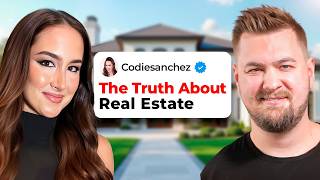
Christian Osgood argues real estate beats small businesses for wealth building, even with lower cash flow, because it builds tangible equity and requires less active management. He uses seller financing to buy multifamily properties with little money down and systematizes operations to scale to millions in net worth while his other businesses demand constant attention.
Chapters
If you want to have financial freedom and you want it to be on a semi-autopilot, real estate and all businesses are somewhat active. Humans need housing just like they need food. Be a provider of something that is an absolute necessity, that is backed by something tangible and real. I've seen an awful lot of it. There are a lot of people online, big, big names, talking about how you buy up small businesses, seller finance, build a ton of cash flow, and why this is a better investment than real estate. Now, while I do agree that small businesses have a tendency to cash flow more, and many of my businesses dollar per dollar will cash flow greater than real estate, there is a very specific reason that I continue to buy real estate right now, why I think you need to in 2025, 2026, and beyond, and why you actually expect a little bit lower cash-on-cash cash flow return from real estate. Now, right now what we're seeing is big names like Cody Sanchez or my good friend Brian Lubin We're buying up small businesses from owners who are closing up shop around the country. And there are a lot of these. Instead of closing their doors, they sell them seller financed. In fact, this same method is how I bought a vast majority of my real estate portfolio. Here is problem number one. By the way, if you're unfamiliar with this channel, I own a resort. I own a sales and marketing company. I own an education company. I own businesses. I own a property management company. I also own a whole bunch of multifamily, in fact, hundreds and hundreds of rentals. I've bought a majority and sold a few of these on seller financing. Creative finance is what makes the world go round. If you're starting out in small business, you can get in low or no money. What people have found is, hey, we really like having a really high income with as little resistance as possible. This is what a lot of people online are talking about when they're saying, hey, we don't actually like to buy real estate because we're all about the cash flow and the cash flow is key. This is the big mistake I think they're making. So while you can buy these small businesses and you're buying a revenue stream and you're typically getting a pretty good chunk of income on your terms, could be low to no money down. Oftentimes you're buying them a few hundred thousand dollars down, maybe even $0 seller financed. What you're missing out on though is the equity growth you see in real estate. See, in real estate, you buy a property for $400,000. Here's the problem they have. You buy a property for $400,000 and cash flow's like $500 a month. You spend $400,000 for like $6,000 a month or a year of income. That's not that great of a trade. And it's truly, that's not going to get you to financial freedom. Now, if you buy bigger buildings, you can resolve for this. And if you're using creative finance, you can use the same $0 to buy that building. But if you're buying a smaller property, single family, multifamily, you're just not getting a whole lot of income for a very high dollar amount. So you have to do deal after deal after deal after deal. And what they find is it's a grind. And then you have this business where you have maintenance, you have tenants. There are real problems with managing multifamily. Here's the advantage. If I buy that building for $400,000 and the tenant moves out, that building's still worth roughly, let me see, about $400,000. Now, as you get into larger multifamily, as the income goes up, as you become a better manager, your business is worth more. But you have, and the inverse is true. If people move out and your income lowers, it's worth less. The beautiful thing about real estate is it doesn't go to zero and it doesn't disappear when you're done. There's always a buyer for real estate. There's intrinsic value. You do not have that in a business. There are some businesses like a laundromat. If the laundromat stops operating, there's still underlying real estate. But if you don't own the building, the landlord has the asset. You no longer have anything. The business closed down. Now, I have friends who have made phenomenal income by buying small businesses, and today they're worth a couple million dollars. I started a bulk of my portfolio 5 years ago. I have built in a relatively short amount of time over a $5 million net worth. While our cash flows are about the same, so while I may have the larger global business, our cash flow is still the same. It was harder to build and it was more effort to build in real estate. I had more systems, more processes, but I solved for X by buying larger deals. See, what I found is that when they're buying buildings, seller finance, $0 out of pocket, If your cost out of pocket is zero and you can do the same thing on a building that you can a business because real estate is a business, you can buy them $0 out of pocket, which means we're both buying assets $0 out of pocket. Mine is backed by real estate. Theirs is not. They always have to work and be active at their job or they have to flip it and sell it to the next person. They maintain the active job. Every company that I have, and I mean every company, the resort, the property management company, they require astronomically more employees and more inputs and more management and more people and way more headache than the real estate. What I see a lot of these online gurus try to brand is like, oh, we don't have to deal with tenants and toilets and taxes and buildings and roofs and maintenance. Turns out most of that stuff is actually very easy to systematize, and there's a ton of fantastic software that's been optimized for it. It took me a few years to absolutely master that to where a lot of it is on autopilot. I get to participate in the projects that I want to participate when I want to participate in them. Otherwise, we have systems and processes just like any other business where we're able to run our business without physically being in the business. I'm not replacing toilets. I'm not replacing roofs. I'm not contacting tenants myself. I have a team that's paid very handsomely to do so. And guess what? I have financial freedom through my real estate. It only took a few years to build, and we have millions of dollars of net worth. In fact, if I ever wanted to get out of real estate, I would sell it for roughly 3 or 4 times what a lot of these people will sell their small businesses for. The other huge advantage is that real estate— do this drill, drive your market wherever you live, consciously look around the next time you're out and about driving, look at how many buildings are physically in your market. I know this is really basic, but do this. Look around and go, okay, someone owns each and every one of these buildings, and most of them probably aren't losing money on these buildings. You look at a retail center, you look at an office, you When you're looking at real estate, there is absolutely everywhere. You can't own it all, which means I don't need to diversify into one small business and another small business and learn this and learn this marketing trick over here and learn the ins and outs of a bunch of industries. Within real estate, I've found that I focused in on entry-level multifamily housing and that was my niche. There is unlimited amounts of housing that is needed in this country that is available in this country. I didn't have to branch out and learn 50,000 things. I had to get really good at one thing. It stores money fantastically. It adjusts for inflation. It increases in value over time. It rewards you for being a better operator than the last person. It does give you cash flow. You just have to accept that you're buying a little bit bigger than a lot of people think they need to start. This is the big difference between business and real estate business. I know they're both business, but there really is a different mindset behind them. The active businesses will take more of your time.. They will be more variable. They will take more stress. If you want to have financial freedom and you want it to be on a semi-autopilot— real estate and all businesses are somewhat active— but if you want to control as many variables as possible, be backed by the most stable asset possible. Humans need housing just like they need food. Be a provider of something that is an absolute necessity that is backed by something tangible and real. By buying buildings and by buying hundreds of them all over the country, I built financial freedom in just a few years. Anyone can copy it. There's nothing special about my strategy. You guys want to learn how to do it? I have a link below to a free school community. You guys can absolutely check that out. I invite you to that. I'm excited to see you guys there. This is an episode. Join that school community for free. Click the link below. Like, subscribe. I'll see you on the next episode.