Michelle Hammons, Certified High Performance Coach TM
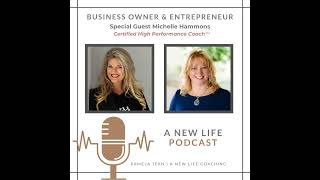
Podcast episode of "A New Life" (host Pamela Jean) featuring guest Michelle Hammons. The two reconnect over a decades-old photography relationship and discuss Michelle's transition from a successful wedding/portrait photography career into certified high-performance coaching. Key themes so far: legacy and heirloom portraits, the idea that relationships are purposeful, belief-as-decision, high-performance mindset, desire for freedom/laptop lifestyle, and the creative-entrepreneur challenge of focus versus many interests.
Chapters
Welcome to A New Life podcast with Pamela Jean, where it's all about empowering women to empower more women. Get ready, friends, to create a new life. And here is your host, Pamela Jean.
Hello, my friends, and welcome to this week's episode of A New Life podcast. I am your host, Pamela Jean. Thank you so much for being here. I know your time is so, so very valuable and I appreciate you spending some of your valuable time listening to this podcast today. This podcast is not going to disappoint. I'm so excited for this interview. As I was doing some interview prep for my guest today. I'm just so excited. We're going to work really hard to keep it to 45 minutes and it is going to be a challenge because there's so much goodness in this conversation that we're going to have before we get started. If you would please like and subscribe to this podcast, Apple, Spotify, wherever you get your podcast and also invite your friends. Your friends need this as well. Invite your friends, invite your family, Please share this podcast so others can be inspired as well. Now, my guest today, her name is Michelle Hammonds. I had the honor of meeting Michelle for the first time 15, 16, something like that years ago. I never would have guessed 15, 16 years ago that she would be in my life again today in such a very, very cool, powerful way. I'll let Michelle tell us that story. So, Michelle Hammons, welcome to the podcast. I'm so glad you're here, Pamela.
Thank you so much. I'm so looking forward to our conversation today. And I just appreciate that as you were reflecting on our journey there been a while since we've known each other. And you never know when someone enters your life, the power of who they are and the relationship and what it holds for a lifetime. And so thank you for that reminder of how, how our, how we got started together.
Well, I know, it's just so funny because I think that, you know, I know that you're a spiritual person as well, and I think God puts people in your life on purpose, obviously, and you just never know the role that they're going to play. So the first time I met you, Michelle, was probably 16 years ago. And we were both, you and I, both were in the portrait industry full time. That was our career. That was our primary business. And you had reached out asking for me to photograph your grandmother. And photographing elderly is one of my favorite, favorite subject matters. It always has been, still kind of is. I really enjoy. I just think there's so much wisdom and Detail, there's so much intricacy with them. But you. You called and asked me that, but we weren't going to capture the traditional old picture of an elderly person like the church directory. We were going for something different. So tell us about that.
Yeah, so I remember thinking, you know, as you mentioned, we were both in the photography industry at that time, and I knew this wasn't an assignment I wanted to take on myself. I wanted to be in the experience with her while we were working through it. And the reason why that was important to me is because 20 years earlier, or maybe 15 from that. That point in time, my mom became sick. And we didn't really ever get to have that family portrait or that portrait of us together where she was really feeling good and at her best. So this, this to me, was a very important purpose, purposeful portrait that I wanted to have made so I would have this beautiful image to reflect back on her. And my grandmother, you know, she was one of a kind. She was a high performer. She was. She lived to be an amazing age of. And I wanted to capture the essence of who she was. And she loved to sow seeds in her life, seeds with her friends, seeds in the garden, seeds of hope. And so this garden metaphor was really what I wanted to bring to life. And I remember calling you and knowing what a distinguished photographer you were and saying, is it okay if I bring some dirt and some live plants and can we just play in the dirt and photograph my grandmother and just see what develops? Right. To be in the moment with her. And you were like, let's do it. And so I. It was in. Those pictures are still such a joy today, which is how we got reconnected. I had some gardeners, and I was talking about my grandmother being a gardener, and they said their friend Pamela was a gardener. And we got reconnected that way. So again, these seeds, you never know where they're going to travel with you in life.
That. Oh, my gosh, that is so true. And you know what was funny is I don't think you knew that about me when you came to me with the idea of photographing your grandmother in her element, but brought to the studio, and I'll never forget, she had this beautiful lime green outfit on, a big brim hat. I mean, she was just a pic out of a magazine. She was just such a beautiful lady. But I am a major dirt nerd. I love throwing dirt. I love gardening, I love planning, I love flowers. So it was right up my alley to create that for you in Such a beautiful way. And, you know, the funny thing is it's been so many years ago since we captured that image. And I can close my eyes and still remember every detail of that photo shoot. I remember your grandmother worried about, don't waste that dirt. That's good dirt. That's really good dirt. I mean, she was concerned about every single little tiny speck of dirt that was on the platform that we were working on. She was just so beautiful about that. And it was an honor, truly, Michelle, to be able to create that heirloom for you and create that legacy.
Yeah. And it is truly an heirloom and legacy. And I thank you for that because, you know, we never know. These portraits that we take of people, they're priceless. Right. And stealing with the outer beauty. You and I both have done thousands of clicking of the shutter where we're capturing the beauty, the outer beauty of who somebody is, the essence, their soul, and bringing them to life in a beautiful way. And you know, today what, what we are working in, which is ironic that we're both doing the same thing again, this is where like minded people get together is, you know, being an entrepreneur as a coach.
Yes. Oh, my gosh. I just gotta jump in, if you don't mind. My gosh. Fast forward. So you have some gardeners come and help you at your home to replace some plants and do some landscaping for you. One of those gardeners happens to be a mutual friend of mine as well. You guys get to talking, she tells you that, yeah, she's a coach now. And you're like, oh my gosh, I'm a coach now. And that's how you and I reconnect. That blows my mind that 16 years ago we were both in the grind of photography and now we both have made a beautiful transition into coaching, which is still nurturing and caring for people, but just in a different way.
Absolutely. Yes. And it's just as exciting in different ways.
Absolutely. I couldn't agree more. So, Michelle, I want to talk a little bit. I want to dig a little bit more into you. That was just kind of a long story of how we've been connected. But I guess I wanted to share that with the audience because I want you to think about, about everybody you meet. Whether it's today or 10 years ago or 15 years ago, everyone you meet has a role in your life. And that meeting is not an accident. You never know where you're going to cross paths in your future that are really purposeful. Because I'm grateful for my connection with you, Michelle, we are both now in the coaching industry. Life coaching, business coaching. For me, you are coaching in a little bit of a different direction still the same type of industry, but a little different focus than mine. But the knowledge and information that we can share with each other is so. It's just phenomenal and I'm so grateful for you. But I want to dig into your coaching. Like what drives you to coach upper level executives and high performers and what motivates you to do what you're doing today.
Sure. So thank you for that question. And what motivates me is really just helping people succeed. Right. When we strip everything away, we do in our lives. I've had the luxury of spending a lot of time talking about legacy and my own family and with other people. And it's never about all of our accolades. It's about the relationships and the connection. And really coaching is about, it's a process. Right. An outcome driven process where we help people become more than who they think they can come. Sometimes it's beliefs we deal with. I happen to be in high performance coaching and that really drives me because I've always been a high performer in whatever I've put my hand to in my life. From the time I was a really young child all the way through today. I always like to, to find the highest level of whatever that thing is. Whether it's where I'm traveling, where I'm going to be serving and helping people from a volunteer perspective, whether it's the, the things and activities that drive me, I always want to be looking at it from that I can be the best and I want to become the best angle. So that's one of the reasons that's, that drives me to work with high performing leaders, leaders of leaders, high performing artists, multidisciplinary people that like to do different things. Sometimes what I, what I know about leaders in that capacity is they get bored, they get restless, they want to be working on more than one thing and they have big goals and dreams. So at that level, it's not about the struggles are different because the struggles are how are we going to go even further and expand more. There's already usually a lot of success built, but there's still we all have things we can improve on in that process. So that's part of what drives me and motivates me to work with such amazing leaders.
That's awesome. Now I have a question for you. You started out this conversation with a I can do anything mindset. I can do any attitude. Where does that come from. Is that. Has that been learned over the years, or is there someone in your life that has inspired you or driven that into you, that Michelle, there's nothing you can't do.
Yeah. So I think when I see where. I see people struggle in this, and there's a lot of struggle in this area of what you're talking about. For me personally, how this lays down is one. I never really was given the option in my life to think about failure as an option. Like, it wasn't always a high drive for success, but it was always like, it's possible. Like there was never a limit on possibility is how I would best describe it. And I think today, and I actually just wrote about this this week, I said, when your necessity is high enough, you won't get stuck in doubt or delay because you won't have that luxury.
That's so good. That's so wise, you know, And I think I can attribute my. I started my first business 34 years ago. I attribute the success to my photography studio to. I didn't have an option. Failure was not an option. I had bills and. And responsibilities. I didn't have a safety net financially. No one else was helping me. It was up to me. And I think that just really stemmed from, you know what, this has to work, and there is no option for it not to work.
And I.
And for me personally, you know, my. There. My father was a person who. Very hard worker, but there wasn't anything that I don't think he didn't think I could do. You know, he taught me to change the oil in the car, how to change a tire, you know, pop the hood, all of those things, because. Just because I was a girl didn't mean I couldn't do things. And. And I think just growing up with that mindset of my father and my mother was a very hard worker as well, that I there. I just have never felt like there's something that I could not do.
Mm. Yeah. So I would say that it just comes from this, like, limitless belief. Right. And I've always believed from a faith perspective that things are possible. I mean, that's where it's rooted. Right. Everything's possible when we're. When we can believe. Right. But then it's just like without those limiters, then it's like the highway is pretty open. You know, there's no. There's no. There's no one. You might pass by a few things that might try to trip you up, but you can keep going.
Right? So if there's a listener right now who is just really, really stuck in that limited belief. Stuck in that there's no way I could start this business. There's no way I could quit this job. There's no way I could do. Fill in the blank. What advice would you have for them? Where do they start?
Yeah. So this is another life lesson I was reflecting on this week and it's that belief is a decision. And every. When I go back and look at all the success points in my life which have been pretty amazing in my journey, and all of those little demarcation or mile markers reflect a belief. And I just simply decided I was going to believe that whatever I was trying to attempt was what I was going to do. Whether it was a salary increase, whether it was a change in career, whether it was developing travel somewhere, whatever the goal was. The biggest element to create the success is to decide it, but more importantly to believe that it's possible. And once you make up your mind to believe it, then it can make anything possible.
That's such, such great advice. So tell us, tell the audience, Michelle, about your, your career journey. Because when I first met you, you were one of the most sought after wedding photographers in the state of Oklahoma, for sure. And then you left the portrait industry. Where did you go from there?
So it was a transition that was related to another life change. So I knew I, so I got remarried and I wanted to have a laptop lifestyle and so I was searching. So I've had two tracks in my life. There's always been the creative track and then there's been the tech. Tech track. Right. The science part. I always say I'm a blend of art and science.
And that is, and anyone listening, that is 1,000% true.
Like, I can't do just one. I have to do both. That's the multidisciplinary part. And so alongside opening my photography business and when I decided to close it 15 years later, I knew I wanted to transition into something else. But I also knew that the emotional part about that work was really important. And someone introduced me to coaching. And so I started exploring coaching because I hadn't really, I mean, I knew what a coach was from like a, you know, I had a cheerleading coach, I had a gymnastics coach. And we have all those coaches when we're kids, but like we should have this term coaches for adults. Right. Because we all need one. And when I really got introduced to someone who's a major influencer, that really showed me some very simplistic ways of managing high performance. I was like, that's it. I can attribute all my success to those particular concepts. And so I was like, I mean, this is what I'm going to do. And so I primarily work in high performance coaching today. But that was the transition, it was really getting remarried where I closed one chapter in my photography business and I opened a new chapter in the coaching.
Well, that's awesome. And, and I what I think was a bigger shock when that happened just in the industry because our industry is pretty a tight knit group, the photography world. Michelle, your business was thriving. You didn't leave your business because it wasn't thriving. That's what's so remarkable is that you had this viable, amazing, very successful wedding business and then you like shut the door and walked away. It was like, what is going on? You know, normally people would stop the photography studio when they weren't. Weren't successful, but you left on a high and I think that's really admirable.
Yeah. And I reflect on that as like a pivot point. Right. Sometimes we have to be comfortable pivoting and because there was something greater that I wanted, which was more freedom, more flexibility, more time. That's what most high performers want, is more of something.
Right.
I wanted all those things and I was like, if I keep doing what I'm doing, even though I love it and even today it's still a passion of mine, I knew I wanted the freedom because photography in particular, not only do you create your own product, but you also have to have a. Well, not through zoom, but in a traditional way. You have to be connected face to face. And I knew I wanted the freedom to travel to different places, different countries, different cultures. And I didn't want to be tied to a business that required that face to face interaction. And coaching allowed me to do that.
That's awesome. So what would you say is your biggest business struggle?
Yeah, so this one is a one that I think is common. We all struggle with this and it's when we decide to be in business for ourselves. It has the greatest freedom and flexibility that you could ever decide. You have to be really courageous to decide to be a business owner. But the thing that can trip us up, and it trips me up too, is we have so many things that we want to focus on and what we have to really get very tight on is that focus. And it's very good photography metaphor. Right. The focal point, what we're going to frame up and focus and we have to really know what to let fall to the wayside. And sometimes that can Be a struggle, because when you are creative, and I have a lot of creative ideas and I love to play, you know, all the different things I love to do, I have to limit my exposure to some of those things. And sometimes that's a struggle because it sounds like this, I love this, I love that, but I love this even more. And it's just this micro difference between those levels that it makes it hard to decide. The forks in the road are always good. There's like, not a, this is a bad way, and this is a good way. It's like, oh, it could be this, it could be better, and it could be the best way, or it could be even here, even better. And we have this kind of. These choices that can be hard to choose because they're all interesting and exciting and they all could lead us down different paths. So I think that's the struggle is really knowing sometimes where to focus and having to really get finite about that.
Right. And I totally understand that because as a creative person and an entrepreneur, there's just something different about that person. Where we're visionaries and we're constantly visualizing the next thing that we could do and the next thing that seems really fun. And I think where we sometimes can get off track is really crossing the finish line and finishing what we start. Because, oh, I could go do this, I could do this. Oh, and I love that I. When you say that, I completely see that because that's what happens in my brain as well. I'm really good at coming up with new concepts and new ideas, new business plans, new business ideas, marketing strategies. Really good at that. And sometimes it's kind of like the squirrel metaphor. Squirrel. And then you're onto the next thing because you've gotten distracted by another shiny object.
Yeah. And in the high performance life, those shiny objects can still be very viable, great things. They're not just distractions. They can be good distractions. So it's. It really does have that finite measurement of what to focus on.
That's so good. Can you think of a time, Michelle, that you held yourself back, that you got in your way? I know that you are one of those people that are so driven and, and rarely miss.
More from Pamela
Great Things Happen When You Forgive_An Interview With Lisa Bain | A New Life Podcast with...