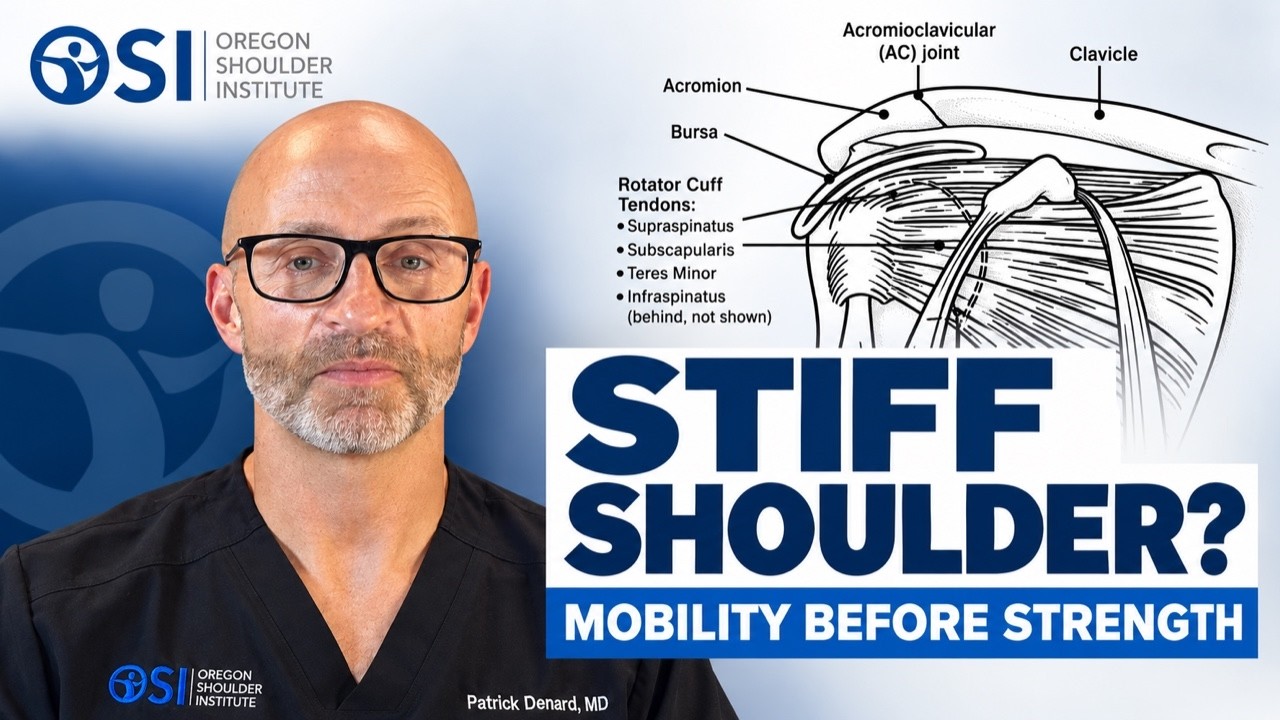
In this single‑speaker presentation Dr. Patrick Denard, a shoulder specialist with over 10,000 surgeries and 300 publications, explains what platelet‑rich plasma (PRP) is, how it is prepared, and where it fits in the treatment of rotator cuff pathology. He describes PRP as an autologous blood product obtained by centrifuging about 15 mL of the patient’s blood to isolate a platelet‑rich layer that is then injected back into the shoulder. The procedure is off‑label for most indications, not covered by insurance, and typically costs $500–several thousand dollars. Denard reviews the evidence: • For partial‑thickness tears and tendinopathy, PRP provides modest pain relief that is more sustained than corticosteroid injections, though onset is slower (weeks‑months). Head‑to‑head studies show PRP outperforming steroids at 3 months and up to 1 year, but the benefit may stem from steroids’ catabolic effects rather than a true PRP advantage. • For full‑thickness tears managed non‑operatively, there is no data supporting healing; PRP may offer limited pain relief but does not replace surgical repair. Delaying definitive treatment risks muscle atrophy and irreversible damage. • As an adjunct to rotator cuff repair, meta‑analyses report a relative 58 % reduction in re‑tear rates, though absolute benefit depends on baseline risk (e.g., a 20 % re‑tear risk drops to ~10 %). Functional improvements (Constant score +2.3 points) and pain reductions (0.2/10) are statistically measurable but clinically modest. He cautions against marketing hype that promises cuff healing, emphasizes the importance of accurate tear classification via MRI, and advises patients to discuss tear size, retraction, and progression with a knowledgeable surgeon. He also notes the placebo effect of injections and the limited downside of PRP compared with repeated steroid shots (which should be limited to ≤2 per year). Finally, Denard states that, for his own surgery, he would always use PRP as a low‑cost adjunct to maximize healing potential. Key take‑aways: PRP is not a magic cure; it can be useful for pain relief in partial tears and as a modest adjunct in surgical repair, but it should not be used as sole therapy for full‑thickness tears. Informed decision‑making requires MRI confirmation, understanding of tear severity, cost considerations, and realistic expectations of benefit.
Chapters
So PRP, or platelet-rich plasma, is everywhere right now. And if you have a rotator cuff tear or been told you have a rotator cuff tear, you probably have been told that PRP may help. But what does the research show? I'm going to give you the straightforward answer, no sales pitch. I'm Dr. Patrick Denard. I'm a shoulder specialist. I've spent my career focusing on just the shoulder. I've done over 10,000 surgeries and published 300 publications. And my primary goal here is to give you the straight facts about platelet-rich plasma, which I use in my practice routinely, but it has a specific place where it should be used appropriately. So let's talk about platelet-rich plasma in general. What is it? Simply stated, this is where you take blood from your own body. You withdraw about 3 tablespoons of blood or 15 mL. That blood is then centrifuged, so it's spun down, and that spinning process leads to separation of the cell layers. And then what you can do with that is you can take the platelet-rich plasma layer and then inject it back in. And that has some anti-inflammatory properties. Now, actually, technically speaking, this is an off-label procedure in most cases because it really technically has to be mixed with bone to be on-label, although it's a widespread use because once you have one indication, people of course use it for many other indications. Now, PRP, as I'm going to show you, has some evidence in some particular areas, but currently it's not covered by insurance. So typically you're going to see an out-of-pocket expense anywhere from $500 on a very low range to several thousand dollars depending on Who you go to and where you live. So let's kind of get into some of the evidence of what the research actually shows. So I've seen patients spend $3,000 on platelet-rich plasma for a tear that needed surgery 6 months ago, and that window doesn't wait. So it's really important to know exactly what your tear is and if you're actually going to get a benefit. The bottom line is that the data shows that for partial tears, for non-surgical treatment, You can get some benefit. This is a pain-relieving benefit, not a healing benefit. Post-augmentation, that's using it after rotator cuff tear. There's also a role there. So when you do a repair, there's data that says if you take platelet-rich plasma and inject it back into the surgical repair site, you can get some improvement in tendon healing. I'll go over that data with you. But if you're talking about non-surgical treatment of a full-thickness rotator cuff tear, there's not data that says this is going to be effective. And particularly where people get misled is they are sold into the idea that they're going to have healing of a rotator Cuff tear. The only way to get healing is to actually repair the tendon back down to the bone. Now, you can sometimes get some pain benefits, but you're not going to actually get healing of the rotator cuff tears. So partial tears first. Now, actually, I was slow to adopt this, but the data now shows that PRP can have some benefit. Here's a study here, for instance, referencing showing that partial thickness rotator cuff tears or those with tendinopathy actually had some benefit. What are partial rotator cuff tears? Those are tears that are less than 50%. Of the tendon. Tendinopathy is another way to essentially say that there's breakdown within the tendon that occurs with age. This study in particular looked at people who have failed physical therapy, and essentially they found that pain relief was actually better than steroid at 3 months. And when you got out to a year, it was much better than steroid. Now the question there is, is it that PRP is really providing a benefit, or in this case, is it just less detrimental than steroid because steroid is very effective in relieving pain, but it also has a catabolic effect where it breaks down tissue. We don't know the answer to that for sure, to be quite honest. But what we do know is head-to-head, if you compare steroid and PRP for partial rotator cuff tears, you get a more sustained effect with PRP in terms of pain relief. Now, one caveat to that that people should be aware of is that the pain relief is slower in onset. So if somebody has a steroid injection, I will typically tell them they should see relief in the matter of days to weeks. PRP can be a couple of months. You're on the order of weeks to months that occur. So, some of this decision-making can depend on the individual situation. Somebody's really having a really hard time sleeping, they're going to go on a trip coming up, they may want to use a steroid on a case-by-case basis. In fact, that's the most common injection used. If they have more time to work with this, PRP may be something that somebody would select. Steroid, definitely you don't want to use it over and over again. I think that's another thing to highlight is that PRP, there's probably not the downside there is with steroids. So be cautious about the number of steroid injections you have. Some data shows no more than 2 in the year prior to a rotator cuff repair, just to give you some idea there. Now, full thickness rotator cuff tears, extreme caution. So full thickness rotator cuff tears, if it's retracted, you're wasting your time. Basically what you're going to do there is the tear is going to be pulled back. There's no healing that's going to occur. Okay, you might get some pain relief, but really it's therapy and surgery depending on the type of rotator cuff tear somebody has. The downside to doing PRP is that if you wait, muscle atrophy will progress, right? And you'll have cost without benefit. In other words, if it's a potential that you can have healing and prevent the tear from going on to get larger and developing atrophy, which is irreversible, you want to avoid that. So, I'm not necessarily completely opposed if somebody knows that they're going to treat their tear conservatively and they're just looking for another source of pain relief. But what I'm completely against is the idea of somebody being sold that PRP is going to heal their rotator cuff, which it is not. So, if you're a young individual with a full thickness rotator cuff tear, you should really have an informed discussion with your surgeon about what is the best option in your case and don't be misled by people who will tell you that PRP is going to heal your rotator cuff. So now the summary here is that PRP for rotator cuff tear isn't magic, but it also isn't useless. The problem is nobody's telling you what category you're in. And why does this keep happening? Well, there's marketing that outpaces evidence for people. There's a big incentive here because it is a cash pay item, and there are clinics out there that are just trying to make a lot of money off of PRP rather than using it in an evidence-based manner. The other thing I will tell you is that anytime you have any injection, placebo effect is There are multiple studies on the placebo effect, so you can see somebody have it for the wrong indication or wrong reason and yet get relief as a result of placebo. And I think one of the problems too is that tear severity is underestimated. That is, many providers will go off of a report alone. They really don't know what they're dealing with. They're really just trying to manage the pain for the patient, but not really thinking about the overall implications or understanding the exact path. Now, I mentioned full thickness rotator cuff tears and repair. Now, in the repair setting, there is actually pretty good evidence that if you add PRP to the repair setting, you can get improvement in healing. These effects are not dramatic. If you actually look at the reduction in retear based on large systematic review or meta-analysis, that reduction in retear rate is 58%. That sounds really, really large. But it depends on your overall risk of retear. If your overall risk of retear is 20%, you're going to bring it down to 10% approximately. If you have a very small tear that has perhaps a 10% chance of not healing, you're only talking about a 5% reduction. So always pay attention to what's called the absolute risk and not just look at the relative risk. Now, if you look at this study and look at the functional outcome differences, constant scores, that's a 0 to 100 score. A 2.3-point difference is a very small amount with the addition of PRP. People also talk about reduction of pain if you inject it at the time of the rotator cuff repair, and that difference is also very small, 0.2 on a 0 to 10 scale. So they are measurable differences that appear, but they are not perhaps of the largest clinical significance. Now, I do think that healing data is really important, and although I underplayed the overall effect, I can confidently say if it's my shoulder and I'm having my rotator cuff repair, There's a 100% chance I'm going to do PRP at the least because I want to add everything I can to improve my chances of healing. And when you overall look at the relative cost here of something, when you're talking about the function of your shoulder, I think that it's actually quite small if you're talking about a few hundred dollars in the setting of something that's going to potentially impact your life for a very long time. So again, here, what it really comes down to is your MRI. If you have a partial rotator cuff tear, you may be a candidate to use this on a conservative basis. If the partial tear is a bit larger, it may or may not be a discussion of surgery. I absolutely would not use it for solo treatment of full thickness rotator cuff tears unless it's the very rare case where somebody understands, hey, pain relief only. Again, clarifying, not leading to healing. I think there's good evidence to use it as a surgical adjunct in the setting of a rotator cuff repair. And what we do there is somebody has their procedure done. While their procedure's being done, we draw blood, spin it down in the centrifuge, and inject it back at the tendon-bone interface. And you're essentially trying to provide cells there to give some signal to encourage healing. Now, so the honest answer, it depends particularly on your tear type. Anyone who tells you otherwise is not reading your MRI. So your next step, if— don't guess, know what you're getting into, get an MRI, make sure you see somebody who really understands your rotator cuff tear, and ask key questions. What are my tear size? Do I have retraction already? Is this something that's going to go on and progress? If you understand the questions to ask and you see somebody who's well-informed, then you can make an informed decision and choose what is best for you.