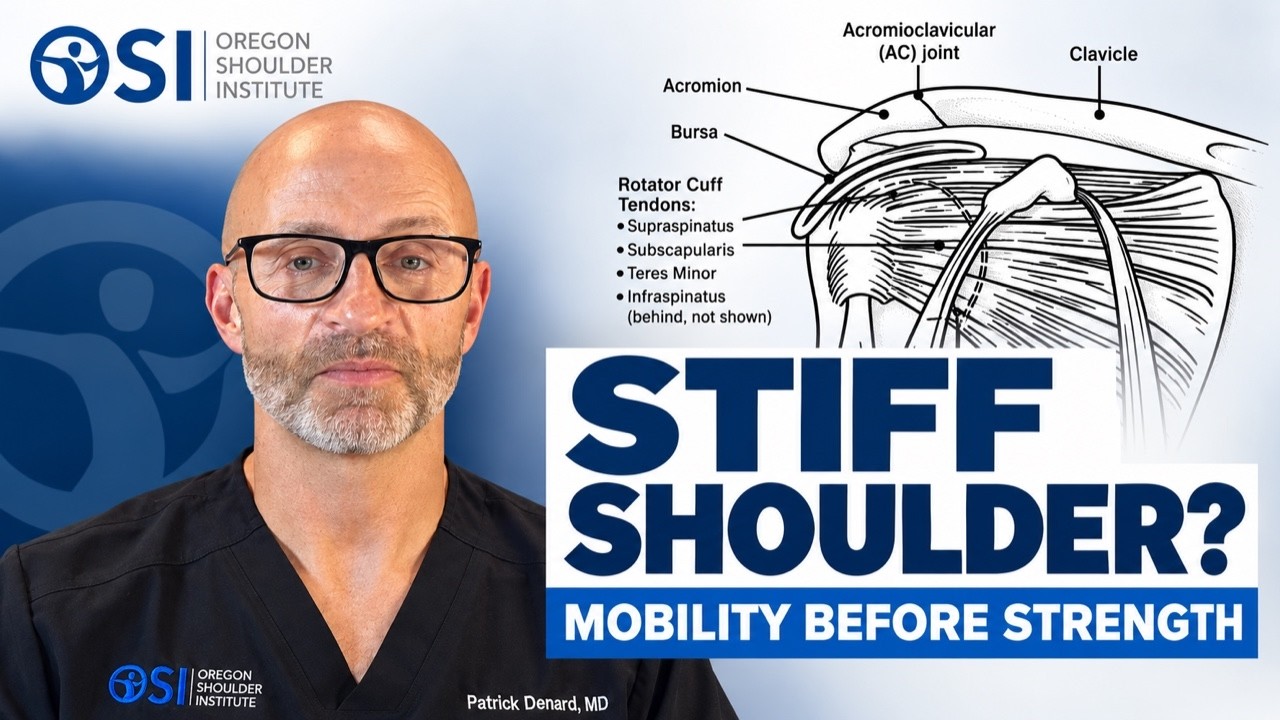
Dr. Patrick Denard, a shoulder surgeon with 15 years of experience, walks through five mobility exercises to do before strengthening a stiff shoulder. The routine includes the Table Slide, Supine Active-Assist Elevation, Supine Passive External Rotation, Doorframe Stretch, and Cross-Body Stretch, each done in sets of ten reps with ten-second holds. Mobility comes first, strengthening second.
Chapters
I'm Dr. Patrick Denard. I'm a shoulder surgeon, which is 100% of my practice. I've been doing that for 15 years. I've done over 10,000 shoulder surgeries, and here I'm going to talk about early mobility exercises. Early mobility is the foundation to any shoulder recovery, whether it's conservative or after surgery. Each of the exercises you want to do in sets of 10, and I recommend you hold each stretch for approximately 10 seconds. Once you've achieved complete mobility, you can then progress up to other phases that begin strengthening and work your way up.
For the table slide, you're working on forward elevation. You want to be in a seated position. Start with the arm comfortably in front of you. Here I'm demonstrating the right side. I'm going to place the opposite hand on top of the right arm, and I'm simply going to move forward. I'll use that left hand to push the right arm forward. I want to go down to where I feel a stretch and hold it there for about 10 seconds. And you can progressively work up so you can get even further and further away. If you get to the point where you're getting all the way to the end, you can kind of lean forward a bit more, scoot back on the chair, that'll give you a little bit more flex. But the idea is to be closed chain working on forward elevation. For supine active assist elevation, we're again working on forward elevation. It's a little bit of an advancement up from the table slide. You simply want to lay down on your back. I'm going to use the opposite arm to take my right arm forward. Again, I'm going to go to where I feel the stretch and just kind of hold it in that location. This places a bit more stress on the shoulder than a table slide, but it's still doing passive range of motion because you're using the opposite arm to take your hand overhead. So for supine, or laying down, passive external rotation, we want to take a stick in the opposite arm. Here I'm again demonstrating my right arm. I want my right elbow directly at the side. We don't want to come out. We want that elbow tucked in against the side or chest wall. I'm going to place a stick or anything you have in your opposite hand, and I'm simply going to push out to the side. I'll go to where I feel the stretch and hold for 10 seconds. I'll go back, and then we can go and repeat. The doorframe stretch is one of my favorite stretches for the shoulder in general. It's really good for stretching the front part of the shoulder Countering that pec minor that gets tight, especially as we tend to hunch our shoulders forward. You want to take your wrist and your elbow and place it against a solid surface such as a door frame. Here I'm demonstrating against a bar. I want to line those up. I have the arm up at about 90 degrees of abduction, and I just simply turn away to the opposite side. I'll feel the stretch in the front part of the shoulder. It's also an option to move the arm into some different positions. I can slightly raise to get a little bit different feeling of stretch, or I can slightly lower to therefore get another slightly different location of the stretch. The cross-body stretch, we're working on the posterior or back of the shoulder for stretching. I want to take the arm straight in front of me. I'm going to use the opposite arm to pull across. So I'll take my forearm here, I'm going to pull against the forearm. I'm feeling the stretch in the back of the shoulder. As you do this, it's also helpful to set the shoulder blade. So I don't want to simply just pull across and move my arm over. I want to set my shoulder blade back and pull across. That really helps emphasize stretching the posterior capsule in particular.