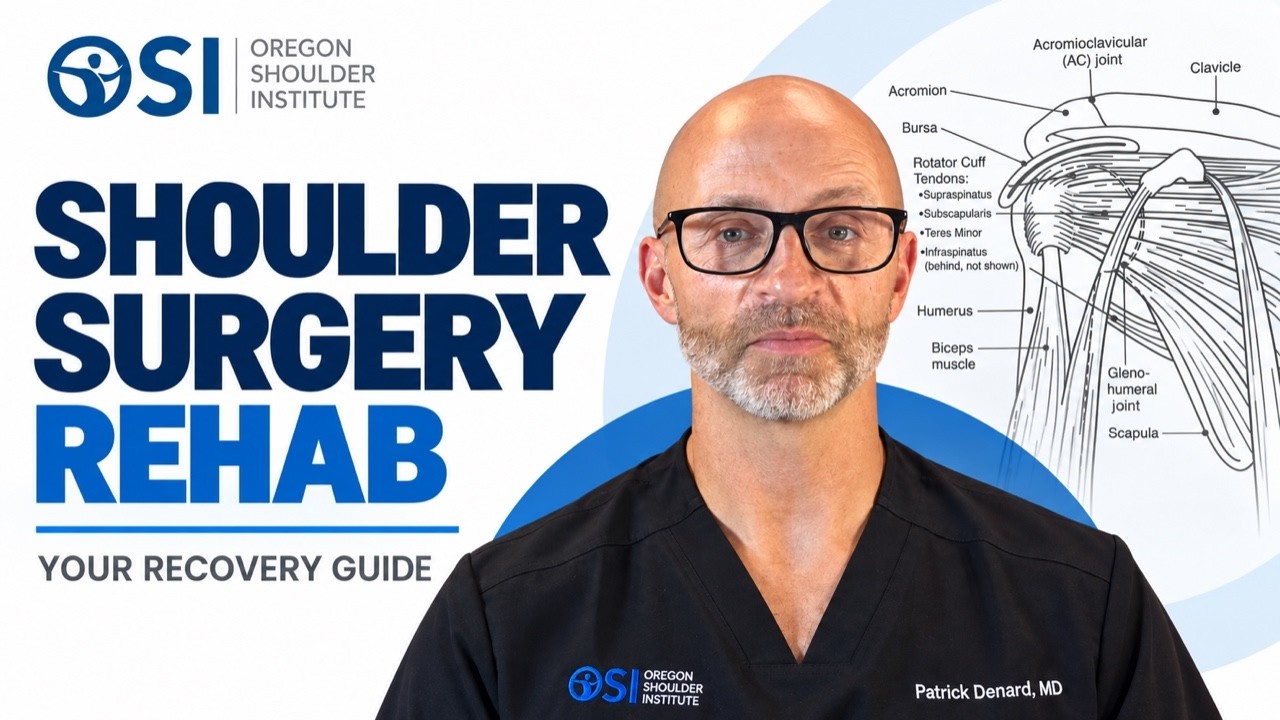
A surgeon explains post-operative shoulder rehab after rotator cuff repair. Tendon healing takes 8-12 weeks, but controlled isometric loading starting the day after surgery promotes healing better than prolonged immobilization. Rehab progresses through swelling reduction, range-of-motion work, strengthening, and return to activity, with plans tailored to tear size and surgical approach.
Chapters
So I wanna share a little bit about my philosophy of rehabilitation after rotator cuff repair or any shoulder surgery for that matter. Now, historically, I was very conservative with rotator cuff repair in particular because tendon healing, it's important to know, takes about 8 to 12 weeks based on primate studies. And the tendon continues to remodel out to 6 months. So for larger tears, we've historically been very conservative putting those patients in a sling for 6 weeks but for smaller tears, letting them move a little bit earlier and shortening the sling time down to 4 weeks. And that has to do with the risk of retear or failure of healing being higher in large tears compared to those in small tears, feeling like we could move small tears earlier. However, there is increasing data that shows that early isometric exercises are important. So I'm not a big advocate of doing a lot of aggressive range of motion overhead right out of the gate, but early isometric exercises have been shown to benefit tendon healing. And that's applying an early controlled load through the tendon that begins the day after surgery. So I like to break down rotator cuff healing or shoulder rehab in general into phases. So initially we're gonna work on decreasing swelling, improving early mobility as much as we can, and adding isometric exercises. What do I mean by that? Well, our basic exercises consist of hand, elbow, and wrist range of motion, moving your scapula. This is overall beneficial. Doing early walking is beneficial as well. Secondly, controlled range of motion to the extent we feel is safe based on the repair or the type of surgery that was performed. And then third, adding isometric exercises early for the benefits on tendon healing and progression. After we move through that phase, depending on the timeline, I then like to move into range of motion progression. That'll be when somebody comes out of the sling and is typically at that time working with a physical therapist. Next, we move into strengthening, again, based on the science, deciding when that is safe with a particular repair. And then finally, progression into return to normal activities and sporting activities. That occurs later. Now, the earlier you're doing motion and those isometric exercises, you can actually possibly have a higher or quicker return to those later phases. So, if we could do some early stuff, we can help move people through and get back to their activities sooner. Importantly, taking into consideration individual patient and the tear pattern or surgery so that we can help guide them of how to get there in the end. Because what we want to do is is get somebody back to sport and life as quick as possible. But we also want to do that in a safe manner because if we have lack of healing, that's a failure. It's easier to overcome stiffness in general because we can typically correct that if needed by going back and doing a release of adhesions if in the rare case it is necessary. And, and most of the time, if we're doing early range of motion, stiffness is not a long-term problem that limits us. We're really more worried about the failure of healing. So hopefully that helps you understand how I think about rehab from the shoulder, kind of progressing from the beginning phases of early mobility in a safe, controlled manner with isometric exercises, adding overall exercise, and then progressing from range of motion to strengthening to return to general activities and sporting activities.