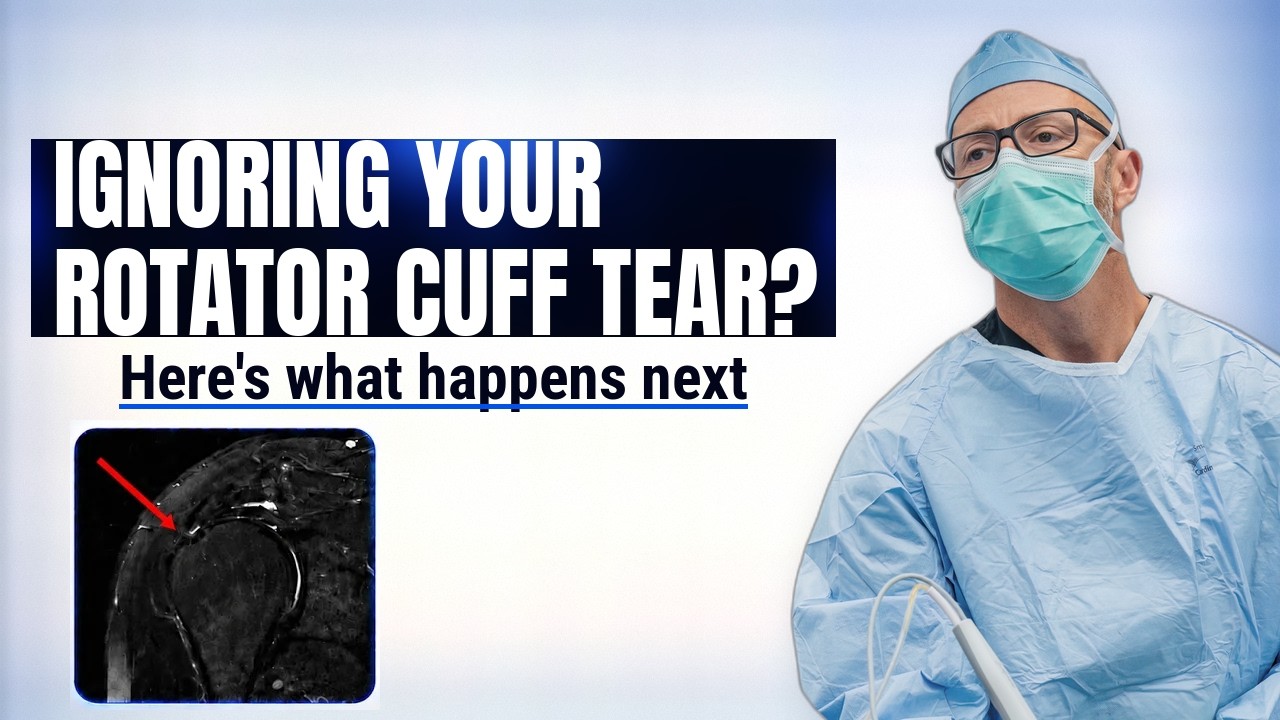
In this video Dr. Patrick Denard, a shoulder specialist with 15+ years of experience, explains what occurs to a rotator cuff tear when it is managed conservatively versus surgically. He cites systematic reviews showing that about 50% of degenerative tears enlarge over three years, and emphasizes that progression is gradual, typically over months to years. He introduces the Rotator Cuff Healing Index (ROHI), a scoring system based on age, tear size, retraction, and fatty infiltration that predicts healing likelihood (e.g., 5 points → ~70% chance, 8 points → ~25%). Fatty infiltration is assessed on a 0‑4 T1 sagittal scale and is irreversible, influencing repairability and re‑tear risk. Denard stresses tear location, especially involvement of the anterior cable, which behaves like a critical support beam in a suspension bridge and carries a higher risk of rapid progression compared with central‑cuff tears. He outlines clinical decision guidelines: patients <60 years with full‑thickness tears are generally advised to have repair; those >70 years are usually started on physical therapy and injections, with the decision individualized based on activity level and tear characteristics. A detailed patient case illustrates a small anterior‑cable tear that, after years of repeated injections, progressed to a large tear with fatty infiltration, necessitating a double‑row repair with dermal allograft augmentation and a longer rehabilitation timeline. The outcome was excellent, but the case underscores how delayed surgery can increase complexity and cost. Denard concludes with practical advice—consider early repair for younger patients with full‑thickness tears, use conservative care for older or partial‑tear patients, and offers MRI review services to help patients understand their specific tear and make informed choices.
Chapters
So you have a rotator cuff tear and you decide not to have surgery. Maybe got a little bit better. The pain started to recede. Your strength even came back. But what's happening inside your shoulder? In this video, I'm going to walk through what happens to a rotator cuff over time, that is, over the months and years, and how tear location and understanding your tear help you make an informed decision. I'm Dr. Patrick Denard, shoulder specialist. I've been in practice for over 15 years. I spend 100% of my time doing just the shoulder in my research and in my clinical practice. So let's first off acknowledge that there's many treatment options for rotator cuff tears. You can treat with injection and physical therapy, and the success is very high of that. But then on the other case, there is rotator cuff repair, which actually heals the rotator cuff. Now, many people can do well with conservative treatment. I've talked about that previously, but it's important to understand what's actually happening over time because ignoring a rotator cuff tear doesn't mean nothing is happening. It means something is typically happening slowly. So do tears get bigger over time? Systematic review shows tears progress over a year's period. So specifically, a number I like to quote to my patients is that about 50% of tears progress over a 3-year period, and that's based on series of several thousand patients which shows that data. That means that it's not going to change over a couple of days, over a couple of weeks, but practically what it means for me is that if somebody decides to treat a rotator cuff tear conservatively, which is obviously their choice and right, if they come back to me and are interested in surgery at a later period, If it's been more than 6 months, but definitely more than 12 months, I will order a repeat MRI to see if there has been change. Also, if somebody says, hey, I want to have my rotator cuff repaired, but I'm not quite ready, how critical or how important is it I do this in a matter of weeks? And in most cases, if we're talking about degenerative rotator cuff tear, not a traumatic rotator cuff tear, but a degenerative rotator cuff tear, there is no urgency. Typically, if somebody has it addressed in 3 to 6 months, that's going to be quite safe for their particular case. Now, a small tear can become bigger over time and it can become irreparable over the years. The muscle is what changes, not just the size of the rotator cuff. So one of the things that I like to use is what's called a Rotator Cuff Healing Index, also called a ROHI score. This was based on a study out of Korea. They took 600 patients. About 25% of those rotator cuff tears did not heal, but they broke down factors that occurred that led to a higher risk of failure. Those were things like age, tear size, retraction, and also importantly, the fatty infiltration or atrophy of the rotator cuff. And it's important to know that that is not reversible in the setting of a rotator cuff tear. The reason I think it's important or valuable to understand this scoring system is that if you start stacking factors on top of each other, the likelihood of healing goes down. So if you have a small tear in a younger individual, healing rate is very high. But as the tear enlarges, as fatty infiltration goes up, the risk of getting retear or failure of healing, if you choose to proceed with rotator cuff repair, can become quite high. So for instance, if people have 5 points on their scale, they have a 70% chance of healing. If you get down to 8 points, that drops to 25%. You see pretty dramatic differences with just some small changes that occur over time. I mentioned this, but fat infiltration is really looking at the rotator cuff. We use a T1 sagittal view here. This is for assessing muscle quality. I'm always putting a lot of emphasis on looking at this in my clinic to make sure I'm understanding what is the status of the muscle, because the status of the muscle determines the repairability and healing in many cases. Shoulder surgeons like to grade this on a 0 to 4 scale. It's pretty simple. 0 means you have normal muscle, 4 means you have more fat than muscle, and there's everything in between. Again, another study here that looked at a systematic review of many patients showed that as fatty infiltration or atrophy increases, your retear rate rises as well. The general concept here is that it's better to get to a tear early if it's appropriate for somebody rather than wait years and years for it to become irreparable. To really drill that down, that means for younger individuals with a full-thickness rotator cuff tear, we're more likely to recommend surgery to try to alter the natural history. However, if somebody is older, we know that people respond to physical therapy, so we usually start there as a first line of treatment. But especially in the young individuals, you're really trying to alter the natural history for them. Now, it's not just the tear that matters or the size of the tear, it's also the location of the tear. So some tears never need surgery. The problem is knowing which kind you have. And particularly what I'm really emphasizing here is tear location. So shoulder surgeons like to talk about the rotator cuff as a suspension bridge model, and there are important attachments. I tell people this every day in my clinic. You can have the corner structural support beam. If you take that down, that's a big impact. If you take down kind of the middle support beams in the middle, it's not such a big deal. You still have a stable wall. It's the same thing in the rotator cuff. If you affect the anterior cable of rotator cuff, you have a much higher risk of that tear progressing. Whereas if it's in the center aspect or central aspect of the rotator cuff, it's more likely to be protected. It has a slower risk of progression. So when I look at an MRI, I always want to know where the rotator cuff tear is because that's really important in helping giving somebody some information about their risk of progression over time. And you could imagine that if it's in the central aspect, we may be slower about going to surgery, whereas if it's in that what's called the anterior cable, you have a high risk progression potential and we may want to intervene. If you look what actually happens with control groups compared to surgical groups in patients with rotator cuff tears, there are randomized controlled trials. But this study here, I thought, just really highlights the fact that those who undergo surgical treatment have a lower risk of progressing over time, whereas those who are treated conservatively slowly progress in their fatty infiltration over time. And again, that really relates to that anterior cable. So I want to show you an example. What does this all mean? So this is a patient who came to me. He's 58 years old. He's got shoulder pain for 6 months. He had tried some conservative things and he recently just had an injection before coming to me. On his physical exam, he has normal range of motion. He has some weakness in the rotator cuff. And if we look at his MRI, he actually has a small to medium-sized rotator cuff tear. This is called a coronal sequence. Here I'm looking at the front. He has a small tear of the supraspinatus tendon. It really involves that anterior cable, as I talked about. This is somebody I counseled him that he has a higher risk of progression. However, he had been feeling better with his injection, and then he thought, well, I'm going to keep doing this. He goes on to his primary care, who keeps giving him injections over the years. He gets 3 more injections for a total of 4 injections, comes back 4 years later. He's now 62. And his motion is still relatively preserved. It's dropped a little bit. Strength is a little bit weaker. His x-rays show no evidence of arthritis, but what's interesting is on his MRI, now his full thickness rotator cuff tear has progressed. So instead of a small tear, it has now become a medium to large size tear where it's pulled back to the mid portion of the humeral head. Moreover, he's developed fat infiltration. So now we've gone from a situation where a tear was very repairable with probably an 80%+ chance of healing because it was a small tear in a healthy individual, to now having risk factors that are stacked against us. We have fat infiltration, we have a larger tear that's progressed. If we add up that ROHI score that I showed you earlier, now his risk for progression is quite high. So he still needs surgery because he's failed conservative treatment. The natural history, however, was ignored, and now we're in a situation where we have a high risk of retears. So when I estimate his risk for failure, he's somewhere on the order of 30 to 60%. What do we do about that? We can still manage that. We can still repair the rotator cuff, but it changes what we do. Instead of doing a standard repair and having a short immobilization period, now we add augmentation. And in this case, what I'm going to do is add what's called a dermal allograft. That is skin that comes from somebody who's passed away and gets sterilized. After we do what's called a double row rotator cuff repair, as I've done here, I apply a graft over the top of the rotator cuff. Now, fortunately for this individual, he healed and he did very well. But the point here is that he went from having a small tear with a Relatively quick rehab being 4 weeks in a sling to needing augmentation, which is a more costly procedure and also resulting in a slower rehabilitation. And in this case, it worked out very well, but not every case does it work even with the use of augmentation or cells and all of those things that we try to do to improve outcomes. So he was in a sling 6 weeks. He slowly progressed. He couldn't do strengthening until 3 months instead of— it would've been 8 weeks had it been the former case. Again, he did do well in the of the day, he was actually in a study that I was performing where we got an MRI. We see that his subjective shoulder value is 97 out of 100, actually at a year, which is an excellent outcome. But again, it was, it was changed over time. So the longer a tear goes untreated, the more the decision gets made for you. And that's why it's important to understand what your particular tear is and what your outlook is over time. My guidelines, If somebody is less than the age of 60, just as a general rule, and has a full thickness rotator cuff tear, I would recommend repair. If they're over 70, most cases I'm going to start conservatively and kind of go in between based on the individual patient and activity level. Those are just guidelines. It doesn't mean you can't have an unhealthy individual who's less than 60 or a very active, healthy individual who's in their 70s. I love those patients. These are just general guidelines to help give somebody an idea of how to think about it. Traumatic rotator cuff tears, which I didn't talk about in this video in particular, those are a different animal because you want to get on those early because the outcomes show that repair earlier leads to better outcomes. Partial tears, you almost always want to start with conservative treatment. Those are going to progress very, very slowly over time. It's really the full thickness rotator cuff tears, and that's why it's also important to know not only the location but the type of tear you have. Because if you have a partial rotator cuff tear, your risk of Progression is over many, many years. And so especially the older you get, you may never see that become a full thickness tear over time. So not sure what your MRI shows? I offer MRI reviews. You can send me your MRI and I can give you a video feedback to help give you some guidance to help make an informed decision.