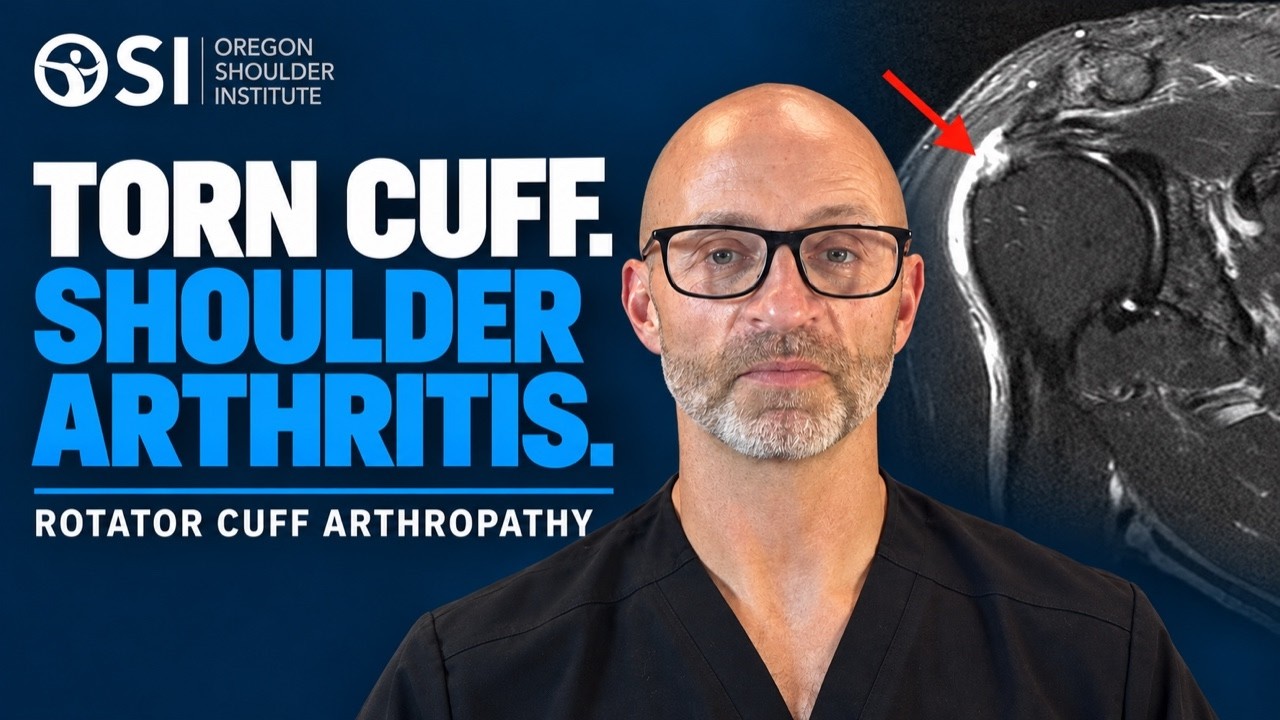
Dr. Patrick Denard explains rotator cuff arthropathy, where chronic rotator cuff tears cause arthritis by destabilizing the shoulder joint. Conservative treatment includes NSAIDs and physical therapy, but reverse shoulder arthroplasty is most reliable for persistent pain, restoring stability and overhead motion in about 50% of patients.
Chapters
Hi, I'm Dr. Patrick Denard. I'm a shoulder specialist at the Oregon Shoulder Institute where I do 100% shoulder in my practice, whether it's conservative treatment or surgery. Shoulder is truly my passion. And here I want to talk about rotator cuff arthropathy. So what is rotator cuff arthropathy? This is arthritis associated with a chronic rotator cuff tear. So rotator cuff arthropathy causes pain and weakness in the shoulder. What you'll typically see is that people have pain sleeping on the shoulder, and they will have pain with activity. Now, in addition to that, they often have a lot of weakness with overhead activity. Oftentimes, or most times, they will have full passive range of motion, meaning their arm can be brought up overhead even if they don't have the ability to do that on their own. Active motion can be more variable because it really relates to how well somebody can compensate with their rotator cuff tear. So some people can only get their arm up a little bit. That's a classic finding of chronic rotator cuff arthropathy. Other people will be able to compensate very well and get all the way up and are mainly limited by pain and the strength loss. The diagnosis of rotator cuff arthropathy is really obvious on X-ray. What you typically see is rounding of the ball and you'll see what we call adaptive changes of the proximal humerus. Proximal is the top of the ball. Is proximal, is closer to the body. So you'll see changes which show that the rotator cuff tear has been there for a long time. Some people will start to get spurs on the undersurface of the ball as well. Most of the time it's at that stage. In more advanced cases, you can get erosion into the socket. That is wear into the socket as the shoulder pulls up. Now, how does that occur? Well, the rotator cuff's primary function is to provide concavity compression or stability to the shoulder. What I mean by that is the rotator cuff pulls the ball into the socket. When the rotator cuff is torn, especially when you have more than one tendon torn, you have a massive rotator cuff tear, which is two or more complete tendon tears. Now you have loss of stability, and that loss of stability over time leads to changes in contact force, And that's how you get arthritis. So what happens is because the rotator cuff is not pulling the ball into the socket, the ball rides up because this big deltoid muscle wants to pull the shoulder up. You typically see loss of stability, change in contact force. And then again, in some cases you can see lack of function overhead because in, in rather than having the ability to keep the ball in the socket and have a pivot point through which that occurs, you see that the ball rides up and people's shoulder comes up as they try to raise their arm up and they can't generate that fulcrum. Now the diagnosis is so obvious on x-ray, MRI is not needed. So sometimes I will see people who've been, who come in and they have an MRI with a massive rotator cuff tear arthritis, and that's not necessary. You can pick it up on x-ray. And in fact, if somebody's going to get advanced imaging, really the reason to do that is typically when you're talking about surgery, And the gold standard for imaging in that case, especially with rotator cuff arthropathy, is a CT scan because that's when you're gonna look at the bony architecture of the shoulder and use that for surgical guidance. So what are the treatment options? The treatment options for rotator cuff arthropathy are exactly that of rotator cuff. Anti-inflammatories for pain relief, injections on a judicious basis, meaning 1 to no more than 3 in a 2-year period. I typically try to stay more limited than that though, really stay on the conservative end. Steroid providing immediate relief in many cases and covered by insurance. Platelet-rich plasma is one that can be considered, but I would say in my practice I see that be less effective than for just standard arthritis or for partial rotator cuff tears. And then finally, physical therapy and surgery. Now, I went in it, if you wanna really check this out, go to my discussion on rotator cuff tears where I go into all the details. But the bottom line is that just like rotator cuff tears, therapy can be effective. Therapy is really trying to recoup the surrounding muscles to sort of compensate, and you can surprisingly do that even with really large tears. So even if somebody has a massive rotator cuff tear, it is often shocking what the body can do and how somebody can compensate and maintain the ability to do overhead function. If those fail, and the reasons or what I would consider would be failure is pain that does not resolve with those treatment options, um, or continued lack of strength overhead, the option that's the most reliable solution is a reverse shoulder replacement. How does that work? What we do with a reverse shoulder replacement is put a ball in the socket side and a stem with a cup on the arm bone side. So remember I said With rotator cuff arthropathy, the ball wants to rise up. In other words, we have a stability problem. So with reverse shoulder replacement, we put a ball that is stable in position. The arm bone then gets a cup and comes under that ball. That restores the stability so much so somebody can raise their arm overhead again. That is great for getting pain relief because you get rid of the arthritis and you restore the stability. Secondly, it's very good for getting motion overhead and out to the side. However, you can have limitation in motion behind the back, and that's because of the anatomy of the shoulder. The anatomy is different in the front where there's some more bony blockades, and because you're rotating around that ball in a fixed manner, there can be conflict as well as perhaps some soft tissue tension that limits somebody getting behind the back. What do I mean by that? I tell people 50% of people are gonna get to their belt line after reverse shoulder replacement. 50% of people are gonna be below that, meaning closer to their pocket. Now that's typically well tolerated if somebody understands that. Uh, but they want to know that going into the procedures so they really know what to expect because again, information is really powerful on knowing what's gonna be best for you. There are cases where people will have full range of motion and their primary complaint is stability at shoulder level. And a reverse replacement can give that. But the one that's a real no-brainer is if somebody has rotator cuff arthropathy with pain and no function, reverse shoulder replacement is going to be a life-changing event where it's going to help them get overhead again. Reverse shoulder replacement itself is done on an outpatient basis. The procedure takes about 10 minutes. I have my patients in a sling for 2 weeks afterwards. They go home the same day. They're doing some early range of motion. And you will very quickly see that people have the ability to raise their arm again because the stability is restored in such a quick manner. There's more details in my video on shoulder replacement if you want to dive into those, such as commonly asked questions on shoulder replacements and what to expect after shoulder surgery, as well as comparison of anatomic and reverse shoulder replacement. But here I just want to review the overall options for rotator cuff arthropathy. Hopefully that gives you a little bit of understanding of what's going on in the shoulder so that you can treat it better and hopefully restore your function.