Rotator Cuff Tears: The Most Common Cause of Shoulder Pain After 40
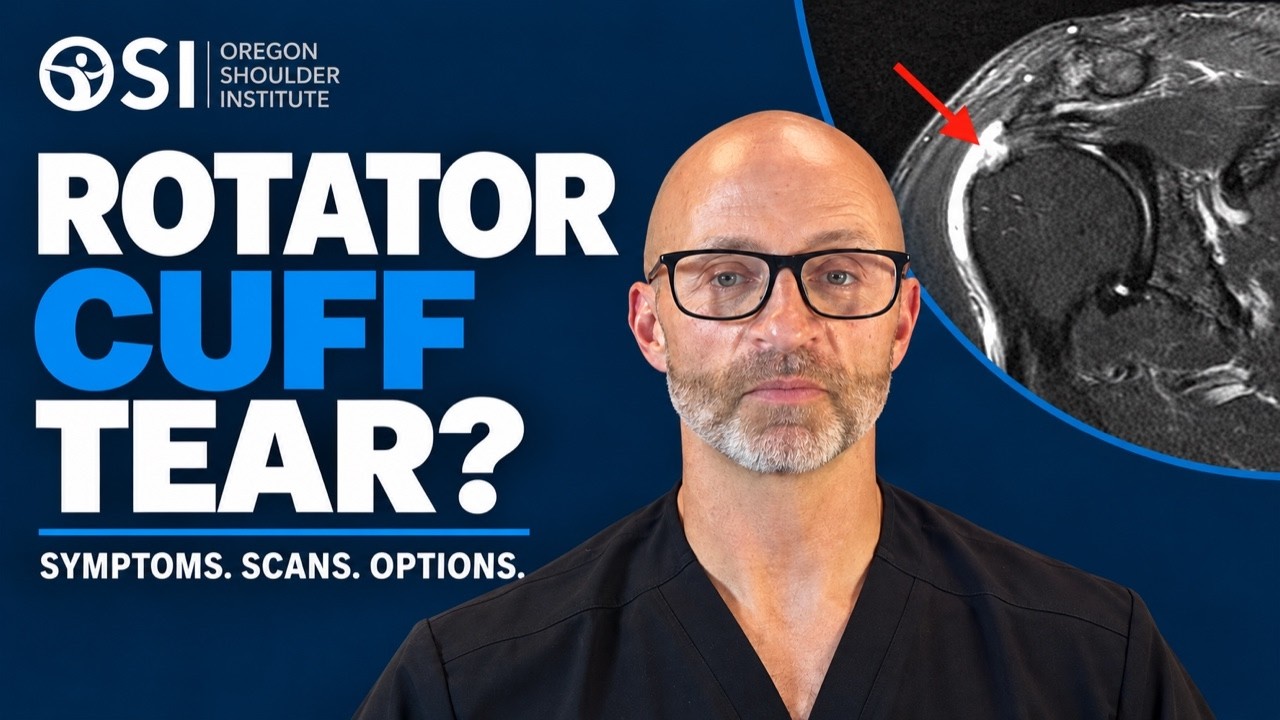
Dr. Patrick Denard explains rotator cuff tears, the most common shoulder problem after 40. About 50% of 65-year-olds have a full-thickness tear, often from degeneration rather than injury. Physical therapy succeeds 70% of the time; surgery is recommended for younger patients with large tears, while those over 70 typically start with conservative care.
Chapters
I'm Dr. Patrick Denard, shoulder specialist at the Oregon Shoulder Institute, where I do 100% shoulder in my practice, both surgery and conservative treatment. And here I'm talking about rotator cuff tears. I want to go over the symptoms, causes, anatomy, and treatment options for rotator cuff tears. This is designed to help my patients understand their condition better because information is power. The more information you have, the better chance you're going to have of getting restoration of function. So rotator cuff tears are one of the most common causes of shoulder pain. Pain typically occurs on the side or the front of the shoulder. Generally speaking, with shoulder-related pain, it does not go below the elbow. So if you're having symptoms that are radiating below the elbow, in particular numbness, that can be a sign of something else going on, like a pinched nerve in the neck or some other, uh, different conditions that are, uh, less common. In addition to pain, the biggest thing that people have is weakness, particularly with overhead activity. Okay, so you'll typically see somebody say they have trouble raising things above shoulder level. They will have pain with that and weakness. When it comes to the pain, the common thing that you will see, aside from activity-related pain, is pain with sleeping on the shoulder. And lack of sleep is hands down the single biggest thing that drives people to see me in my practice across the board. One of the interesting things about shoulder range of motion though with rotator cuff tears is that most people actually have full range of motion. In other words, in order to have a lack of range of motion that's not just pain related but actually true lack of range of motion, you have to have a very, very large rotator cuff tear. So sometimes people will be surprised that they have a rotator cuff tear when they have normal range of motion, but in fact, That's the most common presentation, and that's because the shoulder has over 20 muscles that help drive function. So you can compensate for a rotator cuff tear even if you have it. So let's talk about anatomy of the rotator cuff. So the rotator cuff are 4 muscles that surround the ball and socket joint. Muscle inserts in a bone via tendon. The tendon is typically what tears off of the bone. There are 4 rotator cuff muscles to know about. The first is the subscapularis, which is in the front of the shoulder. This is the largest and most powerful rotator cuff. It helps you turn in. It also assists in forward elevation. The next most commonly torn tendon, that is the most commonly torn tendon, but next one to talk about is the supraspinatus. That is the tendon on the top of the shoulder. This runs directly under the acromion bone. Typically people get pain right here on the side and they will have weakness in abduction. After that, in the back, you have the infraspinatus and the teres minor. The infraspinatus and teres minor wrap around the back of the shoulder, insert out here onto the side, and they really help you provide external rotation, so motion out to the side. Again, the most commonly torn rotator cuff muscle is the supraspinatus tendon. Now the rotator cuff as a whole, the primary function of the rotator cuff is to provide stability of the shoulder and rotational range of motion. So what I mean by that is the shoulder is a very inherently unstable joint because it's the most mobile joint in the body. So it's a very shallow socket, unlike the hip where the hip joint is contained around the ball. In the shoulder, we have a very shallow socket that allows a large amount of range of motion, not just rotation, but actually gliding to occur. So the way you have stability in a situation like that is you have the capsule, which is the closest layer to the shoulder, but also the rotator cuff. And the rotator cuff provides a dynamic stability because as you go through motion, muscle contracts and pulls the ball into the socket. So another way that people have termed this is concavity compression. Okay. But in other words, the rotator cuff pulls the ball into the socket to maintain stability. So effectively, when you have a rotator cuff tear, especially if you have a full thickness rotator cuff tear, you can have a compromise to stability. And that lack of stability is probably one of the things that causes pain inside the shoulder. Now that stability aspect is important because if you have a rotator cuff tear, especially full thickness rotator cuff tear that's left untreated, you can develop arthritis as a consequence. This is called rotator cuff arthropathy or rotator cuff arthritis. And that occurs because normally you have to keep the ball centered. In the socket throughout range of motion. If the rotator cuff is torn, you get abnormal mechanics. That abnormal mechanics over years leads to breakdown of the cartilage or arthritis. Now, that doesn't mean that everybody gets arthritis. This just means that this can occur if the rotator cuff tear is left untreated. When it comes to rotator cuff tears, there's really two types of tears. Again, we talked about tears most commonly being the tendon that tears off the bone, but you can have partial tears or full thickness tears. So often people get an MRI report and it can be very confusing for people. And you may see something such as low-grade partial tearing or tendinopathy. This is not something that is typically something to worry about. There are some cases where it can be underread, but generally low-grade changes or tendinopathy are something that occur over time. And there are other things we can do to treat or have to look for as a cause of shoulder pain. True tears, or tears that we're most commonly concerned about, are high-grade partial tears or full-thickness rotator cuff tears. So partial means it goes partway through the tendon. Low-grade is typically less than 50%. High-grade is greater than 50%. Full thickness means you have at least one area where there's complete tearing or separation of the tendon from the bone. So it's really important that a surgeon or orthopedic specialist in particular looks at your MRI and doesn't just go off the report alone. And that's important for not only understanding the rotator cuff tear, but also for making sure that certain things aren't missed. For instance, subscapularis tears— I talked about subscapularis being the muscle in the front of the shoulder— are commonly missed by radiologists. About 50% of these tears get missed And you can improve that by having somebody who's a dedicated shoulder specialist who looks at a lot of MRIs and also has the benefit of doing an examination and listening to your symptoms so you can correlate symptoms, exam, and MRI findings. And that's really the best way to make sure that is not missed. If you look at the incidence of rotator cuff tears, once somebody gets to about the age of 40 or 50, most people are going to have some low-grade changes or tendinopathy in the rotator cuff. And in fact, by the time you get to 65, about 50% of people have a full thickness rotator cuff tear. So this is really important to understand. So this tells you two things, which kind of gets into the causes. So first off, majority rotator cuff tears are not related to injury. They're related to age and genetics. So age is the degenerative factor. That is, over time, our bodies break down and you can get rotator cuff tear, which is why about 50% of people aged 65 have a full thickness rotator cuff tear. And the incidence or prevalence chance of it is even higher as we get older. What's interesting about that is a lot of people will come in and they'll say, well, I didn't have an injury, right? But you don't have to have an injury to get a rotator cuff tear. Most rotator cuff tears are degenerative. In terms of activity or use, there is a relationship there, but it's much less of a factor than age and genetics, which are the two biggest factors relating to rotator cuff tears. So let's talk about treatment. The first baseline to know is that if somebody is in an older age category, you know that it's a really common condition. And I think that's important to understand because recognize if you have 50% of people at age 65 have a full thickness rotator cuff tear, we don't have 50% of the population that's undergoing surgery for those rotator cuff tears. And that's because the body has the ability to compensate. We have backup systems, just like a plane has backup systems to guide us through life. And so understanding that's a common condition, I think is really, really powerful. I like to think about rotator cuff treatment as going through phases. The first thing is to calm down the inflammatory process. You can do that really with a couple of things. Number one is nonsteroidal anti-inflammatories like Aleve or ibuprofen on a short-term basis. Number two would be injections. Two broad categories here: steroid injections and platelet-rich plasma injections. Steroid injections, the benefit is it really calms down inflammation quite rapidly. It's covered by insurance. The downside to steroid injection is that steroid Steroids create a catabolic effect, meaning they break down tissue. So a little bit is okay, but you don't want to do steroid injections repeatedly over time because theoretically you're going to lead to tissue damage that may be detrimental in the long term. So in my practice, it's going to be anywhere from 1 injection to a maximum of 3 injections over a couple of year period. But I am definitely not going to inject somebody 5, 6, 7, 8 times as I will sometimes see. Unless somebody is just so unhealthy that we do not have other alternatives. And in other words, surgery is really not a good idea. The next option for steroid, or the next option for injection is really platelet-rich plasma injections. Platelet-rich plasma is where you take blood off your own body, you spin it down, you get the growth factor-rich area, and you inject that back into the shoulder. Now that does not heal the rotator cuff. It has an anti-inflammatory property, but there is data that says that that is as effective or more beneficial than steroid. There's some question is if, is it just less negative than steroid? But we know the steroid is very effective in reducing pain. I think it's probably because it's more effective. The downside to doing platelet-rich plasma is it's not currently covered by insurance. At least most major insurances do not cover platelet-rich plasma. So it's an out-of-pocket expense. One of the papers that looked at this in particular showed that that the individuals who had platelet-rich plasma injections had a more sustained relief. So they had a little bit of slower onset than steroid, but they were better at the 6-month and 12-month mark. So this is good to think about from not only an insurance perspective, but say somebody really needs immediate pain relief, they're having a really difficult time sleeping, they're going on a trip, steroids, probably great first line. If somebody is not so painful, they're really just trying to get through, recovery, they really wanna focus on rehab, maybe platelet-rich plasma is a consideration as a first-line treatment. But most people will start with a steroid injection and then go to platelet-rich plasma. Another alternative is Toradol, which is a nonsteroidal anti-inflammatory. We'll typically use that in people who are diabetic because one of the downsides to steroid injections is it can raise your blood sugar level. So in those cases, Toradol is an alternative. As well as PRP. Another thing that's really important to know for steroid injections is the timing and amount around rotator cuff repair. So if you have a steroid injection, there's data that suggests that you should not have a rotator cuff repair within about 3 months, and that's because you raise the risk for infection if you have surgery within that time period. Now, that's not something that's a very high risk. It's a risk that's picked up in databases of thousands of patients. For years we, we did that and really rarely if ever saw issues. But if you look at a large population, you'll see some subtle differences. So if you can, you want to avoid steroid injection within 3 months, but it's not just like it goes 3 months and drops off. This is probably something that the risk slowly goes down over time. So if somebody had to have a rotator cuff repair within a couple of months, it's reasonable to proceed. You just have to understand there's a slight increase risk. The second thing that's been shown with steroid injections is if you have multiple injections in the year prior to surgery and go on to surgery, you have a slightly higher risk of revision. This gets to that metabolic thing or catabolic thing where you're probably having some detrimental impact on the tissue. And if you know you're going to go on a rotator cuff surgery, you have a high likelihood of that, you may consider only doing one injection as a consequence. Now what I tell people about injections is it's not going to make you better in the long term. It's generally a shorter-term process. Maybe PRP is a little bit different, but steroid in particular is a shorter-term relief of symptoms. Really, the mainstay of treatment is physical therapy, and the injection is just try to get the pain down so that you can do physical therapy. But if somebody's not really having, you know, a lot of difficulty, if they can sleep at night, they just have some pain with overhead activity, I would just do therapy alone. If they're really impacted from the sleep perspective, their quality of life is really limited. That's where steroid comes into play because then that can help them do the therapy. When it comes to physical therapy, the success of physical therapy for rotator cuff tears is quite high. In fact, one study showed that about 70% of people who do a 6-week course of physical therapy get better and don't go on to surgery for a period of over 10 years. So that's a really high success rate. What are you doing with physical therapy? What you're really doing is you're compensating for the rotator cuff tear. In other words, you're rehabbing the muscles around so that you can compensate. Now, if somebody tells you you're going to heal a rotator cuff tear with therapy, that is wrong. Your symptoms might go away. And in fact, the majority of cases they will. But it is not truly heal the rotator cuff. If you look at healing, the only way to get the tendon to heal is to actually repair the tendon with a surgery. That's most commonly an arthroscopic surgery. That's what I do is all arthroscopic because with a camera I can see into, inside the shoulder, visualize the repair that is the tear pattern and get the repair as we want in an anatomic manner and also address other things. If we compare therapy to surgery, we see that in the short term there's really not a lot of difference based on randomized controlled trials. So randomized controlled trials where you put people in two groups, There was a study out of Scandinavia that looked at this years ago and showed that essentially, uh, short-term, both groups do well. But if you go out longer term, especially the 10-year follow-up, but perhaps the 5-year follow-up, you see that those people who have a rotator cuff repair do better than those with physical therapy. In that study, they even did an intention-to-treat analysis. In other words, in the therapy group, some of those people dropped out of that therapy group and went on to surgery, so they potentially got healing, but they analyzed them as if they were in the physical therapy group. So when they truly looked at those who just did physical therapy compared to those who did surgery, the differences were even larger. If you think about this, what is happening is in the therapy group, the natural history of rotator cuff tears is to get larger over time. So you'll see progressive increase in size. Essentially about 50% of tears will progress over a 2-year period. So they'll go through therapy, they'll rehab, they'll feel better, but the tear will slowly enlarge. And in the physical, in the, that is in the surgery group, you can actually get healing of the rotator cuff. And that's why early on, no difference. But as you get out further, you start to see a bigger difference. Now this is where it really comes into treatment options. Okay. So now we know what you can do in terms of bringing down inflammation. Physical therapy, and surgery. So what does it look like in terms of what should your decision-making be? Here are some general guidelines. For me, if somebody is under the age of 60 and has a full-thickness rotator cuff tear, I generally just recommend surgery. And in these cases, I'm talking about degenerative rotator cuff tears. They don't occur without an injury— that's a separate conversation. But if they have a degenerative rotator cuff tear and they're young, I really worry about that long term because presumably that person's going to have 10, 20 more years to be around. That rotator cuff is going to get larger, and the success or healing rate after rotator cuff repair is highest when the tears are small. This makes sense. The larger a tear gets, the harder it is to get healing. Tear, uh, retear rates can go from 10 to 20% up to 70% with a large or massive tear. So you want to get to the tears in an early time point. So if somebody's young, I pretty much recommend having a rotator cuff repair. As a general guideline though, if they're over the age of 70, we know that therapy is successful. We're less worried about what happens long-term because they're— those people are typically less active as a general rule. And we're less worried about that progression over time. So physical therapy is always my first line of treatment. Between the ages of 60 and 70 is a general guideline. We talk about somebody's activity level, their health, because that really plays in what they like to do, and that's a case-by-case decision. Now, this doesn't mean that if you're over 70 you can't have a rotator cuff repair, and some people will say, well, there's an age cutoff, and it is true that as we get older, our potential for healing decreases. However, there are studies that show that people even in their 80s can heal after rotator cuff repair, and they can do very, very well regardless. So what do you do in those cases? You start conservative, but if it's not getting better, rotator cuff repair is an option, and you try to do all the things you can around the rotator cuff repair to optimize the outcome. That's a technical aspect, and I would also encourage you to check out my video on how to maximize rotator cuff healing because there's a lot of factors that go into this. So don't use age alone as a cutoff. Age is a factor, but the bigger factor is tear size and the quality of the muscle. So age is— it should not be a cutoff of surgery alone. So we talked about degenerative tears. Let's talk about acute tears. These are the true tears that occur from a fall. So somebody comes in, they've fallen on an outstretched arm, their MRI shows they have a lot of edema— that is swelling inside the rotator cuff— they've had a loss of function. They've gone from having normal function essentially to having very limited function. So what do you do in these cases? This is a different ballgame compared to generative tears. The reason for that is data shows that if you have an acute rotator cuff tear, that is one that happens from trauma, results are best if it is repaired within 3 months. Some data even suggests perhaps within a few weeks. This makes sense. The earlier you get to a tear that's occurred, The better the biology is going to be, the better chance of success you're going to have. Now, oftentimes it's acute on chronic, so you have to have somebody such as a shoulder specialist who really looks at the muscle itself and has a good sense of the overall picture. Because one, one tear that has a lot of chronic aspect that just had a slight acute propagation that is extension that is going to be a lot different from somebody who has normal muscle, who has an acute tear with a healthy tendon. That latter person is going to have a very good result. You want to get to that early. The former person, the person who had really had a lot of chronic changes and just propagated a bit, it may indeed be best to go conservative first. So you really have to understand what the chances are for healing and what the status of the rotator cuff was going in. And the way you know the status of the rotator cuff is you look at not only the edema or amount of swelling in the MRI, but you look at fatty infiltration, otherwise termed atrophy. So you can look at an MRI. I'll look at what are called the sagittal T1 cuts. You can see the muscle, and the muscle quality really reflects the duration of the tear. In other words, the longer the tear is, is there, the longer that there's, uh, the tendon's detached, the more likely it is that you're gonna develop fatty filtration or atrophy of the rotator cuff. Generally, this takes a couple of years to develop. So if you see somebody with fatty, fatty infiltration or atrophy, I know that that tear has been there for quite some time. Now, it doesn't mean somebody had symptoms. Oftentimes, in fact, they will say, hey, I have no symptoms, you know, prior to the recent development or injury. But nonetheless, it's really important to know that in terms of the decision-making. To that point, there are also some tears that are more likely to undergo fatty infiltration, that is, have developed atrophy over time. So in particular, tears that involve the anterior or front part of the supraspinatus have a higher chance of undergoing fatty infiltration or atrophy. So those are tears that I tell people, hey, biomechanically you've damaged an important structure of the shoulder, so we really neither need to follow this closely or treat this surgically because you're more likely to go on to fatty filtration. And that's important because once you develop fat infiltration, it's irreversible. And as you develop fat infiltration atrophy, the chances for healing go down. So there's a lot there that I think about as a shoulder specialist. But the, the, the overall summary is that rotator cuff tears are very common. Most of the time you can treat these conservatively, but you have to think about that in terms of age and activity level of the individual, because we have to be thoughtful about the natural history and where we are and where we're going to be in the future in terms of maintaining health and function, because the shoulder, again, is the most mobile joint in the body. So it's critical for function in our daily lives.










