Shoulder Instability: Why Your Shoulder Keeps Slipping Out of Place
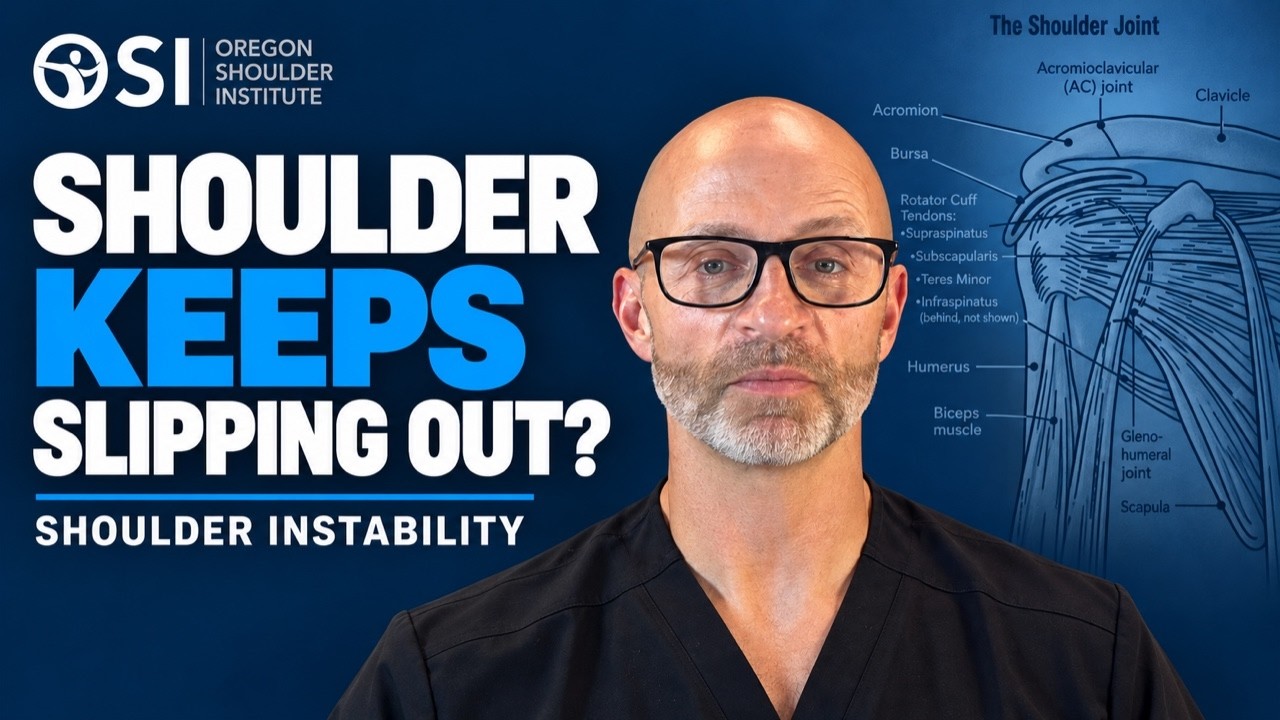
Dr. Patrick Denard explains why shoulders dislocate and how to fix them. Traumatic tears from acute dislocations differ from attritional tears from repetitive overhead work. Young patients under 20 have a 75% recurrence rate, but Bankart repair with remplissage reduces 2-year redislocation to 2-3%.
Chapters
I'm Dr. Patrick Denard. I'm a shoulder specialist at the Oregon Shoulder Institute where I do 100% shoulder in my practice. And we'll talk about labral tears of the shoulder and shoulder dislocations. So what is the labrum? Labrum is a cartilage ring that surrounds the socket. And the cartilage ring here helps provide stability to the shoulder. The shoulder is the most mobile joint in the body. It moves more than any other joint, and that's to help us put our hand in space do overhead function. Because the shoulder joint is very mobile, that is, it does not have inherent stability because it's shallow and allows gliding as well as rotation, it is more prone to instability than other joints. The labrum essentially deepens the dish of the, uh, socket or the glenoid to help provide stability. So when you get tearing of the labrum, you can get symptoms of instability and pain. You can also get mechanical symptoms. There's two broad ways in which this presents, or categories. The first is the obvious, which is the shoulder dislocation. Somebody has a forceful event, their arm's put at end range of motion. Most commonly this occurs at the front of the shoulder from a throwing position. Somebody gets their arm pulled back, the shoulder dislocates, tearing the labrum as well as the capsule that attaches near the labrum. Now that traumatic event is much different from somebody who has labral tearing that occurs over time. So sometimes you can get what are called attritional labral tears. This particularly occurs with repetitive activity. The classic or most common one is if somebody does a lot of bench press, or like a football player overhead activity as well, where they will get repeated posterior forces— that is, force direct toward the back— that will gradually lead to cracking and weakening of that labrum in the back of the shoulder. Those people, rather than reporting instability as their main symptom, are those that are more likely to report pain in the shoulder. It might be a subtle sense of instability, but it's typically more pain that is activity related. So let's break this down a little bit further. So again, the labrum is really important in stability of the shoulder. So when you have that traumatic lesion, the classic being somebody dislocates the shoulder out the front of the shoulder, they tear the labrum. And then once that occurs, it doesn't typically heal. In an anatomic position. And the risk that, that keeps happening again relates to age and activity level. So for instance, as a general guideline, if somebody's under the age of 20, they're gonna have about a 75% chance. If it happens, it's gonna happen again. If somebody's about 25 or less, it's about a 50% chance. At age 30, it's about a 25% chance. Now, this varies based on a lot of factors. In studies, people look at sex as an option. For instance, male and female, just being that men tend to be more involved in contact sports that put them at risk. But it really, it's not about sex alone because I think that's an old holdover from, uh, historically the activities that people were doing. It really relates to the activity itself. For example, if somebody is 25 and they have a desk job and they just fell randomly and dislocated their shoulder, they're going to be a lot less risk of that happening again because it was just an isolated random event than the 25-year-old person who's playing sports on a regular basis or doing rock climbing, for instance. Now, if the shoulder dislocates, That relates to several things. One is you want to prevent that dislocation from occurring again because as you dislocate, you get bony damage. You knock off part of the socket. You also damage the ball as you dislocate out of the front of the shoulder. That defect in the ball is called a Hill Sachs lesion. Think about the shoulder as a ball on a golf tee. If the tee is intact, you're very stable. The ball can sit there. As you knock off a little bit of the tee, it might be okay. But if you knock off a significant portion of the tee, now suddenly that ball is going to fall off, and it doesn't take a lot. The data suggests that somewhere between 15 and 25% puts you in a threshold where simply repairing soft tissue alone is not necessarily sufficient. So one of the things we like to do is to identify or stratify the people at risk for redislocation and try to prevent that. So as a general rule, if somebody comes and sees me as a shoulder dislocation and they're less than the age of 30, I generally recommend doing a soft tissue repair where I can restore the labrum back to its anatomic position. Because if we do that, we can take the risk of redislocation down from about 75 to 25%, depending on their age, down to about 5 to 10%. And that's a big difference. And that's important because the more times somebody dislocates, they get more bony damage. They can need more invasive procedures such as bony procedures to restore the anatomy. They also do further damage. You can get further damage to cartilage, for instance. The more times you dislocate, the more likely you are to get arthritis in the long term. Now, if you dislocate one time, you're at increased risk for arthritis, but we want to limit the amount of times that occurs. The other thing that's been shown is that every time somebody dislocates, their success, at least especially with a soft tissue procedure such as a, what's called a Bankart repair, really decreases. So that's the you know, the broad category of treatment of traumatic labral tears that occur out the front of the shoulder. The other category of labral tears that I talked about earlier, the more attritional ones, those are a much different animal. And one of the first things to do is look at the function of the, of the individual as well as their age. So the person who has a repetitive injury from attritional injury where they're getting damaged labrum in the back of the shoulder, that is classically like a football player, an overhead athlete, that is much different from the person who comes in at age 40 and has an MRI that says they have a labral tear. In other words, it's really important to correlate symptoms with the MRI because if I just MRI people over the age of 40, there is a very high chance that their MRI is gonna say they have labral tearing. Typically when you get in your 40s and 50s, it's the degenerative process that is without injury, and that's something that should be observed. I unfortunately see many cases where somebody did not have an injury. They were told they had a labral tear, actually wasn't a problem. They get a labral repair, which just creates more damage, tightens the shoulder, and suddenly they have rapid onset of arthritis. So we have to separate that older individual from the person who has a true mechanism, typically repetitive, that correlates with their exam findings and their MRI. So when it comes to treatment, if we're in that first category of that degenerative stuff, we want to first see if there are other causes of pain. And they— there typically is. Typically in that older category, that degenerative stuff is a red herring, and we want to focus on other causes and treatment. Working backwards, for the posterior labral tears, those people who have those attritional tears or superior labral tears, conservative treatment is typically the place to start. That's with physical therapy to strengthen the shoulder. If it's not responsive after several months, that's when we consider doing a labral repair. What's involved in a labral repair? I put a camera inside the shoulder, evaluate the labrum, and I want to use multiple little anchors to repair the labrum up to the bone. So the anchors go into the bone. They have suture that wrap around the labrum that are used to bring the labrum back up to the bone. This is done arthroscopically. So just through really small stab incisions. The sizes of the anchors are typically 2 millimeters in size. So they're very small. And we use anywhere from 2 to 4 anchors as a general rule. To repair the labrum back up to restore that stability to the shoulder. The third category working backwards is the shoulder dislocation or anterior shoulder instability as a broad category. Now, what we found with my data is that people not only generally require doing a Bankart repair, but also require doing what is called a remplissage. So if what a Bankart repair is, is the soft tissue and labrum in the front of the shoulder is repaired very similarly with those same little anchors, bringing everything back up, tightening back up to the shoulder. But somebody dislocated a normal shoulder and the capsule also gets stretched as well. So even though you can tighten that capsule at the time of repair, if you look at the failure rate of an isolated Bankart repair, It's somewhere on the order of 10 to 20%, especially as you go out long term. Like, you'll see people do really well for a couple of years, but if you go out to 4 years, for instance, you see results drop off. What I do in people who are higher risk— so for me, it's pretty much under anybody under the age of 25— I add a remplissage. What is remplissage? That is putting 2 anchors in the back of the shoulder. Remember I said you can get what's called a Hill Sachs lesion where you get a defect in the back of the ball. Essentially put two anchors in the back that tightens the tissue in the back. And effectively what we've shown biomechanically is that it helps pull the shoulder back. So it provides more stability or restraint to anterior force. Biomechanically, that's very effective. Clinically, we've found that the, the recurrence after doing that is dramatically lower than compared to doing a Bankart repair alone. So in our data at 2 years, the, the redislocation rate is on the order of 2 to 3% with the addition of a remplissage. And what's interesting is it's not just the 2-year, but other studies have found that the data does not drop off. In other words, you don't get that effect that you see with a Bankart repair alone where people do well, but they have a high chance of redislocating. They tend to do very well even for many, many years down the line. Additionally, one of the things we found, we've done an MRI study and found that people not only have a high healing rate of rhomboplastage, but also they don't appear to have negative consequences. So we found clinically they don't tend to lose motion by doing this additional procedure, but also if you look at the MRI findings in the muscle of the rotator cuff, there isn't evidence that we're sustaining damage to the rotator cuff by doing this addition. So for me, I almost do Rumpassage again in almost all of my patients who have an anterior shoulder dislocation under the 25, age of 25. I really have to ask myself, when do I not do Rumpassage? Because it's such a powerful tool. Of course, we don't want to do the same thing every time, but it is a very powerful adjunct to doing an anterior bankart repair. The last category within anterior shoulder dislocations that we that we consider for treatment is a Latarjet or bone block. So some people return to a bone block. You could do a free bone block. Others refer to a Latarjet where you take bone from the front of the body and put it down against the socket. So the Latarjet is classically described. There's the coracoid bone, which is in the front of the shoulder. That bone is cut through an open incision. Most commonly it can be done arthroscopically, but most commonly it's done through an open incision. That bone is then placed flat against the socket and it's held in place with screws or sometimes other anchors. The Latarjet was described by a gentleman in France, Michel Latarjet, and it really became a popular procedure in France and then subsequently came into the US probably around the early 2000s, but it's become very popular for people who have bone loss. What do I mean by that? I mentioned earlier, in some cases you can knock off much of the socket that you can't simply treat it with a soft tissue procedure alone. So you need to add bone back. And so what we do is I assess the amount of bone loss in every patient that I see. I do that through a combination of X-ray, MRI, and if I have any question, a CT scan, because a CT scan is the gold standard for looking at the bone. And if there is a high amount of bone loss, I'll do a Lattouret procedure to restore bony stability. Oftentimes people ask, What can I do after a Latarjet? You can get back to full function. So the recovery actually is just 4 weeks in a sling. And because you actually have bony healing, in some ways it's actually quicker than the soft tissue procedures. It's held in place again with a couple of screws and people can go back to full contact sports. There's even data suggesting that people can get back to things like football and rugby. In fact, if somebody does a very high-risk procedure, or a high-risk sport, that is. I think about doing LATER-J at smaller amounts of bone loss. So in every case, I want to look at the age, activity, and bone loss of the individual patient and try to do the procedure that is best for them. My preference is to do the least invasive thing. If it's conservative, that's great. But after that, it's arthroscopic treatment, and then finally doing bone block procedure. But again, if they have a lower amount of bone loss than maybe another individual, but they're in a very high-risk sport such as football or wrestling, we want to have a lower threshold for doing Latarjet because we want to make every effort we can to do one procedure for that individual and restore their stability so they have less, not only complications, but also less time off and quicker return to activity. So in summary, on shoulder dislocations and labral tears, the first thing is know that the labral tear actually correlates with what is going on in your shoulder. Don't go off the MRI alone. You gotta look at the history and, uh, have somebody who really understands your MRI and physical exam findings. Secondly, when it comes to anterior shoulder dislocations, traumatic dislocations, you're best off having that treated earlier, especially if somebody is under the age of 30 to 25. There may be some cases where an individual over the age of 30, we may go on to an arthroscopic treatment right out of the gate, such as somebody who's a whitewater kayaker who is at very high risk. Again, that's really important to think about the individual patient, not just age alone. But generally speaking, it's the younger individuals we want to get to that earlier to have a higher success rate. But if we see somebody who's had multiple dislocations, they have bone loss, they're even dislocating with sleep, we may be looking at Latarjet or bone block procedures.










